Vegetation affects climate via surface energy exchange
Climate determines where and how organisms can live, but organisms, in turn, influence the climate system in several ways. First, the amount and type of vegetation influence how the ground surface interacts with solar radiation and wind and how much water it loses to the atmosphere.
The amount of solar radiation that a surface reflects, known as its albedo, is influenced by the presence and type of vegetation as well as by soil and topography. A coniferous forest, for example, is darker in color, and thus has a lower albedo, than most types of bare soil or grasslands, so the forest absorbs more solar energy.The texture of Earth's surface is also influenced by vegetation. A rough surface, such as a savanna of mixed trees and grasses, allows greater transfer of energy to the atmosphere by wind (convection) than a smooth surface such as a grassland. This is because the vegetation disrupts airflow at the ground surface, causing turbulence that brings more surface air into the atmosphere. Finally, vegetation can cool the atmosphere through transpiration (evaporation of water from inside a plant via its leaves). The amount of transpiration increases with the amount of leaf area per unit of ground surface area. The sum of water loss by transpiration and by evaporation is referred to as evapotranspiration. Evapotranspiration transfers energy (latent heat) as well as water into the atmosphere, thereby reducing air temperature and soil moisture.
What happens to climate when the type or amount of vegetation is altered? This question is particularly important because of the current high rates of deforestation in the tropics: since 1990 about 129 million hectares (500,000 square miles) of tropical forest have been cut (FAO 2020). Loss of the trees increases the albedo of the land surface as bare soil is exposed and the trees are partially replaced with lighter-colored grasses (FIGURE 2.19).
The higher albedo decreases the absorption of solar radiation, resulting in less heating of the land surface. However, the lower heat gain from solar radiation is more than offset by lower evapotranspirative cooling (lower latent heat flux) due to loss of leaf area (Foley et al. 2003). Lower evapotranspiration rates not only reduce surface cooling, but also lead to lower precipitation because less moisture is returned from the ground surface to the atmosphere. Thus, the outcome of tropical deforestation may be a warmer, drier regional climate. Widespread deforestation may lead to climate change that is significant enough to inhibit reforestation and may thus lead to long-term changes in tropical ecosystems. The conversion of natural grasslands to crop production—a widespread human practice—can also affect climate, as you can evaluate in ANALYZING DATA 21.ANALYZING DATA 2.1
How Do Changes in Vegetation Cover Influence Climate?
We've learned that the type and amount of vegetation can influence energy exchange at Earth's surface. As a result, human alteration of the land surface, such as tropical deforestation, can lead to changes in regional climate. Determining whether temperatures are likely to get warmer or cooler after such an alteration requires knowledge of the magnitude and direction of the changes in energy balance components.
For example, what happens when humans replace short-grass steppe, a type of grassland characteristic of the western Great Plains of the United States, with croplands? This vegetation change occurred along the South Platte River of northeastern Colorado in the latter part of the twentieth century, and its effects were evaluated by Chase and colleagues (1999).* Some of their data are presented here in the form of questions for your evaluation.
1. First consider changes in albedo. When sparse stands of light-colored grass (albedo = 0.26, meaning that 26% of incoming solar radiation is reflected) are replaced by dark green irrigated crops (albedo = 0.18), how does this influence absorption of solar radiation? If the incoming solar radiation is 470 watts per square meter (W/m2), what is the difference in energy gain due to solar radiation as a result of the vegetation change? Would this change in albedo alone cause warming or cooling?
2.
Next consider heat exchange due to sensible heat flux, including convection, which is related to the roughness of the surface. A dryland (nonirrigated) crop has approximately three times greater surface roughness than short-grass steppe. Which surface would have greater heat loss due to convection, assuming that surface temperatures are warmer than the atmosphere: a cropland or short-grass steppe? The estimated difference in heat exchange due to sensible heat flux associated with the land use change to a dryland crop is about 40 W/m2. Would a combination of change in albedo (Question 1) and in surface roughness cause cooling, no net change, or warming?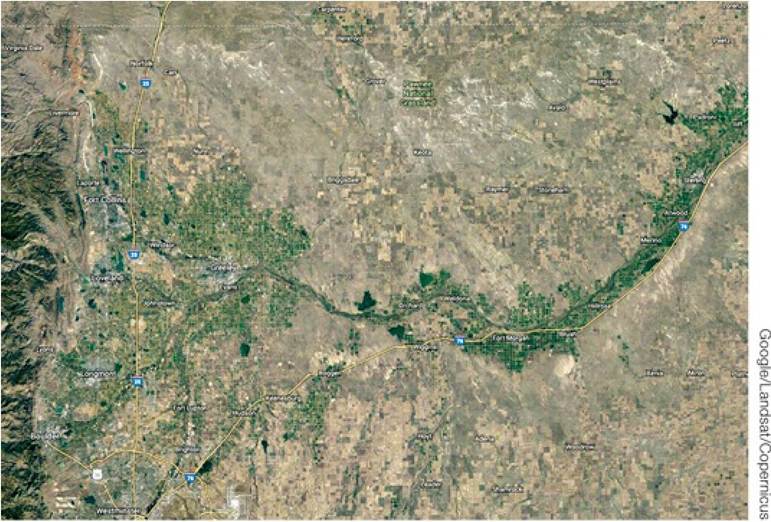
Satellite Image of the South Platte River Drainage Basin, Colorado The
Rocky Mountains are to the west. The green circles and rectangles are irrigated cropland found along the South Platte River flowing eastward. The surrounding area is a mix of dryland crops and short-grass steppe. View larger image
3. Replacing short-grass steppe with irrigated crops, which have a higher leaf area per area of ground surface and higher soil moisture, alters the amount of energy lost via evapotranspiration (latent heat flux). Would this change result in more or less heat loss to the atmosphere relative to the short-grass steppe?
4. Taking both sensible and latent heat flux into account, the combined estimated difference in heat exchange associated with the land use change to irrigated cropland is about 60 W/m2. Including the change in albedo from Question 1, would an irrigated crop surface have cooler or warmer temperatures relative to short-grass steppe?.
*Chase, T. N., R. Pielke Sr., T. G. F. Kittel, J. S. Baron, and T. J. Stohlgren. 1999. Impacts on Colorado Rocky Mountain weather due to land use changes on the adjacent Great Plains. Journal of Geophysical Research 104: 16673-16690.
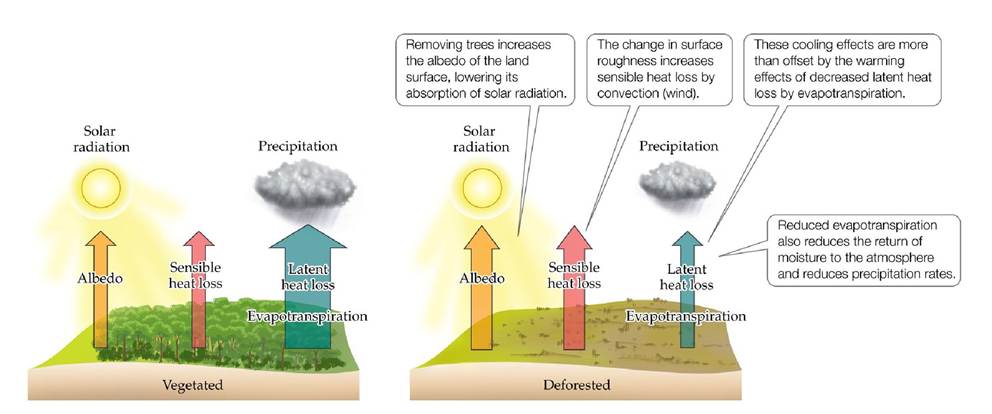
FIGURE 2.19 The Effects of Deforestation Illustrate the Influence of Vegetation on
Climate The conversion of forest to pasture in the tropics results in a number of changes in energy exchange with the atmosphere. (After J. A. Foley et al. 2003. Front Ecol Environ 1: 38-44.) View larger image
In Chapter 25 we will return to the effects of human activities on climate, especially over the past two centuries. Human activities, however, are not the only cause of long-term climate change. We turn next to the natural climate variation that has occurred throughout Earth's history.