35 The Black Ships of Macau
I
One of the constant and in many ways justified complaints about histories of the seaborne empires of the sixteenth and seventeenth centuries is that they are Eurocentric, even when the subject matter is Goa, Melaka, Macau or Manila.
This partly reflects the richness of the archives in Lisbon, Seville, Amsterdam and other European cities compared to what can be found in Asia; and it partly reflects an assumption that the Portuguese and their successors were able to dominate the long-distance movement of goods to the exclusion of any serious rivals. But that was not the case. At best the Portuguese could only blockade the Red Sea, for, as has been seen, they were unable to force their way into it, and much the same applied to the Persian Gulf, where they could control movement through the narrow Strait of Hormuz. But the trouble with a blockade was that it cost a good deal of money to maintain and produced no revenue. It made more sense to treat the Portuguese forts as customs stations through which the Asian merchants would have to pass. The Red Sea did remain open. So long as Gujaratis, Malays and others paid for their trading licences, they were able to carry on their business without further interference from the Europeans, who were more likely to confront one another (once the Dutch arrived in the Indian Ocean around 1600) than to interfere with local shipping. Indeed, paying for one’s licence brought a certain amount of protection. It has been well said that ‘the Portuguese forced their way into an established trading world; they did not revolutionise Euro-Asian trade.’1Portuguese methods were rooted in traditional medieval practices: they created trading bases, the nodal points of their Asian trading world being Hormuz, Goa, Melaka and Macau, which were backed up by coastal forts and by the Portuguese fleets that moved across the Indian Ocean and into the South China Sea.
The Spaniards, on the other hand, did conquer entire territories, as happened in the Philippines, and as had already been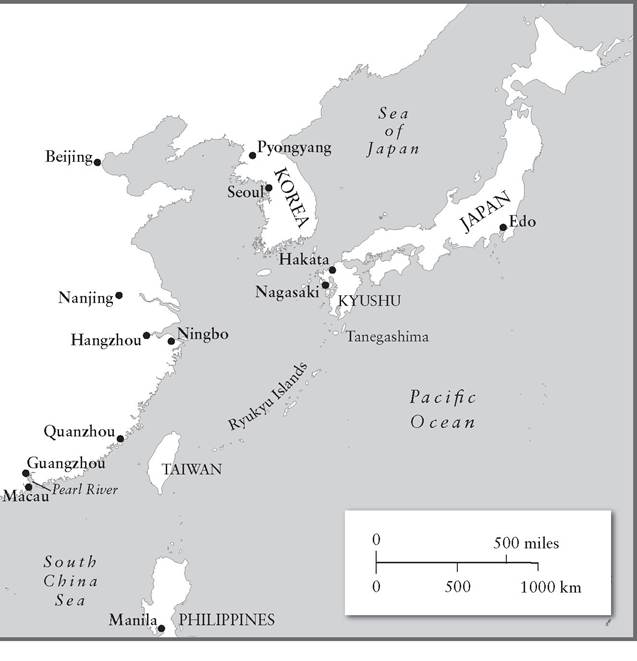
happening in the Caribbean, Mexico and Peru. Their interest in commercial connections across the oceans grew as the silver mines of Peru and Mexico delivered vast amounts of bullion to Manila and Seville, and their conquistadors had been attracted by stories of the gold of the Aztecs and Incas. So the two Iberian empires had very different profiles, one more sea-based, the other more l and-based. In reality, the Portuguese made more money out of the taxes they imposed on Asian shipping and out of their own intra-Asian shipping routes than they did out of the spice trade linking the Indies to Lisbon and Antwerp. Rather than pepper, nutmeg and cloves, the source of profit was cotton and calico cloth from western India, carried eastwards to what is now Indonesia (enabling the Portuguese to buy spices with the proceeds), while in the other direction they took these goods to east Africa, exchanging them for ivory and gold.2 This ability to carve out a role for themselves as intermediaries between Asian (and even African) ports was most clearly demonstrated in the trade route they created between Macau and Japan.
The Portuguese became aware of Japan in stages. The traditional description of ‘Cipangu’ by Marco Polo placed the Japanese Empire much too far from the coast of Asia, and the major interest of the Portuguese following the capture of Melaka in 1511 lay in trade with China; even when they arrived in Japan, the Portuguese may not have realized that they had reached the land described by Polo. Until the 1540s the Portuguese remained vague about the layout of the western Pacific. The ambassador the Portuguese sent to China, Tome Pires (who wrote a magnificent account of the Far East, the Suma Oriental), arrived in Nanjing soon after Albuquerque seized Melaka, aware that the links between Melaka and the outside world pointed in three directions: towards India, towards the Spice Islands, and beyond those islands towards China, for Chinese junks were a familiar sight in Melaka.
It has been seen how Zheng He’s voyages, among other visits, brought fifteenth-century Melaka under the notional sovereignty of the Chinese emperor. After Albuquerque seized the town, its deposed sultan urged the Chinese to help him recover control of Melaka. All this created panic among the Portuguese: would the Chinese emperor sit back and permit the Portuguese to hold on to such a valuable possession? Tome Pires had a frustrating time in China - he played board games with Emperor Zhengde in Nanjing, and he moved on to Beijing ahead of the emperor, hoping to negotiate a trade deal, but the emperor died almost immediately after returning to his capital. The new emperor was much less interested in these barbarians and sent them back to Guangzhou. Once again the Portuguese began to worry about Chinese intentions.3 No Chinese fleet materialized, and the Portuguese tentatively made their way deeper and deeper into the Pacific, by way of the South China Sea. They began to realize that there was profit to be made not just out of the spices of the East Indies but out of the lands that lay off the coast of China. First, they took an interest in the Ryukyu island chain, which, as an earlier chapter showed, possessed its own lively culture and functioned as the crossroads of the trade routes of the western Pacific. The Portuguese heard that these islands were rich in both precious and base metals, and Tome Pires offered a description of the islands in his book, though he knew very little about Japan.4The Portuguese discovery of Japan (insofar as it makes sense to use the term ‘discovery’) was unplanned, though not, surely, unexpected. To understand what was happening it is necessary to begin with a series of Portuguese attempts to penetrate the markets of China. Following the capture of Melaka, Portuguese merchants began to fit out junks, or occasionally (from 1517 onwards) European ships, and reached the south coast of China. The squadron of eight ships that set out in 1517 with Pires aboard was allowed to sail up the Pearl River and to dock at Guangzhou (Canton), where they were able to observe how the city acted as a magnet for ships coming from all over the region, including Japanese junks; unfortunately these peaceful Portuguese were followed by others who disregarded royal instructions not to interfere with other ships, and ‘captured islands, robbed ships and terrorised the population’; they were, this Chinese writer continued, ‘a crowd of riffraff’ who set up ‘boundary stones’, which must be more of the padroes the Portuguese had been erecting all the way from west Africa to Asia.
Skirmishes between the Portuguese and the Chinese in the waters off Hong Kong kept recurring; the Chinese made clever use of fireships, tactics they owed to a certain Wang Hong, who is still worshipped as a minor god in Castle Peak, Hong Kong.5 Other troublemakers along this coast included the wako, who have been met already; this term was used mainly for Japanese pirates. The Portuguese had some contact with them and would therefore have known something, though not very much, about who the Japanese were.6In 1543 three private traders from Portugal were on their way from Ayutthaya in Siam to Quanzhou aboard a junk loaded with hides; they took a long way round because they knew that the Portuguese were ‘detested and abhorred’ in Guangzhou after events earlier in the century - a Portuguese ambassador had had the temerity to flog a mandarin.7 A Portuguese writer described their unexpected arrival in Japan:
As this junk was making for the port of Chincheo [Quanzhou], it ran into a fearful storm of the kind the natives call typhoon [tuffao ], which is fierce and appalling, and makes such bravado and quaking, that it seems as if all the spirits of Hell are whirling the waves and the sea, whose fury seems to cause flashes of fire in the sky, whilst in the space of an hour-glass, the wind boxes all the points of the compass.8
They were blown on to the shores of Tanegashima, a small island off Kyushu, the southernmost landmass of Japan, where the inhabitants looked after them well. They had arrived in ‘Nipongi which we usually term Japao’. The Japanese were fascinated by the weapons the Portuguese carried, and now or subsequently they acquired some firearms and began to copy them; the term for a wide range of guns made in Japan became tanegashima, because that was where the lessons had been learned and where the guns were often made.9 In other respects the Japanese were mystified by the Europeans; a Japanese chronicler recorded the opinion of the Chinese interpreter who had acted as go-between between the islanders and the surprise visitors:
They eat with their fingers instead of with chopsticks such as we use.
They show their feelings without any self-control. They cannot understand the meaning of written characters. They are people who spend their lives roving hither and yon. They have no fixed abode and barter things which they have for those they do not, but withal they are a harmless people.10Apart from anything else, this passage reveals a very particular Chinese and Japanese attitude to literacy. And harmless they were not.
II
Macau (as Macao tends to be spelt nowadays) became the conduit for trade between Japan and the wider world in the second half of the sixteenth century. Its foundation in 1557 was the culmination of failed attempts to secure a base in the Pearl River, not helped by the all too typically aggressive stance of the Portuguese in the first half of the sixteenth century. Now avoiding the Pearl River, the Portuguese crept into other ports than Guangzhou, such as Quanzhou and Ningbo, near Hangzhou, and even unloaded their goods on to Chinese junks out at sea.11 Their difficulties in gaining free access to China encouraged them to seize a new opportunity, trade with Japan. Japanese soil contained rich veins of silver, and the Japanese were voracious consumers of Chinese silk, insisting that it was superior to their own excellent products.12 But the Portuguese knew that they needed a way station between Melaka and Japan, somewhere where they could break their journey, take on Chinese goods bought with Japanese silver, and refit their ships. Tentatively, therefore, they installed themselves about fifty miles from the mouth of the Pearl River, bribed the local officials, and set up their encampment on what they called the ‘Island of St John’. At first the imperial court tried to exclude European ships, because the Ferengi, or ‘Franks’, were ‘people with filthy hearts’, and pirates. But a spice shortage and the loss of revenue from trade were beginning to worry the emperor’s courtiers. So by 1555 the Portuguese were at last able to visit Guangzhou so long as they paid their taxes.13
St John Island did not satisfy the Portuguese.
It was too distant from the Pearl River, so they left after three years. The traditional account of the foundation of what became their base, the future city of Macau, tells how the Portuguese won the approval of the Chinese authorities by defeating a dangerous Chinese pirate. Wako pirates had been making a thorough nuisance of themselves in the 1550s.14 But the permission granted to the Portuguese also generated a difficult question. The Chinese Empire could not really allow the Portuguese to treat this patch of territory as its own. Equally, the Chinese were perfectly aware that the king of Portugal had no intention of submitting to the Heavenly Emperor. The solution was to keep Chinese tax officials in place whose special (but not unique) concern lay with the taxation of Chinese visitors to Macau. The fact that no formal grant of the territory was made, as did indeed happen with parts of Hong Kong, left Macau vulnerable to China’s claim that the territory should be returned to China, as happened in 1999; in the case of Hong Kong, by contrast, the argument for cession of the territory to the People’s Republic turned on whether the treaty granting it to Great Britain had been unjustly imposed. The Portuguese appear to have received a scroll commemorating their help in defeating pirates and a document permitting them to set up their trading station; a version inscribed on wood and stone was kept in the Senate House of Macau, but the Senate House burned down and no one kept a record of what the inscription said. Macau was allowed to exist ‘completely outside the rules and precedents of the tribute system’; in other words the solution to the problem of its status was for the Chinese largely to ignore the problem.15The name Macau was derived from a Chinese term, A-ma-ngao in Cantonese dialect, meaning ‘Bay of Ama’, a goddess whose temple, predating the arrival of the Portuguese, still stands by the site of the original inner harbour. This became Amacao and Amacon in Portuguese documents, although the Portuguese had, typically, intended to give their settlement a Christian rather than a Chinese name: La Povoagao do Nome de Deos na China, ‘The Town of the Name of God in China’, later elevated to the status of Cidade or ‘City’.16 Initially the settlement consisted of quite simple buildings made of wood and straw - what are called matsheds in the Far East.17 The Florentine traveller Carletti, who visited Macau in 1598 aboard a Japanese ship, described it as ‘a small unwalled city without fortresses, but having a few houses of Portuguese’; the imposing fortress that now dominates old Macau was built around the Jesuit College after his time, more as a defence against the Dutch than as a defence against local powers.18 The population stood at 800 in 1562.19 As the settlement grew, the ever-watchful Chinese authorities tried to ensure that fellow Chinese did not stay overnight, though there were ways of hiding away and there were Chinese servants living in Macau. The Chinese authorities worried that trade relations between Macau and Japan were making the Portuguese too friendly to the Japanese, nearly a hundred of whom were expelled from Macau in 1613 at Chinese insistence.20
The Portuguese were not permitted to cross the wall into China proper, which meant that the growing town possessed no hinterland from which to draw its food. This suited the Chinese merchants who profited from supplying Macau with essentials, and it suited the Chinese officials who knew they could blockade Macau if trouble with the Portuguese loomed.21 The great age of building that threw up the magnificent Church of St Paul (partly built by Japanese craftsmen) and the substantial Dominican church was yet to come, but even before 1600 there existed a cathedral and convents for the three great orders of friars, the Dominicans, the Franciscans and the Augustinians, as well as the Jesuit College from which missionaries passed into China and Japan.22 A charitable foundation, the Santa Casa de Misericordia, came into existence in 1569, following a model established elsewhere in Portuguese Asia - the first of these houses had been created in Cochin as early as 1505. This was a sign that the Portuguese saw Macau as a stable base for their operations, as well as a recognition of the need to cater for widows, orphans and others who fell on hard times so far from their original home.23
Macau had first of all to make its money, and it did so very successfully. Guangzhou was the source of the silk the Macanese (the term for Macau’s inhabitants) sent on to Japan and elsewhere; Carletti believed that up to 80,000 pounds of silk were carried down from Guangzhou twice a year, as well as mercury, lead and musk. Only a select group of Portuguese from Macau were permitted to land in Guangzhou, and they had to travel up the Pearl River in Chinese boats. Carletti was excited by what they brought to Macau, and eagerly bought silk, musk and gold, which, he observed, ‘is really another sort of merchandise and is used more for gilding one or another kind of furniture and other objects than as a kind of money’, so that its price fluctuated according to seasonal demand. Carletti resolved to send all his goods on to distant Middelburg in the Netherlands and to sell them there. Among these goods were two enormous porcelain vases filled with branches of ginger; the vases were ‘perhaps the largest that ever have been brought to Europe from those lands’, and the Middelburg merchant who bought them forwarded them to the duke of Tuscany. The very best porcelain was reserved for the emperor, ‘but the most beautiful is what one sees ordinarily, white and decorated in blue’. Carletti bought something like 700 pieces of Chinese blue-and-white, all at low cost, a mixture of plates, bowls and other pieces. It is no coincidence that Portuguese tiles (azulejos ), and later on Dutch ones, also came to be decorated in blue and white, even though the Iberian peninsula had its own long tradition of more colourful tile-making based on Islamic designs.
The English traveller Ralph Fitch was in Macau in around 1590, and he explained the simple strategy of the Macanese:
When the Portugales goe from Macao in China to Japan, they carrie much white silke, Gold, Muske and Porcelanes: and they bring from thence nothing but Silver. They have a great Carake which goeth thither every yeere, and shee bringeth from thence every yeere above 600,000 crusadoes [ducats]; and all this Silver of Japan, and 200,000 crusadoes more in Silver which they bring yeerly out of India, they imploy to their great advantage in China: and they bring from thence Gold, Muske, Silke, Copper, Porcel- anes, and many other things very costly and gilded.24
One writer after another confirmed that the profit to be drawn from the ‘great carrack’ or (as the Portuguese called it) the ‘ship of trade’, Nao do Trato, was truly vast, ‘a million in gold’, as Diogo do Couto hyperbolically asserted in around 1600. In 1635 an English visitor to Macau believed that one could make a 100 per cent profit on the return voyage between Macau and either Japan or Manila.25 And yet the Portuguese showed little interest in the beautiful objects produced by Japanese artisans, buying a few writing boxes and an occasional decorated weapon; they craved instead the silver extracted from deep mines. Estimates of the amount of silver exported from Japan on board native, Chinese and European ships during the early seventeenth century reach as much as 187,500 kg per annum.26
These carracks were rather different to the galleons that crossed the Pacific from Manila. They tended to be larger, broader and slower, starting, in the middle of the sixteenth century, at 400-600 tons’ capacity, and rising by 1600 to as much as 1,600 tons, with occasional ‘monsters’, as Charles Boxer called them, of 2,000 tons; ‘a shipping ton,’ he explained, ‘was a unit of capacity and not of weight’, roughly sixty cubic feet, so that a 2,000-ton carrack had space for 120,000 cubic feet of cargo. They had fewer guns than the galleons, and the disadvantages began to tell once Dutch competitors entered the waters off China and Japan, leading to substitution by smaller and faster vessels known as galiotas, ‘galliots’, and occasionally small frigates and pinnaces as well.27 All these ships descended from the same basic model, the late medieval galleass, with its lateen foremast and its array of square sails, as well as officers’ living quarters at the stern, though the carrack retained the large forecastle of medieval ships. The Japanese made fewer distinctions between the carracks and the galleons than the Portuguese; they looked very different to their own junks, and were simply described as ‘black ships’, kurofune, while the word galiota was transmogrified into the Japanese term kareuta-sen; the Japanese language has always been very open to foreign terms, and the Japanese word for ‘thank you’, arigato, is said (mistakenly, it seems) to be a corruption of the Portuguese obrigado. Japanese fascination with the ‘black ships’ went much further than their name. A popular way of decorating the silk screens that were required in prosperous Japanese homes was to portray the arrival of a massive black ship, with the crew (occasionally displayed as monkeys) swarming over the rigging, Portuguese merchants strolling along the quayside in their western garb, and sometimes a Jesuit missionary to add further verisimilitude.28 Nonetheless, the Portuguese were keen to exploit every opportunity to fill their hold with Japanese silver, and often they hired large junks, manned mainly by Chinese sailors.29 The Portuguese did not insist on using European ships - which in any case were not made in Europe but in Portuguese bases along the shores of the Indian Ocean, where good, hard teak was ready to hand.
As in the case of Manila, the raison d’etre of the town was its intermediary role, rather than anything it could offer from its own limited resources. The secret of Macau’s success was that it was not a royal foundation, but had been created by private initiative. It never cost the king of Portugal anything. Macau was governed by its own ‘Loyal Senate’, or Leal Senado, whose members, mainly interested in profit from trade, took advantage of the distance separating Macau from Lisbon to manage the town’s own affairs.30 The accession of Philip II of Spain to the throne of Portugal did not, as has been seen, lead to a merger of the Spanish and Portuguese trading networks in the Pacific or anywhere else. From 1581 onwards the governors of both Goa and Manila deplored what still counted as illicit trade across the imaginary line dividing the Spanish from the Portuguese hemisphere, but in the vast spaces of the Pacific it continued. Wealthy Mexican merchants obtained Chinese silks from Guangzhou by way of Macau and Manila, where the Portuguese sold their silk at a very respectable profit, before the goods were ferried along the galleon route all the way to Acapulco.31 The route to Japan was the foundation of Macau’s fortune, and had the great advantage of being relatively short, compared to the routes from Melaka westwards, or from Manila eastwards.
As the Portuguese became more familiar with the coasts of Japan, they realized that they needed a base there, just as they now had a base in southern China, and the obvious place to look was the south-west of Kyushu island, not too far from important ports such as Hakata. One very promising location was a fishing village within the lands of a great landowner sympathetic to the Christians, Omura Sumitada. A Jesuit priest had turned up there in around 1569 and, having kindly been offered accommodation in a Buddhist temple, he proceeded to demolish it and to build a parish church out of its planks; he managed to convert the entire population, including Omura. There was a large bay that would provide excellent anchorage for a great black ship. Local wars brought refugees to the village, and it grew and grew - all the more so when the Portuguese chose it as their port of preference in 1571. The name of this place is Nagasaki, meaning ‘Long Cape’.32 Within a couple of years the risks in sailing seas that were still little known became obvious when a massive carrack bound for Nagasaki and weighed down by a very heavy cargo foundered in a matter of minutes after being violently struck by a summer typhoon. There were a good many Jesuit missionaries on board and a large part of the cargo consisted of Chinese silks the Jesuits were bringing to Japan, where they planned to sell the goods and use the profit to fund their missionary campaigns.33 Two survivors were pulled from the sea by a passing Melaka junk, under Portuguese command; they were Arabs or Indians, and one soon died.
The constant problem with any attempt to explain the lively maritime connections linking such places as Malaya, Siam, Cambodia, China, the Philippines and Japan is that it easily develops into an account of the links between Melaka, Macau, Manila and Nagasaki, in other words the places where the Portuguese or the Spaniards created their bases. Yet it is obvious from (say) Carletti’s account of his voyage round the world that he saw and sailed in non-European ships, and that the Siamese, the Javanese and others were in constant movement back and forth, while far more spices were absorbed by China than ever reached Europe.34 For under the Ming China was the big economy on the planet. Its own sailors were still discouraged from venturing on to the open sea, but that did not stop them from doing so, nor did it prevent the large Chinese settlements all around the South China Sea from coming into existence. China’s hunger for silver shaped the economy not just of the Ming Empire but of much vaster spaces, including Japan and Spanish America. Trade with China from nearly all directions continued to flourish until the 1640s, a decade marked by the collapse of the Ming dynasty and a period of cool weather that damaged production across the globe.35
What made the Spanish, Portuguese and later Dutch ships that entered these waters different - even ships constructed in India or in Mexico - was that they formed part of a worldwide network that linked Antwerp and Amsterdam to Melaka, the Moluccas and Mexico. They were the agents of empires that stretched across distances never matched in human history, whether one is thinking of the Portuguese seaborne empire, largely consisting of trade stations and subject ports, or the territorial empire of the Spaniards that encompassed the Americas and saw the Philippines as a dependency of Spanish America. A particularly important aspect of the creation of transoceanic links was the arrival of alien plants in new continents. Obvious cases include the arrival of maize and tobacco in Europe, from Spanish America, but the Portuguese presence in Macau introduced ‘the vegetables of the western seas’ into Ming China: lettuce, watercress, bell peppers, new types of bean. Several of these new fruits and vegetables, such as the papaya and the guava, were not European at all, but they were still brought by Europeans; both the papaya and the guava were Mexican fruits, and the papaya was native to the area around Veracruz, from where the Manila galleons headed westwards.36 More sinister arrivals in the Far East were European weapons, not that the Chinese or Japanese lacked firearms of their own; however, they admired European ones, and the existence of their own advanced technology meant that it proved easy to copy what the Portuguese and their rivals showed them. The same applied to navigation, where the superior charts and handbooks carried by the Portuguese gave a distinct advantage; Portuguese sailing manuals, or roteiros, were translated into Japanese.37
III
Nothing could be achieved in Japan without the consent of the rulers of the empire. However, identifying who actually exercised power was not straightforward. In the mid-sixteenth century the emperor was a cipher, and the power of the daimyo, local warlords, remained formidable; occasionally they would send messages to Macau asking for help against their enemies: Omura Sumitada wrote asking for a supply of saltpetre, which was a vital ingredient of gunpowder, while showing due deference to the Catholic Church.38 The great weakness of the daimyo was that they spent all their resources on the maintenance of their samurai, whom they paid in kind with supplies of rice from their estates, and without whom they could not hope to stay in power. By and large, both daimyo and samurai had little money to spare, and lived simply off rice, vegetables and fruit. The opportunity to make money from the Great Ship of Amacon was too good to miss.39 However, by 1600 a succession of capable and ruthless shoguns managed to impose control from the imperial capital at Kyoto and their own headquarters at Edo (now Tokyo) over large areas of the country, and they were the people with whom the Portuguese would most need to curry favour, even though the daimyo remained a force in the outlying regions. The relationship between the Portuguese and the shoguns was complicated by the attempts of the Jesuits to introduce Christianity into Japan, and the increasing alarm the shoguns felt at their success; this was exactly the area where the policy followed by sundry daimyo often diverged from that of the central government. An example of this divergence was the daimyo Omura Sumitada, who vigorously encouraged conversion to Christianity.40
Much has been written about the Jesuit attempts to bring Christianity to China, and the way the Jesuits tried to make Christianity palatable to the Chinese by themselves adopting Chinese ways of life, and by adapting their teachings to the assumptions of a society dominated by Confucian ideas about rank and honour. Macau, where Jesuits had been residing from the start of its history, and where they built the imposing Church of St Paul, whose facade is now the symbol of the city, was the base from which Matteo Ricci and others launched their missions into China. Before he reached Macau, Ricci had already spent some time in Goa, the major Jesuit centre in Asia, with a Jesuit college containing over a hundred members, so that his Chinese mission can be seen as a spin-off from the creation of the Portuguese trading network.41 However, from the perspective of maritime history the Jesuit campaigns in Japan, rather than China, have particular interest, because the silk trade from Macau and the missions became closely intertwined in what sometimes proved a very dangerous operation.42
The missionaries were well aware that conversion took place by command. An Italian Jesuit, Alessandro di Valignano, who for thirty-t wo years led the Jesuit mission in Japan, saw a direct link between the Christianization of Japan and the arrival of the Great Ship of Amacon in Kyushu. He suggested that the Pope should ban, under pain of excommunication, visits by the Great Ship of Amacon to ‘the ports of lords who persecute Christianity or who are reluctant to allow their vassals to be converted’.43 Valignano was keen to promote the trade in silk towards Japan because the Jesuits invested heavily in it; from the profits of this trade they funded their operations, and unless someone else could come up with 12,000 ducats per annum they would have to continue to pursue profit, whatever the Franciscans, with their vows of poverty, or the Protestants, with their accusations of hypocrisy, might say.44 In a text he wrote in 1580 Valignano showed how important the Great Ship had become in the great project of turning Japan Christian:
The greatest help that we have had hitherto in securing Christians is that of the Great Ship... For as the lords of Japan are very poor, as has been said, and the benefits they derive when the ships come to their ports are very great, they try hard to entice them to their fiefs. And since they have convinced themselves that they will come to where there are Christians and churches, and whither the padres wish them to come, it therefore follows that many of them, even though they are heathen, seek to get the padres to come thither and to secure churches and convents, thinking that by this means the ships will [in their turn] secure other favours they wish to obtain from the padres. And since the Japanese are so much at the disposal of their lords, they readily become converted when told to do so by their lords and they think it is their wish.45
Valignano opined that, being ‘white’, the Japanese were ‘of good understanding and behaviour’, the whiteness of the Japanese being a common motif in European writings at the time. Whiteness might be thought of as a metaphor for the rational behaviour that some contemporaries denied to American Indians, black Africans and other peoples. Valignano expounded a racial hierarchy in which white-skinned Christian Europeans naturally stood at the apex, but his respect for Japanese culture and manners led him to place his hosts very high up his scale.46
The dominant figures in Japan during the 1580s, the shogun Nobunaga and his successor, the regent Hideyoshi, were worried that the Jesuits were the secret vanguard of a Portuguese takeover of their islands. Their hostility to the missionaries was demonstrated in 1587 and again ten years later. On the first occasion they ordered the priests out of Japan, but within a few years the Jesuits had argued their way back in; on the second occasion Hideyoshi unleashed a brutal persecution of Japanese Christians, resulting in mass crucifixions of men, women and children in and around Nagasaki. Yet the suspicion remains that Hideyoshi’s prime aim was to bring the daimyo of Kyushu, often sympathetic to Christianity, under his control, rather than a deep-seated hostility to the religion itself, for he could also show the Christians favour when it suited his interests. This interpretation is bolstered by the fact that Hideyoshi vigorously persecuted Buddhist monks of various sects, since he regarded the Buddhist monasteries as political rivals, institutions that stood outside the centralized state he was trying to create. Valignano observed that Buddhist monasteries of around a hundred monks were reduced to only four or five after these persecutions. On one occasion Hideyoshi even rejected a plea from Buddhist monks who suspected that the local daimyo, a Christian, planned to destroy the images in their temple; far from supporting them, even though his wife pleaded with him to do so, Hideyoshi had the images brought to Kyoto and chopped up for firewood. On another occasion Hide- yoshi visited a church and declared that all that was stopping him from becoming a Christian was the ban on having many concubines: ‘if you will stretch a point in this, I will likewise become a convert.’ A further reason for his friendly attitude in the years around 1586 was that he was planning the conquest not merely of Korea but of China; he wanted to hire two Portuguese carracks and he promised the Jesuits that he would build churches right across China were his campaigns to succeed. When
a Jesuit emissary agreed to obtain the ships Hideyoshi’s enthusiasm knew no bounds, and he offered the Jesuits the right to preach throughout his lands and a bundle of privileges greater than those enjoyed by the Buddhists.
No doubt all this was made easier by the gifts of Portuguese wine that Hideyoshi greatly enjoyed. One night in 1587, while Hideyoshi was in his cups, his physician persuaded him that the Christians were up to no good, since they destroyed Buddhist temples and Shinto shrines, ate cows and horses (which could be put to better uses), and carried overseas Japanese servants whom they had enslaved. Literally overnight, if accounts of these events are to be believed, Hideyoshi transformed himself from a friend of the Christians into their bitter enemy. All of a sudden he banished the missionaries, but emphatically not the Great Ship: ‘as the Great Ship comes to trade, and this is something quite different, the Portuguese can carry on their commerce quite unmolested.’ Yet the Jesuits continued their work in the lands of Christian daimyo beyond the regent’s control, and few left the country; before long, the Japanese authorities tolerated the Jesuits as much-needed intermediaries between themselves and the Portuguese merchants, who could not speak Japanese and knew little about the way of life in Japan.47 Alessandro di Valignano wrote that Hideyoshi was persecuting the Jesuits ‘not for love of the false gods of Japan, for he believes nothing, and has done more to destroy their temples and bonzes [religious teachers] than we have’.48 The fact was that both Jesuits and bonzes appeared to undermine central authority. The testimony of the Florentine traveller Carletti confirms Valignano’s view: ‘this king did not believe in any sect, and he often used to say that laws and religions had been founded only to regulate men and to force them to live with modesty and civility’; Carletti sternly reminded his readers that Hideyoshi’s lack of a belief in an afterlife was at this very moment being disproved to him, while he burned in the fires of Hell.49
At the same time, Nobunaga and his successors brought a greater degree of peace to Japan, and they valued the trade between Japan and the outside world. They saw the Portuguese, and later the Dutch, as useful sources of luxury products that were especially valued at their own courts, but also across the country (which meant that they generated useful tax revenues). Silver was easy to come by under the soil of Japan, so that the outflow of bullion towards China, whether on Portuguese or Asian ships, does not seem to have placed a strain on the Japanese economy, even though, understood in modern terms, the balance of payments was extremely unfavourable to Japan. Japan had not sealed itself off from the outside world, and the European merchants formed only a small part of a much wider trading network dominated by Japanese, Korean and Chinese merchants that tied the islands to neighbouring lands.
For the Florentine traveller Francesco Carletti the sea held few fears. He described the routes across the Pacific, linking Acapulco to Manila, Macau and Nagasaki, and beyond the Pacific to Goa and Lisbon, as if the movement of ships was entirely regular and safe.50 Just as Hideyoshi was turning his ferocity upon the Christians, Carletti set foot in Japan. His curiosity took a morbid turn at the very start of his visit: as soon as his ship reached Nagasaki ‘we went immediately to see the spectacle of those poor (as regards this world) six monks of St Francis... who had been crucified with twenty other Japanese Christians - among them three who had donned the habits of the Jesuits - on the fifth of the month of February of that same year, 1597’. He described in intricate detail the design of the cross used in Japanese crucifixions, and he noted how a whole family might be executed for the mistakes of a relative or even a neighbour.51
Carletti brought back to the duke of Tuscany an elaborate report on the food, manners and products of Japan. It is striking how much has remained the same to this day: he wrote about the Japanese writing system, tatami mats, Japanese screens and many other features of Japanese houses. He was particularly fascinated by the food the Japanese ate, including warm rice wine and a sauce that he called misol, made out of fermented soya beans, ‘taking on a very sharp, piquant flavour’. ‘They eat everything by using two small sticks’, and when they eat they bring their bowl close to their mouth ‘and then, with those two sticks, are able to fill their mouth with marvellous agility and swiftness’. Rice, not bread, was their staple food, and most of the wheat they produced was turned into flour and sent to the Philippines, where the Spaniards baked it into bread; Japanese traders made a profit of up to 100 per cent on these transactions. He noted that the Japanese did have copper coins, used in trade with China, but that many payments were made with weighed chunks of hack silver. Some of this silver was used to pay for the woven and raw silk that was brought each year from Macau aboard a Portuguese ship.52
Most Serene Prince, I say that Japan is one of the most beautiful and best and most suitable regions in the world for making profit by voyaging from one place to another. But one should go there in our vessels and with sailors from our regions. And in that way one would very quickly make incredible wealth, and that because of their need of every sort of manufacture and their abundance of silver as of the provisions for living.53
Carletti does not portray a closed-off Japan but an island empire whose elite took great delight in perfumed woods and shagreen, or shark-skin, from Siam and Cambodia. His ambition, which the duke of Tuscany was not in a position to satisfy, was to see his fellow Florentines flocking to make profit out of the trade of Japan.
Some of the most eloquent evidence for day-to-day contact between Japan and its neighbours comes from ceramics rather than chronicles. The Japanese taste for tea dates back to the eighth century, and by the end of the Middle Ages not just Buddhist monks but members of the lay elite consumed delicate teas in carefully chosen cups. Korean tea bowls were in fashion from the fourteenth century onwards, and among the remains of a ship that foundered in 1322 off the coast of Korea during a violent storm were about 15,000 pieces of Chinese pottery, destined for the Japanese market. As demand for tea continued to develop, so did the fashion in tea bowls, but the interest in exotic pieces was constant, so that ‘found objects’, rustic ceramics made for other purposes in Korea and elsewhere, became specially desirable. This shift in taste took place at the end of the sixteenth century under the influence of Takeno Joo, a merchant from the port of Sakai, and his protege Rikyu, tea instructor to both Nobunaga and Hideyoshi and an enthusiast for the strong ‘whipped tea’ that still features in tea ceremonies. Both rulers made use of tea gatherings to draw around themselves a group of political allies. In the sixteenth century samurai warriors, though often short of resources, dined off Chinese porcelain, and Buddhist temples also possessed porcelain dinner services. By the 1620s Japanese merchants were ordering consignments directly from the porcelain factories at Jingdezhen deep inside China, and within ten or twenty years new styles were being developed specially for the Japanese market, the cobalt-blue porcelain known as Shonzui.5
In the early seventeenth century the Japanese learned to make their own porcelain, but the high-volume trade in ceramics from China and other lands continued, and the development of Japanese pottery bears witness to the importance of the sea route across the Yellow Sea in the transmission of ideas and technology as well as hard goods. Stories circulated about a Korean potter whom the Japanese knew as Ri Sanpei; he was brought to Japan in the 1590s during the Japanese war in Korea, of which more in a short moment. It is difficult to disentangle legend and fact, but excavations at the site where Ri Sanpei is said to have introduced the manufacture of porcelain in 1616 reveal that its porcelain is slightly later in date than that, and it seems that others were busy making Chinese- and Korean-style porcelain before Ri set to work. A document concerning a master potter whose grandfather had made ceramics for Hideyoshi shows that a porcelain kiln was up and running some years before 1616. Maybe, then, Ri was a merchant rather than an industrialist. But he has become a national hero in Japan and Korea, and the symbol of the creation of the Japanese porcelain industry, which depended on the discovery of kaolin in Japan, since it was impossible to import vast amounts of China clay. Out of these innovations developed the beautiful Imari wares which in due course would be carried out of Japan by Dutch merchants.55 In all of this, it is hard not to notice how often the name of Hideyoshi crops up. Cruel and temperamental he may have been, but his vigorous promotion of a wide range of economic activities both at home and overseas marks his period of rule as a golden age in the economic history of Japan.
IV
Hideyoshi was interested in more than trade. Having mastered many of the daimyo, he imagined that he could achieve similar results across the water. He still dreamed of conquering Korea and ultimately China, and launched a massive naval expedition to that end in 1592/3. Carletti said that the army was 300,000 strong.56 During the land campaign that followed, Seoul and Pyongyang fell to the Japanese, though a Ming-led army flushed them out of Pyongyang and they proved unable to hold Seoul after the Chinese threatened to unleash an army of 400,000 men against them: ‘Stay here in Seoul and you will be slaughtered.’57 A second invasion was unleashed in 1597, following the defeat of the Korean navy at sea. Hideyoshi ordered his army to ‘mow down everyone universally, without discriminating between young and old, men and women, the clergy and the laity - high-ranking soldiers on the battlefield, that goes without saying, but also the hill folk, down to the poorest and meanest - and send their heads to Japan’.58 Rather than collecting heads, the Japanese preferred to send back mountains of noses sliced off the faces of their dead victims. Just as the ancient Egyptians used to cut off the penises of dead invaders, this was a useful way of counting the enemy dead: ‘To: Kuroda Nagamasa. Total number of noses taken verified as 3,000. 1597, ninth month, fifth day.’59 On land, Japanese troops penetrated deep inside Korea, though not this time as far as Seoul, and they engaged with both Korean and Chinese armies; they also set up bases along the Korean coast, but they failed to achieve the breakthrough they sought. The Ming emperor’s support for his Korean vassals made the Korean nut impossible to crack. At sea, the Japanese needed to keep the supply lines open, as the Korean fleet was well aware.
Hideyoshi gravely underestimated the abilities of the Korean navy. He assumed that size was all that mattered. In September 1597 thirteen ships under the Korean admiral Yi Sun-sin proved capable of holding back the entire Japanese fleet of over 200 ships at the battle of Myongnyang. In the fifteenth century the Koreans had developed a type of fortified ship known as ‘turtle ships’, with strengthened sides and spiked roofs, making them all but impregnable; they had gone out of fashion, but Yi had new ones built, adorned at the bow with an impressive dragon’s head, through which the muzzles of heavy guns poked. Generously provided with additional firepower at port, starboard and stern, they were rather like floating armoured tanks.60 These ships were also used as rams, because the lighter ships of the Japanese were no match for their heavy prows. Guns blazing, the tiny Korean squadron abandoned all thought of coming out alive and charged the Japanese fleet. The Koreans targeted the Japanese flagship, which was set ablaze and sank; Admiral Yi had the satisfaction of seeing the corpse of the Japanese commander dragged from the water: it was cut in pieces and hung from the mast, so the Japanese could see what had happened to their leader. This was Korea’s battle of Salamis, fought in a narrow channel, from which the Korean ships emerged unscathed, but the Japanese lost thirty-one ships.61
By 1598 the struggle had become a matter of honour for Hideyoshi. By then, his real intention was not so much to subdue Korea, which now seemed impossible, but to humiliate the Ming emperor, by showing that Korea, a tributary state of China, was open to the armies of the other great empire, that of Japan.62 After a glittering career of naval victories, punctuated by a period when his jealous rivals had him imprisoned, Yi Sun-sin died in his final battle at the end of 1598, struck down by a bullet in much the same way as Lord Nelson, with whom he is often compared. Estimates of the number of Japanese ships destroyed in this battle hover around 200, with another hundred captured and 500 Japanese killed, quite apart from a great many who drowned. He even became a hero in the modern Japanese navy. A Japanese admiral who scored a great triumph over the Russians in 1905 objected when he was compared at his victory celebrations to Nelson and Yi. ‘It may be proper to compare me with Nelson,’ he said, ‘but not with Korea’s Yi Sun-sin. He is too great to be compared to anyone.’63
V
These events in Korea might seem to have had nothing much to do with the links between Japan and Macau. However, having spent so much time and money on his futile invasion of Korea, Hideyoshi was all the more inclined to favour trade, in the hope of generating more income. Trade within the Inland Sea was already lively, carrying not just goods but pilgrims between the islands of Japan. With the rise of the new administrative centre at Edo in Tokyo Bay, a new centre of consumption for rice and its much-appreciated by-product, sake, became prominent, and in the early seventeenth century the so-called ‘barrel ships’, named after their barrels of sake rather than their shape, moved back and forth to Edo following a regular timetable.64 Hideyoshi was also interested in much more distant connections. He enthusiastically issued ‘vermilion seal’ passports which allowed Japanese ships to travel back and forth to his lands. As early as 1587 he sent an expedition into Kyushu island consisting of 300,000 troops and 20,000 horses, and both Hakata, the ancient port, and Nagasaki, the new one, were brought under his direct control, which meant that he possessed windows on the world a good distance from Edo and Kyoto. Hideyoshi listened carefully to news of foreign ships, buying Portuguese gold and on one occasion offering to buy all the pottery brought from the Philippines on a Spanish ship - Luzon ceramics, though rather rough, were much appreciated by Japanese tea-drinkers.65 Japan was not isolated from the outside world, but its rulers were selective about the contacts they were willing to encourage. The importance of the Portuguese lay in the access they gave to fine Chinese silks and the links that extended beyond Macau all the way to Melaka and Goa.
The rulers of Japan also became aware that Spaniards were taking an interest in their dominions. These were not just merchants, whose attempts to integrate Japan into the Manila galleon route have been discussed already. A remarkable Dominican friar, Juan Cobo, had travelled from Mexico to Manila in 1588; he quickly learned 3,000 Chinese characters before moving on to Satsuma in Japan in June 1592. He came as much to spy out the land as to build friendly relations with the regent’s court on behalf of King Philip of Spain; Spanish dreams of conquering China could only be realized if Japanese troops came to King Philip’s aid. In Satsuma, Cobo encountered a merchant from Peru who claimed he had been cheated by the Portuguese, so together they made their way to the military camp of Hideyoshi, who was on campaign near Nagoya. Hideyoshi was intrigued by a globe that Cobo produced, on which the friar traced the extent of the Spanish empire; but he was not convinced that Cobo’s boasts were to be taken seriously, for he was disappointed by the modest presents Cobo had brought from the Philippines, which, in any case, he chose to treat as tribute. Hideyoshi sent a letter to the governor of the Philippines, full of exaggerated boasts about his conquests in Korea and his victories over Chinese armies. He insisted that the Philippines were ‘within my reach’.
He concluded with a message that mixed appeasement with threats: ‘Let us be friends forever, and write to that effect to the king of Castile. Do not, because he is far away, let him slight my words. I have never seen those far lands, but from the accounts I have been given I know what is there.’ Cobo was shipwrecked off Taiwan and was killed by local headhunters.66 Spanish Franciscan friars began to compete with the Jesuits in Japan, and one of them, Fray Jeronimo de Jesus de Castro, was thrown out of Nagasaki in autumn 1597, only to bounce back into Japan the next summer; this time the shogun, leyasu, who had just come to power, decided that the presence of a Spanish friar in his lands might encourage the Spaniards to strike a trade deal, and Fray Jeronimo was allowed to build a church in Edo in May 1599, even though leyasu did not grant him permission to convert his subjects to Christianity. The Jesuits became as busy fending off their Franciscan rivals as they were currying favour at the court of the unpredictable shogun.67
The complications in dealing with Ieyasu were clearly demonstrated in 1599. A Portuguese sea captain based in Nagasaki named Francisco de Gouvea got it into his head that he could enrich himself by coming to the aid of the king of Cambodia, who was fighting his neighbours; he recruited a mixed force of Japanese and Portuguese and sailed by way of Macau to Cambodia, where his ship was joined by two Spanish vessels from Manila. Gouvea never made himself rich and was killed in Cambodia, but many of his followers escaped from Cambodia aboard his ship. Still hoping to make some money out of the expedition, they seized a boat heading across the South China Sea from Malaya, and took it with them to Nagasaki. Their exploits were deemed to be acts of piracy; all the Japanese soldiers as well as many of their wives and children were arrested and crucified, with Fray Jeronimo brought in as a witness. Only the intervention of the Jesuits prevented an even worse massacre - the wife and children of Gouvea had also been arrested but in the end were spared.68 The arbitrary nature of Ieyasu’s rule became very obvious, particularly after he defeated his Japanese foes in 1600.69 Soon after that Fray Jeronimo died of dysentery and his rival Valignano spat out the comment: ‘the Lord taught him a lesson!’ At the root of the disagreement between the Franciscans and the Jesuits was a sense among the Franciscans that the Jesuits were too willing to respect the strict limits placed on their activities by the regime in Edo: ‘they therefore go about in Japanese dress, and they say Mass and administer the sacraments behind closed doors.’ Meanwhile the Jesuits, who certainly knew Japan much better, were convinced that the open evangelization favoured by the Franciscans was placing Japanese Christianity in jeopardy.70
In 1614 Ieyasu banned Christianity in Japan. By then hundreds of thousands of Japanese had already accepted the faith, mainly in Kyushu. The daimyo were expected to conform and to abandon Christianity for Buddhism. Over the next quarter of a century, horrific persecutions took place.71 What has been called Japan’s ‘Christian Century’ came to an end in the middle of the seventeenth century. The Portuguese found it more and more difficult to trade, and were thrown out in 1639; an embassy set out the next year from Macau, hoping to restore ties, but the uncompromising attitude of the authorities was made absolutely clear when most of the diplomats were beheaded.72 This was not simply the result of the ban on Jesuit proselytization and the withdrawal of the Jesuits from the lucrative trade in Chinese silk. Other forces were at work: the Portuguese had new European rivals in these waters who, like them, had once been under the rule of the dour King Philip II of Spain, but had been more successful in throwing off his rule: the Dutch. The English too had resisted King Philip, who had also, briefly, been their own king while he was married to Queen Mary. In England, and then in the Netherlands and Denmark, new ideas were being propagated that suggested there were previously unexplored ways around the seas patrolled by Spain and Portugal, routes that were investigated with extraordinary persistence in the late sixteenth and early century seventeenth.