34 The Great Galleons of Manila
I
The Ottomans were not alone in wishing the Portuguese i ll-fortune in the Indian Ocean. When Andres de Urdaneta reached the court of Charles V at Valladolid in 1536, after more than eleven years spent stuck in the East Indies under Portuguese detention, he was not discouraged by his experiences.
He was still young, twenty-eight years old. He could only deliver a verbal report, after the Portuguese had confiscated all his maps and papers, but ‘he was very well informed, and able to relate, stage by stage, all that he had seen’, according to the polymath natural historian Oviedo, who witnessed his performance.1 Forty-four years had passed since Columbus had set out for the Spice Islands by the western route, and Urdaneta was keen to show that a western route was still feasible, even with America in the way and the Pacific to be mastered. He told the emperor: ‘If Your Majesty were pleased to order commerce to be maintained with the Moluccas, there might be brought from there every year over 6,000 quintales of cloves [roughly 600,000 lb], and there are years when there is a harvest of more than 11,000 quintales.. In addition, gold, nutmeg and mace could be found there; ‘there are many rich and valuable conquests to be made round the Moluccas, and many lands with much trade, including China, with which communication might be made from the Moluccas.’2 It was still unclear whether the Moluccas lay in the Spanish or Portuguese half of the world, as defined by the treaty of 1494, but seven years earlier Charles had renounced Spanish claims in return for a cash payment from Portugal of 350,000 ducats, which was much-needed money at a time when Charles was busy with his Italian wars.3 As the Spaniards consolidated their hold on Mexico, under Cortes, and Peru, under Pizarro, it became clear that vast amounts of silver could be extracted from the New World, and the Genoese were willing to advance money in anticipation of the arrival of the silver fleets from America.4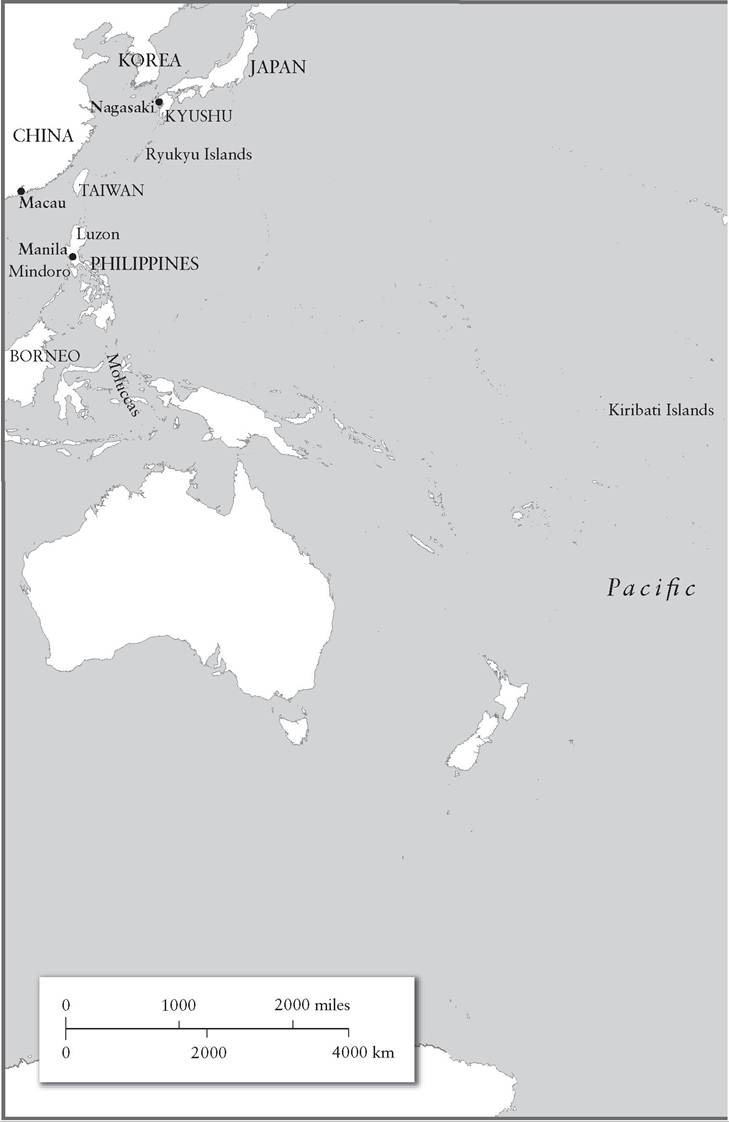
Charles therefore had reason to believe his money worries would come to an end.
This explains the rather slow progress the Spaniards made in marking out those parts of the western Pacific that they wanted to take under their control. Gradually they learned that the Pacific was studded with islands, but they took little interest in them - an expedition in 1536 headed into the south Pacific and saw the Kiribati Islands, but the captain, Grijalva, decided he would rather return to South America than press on to the Spice Islands. However, his crew mutinied and killed him. Grijalva had had cogent reasons for avoiding the Moluccas: he knew that Charles V had ceded the islands to the Portuguese, and engaging with the Portuguese was always the great fear of Spanish commanders en route to the East Indies. The sailors reached the Moluccas after all and most were massacred by irate islanders, but two fell into the hands of the Portuguese, with the result that their unsavoury story can be told.5 Still, the gaps in the Spanish map of the Pacific were gradually being filled in. In 1542 the Spaniards extended their ambitions all the way to the Ryukyu Islands, which, as has been seen, were lively centres of trade with China and Japan. The idea that was germinating in the minds of the Spaniards was that they could use the Philippines (not as yet known by that name) as a base from which to trade with east Asia. They did not rate the Philippines themselves very highly; greedy for cloves and nutmeg, which fetched startling prices in the Antwerp market, they were disappointed to find that the Philippines could not offer them either spice.
In 1542 the viceroy of New Spain (that is, Mexico) despatched his brother-in-law, Villalobos, to the Philippines, where his crew was at first discouraged to find that the inhabitants did not bother, or need, to produce a surplus and had no food to offer. Before long they were reduced to a diet of grubs, psychedelic crabmeat and luminous but poisonous lizards. Yet the Spaniards could see the potential of these islands not as sources of wealth in their own right but as a strategic location looking towards Borneo, China and Melaka, and they were impressed to find a market on the island of Sarangani, where the Spanish crew spent seven hungry months; here, silk, porcelain and gold were to be had.
When a local king based on a neighbouring island offered the Spaniards plenty of food and water, and showed them his wooden palace with its collection of Chinese pottery and silk, Villalobos decided that, henceforth, the island group would be known as the Philippines in celebration of the heir to the throne of Castile, the future King Philip II, an honour that meant far more to the Habsburg dynasty in Spain than to this king.6 But once again the explorers were stymied by their ignorance of the prevailing winds in thePacific; when they tried to reach Mexico, they could not make any headway, and Villalobos died on Amboyna, an island west of New Guinea, in 1544. The Spaniards began, however, to see that the Philippines were not a complete desert, even if they were less sophisticated than some parts of the East Indies. The native peoples wore gold ornaments made out of local metal; there was cinnamon bark; and ginger, long the second most popular eastern spice, grew in the islands. The inhabitants were drawn from several peoples; the area had been settled in the remote past by Malay navigators, and the different languages spoken in the Philippines were related to Malay and the Polynesian languages. The coastal peoples had often retained the skill in seamanship for which the Pacific peoples are famous.7
The problem was that the Philippines seemed so inaccessible. Only in the 1550s did the Spanish king, now Philip II, decide that the time was ripe for a new expedition, and his decision may have been influenced by short-term inflation in the spice market: between 1558 and 1563 spice prices nearly trebled in Old Castile, and cloves and cinnamon were particularly badly affected. Quite why this occurred is not clear - one explanation is runaway speculation in the spice market of Antwerp.8 The plan to reach the Philippines was all very well, but the question remained whether there was anyone who knew enough about the Pacific to guide a new venture across the ocean.
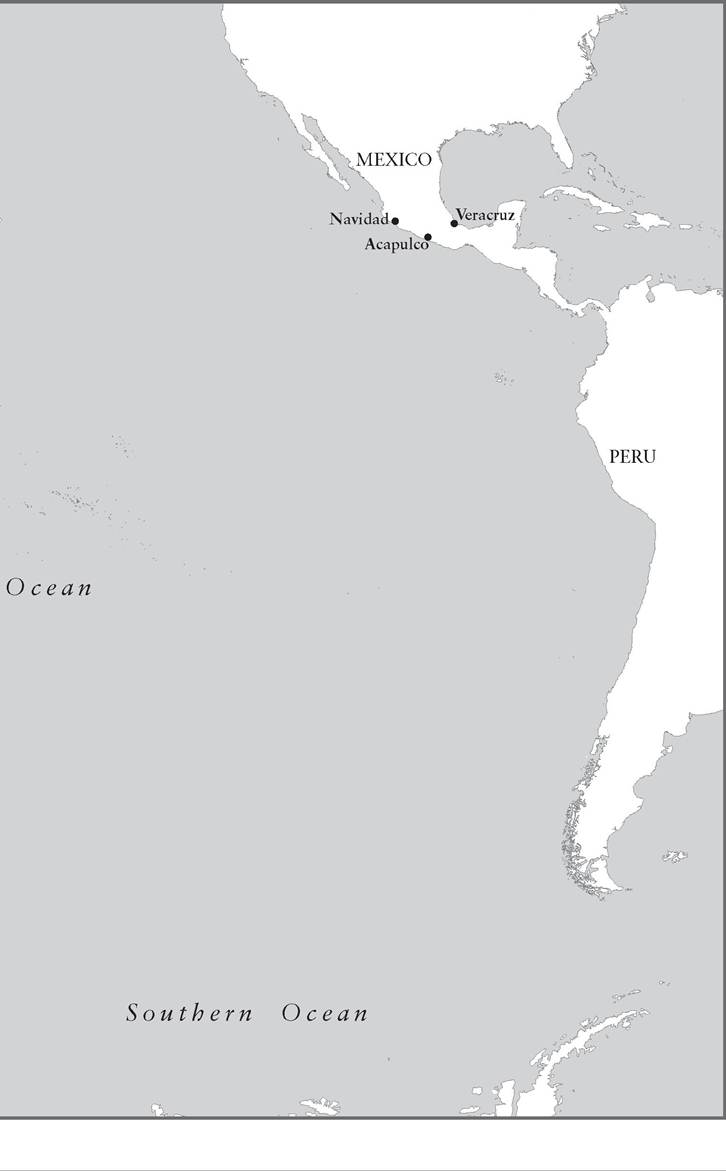
There was one person: Andres de Urdaneta, who, moreover, was conveniently convinced that the Philippines lay within the Spanish hemisphere of the world. However, Urdaneta was well into his fifties and had entered a convent of Augustinian friars; no one in his right mind wanted to join such a risky voyage, which ensured that many of the crew were not Spanish at all but Portuguese, Italian, Flemish and even Greek. But a personal appeal from the king of Spain to Urdaneta persuaded him to leave his convent and take up the position of senior pilot, advising the captain-general, Miguel Lopez de Legazpi.9The fleet was to consist of two galleons and three smaller vessels, and the first problem was that no shipyard capable of building large galleons existed on the Pacific shore of Mexico. Everything had to be created from scratch, including a workforce; and the right sorts of wood had to be obtained and hauled down to the coast. The cost of building this tiny fleet was 7,000,000 pesos.10 It set out from Navidad, a port on the Pacific coast of Mexico, late in 1564.11 One of the small ships, of a type known as the patache, or pinnace, became detached from the rest of the flotilla but reached Mindanao in the Philippines on its own; after patiently waiting for the other ships, which had headed off elsewhere, its captain, Arellano, decided that he did not have enough food to stay any longer and returned to Mexico, having spent eight and a half months away from Navidad. This was the first really successful return journey, because Arellano had the good sense to seek out the east winds that would blow his ship back to the Americas. In the process he discovered a route back from the Philippines, ignorance of which had frustrated previous attempts to reach Mexico. There was a Kafkaesque finale, though: he was accused of abandoning his commander and avoiding any attempt to find him in the Philippines. After his own return to Mexico, Legazpi submitted a request to the Audiencia, the highest court in New Spain, demanding that Arellano be put on trial.
Arellano was forced to defend his conduct before the Audiencia but he was never actually punished for his supposed crime.12As for Legazpi, he made good progress in extending Spanish dominion over the Philippines. Local rulers, including Muslim ones, were willing to enter into pacts with him when they saw the glitter of American silver, invaluable in trade with China. When the Filipinos objected, Spanish firepower proved irresistible. Less blood was spilled than during the Portuguese entry into the Indian Ocean, but Legazpi could be ruthless when he thought occasion demanded a show of strength. His expedition was not all about conquest, however; he informed King Philip that Chinese and Japanese merchants came to trade in the big Philippine islands of Luzon and Mindoro year in, year out; but he was also aware that he had come into an area where Portuguese merchants occasionally wended their way. To keep them at bay he really needed a base in the islands, and he needed to convince the local sultans, even if they were Muslim, that Spanish overlordship was a good thing.13
Like Arellano, Legazpi’s men found their way back to Mexico. Urda- neta once again proved to be an able pilot, and the maps he made were not, this time, lost to the Portuguese but were copied for generations. He found a much better route than Arellano, but even so the voyage from the Philippines to Mexico proved to be much longer than the journey outwards; the south-west monsoon took the galleon San Pedro (sometimes referred to as the San Pablo ) up to the latitude of Japan, and then into the wind system of the northern Pacific, which drove the ship eastwards in a great arc until it reached the Santa Barbara Channel off California.14 It took a little over four months for the galleon to reach Acapulco, in October 1565. The bare recitation of the route taken does not do justice to the misery the sailors experienced on the long homeward run. As with da Gama’s fleets, scurvy took the lives of several men (sixteen died en route, but the crew numbered more than 200, so the ratio of deaths was much better than on many earlier voyages).
The Legazpi expedition is generally taken to mark the beginning of the Manila galleon trade, which lasted for 250 years from 1565 to 1815, punctuated by occasional interruptions during periods of conflict or following the shipwreck of a galleon.15 These galleons frequently displaced 1,000 tons and were perhaps the largest trading ships afloat at the time.Once they lay under Spanish rule the Philippines were treated as part of the viceroyalty of New Spain, in other words as an extension of Mexico; and the inhabitants, like the native Americans, were indiscriminately called ‘Indians’, Indios, or, in the case of the large number of Muslims in some parts of the archipelago, they were called ‘Moors’, Moros. These were the traditional broad-brush ethnic categories into which the Spaniards divided much of humanity.
II
While the circumnavigators, notably Magellan and Elcano and then Drake, have attracted a great deal of attention, the really important circumnavigation, conducted in stages, was that which was created following the opening of the Manila galleon route, and this has been oddly ignored by historians.16 The Philippines were linked to China and Japan, but also to Mexico and Peru; goods transported across Central America reached Veracruz on the Gulf of Mexico, were ferried to Havana and were then carried across the Atlantic to Seville and Cadiz. And in the opposite direction, despite the longstanding hostility between the Spanish colonizers and the Portuguese, goods filtered from Manila to Macau, Melaka, Goa and then into the Portuguese spice trading network all the way to Lisbon and Antwerp. The oceans had been joined together, and the nails that held the network together were all these cities. Chinese silk and ceramics might reach a table in Spain by way of Mexico or the Cape of Good Hope. Spanish hidalgos in Mexico, and the native elite, could dine off Chinese porcelain and dress in fine silks brought by galleon once a year from Manila.17 For, as the Spaniards and their Portuguese rivals penetrated deeper into the trade networks of the South China Sea, the search for ever greater quantities of spices was matched by a passion for the exotic products of both China and Japan. These ambitions were independently boosted by the decision of the Ming emperor in 1567 to permit Chinese merchants to trade abroad, after a century and half during which the Ming court had strongly discouraged foreign trade.18
To achieve their aims the Spaniards would have to identify the best- placed harbour from which they could conduct their trade. An expedition sent out in 1570 had the pleasing result that the sultan of Manila, a settlement on the island of Luzon, entered into a pact of blood brotherhood, in the traditional way (which involved drinking a liquid containing drops of the blood of the parties to the agreement). However, there is a difference between sworn amity and submission, and Sultan Soliman was upset when he realized that the Spaniards now thought he was their subject and owed the king of Spain tribute. This meant that the Spaniards resorted to force, but in 1571 they formally established Manila as the capital of their Philippine colony, a title confirmed by King Philip in 1595, when the city, now booming, was recognized as Cabeza, head, de Pilipinas.19 The Chinese had their own story about the foundation of Manila:
When they perceived that the country was weak and could be occupied, they bestowed rich presents upon the king and demanded a plot of land as big as an oxhide for building houses and living there. The king did not suspect any trickery and assented. These men thereupon cut the hide of an ox into narrow strips, pieced these together until they extended the length of a thousand fathoms, and in this way encompassed the whole land of Luzon, which they then claimed, in accordance with their agreement.20
This was the story of how Dido founded Carthage, which had found its way, perhaps in the storytelling of Portuguese travellers, all the way to China.21 Yet the gloomy view of Legazpi was that ‘this land cannot be sustained by trade’, by which he meant not that the creation of a trading base there would fail, but that the resources of the Philippines were not sufficient to keep Manila alive. Its future depended on becoming the hub for Pacific trade - which is what did happen.22
Remarkably, the Manila galleon - often just one very large ship - was the main source of income for the Spanish population of Manila. The lifeline linking Manila to Mexico was fragile and was easily snapped. Even so, sailors and settlers were prepared to risk taking this route in the search for profit or sometimes out of curiosity. A vivid account of a journey to Manila survives from the hand of Francesco Carletti, a Florentine merchant who set out across the world in 1594, when he was about twenty-one years of age. He had been living in Seville with his father, learning ‘the profession of merchant’, and after three years there his father suggested that they should hire a small ship of about 400 tons, sail to the Cape Verde Islands, load the ship with black slaves, and transport them to the West Indies. This was (it is sad to say) a normal enough operation, apart from the fact that the Carlettis were Italian, and only subjects of Spain were permitted to ply these routes. It was therefore essential to find a Spanish backer; this was a woman from Seville who had married a Pisan businessman, and who agreed to front the expedition.23 The Carlettis arrived in the Caribbean safely, mourning the loss of slaves thrown into the sea after they died (so they said) from eating fresh fish, and on a whim they penetrated deeper and deeper into the New World, reaching Panama and Peru, and then up to Mexico, visiting Acapulco and next trekking up to Mexico City with a load of silver, buying and selling, and recording the wonderful sights they saw, for Francesco had decided that his account of the voyage was to be sent to Ferdinando de’ Medici, the Grand Duke of Tuscany and an enthusiast for the promotion of trade - he showered the free port of Livorno with privileges that enabled Armenians, Jews and others to settle in the city.
The Carlettis had it in mind to buy goods and take them back to Lima. The maritime route along the coast from Peru to Mexico was now fully functioning; it was a Spanish creation, for the Aztecs and the Incas had barely been aware of one another’s empire. But the longer they spent in Mexico, the more Carletti’s father was convinced that this was only halfway to where he needed to be: the Philippines. Once again they had to find a way of being taken on board when only Spaniards were allowed to buy passage to the islands. However, those who served on board were exempt from this rule - after all, the crews included large numbers of Filipinos, Chinese and even black Africans. The Carlettis were appointed as officers on board, though the captain agreed to find two sailors who would perform their duties so long as they renounced their officers’ pay. There was also an official limit of half a million golden escudos (converted into silver) on the amount of silver, mined in Peru and Mexico, that could be taken to the Philippines to pay for the goods available there. The Crown wanted to treat the Manila trade as a royal monopoly, but in reality there was plenty of opportunity to smuggle money into the islands, and goods out of them; the captain was fully complicit, for ‘he was used to carrying such things for various people who shipped money’, with the result that the amount of bullion on board was worth 1,000,000 escudos. Out of this, the captain was entitled to take 2 per cent as a fee, so one can see why he was perfectly willing to defy the Spanish authorities despite threats of confiscation and worse.24
The outward journey was generally less of a trial, and after setting out in March 1596 the Carlettis enjoyed a ‘prosperous and very happy navigation’; there was always a following wind, so that the journey lasted sixty-six days, compared to the six months that a return trip might take. The ships took on fresh water in the Marianas, the islands Magellan had called the ‘Islands of Thieves’; it was loaded in the form of very stout lengths of bamboo cane, filled with water. All the inhabitants wanted was bits and pieces of iron, which were prized more than gold: ‘they were asking in the friendliest way, rubbing the palm of their hands along the side of their hearts, saying “Chamarri, her, her,” which means “Friends, iron, iron.” ’ Francesco Carletti was especially impressed by the boats the islanders built, ‘so well made of the thinnest boards painted and worked with various colours, these mixed with much artistry, and sewed together without nails in a capricious and beautiful way and style, so light that they appeared to be birds flying over that sea’. He admired the outriggers that made sure the boats could never capsize or sink, because they buoyed up the boats, and the long, narrow sails ‘made in the manner of rush mats’.25 He was less impressed by the ‘barbarians’ themselves, whose men went around shamelessly naked.
In many respects, the approach to Manila was the most dangerous part of these voyages. Manila lies on the western side of the large northern Philippine island of Luzon, and to reach it ships had to pass through the Luzon Strait between Taiwan and Luzon, and then manoeuvre through narrow channels and past shoals into Manila Bay. Even before the galleon carrying Carletti had passed Taiwan, a typhoon started to blow, and at that point the sails were at last lowered, and the galleons were immobilized for eighteen days, running short of fresh water. Carletti described how water was rationed and orders were given not to cook any food, on the grounds that this made people drink more (the meat taken on board was heavily salted); all one was allowed was ship’s biscuit moistened in water and oil, and sprinkled with sugar. These privations seemed distant memories once the storm abated and the ships anchored off Luzon, taking on fresh fish and marvellous fruits: ‘truly those bananas in that region seemed to me one of the most delicious fruits to be found anywhere in the world, and in particular certain ones that had a very subtle odour, so that one could desire nothing more welcome or more flavoursome.’26
Carletti was not as overwhelmed by Manila as he was by Philippine bananas. He recognized that its layout and the style of its houses were similar to what he had seen in Mexico City, which was much larger, though he thought Manila was better defended by its thick walls and a garrison of 800 Spanish soldiers, which made sense as they faced many enemies in a sea that contained, he said, 12,000 islands. But he was impressed by the profits that the Spanish settlers were able to make: ‘from the merchandise brought there by the Chinese and then transported to Mexico, they still earn 150 and 200 per cent.’
Whatever those islands lack is brought there from outside. From Japan comes the wheat flour from which they make bread to serve to the Spaniards; from there also come divers other things that they bring on their ships and sell. And the Chinese - that is, those from the province of China - also come there each year with some fifty ships laden with raw silk that has been spun and woven into pieces of velvet, satin, damask or taffeta, as well as much cotton cloth and musk, sugar, porcelain, and very many other sorts of merchandise, from all of which they make very noble trade with the Spaniards, who buy it from them to take it to Mexico in New Spain.27
The year Carletti arrived there were only about a dozen of these junks in port, and everything was snapped up quickly. Carletti attributed the lack of Chinese goods to a big fire in the Chinese quarter of the city; but, as will be seen, there were other interruptions: pirate raids, riots by Chinese settlers, and so on.
Carletti did not simply report on business opportunities; he was also fascinated by the Filipinos themselves: the Moros, who enjoyed gambling on cockfights, and the heavily tattooed Bisaios, the pagan population, whose men pierced their penises with studs, which somehow increased their ‘lustful pleasure’, though at first, at any rate, the studs made their female partners extremely uncomfortable. But he was full of praise for the islands - ‘everything is good in those islands.’28 Aware that the Spanish government made it very difficult for foreign merchants to trade out of Manila, the Carlettis next conceived a plan to sail by way of Japan to China, the East Indies, Goa and Lisbon. This was no more straightforward than attempting to load merchandise on ships bound for Acapulco. Castilians were forbidden to enter the Portuguese area of trade, under pain of confiscation of goods and imprisonment. This rule still held even though Philip II of Spain had succeeded to the throne of Portugal in 1581, following the death of King Sebastian in battle against the Moroccans and of his childless heir shortly afterwards. It was a way of keeping the peace between enemies who had a common monarch but not a common purpose.
The answer to the problem the Carlettis faced was to steal out of Manila at night carrying their bars of silver on board a Japanese ship, for Japan was ‘a free region in which neither the Portuguese nor the Castilians rule’. This ship was similar to a junk, and Carletti was fascinated but not entirely convinced by the sail, which, he said, folded up like a fan but was really quite weak, and he was intrigued also by the fragile rudder.29 Portuguese ships arrived each year at Nagasaki, sailing in from Macau on the coast of China, so that there would be no great difficulty in heading for the South China Sea after looking around parts of Japan, which was not yet closed to foreign traders, and where Carletti encountered a leaf called cha, or tea, and warm rice wine - his experiences in Japan will be examined later.30 Carletti’s account of Manila clearly demonstrates the city’s place at the hub of networks linking the Spanish Philippines not just to Mexico, and through Mexico to Spain, but also to China (when the junks arrived) and northwards towards Japan; nor in reality were the Portuguese always unwelcome in the city. As a centre of exchange, Manila was connected to the maritime trading centres of the entire known world.
III
Manila, with its fine harbour and its fertile hinterland, was a cosmopolitan city, though that is not to say that relations between its many different peoples were always cordial. The Spanish presence was complicated by the fact that the conquerors were Catholic and that they were in constant contact with Muslims, Buddhists, Daoists and pagans. While the Spanish settlers in Manila, numbering 7,350 in 1650, confined themselves to a fortified city, which came to be known as Intramuros, ‘within the walls’ (still the name of old Manila), the suburbs of Manila teemed with Chinese, Japanese and Filipinos.31 There had been a settlement at the site the Filipinos called Maynila for some time, and the Spaniards thought of calling the city ‘Sweet Name of Jesus’, but somehow a hispanized version of the old name seemed simpler.32 The Chinese presence in the Philippines already had a long history when the Spanish conquerors arrived. In the Song period, from the mid-tenth to the late thirteenth century, Chinese junks regularly visited the islands, for this was a period when the imperial court encouraged private trade. But private trade continued unofficially even under the sterner policies of the early Ming emperors; the Philippines were among the places visited by Zheng He’s fleet, since the Yung-l o emperor was keen to draw the islands under his overlordship and had already sent an official to the island of Luzon in 1405 in the expectation that he would take charge of the place.33 Two years later Zheng He’s fleet arrived, and then and on other occasions tribute reached China from the islands, including gold, precious stones and pearls, but Filipino boats continued to come to China, and spices from Java and the Moluccas were collected in the Philippines by Chinese merchants who evaded the official ban on private trade. The clearest evidence for intensive contact between China and the Philippines before the arrival of the Europeans comes from the description of local chieftains dining off porcelain in Pigafetta’s account of Magellan’s voyage, while archaeological finds even in the Philippine uplands, away from the coastal areas visited by shipping, show that gifts of Chinese ceramics were used to bond the highland chiefs to the powerful datus, or petty rulers, of l ow-lying regions. Admittedly, the datus kept the finest porcelain for themselves.34
It rapidly became clear that Manila could not live without China, just as it could not live without Acapulco. After a great massacre of the Chinese in 1603, a Spanish commentator complained that the city ran out of food, even out of shoes, for the Chinese were not just traders but artisans: ‘it is true that the city can neither go on nor maintain itself without these Chinese’.35 The Spaniards knew the Chinese as Sangleys, a corruption of the term seng-li, which in the Amoy dialect of Chinese meant ‘trade’.36 The Sangleys arrived on big junks that carried up to 400 passengers, some of whom could be expected to stay put in Manila, settling in the Parian, or Chinese quarter. The junks were quite unlike European or Filipino vessels; each end was square, and the deck was covered with little huts roofed with palm leaves, while the hold was divided up by partitions, so that if the ship sprang a leak only one partition at a time would be flooded. Merchants rented space in these partitions, storing their cargo for a fee of 20 per cent of the price the goods fetched; another 20 per cent or more went to the Chinese brokers in Manila who helped manage the sales, if need be by handing out bribes to Spanish officials, although officially goods were sold through a system of wholesale bargaining which met the needs of Spanish merchants - with little or no knowledge of Chinese, they remained suspicious of the bargaining ability of the Chinese.37 Already familiar with old Maynila, the Chinese junks came in ever greater numbers once the Spanish city had come into being, recorded arrivals rising from only six in 1574 to forty or more each year by 1580, and generally at least thirty could be expected to arrive, so long as the Chinese knew that the Manila galleons had come into port with the silver needed for settling bills. The visit was brief, to allow for the monsoons and the danger of typhoons: out from China in March, and leaving Manila by early June.38
This trade was dominated by silk and porcelain. At first some of the Spaniards were rather dismissive when talking about the quality of the silk coming from China, but once the Chinese had a good sense of the distant markets they were trying to reach all this changed. They imitated the silks of Andalusia, and opinions differed about which was better, Chinese or Andalusian silk cloth. The business community of Seville looked with disapproval on the expansion of the silk trade from China to Manila and from Manila to Mexico, having assumed that Mexico would be their own special market. Chinese kilns showed similar adaptability to Chinese looms. In the seventeenth century Chinese potters knew what the Europeans and the Japanese wanted, and modified their designs accordingly. What resulted was a European and Spanish colonial taste for Chinese goods, subtly altered to meet the cultural preferences of the purchasers; this was an important moment in the encounter of Chinese civilization with the West. Antonio de Morga, president of the high court, or Audi- encia, at Manila late in the sixteenth century, itemized the goods that arrived on these junks:
Raw silk in bundles, of the fineness of two strands, and other silk of coarser quality; fine untwisted silk, white and of all colours, wound in small skeins; quantities of velvets, some plain and some embroidered in all sorts of figures, colours and fashions, others with body of gold and embroidered with gold; woven stuffs and brocades, of gold and silver upon silk of various colours and patterns, quantities of gold and silver thread in skeins; damasks, satins, taffetas and other cloths of all colours... 39
That was only the silk; they also brought linen and cotton cloth, hangings, coverlets, tapestries, metal goods including copper kettles, gunpowder, wheat flour, fresh and preserved fruits, decorated writing cases, gilded benches, live birds and pack animals - each junk must have been the sixteenth-century equivalent of a floating department store. So responsive were the Chinese to the demands of the market in Manila and Mexico that they sometimes jumped to the wrong conclusion. A Spaniard had lost his nose, probably from venereal disease, and he commissioned a wooden nose from a visiting Chinese craftsman, whom he paid very generously. On his next trip to Manila the craftsman thought he had worked out how to make himself a small fortune, and brought a whole cargo of wooden noses, only to discover what he should have noticed earlier: that the Spaniards in Manila already had noses of their own.40
All this was paid for with enormous quantities of Peruvian, and to a lesser extent Mexican, silver shipped out from Acapulco on the annual galleon voyage. One estimate for the quantity of American silver mined between 1500 and 1800 is 150,000 tons; only some of this was carried west on the Manila galleons (apparently 12,000,000 pesos of silver were sent to Manila in 1597, 5,000,000 in most years), but even so the export of American silver had a dramatic effect on the silver-starved Chinese economy.41 The Ming emperors had tried to deal with the shortage of silver within their empire by continuing the Mongol practice of issuing paper money. Foreign rulers who received gracious gifts of paper money in exchange for their tribute may well have wondered whether this was fair exchange, especially when (as in 1410) an embassy from the Philippines brought the emperor a present of gold.42 Another possibility was to collect taxes in grain, but Chinese officials responded to the influx of bullion by accepting payments in silver instead, as it was easier to transport; and then a decision to rationalize a whole series of taxes into what was evocatively called the ‘Single Whip’, in about 1570, made silver payments the norm.
In the very long term the gold:silver ratio in China became less extreme; it stood at 1:5.5 in Canton around 1600, but could be as high as 1:14 in contemporary Spain. In China as in Europe, the arrival of large amounts of bullion pushed up prices, leading to a ‘great inflation’; on the other hand, the arrival of so much silver drove economic expansion within Ming China by vastly boosting the money supply.43 Meanwhile visiting merchants could buy gold cheaply with silver so long as the Chinese exchange rate was much more favourable than elsewhere. There were opportunities to make a considerable fortune by shifting bullion around the world from places rich in silver to places poor in silver, something the Genoese and Venetians had known in earlier centuries.44 A Portuguese merchant commented in 1621: ‘silver wanders throughout the world in its peregrinations before flocking to China, where it remains, as if at its natural centre.’45
Chinese trade brought people as well as goods to Manila. The Chinese quarter, the Parian, had been set aside by a late sixteenth-century governor of the Philippines as a sort of Chinese ghetto; the name was a corruption of the Chinese word for ‘organization’.46 This lay outside the walled area of Intramuros inhabited by the Spanish settlers, and it grew very rapidly, so that by 1600 there were more than 400 shops in the reserved area and the Chinese population of Manila is thought to have reached 12,000, mainly men, as they tended to arrive from China without women, though many took Filipino wives. The Spaniards were deeply suspicious of the inhabitants of the Parian. Some became Catholics, but on one occasion the ringleader of Chinese opposition to the Spaniards was a disillusioned Christian. King Philip III believed that they were a ‘great peril’.47 Tensions increased when Manila was under threat from Chinese ships, as occurred in 1574; that year Chinese pirates aboard seventy large junks commanded by Lin Feng, or Limahon, overran large parts of Manila, and were only beaten back with great difficulty after Spanish reinforcements arrived by sea under the able command of Juan de Salcedo, who was the grandson of the pioneer of the Philippines, Legazpi. Once Limahon and his men had been chased away from Manila, the Spanish ships caught up with the pirates and annihilated their fleet. But there was also trouble inside the colony. In 1593 the Spanish governor and Spanish members of his crew were assassinated by Chinese oarsmen aboard his galley. The governor’s son and successor sent out an appeal as far as Macau and Melaka in the hope of tracing the culprits and arresting them, and a few Chinese sailors were sent from Melaka to Manila for execution, though they may just have been scapegoats. Meanwhile (a Chinese account says) the Chinese, from love of trade, continued to live in Manila.48
Tension boiled over every fourteen years, on average, during the late sixteenth and seventeenth century. The most bizarre example of Chinese- Spanish tension took place in 1603, and even at the time the Spaniards wondered whether they were witnessing a farce or serious political negotiations. Three mandarins arrived in Manila, and were ceremonially carried to the governor’s palace, where they said that they were looking for the gold-bearing island of Cabit, which was not far off and belonged to no ruler. There was indeed a place called Cavite near Manila, a port that served as a gateway to the capital, and the mandarins were taken there and were shown that it was not full of gold.49 It did possess a naval shipyard, and that was surely what the mandarins hoped to inspect. The arrival of the mandarins set off rumours about their real intentions. The Spanish settlers became convinced that they were spies and that a large Chinese fleet was being prepared, bearing 100,000 soldiers who would flush the Spaniards out of the Philippines. On top of this, rumours spread that the Chinese in the Parian district were about to rise in revolt. The mistrust between Spaniards and Chinese was nothing new, but Chinese grievances mounted as Japanese mercenaries who formed part of the Manila garrison threatened to head off rebellion by massacring the Chinese. October 1603 saw a series of terrible events, as the Chinese rose in revolt, burned the outskirts of the city and killed the elite soldiers of Spain, including the governor; on another occasion they were able to scatter the formidable Japanese mercenaries. The rebels even massacred fellow Chinese who were not interested in joining the rebellion. The rebellion could only be put down when Spanish reinforcements arrived from elsewhere in the islands; they pursued and killed Chinese rebels everywhere they could find them, and a Chinese chronicle states that the death toll was as high as 25,000.5°
Even the massacre of thousands of Chinese did not lead to a rupture with China: trade continued and 6,000 settlers came back to the Parian within the next two years. The new governor told King Philip III: ‘this country has been greatly consoled at seeing that the Chinese have chosen to continue their commerce, of which we were much in doubt.’ The Chinese view, not surprisingly, had a slightly different emphasis: ‘after that time the Chinese gradually flocked to Manila; and the savages [the Spaniards], seeing profit in the commerce with China, did not oppose them.’51
IV
King Philip had even grander plans, going far beyond a trading relationship with the Chinese. As early as 1573 the idea of a Spanish invasion of China had been mooted. The examples of Mexico and Peru seemed to prove that compact Spanish armies, well supplied with arms, could overwhelm mighty empires. The Japanese were known to hate the Ming and could be persuaded to join the invasion. The Ming Empire was dismissed as fragile and ill-defended. As with the other Iberian conquests, the mercenary and the spiritual were intertwined. One only needed to think of the great benefit to Christendom of conquering this heathen land and converting its inhabitants to the Catholic faith. An expedition set out from Manila in June 1575, and many of those on board imagined that they were conquistadores who would win control of the legendary wealth of China. However, the first priority was to persuade the Ming emperor that Spanish friars should be allowed to preach the faith in China. Another topic for discussion was the creation of a Spanish trading base on the Chinese coast opposite Taiwan, which the Chinese were quite happy to permit, especially if the Spanish fleet would help clear the waters between the Philippines and China of pirates - one troublemaker, Limahon, was as much of a nuisance to the Chinese as he was to the Spaniards.52 Over the next few years schemes to invade China were presented again and again at Philip’s court, and - though they looked attractive - the defeat of the Spanish Armada by the English navy in 1588 brought Philip down to earth. Hugh Thomas wondered whether these schemes might have been brought to fruition had Philip not lost his fleet that year, while the increasingly bitter rebellion in Philip’s north European possessions, the Netherlands, was another drain on resources.53
Philip understood that his priority would have to be the promotion of Spain’s commercial interests in the western Pacific, rather than dreams of conquering another exotic empire. His Spanish subjects, not just in Manila but in Mexico, Peru and even Europe, were fascinated by Chinese goods.54 Behind their commercial ambitions lay the old question of rivalry not with Chinese merchants but with Portuguese ones. The Spaniards were aware that their Portuguese rivals had managed to camp on the very edge of China, where, at the mouth of the Pearl River, which leads to Guangzhou (Canton), they had created the outpost of Macau, whose foundation will be examined in the next chapter.55 After 1580, and Philip’s accession to the throne of Portugal as well as Castile, opportunities seemed to beckon for Spanish trade through Macau. The king was not keen, however, banning Spanish visits to Macau in 1593. A few years later he did permit the Spaniards to visit the coast of China, and they tried to copy the Portuguese by setting up their own base at a place they called El Pinal, which also lay close to the Pearl River; it probably stood somewhere in the territory of modern Hong Kong. Not surprisingly, the Portuguese complained vociferously, while a Spanish official who had to endure a freezing winter in El Pinal in 1598 grumbled that not just the Portuguese but the Chinese were an endless source of trouble - rather than robbing the Spaniards by violence they found more subtle means of robbing them ‘by other and worse methods’, in other words clever trading practices.56 El Pinal did not survive much longer. Over time, contact between Macau and Manila grew; Manila learned to look westwards as well as eastwards, and the value of goods sent from Macau to Manila reached 1,500,000 pesos by 1630.57 From the perspective of the Manila settlers, what counted was that the Chinese junks kept coming, accompanied by Filipino outrigger craft, Portuguese ships and, importantly, Japanese junks.
V
The Japanese connections of Manila were not as important to the city’s prosperity as its Chinese connections, but they were nonetheless significant. It would be wrong to think that Japan always cut itself off from contact with Europeans, once the Portuguese, Spaniards and finally the Dutch had penetrated into their waters. The closure of trade to European merchants for more than two centuries, except through Nagasaki (where the Dutch established a small trading station in 1641), followed a period of close but wary engagement with these visitors from the other side of the world, who were as puzzled by the Japanese as the Japanese were by them. Until 1639 the Portuguese enjoyed an active trade in Japanese silk; problems arose, however, when Jesuit missionaries, also Portuguese, began to proselytize actively in southern Japan, and the shoguns decided that not just they but converted Japanese were a political threat. A Spanish pilot who reached Japan had brought with him a world map on which the many lands of the Spanish Empire were marked. The Japanese were curious to know how these conquests had come about.
‘Nothing is easier,’ the pilot answered. ‘Our kings begin by sending into countries which they desire to conquer some friars, who engage in the work of converting the people to our religion. When they have made considerable progress, troops are sent in who are joined by the new Christians. They then have little difficulty in settling the rest.’58
News of this tactless conversation is said to have prompted the regent, Hideyoshi, to begin the first of a series of persecutions of Christians in Japan.
In the late sixteenth century, as the example of Manila has already shown, Japanese mercenaries were a familiar and frightening sight, and the high quality of their training and armaments, as well as their reputation for ferocity, made them the prime choice of anyone looking for paid military help. Japanese mercenaries were readily available, following the unification of much of Japan by the regent and chancellor, Hideyoshi, ten years earlier, capped by the success of Tokugawa leyasu in defeating his enemies in 1600. There was not much for them to do in Japan itself, so foreign opportunities beckoned. Occasionally, this admiration for the Japanese could take an awkward turn. Maybe they were such skilled soldiers that they would be tempted to launch an invasion of the Philippines? After all, there were plenty of Japanese merchants in Manila by the 1590s.
For this reason the Spanish governor decided that the Japanese, like the Chinese, needed their own quarter, known as the Dilao : ‘to relieve our anxiety regarding so many Xaponese traders in the city, it would be advisable to assign them a settlement located outside the city, after first taking away all their weapons’. By 1606 there were more than 3,000 Japanese living in the Dilao ; later, it attracted large numbers of Japanese Christians, for whom life in Japan was becoming increasingly difficult; it was the largest Japanese settlement outside the homeland. Only in the 1630s, with the decline of direct trade between the Philippines and Japan, did this community pack its bags and leave. The governor was also worried by the large number of Japanese servants living in Manila, who had free entry into houses within the city and might set fire to Manila. Antonio de Morga, who has been met already in his capacity as president of the high court, wrote in 1609 that the Japanese are ‘of good disposition and courageous... of noble bearing and carriage, and much given to ceremony and courtesies’, and he insisted that ‘the maintenance of friendly relations between the islands and Japan is advisable’.59
Admiration was, then, combined with fear. This meant that Japanese ships were by and large untouchable. In 1610 a Japanese trading ship that carried the ‘vermilion seal’, guaranteeing the shogun’s protection, reached Manila just as the Spanish and Dutch fleets engaged in battle with one another offshore. The Europeans suspended action while this ship serenely passed through their ranks, and no attempt was made by either side to come on board. This was not because anyone was afraid of Japanese firepower; trading vessels of this sort would not have carried guns. Both the Spaniards and the Dutch knew that the Japanese were under orders to report any interference to the shogun’s court, where reprisals would be launched against the nation that had insulted the empire’s subjects. The seizure by a Spanish captain of a Japanese ship off Siam in 1629 showed how things could go wrong if the government, or bakufu, was offended.
The Japanese seized a Portuguese ship at Nagasaki in retaliation, drawing the Portuguese (then still subjects of King Philip) into the quarrel. An embassy from Japan to Manila, two years after the incident, failed to soothe either side, and contact with Japan withered, while the Christians in Japan underwent further persecution. The Spanish and Portuguese attempts to spread Christianity in Japan did nothing to help the situation. The governor of the Philippines complained in 1636 that ‘the trade with Japan has been spoiled by the indiscretion of certain religious’.60
Japan was attractive for other reasons than its formidable mercenaries. The sixteenth century saw the extension of silkworm cultivation, and new centres of silk-weaving also emerged, with the encouragement of the feudal lords who dominated during the age of the shoguns, and who saw good opportunities for profit in the silk industry, as well as wanting to clothe themselves in magnificent fabrics. They encouraged the creation of markets. The regent Hideyoshi cleared the land of bandits and cleared the sea of pirates, as well as encouraging the free movement of goods by abolishing internal customs stations. He also tried to take control of the production of silver and gold wherever he could. Hideyoshi also supported foreign trade, encouraging a trading expedition to Korea and taking charge of the key port of Nagasaki. He snapped up (for honest payment) all the raw silk on board when what was described as a foreign ‘black ship’ reached his coast, and acted much the same way when a Spanish ship came in from the Philippines loaded with ceramics, or when Portuguese ships arrived bearing gold. His successor, leyasu, was so keen to promote good relations with the Spaniards that in 1604 the governor of the Philippines felt able to tell King Philip III that ‘peace and friendship with the king of Japan goes on continuing’ (though the shogun was not in fact king).
VI
Ieyasu was thoughtful and observant, and he realized how important to Manila was the link to Acapulco. He too wanted a stake in trade with Mexico. He wanted Japanese merchants to have rights of access in New Spain, and he wanted the Manila galleons to make a short detour and put in at a Japanese port en route to Acapulco. The Spaniards prevaricated, but leyasu was able to seize his opportunity in 1609 when the San Francisco, bearing the ex-governor of the Philippines, foundered on his shores. This official made a treaty with leyasu, although his authority to do so was very doubtful; and leyasu even promised to permit missionaries to preach in his islands.61 In 1610 the ex-governor was ferried back to Mexico on a ship provided (partly thanks to a loan from the shogun) that had been built in Japan but according to European standards. leyasu was well aware that Japanese navigational skills lagged behind those of the Europeans, and would dearly have liked to create a shipyard on the European model. However, this ship was built under the direction of an English shipwright and merchant, or perhaps one should say pirate, who had managed to reach Japan, William Adams, known in Japan as Miura Anjin. Adams’s story was another tale of shipwreck, this time aboard a Dutch vessel out of Rotterdam, De Liefde (‘The Beloved’), that had ambitiously set out in 1598, taking an elaborate route by way of the Cape Verde Islands, west Africa and the Strait of Magellan before the ship was washed up on the shore of Japan. The expedition was better at marauding than at trading. In the Cape Verde Islands, where the crew hoped to take on food and water, they occupied Praia, on the main island, Santiago; the unsurprising result was that the Portuguese governor sent them packing without new supplies, after telling them that he would have sent supplies but for their awful behaviour (memories of Francis Drake’s sacking of the then capital, Ribeira Grande, in 1585 were still powerful). They reached Patagonia, and there were altercations with Patagonian Indians, supposedly eleven feet tall. Passing through the Strait of Magellan, they decided that it was too difficult to return the way they had come, and settled on Japan as a destination, since they were carrying heavy Dutch broadcloth which they realized, belatedly, was not the sort of cloth anyone in the tropical East Indies would want to buy.62
leyasu met Adams and took a liking to him; but he was suspicious about the intentions of the Dutch and English visitors, and for a time clapped him in prison. These suspicions were justified, since the Dutch crew had probably been more interested in finding Spanish treasure ships, as Sir Francis Drake had managed to do several years earlier, than in creating a new route to the Spice Islands or indeed Japan. Fortunately, Ieyasu concluded that Adams possessed the skill needed to build a ship in the Western style. Adams protested that he did not know a great deal about shipbuilding, but even so he and his colleagues put together a seaworthy vessel.63 The ship set sail along with an official ambassador and Japanese merchants, and it returned in 1611 bearing a Spanish ambassador, who, however, was as discouraging as he dared to be. Ieyasu was, in any case, having doubts about Spanish ambitions. All the same, a few attempts were then made to set up a Japan-Acapulco route, manned by Japanese ships, but mutual hostility made sure that direct contact soon came to an end; a final voyage to Acapulco took place in 1616.
Nothing, however, compared with the experiences of an official Japanese party that travelled all the way to Europe, by way of Mexico, setting out from Japan in 1613 and only returning home in 1620. Their journey continues to fascinate readers of Japanese literature, thanks to Shusaku Endo’s book The Samurai.64 The travellers reached Seville, where they brought a letter proposing a Japan-Seville trade route, and even promising that Japan would accept the new faith. Their arrival caused great excitement. They moved on to Madrid, where (given the Japanese obsession with rank) they probably understood the consternation of the royal court at the fact that the letter had not been written by either the emperor or the shogun, but by a lower official; so they were offered the same honours as would be provided for the ambassadors of an Italian duke. Their leader, Hasekura, was baptized by the royal chaplain in Spain before the embassy moved on to Rome, where Hasekura was given the title of patrician and senator and was granted an audience by the pope. Ironically, all this was happening just as leyasu embarked on another persecution of Christians in Japan; the promise that he would turn Japan Christian was an empty one.65 By the end of their extraordinary journey, they had not achieved much beyond knowledge of the New World and Europe, and if anything their immersion in the society of Philip Ill’s Christian empire made them more suspicious of the Catholic world, and less inclined to encourage the building of close relations between Japan and either the New World or Spain.66
The issue of ‘vermilion seals’ by the government to Japanese ships trading southwards was another aspect of the vigorous economic policy the shoguns were pursuing. Roughly fourteen ships set out year after year, visiting eighteen countries, with a preference for Vietnam. At the start of the seventeenth century the most frequent visitors to Japan were the Portuguese, but the first Dutch vessel arrived in 1609, and four years later an English ship came to Japan; both nations aimed to set up trading stations on the island of Kyushu.67 But as tension grew, particularly over the Catholic missions, the Japanese government turned against the foreigners, banning the Dutch and English in 1616, so their stay was very short indeed. And then the shoguns turned against Japanese traders who ventured beyond their homeland. In 1624 the Japanese were ordered to stop trading in Manila, and such foreign trade as there was became concentrated in Nagasaki and Hirado. The vermilion seal was granted to fewer and fewer merchants, members of a small elite with access to the bakufu ; remarkably, they included William Adams, indicating the value Ieyasu placed on his ability and knowhow - in 1613 Adams was a useful intermediary between Ieyasu and an English captain, Saris, who hoped to create a trading base in Japan.68 Gradually, though, prohibitions against foreign trade became stricter: the Spaniards were banned from Japanese soil in 1638, under pain of death, and a ban on the Portuguese followed a year later.69
While it lasted, this trade was profitable. Ships carried grain, salted meat, fish and fruit to Manila, all vital supplies; they also carried military supplies, both horses and armaments; beautiful products of Japanese craftsmanship included lacquered boxes and painted screens and high- quality silks. The value of trade in silk alone was estimated at 111,300 pesos in 1606. In the other direction, Chinese silk, tea jars, glass, even Spanish wines, as well as spices brought from the East Indies, passed north to Japan. The fact that the Japanese came to Manila to obtain Chinese products underlines the importance of Manila as a trading hub attracting goods from all directions. The eclipse of trade with Japan and the disappearance of the Japanese community in Manila were easy to bear so long as Manila could continue to function as a channel through which Chinese goods passed to Mexico, as it continued to do until early in the nineteenth century; the last return trip to Manila by galleon took place in 1815. By then, the Spanish government had relaxed restrictions on the movement of goods between Asian ports and Mexico, so that Manila lost its central importance and smaller ships than the galleons, sometimes flying the flag of other nations (including the United States of America), were now plying between the western Pacific, including Manila, and various ports along the Mexican coast. The Manila galleons had survived for as long as the Spanish monopoly held, but once it was broken the galleons ceased to sail.70