45 Fur and Fire
I
One of the difficulties in dividing up the maritime history of the world between the three great oceans, and several smaller seas, is that the oceans are themselves composite seas.
The Atlantic embraces the North Sea and the Caribbean, icy waters off Greenland and warm waters off Brazil; the Pacific is even more complex, which is hardly surprising since it covers about one third of the globe: the South China Sea, and at times the Yellow Sea and the Japan Sea, acted as corridors linking east Asia to the Indian Ocean, rather than looking eastwards into the open ocean; the island worlds of Polynesia, Melanesia and Micronesia were connected across great distances, and yet they had few or no links with the great continents surrounding the ocean; and in the far north another partly island world existed, inhabited by Ainus (the original inhabitants of northern Japan), Aleuts and other peoples, many of whom had adopted a style of life broadly similar to that of the Inuit of northern Canada and Greenland - a life heavily dependent on the resources of the sea, which provided them with food (fish), oil for lighting their homes (seal blubber), clothing (cormorant skins) and even warm overcoats (stretched seal intestines).1 In the Kuril Islands and the Aleutians, a certain amount of trade was carried on by boat. Along the coast of Alaska, the art of canoeing was taken to a very high level, and the inhabitants could handle choppy seas, strong winds and ice floes with assurance. Yet this maritime world was isolated from the rest of the Pacific. The Japanese and the Koreans did not, as far as is known, explore these waters. Only with the arrival of the Europeans in the seventeenth century did this area begin to arouse interest.There were several reasons why this remote corner began to attract attention. The most important was the availability of furs, in order to pay for the tea of China.
But the first group of Europeans to make their presence felt in the far north of the Pacific had not arrived by sea, even though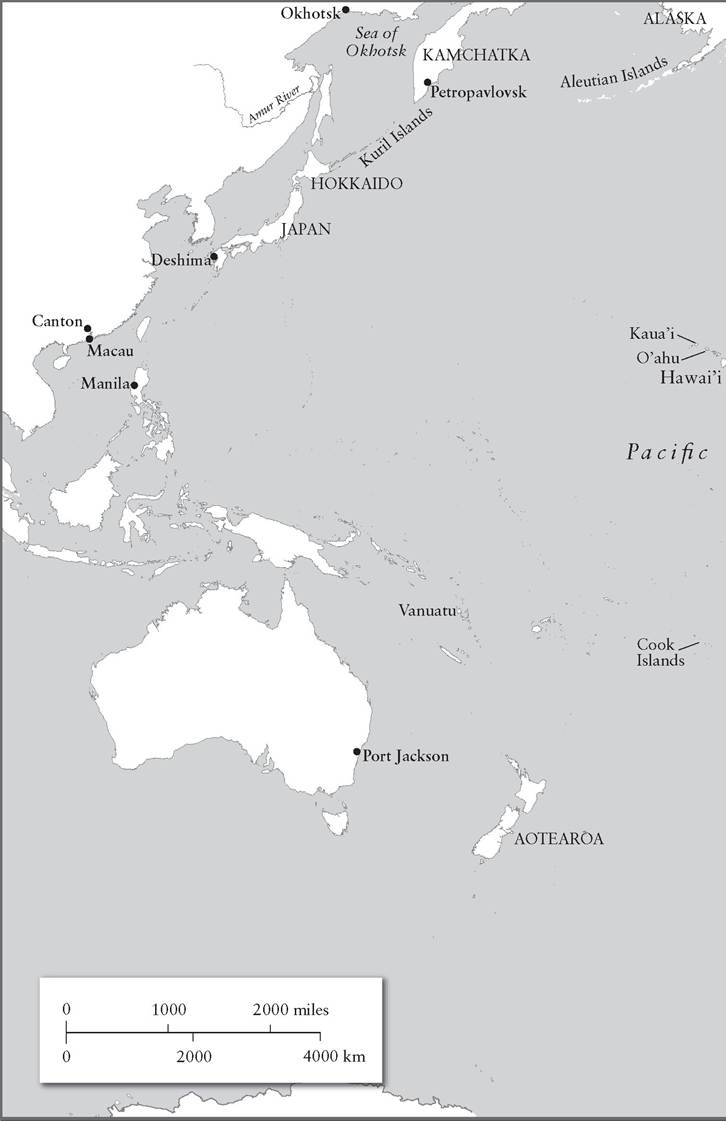
they began to float their ships on the ocean. Russian expansion eastwards, in massive leaps and bounds across Siberia, brought to the shores of the Pacific fur traders who originated as far west as Suzdal, the ancient mother city of the principality of Muscovy. Curiosity about how these newly conquered lands were linked to the oceans grew along with increasing knowledge of the shoreline of eastern Siberia. The Russian rulers, above all Peter the Great, were keen to know whether the much-vaunted sea route around the top of Siberia into the Pacific Ocean was viable. The North-East Passage, which the English had tried to sell to Ivan the Terrible, was still a lure, all the more so as the Russians came close to the American landmass. Was there a passageway between Siberia and North America? If so, was it navigable? The benefits the Russian Empire might derive from a regular sea traffic towards China and Japan were incalculable.
How and when the coasts of Siberia were explored remains a mystery. A Cossack named Semen Dezhnev claimed to have travelled by sea along the Pacific shores of Siberia, as far back as 1648.2 A patriotic Soviet historian wrote of the ‘exceptional bravery and fearlessness’ he showed, throwing aside any doubts about veracity, and sending him through the Bering Strait into the Arctic Ocean.3 He certainly went somewhere, though probably not so far; and he wrote to the tsar from Yakutsk in 1662 begging to be recompensed for his efforts. He would have used a flat-bottomed boat at most seventy feet in length, with sails made of reindeer skin, held together by ropes, straps and pegs, since the native peoples of eastern Siberia did not have iron.
Even the anchor was made of wood. In the eighteenth century this was the standard type of boat used by the Russians in the northern Pacific. These boats were manned by up to forty Russians and locals, and were known as the shitik, or ‘sewn boat’, from the verb shit’, ‘to sew’.4 Whether they were quite as ‘rickety’ as historians suppose is not clear: sewn boats had plied the Indian Ocean since time immemorial and in certain types of heavy sea their pliability was exactly what made them strong. Dezhnev attempted to gain the ear of the tsar’s advisers, and may have influenced Vladimir Atlasov, another Arctic explorer, who had lived in Yakutsk and was in Moscow with Dezhnev; Atlasov is said to have discovered the Kamchatka Peninsula that reaches southwards, pointing towards Japan; and Kamchatka became a source of furs and other tribute by 1697, when Atlasov mapped it out and wrote a detailed description of its inhabitants. He also won the admiration of Peter the Great for his description of Japan, though it had to be based on hearsay.5 Even if some of the accounts of these early voyages are not trustworthy, they do reveal a growing curiosity about the routes to the Pacific.The galloping expansion of Russia’s empire also brought Russian officials and colonists to the northern borders of the Qing Empire, which had taken control of China following the collapse of the Ming dynasty in 1644. At first the advantages for Russia seemed to lie in tribute payments imposed on the native peoples of Siberia, although there were rumours of silver mines somewhere along the river routes beyond Yakutsk.6 But the advantages of trade with China were also clear: if the Cossacks (the main colonists) could break into the Chinese market, they would make great profits for themselves as well as for the tsar. As far back as the 1650s clashes were occurring along the Amur River, which ever since then has been a source of tension between Russia and China; native peoples appealed to the Chinese for help, and Chinese armies advanced into the field.
The Russians found it difficult to hold their own.7II
In 1714 an influential adviser of Peter the Great, Fedor Stepanovich Saltykov, who was an expert on maritime affairs and was then living in London, wrote a series of Propozitsii (‘Propositions’), which he sent to the tsar in St Petersburg. Saltykov had travelled in Siberia with his father, and he was clear in his mind that an opportunity now existed to create a Russian empire in the Far East. He imagined that it would be possible to build a fleet of ships near the mouth of the Ob and Yenisei Rivers, which debouch into the Arctic Sea in central Siberia, and then to send the ships around Siberia looking for islands that could be brought under Russian sovereignty. Russia too was succumbing to the lure of eastern spices and gold:
If an open passage can be found to the coasts of China and Japan, your empire will receive great wealth and profit for the following reason. Ships are sent to eastern India from all realms such as England and Holland and others, and must cross the Equator twice, when they go out and when they return. Because of the great heat in those places many of their people die and there are severe food shortages if they are on their voyage for a prolonged period of time. Thus upon the discovery of a [northern] sea route such as this, they will all wish to use it... For trading purposes your empire is closer than any other realm.
Foreign shipping using this route should be monitored, and of course taxed, as it passed Novaya Zemlya in the Arctic Ocean; Saltykov observed how much income this type of tax produced at both the Danish Sound and Gibraltar. Silver was to be had both in Japan and in Siberia, where Saltykov had actually seen abandoned silver mines. Trade ‘by water’ would be possible with China and the East Indies, bringing gold, porcelain, silk and many other luxury products to Russia, which would become as wealthy as Holland or England. The tsar certainly gave thought to these proposals, saying in 1711 that:
as soon as he has peace and leisure to apply his mind to it, he will search out whether it is possible for ships to pass by way of Novaya Zemlya into the Tartarian Sea; or to find out some port eastward of the River Ob, where he may build ships and send them, if practicable, to the coast of China & Japan.8
The illusion persisted that Arctic waters were safer and easier to suffer than the tropical waters through which European ships passed en route to the Indies.9
Peter the Great did find the peace and leisure to apply his mind to all this, but only at the very end of his life.
One of his very last acts before he died in 1725 was to order Vitus Bering, a Danish captain in his service, to build boats in Kamchatka and ‘to sail on these boats along the shore which runs to the north and which (since its limits are unknown) seems to be a part of the American coast’. The aim was ‘to determine where it joins with America’, and if possible to visit a European settlement along the American coast, in the hope of learning more about the geography of the region and drawing an accurate chart. Typically, Tsar Peter also ordered the Senate ‘to find among the apprentices or assistant masterbuilders one who could build there a deck ship along the lines of the big ships here’; and, should there be no navigators in Russia with experience of the Pacific, two men should be brought from Holland ‘who know the sea in the north and as far as Japan’. As it happened, Bering had experience of the East Indies, having served in the VOC, and was strongly recommended by the Senate and by two admirals.10 This, after all, was the remarkable tsar who had reputedly laboured in (and had certainly observed) the Dutch shipyards in the hope that he could make Russia too into a great naval power.That said, the focus of Peter’s maritime ambitions remained far from the Pacific. The Black Sea was one area where he hoped to extend Russian naval power, but his major interest lay in the Baltic, which became his home when he established his new capital at St Petersburg. More than anything, he was determined to push back Swedish control of large tracts of the Baltic, and the Great Northern War at the start of the eighteenth century eventually - after some checks - brought Russia dominion over the Baltic.11 Bering had served in the Great Northern War, but being sent
803 to Siberia, even as captain of a minuscule fleet, was not the reward he sought. Still, he obeyed orders even after the tsar died and even though the first, and in some respects most arduous, part of his journey was the interminable trek across Siberia to the newly established Russian fort and trading station at Okhotsk.
The trading station had access to the Sea of Okhotsk that lies west of the Kamchatka Peninsula, and is bounded by the Kuril Islands, strung out north-eastwards from the northern tip of the Japanese island of Hokkaido.12 It also had enough facilities to build a shitik, of the type mentioned earlier, and a second boat was built in Kamchatka. Considering that the number of Russians in the trading stations was still very small, just a few hundred, the ability to put ships together, even if they would hardly have won praise from a Dutch or English captain, was impressive. Bering did manage to sail some way into the strait that bears his name, but he was still unsure whether he had identified a passageway into the Arctic Ocean, or simply a large inlet set into a continuing coastline that linked Asia to America. Fog made progress difficult and he turned back, against the advice of his Russian deputy, Chirikov, who has therefore won the plaudits of Soviet historians for being the man with true vision. A second expedition in 1729 was no more successful, although the work of his crew, including the mapping of previously unvisited shores, should not be underestimated.13There was still an enormous amount to learn about the configuration of the northern Pacific, which remained well into the eighteenth century one of the least known areas of the oceans. One of Bering’s deputies, Captain Spanberg, was invited to explore the chain of islands leading towards Japan, which was still unwilling to open its doors to any foreign traders apart from the Dutch.14 Spanberg was in Okhotsk in 1735, building a pair of ships and making ready a third, older one. Setting out in June 1738, Spanberg’s flotilla stood off Japan a year later. Despite official hostility to foreigners, both the locals and the officials who came on board were quite friendly, and the Russians were able to obtain gold coins, rice, fish and tobacco. The officials took Japanese politeness to an extreme, bowing and kneeling - indeed, they stayed on their knees so long that the captain finally felt he had to tell them to rise. Once in Spanberg’s cabin, the officials were impressed by the Russian food they were offered and quaffed Russian brandy with pleasure. But Spanberg knew how these brief encounters could turn from friendship to violence, and soon set sail for Kamchatka.15 Although a further attempt to reach Japan failed, Spanberg had added a great amount to Russian knowledge of the northern Pacific, making it possible to lay more precise plans for the creation of a Russian dominion over the Kuril Islands and beyond.
804 oceans in conversation, ad 1492-1900
Since the Pacific was not a high priority back in St Petersburg, Russian penetration of the northern Pacific in the second half of the eighteenth century depended in high degree on the initiative of individual merchants, some of them Russians of modest origins, born as peasants or into Cossack military families, who had managed to heave themselves up the social ladder, some of them Greeks who had taken up residence in Muscovy.16 Small companies acquired ships and sent them out from the Pacific coasts of Siberia in search of furs; the Russian Senate became increasingly interested in the taxes that could be obtained from the fur trade, and by 1748 merchants were petitioning the Senate for monopolistic rights over patches of territory rich in furs. The Senate was only too happy to fall in with these plans, some of which proved very lucrative: one expedition produced nearly 22,000 roubles for the imperial treasury, one third of the value of the fur cargo.17 Most expeditions produced more than 1,000 roubles for the treasury, and they penetrated deeper and deeper into areas not previously visited by Europeans, all the way to Alaska. Plenty of ships were wrecked in the difficult conditions of the Far North, but by 1770 the profits were getting larger and larger. This was partly the result of the policies of Empress Catherine II, who encouraged free trade from the 1760s onwards. The Soviet historian of these merchants saw in this ‘the power of bourgeois economic development’, though she admitted that private trade was already well established before 1760. After all, eastern Siberia, mainly inhabited by native peoples who were not reduced to serfdom, was a very long way from the centres of government power or the estates of the great aristocratic families. The remote frontier offered freedom and the chance to carve out wealth, whether from land or trade.18
Not just demand but confidence was growing. One ship that spent several years at sea was the Sveti Pavel or St Paul, operated by three merchants; it travelled to the Kuril Islands in 1770 and to the Aleutians in 1771, where the Russians befriended the native Sannakh islanders, with whom, as so often, relations were good at first, but then turned sour. The Russians’ interpreter was found dead in his yurt. The islanders attacked. The ship’s captain, Solviev, hurried off deeper into the Aleutian Islands, where the crew gathered information about the many furry animals to be found - beavers, bears, deer, wolves, squirrels and otters. The crew were back in Okhotsk in July 1775, carrying 150,000 roubles’ worth of furs, though thirty out of seventy-one fur-hunters who had set out had not survived the voyage.19 These experiences were replicated again and again, puncu- ated by special moments such as an encounter between Captain Cook and the Russians, when Cook gave the Russians a telescope as a special ‘token of their visit to those islands’.20
III
Rather as the Spaniards had originally seen their American empire as a source of funds for the struggle against the Turks, the tsars saw their assertion of sovereignty over the many peoples of eastern Siberia, and beyond that the Aleutian Islands and Alaska, as a way of funding their dreams of empire within Europe. There was a certain attraction in claiming to rule over parts of Europe, Asia and America, placing Russia notionally on a par with the multi-continental empires of Spain and Portugal. A memorandum by Counts Vorontosov and Bezborodko, of 1786, made the point explicitly: ‘The north-west coast of America and the islands in the archipelagoes between there and Kamchatka, and from that peninsula to Japan, were discovered long ago by Russian seafarers... According to a generally accepted rule, the first nation to discover an unknown land has the right to claim it.’21 The great advantage the Russians possessed was that they were the pioneers in European penetration into the region; the great disadvantage was that overland trade was slow and cumbersome, and better suited to carrying tribute and tax receipts than vast amounts of goods, while maritime routes seemed impractical until the North-East Passage was brought into being - if it ever would be. Still, a ‘United American Company’ came into existence in 1797, and was transformed into the ‘Russia-America Company’ two years later.22 It lay under ‘imperial protection’, with the full approval of Tsar Paul I, but the basic model was that of the many East India Companies that the Russians knew well from contact with their Baltic and North Sea neighbours. In view of the autocratic system of government in tsarist Russia, the freedom of action of the merchants taking part in this venture was counterbalanced by the supervision of a government department.
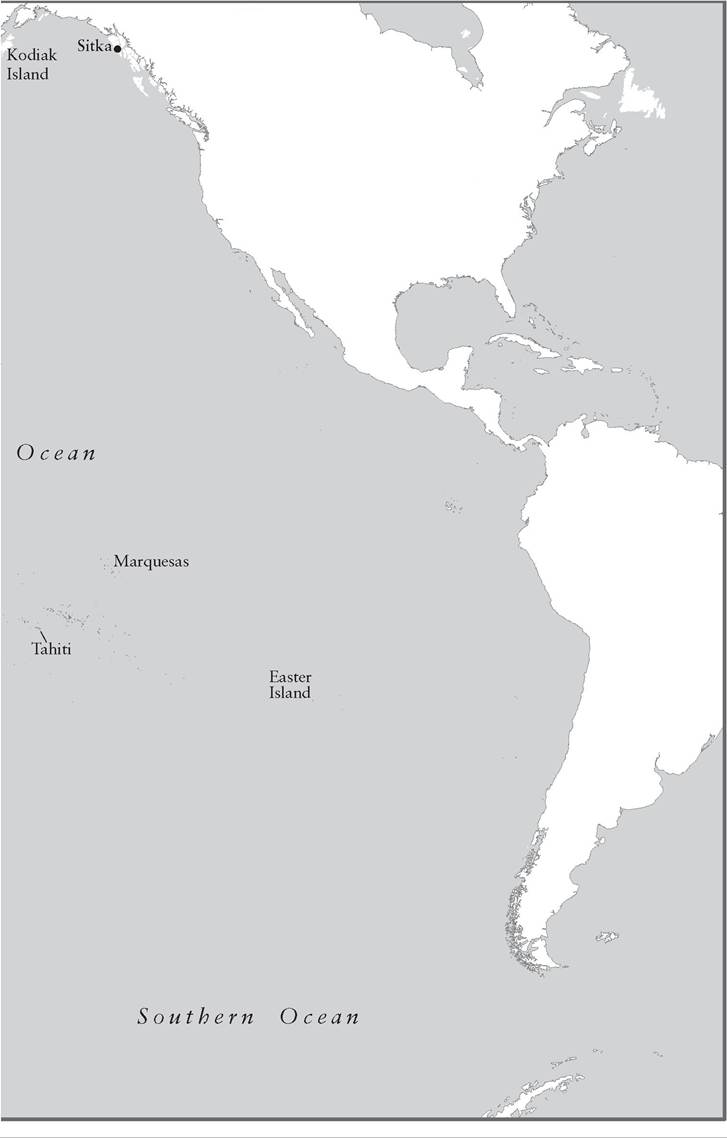
The merchant who did most to bring it into being, Grigory Ivanovich Shelikov, had already died by then, but he had been a fur-trader in the Pacific, living for some years on Kodiak Island, which is now part of Alaska. Of course, Alaska was not understood as the roughly square chunk of icy land that now forms a state within the Union; what interested the Russians was the opportunity to hunt sea otter along the coastline down to and beyond Sitka, a 600-mile strip of land that still acts as a barrier between Canada and the Pacific. Shelikov astutely described his plans to a colleague while Catherine the Great sat on Russia’s throne:
The main end of my enterprise has been to bring newly discovered waters, lands and islands into our empire before other powers occupy and claim them, and to undertake new ventures to augment the glory of our empress and bring profit both to her and our fellow-countrymen.23
Catherine, and then Paul, were far more occupied with relations with western Europe than with the Pacific; but they were aware that what happened in the Pacific might have significant repercussions in the West: the presence of the British and the Spaniards along the coast of California made it certain that contact would be made with European ships and trading stations as Russia consolidated its hold on the north and on supplies of high-quality fur for the Chinese and other markets. By 1800 traders from Great Britain and the United States were pumping vast numbers of skins along their maritime pipeline to Macau, while the Russians were still trying to trade with the Chinese through stations along the Amur River. But the cost of transport from Alaska to the Amur trading stations proved prohibitive; it made more sense for fur merchants in northern China to trek all the way down to Canton to obtain furs because the British, the Americans and the Spaniards were flooding Canton with sea otter skins, with the result that prices were forced down. Moreover, the cost of sending tea to Europe by sea was a small fraction of the cost of sending it to St Petersburg overland.24
Much would depend on the quality of seamanship available out east; yet the hopes that had brought Okhotsk and other settlements into being were disappointed. One Russian admiral complained bitterly that the sailors based at Okhotsk knew far too little about the character of the difficult seas they were supposed to navigate, whose difficulties began at Okhotsk itself, where shifting sands and shallow waters made entry into the harbour a challenge. The quality of shipbuilding was also, he said, well below the standard of the Baltic or the Black Sea. About fifty vessels had been built at Okhotsk by the 1790s, and by then it was possible to find iron nails to bolt the planking together, but these were not to the standards that Peter the Great had been trying to establish. By the start of the nineteenth century the shipyards at Okhotsk contained rotting ships - a Russian commentator likened Okhotsk to a naval museum.25
Creating a merchant navy out in the Sea of Okhotsk seemed beyond Russian capabilities. Perhaps, then, the Russians would have to bite the bullet and send ships all the way from the Baltic to the northern Pacific by way of the Atlantic. Fortunately the Russian Admiralty identified a man of unusual skill and experience to lead an expedition to the Far East. Johann-Anton von Kruzenshtern was a Baltic German from Estonia who had been seconded to the British Navy, fought the Revolutionary French and sailed under the British flag to the Caribbean. But the more he heard
about the ocean world the more his attention turned to the Far East. He wrote:
During the time that I was serving with the English Navy in the revolutionary war of 1793-9, my attention was particularly excited by the importance of the English trade with the East Indies and with China. It appeared to me by no means impossible for Russia to participate in the trade by sea with China and the Indies.26
Setting out on a British ship in 1797, Kruzenshtern called in at Calcutta and Canton, reinforcing his sense that the Russians would never make a success of their fur trade without access by sea to China’s window on the world. Once he was back in Russia, Kruzenshtern’s voice was finally heard, and he was commissioned to take a pair of ships all the way from the Baltic to the Pacific. The first problem, though, was to find suitable ships. Russia could offer nothing capable of such a long voyage. Even Hamburg and Copenhagen had nothing available. Finally two suitable vessels, the new Leander of 450 tons and the even newer Thames, of 370 tons, were found in England. They were renamed the Nadezhda and the Neva and sent to the Baltic naval base at Kronstadt, to be prepared for a voyage that, it was hoped, would reach as far as Japan, carrying on board a certain Rezanov, gloriously appointed as Russia’s ambassador to the imperial court at Edo.27
Kruzenshtern’s route took the ships along the coast of Brazil and round Cape Horn, which proved quite manageable, although soon after that the two ships were driven apart; the Neva found its way to Easter Island, while the Nadezhda pressed on to the Marquesas. These were not, of course, new discoveries, and Kruzenshtern had read Captain Cook with close attention; but it was the first time Russian shipping had entered the south Pacific. Kruzenshtern was determined that relations with the native islanders should remain cordial, and his aim in calling in at the Marquesas was to take on supplies. He permitted his men to barter for local goods, so long as they did not do so on board the ship. This did not prevent naked women from climbing on board who had, as a modern historian coyly observed, ‘more than fruit to sell the Russians’.28 The two ships managed to find one another in the Marquesas and made their way via Hawai’i into the far north of the Pacific, bypassing Japan for lack of time - Kruzen- shtern had promised to deliver a cargo of iron and other naval stores to Petropavlovsk on the Kamchatka Peninsula, while the Neva sailed towards Kodiak Island and the new Russian settlement at Sitka on the Alaskan coast.
When they arrived, the Russians were horrified to discover that Sitka had been sacked by the Tlingits, the native population of the region. The Russia-America Company had made a fundamental error: by settling on the Alaskan coast and displacing the Tlingits, the Russians had created what a contemporary observer called ‘an unalterable enmity against the Russians’. The Tlingits had been living off the resources of the coastline, including not just its fish but its sea otters, whose furs the Russians were now trying to monopolize. By contrast, the British and the Americans took care not to settle the area, but preferred to come on seasonal trading visits. The Tlingits were formidable warriors, who went into battle wearing armour made of leather and bone, capable of stopping a musket shot in its tracks; before long they acquired firearms of their own. The Neva therefore sailed straight into a battle zone, where the Russians and the Tlingits were literally at each other’s throats. The Russians concluded that they would need to arm themselves well if they were going to gain control of the coastline and its furs.29 For if they did not establish settlements, they left the door open to the British, the Americans and the Spaniards, who still had a significant presence in California and further north.
Another setback, this time for those aboard the larger ship, the Nadezhda, followed its arrival at long last in Japan, after setting out from Kamchatka in September 1804. The Russian ambassador, Rezanov, landed in Deshima, only to be berated by the Japanese for poaching on the territory, tiny though it was, that had been assigned to the Dutch; he was also criticized for arriving in a well-armed warship rather than a trading vessel. He hung around for three months before a curt message arrived from the shogun: ‘it is our government’s will not to open this place. Do not come again in vain. Sail home quickly.’ To encourage him to go, the Japanese authorities sent a massive quantity of rice, salt and other foodstuffs, but Rezanov refused to accept the gift and made plain his anger at rejection, which the Japanese officials saw as a highly embarrassing breach of etiquette. They did explain that they would have to take the blame if he left the gifts behind, and would feel obliged to commit a mass act of hara-kiri. Rezanov had the good sense to take the gifts and leave, in April 1805.
Kruzenshtern had other plans, now that the embassy to Japan had failed so completely. After mapping the island of Sakhalin, to the north of Japan, he headed for Macau, which he knew from his earlier sojourn in Canton. There he was joined by the Neva, which had turned its back on the frightening Tlingits. But breaking into the Canton market was not straightforward. The other nations had their consulates and warehouses. Kruzenshtern was eventually able to convince an English merchant named Beale to negotiate on his behalf with a Hong merchant, Lucqua, and the
809 cargo of the two ships was sold, apart from the best sea otter skins, which were known to fetch extortionate prices in Moscow. The ships loaded tea, nankeen cloth and porcelain. This time they would head westwards, through the East Indies and round the Cape of Good Hope, with one ship calling in at St Helena. The two ships were back in Kronstadt in August 1806, after a voyage lasting just over three years.30 The profits were meagre, but there were grounds for rejoicing: Russian ships had circumnavigated the globe for the first time, and valuable information had been gathered about the Sea of Okhotsk and the coast of Alaska. It was understood that a pioneering expedition of this sort was bound to produce mixed results, but that any future successes would be built on the information gathered by these two ships.
The information these ships gathered is what historians tend to call the ‘scientific’ aspect of this and other voyages, such as those of Captain Cook and the Frenchman La Perouse. However, it masks the more prosaic reality: even if the information about the daily life of the Tlingits in Alaska or the Ainu in Hokkaido aroused genuine interest, the prime purpose of these voyages was to uncover sources of wealth, and to reach them before rival European powers did so. This was especially important for the Russian tsars, who were constantly in need of sources of funds for ambitious campaigns around the Baltic and the Black Sea. The Russians failed to gain the lion’s share of the Pacific fur trade, but the importance of their presence lies in the way that Russian pioneers penetrated ever deeper into unknown waters, building ships of questionable quality in unpromising locations very far from the Russian homeland, and setting out year after year into frozen islands.
IV
The Russians were the first to recognize the potential of the northern Pacific, even if their most important motive was to promote trade links with China. The period in which they were making these remarkable advances also saw closer contact between Europeans and the inhabitants of the Polynesian islands, particularly during the 1760s and 1770s. Here too there was a question mark. Did these islands have anything to offer? Coconuts were not going to draw in vast numbers of trading ships. The reputation of the islanders for cannibalism and human sacrifice was counterbalanced by the image that survived to and beyond the time of Gauguin, of islands where free love and a simple life without wants were to be had. This too was part of the Polynesian reality: European sailors were
astonished and generally delighted by the readiness of local women to offer their bodies, as much for courtesy as for ecstasy. Tahiti became ‘the island which encapsulated European images of the south Pacific, whether benign or malign’.31 On the other hand, these islands lived largely from their own resources, and their subsistence economy found it hard to meet the demands of European sailors for food and other basic supplies, quite apart from the lack of luxury products on offer.
It is clearly a mistake to talk, as one otherwise illuminating book has done, of ‘the discovery of Tahiti and Hawai’i’ in this period.32 What the Europeans discovered had been discovered centuries before by Polynesians. The arrival of the Europeans in the Polynesian islands led to vigorous exchanges of information, as each side began to see that they could learn from the other; in some areas, such as Hawai’i, this happened with startling rapidity, as the islanders adopted European clothes and even shipping. The Polynesians looked for similarities at least as much as they noticed differences; an extreme case was the experience of a Tahitian who travelled to the court of King George III in England, and who, while on board ship, had to be persuaded that the Christian rituals he witnessed on board would not culminate in human sacrifice - not that he was opposed to the practice, but he was afraid that he would be chosen as the victim. He was more comfortable with what he saw in Cambridge, where the sight of dons processing through the Senate House in their scarlet gowns brought to mind the processions of high priests back home.33
The best word to use to describe the first encounters in Tahiti is ‘serendipity’. Captain Samuel Wallis, from Cornwall, in charge of the Dolphin, arrived there in June 1767 in the expectation that what was (relatively speaking) so large an island, with mountains looming out of fog in the distance, must be the long-sought Southern Continent for which he was seeking. The natives, who crowded around in hundreds of canoes, seemed friendly, ‘particularly the women, who came down to the beach, and stripping themselves naked, endeavoured to allure them by many wanton gestures, the meaning of which could not possibly be mistaken’.34 But it was unclear whether their attempts to attract sailors to land were a ploy to lure them into a trap and kill them. An attempt was made to conduct ‘silent trade’, with each side leaving goods on the beach, but the English sailors only took what they wanted (some pigs) and left behind the bark cloth they had been offered. For their part, the Tahitians ignored the axes and nails the English had left behind. The English realized that they had somehow offended the Tahitians, and on a second visit they collected the bark cloth and everything else the islanders had put out for them.
Even so, relations were at first difficult. Faced with an armada of boats, the Dolphin fired on the crowd that had gathered on the beach, which fled into the forests; after that, more than fifty canoes left on the shore were hacked to pieces by carpenters sent out from the ship under armed guard. The carpenters had good reason to be in a bad mood: women had in the end been allowed on board, but they had raided the boxes of nails they found lying around, and even pulled nails out of the ship’s beams, which threatened to make her unsafe. Facing European violence, the Tahitians assumed that they were being treated to a display of the wrath of their gods, and the gift of a pig and a plantain leaf was intended to signify submission to a superhuman power. This was transformed into an acceptance that, even if the British, and later on the French, were made of the same flesh and blood as themselves, they still had to be appeased, since the alternative was that the newcomers would unleash destruction far worse than anything their own warring bands were capable of achieving.35 In the end Captain Wallis struck up a friendship with the local queen, and they exchanged visits - he was impressed by the meeting house to which he was taken, which was about 100 metres long. Queen Obearea wept when the Dolphin set sail.36
Gradually, though, it was understood that this was not actually part of the Southern Continent, though surely it must be an island lying off its coast, rather like Hispaniola or Cuba in relation to the Americas? A year after Wallis arrived there, Louis de Bougainville, a high-born French captain, reached another part of Tahiti, knowing nothing of the arrival of the English. Bougainville was well read in classical literature, and, remembering the story of how Venus had been born in the sea and had been washed up on the island of Kythera, he called the island Nouvelle Cythere.37 Bougainville titillated his male readers by describing how a Tahitian girl uncovered herself on deck and insisted that ‘here Venus is the goddess of hospitality’. The nakedness of the Tahitians recalled the nakedness of ancient Greek athletes. For Bougainville what had been discovered was not just a paradise, but a classical paradise; he had, in effect, travelled back in time to experience ‘the true youth of the world’. His experiences were much better than Wallis’s: the Tahitians had learned that European firepower was irresistible, so they eagerly co-operated with the next lot of Europeans, probably unaware of any real difference between the British and the French. The peaceful nature of Bougainville’s experiences in Tahiti led his readers, including Diderot, to enthuse about the grace and innocence of the islanders. As Matt Matsuda has observed, ‘even theft seemed a sign of innocence in a world where all things were shared’, not just objects but sexual relations. The impact of this voyage was all the greater, as Bougainville brought a Tahitian prince named Ahutoru back to Paris, where he became a favourite of Bougainville’s backer, the powerful politician and courtier the Duc de Choiseul, and showed himself to be an opera lover.38
Choiseul had additional, less romantic, motives in supporting Bougainville’s expedition. France could not permit itself to lag behind Britain. Both countries were keen to identify the resources of the Pacific islands, and both were still obsessed by the idea of the Southern Continent. Interest in unfamiliar plants was genuine: the l ate eighteenth-century French explorer La Perouse had naturalists on board; Cook’s companion Joseph Banks hungrily collected Pacific artefacts and kept filling up the South Sea Room which had been set up in the British Museum in 1775, forcing the museum authorities to enlarge the room within a mere six years.39 Cook was not just looking for new lands, though: he was also checking reports of discoveries by the French, even if some of these discoveries, such as the aptly named ‘Desolation Island’, could be dismissed as of little interest.40 The curiosity of the British took a more practical turn: rather than speculating about ‘noble savages’, Captain Cook and his men were requested to watch the expected transit of Venus across the sun from Tahiti, and to carry on the search for the Southern Continent. He was instructed to bear in mind ‘the Honour of this Nation as a Maritime Power’, which ‘may tend greatly to the advancement of the Trade and Navigation thereof’.41 One important feature of Cook’s second and third voyages, of 1772 and 1776, was the testing of John Harrison’s chronometer, a clock that was to prove accurate enough to make it possible to measure longitude; latitude was a much more straightforward problem, but dealing with the measurement of distance in the direction the earth turned was far more complicated. His use of Harrison’s timepiece allowed him to chart the South Sea islands with impressive accuracy. It is said that at the moment Captain Cook was struck down and killed in Hawai’i the clock stopped.42 But here again it is important to remember that science was being deployed in the service of trade and empire.
Cook, like Bougainville, appreciated the skills of Polynesian navigators. He persuaded Tupaia, a highly skilled navigator, priest and local nobleman, to come on board, and Tupaia accompanied Cook around the Polynesian islands, even drawing a famous map of large tracts of the Pacific from memory, sketching in such places as the Marquesas and the Cook Islands; Tupaia was just as helpful as Harrison’s chronometer. Banks thought of Tupaia as another specimen, even if he was a highly intelligent one. Cook was less interested in playing that game, and was impressed by what Tupaia knew: ‘we have no reason to doubt his veracity in this, by which it will appear that his Geographical knowlidge [sic ] of those Seas is pretty extensive.’ Tupaia knew the names of seventy-four islands, and his map covered a vast area of the Pacific roughly equal in size to Europe (including Russia-in-Europe). Most importantly, he explained the complex wind system of the Pacific, still poorly understood after several centuries of a European presence in this ocean.43
The adaptability of the Polynesians to European ways was striking. They were particularly adept at commercial deals. In the early nineteenth century, Pomare I, the ruler of Tahiti, traded with the British settlement in New South Wales and joined forces with the London Missionary Society (having converted to Christianity in 1812), sending a ship to Port Jackson, the bay that includes Sydney Harbour, in 1817; Pomare loaded pigs and sandalwood as the main cargo, and on later sailings by Pomare’s merchant fleet pearls were gathered in other islands and forwarded to Sydney. The crews were largely Tahitian.44 Both Ahutoru and Tupaia had already shown a willingness to work with people from a strange world and a fascination with European culture that was to develop in surprising ways once the Europeans (including the Russians) and the Americans developed an interest in Hawai’i.
V
Tupaia did not include the farthest-flung parts of the Polynesian world, Hawai’i, New Zealand and Easter Island, in his sailing directions.45 His knowledge about the Pacific was an accumulation built up over many centuries and handed down by word of mouth, so that much of the detail was in place long before Hawai’i, Aotearoa and Rapa Nui were settled by Polynesian navigators. Just as it had taken these navigators a long while to cross the band of winds that separated the southern from the northern Pacific, so the arrival of the Europeans in the remote volcanic islands of Hawai’i took a long while, though the Manila galleons or other Spanish ships may well have passed through the archipelago when blown off course, or been attracted by plumes of smoke and fire from the still active volcanoes on Hawai’i Island. A handful of archaeological discoveries, including a piece of woven cloth found in a late sixteenth-century grave, suggest occasional outside contacts with Europeans.46 In 1777 Cook’s target was no longer the Southern Continent but that other persistent obsession of European governments keen to carve out fast and profitable trade routes: the North-West Passage. The British Parliament offered a prize of £20,000 to the crew that would find this route. Cook’s trajectory northwards from Tahiti, across 3,000 miles of open ocean, took him to O’ahu and Kaua’i, on the second of which he made landfall in January 1778. As in Tahiti, the obvious conclusion to be drawn from the arrival of the British was that these were not ordinary humans but the gods who lived far beyond the horizon.47
The story of the first encounter is a familiar one: women offered themselves to the sailors, fresh food was taken on board. Cook sailed off after a couple of weeks, returning to the islands from his icy and fruitless search for the North-West Passage in November of the same year. The king turned up to greet Cook on the main island, Hawai’i, and offered the captain feathered headdresses and a magnificent cloak, now preserved in the Te Papa National Museum in Wellington, New Zealand. This was a sign of exceptional respect: a royal cloak required 400,000 tiny red and yellow feathers, taken from 80,000 birds. One of the crew reported that ‘we live now in the greatest Luxury, and as to the Choice & number of fine women there is hardly one among us that may not vie with the grand Turk himself’.48 Yet the gifts of food placed a strain on the Hawai’ian economy, a subsistence economy that was not well suited to the extra demand generated by Cook’s ships. After the British ships left the king placed a taboo on the land around the bay where Cook had anchored; this was normal practice when the land was exhausted and needed to revive, rather like the biblical sabbatical year. Forced back by bad weather, Cook re-entered the bay and found he was not welcome; the Hawai’ians began to steal from the British ships, and even sneaked away with the cutter attached to the Discovery, leaving Cook’s main vessel without a lifeboat. Cook went on land, hoping to make peace with the increasingly fractious crowd of islanders, but guns and daggers were drawn and Cook was clubbed to death - not, however, at anyone’s orders, for this was a fracas that had got badly out of control. The grief of the British crew was compounded by disgust when Cook’s body was returned, in the form of de-boned hunks of flesh.49
The sudden and violent death of Captain Cook was his passport to eternal fame in Great Britain, one of those national heroes, like Lord Nelson, who did not live to see the results of his achievements. The islanders came to terms with the fact that the British were not after all divine by involving themselves in their trade from a very early date. In 1787 Captain John Meares came to the island of Kaua’i and agreed to take one islander, a prince named Kaiana, to China. Kaiana impressed the British by his build - he was six and a half feet tall - and was showered with presents by the English merchants in Canton, the most valuable in many ways being firearms. These he deployed to his advantage on his return to Hawai’i aboard another British ship; he learned that a coup had taken place on Kaua’i, so he placed himself at the service of the king of the main island, Hawai’i. King Kamehameha I had grand ambitions of his own: he had brought Hawai’i Island under his single rule, and now he aimed to conquer all the lesser islands. Kaiana would be a powerful ally, but no less useful would be the British, with their massive ships armed with deadly cannon, which were also capable of carrying many more warriors than he could pack on to even the longest Polynesian craft.50
So began one of the most extraordinary moments in the history of Pacific navigation. The king needed more ships than could be obtained from reluctant British traders either by bargaining or - in some cases - by sending a squad of men on board to seize the ship. Kamehameha would therefore create his own fleet. In 1789, after a bloody confrontation with the crews of two American vessels in search of supplies, Kamehameha acquired the ship Eleanor and an accompanying schooner, and he appointed a couple of the officers to chiefdoms, which made sure that he kept hold of their nautical talent. Then, in 1792, his subjects built a vessel in the European style, under the guidance of an American ship’s carpenter. By 1803 he was the proud owner of at least twenty ships, some of which had their keel sheathed in copper, the most modern defence against worms. As he became more involved in the sandalwood trade with China, he ordered more and more ships to be constructed. So to the British, French, American, Russian and Spanish fleets in the Pacific a European- style Hawai’ian fleet needs to be added. Three ships are known to have traversed the entire route from the American north-west to China regularly between 1800 and 1832, though most of the Hawai’ian ships set out for Vanuatu or other island groups, to pick up sandalwood, hogs and pearls that could be fed into the networks of not just Polynesia but the wider Pacific. However, the China voyages were financial disasters, because the Hawai’ians were dependent on unscrupulous agents in Canton who saw a good opportunity to exploit innocent newcomers.51
A new generation of Polynesian navigators familiarized themselves with European rather than Pacific shipping, and became an essential element in the crew of foreign ships as well as Hawai’ian ones. When American ships passed through the islands, they were often obliged to carry Hawai’ian supercargoes. The New Hazard, a 281-ton brig, carried a cargo of firearms, Indian cotton cloth, metal goods, tobacco and sugar, among other items, setting out from its home port of Boston in October 1810, rounding the Horn and reaching Hawai’i late in February of the next year. Most of this cargo was intended for the people living along the west coast of North America. However, sandalwood, potatoes, plantains and the inevitable willing young women were brought aboard in Hawai’i, and in due course it headed for Vancouver Island, in search of native American slaves as well as furs. Its job done, it returned to Hawai’i, where the reports wearily emphasize, once again: ‘not much work done this afternoon being girls on board’. The culmination of its voyage was the crossing to Macau and Canton, anchoring at Whampoa, where the ship stood for four months, and where $300,000 worth of tea, nankeen cloth and porcelain was loaded. So, by way of repeated calls at Hawai’i, the routes linking the Atlantic seaboard of North America with the Pacific north-west of America, and China as well, were bound together.52
Kamehameha placed himself under the British Crown, for he saw that this would not weaken but rather strengthen his authority so far from London. At the start of the nineteenth century he decided that he could make a profitable deal with the Russians in Alaska, who were always short of supplies. The Hawai’ian king sent a letter to Alexander Baranov, who was running Russian operations in Alaska, suggesting that Kamehameha could solve his difficulties by sending a consignment each year from Hawai’i. Later, Kamehameha allowed the Russians to build a trading base on O’ahu.53 Kamehameha was careful not to put all his eggs in one basket. As well as the British and the Russians, he had to deal with United States shipping. By 1800 the Americans, not the British, were the most frequent visitors to his islands. This reflected their involvement in the fur trade on the eastern and northern shores of the Pacific, and the tea and silk trade on its south-western shores, by way of Canton. He noted with interest the strength of the trade in Pacific sandalwood towards China, and he decided not just to create a royal monopoly but to encourage sandalwood production at the expense of food production. This resulted in occasional famines, while supplies of sandalwood in Hawai’i became so depleted that he had to issue orders that young trees were subject to taboo, until they had grown sufficiently. These measures were revolutionary: the subsistence economy of the islands was being transformed into a commercial economy, placing heavy demands on a native labour force that had traditionally lived easily off the natural produce of the land.54 Further difficulties were created by Kamehameha’s willingness to accept American imports on credit. Many of these imports were grandiose luxuries used to decorate the royal residences, such as Chinese porcelain, European crystal and American silverware, not to mention the fine Western-style clothing in which the king enjoyed being portrayed.
Difficulties accumulated after Kamehameha I died in 1819. His son, Kamehameha II, thought that the solution was to carry on expanding. His first new ship was a tempting and beautifully appointed yacht named Cleopatra ; it was horribly expensive, was used for royal pleasure cruises around the islands, and was said to have been ‘manned by a drunken, dissipated, irresponsible crew from the captain down to the cabin boy’. This crew managed to wreck the boat beyond repair in 1825.55 Over the next few years the royal family attempted to restore its fortunes and those of Hawai’i (now denuded of sandalwood) by way of the sandalwood trade in Vanuatu, but that proved to be another disaster when the ship they had sent out disappeared without trace.56 By the middle of the nineteenth century the Hawai’ian kings had given up trying to operate a fleet; but there had been a glory period under Kamehameha I during which Hawai’i had managed to assimilate European business practices with remarkable speed.
The most powerful economic force in the islands was fast becoming the United States, not Great Britain or Russia, even though the USA would only become master of these islands at the end of the nineteenth century. The success of the American traders partly reflected the fact that the shipping of the United States was unrestricted by Company rules, which stood in the way of English and Russian trade in the Pacific Ocean so long as the East India Company and the Russia-America Company insisted on licensing movement around the Pacific.57 At least thirty-one American ships arrived in the Hawai’ian islands between 1778 and 1818, maybe as many as forty-three, while British numbers (including warships as well as trading vessels) stood at thirty-nine, and the Russians at eleven.58 Hawai’i was well placed geographically to act as a supply station in the middle of the north Pacific; its role as middleman between the Asian and the American shores of the ocean provides a neat demonstration of how the entire Pacific was being drawn together into a complex network of maritime connections from the end of the eighteenth century onwards.