44 A Long Way to China
I
Just as the inhabitants of Amsterdam, London or Copenhagen developed a taste for the spices of the East and took pleasure in exotic objects brought from China and the Indies, a passion for Chinese and Indian imports developed in the colonies that the Europeans were establishing across the Atlantic.
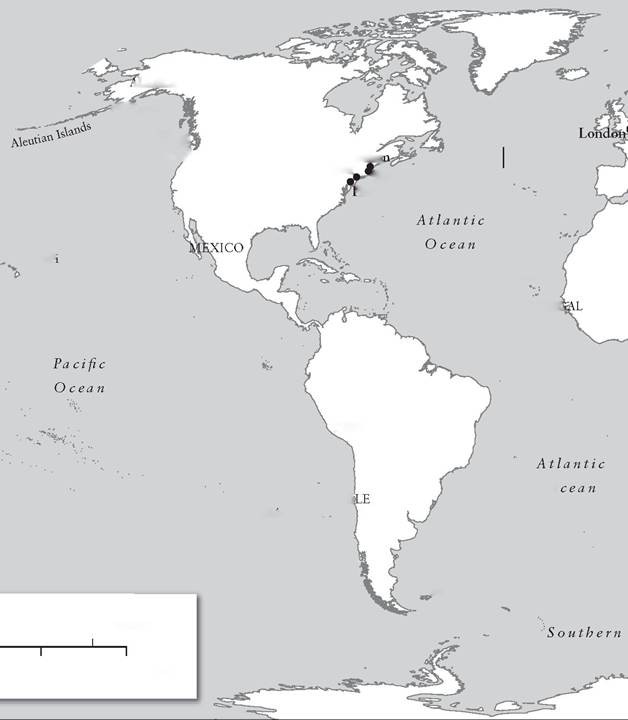
It has been seen that English settlers along the east coast of North America were trying to tap into Indian Ocean trade by way of Madagascar in the late seventeenth century, whether by fair means or foul, although the main outcome was the development of a slave trade carrying Malagasy captives to the West Indies.1 During this period, as Boston, New York and Philadelphia grew into compact but busy trading cities, with populations barely in the tens of thousands, their citizens acquired large quantities of Chinese porcelain, used day to day not just by the rich elite families such as the Philipses of New York but by middle-class townspeople. Around one third of estate inventories from New York at the end of the seventeenth century mentioned Chinese porcelain, and the figure rises to three quarters in the decade before the American Revolution. Chinese silks, already familiar to the inhabitants of Spanish Mexico by way of Manila, reached the north American colonies by way of the Indian Ocean and the Atlantic instead. For, by and large, the American settlers had to rely on imports of these goods either from London, Amsterdam or the West Indies (in which case they had in any case been transported from Europe). The requirement of the Navigation Act of 1651 that the colonies should acquire their eastern goods through London, to which the goods were brought by the East India Company, kept the Company in business, but on the other side of the Atlantic it increased the cost of goods, since the Americans were dealing through middlemen who expected their share of the proceeds.2Early in the eighteenth century goods advertised for sale on Rotten Row in New York included: ‘Fine Heyson, Green, Congoe and Bohea Tea; Coffee and Chocolate; single and double Refined Sugar; Powder and Muscovado ditto; Sugar Candy...
Cloves, Mace, Cinnamon, and Nutmeg; Ginger, Black Pepper and Allspice.. As its position at the start of this list suggests, there was one product of east Asia that held sway in every household: tea, in a variety of types and grades. It was already being drunk right across New England in the 1720s. Among the customers were not just the citizens of New York or Boston but the Mohawks and their native- American neighbours, who were sold tea by the enterprising Philadelphia trader Samuel Wharton.3The monopolistic East India Company was determined to control the movement of these exotic products, in the face of constant challenges. These challenges were not just from European rivals; the Chinese themselves, despite imperial ukases forbidding precisely such activities, sent their junks to Melaka and beyond. As they became familiar with Western taste, Chinese potters adapted their own designs to suit the preferences of far-away peoples they regarded as barbarians.4 In America, however, there still existed confusion about what came from where. The term ‘East Indies’ was a catch-all that described the entire Indian Ocean and the western Pacific; Americans called China tea ‘India tea’, while the porcelain was known as ‘India china’, and the colonists had little understanding of the message that Chinese potters were trying to convey in the images of dragons, flowers or rural scenes; this was a language that clients in and near China could follow, particularly if they knew Chinese legends or had read the most popular Chinese classics. Eventually the richer sort of American would opt for custom-made pottery with family monograms or other decorations that had nothing to do with Chinese culture - within a few years of the break from Britain these pieces might be decorated with the coat of arms of the United States and the inscription E PLURIBUS UNUM.5 Well-heeled Americans would buy porcelain in standard sets of 270 pieces for a dinner service and 101 for a ‘long’ tea set, forty-nine for a ‘short’ one.6 As time went by coarser porcelain, poorly decorated, chunky and cheap, arrived in massive quantities; its function was as much to provide ballast when the ship’s cargo consisted of light chests full of tea as to satisfy domestic demand, and these bulk wares were often sold at a loss.7
In the growing literature on the opening of America’s trade with China there is a tendency to begin the story with the expeditions sent out after British recognition of the independence of the United States in 1783.
That is when direct contact was established between North America and Chinese ports. However, American ‘Red Sea men’ were bringing exotic goods to North America a century earlier - by ‘Red Sea’ was meant the Indian Ocean. Five or six ships reached Pennsylvania from the ‘Red Sea’ in April0
l·
0
EASKA
Hawai'
SENEG
PERU
O
1000
2000 miles
4000 km
2000
Falkland
Islands
r'^Kodiak
Island
Nootka Bay___
Vancouver Island /
Boston
)hiladelphia
Cape Verde Islands
Salei
New York
CH]
Mas Afuera
1698, and others arrived at the same time off Connecticut. Among those sending out ships was the wealthy Jacob Leisler, a smart operator with a murky record of contraband trade and privateering, who had manoeuvred himself into the role of lieutenant-governor of New York. He sent the modestly named Jacob to Madagascar and India in 1689. Leisler was born in Germany, and he had more experience of the Atlantic than he could have wished: in 1678 he and his ship were seized by Barbary corsairs in one of the Atlantic archipelagoes, where he had been loading wine, and he found himself paying a vast ransom of over £2,000? The Jacob was still at sea when his tumultuous career ended with his execution for treason against William and Mary in 1691, but the sailors, who came back to America in 1693, handed out dozens of bribes in gold and silver to
‘prevent them from being put to trouble’ by the new governor of New York. The crew told the tale that they had thrown their eastern goods overboard when they heard what had happened to Leisler, but no one can have believed that then and no one does so now.
It was standard practice to unload goods on a deserted American beach, letting most of the sailors disappear with their share, and then to sail into harbour where officials could be, and expected to be, bribed to ignore this contraband trade.
The bribe would be made up of silver coins already collected in a whip-round of the sailors before they went their separate ways. Many cargoes contained large consignments of tea, which was easily available in the Dutch West Indies for those willing to circumvent the customs regulations imposed by Great Britain - the Dutch had no qualms about selling to American smugglers, and they sold plenty of Chinese porcelain to the Americans, for that too was smuggled in via the West Indies.9 More tea arrived by these unofficial routes than through the customs houses of Boston, New York or Philadelphia. When smuggling was so widespread it may seem odd that tea became the catalyst for revolt against British taxation, and ultimately against British rule.The China trade was an issue from the moment that rebellion against British rule broke out in the Thirteen Colonies. The Boston Tea Party, during which 342 chests of tea were dumped in the town’s harbour in December 1773, was the culmination of a long series of protests against British taxation of tea, and the monopoly exercised by British firms in the tea trade. In the weeks before the Tea Party, British ships loaded with 2,000 chests of tea, or approximately 90,000 pounds of tea, had arrived in North America, where consumption of honestly acquired tea amounted to about 200,000 pounds of tea a year by 1770. The complex history of these events goes right back to the restrictive Navigation Act of 1651 and to the adjustments to the taxation of tea made by the British Parliament in the years before the Tea Party. This legislation culminated in the Tea Act a few months before the Tea Party, which assigned a monopoly on tea exports to America to the East India Company at a time when the EIC was in increasing financial difficulty, and facing increasing competition on the routes to the East; it urgently needed help from the British government. American opposition to the new tea taxes took several forms: customs officials were beaten up; rumours spread that English tea had been poisoned with smallpox germs; and a tea temperance movement recommended herbal teas made out of all-American raspberry leaves.
In the event, herbal teas made only a slight dent in the tea market. Caffeine was queen.10The British government’s new tax regime reduced the price of tea in the American colonies. But if prices fell below a certain point contraband tea traders would suffer, since legally imported tea would be available more cheaply than the tea they picked up in Holland or the Dutch West Indies. Unhelpfully, the EIC produced a list of partners in the North American ports that left out some tea brokers, for whom exclusion spelled ruin. Boston and the other coastal ports had become caught up in manoeuvres whose main aim was not to squeeze the American colonies, but to save the East India Company. In that way, what was happening in the Indian Ocean and along the routes to Macau and Canton was having an effect on what was happening right over the other side of the Atlantic Ocean.11
Tea was still on the menu once peace with Britain was signed: the Americans immediately seized the opportunity to explore the sea routes to China. The ambitions of the new nation were clearly expressed by Ezra Stiles, President of Yale College, in 1783 in an early example of the celebration of the Stars and Stripes (though at that time the stars were arranged like the flag of the European Union): ‘Navigation will carry the American flag around the globe itself; and display the thirteen stripes and new constellation at Bengal and Canton, on the Indus and Ganges, on the Whang-ho and the Yang-tse-kiang.’12 So determined were the Americans to reach China directly that the first of their ships to be sent to China, the Empress of China, left New York in February 1784 at the same time as another vessel slipped out of the city bound for London and carrying ‘the definitive articles of peace’ between the United States and Great Britain. Yet the prospects were not quite as bright as the optimistic President of Yale averred. Great Britain continued to block trade between the United States and its own valuable possessions in the Caribbean, which were a prime source of contraband goods from the Far East.
It was far from clear that wider European markets would be open to the Americans, and that might well include European colonies in Africa, Asia and South America as well. The answer was to go global, taking advantage of the simple fact that the Americans were now free from the authority of the East India Company.13Sending a ship to China was a dangerous and expensive business. The Empress of China was built in Boston, and was about a hundred feet in length, displacing 360 tons. The bottom of its hull was coated with copper, to keep at bay the barnacles and sea slugs that would eat into the wood during a long voyage. But this was only one of the ships that the investors, led by Robert Morris (English-born) and Daniel Parker, intended to send to China; the value of the goods and money on board was said to be £150,000. They were to sail on the riskiest route of all, around Cape Horn and into the Pacific Ocean, whereupon two ships would travel along the coast of South and North America until they reached the islands and ice floes on which seals and sea otters were known to congregate. The aim was to kill and skin as many animals as possible, and take their fur to Canton, where the third ship should already have arrived.
Everything indicated that Chinese traders would leap at the opportunity to buy all this fur: Morris and Parker were relying on information from an American named Ledyard who had taken part in one of Captain Cook’s voyages, and had seen what happened when the English ships arrived in Canton carrying the pelts that the Chinese craved. It might be possible to take advantage of the doubts the English had about developing a fur trade in the far north of the Pacific. Captain Cook recorded his thoughts in the journal of his third and final Pacific voyage, in 1778, as he made his way along the coast of Alaska: ‘There is no doubt but a very beneficial fur trade might be carried on with the Inhabitants of this vast coast, but unless a northern passage is found it seems rather too remote for Great Britain to receive any emolument from it.’14 The English sailors discovered that there was intense demand for the sea otter furs, which contain an enormous number of hairs per square inch, making them the warmest furs anyone in China had ever found; besides, the type of fur one wore was an indication of status, sea otter fur being a sign of wealth and distinction. Traditionally, the Chinese relied on Russian fur-traders to supply pelts from the northern Pacific - the Russians could even be found on Vancouver Island, and they ventured right up to the Kamchatka Peninsula and to the Aleutian Islands strung out to the west of Alaska.15 If the Americans could break into this traffic, they would have something valuable to sell to the Chinese, since it was not obvious what else the Chinese might be willing to buy from the United States.
Morris and Parker dreamed of sending another three ships to China by way of the Cape of Good Hope, but they could not arouse much interest in the idea, and the plan to send ships to seal country in the northern Pacific began to pall. The early optimism of the first investors was soon dissipated. The funds available were only sufficient for one ship after all, the Empress of China, and the idea of sending it through the Pacific had to be abandoned; the safe route around the bottom of Africa, created by the Portuguese, was chosen instead. The ship was loaded with thirty tons of ginseng, a product of the Appalachian mountains known to be in high demand in Chinese medicine; $20,000 in Spanish coin; also furs and other goods.16 Even though the original plans had to be scaled back, the departure of the Empress of China was celebrated as the great event that it was, with a thirteen-gun salute representing the thirteen states of the Union.17
One New York newspaper printed a poem by a prolific poet, Philip Freneau, that made plain the political as well as the commercial significance of the voyage, invoking the Roman goddess of war at the very start:
With clearance from Bellona won
She spreads her wings to meet the Sun,
Those golden regions to explore Where George forbade to sail before... To that old track no more confin’d, By Britain’s jealous court assign’d, She round the stormy Cape shall sail And eastward, catch the odorous gale. To countries plac’d in burning climes
And islands of remotest times
She now her eager course explores, And soon shall greet Chinesian shores. From thence their fragrant TEAS to bring Without the leave of Britain’s king;
And PORCELAIN WARE, enchas’d in gold,
The product of that finer mould...18
Freneau had served at sea during the Revolutionary War. He and other Americans keenly awaited the outcome of a voyage during which the ability of the United States to break into new markets was being tested - an outcome, in other words, of significance for the whole of the new country, and not just for Morris, Parker and the other investors.
II
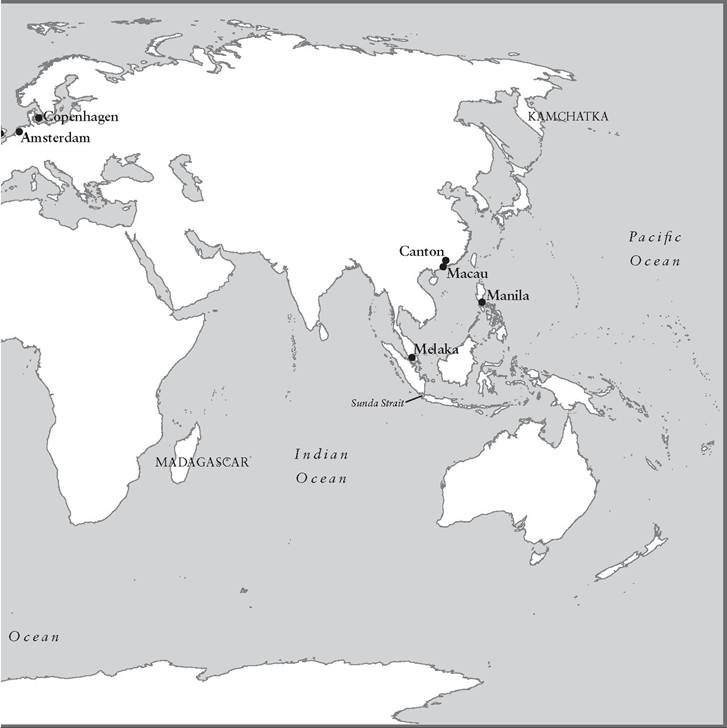
The voyage passed through mainly calm seas of the sort that irritated diarists and letter-writers looking for drama on the high seas. The ship’s purser complained that ‘it has been one dreary waste of sky & water, without a pleasing sight to cheer us’. One went to sea for excitement, and all that happened was that the captain fell against a railing and bruised his head and arm.19 When the Empress of China reached the Sunda Strait leading into the South China Sea, the Americans found a French ship at anchor whose crew were delighted to hear stories about the American Revolution, which France had supported; so this ship, the Triton, agreed to accompany the Empress to Macau and Canton, showing the way and helping to fend off any attacks. In Macau the Portuguese welcomed the new arrivals, even though they had never seen their flag before. The Americans had little to fear: as they made their way up the tangled waterways of the Pearl River towards Canton in August 1784 they were greeted not just by the French, the Dutch and the Danes but by the British. The American supercargo, Samuel Shaw, was impressed by the polite conduct of the British, which is all the more impressive as he had served with distinction in the Revolutionary army:
The behaviour of the gentlemen on board was perfectly polite and agreeable. On board the English it was impossible to avoid speaking of the late war. They allowed it to have been a great mistake on the part of their nation, - were happy it was over, - glad to see us in this part of the world, - hoped all prejudices would be laid aside, - and added, that, let England and America be united, they might bid defiance to all the world.20
Meanwhile the French let the Americans use their storehouse, or ‘factory’, until an American warehouse was made ready. Relations between the representatives of the European nations were very harmonious; they knew that their safety depended on mutual support, and that negotiations with a sometimes unpredictable Chinese government could be delicate. So, when a Chinese subject was accidentally killed by a ceremonial cannon shot from the Lady Hughes, a British ship that plied between India and Canton, its supercargo, named Smith, was arrested, and all the foreign supercargoes lodged a protest - but the Americans alone stood by the British even though the Chinese briefly suspended trade with them at the height of the row.21 The Chinese were perplexed that these new arrivals came from a state of which they had not heard, and needed to be shown a map before they were convinced it existed; everything seemed to suggest that they were just more Englishmen, though eventually the Chinese called them ‘New People’ and later still ‘Flowery-Flag Devils’, since they thought the stars on the American flag were flowers. The Americans had thought ahead, and the captain of the Empress was supplied with a letter that was indeed flowery, addressed to whatever ‘Emperors, Kings, Republicks, Princes, Dukes, Earls’, and so on ad infinitum, he might meet; it was made plain that he was a citizen of the United States of America and Congress, no less, requested that he should be treated ‘in a becoming manner’ and be allowed to trade freely.22
In accordance with closely prescribed Chinese policy, the Empress of China had anchored at Whampoa Island, a dozen miles from Canton, rather than in the teeming city itself. The supercargo Smith described the conditions the foreign merchants had to endure:
The factories at Canton, occupying less than a quarter of a mile in front, are situated on the bank of the river. The quay is enclosed by a rail-fence, which has stairs and a gate opening from the water to each factory, where all merchandise is received and sent away. The limits of the Europeans are extremely confined; there being, besides the quay, only a few streets in the suburbs, occupied by the trading people, which they are allowed to frequent.23
As in the merchant fonduks of the medieval world, the ground floor was given over to the goods themselves; the first floor contained parlours and offices where deals were struck; and above that was the hostel where the merchants lived.24 They were not supposed to bring in women, but occasionally smuggled wives or mistresses in nonetheless. Sometimes Chinese merchants did invite their European counterparts to dinner, but it was impossible to squeeze any useful information out of them; and the tedium of life along the hot and humid riverbank, with a working day of up to fifteen hours, was eased by trips up and down the river to nearby pleasure gardens, and even, in the early nineteenth century, by yacht races along the river, despite official attempts to forbid this.
By the end of the eighteenth century the Europeans decided to advertise their existence more visibly. Individual merchants claimed that they were consuls who represented their home power, and the consuls made sure to run up their flag, so that the factory area became a blaze of colour, beginning with the Austrian consul (who was in fact a Scot) in 1779. The Prussians, Danes, Genoese and Swedes followed suit, and paintings of the European factories were livened up by many of these countries’ colours. The trading community also contained people of non-European origin: Armenians, Parsees, Bombay Muslims, although in the early nineteenth century the largest groups were the British and the Americans - after 1812 and the end of a brief spat with the British Navy, the Americans had taken advantage of their neutrality during the Napoleonic Wars to transport tea back to Europe without the interference that every European nation faced as alliances were forged and broken with dazzling speed.25
Despite these pretensions, what really mattered was a good relationship with the Hong merchants, members of the Co-hong guild which had been set up in the mid-eighteenth century (on much earlier foundations) to manage trade with the foreigners. By 1831 a complex set of rules, often honoured in the breach, had been imposed in the name of the emperor. Foreign merchants were not supposed to reside permanently in Canton; they were not allowed to bring women into the factories; they were not to take trips in sedan chairs; they could only communicate with the government through the Hong merchants.26 A ‘Canton System’ came into being, supervised by a powerful agent of the emperor, known as the Hoppo, whose office went back to 1645. One of the most memorable moments in a voyage up the Pearl River was the elaborate measuring ceremony, when the Hoppo would come on board and check the size of the incoming vessel with long silk tapes. But this was not just a matter of recording length and breadth. The Hoppos were flattered with gifts, and gave gifts in return, consisting of a couple of cows, a store of wheat and some strong drink; these practical gifts were a sign that the emperor cared about the welfare of the foreign barbarians who came to his lands, although the Europeans were known to complain among themselves that the animals were too old or scrawny to be edible. The Europeans would lay on music, make lengthy speeches and dispense plenty of wine; gun salutes would be fired time and again. Doing this again and again became tedious, so the Hoppos would save up ships and try to measure six or seven in one day.27
Relations with the Hong merchants were often cordial. Both sides knew that their relationship could be very lucrative. One, Howqua (1769-1843), is said to have become the richest man on earth, worth $26,000,000 by 1824 - he had no trouble in generously abandoning a claim for $72,000 against a Philadelphia opium-trader to whom he had taken a liking. One wonders how credible the account of their conversation is: ‘You and I are Number One, olo flen [old friend], you belong honest man, only got no chance.’ But pidgin English was a standard way for the foreigners and the Chinese to communicate. Howqua fascinated the Americans and was commemorated in countless paintings sent back to America which show an ascetic-looking, painfully thin man wearing silken robes. His investment policy was wise: protecting himself against the ups and downs of the international tea trade, he became a property magnate as well as a tea-trader, owning some of the land on which the foreign factories stood; and he went straight to the tea-growers or even grew the tea himself, cutting out costly middlemen. He entered into close partnerships with his friends from Boston and invested in the new American railway network; he relied on American businessmen to write whatever letters he needed to send abroad. It is not an exaggeration to speak of his American friends: he sent off one American trader, Warren Delano (an ancestor of Franklin Delano Roosevelt), who had spent ten years trading through Canton, with a spectacular fifteen-course dinner that included bird’s nest soup, shark’s fin, sturgeon’s lip and other Chinese delicacies. Some Americans made a fortune in China: John Cushing went back to the United States in 1831 $700,000 richer, though no one could quite compete with that.28
The Americans adapted quickly to all this, selling and buying in the Chinese markets through the Hong merchants. When the Empress of China set out on her return voyage she was loaded with tea, silk, porcelain and the yellow cotton cloth known as nankeen, named after Nanjing in northern China, which was very popular in North America. She arrived back in New York in May 1785, bringing her investors a profit of at least 25 per cent, which was less than they had hoped but still a good augury for future trade in China. The next year five ships, including the doughty Empress, set out for China, and this time Philadelphia and Salem sent ships; by 1790 Canton had been visited by twenty-eight American ships, although they were often only a third of the size of the ships the East India Companies sent out from Europe. In the early nineteenth century the Americans were sending more (but smaller) ships to Canton than the British. Their fast, light vessels could cope more easily with the risks in sailing through poorly charted seas. The turn-around for American ships was quicker, though they had further to go - which raised the question once again of whether they were following the best route to China, especially if the Chinese wanted them to bring furs from the Pacific or, as will be seen, the far south of the Atlantic.29
III
The search for furs in the north-eastern Pacific opened up new worlds to the citizens of the United States who explored the shores of what would become Oregon, British Columbia and Alaska; they also provided the Americans with a launching pad for expeditions to Hawai’i, Fiji and other Polynesian islands, where they collected sandalwood, a dyestuff that was in demand in China. The challenge was to find goods that the Chinese were interested in buying, so that one did not have to pay in silver, for silver was in short supply in the early United States, with the effect that the volume of transactions fell and a severe economic depression took hold of the new country, with a heavy impact on merchant shipping.30 Other sources of credit were therefore essential, and the enormous attraction of fur trapping was that the seals did not need to be bought, although the less said about the revolting methods used to kill them the better. They could be found elsewhere than the Pacific, but the Chinese market was what attracted the Americans there, both to the far north and to the island of Mas Afuera off Chile, which was a major sealing station, ‘the mecca of the fur seal’. This did not prevent them from looking for seals elsewhere: Captain Cook already knew that the Falkland Islands, not long discovered, were a good source of skins. Captain Cook’s journals were printed in London in 1785 and in a shortened version in Philadelphia eight years later. A year before the American publisher went into print, American ships had already begun to exploit Falkland furs.31
There were two major obstacles to operation in the eastern Pacific (generally called, from the American perspective, the ‘Pacific northwest’). One was the presence of ships flying the flag of other powers: Russians along the coast all the way down to what would become known as Vancouver Island; Spaniards all the way up the coast of California, also very interested in Vancouver Island; and the British, who had come to know these waters after the third voyage of Captain Cook, and once again saw attractive possibilities on the very same island, while reports reaching the United States also made the island sound the ideal base for fur-trapping. The other obstacle was the route around Cape Horn. The Empress of China had avoided this route in the end. Its terrors and perils were nowhere better described than in Richard Henry Dana Jr’s best-selling account of Two Years before the Mast, recounting a journey out of New York in 1840:
Wednesday, November 5th... Just before eight o’clock.
Then about sundown (in that latitude) the cry of ‘All hands ahoy!’ was sounded down the fore scuttle and the after hatchway, and, hurrying upon deck, we found a large black cloud rolling on toward us from the southwest, and darkening the whole heavens. ‘Here comes Cape Horn!’ said the chief mate; and we had hardly time to haul down and clew up before it was upon us. In a few minutes a heavier sea was raised than I had ever seen, and as it was directly ahead, the little brig, which was no better than a bathingmachine, plunged into it, and all the forward part of her was underwater; the sea pouring in through the bow-ports and hawse-holes and over the knight-heads, threatening to wash everything overboard. In the lee scuppers it was up to a man’s waist... The brig was laboring and straining against the head sea, and the gale was growing worse and worse. At the same time sleet and hail were driving with all fury against us... At daybreak (about three, A.M.) the deck was covered with snow.32
And this was summertime in the southern hemisphere.
The ship on which Dana sailed had many American precursors. In 1787 the Lady Washington and the Columbia had set out from Boston, in the hope of loading furs along the Pacific coasts of North America. News of the impending voyage set off enormous enthusiasm. Around 300 pewter medals were struck in the newly founded Massachusetts mint to commemorate the two ships, along with silver and copper versions intended for grandees such as George Washington and Thomas Jefferson. The pewter medals were mainly intended to be gifts to the native inhabitants of the regions the ships were expected to visit, though what they would make of them is a mystery. Captain Cook had also received the accolade of having medals struck in his honour by the Royal Society of London. But that happened after, not before, the voyage.33
This voyage contained plenty of high drama, from the moment the ships reached Praia in the Cape Verde Islands and the surgeon of the Columbia, Dr Roberts, decided he had had enough of the tough rule of Captain Kendrick. He left the ship and could not even be persuaded to go back on board when Kendrick found him in the street and threatened him with his sword. Roberts insisted that without a promise from Kendrick not to have him flogged for deserting the ship he would stay in Praia. Kendrick refused to make this promise, oddly acting as if he did not really need the surgeon on his ship, and let him go. This and other quarrels kept the ships in the Cape Verde Islands too long: if they did not leave soon they would face the seasonal hurricanes that plague the waters off Cape Horn - that, at any rate, was the prediction of Captain Gray, who commanded the smaller ship, the Lady Washington. Once they were under way, an officer named Haswell struck a sailor who had disobeyed an order to come on deck. Kendrick took the side of the sailor and threatened Haswell with being shot if he ever again set foot on the quarter-deck (reserved for officers); he would have to sleep in the common quarters.34 These events, recorded by Haswell himself, confirm that Kendrick was a tough captain, though perhaps no tougher than many of his contemporaries, who took the view that keeping order on board demanded ruthless decisions, all the more so when a ship was following an unfamiliar route that exposed it to natural dangers as well as danger from rivals.
The ships rounded Cape Horn by heading hundreds of miles to the south of the cape, experiencing the full diet of gales and sleet before entering what Haswell called ‘a perfect hericain’. The two ships were driven apart, and Gray’s opinion that time had been wasted in Praia seemed to have been confirmed.35 The ships would travel separately for many hundreds of miles before they arrived at Nootka Bay on Vancouver Island; and in the meantime they faced constant harassment from Spanish ships along the coasts of Chile, Peru and Mexico. In August 1788 the Lady Washington reached the shores of North America and started trading with the native Americans, only to find, as so often happened, that a friendly reception turned sour: at first the Indians brought cooked crabs, dried fish and berries, and were happy with the small items of truck, buttons and bells, that the Americans offered in payment. Captain Gray was also happy, as fresh food was the best cure for the scurvy that raged on board. But when an Indian stole a cutlass that Captain Gray’s servant, an African who had boarded at Praia, had left stuck in the sand, the mood changed. The servant, Marcus Lopius, tried to recover the cutlass and was seized; the Indians unleashed their arrows against the American intruders and skewered Lopius with their knives and spears. Even when the Americans scrambled back on their ship, their troubles were not at an end, because the Lady Washington was stranded on a sandbank and had to await the tide before it could float out to sea.36 But the ship and its crew survived, and managed to meet up at long last with the Columbia off Vancouver Island.
All this was happening just as the Spaniards pressed further and further north along the same coast, reaching Kodiak Island in late June 1788, while another Spanish ship coasted along the Aleutian Islands in the far north of the Pacific, and met the sole Russian inhabitant of Unalaska Island, Potap Zaikov, who relied on local Aleut hunters to obtain the skins he traded. Isolated he may have been, but somehow he knew, or thought he knew, a great deal about his country’s plans: four Russian warships were expected to arrive by way of the Cape of Good Hope. The Russians too were determined to stake their claim to rule this coastline - literally, for the ship Trekh Sviatitelei was carrying stakes and copper plates that could be hammered into place as a formal sign that Imperial Russia laid claim to these lands. Moreover, the Russians knew that British ships lay not far off, and they were determined to stop them from establishing a settlement of their own.37
The flashpoint was Nootka Sound, which everyone identified as good seal-hunting country; and when the Americans arrived they found a British settlement under construction, with a partly imported labour force - there were Chinese carpenters at work. The Americans also witnessed the arrival of irate Spaniards, who claimed Nootka Sound for themselves, and managed to impound four British ships, as well as arresting all the Chinese workers. These events could easily have set off a war between Great Britain and Spain, but everyone’s attention was turning elsewhere at the moment, as the political crisis in France turned into revolution. The Spanish commander was less worried about the Americans than about the British. It seemed extremely unlikely that the Americans would try to create their own settlement on the west coast of this continent; the United States was patently an east-coast entity. When the Boston newspapers reported the friendly encounter between the Spanish and the American commanders at Nootka, they rejoiced in the ‘protection and respect of the European Lords of the Soil’ for their flag and took wicked delight in the fact that the flag ‘of another nation hath been forbidden to be unfurled on the coast’.38 In the event, the British preferred to make their peace with Spain, signing the Nootka Convention in October 1790, which was a victory for diplomacy (and for Spain) over war - even so, in the long run, this area would fall under British rule, when the boundary between Canada and the USA was fixed in 1846.39
The Americans seized the opportunity to find the sea otter skins they knew the Chinese craved. Captain Gray sold his furs in Canton and decided to continue round the world, returning to the United States via the Cape of Good Hope, which made him the first American captain to circumnavigate the globe, after a journey of three years. Kendrick, on the other hand, was killed in a tragic accident while still in the Pacific: a gun salute went wrong and the shot pierced his cabin and blew him to bits.40 Meanwhile interest in the Nootka Sound continued to grow, but in more peaceful ways. A question that had been raised many times in the past was whether a channel could be found around the top of North America. Looking for the North-West Passage from the Pacific side made sense after so many failures on the Atlantic side, and was not a new idea - it has been seen that Francis Drake may have been looking for such a route when he sailed up to California on his round-the-world voyage. This was also a reason why British and other ships poked around the waters off Alaska and western Canada. Alejandro Malaspina, an Italian in Spanish pay, led two large ships into these waters in 1791. His expedition set out just as a Spanish publisher issued a specious account of a journey from the Pacific to the Atlantic in 1588 by a certain Maldonado. So Malaspina was sent on a wild-goose chase; even so, he mapped unknown stretches of coast, studied the life of the local Indians, and drew up elaborate and intelligent proposals for the creation of an integrated trade network in the Pacific, involving Russia and China as well as Mexico and the Philippines; but no one at court expressed much interest. After all, he had not found the gateway to the Pacific, and was seen in Madrid as a failure.41
The merchants of this new nation were bringing furs from the south Atlantic as well as from the Pacific north-west. In 1792 Captain Daniel Greene led the Nancy to China by way of the Falklands. When he came back to the Falklands five years later, he loaded around 50,000 skins, and then added some more at Mas Afuera in the south-eastern Pacific. The Falklands were at that time a largely unclaimed space. A French settlement on East Falkland, founded in 1764, had been matched a year or two later by a British settlement on West Falkland; and then the French agreed to hand over the islands to Spain, which sent two priests ‘who, beholding their settlement, were overwhelmed with grief’. As a result of these claims, the two islands were known to sailors as the ‘English Maloon’ and the ‘Spanish Maloon’, a corruption of their Spanish name, Las Malvinas.42 But the people who did most to exploit the islands at this stage were the Americans, with their raids on the seal population. Meanwhile, first the British and then the Spaniards withdrew from the Falklands early in the nineteenth century, and, although they were eventually reoccupied by Great Britain, the question of their ownership has festered ever since. Beyond the south Atlantic, American ships regularly went in search of seals in the southern Indian Ocean, on islands such as St Paul. Places uninhabited by humans were ideal, as the seals had as yet no reason to fear humans and lay passively on the rocks while the hunters did their bloody work. Later, seals did sometimes grow wise to what was happening, but escaping on land was almost impossible - these are animals made for the sea.43
Furs from as far away as Alaska thus fuelled the maritime links between the early United States and China. The fur trade of the United States was truly global, stretching in both directions towards China, around both southern capes. The profits from this trade, and from the China trade more generally, fuelled the recovery of the American economy and the prosperity of great business houses such as that of the German immigrant John Jacob Astor. The first generation of American millionaires came into being, an aristocracy of wealth rather than blood whose prosperity had been created by the China trade and all the other business that was intertwined with it: trade in furs, trade in sandalwood and - as will be seen - trade in opium.44