43 The Wickedest Place on Earth
I
When looking at the centuries after Columbus and da Gama, this book has laid an emphasis on the links between the oceans. The flow of people and goods from one ocean to another created a series of connections, wrapped right around the world, that can justifiably be described as a global network.
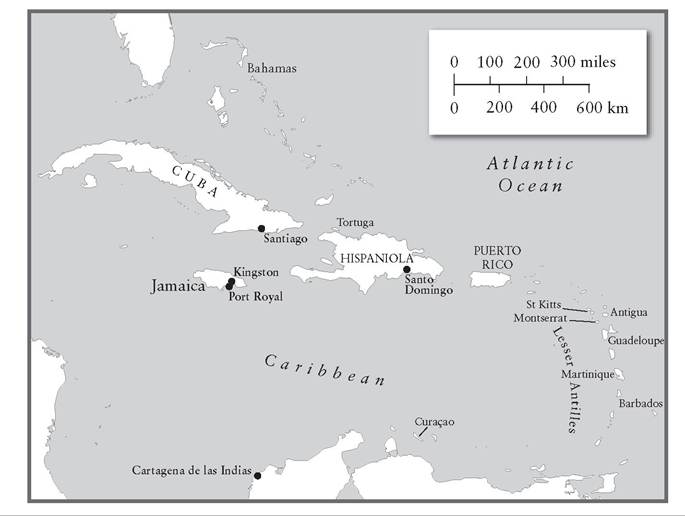
Whether one would want to call this a global economy is a less straightforward question, since the term ‘global economy’ might indicate an economy in which global connections moulded the activities of a high percentage of merchants, craftsmen and consumers in all the major centres of economic power, from China to England to the Spanish cities in the New World. The careers of the English and other pirates who plagued the Caribbean in the middle of the seventeenth century may seem a rather unimportant issue, despite the enormous fascination that pirates of the Caribbean have generated among film-makers and film-goers. However, the passage of treasure ships through the Caribbean is not simply a story of Caribbean, or at best Atlantic, history. Bearing in mind the origin of much of this bullion, the Potosi silver mines in Peru (now in Bolivia), and the route the silver had already taken along hundreds of miles of Pacific water to reach the isthmus of Panama, the history of the silver routes shows clearly how the different oceans were bound together by the sixteenth and seventeenth centuries. Nor should it be forgotten that much of this silver was being sent westwards, reaching Macau by way of Manila. In the seventeenth century, though, production was declining and Spain was financially overstretched thanks to its heavy involvement in European and Mediterranean conflicts. The failure of a treasure fleet to arrive, following raids by English pirates, was a bruising blow to a failing empire.These pirates certainly existed, although many of them are better described as privateers, armed with official letters of marque entitling them to attack the ships of enemy powers, than as freebooters.1 The term that
came into use to describe the Caribbean pirates was ‘buccaneers’, derived from the French word boucan, which meant the grill on which they would smoke large slabs of meat, often cut from the sides of animals they had rustled in Hispaniola and other Spanish islands, which were now depopulated of Taino Indians and heavily populated instead with roaming cattle, easy to find and wholesome to eat.
The term ‘corsairs’, derived from corso, ‘journey’, is usually reserved for a quite different class of pirate, the Barbary corsairs who infested the western Mediterranean and eastern Atlantic waters.2 It is true that the pirates of the Caribbean tied red cloths around their heads, wielded cutlasses and drank plenty of rum, and that they preferred a rather democratic system of command according to which the ship’s captain lived and slept among his men, and decisions were made by consultation.3Nonetheless, the pirates and privateers served the interests of higher powers even when, like Henry Morgan, famous for his raid on Panama, they went about their business without taking direct instruction from above. They were valuable instruments in the creation of a permanent English presence in the Caribbean from the middle of the seventeenth century onwards; they shared with the Lord Protector, Oliver Cromwell, and then the king, Charles II, the ambition of interrupting the Spanish treasure fleets bringing silver from Veracruz in Mexico and Porto Bello in Panama to Cadiz and the coffers of the Habsburg kings of Spain. Successful piracy depended, however, on maintaining a watchful balance between the capture of treasure ships and their free passage through the Caribbean. The principles underlying this approach were once explained by an economist who developed ‘The Pure Theory of the Muggery’. Just as a fishing fleet has to take care not to overfish so that no resources are left behind, a mugger, or equally a pirate, has to ensure that streets or seaways are sufficiently clear to permit most people to pass. Winning too many prizes results in abandonment of the route by those the pirate hopes to despoil. If the route is too dangerous, like Central Park, New York, at 3 a.m., it will be abandoned entirely by potential victims. Equally, the pirate, or the mugger, or indeed the fisherman, has to ensure that competitors are kept at bay.4
The idea that piracy remained a constant scourge in the Caribbean needs to be qualified.
Licensed piracy aimed at Spanish ships was a serious problem between 1655 and 1671, but after that the problem receded, partly because the English and the Spaniards had hammered out a peace agreement, and partly because the passage of the treasure ships had become intermittent, with several years at a time going by during which no silver ships left Mexico or Panama. The Spanish navy was by now so poorly supported at home that Spain could not always provide ships to carry the bullion to Spain, and there were even occasions when Dutch ships had to be hired to do the job. Returns from raids on treasure ships were, therefore, sinking. Moreover, the major English base in the Caribbean, at Port Royal on the coast of Jamaica, was largely destroyed by an earthquake and tsunami in June 1692. This is not to deny that outbreaks of piracy recurred. Piracy was rather like the plague: it came in waves, but was generally a low-level threat. To give one example: in the first few years of the eighteenth century, the Bahamas became a nest of pirates, what has been described as a ‘buccaneer republic’. But once a British governor was in place (himself a former privateer) he offered an amnesty to those who were willing to change their ways, and set them against those who were not. Within a few years the pirate plague was at an end.5II
The acquisition of Jamaica by the English is a good example of Sir John Seeley’s dictum that the British Empire was acquired ‘in a fit of absence of mind’. Yet it was not the first English colony in western Atlantic waters, even if it became one of the most important ones. Sir Walter Raleigh’s attempt to create a colony at Roanoke on the coast of North Carolina during the 1580s had ended with the mysterious disappearance of its settler population.6 More enduring was the Jacobean colony at Jamestown, founded in 1607 in Virginia, which gave the English their first permanent foothold in North America, over a century after Cabot’s first voyage, but only a year after a legal ban on the right to emigrate was abolished.7 One accidental spin-off from the establishment of Jamestown was the settlement of Bermuda, briefly visited a century earlier by a Portuguese seaman named Bermudez.
In 1609 an English ship caught in a hurricane while bound for Virginia collided with rocks off Bermuda; no one drowned but some of the sailors and passengers kept insisting that they would rather stay there than return home once their ship had been repaired - there was even a meat supply, since wild pigs infested the island, having survived an earlier shipwreck. When the Virginia Company back in England heard about this, they seized at once on the attractions of an island that had no previous inhabitants (unlike Virginia) and whose contours had been carefully mapped by the castaways, whereas much of the Virginian hinterland was still terra incognita.It took three years, starting in 1612, to despatch 600 settlers to Bermuda, aboard nine vessels. Bermuda proved to be very suitable for tobacco cultivation, and lumps of ambergris, the enormously valuable secretion from the bile duct of whales, were sometimes washed up on its shores. Soon after settlement began, a large lump worth £12,000 secured the financial future of the new colony. It became the first English colony to make use of African slave labour. However, planters on other English islands learned how to produce far superior tobaccos, and the islanders on Bermuda shifted their attention to food production, first cattle and then sugar. Out of that, by the early eighteenth century, a lively exchange market sprang up, with North American grain and timber passing through Bermuda to the Caribbean, and Caribbean sugar and rum passing the other way. The ships the Bermudians used were put together on the island, built and sailed by slaves as well as free men. These mainly small but fast sloops became a familiar sight in North American ports, which, rather than Great Britain, were before long the focus of the island’s trade; the Bermudians also ran their ships down to Dutch Curasao and all around the Dutch Caribbean. Bermuda’s success as a centre of exchange was extraordinary: its ship movements compared well with those of New York and Jamaica, though they fell some way behind Barbados, of which more shortly.8
James Evans has pointed out that during the seventeenth century almost 380,000 Englishmen and women migrated to the Americas; a majority, 200,000, headed for the Caribbean.
This far exceeded migration by rivals: Spanish migration to the Americas reached about half that of the English, while the number of French migrants was minute, one fortieth of those from England. The figures are all the more remarkable because there was a similar flow out of England towards Ireland.9 These figures are also greater than those from the eighteenth century. There were many factors driving people across the Atlantic: poverty at home, the wish to practise one’s faith without interference, the search for wealth, as rumours of gold continued to spread, notwithstanding Frobisher’s fiasco with fool’s gold. The sailing of the Mayflower with 100-odd passengers has become part of the American national myth, so it is important to remember that most colonists were not Puritan idealists; those in Britain and Europe who remain mystified by the American cult of ‘Thanksgiving’ are right to wonder how important this voyage really was.10In Virginia, moneymaking opportunities opened up for reasons quite other than gold-digging: the fashion for tobacco had created a seemingly inexhaustible demand for a product that was supposed to have impressive health-giving properties.11 At first the labour force consisted of indentured servants, English migrants who sought a route out of poverty by signing away their freedom in return for food, clothing and a roof over their head, so that one third of the settler population in Virginia consisted of these people in the middle of the century. The notoriously cold seventeenth century saw several severe famines, particularly in the 1630s, encouraging emigration. This ‘Little Ice Age’ was a global phenomenon, however: on arrival in North America, conditions were also still unusually cold at this period. Even so, the risk of crossing the sea and of living in a land where unfamiliar and untamed diseases wiped out perhaps half the settlers within a few years of their arrival could seem a risk worth taking.12
The Caribbean was a different sort of success story to Virginia.
England acquired Barbados, on the outermost edges of the Caribbean, in 1625 after Captain John Powell arrived there and planted the English flag in what had once been a flourishing native settlement, but was now empty of people: the Spaniards had not bothered to occupy the island, and had used it as a source of slaves, since the warlike and probably cannibalistic people they knew as Caribs were treated as legitimate foes of the Spanish Crown; the exasperated inhabitants decamped to other, less exposed points in the Lesser Antilles where they could defend themselves better.13 That did not solve their problems, as the English had already installed themselves on St Kitts in 1624, at the price of having to fight a war with the Caribs for mastery over the island, which was given over to tobacco plantations. There was much to learn: a hurricane wrecked the first crop. Then England took charge of Antigua and Montserrat eight years later. Meanwhile the French occupied Guadeloupe and Martinique, as each European nation that followed in Spain’s wake took advantage of the Spanish failure to establish control of the smaller islands; inevitably this led to bitter battles with the warlike Caribs, and the ruthless extinction of Carib communities.14In Barbados, on the other hand, attempts to grow tobacco were not particularly successful. The economy took off when Sir James Drax observed the success of the sugar plantations that were spreading across the Dutch and Portuguese colonies in South America. Drax brought Sephardic Jews from Dutch Brazil to help him set up the industry. The result of the sugar boom was that the island attracted plenty of English settlers, 2,000 by 1657 just in the new capital, Bridgetown, which attracted admiring comments from a French Catholic missionary: the houses ‘have an appearance of dignity, refinement and order, that one does not see in the other islands and which indeed it would be hard to find anywhere’.15 In this period, Barbados was already able to export 8,000 tons of sugar to England each year; in the early eighteenth century the sugar output of the small Caribbean islands under English rule exceeded that of Brazil. Barbados became England’s sugar island, just as Madeira had once been Portugal’s. In the early days, the human cost was lighter than it became. About half of those who arrived from England were indentured servants; there were 13,000 servants, mostly young men but also some women, in Barbados in 1652, with an annual flow of roughly 1,500 to 3,000 into the island. It cost up to £8 to bring a servant across the Atlantic, which in mid-century was a cheaper option than buying slaves, the price for which hovered somewhere around £35 - although indentured servants were not slaves and were treated much better than black slaves. As slave prices fell and the numbers volunteering for indentured labour also fell, the slave plantation became the norm, and a new elite of planters emerged, seventy- four of whom appeared in an official list submitted to London in 1673.16
Throughout the eighteenth century Barbados continued to satisfy Britain’s craving for sugar - and continued to import the enormous numbers of slaves who made that possible, in unspeakable conditions. The English taste for sweet tea helped fuel the expansion of production. Thus the Barbadian sugar producers were in part responding to demand created by the tea trade out of China, another example of the way what happened in one ocean could have a powerful impact on what happened in another. Barbados became the model for other sugar-producing islands: for English Jamaica, but also for the French settlement that was established in 1665 at the western end of Hispaniola, known as Saint-Domingue, the lineal ancestor of modern Haiti. Curiously, these cases apart, the ‘sugar revolution’ in the Caribbean took off not in the islands settled by Columbus but in the new colonies of the English, the French and the Dutch - Columbus’s attempts to cultivate sugar on Hispaniola had faltered once the Portuguese brought sugar to Brazil. Spanish Cuba and Puerto Rico only became major producers much later, during the nineteenth century (though still thanks to slavery, which continued to exist on the islands).17 In each of the islands, slave labour became the source of the colonists’ prosperity. Yet the slaves were not politically passive. In 1675 and again in 1692 slaves plotted to seize Bridgetown and take control over the island and over the ships in its harbour. Both conspiracies were discovered in time, and ninety-three conspirators were executed in 1692.18
III
The short but turbulent history of Port Royal began as a result of a series of mistakes. In 1655 Oliver Cromwell, Lord Protector of the Commonwealth of England, Scotland and Ireland, agreed to support an English expedition against the capital of Hispaniola, Santo Domingo.19 As ruler of Great Britain, Cromwell had an extraordinary ability to swallow his profound religious convictions and to make friends, if necessary, with Catholic powers such as Spain, and enemies with Calvinist ones such as Holland. It was therefore in a spirit of mild threat that he summoned the Spanish ambassador a year earlier, requesting free passage for English trading ships bound for the New World in return for continuing friendship. The ambassador flatly rejected the proposal; but Cromwell was prepared for this already, as he had been thinking for a while that he could exploit Spain’s weakness by sending a fleet into the Caribbean. Among those urging the Lord Protector to take this course was supposedly a Portuguese merchant named Carvajal who had taken refuge in London after the Inquisition had run him to earth in the Canary Islands. He is said to have been another of those crypto-Jews who had managed to move around the Iberian lands from which Jews were banned, and he continued to trade in American silver, importing silver bars into England from Seville. In this reading of the very fragmentary evidence, Carvajal is portrayed as a key figure in Cromwell’s willingness to permit the Portuguese New Christians living in London to live openly as Jews - though Cromwell’s support for the readmission of Jews to England had to face bitter opposition from such prominent but disruptive figures as William Prynne, already punished for his constant abuse of his foes by the loss of both ears. In one highly exaggerated account, based on the testimony of an English boy captured by the Spaniards in the Caribbean, Cromwell had promised to turn a London church into a synagogue, in return for the funding provided by Portuguese Jews keen to support this expedition.20
Cromwell cited the cruelty of the Spaniards towards the native inhabitants of the Caribbean and towards people of other nations when he issued his instructions to the admiral in charge of the English fleet, William Penn (the father of the founder of Pennsylvania), in October 1654. By ‘other nations’ he also meant those like the English who were trying to trade in the Spanish Main. (He had evidently forgotten his own harshness towards the inhabitants of another English colony, Ireland.) Cromwell was strongly encouraged in his view by pamphleteers who insisted on the weakness of the Spanish Empire, among them John Milton. One theme that was taken up by the English invaders was the promotion of evangelical Protestantism in the face of the papist Spaniards - and the Spaniards regarded their fight with the English in the opposite way. The English position was that ‘just as the Spaniards had taken Jamaica from the Indians, so we English have come to take it from them. As for the pope, he could neither grant lands to others nor delegate the right to conquer them.’21
No doubt some of the New Christians were keen to punish Spain for the continuing persecution of Portuguese merchants by the Inquisition. But Cromwell’s plans went askew. He sent sixty ships and 8,000 men against Santo Domingo, ‘a genuine riff-raff of criminals and vagabonds’, according to a modern Spanish historian, only to find that the campaign was seriously mishandled. For whatever reason, the English camped some way from the city and were soon flushed out of Hispaniola. There was no easy repetition of Sir Francis Drake’s triumphant occupation of Santo Domingo several decades earlier, when he had only 1,000 men at his disposal.22 But the English commanders, who had not helped the campaign by their quarrels, were determined not to return home with nothing. It was the old story, repeated in many armies and navies, of discord between the man in command of the fleet, Penn, and the general in charge of land forces, Robert Venables. They redirected their energies to Spanish-held Jamaica, a poorly defended and neglected island, whose strategic position south of Cuba and west of Hispaniola was, as the Spaniards would learn, much more valuable than they had ever suspected. Cromwell, meanwhile, had no idea what was going on and can at best have had only a hazy notion of Jamaica’s existence.23 When news of the disaster in Hispaniola reached England, it caused deep consternation among the Godly elements of society close to Cromwell: maybe the Almighty had not deemed England virtuous enough to defeat Spanish Catholic power in the Caribbean? But, if so, surely this was a divine test, an opportunity to increase the effort to achieve God’s Design, the defeat of popery. The Spaniards were cast in the role of the Philistines, while the English were likened to the ancient Israelites, whose bad ways had led them to well-deserved defeat at Ai, as the biblical book of Samuel recorded.24
Yet Divine Providence seemed, on later reflection, not to have abandoned the English. Jamaica was not a negligible prize. No one had previously given much thought to the strategic position of this neglected island - no one, that is to say, of consequence, but a Spanish priest had shown great prescience when he wrote a few years before the conquest:
The defence of the island is very poor... If the enemy takes possession there can be no doubt from it he will quickly infest all parts, making himself master of their trade and commerce. As it lies in the way of the fleets voyaging from these kingdoms to New Spain and the plate galleons to Havana... it can be gathered how harmful it would be for ships in that trade if the enemy should take possession of this island.25
So weak had Spanish interest in Jamaica been that the island was granted as a perpetual domain to the descendants of Columbus, who notionally ruled it as a Marquisate, although the benefits were financial - there was no need to go there very often. Columbus’s grandson, Don Luis de Colon, was accused of involvement in contraband trade; he managed to stop further investigation in 1568, which seems to provide perfect proof that he was guilty.26 The lack of rich gold or silver mines was recognized early on, and its sugar industry remained small under Spanish rule, with only seven mills in operation at the time of the English invasion.27 ‘Fulfilling no specific need,’ it has been said, ‘Jamaica nonetheless had to be kept out of the hands of others.’28
From the moment that English troops landed in Kingston Bay, the Spaniards found themselves on the defensive, for their Jamaica garrison was small, and resistance to the English from forts inland was not effective: the English had what they wanted, a base on the coast in what is now Kingston Bay, where they occupied the Spanish forts and were able to interfere with shipping heading across the Caribbean. In any case, the Spaniards assumed that the English had come to raid the island and resupply their ships, after which they would surely up-anchor and sail away.29 Hearing of the humiliating defeat near Santo Domingo, Cromwell was not particularly impressed with the news from Jamaica; Robert Venables was disgraced and briefly locked up in the Tower of London on his return to England, while Penn fled from the wrath of the Lord Protector to Ire- land.30 Not surprisingly, it took a while for the English to work out the implications and advantages of this conquest. Cromwell was being advised by a committee of West Indies commissioners, and they immediately saw that the island would need to be properly defended and populated; they suggested that as many Scottish Highlanders as possible should be sent over there - but as servants, for many or most would be prisoners taken in Cromwell’s Scots campaigns.31
In the long term, this failure to establish Spanish mastery over the entire Caribbean left interlopers such as the English, the French and the Dutch free to occupy the small islands of the Lesser Antilles. In 1623 Dutch raids on the Caribbean islands disrupted the trade of Cuba. With an eye, no doubt, on the English occupation of Barbados, the Dutch gained control of Curasao in 1634, and there too they faced no opposition from the Spaniards; many of those involved in its settlement were Portuguese Jews, active also in the colonization of the parts of Brazil seized by the Dutch between 1630 and 1654. And it has been seen that the Danes too intruded into the area by the 1670s.32 Spain had become too feeble to stand in the way of any of these maritime powers.
IV
Most of these islands were exploited for sugar and tobacco; but from being a backwater Jamaica was transformed into one of the major commercial centres of the seventeenth-century Caribbean. With an eye on the success of other trading centres such as Livorno and Amsterdam, where people of all religions had been welcomed, Jamaica was thrown open to settlers of all religions and nations, Protestants, Quakers, Catholics alike; and, just as Amsterdam and Livorno, the new colony attracted settlement by Portuguese Jews, whose presence brought Jamaica into a network that embraced London, the Dutch cities and Brazil.33 These Jewish settlers, who had shrugged off their supposed Catholic identity and operated their own synagogue, have been labelled the ‘Jewish pirates of the Caribbean’; but here, once again, sensationalism has corrupted the reading of the evidence. They funded the privateers; they invested in trade, and that trade included contraband goods smuggled past the Spaniards; they built a warm relationship with the English Crown, which protected them from hostile rivals among the other settlers in Jamaica; but the idea that a kosher version of Captain Morgan plied the high seas is fantasy.
What Charles II hoped for was the discovery of mines bearing gold, silver or copper on Jamaica, and some of the Jewish entrepreneurs optimistically built up his hopes. Benjamin Bueno de Mesquita, also known as Muskett, arrived on board the Great Gift in March 1663 with a number of Portuguese Jewish colleagues keen to find the mines; he may have been sincere about the mines, but filled his time with contraband trade in ammunition across the straits to Cuba. What was probably a stolen Spanish treasure chest, bearing on its keyhole the royal coat of arms, has been excavated close to a house he owned in Port Royal. King Charles II had high hopes for developing the island’s economy, and he was angry when no mines were found, and thought of expelling the Jews from Jamaica (though he was too dependent on Portuguese Jewish loans to think of expelling them from England).34 Although Jamaica became an important centre of sugar production, the hopes of mineral wealth raised by its conquest had not been realized. It was therefore a relief to find that it was still very prosperous; and the reason for that was not its own resources but its proximity to the main shipping lanes of the Spaniards. Jamaica successfully challenged the Spanish monopoly on trade through the Caribbean. The English sought more than an occasional boost to their fortunes from the capture of a treasure fleet; they wanted rights of navigation on the high seas that (as Grotius had already assured the world of lawyers) should be free to all.35
Within four years of its occupation by the English, Jamaica had become the base for successful raids on Spanish shipping. At first the major role was played not by pirates but by the English navy. Gradually the involvement of privateers became greater and that of the navy smaller. The assumption that this was an unlicensed pirate war is based on the constant and contemptuous use of the term pirata by the Spaniards, who eagerly dismissed all their foes in the Caribbean as enemies of mankind. This assumption has provided the basis for popular ideas of reckless and bloodthirsty ‘Pirates of the Caribbean’, whose existence at various times is not in doubt, but whose presence at this period has been greatly exaggerated, especially since the seas around Jamaica were policed by the English navy, which committed its resources to Jamaica even while it was very strapped for cash.36 So the picture is much more complicated: Cromwell was content to encourage buccaneers to come to Jamaica, so long as they remained under some sort of English command. He could see that they would be the ideal force to deploy against Spanish ships: their relatively small vessels rendered them much more mobile than the heavy treasure ships; they were accustomed to finding hiding places among the creeks and coves of the Caribbean islands; they were strongly motivated and self-sufficient, even if that made them, from the point of view of the English governor, unruly. They were not all English; the first buccaneers in Jamaican service were drawn from the island of Tortuga, off Hispaniola, which had become a nest of pirates of the most varied origins, English, Irish, Scots, French, Dutch, with a smattering of Africans and native Indians as well.37
The first privateer to make his mark was Christopher Myngs, who had very modest origins - his father was a cobbler - but he was (literally) a commanding presence, and captained a fleet that sacked four Spanish towns in the Caribbean in 1659, returning to Port Royal with 1,500,000 pieces of eight. He proved to be more of a pirate than a privateer, refusing to hand over part of the proceeds to the governor of Jamaica, which led to his arrest, his despatch back to England and his release by the newly installed king, Charles II, who thought he could tame such a talented sea captain. The king’s confidence in him was justified: in 1662 he led what seemed an impossibly foolhardy attack on the second city of Cuba, Santiago, which lay just across the water from Jamaica, an obvious, tempting but well-defended target. He managed to scatter the Spaniards, march his men into the heart of the city and leave them there for five days of wanton pillaging. His crew included a young Welsh privateer, Henry Morgan, who would terrorize the Spaniards even more effectively in the coming decades, and who would also manage to switch back and forth between licensed and unlicensed raiding.38
Morgan, who was born in 1635, came from a more prosperous background than Myngs. This casts doubt on the romantic version of his career, which was told during his own lifetime by his Dutch biographer, Exquemeling: that he had run away to sea at Bristol, apparently hoping to make his fortune in Barbados. There he supposedly ended up not as a rich planter but as an indentured servant, at a time when English servants still carried out much of the backbreaking work on the sugar plantations. This led him to run away to sea again, when Cromwell’s fleet arrived in Barbados bound for Santo Domingo.39 It is more likely that he made his way across the sea after paying for a gentleman’s passage on a boat bound for Barbados. He did take part in the Hispaniola campaign, and before long he was sailing aboard Myngs’s ships.40 In 1666 he sailed in a substantial fleet of fifteen ships under the command of an English privateer named Mansfield, en route to Porto Bello and the treasure-l aden ships bringing the silver of Peru across the Atlantic. Mansfield realized that the Spanish governor had wind of his arrival, and the privateers selected another, lesser target in what is now Nicaragua. However, Morgan’s appetite for an attack on Panama had been whetted. In 1668, following successes in other theatres, notably Cuba, Morgan led an attack on the surprisingly ill-defended silver station of Porto Bello. The loot amounted to around 250,000 pieces of eight, though there was also profit to be made from merchandise and slaves seized during the raid. Ordinary crew
members might expect to receive around one thousandth of the haul of silver, which was enough to lead a comfortable life, or to spend their loot over many months in the bars and whorehouses of Port Royal.41 His most famous expedition was once again sent against the Spaniards in Panama, three years later. This time he marched his men across the isthmus and burned Panama City, though the booty was smaller than Porto Bello had delivered. The problem was that this happened just as Spain and England made peace, so he was sent back to England, notionally in disgrace, but the king could not resist the opportunity to grant him a knighthood.42 And before long he was back in Jamaica, concentrating on the suppression rather than the promotion of buccaneering.
Morgan is a good example of the pirate who, on close examination, does not look much like a pirate. It has been pointed out that he stayed married to his wife for two decades; that he never led an expedition without obtaining a letter of marque from the Jamaican governor; that he won the strong approval of the English Crown despite the destruction of Panama; and he even became lieutenant-governor of Jamaica; he is known to have joined only one expedition, in 1661, whose members were accused of piracy.43 In addition, he spent the years after 1671 ensuring that piracy was held in check within the Caribbean, to honour peace with Spain and to assert the authority of the English Crown in its Jamaican colony; he saved rather than squandered his money and became a prominent planter on Jamaica.44 Attempts to argue that he did not torture his captives, as Exquemeling’s colourful contemporary account of his career claimed, are less convincing, though if he did so he surely had in mind the methods of the Spanish Inquisition, which were sometimes applied to Protestant sailors. When he read Exquemeling’s biography, which had appeared in two competing English translations in 1684, Morgan tried to suppress it; he even won a libel case and £400 in damages from two publishers. He was as angry at being described as an indentured servant as he was at accusations of torture.45 On the other hand, the wide diffusion of Exquemeling’s book, including Dutch, Spanish and German editions, proves that Sir Henry Morgan had acquired a powerful reputation; and it was inevitable that his days as a privateer would be given all the emphasis, rather than his more respectable career spent clearing the Caribbean of buccaneers.
The connection between licensed raids and Jamaica is made crystal clear by the fact that the word ‘privateer’ only came into use in the English language following the seizure of Jamaica. The specific circumstances of the English presence in the Caribbean and the raids on the Spanish treasure fleets generated this term, which described an old practice but now gave it legal form - in 1671 the English Parliament passed An Act to Prevent the Delivery up of Merchants Shipps, and for the Increase of Good and Serviceable Shipping, which included clauses dealing with the distribution of ‘Prize Money as in cases of Privateers’.46 However, privateering had already passed its peak. The successful raids of the 1660s had left fewer prospects for profit within the Caribbean. The rule that muggers must not over-mug if they are still to find people to mug came into play. Even before Spain and England made their peace in 1671 privateers started to abandon raids on the Spanish towns, choosing instead voyages to empty coastlines where they could load logwood without interference. They were turning themselves into boring but honest merchants.47
V
Prize money spent indiscriminately and smuggling allegedly made Port Royal into the ‘wickedest city on earth’. Its businessmen were involved in several enterprises that were barely legal or were outright illegal. Contraband trade with the Spanish islands has been mentioned already. In the 1670s and 1680s, as privateering went into decline and overt piracy was suppressed, the best opportunities were provided by this contraband trade. Probate documents from Port Royal not long before the great earthquake of 1692 describe about half of the deceased as merchants, even though at this stage Jamaica was producing much less sugar for export than Barbados.48 It was easy to smuggle as there were so many inlets and channels that were left unsupervised by the Spaniards after they had turned Hispaniola into a vast ranch from which cattle and meat products could be obtained for little trouble. Then there was the resale of ships seized at sea, assuming they were not simply kept by the privateers. Prize vessels, even those captured by licensed privateers, were sold at Port Royal under the watchful eye of the governor, and not sent back to England. They could be obtained quite cheaply: when Myngs returned from his campaign in 1663, he had nine ships for sale, at a total price of £797, an average price of £89 - in London one might have to pay £2,000 per ship.49 Salvaging operations also occupied a good deal of energy. The islanders were adept at identifying shipwrecks, and managed to raise large amounts of Spanish gold and silver from the sea, to the frustration of their Spanish neighbours. One ship was the focus of so much attention that it was simply known as ‘the Wreck’; it had foundered off Hispaniola several years before the English arrived in Jamaica, but had lain undisturbed on the seabed until one privateer after another found something worth taking away from the site.50
One unusual feature of Port Royal was the amount of silver coin that circulated (coins from Peru have been found on the site of Port Royal).51 Other English colonies still relied heavily on barter, but even when the English no longer raided Spanish galleons there was plenty of coin in people’s pockets, because it was easy to sneak into the smaller harbours near Porto Bello or either side of Cartagena, on the coast of Colombia, and do semi-secret business there. Jamaica became an important source of silver for both England and the growing English colonies in North America, for ships plied back and forth between Jamaica and the American colonies - 363 arrived in five years (1686 onwards). These were relatively tiny ships averaging about twenty-five tons, but the number of these little ships was rather higher than the number of larger vessels that arrived within the same period from the other side of the Atlantic, from England and west Africa.52 The ships brought everything and everyone: convicts who had been spared execution by Judge Jeffreys and his colleagues after the rebellion of the duke of Monmouth against King James II; African slaves who stayed on the island, though most were re-exported; and goods aplenty: every alcoholic drink on the market, from Madeira and Canary wines to naval stores, firearms, tiles, bricks, pots and pans, as well as preserved meat, cheese and cereals, though the islanders preferred fresh turtle meat they could obtain locally to salt pork.53
Jamaica became an important source of slaves for the Spanish colonies in central and South America. Spain did not have a direct source of supply for slaves, because the trading stations along the coast of west Africa were held by the Portuguese, later joined by the Dutch and the Danes. The Spanish lands in the Americas therefore depended on intermediaries, who held contracts (asientos ) to supply slaves. The Genoese normally stood at the top of this chain, but they did not have the ships and slave stations that would be required, something that the English Royal African Company could supply. Spanish slave-merchants were happy to come to Jamaica to buy slaves brought across the Atlantic by the African Company, at a mark-up of 35 per cent; it made the whole business easier for the Spaniards. So far, demand for slaves on Jamaica itself was still quite limited, as the sugar industry had not taken off.54
Some of the profits were ploughed back into the island, for, remarkably, there was very little investment from England. The slow but sure development of its sugar plantations was financed from the proceeds of contraband trade and other local activities, licit or illicit. The autarky of the Jamaican economy is striking. And yet all this was sufficient to make Port Royal into the most important harbour in the English colonies, indeed the most important harbour in the Caribbean, to the horror of its Spanish neighbours, who could see that its wealth was not all honestly derived. Contemporary accounts describe how splendidly the richer merchants lived, so that even their slaves were dressed in fine livery, and there was never any lack of meat and fruit. The standard of living was said to be higher than in England, even for artisans. Plenty of luxuries were on sale - archaeological finds at Port Royal include Chinese porcelain that must have arrived by way of Macau, Manila and Mexico, as well as English Delftware with blue-and-white decoration in imitation of Chinese ceramics.55 The better-off Jamaicans were also well supplied with silver plate off which to dine - a silver wine taster was excavated on the site of one of the town’s many taverns, and imported English tableware made of brass and pewter turned up in abundance.56 Against this must be set the dangers of living in a tropical climate where malaria and other diseases were widespread; the first English invaders had died like flies during the campaign that failed to capture Santo Domingo. Contrary to Columbus’s claims, Jamaica was not a branch of Paradise.
To some observers, indeed, it was a branch of Hell. The more colourful accounts of Caribbean pirates enjoy describing it as ‘a rollicking town, where rum-drinking was so common that it seemed to flow through the town’ - not to mention whores such as Mary Carleton, with her frank statement that ‘they have almost delug’d this place in liquor’. She was hanged in 1673 in London, and her notoriety became attached, perhaps unfairly, to Port Royal, which may not have been much worse than other port cities where strong drink and ‘hot Amazons’ abounded. In reality the large number of places of worship, from a Quaker meeting hall to a synagogue, suggests that a fair number of inhabitants tried, at least outwardly, to lead respectable lives in the sight of God.57
Port Royal stood on a low-lying island at the tip of the narrow peninsula that closed off Kingston Harbour. The harbour itself was excellent, though strong winds and earth tremors were always a source of concern. Houses were crowded together in this confined space: 200 in 1660, 400 in 1664 as the town boomed, maybe 1,500 by 1688, containing a population that peaked at about 6,500 people in 1692, including 2,500 slaves.58 Despite the accounts of luxurious living, there were no truly grand buildings and the streets were unpaved, simply covered with sand; but there were strict building regulations, which required stone foundations and brick walls. As a result the town resembled nothing so much as the English West Country towns from which many of its inhabitants hailed.59 On its exposed site, Port Royal lay at the full mercy of the elements; and just before noon on Wednesday, 7 June 1692, these elements proved fiercer than anyone could have imagined: a violent earthquake brought down the tower of the Anglican church, as buildings crashed to the earth and people were swallowed up in the great cracks that opened as the entire earth heaved apart. That was only the beginning: a vast tidal wave crashed into Port Royal, sweeping away people, buildings and objects. Even the town cemetery was torn apart, so that decayed corpses were seen floating on the water alongside those who had just drowned. Stone and brick had not been enough to protect the inhabitants of this fragile spit of land, much of which remains submerged to this day. At least 90 per cent of the buildings of Port Royal were wiped out. About 2,000 lives were lost on 7 June, and an equal number in the days that followed, as disease spread among the survivors.60
This was not the end of Port Royal. Reconstruction of part of the town, notably its forts (in view of the danger of Spanish or French attack), took place; and trade resumed. But it seemed to make more sense to govern the island from a place a little further inland, Kingston, for no one could guess when another earthquake and tsunami would strike. In any case, Port Royal had already passed its true peak. The days of privateering had come to an official end in 1671, following peace with Spain; even its entrepot trade began to tail off, as English residents gradually switched their interest from shipping to the exploitation of the island itself. In the eighteenth century Jamaica would be reborn as a full-scale sugar island. Those who really paid the price for this were the many thousands of African slaves carried across the ocean in abominable conditions to work in the equally abominable conditions of the sugar factories and plantations.