42 Knots in the Network
I
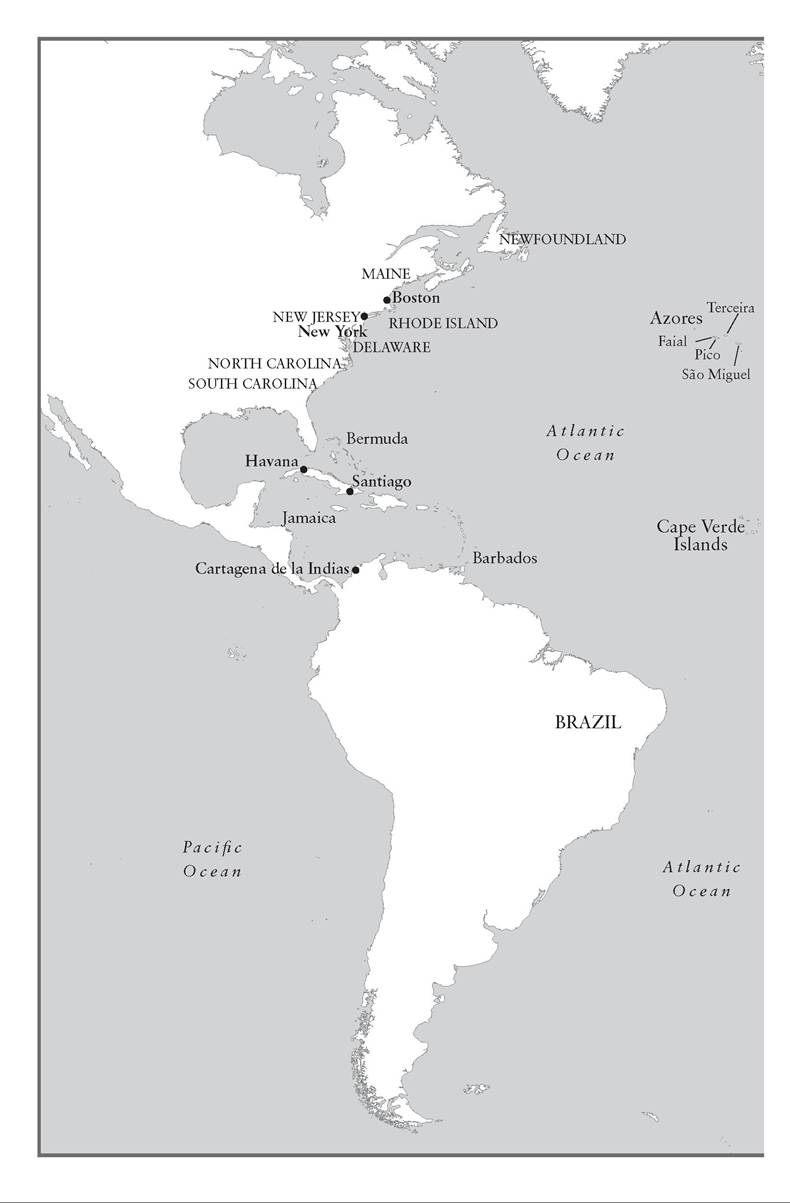
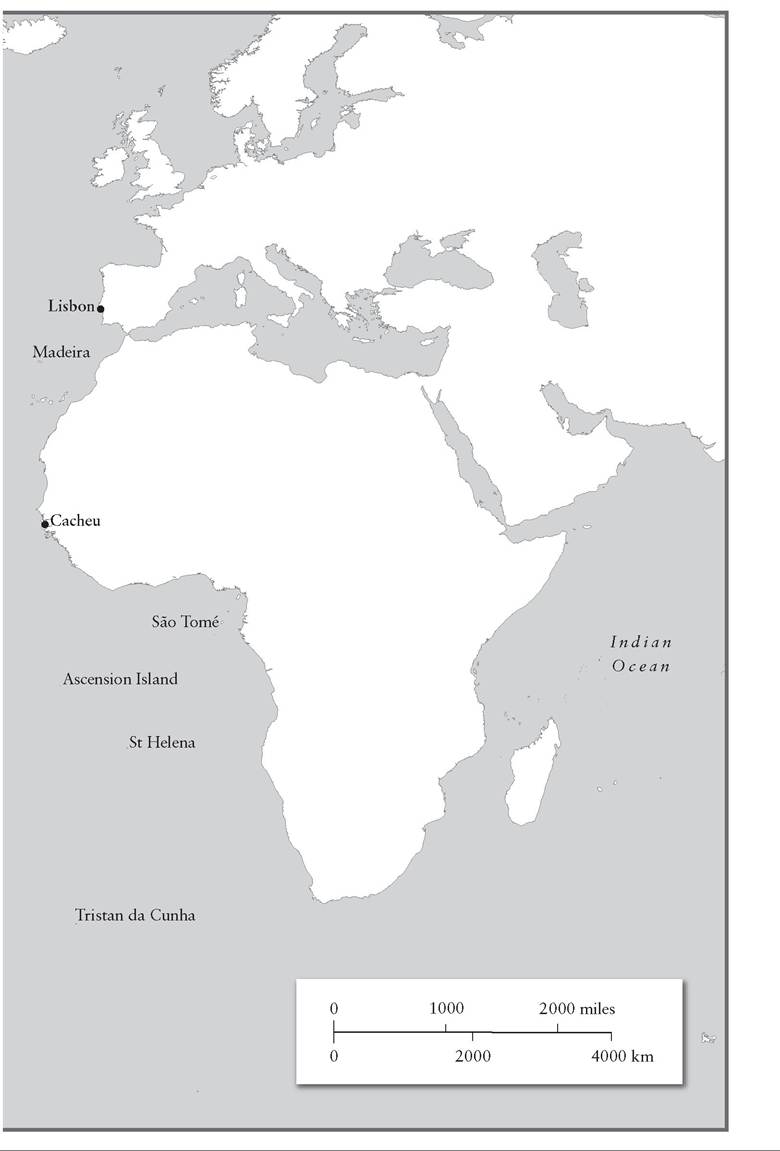
Sixteenth- and seventeenth-century maps exaggerated the size of the midAtlantic islands. It was hard to believe that places such as the Cape Verde Islands, the Azores and St Helena were mere dots on the ocean, when they possessed such importance as resupply stations for fleets crossing the Atlantic, or passing between the Indian Ocean and the Atlantic.
As a result, Madeira might appear to be the same size as the area that now makes up New York State. Yet from a maritime perspective these were not such small territories: the Azores stretch across 360 miles, or 580 kilometres, so that ships in search of shelter were not exactly looking for a needle in a haystack. The islands were also places where it was not too difficult to collect goods from right across the world. Sailors expected to make a little money on the side by buying and selling the spices of the East as they travelled back home from the Moluccas or India by way of the Cape of Good Hope and the Portuguese islands of the Atlantic. In this way the Azores became an unlikely but useful source of tropical spices that the temperate islands themselves were incapable of producing; Brazilian sugar too was easy to obtain in the archipelagoes, as Brazil became the dominant source of high-quality sugar after 1600. Complex trade networks were created by Dutch and Portuguese merchants that exploited all the loopholes in the relatively light Portuguese system of control; Portuguese ships out of Brazil would arrive in the two major Azorean islands, Terceira and Sao Miguel, pleading that they had been forced into port by storms, or that they were fleeing from pirates. Then they would unload their sugar and despatch it directly to the Low Countries on other ships, without being subject to the customs duties they would have had to pay in Lisbon.1The islands were home to very diverse communities: as well as Portuguese and Spanish settlers, the Atlantic islands were host to English,
Scottish, Irish, Dutch, Flemish, Italian, German and west African inhabitants, the last group consisting mainly of slaves, although in the Cape Verde Islands they mixed with the Portuguese and others to form a partly free mulatto population.2 However, the development of large-scale sugar plantations in Brazil, and then in the Caribbean, took the wind out of the sails of Madeira and other Atlantic islands.
The slave economy of Brazil suited the back-breaking work that took place in the fields and furnaces of the sugar estates. Transport costs were kept low by relying on mass-produced Portuguese caravels for the shipping of Brazilian sugar. The Dutch took a share of this trade, operating alongside the Portuguese, and again making use of cheaply built ships to reduce overheads. Brazil therefore became a perfectly viable alternative to Madeira or Sao Tome, with its notoriously bad sugar. One measure of the decline of sugar in Madeira is that slaves disappeared from the island, for their presence was a sure sign, within the Atlantic world, that sugar or other highly intensive production was under way.3In Madeira, the hunt began for alternatives, but the rich soil of the island was becoming exhausted after two centuries of intensive exploitation by sugar-planters. What saved Madeira was the product for which the island remains famous: its wine. Seventeenth-century Madeira wine was rather different to the rich dessert wine that is produced nowadays. It was neither fortified nor nurtured for years into a fine vintage wine; most of it was red plonk, drunk within a year of the harvest, but it was very popular with sailors. There were some superior wines made in small quantities from Malvasia (or Malmsey) and other grapes; but these were hard to obtain. Yet Madeira wine had some remarkable characteristics. It seemed to be unaffected by heat or transportation; if anything, they were thought to improve the wine, and nineteenth-century English Madeira enthusiasts would often demand wine that had been carried first of all to the Caribbean or South America.4 Besides, there were plenty of willing consumers in Brazil and the West Indies, whom English merchants supplied not just with slaves but with wine. Barbados was especially thirsty for Madeira wines, while English settlers in Jamaica became major consumers after the island fell under English rule in 1655.5
The Madeira wine trade was boosted by the fact that the island lay within easy reach of England, but was also well situated along the Atlantic trade routes, making it a useful loading point for ships bound for either North or South America.
So began the intimate relationship between Madeira and England that remains unbroken. English business houses began to flourish on Madeira, beginning in the late sixteenth century with Robert Willoughby, whose safety on the island was guaranteed since he was a Catholic - indeed, he became a Knight of the Portuguese Order of Christ. The seventeenth-century English colony included a good number of Protestants. There were frequent brushes with the Inquisition; however, it was obvious to the Portuguese authorities that the English colony was a valuable asset, so the Protestants mainly suffered insults.6 In many ways their position was similar to that of the Portuguese New Christians, whose Jewish identity could conveniently be ignored when doing business. These English merchants often lived in some style, possessing agreeable quintas, or estates, away from the capital at Funchal. The bonds became closer as the English brought in cloth, which helped balance the cost of the wine they were taking out of the island. The looms of Devon and Essex hummed as English cloth displaced French and Flemish. A firm mutual relationship came into being.7The English presence in Madeira is illuminated by the chance survival of letters written by a merchant from Warwick who traded actively between Madeira and the West Indies, as well as towards England, around 1700. William Bolton was the agent in Madeira of Robert Heysham, a London banker and merchant who had interests in Africa and who also owned lands in Barbados, where his partner and brother, William, functioned as official agent for the British planters.8 ‘African trade’ in this period meant, above all, the trade in slaves, imported into the West Indies to work on sugar plantations. That, however, was not Bolton’s speciality, even if the goods he sent to Barbados and Jamaica were no doubt paid for with profits from the sugar mills and the slave trade. Bolton’s career shows how Madeira was locked into a much larger world than that of the eastern Atlantic.
Quite apart from his connections with the Heyshams and Barbados, he found customers in Boston, New York, Rhode Island and Bermuda, and he loaded Madeira wines on to ships that passed the island bound for Brazil, India and the East Indies.9 His activities also reveal how dependent Madeira had become on Europe for basic supplies, for the shift first to sugar and then to wine had turned the island into a place of monoculture, drawing its wheat from Holland, England, North America and the Azores, its meat and dairy goods from Scotland and Ireland, its fish from Scotland and Newfoundland, its woollen, silk and cotton goods from England. Particularly astonishing is the dependence of Madeira on the West Indies for supplies of the very product that had catapulted Madeira to fame in the fifteenth century, sugar; and timber, another prized export from the island in the days of Henry the Navigator, was now brought from the English colonies in North America.10In mid-December 1695 William Bolton reported on the ships that stood off Madeira. A Portuguese vessel was loading plenty of wine for delivery in Brazil, and a Bristol ship was heading for the West Indies also carrying wine; a ship from New York was ‘bound home with about 100 Pipes’, approximately 5,700 litres.11 In July 1696 Bolton described how ‘a strang [sic ] revolution in my affairs’ took place: ‘I was seized upon and putt into a wett dungeon’; and the complaints against him tell something about the priorities of the Portuguese government of Madeira - he was told by the governor himself that the English ships had stayed for too short a time during a recent visit, with the result that not enough wine could be shipped: 2,000 pipes remained unsold. But, he objected, some of these ships were West Indian and simply did not have the capacity to carry large amounts of wine.12 In July 1700 he was already thinking ahead and keeping his partners in London well informed: ‘We are like to have a plentiful Vintage: the weather is good and above half the vines are out of danger, soe that it wil be your advantage to send a ship to be here the latter end of December, or the beginning of January.’ He insisted that ‘our Vintage wil be large.
The weather cannot be better. Now our hopes is only upon a good season to gather it.’13 One visitor Bolton observed was the great astronomer Edmund Halley: a ship arrived in January 1699, and ‘on borde her was Mr Halley, the Mathematician, bound to the coast of Brazil and to the southward of ye Cape ; his designe is to observe the variation of ye Compass’.14 Bolton’s letters thus expose to view a whole network of contacts mediated through Madeira, which became the meeting point for ships travelling to and from Portugal, the Netherlands, England, North America, the West Indies and Brazil.II
Like Madeira, the Azores were particularly favoured by the English. Between 1620 and 1694, 279 ships are known to have put in at Sao Miguel, now the capital of the Azores. Well over half were English, while fewer than 10 per cent were Portuguese. Not just the ships were English: the major routes pointed to and from England, for the Azores, even more than Madeira, depended on the cloths of south-west England, such as the Taunton cottons that, despite their name, were made of wool.15 The Azorean ports, such as Angra on the island of Terceira, could handle large merchantmen and men-of-war much better than Funchal in Madeira, where there was barely a harbour to speak of. Nor was this simply the story of a close relationship with Great Britain. England’s American colonies benefited greatly from access to these Atlantic islands. Horta, on the island of Faial, developed intimate ties with the English possessions in North America during the seventeenth century. The wine of the neighbouring island of Pico, grown on the steep slopes of its volcano, and comparable to Madeira wines, was a great attraction. As Horta grew, so did its contacts with New England, and it was on its American business, rather than its European, that its flourishing economy was based, since the Bostonians often bought more Azorean than Madeiran wine, and then made a handsome profit redistributing it across the English colonies just at the moment when these colonies were being established along the east coast of North America - in Maine, New York, New Jersey, Delaware, North Carolina and South Carolina.
The early newspapers of New York and Boston carried advertisements for wines brought from the Azores. Horta was also a vital stopping point for shipping bound from England to the West Indies.16 One cannot understand the success of the English in creating a transatlantic network of maritime routes without taking into full account the role of the Azores.There was, however, a fly in the ointment. East Indiamen would arrive ready to be resupplied with food before making the final leg of their long journey to Lisbon. As has been seen, Portuguese law forbade those on board from unloading their eastern spices and luxury goods, which were supposed to be sent all the way to Lisbon and then re-exported, if the Azoreans still wanted them. Naturally there were ways around this - smuggling, bribery, open defiance of the law. In 1649 a big, heavy ship called the Santo Andre was escorted into the port of Angra, on the island of Terceira, by English and Dutch allies of the Portuguese, since it was under threat from pirates and was carrying a very valuable cargo of cinnamon. Special permission was given to unload the spices but this cargo still needed to get to Lisbon, and the Santo Andre was twenty-six years old and not very seaworthy after its long voyage from the East Indies; besides, there were strong winds against which she would make little headway. The Portuguese therefore hired two English ships, and the precious cargo was divided equally among all three boats. They reached the mouth of the Tagus safely enough, but once again the wind was the obstacle. The English ships were small enough to work their way into Lisbon harbour, but the Santo Andre was a cumbersome galleon, and its master fled before the winds to the inlets off the coast of Galicia, the famous rias. But this was Spanish territory, and the Spanish king was still fighting what he regarded as an impudent rebellion by the Portuguese, who had broken free from the Habsburg dynasty nine years earlier. As a result, the galleon and its cargo were impounded, meaning that a good third of the cinnamon was lost to the enemy.17
Portugal was able to face up to its Spanish enemy thanks in part to the support of the English and the Dutch. Angra became the base for merchants from all over Europe; the Dutch consul acted on behalf of other nations as well, including Denmark, Sweden and Hamburg. Seventeenthcentury Angra has been described as ‘one of the nodal points of Atlantic maritime commerce’.18 With its spacious harbour, overlooked by a massive promontory that had already been heavily fortified by the Spanish Habsburgs, it was a safe retreat in times of tension and a much valued port in times of peace.
III
There is a stark contrast between the lush Azores and the barren Cape Verde Islands. Yet the existence of both archipelagoes made long-distance oceanic navigation possible in an age when supplies of food were liable to be exhausted in mid-voyage - no one could predict the time it would take to battle against the winds and the waves until the coming of the steamship. The Cape Verde Islands provided goat meat, the flesh of the very animals that had done most to strip the islands’ vegetation bare; there were cheese and butter made out of goat’s milk; they offered salt in great quantities, at virtually no cost; there were citrus fruits, even though European sailors were slow to make the connection between limes or lemons and a cure for scurvy. These islands also played a significant role in the transmission of African and European plants to the New World, including yams and rice; the links between the Cape Verde Islands and Brazil had been forged as early as the first half of the sixteenth century. The movement of plants went both ways: arriving by way of the Cape Verde Islands, American maize became a favoured crop in west Africa, along with manioc. It has been pointed out that this transmission took place within the space of just a few years; but ‘once a certain amount of diffusion had taken place, it was self-perpetuating’.19 It was also irreversible, part of a wider process that transformed the domestic economy of each continent bordering the Atlantic - the example of the potato and its importance in the nineteenth-century Irish economy hardly needs to be stressed.20
By the 1680s enterprising English merchants were selling Azorean wheat and Caboverdean salt to settlers in Newfoundland, who then used this salt to process the cod in which that part of the Atlantic was so rich, before the salted cod was passed back across the Atlantic to Spain and Portugal, where bacalao remains a national dish to this day. The Cape Verde Islands were also visited by East Indiamen, whose crews would stock up with supplies before making the long haul around the Cape of Good Hope to the Indies. From the sixteenth century onwards, this gave the islands a certain strategic interest; Francis Drake arrived in Santiago, the main island, in 1585, and ravaged its tiny capital, Ribeira Grande.21 The Habsburg rulers of Portugal reacted by building the Fort of Sao Felipe, an imposing structure that still hangs high above the remains of the old town, looking far out to sea.22 This did not protect the bays further east along the coast of Santiago, and other predators arrived, notably the Dutch, who briefly occupied Praia. However, there was not much to occupy. The islanders relied on imported knick-knacks from Europe, cheap ceramics and textiles, simple metal goods, as well as African pottery, some produced locally and some carried across from the Portuguese trading posts on the west coast of Africa.
The real source of prosperity for the Europeans living in or trading through Santiago remained African slaves.23 As the sugar industry of Brazil took off in the late sixteenth century, the importance of the route past Santiago was magnified. In 1609-10 thirteen ships took something like 5,900 African slaves out of Ribeira Grande to a variety of destinations, Cartagena, in modern Colombia, being the favourite. However, this was just the official trade, and we can be sure that many more Africans were loaded on ships and sent across the Atlantic; the islands remained a useful entrepot where slaves could be held for a while until slave-merchants came to collect them. Proof of this comes both from the fact that recorded numbers of slaves arriving in Santiago are lower than the numbers of those leaving, and from the fact that the slave cemetery excavated by archaeologists from Cambridge in Ribeira Grande contains the skeletons of so very many slaves who died on the island before being re-exported.24 By the end of the seventeenth century some attempts had been made to protect slaves from abuse. They were to be baptized within six months of arrival, or else they would be forfeited, and they were to have time off on Sundays. Slaves bound for the Americas were to have a certain minimum space on board, and time for exercise on deck, as well as for instruction in their new faith. The Portuguese view was that their souls had a chance of salvation, so that being a Christian slave had clear advantages over being a free pagan.25
There were distinct advantages in picking up slaves in the islands rather than on the African coast. The Portuguese trading bases in west Africa such as Cacheu, inhabited by the so-called lan^ados, Portuguese often suspected of crime or heresy, built close ties to the courts of African rulers. Many were well assimilated into African society, with African mothers or wives and a good knowledge of both European and African culture. Some were of New Christian descent; local Muslim rulers and their economic usefulness to Portugal protected them from the long arm of the Inquisition. Since many of the Portuguese settlers in the Cape Verde Islands were also New Christians, there existed a natural kinship between the colonists on the islands and on the coast, a network of trust that helped to foster trade.26 The lan^ados obtained trading privileges and knew what sort of gifts the African kings expected to receive in return for favours, for the kings could be very specific in their demands for weapons or brass goods. This was an art that the slave-merchants and sea captains, who were only transient visitors to these waters, could not be expected to develop.
Dealing with the lan^ados brought another benefit: they supplied the islands with the basic goods that the islands found it hard to produce, such as palm wine and millet. These were required at least to feed the slave population. And the lan^ados were happy to send these goods in payment for the worldwide manufactures that were popular among the west African elites: Europe sent red cloth of Portugal, metal bracelets, buttons, Venetian glass beads; the New World sent silver coins; the Indies sent coral, cloves and cotton, though these were often re-exported through Lisbon.27 All these goods passed through the Cape Verde Islands, reinforcing their role as a key entrepot between Africa and the rest of the world. Islanders of African descent began to weave cotton cloths in the African fashion, often coloured blue and white and copying traditional African designs. These cloths, or barafulas, were similar to but often better in quality than west African ones; they were produced for the African market, making it possible to exchange Caboverdean products for the captive humans of west Africa. The whole process was helped further by the planting of indigo in the islands, where it flourished. The barafulas were used as standard currency (the American silver coins were melted down and turned into jewellery in west Africa). The use of cloths as currency defeated the bureaucrats of Lisbon, who expected customs dues to be paid in coin, with the result that many merchants simply failed to pay their taxes.28
The Portuguese rebellion against Habsburg rule in 1640 posed the usual problem that political freedom was one thing, but the risks to prosperity were quite another. The solution was simple: that year, the Portuguese government decreed that Spanish ships could continue to visit both the Cape Verde Islands and Guinea, so long as they arrived from the New World, so long as they deposited a financial guarantee in Lisbon and so long as they paid for the slaves with American silver. This led to a lucrative trade with places such as Havana. Either side of 1640 the slave trade continued to bring profit (and to inflict massive misery): taking the seventeenth century as a whole, 28,000 slaves are known to have passed through the Cape Verde Islands, which is definitely not the full total.29
These archipelagoes were not simply part of a Portuguese network but part of a global one. Without the Azores and the Cape Verde Islands it is hard to see how not just the Portuguese but the Spanish and English commercial networks would have functioned reasonably efficiently during the seventeenth century. At the same time, one cannot close one’s eyes to the horrors that this trade inflicted on the innocent human cargoes that passed through the Cape Verde Islands towards the Americas.
IV
Far beyond the Cape Verde Islands lay other isolated peaks sticking up out of the southern Atlantic Ocean, uninhabited by humans or by mammals until the arrival of the Europeans: St Helena, Ascension Island and Tristan da Cunha. Historians of St Helena in particular have noticed that this island, mainly known to history as the last abode of Napoleon, had an importance out of all proportion to its size, for what really mattered was its location on the sea routes to and from India; the takeover of the island by the English East India Company reflected a carefully constructed policy of creating stepping stones across the oceans, in the awareness that without resupply the routes across the high seas were quite simply unmanageable. Oddly, the island had been known to European navigators since the Feast of St Helen in May 1502, and it was visited again the next year by Vasco da Gama on his return from his second Indian voyage. St Helena may be tiny; but it was impossible to miss: heading out across the Atlantic from the Cape of Good Hope ‘the wind is very constant and carries you in sixteen days into St Helen’s road’.30
The Portuguese realized that this island could serve its India fleets well, without the need to create a colony there on the model of Madeira or the Azores; they actually discouraged l ong-term settlement, for they knew that such a remote place would be impossible to control from Lisbon. They wanted to keep St Helena out of the public eye, all the more so as the English and the Dutch began to navigate to and from the Indies. They had not learned from their experiences in the Cape Verde Islands, for they populated the island with goats. At least one Portuguese resident settled there voluntarily in 1516. Fernando Lopez was well born, but was arrested in Goa for desertion and was brutally punished by having his ears, nose, left thumb and entire right hand cut off. Understandably he avoided human company, preferring his pet chicken, but he did some business with visiting ships, selling the skins of the goats he had captured for his dinner with his four remaining fingers.31
Aware of the value of this island as a source of fresh food, the Dutch began to prey on Portuguese shipping off St Helena at the end of the sixteenth century. The Witte Leeuw, or White Lion, a Dutch East Indiaman, attacked Portuguese ships off St Helena in 1613. This proved to be an act of hubris: a cannon exploded on board, and the powder room then blew up, leading to the loss of a hundred tons of pepper and a large cargo of fine Chinese porcelain, some of which has been recovered from the sea and is preserved in the island’s museum.32 This was the prelude to Dutch attempts to push the Portuguese out of the island, without, however, taking direct control. The idea that it could continue to function as a resupply centre, to all intents a neutral territory, still found favour. This was not the view of the English. In 1656 Oliver Cromwell was persuaded by the English East India Company that the Company’s trade with the Indies would take off once England took charge of St Helena - ‘a halfway house in the midst of a great ocean’, as a French traveller described it in 1610. St Helena had already been visited by Cavendish as he headed back into the Atlantic on his round-the-world cruise. He was greatly impressed, for by now he was glad to see melons, lemons, oranges, pomegranates and figs, streams of fresh water, big fat pheasants and partridges, and goats and pigs brought there by the Portuguese.33 Oliver Cromwell’s son and momentary successor, Richard Cromwell, granted the EIC a charter giving it authority to ‘settle, fortifie and plant’ the island. The EIC thought of St Helena as a base from which to launch expeditions towards the far- distant Moluccan island of Run, which they still dreamed of recovering from the Dutch right up to the exchange agreement of 1667 that sacrificed Run for Manhattan.34
Defeated in the Moluccas, the EIC was nonetheless disinclined to let go of St Helena, for the island was thought to have real potential. The quality of its fresh water attracted wonder, making the island ‘an earthly paradise’.35 It was assumed that ‘plants, rootes and grains and all other things necessarie for plantation’ would transform its lush but wild environment, while fish swarmed in the waters round about, and even the wild grasses provided wondrous cures for ‘sailors just dead with scurvy’, who would ‘recover to a miracle’ and bounce back into life. Using plants brought from the Cape Verde Islands, St Helena became a garden island where fruits and roots from across the world were cultivated: from the Americas cassava and potatoes, from Europe oranges and lemons, from Africa plantains, from India rice, all intended to make the island selfsufficient, since a settled population would require rather more than the limited list of items needed for the resupply of passing ships. The animal population was boosted by sending cattle and sheep as well as chickens. Even so, at the start of English colonization, it was difficult to obtain agricultural knowhow. Four free planters could be found on the island in the 1660s; inevitably, the hard work planting and harvesting the new crops was carried out by black African slaves, who were permitted to cultivate their own plots of land, and produced promising yields. This was an island that suffered from underpopulation, not overpopulation: in 1666 there were fifty male inhabitants, twenty women, and six slaves. Male and female slaves were regularly brought from the Cape Verde Islands; Madagascar slaves were specially prized by the English and were taken as far as Barbados, where they trained as highly skilled artisans. It was hoped they could be equally useful on St Helena.36 In 1673, 119 colonists set out from England, following an abortive Dutch invasion of the island. Some of them were reasonably well-off, with servants of their own, or black slaves. By 1722 the population had reached 924, more than half of whom were free; and of those the majority were women and girls.37
The settlers were not a passive body of people, willing to take orders from the EIC. St Helena was a turbulent place in the late seventeenth and eighteenth centuries, as its governors, its garrison, its free planters and its slaves clashed with each other. The colonists held a majority on the island council for a few years, but from the moment the English took control of the island its governors were not inclined to pay the council much attention, and back in London the directors of the EIC were well aware that this high-handed treatment of the settlers was counterproductive. In 1684 the governor responded to an uprising by the settlers by ordering his soldiers to shoot at the rebels, killing some of them; and then others were taken prisoner and executed. Another governor was assassinated. The slaves rose up in rebellion. The leading historian of this island has pointed out that it was only ever a Utopia on paper; theory and reality stood far apart.38
The East India Company wanted to keep St Helena for its own exclusive use, and that did not simply mean defending the island against the Dutch or other foreign rivals. Even other English companies were discouraged from making use of the island. This was the EIC’s link to India, not England’s link, even if it had been established by a charter of the Lord Protector himself. Not for nothing was St Helena known as ‘The Company’s Island’. In 1681 the EIC resolved that slave ships coming from Madagascar or the adjacent coasts of Africa would be made welcome, if they touched at the island for supplies or were in distress. However, the governors discouraged non-Company ships from attempting to trade. The Roebuck, an English slaver, reached St Helena in spring 1681, having lost forty of its 346 slaves to disease; sickness had also taken hold of the crew. Medical help was offered, but the governor forbade the sailors to carry on any trade, to the intense annoyance of the planters.39 Yet this policy was consistent with the monopolistic outlook of the Company.
The EIC hoped to extend its monopoly even further by taking control of another remote south Atlantic island, Tristan da Cunha, although the weather there was worse even than on St Helena and the island was even more barren.40 The motive was control of the sea routes into the Indian Ocean, and also looking westwards towards Brazil, though Tristan da Cunha stands a little south of the latitude of the Cape of Good Hope, a long way down from St Helena, which lies roughly on the latitude of the border between modern Angola and Namibia. Tristan was not occupied by the British until 1816, although the first attempt to colonize the island took place in 1684, when the English ship Society was despatched there with orders to conduct a survey; the East India Company was keen to learn how good its harbours might be. There, or on other promising but empty islands, the ship’s captain was to leave a boar and two sows and a letter in a bottle, which was deemed sufficient evidence to establish an English claim to the territory. By the early nineteenth century British enthusiasm for this utterly remote volcanic island had reached the point where it was compared favourably to Funchal, the main town of Madeira, ‘from the circumstance of its being a straight shore’; there was sufficient land for cultivation and there were good supplies of fresh water.41
St Helena and Tristan da Cunha, and even the archipelagoes much further north, were not simply Atlantic bases. They were tied as closely to the Indian Ocean as to the Atlantic. Just as the oceans flowed into one another, their trade routes were inextricably intertwined.
V
It may seem strange to include the fourth largest island in the world, Madagascar, among these dots on the map, but there are good reasons for doing so: a few points along its coasts were initially seen as potential points for the resupply of ships; and, although it does not lie in the Atlantic, it was seen as a valuable link between the Indian Ocean and the Atlantic, reinforcing the sense that merchants, pirates and indeed governments did not employ the rigid divisions between oceans that tend to be applied nowadays, above all among historians.42 Later, as the idea of settling larger tracts of the island took hold, the assumption grew that this was a more attractive version of Asia, rather than Africa; the full title of a widely circulated pamphlet by ‘Richard Boothby, merchant’, published in London in 1646 and reprinted the next year, was A Breife Discovery or Description of the Most Famous Island of Madagascar or St Laurence in Asia neare unto East-India; with relation of the health- fulnesse, pleasure, fertility and wealth of that country, also the condition of the natives: also the excellent meanes and accommodation to fit the planters there. Another tract by an Englishman who knew the island well was enthusiastically entitled Madagascar, the Richest and most Fruitfull Island in the world; and the author was especially charmed by the ‘loving and affable condition’ of the people - indeed, in another pamphlet he called them ‘the happiest people in the world’.43 These were some of the many manifestos that praised an island that, in truth, the Europeans did not know well, but one that was much more easily accessible by way of the Cape of Good Hope than Sumatra, let alone the Moluccas. The hope was raised that Madagascar could be a substitute for the East Indies, a new Asia away from Asia proper. As usual, optimism turned to disappointment when the Europeans encountered areas of dry, red earth that seemed to extend for ever. On the other hand, there was truth in the idea that this was a world apart from Africa - a miniature continent, with its own extraordinary wildlife and its historical links right across the Indian Ocean.
The Portuguese had reached Madagascar in 1500, and they found that the island lay under the authority of several different kings. They also found that it was already well connected with the outside world through major east African ports such as Mombasa. In 1506 they conducted a raid on a Malagasy port; it did not produce gold or ivory, but there was so much rice that it would fill twenty ships. These contacts brought Islam as well as goods to Madagascar, but Islam failed to make a strong impact on the island, even though some Muslim practices, such as circumcision and avoidance of pork, became quite widespread. The same applied to Hinduism, whose influence trickled along the trade routes that had brought the first Malay sailors to the island during the Middle Ages; but again it remained weak, and the main cult consisted of ancestor worship (which could, according to some accounts, involve the ceremonial display of ancestors’ corpses and even their consumption).44 Although it became obvious that conquering the island was out of the question, the Europeans exploited the wars between local kings, just as they always had in west Africa, to secure a supply of slaves, which they exchanged for European textiles and cattle. Some of the kings had more upmarket tastes: Dian Ramach had been educated in Portuguese Goa, so it is not surprising that he showed off a lacquered throne made in China, a Japanese vase and both Persian and European robes.45
Slaves were the main ‘product’ of the island in which the Europeans took an interest. As in west Africa, there was a world of difference between the harsh regime to which the great majority of exported slaves would find themselves subjected, whether in Indian Ocean colonies or across the Atlantic, and the much looser style of slavery on the island, a light version of serfdom that only turned vicious when rulers and nobles decided to sell their unfree subjects to the Europeans.46 Malagasy slaves accounted for a small percentage of the number of slaves who were carried across the high seas by European merchants, less than 5 per cent of slaves traded by Europeans in the Indian Ocean, and a small fraction of those traded in the Atlantic. By comparison, over 2,800,000 slaves are believed to have been transported out of west and central Africa just on English ships during the seventeenth and eighteenth centuries.47 However, the Malagasies were valued for their intelligence and skills (while their distant relatives, the Malays, were deemed to be too lazy and unreliable); in Barbados, English planters took the view that Malagasy slaves were the ‘most ingenious of any Blacks’, well suited to be trained as carpenters, blacksmiths or coopers. The East India Company sought ‘lusty well-grown boys’ on Madagascar - the term ‘lusty’ being used here without sexual connotations.48
However, there was another advantage to Madagascar beyond resupply and the slave trade: piracy. At the end of the seventeenth century, local kings actively tolerated the presence in coastal ports of European pirates, as well as pirates from the English colonies in North America. Well-armed pirates could be recruited to take part in wars between rival kings. And the reason they were well armed was that far away in the Atlantic - as far away as New York - friendly merchants could be found who were keen to supply them with arms as well as strong drink. Casks of beer and spirits were sent all the way from America, despite the objections of the East India Company and the Royal African Company in London. Meanwhile the pirates, who were variously of English, Dutch, French and - interestingly - African descent, supplied Malagasy slaves to willing buyers.49
The American backers of these pirates were men of significance back in New York. Frederick Philipse, of Dutch descent, was one of its wealthiest citizens; and, hearing that a pirate named Adam Baldridge had abandoned his old business, piracy in the Caribbean, and had taken up residence on St Mary’s Island, off the north-east coast of Madagascar, he saw a golden opportunity to send him supplies in return for Malagasy slaves. Philipse and Baldridge had bought a winning ticket: once the base on St Mary’s was up and running, with hundreds of people living in the settlement, all the pirate vessels active in the western Indian Ocean began to call in there for supplies. Baldridge did particularly good business by selling on rum and beer at an appreciable mark-up. Yet he also imported bibles from North America, a reminder that many pirates saw no contradiction between robbery on the high seas or the enslavement of fellow humans and the Christian life. As the settlement expanded, so did the Malagasy population; and while Baldridge was away from St Mary’s late in 1697, on a local slaving expedition, the islanders living in the town rebelled, tearing down the fort he had built and killing about thirty of the pirates. Baldridge abandoned St Mary’s, and later he would complain that the revolt had taken place because the Europeans had no idea how to treat the islanders gently. But William Kidd, a famous Scottish pirate who was later to hang for his crimes, thought that Baldridge was making excuses for his own mistreatment of the Malagasy inhabitants of his little town, since he would inveigle men, women and children on to his ship, before taking them captive and selling them as slaves to the Dutch in Mauritius and the French in Reunion (then known as Ile Bourbon), the two Mas- carene islands to the east of Madagascar which were being colonized just at this period.50 Maybe, then, there were other pirates like Kidd who did read their bibles and did have a conscience.
Some pirates valued their Malagasy slaves highly and appointed them as cooks on board ship, where they occupied positions of some responsibility; making sure that food did not run out and that as much fresh food as possible was served was an important task. One such cook was Mar- ramitta, who was appointed by his master, none other than Philipse, as cook aboard the Margaret. His real name is unknown, for ‘Marramitta’ appears to be a corruption of the Malagasy word for ‘cooking-pot’, marmite in modern French. Malagasy slaves were dispersed across the world. The English East India Company made use of Malagasy labour when it built a fort at its pepper factory in Sumatra, at Bencoolen, towards the end of the seventeenth century. Once there, quite a few headed off into the jungle, no doubt able to take advantage of the fact that they spoke a language not too dissimilar to Malay-Indonesian. But the Atlantic also received increasing numbers, often via a holding station on St Helena.51 As early as 1628 a slave from Madagascar arrived in the new French colony of Quebec; and at the end of the century ships loaded with slaves were regularly reaching New York. However, the growing cities of North America were less frequent destinations than the islands of the Caribbean, particularly Barbados and Jamaica, or the English settlements in Virginia and the Carolinas. In 1678 three ships out of Madagascar delivered 700 slaves to Barbados, where the intensification of sugar production (with the high mortality this industry produced) led to greater and greater demand for slaves not just from west Africa. By 1700 something like 16,000 slaves on Barbados were Malagasy, about half the total; and just one port in Madagascar is thought to have exported between 40,000 and 150,000 slaves during the seventeenth century.52 The good news, if it can be called that, is that mortality on English ships carrying Malagasy slaves was low.53 This may reflect the quality of supplies they were fed, loaded in Madagascar, at the Cape or in St Helena; and it may also reflect the fact that they were often transported in relatively small ships, which reduced the danger of epidemics: average cargoes in the eighteenth century were sixty-nine slaves. In 1717 the Board of Directors instructed the East India agents on St Helena to treat slaves ‘humanely’, pointing out that ‘they are Men’.54 And, after all, slavers wanted to deliver their human cargo alive; a dead slave meant financial loss.