THE NORDIC BRONZE AGE MYTH OF THE ETERNAL JOURNEY OF THE SUN
By 1969, analyses of images on Danish Late Bronze Age objects indicated that the primary myth of the northern Bronze Age concerned the “chariot of the sun journeying across the heavens, and also the ship of the sun, which is thought to have symbolized the sun’s journey beneath the earth when it disappeared beneath the western sea” (Davidson 1969: 23; cf.
also Goldhahn 2006: 111). My version of the interpretation (Kaul 1998, 2004a) thus follows in the wake of others: Wilke (1923), Jacob-Friessen (1934), Sprockhoff (1936, 1954, 1955), Brondsted (1938), Schwantes (1939) and Gelling and Davidson (1969).My own research reveals that the cyclical views in the Late Bronze Age are far more complex than those outlined by Gelling and Davidson. Not only does this work lead to a much more sophisticated and “finely meshed” order, with additional agents transporting the sun, such as the fish and the snake, but it likewise emerges that while the ship is significant at night, it also plays a vital role throughout the day as the link between the other agents transporting the sun: at night, dawn, in the afternoon, and in the evening (Kaul 1998: 261). Furthermore, there is no chariot: a sun-horse pulls the sun - without any vehicle.
The decisive clues to the structure and meaning of the iconography lie in understanding the direction of travel of the ships, from left to right. The ships of the Nordic Bronze Age (mythological and real) were not symmetrical, unlike their southern counterparts of the central European Urnfield Culture (Vogel- Sonnenbark). The bow has a marked and highly raised keel extension, whereas the keel extension aft is short and horizontal. Significant patterns can be observed by systematic analyses of the direction of travel of the motifs (Kaul 1998).
Sun images never occur together with left-sailing ships. If we forget about spherical geometry, maps and the cardinal directions known today, the observable direction of travel of the sun (on the northern hemisphere) is always from left to right.
Thus, ships sailing right, and associated with sun images, are renderings of the sun’s daytime journey.To understand this cosmology, we must consider the earth to be flat, and when the sun sets in the evening, it has to return to its dawn starting point by moving left under the water and through the underworld. In this way, sailing to the right in Bronze Age iconography indicates daytime, up, sky and light, whereas the left indicates night, down, earth (or sea), underworld and darkness.
The direction seems to indicate at what point in the daily cycle the various motifs had their main “field of activity” and how far they were associated with the night or the day, the morning or the evening. The sun-horses almost always move towards the right. Statistically, however, the fish and the snake can face in either direction, indicating that their field of activity was close to the horizon, working just above or below it, and thus that they could work both day and night. This left-right structure aids in understanding the mythological circumstances surrounding the journey of the sun on its daily cycle, allowing it to be represented in iconographical form as a kind of cartoon-strip narrative on the bronzes. The zoomorphic helpers or manifestations of the sun thus had specific functions or “finest hours”. The left-right logic is demonstrated as early as “The Chariot of the Sun” from Trundholm, Northern Zealand, ca. 1400 BCE (Kaul 1998: 185-7).
Let our starting point be the morning. One of the most illustrative razors shows how sunrise was perceived in this Bronze Age cyclical myth. Reading the raised keel extensions illuminates the directions of the two ships and the left-right logic. The night-ship at the bottom is sailing left, and further up, the day- or morningship is sailing right. From the top of its prow, the night-ship has just passed the sun to the fish which is on its way upwards and right, towards the day-ship (Fig. 9.1).
The fish then - for a time - was allowed to sail on with the ship.
Another razor shows the fish about to be devoured by a bird of prey, the sun now being on the ship. To the right, a group of stylized sun-horses are ready to fetch the sun. The role of the horse is best seen on another razor, where a fine horse pulls the sun away from a ship. It is the sun-horse that at mid-day takes over the transport from the morning ship (Fig. 9.2).On another razor, the horse seems actually to land on a ship, and this is interpreted as the sun-horse landing on the afternoon ship, passing on the transport of the sun to this ship. Finally, at sunset, a snake took over the sun from the afternoon ship, as shown on another razor. This serpent helped the sun descend over the horizon, into its nocturnal travel, where ships, the sun-horse and the fish could assist the sun on its path through the underworld, and its left- turned voyage.
In other cases the snake seems to work in one direction, while the related ship sails in the opposite direction. This confusion may hint at circumstances at sunset or sunrise, where the directions left and right and the orientation up and down were changing just when the sun meets the separating horizon, and where night- and day-ships change their direction and for a moment can work upside down. Then, after sunset, during the nocturnal, sinister and left-directed voyage of the ship (or ships) of the night, the fish follows the ship, swimming left. The sun is not visible, extinguished and dark on its voyage through the underworld.
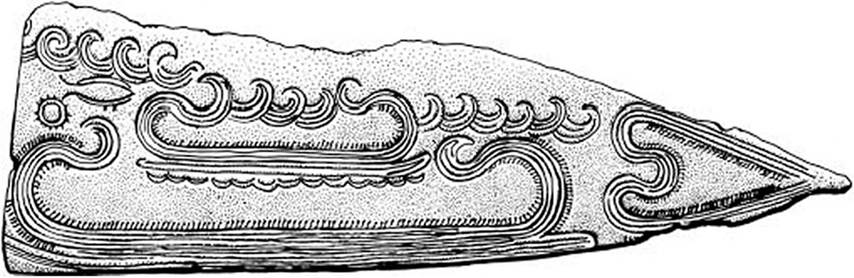
Figure 9.1 Razor without find provenance, probably Jutland, Denmark, c. 800 BCE. Here a ship is sailing to the right above a ship sailing to the left, where a fish is seen pulling the sun upwards and to the right from immediately above the ship sailing to the left to the ship sailing to the right. Note the raised keel extensions which indicate the sailing direction of the ships (Kaul 2004a: 245 fig.
63). Drawing: Bjorn Skaarup. © TheNational Museum of Denmark and Flemming Kaul.
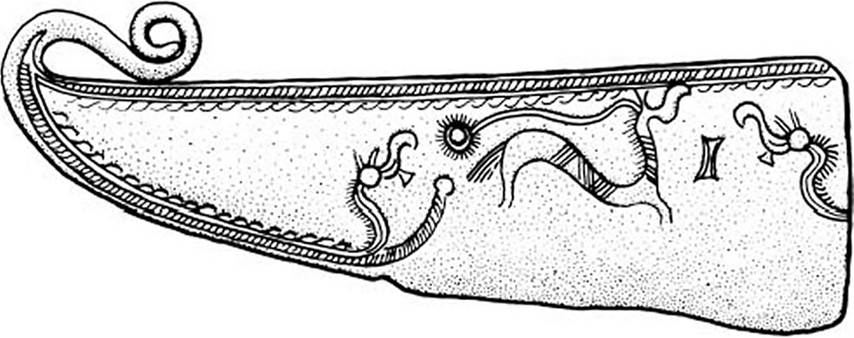
Figure 9.2 Razor from Neder Hvolris, Northern Jutland, Denmark, c. 900 BCE. The sun-horse is pulling the sun to the right just in front of the stem of a ship sailing to the right. The ship has a highly raised keel-extension and a stem with a horse head. The ship is folded, and the other stem is seen right (Kaul 2004a: 246 fig. 63). Drawing: Bjorn Skaarup. © The National Museum of Denmark and Flemming Kaul.
The eternal cyclical voyage of the sun helped by the sun-ship and other divine agents has been completed, and the sun can be born anew. Tentatively, I have related some of the motifs at different points of the daily cycle, to the wheelcross, a symbol of the sun and its eternal voyage (Fig. 9.3).
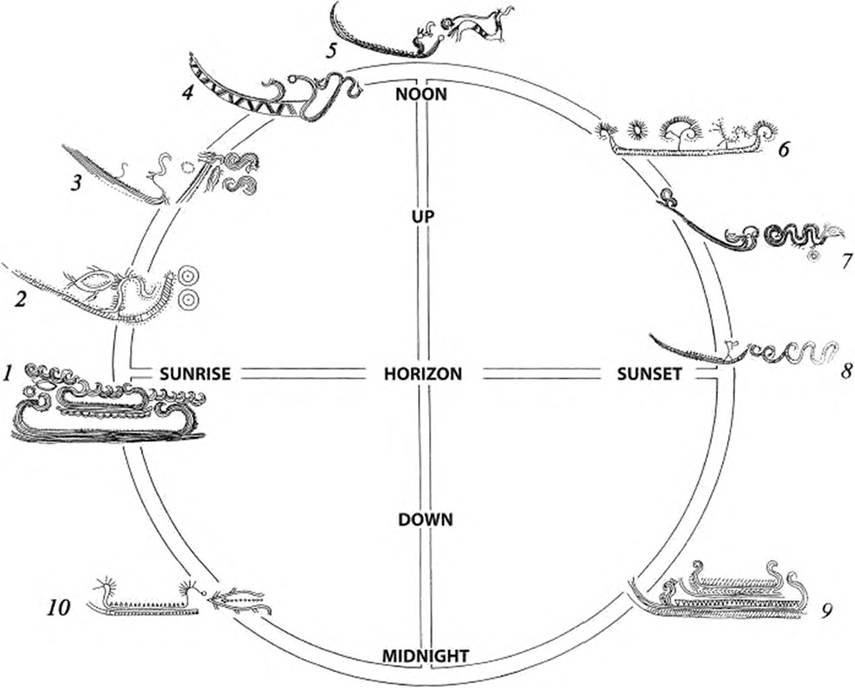
Figure 9.3 Motifs from Danish razors, Late Bronze Age, 1100-700 BCE, showing different points of the cyclical movement of the sun, here placed in relation to a wheel-cross figure. (1) Sunrise. The fish pulls the rising sun up from the night-ship to the morning-ship. (2) For a while, the fish is allowed to sail on with the ship. (3) The fish is to be devoured by a bird of prey. Stylized sun-horses (S-figures) are ready to fetch the sun. (4) Two sun-horses are about to pull the sun from the ship. (5) At noon the sunhorse has collected the sun from the ship. (6) In the afternoon the sunhorse lands with the sun on the sun-ship. (7) Some time after the sunhorse has landed, the sun is taken over by the snake from the afternoon ship.(8) The snake is concealing the sun in its spiral curls. It will soon lead the sun down under the horizon. (9) Two night ships sailing towards the left. The sun is not visible. It is extinguished and dark on its voyage through the underworld. (10) A night-ship followed by a fish swimming to the left. The fish is ready to fulfil its task at sunrise. The “wheel” has come full circle. Drawing from Kaul (1999: 26-7). © The National Museum of Denmark and Flemming Kaul.
More on the topic THE NORDIC BRONZE AGE MYTH OF THE ETERNAL JOURNEY OF THE SUN:
- THE NORDIC BRONZE AGE MYTH OF THE ETERNAL JOURNEY OF THE SUN
- ADITYA, THE SUN GOD
- Bredholt Christensen Lisbeth, Hammer Olav, Warburton David. The Handbook of Religions in Ancient Europe. Acumen,2013. — 456 p., 2013