Colonies and the slave trade in the second half of the eighteenth century
France, Britain and Denmark were all colonial powers, possessing sugar colonies in the West Indies, slave-trading stations in Africa and trading outposts in India. France and Britain also counted possessions on the American mainland, while the Kingdom of Denmark-Norway's Atlantic colonies included the Faroe Islands, Iceland and Greenland as well as St Croix, St John and St Thomas in the West Indies (the present-day U.S.
Virgin Islands). In Africa, the French claimed the island of Goree, several comptoirs in the region of Senegambia and a few forts on the Gold Coast, principally the fort of Juda (Whydah). Britain held a monopoly over most of the Gambia region, while also possessing several forts on the Gold Coast. Finally, Denmark was in charge of the stretch of land on the Gold Coast between Accra and the Volta River (present-day Ghana), where it had four slave stations: Christiansborg, Fredensborg, Prinzensteen and Kongenssteen. From 1750 to 1800, the respective slave trades of the three powers amounted to about 1.5 million persons for the British, 680,000 for the French and 35,000 for the Danish.4 As shown in Figure 5.1, Britain was the primary empire able to carry on its slave-trading during times of war. The French trade came to a complete halt during both the Seven Years' War and the War of American Independence, while Denmark was mostly able to keep its slave trade going given her position as a neutral power. The Danish trade even grew in the American War of Independence and the French Revolutionary Wars.Despite a boom in the slave trade in the second half of the eighteenth century, the trade also caused several difficulties to all three powers. Often, the Crowns would try to leave management in the hands of a chartered company, but in doing so they faced strong criticism from independent slave-traders. Other problems included the high mortality rates for crew and captives, particularly during the Middle Passage.
Moral arguments against the slave trade were, of course, as old as the trade itself. Yet, from the 1750s onwards, the rise of political economy and Enlightenment ideas added to such criticism by questioning the trade's efficiency and legality. French political economists argued from the late 1750s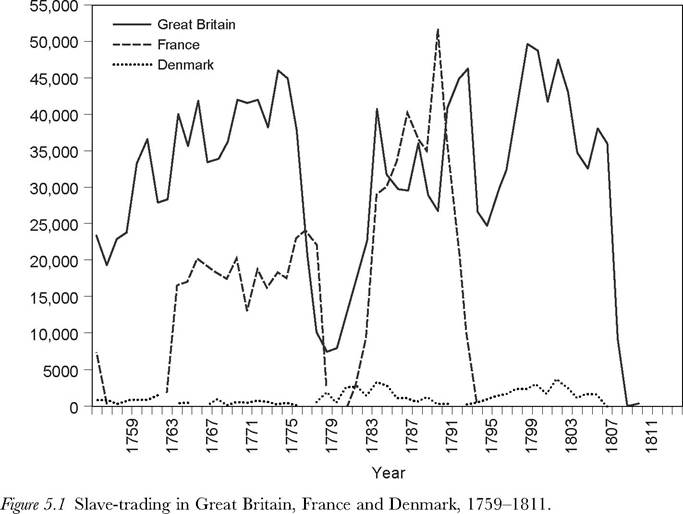
that slave labour was not economically viable in the long term. They suggested transplanting the plantation system to Africa, the home of the cultivators, and dispense with American colonisation. The circulation of such ideas was given additional force by the various natural histories of Africa, written by botanists and colonial agents, which appeared in the same period.
With the circulation of such ideas, semi-private projects to cultivate land in Africa followed, though few succeeded. In the mid-1760s, in Senegambia, the French governors Poncet de la Rivière and Esmenager attempted to cultivate a range of crops and launch white settlements.5 In 1769 the Danish government sent seeds to the Danish holdings on the Gold Coast and encouraged the Herrnhutter missionaries to go to Africa to found plantations and colonies.6 These experiments, however, were not necessarily linked to, or motivated by, anti-slavery views. Only after the American War of Independence had come to an end did the Crowns of Britain, France and Denmark show signs of any official support towards such ventures.
More on the topic Colonies and the slave trade in the second half of the eighteenth century:
- The second half of the eighteenth century witnessed a rise in new colonial projects and exploration.
- During the eighteenth century, trade, discovery, warfare and settlement took Britons to all parts of the world.
- For three and a half centuries Europeans extended the bounds of their overseas possessions. In the half century that commenced in the 1770s the scope of imperial holdings shrank dramatically.
- The Emergence of the Three Colonies System
- TYPES OF COLONIES
- The mature plantation complex
- Disruption