27 Guinea Gold and Guinea Slaves
I
The different groups of Atlantic islands participated in the slave trade in different ways: the Canaries as exporters of native slaves, and eventually as importers of black slaves to replace the depleted population; Madeira and the Azores as consumers, especially in the growing sugar industry; Cape Verde as a base for the despatch of slaves first to Portugal and later to the Caribbean and Brazil; Sao Tome as another consumer of slaves, another point of despatch, and as the last home of captive Jewish children of Spanish descent.
It is difficult to read the bare documents listing slave exports out of Cape Verde without a feeling of deep sadness and disgust. Children as young as two or three years old were transported through Santiago to Portugal (assuming they survived the journey); families were split up, as the slaves were divided into equally numbered groups and as one fifth of these animate trade goods were assigned to the Crown, with another share for the crusading Order of Christ. Prince Henry’s biographer, Zurara, described the misery of slaves arriving at Lagos in the Algarve in 1444:It is not their religion but their humanity that makes me weep in pity for their sufferings. If the brute animals, with their bestial feelings, understand the sufferings of their own kind through natural instinct, what would You have my human nature do when I see before my eyes that miserable company and remember that they too are of the generation of the sons of Adam?... To increase their sufferings still more, there now arrived those who had charge of the division of the captives, and they began to separate one from another in order to make the shares equal. It now became necessary to separate fathers from sons, wives from husbands, and brothers from brothers... You others, who are so busy in making that division of the
captives, look with pity upon so much misery and note how they cling to one another so that you can hardly separate them!1
In the thirteenth century Thomas Aquinas had insisted that slave-traders must not break up families, which would be contrary to natural law; but Prince Henry and his successors let this happen without a second thought.
Zurara was not, however, alone in reasoning that enslavement also brought an inestimable advantage to these miserable people; they were given the opportunity to become good Christians, so captivity was in fact their road to salvation - a notion that was still in the air in the southern United States in the nineteenth century. Zurara had his prejudices too. He believed that black races were condemned to slavery because of sin - specifically the sin of their supposed ancestor, Ham, who mocked his naked and drunken father, Noah.2 Zurara complained that the black slaves he saw were very ugly, like monsters from Hell. Physical difference had not been an issue while the slaves traded in Iberia and the Mediterranean were white or light brown, and similar in colour and facial characteristics to southern Europeans - descriptions of Canary islanders stressed that their physique was similar to that of Europeans, that they were intelligent, and that, if anything, they were taller, though sometimes a little darker.3 No one was very interested in the intelligence of the black slaves, even though, as will be seen, many of them came from sophisticated, partly urbanized societies whose technology far surpassed that of the Neolithic Canary islanders.The slaves delivered to Portugal were callously seen as commodities, for all the talk of Christian salvation. Portuguese trading documents from around 1500 never name the slaves, any more than they would have attached names to the pieces of ivory that they also sent towards Portugal. No questions were asked about how these people were obtained. In one bare list from 1513 four ‘lots’ of African slaves are mentioned, consisting of two men in their early thirties, a teenage boy, two mature women and five children, one of whom, a girl of between ten and twelve years of age, was retained as a tax payment to the king’s officials; and this composition of a slave cargo was fairly typical of the time.4 The bare facts do not explain how the slave trade came into existence, what needs it was thought to satisfy, or where the slaves originated.
But it is important to understand the origins of the transatlantic traffic in human beings that lasted for another 400 years and that, amid massive misery, reshaped the ethnic map of large areas of North America, South America and the Caribbean. This takes one back to the early history of Portuguese exploration in the Atlantic - exploration this time of coastlines rather than islands.II
The challenge of Africa was of a very different order to the challenge posed by the occupation of uninhabited islands. Broadly, there was a difference between the lightly islamized peoples of the savannah, who controlled the great rivers, notably the Niger, and the peoples of the forests, who were animists, and who often became the target of the Muslim jihad against pagans. The pagan Serers, for instance, lived in present-day Sierra Leone and were flanked entirely by Muslim principalities or by the sea; not surprisingly, they would find common cause with the Portuguese. West Africa was known to be inhabited by people of high culture, many of them Muslim, many also living in large towns. These towns were the home of leather, cloth and other industries; payments were often made in cowrie shells, individually worth very little, so that a piece of cloth might cost tens of thousands of units. Many west African kings relied on cavalry; even when they were pagan, their courts welcomed Muslim merchants from the north, who lived in reserved areas not far from the court itself. Although war captives were enslaved, slavery in much of west Africa had many similarities to the serfdom of medieval Europe: slaves were occasionally sold, for instance to buy war horses; but the main task of slaves was to cultivate the land on behalf of their masters. Many features of these societies were therefore familiar to western Europeans.5
Reports reached Europe of wealthy courts, such as that of Mansa Musa, king of Mali, whose fabulous wealth in gold was no fable; he continued to be shown on Catalan world maps well into the fifteenth century, and memories of his visit to Egypt, where he had scattered gold in the streets of Cairo and had set off rampant inflation, increased the certainty that the gold of Africa was within reach if only it were possible to bypass the caravan routes of the Sahara, dominated by Muslim Tuareg Berbers.
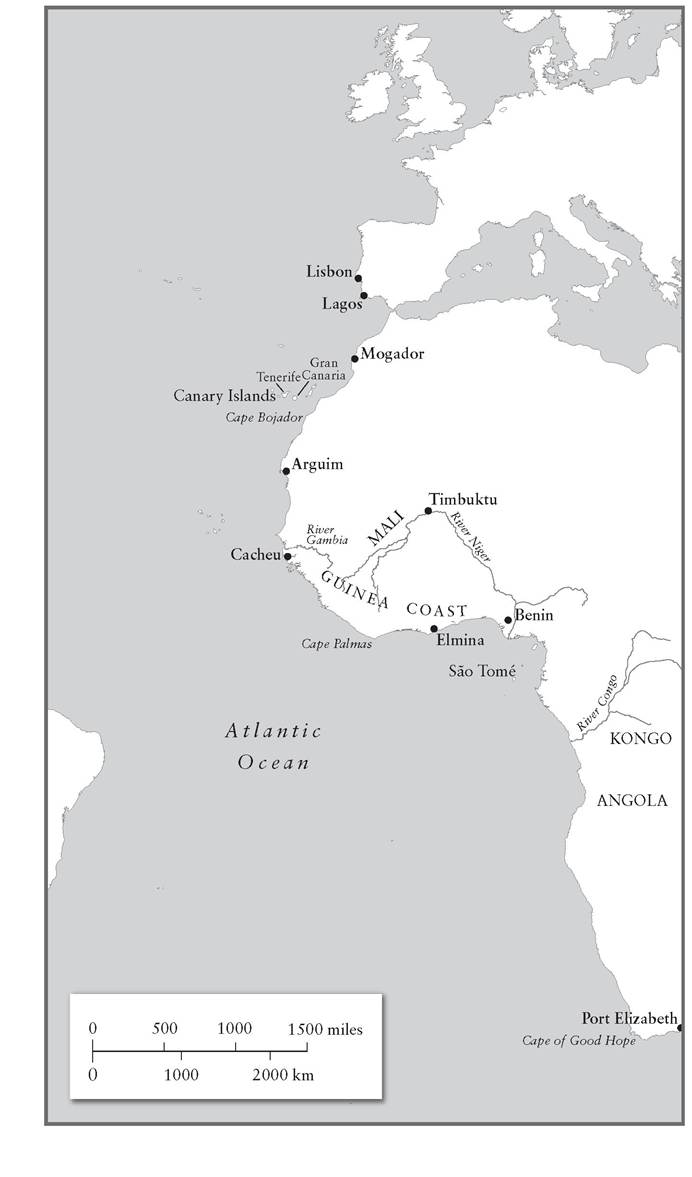
Europeans were unaware that the power of the Mali empire had peaked by 1400; in 1431 the Tuaregs even managed to take control of Timbuktu, holding it for thirty-eight years.6 It has been seen that adventurers such as the Majorcan Jaume Ferrer, who vanished off the coast of Africa, were already heading out in search of the ‘River of Gold’ in the mid-fourteenth century. Around 1400 demand for gold was very high in Europe, and western Europe was experiencing a bullion famine, as gold and silver leaked out in payment for spices and eastern luxuries, targeted by an increasingly prosperous urban middle class as well as by princely courts that often spent beyond their means.7 Availability of sugar in southern Spain and the Atlantic islands helped ease the outflow of bullion to the Islamic world; the jury is still out on the question of whether this bullion famine was as severe and universal as some have argued. Economic warfare against Islam was an integral part of the grand strategy of late medieval crusaders; if the gold that north Africa and the Middle East received from sub-Saharan Africa, by way of Timbuktu and its neighbours, could be diverted to Christian Europe, a double blow would be struck: Christendom would be enriched and Islam would be impoverished.8In 1444 a Genoese spy, Antonio Malfante, penetrated deep into the Sahara in search of the sources of gold; but, if his trek proved anything, it was that an overland route managed by European traders was out of the question. Then the occupation of the Canary Islands opened up the prospect of European bases being created along the flank of Africa, but as it turned out the islands lay a long distance north of the sources of gold; moreover, the islands, being already inhabited, proved difficult to tame (Tenerife was only conquered in 1496, and Gran Canaria in 1483). It made more sense to see what could be found on the coast of Africa itself. The traditional date for the breakthrough into west Africa is 1434, when, under the patronage of the Order of Christ (and therefore of Prince Henry), Gil Eanes worked his way past the reefs of Cape Bojador into what were thought to be unknown waters, though it is quite possible pioneers such as the Genoese Vivaldi brothers in 1291 and Jaume Ferrer in 1346 had already gone beyond.
However, Eanes not merely went beyond - he returned home. And he returned home a year later from a second expedition with reports of footprints left in the sand by human beings and their camels, as well as of rich fishing grounds, for, as ever, the Portuguese were on the lookout for good fish.9 Gradually the Portuguese gathered information about who lived along the outer shores of north-west Africa; these were lands inhabited by Sanhaja Berbers, or Aznaghi, some of whose ancestors had formed the mainstay of the terrifying Almoravid armies that invaded Iberia in the late eleventh century.The Portuguese did not involve themselves in any depth with the complicated politics of western Africa. Their aim was to find allies with whom they could trade, preferably in gold or ivory. Henry’s resources were far from limitless, although he made a handsome profit out of Madeiran sugar; and the Ceuta garrison was a constant drain on the resources of a kingdom that was only now lifting itself out of relative poverty. Alternative sources of revenue had to be found by Henry’s explorers. This led to the foundation of an offshore trading base at Arguim, on an island off the coast of modern Mauretania. The choice of a small island made excellent practical sense. No one lived there apart from a few Sanhaja fisherfolk. No ruler’s sovereignty was being challenged. The island was easily defensible. Offshore islands and defensible promontories had again and again been chosen by merchants in the Mediterranean, at least since the time of the Phoenicians, as safe places from which to penetrate the hinterland opposite.10 The Portuguese also briefly occupied the islands off Mogador, which had themselves been Phoenician bases in the days of the trade in purple dye.11
It was all very well to create a base; but there were no big profits to be made out of sealskins, orchil dye or even fish. Ten years after the rounding of Cape Bojador one of Henry’s Genoese captains brought back to Lagos caravels crammed with 235 Berber (or ‘Moorish’) slaves he had captured along the coast of west Africa.
They were put on show in Lagos, where Prince Henry and Zurara saw them, one taking pity and the other not.12 The first slaves to arrive en masse from Africa were therefore white or brown, not black; the trickle of Canary islanders towards Spain and Portugal had continued for a century already. But what Henry wanted to prove was that he could obtain more and better slaves with greater ease. In the years that followed, raids penetrated further south, and the expeditions returned with black slaves as well as brown ones; and eventually they came only with black slaves. Arguim and later the Cape Verde Islands served as way stations from which the captives were sent on to Portugal.13 Raiding was not the most satisfactory way to achieve this; trading was more effective. This required the Portuguese to make treaties with local rulers who might see some advantage in an alliance - whether the provision of trade goods, armaments or even mercenaries willing to fight on their behalf and to train local warriors in skilled horsemanship. This happened when the Portuguese made contact with the Serer people, animists who made no use of horses, but who realized how useful they would be in fending off the cavalry of the Muslim Mandinga and Wolofs on their borders. As a result the Cape Verde Islands became an important centre of horse-breeding within easy sailing distance, able to supply Serer needs. Even so, the islanders had to import a great amount of basic equipment such as bridles, bits and spurs from Portugal, before passing them on to their African allies.14The Portuguese were not dealing with maritime peoples. The boats they encountered as they crept down the coast of Africa were either rivercraft or vessels that kept close to shore, like the boats used by the fishermen of Arguim. There were no ports along the coast, although it was not too difficult to find safe harbours in river mouths. All this meant that it was much easier to make contact with local rulers inland than along the coast. However, by making full use of the virtues of the caravel, the Portuguese could navigate a long way upriver, whether in search of African towns and villages, or in the hunt for the ‘River of Gold’. In 1455 the Venetian nobleman in Prince Henry’s service, Alvise da Ca da Mosto, took his caravel up the Senegal River and reached the court of Budomel, an African king who extended a hearty welcome to the insatiably curious traveller, although one of his motives for doing so was his wish to increase his sexual potency still further - he already, as da Mosto discreetly wrote, ‘has a different dinner each night’.15 These river journeys continued: the Portuguese would travel as much as sixty miles up the river from their base at Cacheu-Sao Domingos, which was their largest base on the African coast by the end of the fifteenth century, trading in honey and fine-quality beeswax with the Mandinga in the interior.16 By 1500 too the Portuguese were not simply living in the Cape Verde Islands, Arguim and Cacheu. Some, the so-called lan^ados, or ‘thrown ones’, by and large people who had good reasons for not wishing to return to Portugal, were living among the Africans and had taken African women to their bed, with the result that a mulatto generation came into being.17 These good reasons included being under suspicion as New Christians who had not abandoned their Jewish religion. The lan^ados played an important role as cultural intermediaries, inspiring African ivory craftsmen to produce the extraordinary carvings of Portuguese soldiers and merchants that started to appear towards the end of the fifteenth century.
This still leaves in the air the controversial question of how the Portuguese obtained the thousands of slaves they were exporting. Modern politics dominate discussion, and admitting that black rulers sold slaves to white merchants has not come easily to historians of the slave trade. The idea that these rulers sold their own people is certainly an oversimplification. The Serers did not enslave fellow Serers. War captives were another matter, and the intense struggles for power on the frontier between the savannah and the forest made sure that there were plenty of such captives. Further south, in Kongo and Angola, the situation was more complicated, and at the start of the sixteenth century the Portuguese leaned on local rulers to ensure that they delivered large numbers of slaves, even from their own population. The truth is that the slave trade could only come into being because plenty of different people collaborated: back in Portugal, Prince Henry and then the Crown; merchants of various origins, including Spaniards and Genoese as well as Portuguese; settlers living in the Cape Verde Islands; lan^ados living in west Africa; local African rulers; and even parents who imagined that selling their sons and daughters to the Portuguese would offer them new opportunities in rich lands far away. Payment often came in the form of manilhas, brass bracelets that could be worn or melted down to satisfy the craving of the African elite for copper and brass goods, for which they generally depended on imported raw materials. One slave might be worth forty to fifty bracelets.
A ship called the Santiago that set out for Sierra Leone in 1526 carried 2,345 manilhas, which might be enough to purchase fifty or sixty slaves; and slaving in Sierra Leone and Guinea Bissau before returning to Portugal by way of the Cape Verde Islands and Terceira in the Azores was the main aim of the voyage.18 Not every ship was carrying slaves; one Flemish ship captained by a well-born Portuguese sailor was only interested in ivory and raw cotton. The peoples who lived upriver were keen to receive raw cotton, which grew quite well in the Cape Verde Islands; and these peoples then sold cloth made out of this cotton.19
III
So long as the sources of gold lay out of range, the Portuguese continued to trade in slaves and ivory along what became known as the Guinea Coast, and the king of Portugal adopted the grandiose and not totally empty title ‘lord of the navigation of Guinea’. The discovery of a hot spice, named Malagueta pepper after the stretch of coast where it was first found, increased the attraction of the Guinea trade, even though this pepper did not compare in quality with the true pepper that continued to arrive in the eastern Mediterranean along the Indian Ocean sea routes; Malagueta pepper is not actually a botanical pepper, but a member of the ginger family. However, the Crown waited a while before it took direct control of traffic along the Guinea coast; a wealthy merchant and shipowner, Fernao Gomes, was granted licences that permitted him to trade beyond Sierra Leone. Gomes not merely had to pay a handsome sum each year for his special privilege; he had to sell all his ivory to the king at a knockdown price (before resale at a grand profit by the king) and promise to explore 100 miles of coast each year. Even without the gold, the profits were attractive enough for King Afonso to keep increasing his share of the Guinea trade, claiming a monopoly, for instance, on the import of civet cats, whose anal gland produced a foul-smelling excretion that perfumiers knew how to turn into one of the most prized scents in the world.20
The more attractive Guinea became, the greater became the danger of interlopers, especially since the Canary Islands were occupied (as yet only partly) by Castilian forces, and provided a good base for pirates looking for business on the Guinea Coast. This problem became more serious still when the Portuguese king set out his claim to the crown of Castile following the death of King Henry ‘the Impotent’ in 1474 - he was not really impotent, but his half-sister, Isabella, who had married the heir to the throne of Aragon five years earlier, took the view that anyone accused of homosexuality must ipso facto be unable to father a child. So she pushed aside the claims of Henry’s daughter Juana and seized the throne; thereupon Afonso, already Juana’s uncle, married her and invaded Castile. The contest was settled on Iberian soil, with the victory of Ferdinand and Isabella; but events in the Atlantic, even if they were a small sideshow, had lasting effects too.21 These were the circumstances in which the Castilians gained control of the Cape Verde Islands for a while, in the hope that they could establish a Spanish stake in the Guinea trade.22 Ferdinand and Isabella hoped to intercept Portuguese fleets bringing Malagueta pepper, ivory and maybe even gold, while claims to Castilian dominion over the Guinea Coast were also put about, though it is hard to see what they might have been based upon, since by now the Portuguese could wave several papal bulls that confirmed their possession of the Guinea Coast. Meanwhile, Spanish traders arrived aboard three caravels at the mouth of the River Gambia, and started trading with the local ruler, buying slaves in return for brass bracelets and other goods. The king had no reason to suppose these Europeans were anything other than Portuguese. Tricked into visiting one of the ships, he and 140 of his best men were seized and carried off to Spain; King Ferdinand thought the capture of a king was a disgrace, and in solidarity with his fellow prince he sent him back to Africa, but several of his companions were less fortunate, and were sold as slaves in Andalusia.23
This conflict was resolved fairly amicably in the Treaty of Alcagovas of 1479: the Portuguese retained their rights in the Atlantic islands, including those yet to be discovered, and along nearly all the Guinea Coast, while Castile was allowed to keep hold of the Canary Islands and a notch of the mainland opposite. This was a less generous concession than it might seem, since Grand Canary and Tenerife, the two largest islands, were still unconquered.24 The Treaty of Alcagovas was the first step to the more ambitious division of the world between Spain and Portugal by drawing a line down the Atlantic that followed Columbus’s discoveries in the Caribbean.
By now Portuguese (and rival) ships had rounded Cape Palmas, which lies on the present-day border between Liberia and the Ivory Coast, and which marks the beginning of the roughly horizontal coastline of the southern shore of west Africa, several degrees north of the Equator. At the western end, along the ‘Ivory Coast’, there were swamps and lagoons, so obtaining ivory there was not as easy as the name given to this area suggested; still, it was elephant country, and when one did reach land, tusks were there for the asking. Moving ever eastwards, a further stretch of coast was discovered in 1471; here the Portuguese found villages whose inhabitants hardly gave a second thought to adorning themselves with gold ornaments. The story grew: it was assumed that there must be a
506 THE YOUNG OCEAN: THE ATLANTIC, 22,000 BC-AD I500 massive gold mine somewhere near these villages, so this stretch of the shore was baptized ‘Mina’, or ‘mine’.25 In reality this was the steamy environment in which the Portuguese eventually made contact with rulers who would supply them with gold that had been brought down from the River Niger through the thick belt of forest that separates the savannah from the sea. These were also lands into which Islam had not yet penetrated; they included the seat of wealthy kingdoms such as Benin, famous nowadays for its ivories and bronzes; ruled over by its Oba, or king, Benin contained a massive city but, like the other towns of west Africa, it lay nowhere near the Atlantic Ocean.26 For the moment Benin City was beyond reach; but Portuguese ships reached the sharp bend of Africa by 1472, discovering the uninhabited islands that were to become major bases later on - Sao Tome and Principe, on the Equator.
Finding the route to gold was more difficult than the optimistic first generation of Portuguese explorers had ever imagined; but with the discovery of the Mina coast Fernao Gomes became wealthier than ever - and the king began to think about what would happen when Gomes’s licence expired in 1474, which would provide an ideal opportunity for the Crown to take charge of such a lucrative sea route. Observing the ever-increasing flow of gold from Mina, and aware that the Castilians and others would like to muscle in on the success of the Portuguese, King Afonso decided that Gomes’s contract should not be renewed; but Gomes would be rewarded for his service with a grant of noble status and of a coat of arms bearing the heads of three black slaves.27 Thirty-seven years had elapsed between the rounding of Cape Bojador and the discovery of the gold-rich villages. The Portuguese advance along the coast of Africa looks rapid in retrospect, and was certainly purposeful; but the speed of advance only increased rapidly from 1469 onwards, and then slowed down again in the decade before Vasco da Gama left for India (in 1497).
Under Gomes, and still more under the Crown, the Portuguese assumed the right to a trading monopoly in Guinea. Still, both the Portuguese and the Spanish interlopers did begin to obtain gold along the Mina coast; in 1478 Joan Bosca of Barcelona visited Mina, exchanging gold for cowrie shells, brass and other sundry goods; he thought things were going well until the Portuguese sent out ships to intercept him - in 1479 his treasure of gold was seized; but even after the Treaty of Alcagovas Spanish ships kept trying to intrude.28 Even more interesting is the presence of Flemings so very far from home; the North Sea and the southern Atlantic were beginning to connect well before the end of the fifteenth century.29 Eustache de la Fosse from Tournai in Flanders was one of several north European merchants and travellers who penetrated this region in 1479,
setting out from Bruges and conducting business in northern Spain before moving down to Seville, where he collected the merchandise he would be taking for sale at la Minne dOr.30 It is obvious from the account he left of his voyage that precise knowledge of the geography of west Africa had spread all the way to northern Europe, with which, after all, Portugal had close commercial and political ties. En route to the Mina coast his ship not surprisingly had to dodge Portuguese caravels.31
As he travelled down the coast of Africa, Eustache marvelled at the sight of Malagueta pepper, or ‘grains of Paradise’ as he called them; he also marvelled at the naked inhabitants of the Guinea Coast, but not enough to dissuade him from buying several women and children in return for brass bracelets and other metal goods; however, he and other merchants had it in mind to sell the slaves along the Mina coast in return for gold. This shows that there was a market for black slaves among the black population further east; it has been seen that there was reluctance to enslave one’s brethren, but less reluctance to own or sell slaves from neighbouring ethnic groups. In due course, Eustache was delighted to find a place where he and his partners could buy gold - as much as twelve or fourteen pounds of it. All seemed to be going well in what was, after all, a fairly deserted area of ocean until his ship was pounced upon by a Portuguese squadron of four ships commanded by Fernando Po and Diogo Cao, an intrepid explorer who would before long be travelling very much further along the coast of Africa; ‘we were pillaged of everything’ - fumes tout pillez.32 Taken back to Portugal, Eustache and his colleagues were clapped in prison; the penalty for unlicensed trade on the Mina coast was death, for it was seen as a pure act of piracy. Eustache bribed his jailer with 200 ducats and was able to sneak out of prison at night-time, escaping to Castile.33
Everyone wanted to cash in on the Guinea trade. In 1481 there were plans afoot in England to send ships to west Africa. The Portuguese king prevailed upon his English ally, Edward IV, to forbid the English ships to sail, though it has been suggested that the ringleaders, John Tintam and William Fabian, may have visited Africa a year or so earlier, and that an English expedition far into the Atlantic just now should come as no surprise: as has been seen, this was the period when English ships were ranging deep into the Atlantic in other directions too.34
IV
Trading with villagers by anchoring offshore was one way of doing business; but what appealed much more to the Portuguese Crown was the
508 THE YOUNG OCEAN: THE ATLANTIC, 22,000 BC-AD I500 creation of a permanent base on the Mina coast, comparable to Arguim and Cacheu.35 For the Portuguese kings were claiming to be masters of ‘the navigation of Guinea’, rather than planning to build an empire on the African mainland, even if an occasional African king loosely acknowledged their overlordship. The so-called Portuguese empire began as a network of trading stations, and for much of its early history it would continue that way, as it spread into the Indian Ocean and Pacific, as far as Goa, Melaka, Macau and Nagasaki. But trading stations needed a patch of territory and a guarantee of safety, which made negotiation with local rulers essential. The decision to build a fort at what became known as Sao Jorge da Mina, or Elmina, followed logically from the success of the Portuguese in buying impressive amounts of gold along the Mina coast; they had been trading through an African village called Shama, but its water supplies were limited and the Portuguese caravels, standing offshore, were sitting ducks so long as there were no defensive walls behind which the merchants could hide and so long as interlopers continued to evade Portuguese patrols.
In 1481 King Joao II of Portugal put together an expedition under the leadership of a faithful and experienced commander, Diogo de Azam- buja.36 The king even obtained a crusading privilege from the pope, promising a plenary indulgence to anyone who might die in the castle of ‘Mina’: its name preceded the choice of its exact site, let alone its construction. The pope was terribly confused about who lived in this part of Africa, speaking of ‘Saracens’ ripe for conversion, but also permitting trade in weapons with them - the term ‘Saracen’ often being applied to pagans as well as Muslims. Oddly, given papal approval, the expedition made no attempt to spread the Gospel in Mina; the priest or priests who accompanied the voyage ministered to the Portuguese alone. Although the Portuguese did not lose sight of missionary opportunities, they were already placing the lure of gold higher than the lure of souls; they would have argued that all this gold would eventually pay for victorious wars against the Muslim Infidel, even though the people of the Mina coast were not Muslims. In the sixteenth century an influential Portuguese chronicler, Joao de Barros, insisted that the real plan was to tempt the Africans with trade goods, and then to tempt them still further with the inestimable goods of Heaven, but this was a much later rereading of the evidence.37
Ten caravels were assigned to the expedition, carrying 500 soldiers as well as 100 stonemasons and carpenters, but two further ships, sturdy urcas, were sent ahead, loaded with dressed stone prepared in Portugal, so that prefabricated windows and gateways could be fitted quickly on site; and there were plenty of tiles, bricks, timber joists and other essential
supplies that would not be available along the Mina coast. The big urcas were to be broken up when the fortress was built, which would put to good use the mass of timber they contained.38 Early in 1482 the ideal spot was identified about twenty-five miles beyond Shama, at a place called the Village of the Two Parts, perhaps because the village lay on the boundary between two tribes; this offered a rocky promontory, some high ground and access to the river that led inland, and it was already known to be a good base for trading in gold. This was not the gold that had for centuries been traded through Timbuktu and other towns and then carried northwards across the Sahara; sources were local, in the thickly forested interior that was cut off from the goldfields the Portuguese had so long hoped to reach - still, it was gold, and there was plenty of it.39
On 20 January, after only a couple of days at the site, Azambuja was ready to hold an interview with the local ruler, who is known to history as Caramansa, though this was probably his title rather than his name. This interview was a comedy of errors: Azambuja, like many an explorer of his day, chose to meet the king dressed up to the nines, with a bejewelled golden collar around his neck; his captains wore festive costumes. Caramansa was not to be outdone. He arrived with his soldiers, accompanied by drummers and trumpeters who (Barros related) produced music that ‘deafened rather than delighted the ear’. Whereas Europeans imagined that fine clothes (hardly suitable for the tropics) were the way to display power and prestige, Caramansa and his followers arrived naked, their skins shining from the oils they had rubbed into them; all that was covered was their genitals, though the king wore gold bracelets, a collar from which little bells dangled, and gold bars in his beard, which had the effect of straightening the tightly curled hairs.40
Barros piously but implausibly insisted that Azambuja did raise the question of conversion at the start; but the conversation mainly turned on the question of building a Portuguese fort on the site of the meeting. Cara- mansa was promised that this would bring him power and wealth, and that, rather than religion, was the argument which convinced the king. However, Caramansa was also aware that the Portuguese had considerable firepower, and he was anxious to avoid a clash with the hundred wellarmed soldiers aboard the caravels. He did complain that previous European visitors to his village had been ‘dishonest and vile’, but graciously conceded that Azambuja was not of that ilk - indeed, his lavish clothes proclaimed that he too was the son or brother of a king, a statement that the overdressed commander had to refute with embarrassment.41 So building was allowed to begin; there were hitches, when the Portuguese began to cut into a sacred rock, because they still needed some local stone in addition to what they had brought. Fighting broke out, but Caramansa’s subjects were appeased with extra gifts. A fort was thrown up in three weeks, and, once a secure area had been created for a Portuguese garrison, it was extended to include a courtyard and cisterns. All that was built outside the walls was a small chapel. Sixty men and three women stayed behind after the fort was built, and the rest of the Portuguese went back home.42
Just as important as the creation of the settlement, which lasted for many centuries first under Portuguese and then under Dutch rule, was the creation of a set of rules controlling trade from the Castelo de Sao Jorge (generally known simply as Elmina, ‘The Mine’). Trade was conducted in the courtyard of the fortress, not within the African village that developed beneath the castle walls.43 These rules were refined over the next few decades, but they testify to the difficulty in keeping control of movements over the unprecedented distances (by European standards) that the Portuguese ships were now sailing. The most important rule was that ships had to sail directly from Lisbon to Elmina, a journey that would normally take a month. Everything was carefully regulated: the provisions on which the sailors would depend during their long voyage included prescribed amounts of biscuit, salted meat, vinegar and olive oil, not just to make sure the crew was fed but to make sure they did not load surplus goods and sell them in Elmina at a profit. On leaving Lisbon, special pilots stayed on board until the ship left the Tagus; their job was to check that no skiffs came alongside, loading contraband out in the estuary. On arrival in Elmina there were further strict rules about signalling arrival by raising a flag and waiting for the Elmina garrison to answer back with their own flag. These rules applied not just to the ships coming in from Lisbon, but to the small craft that plied between Sao Tome and Elmina, bringing fruit, fish and above all slaves who had been taken off the shores of Kongo and Angola or were bought in the kingdom of Benin.
Ships were supposed to be sent out from Portugal once a month; in most years fewer ships came from Lisbon - in 1501 only six ships arrived from there, although the slave ships from Sao Tome kept coming even in years when nothing at all arrived from Portugal. Whereas single ships set out from Lisbon in the early days, from 1502 onwards the Portuguese sometimes put together a small convoy, which was a much safer way to travel. On the return journey the chests containing gold were sealed and the sailors’ own sea chests were often closely inspected for contraband gold, which was easy enough to carry, as the gold took the form of small nuggets and gold dust. The value of these cargoes was out of all proportion to their weight, so on the return journey ships had to be weighted down with rock ballast.44 Coming out to Africa, the Elmina caravels brought textiles, not just European ones but striped Moroccan ones which were in strong demand in west Africa; they brought brass goods, as elsewhere; they brought cowrie shells. Paying for the gold was not a problem. Relations with the local inhabitants were increasingly cordial, and African soldiers helped to man the battlements of the fort from 1514 onwards; the Portuguese and their African neighbours came to depend on one another.45 There were also Portuguese private traders who travelled into the interior and made sure that Elmina was well supplied with food, as the settlement could not simply rely on Lisbon for sustenance.46
Meanwhile slaves brought through Sao Tome were assigned menial tasks in the fort, including the unloading of goods from the supply ships. Many slaves were sold to black African masters in Caramansa’s kingdom, and Caramansa’s subjects preferred to be paid for their gold not in cowrie shells or cloth but in slaves.47 Ships plied back and forth between Sao Tome and Elmina, carrying up to 120 slaves on each four-week voyage to Elmina; a rough calculation would suggest that somewhere around 3,000 slaves were coming through Elmina each year.48 Even so, Elmina was not seen as a centre of the Portuguese slave trade. The Portuguese king was determined to extract literally every ounce of profit from the gold trade. By 1506 Elmina was bringing in a revenue of nearly 44,000,000 reis, more than ten times the revenue from Guinea slaves and Malagueta pepper.49 This was what funded the imperial expansion of Portugal as the little kingdom’s fleets broke their way into the Indian Ocean.
V
Reaching the Indian Ocean had always been on Portugal’s agenda. The search for the ‘River of Gold’ had been based on the assumption that the river flowed right across Africa, linking the oceans, as if any known river did such a thing. But the aim was to gain mastery over gold; slaves were a convenient substitute when gold was not to be had; Malagueta pepper whetted the appetite for the real pepper of the Indies. The pioneer who was entrusted with the exploration of further stretches of the African coast was Diogo Cao, who first appears in the record as captain of a caravel that became involved in the arrest of the Flemish interloper Eustache de la Fosse. For de la Fosse, Cao was ung bien rebelle fars, ‘a very bad sort’, who bought de la Fosse’s ship from his captors, forced de la Fosse to sell his own expropriated goods up and down the African coast, and then made him render an account of his sales each evening.50 The Portuguese explorers possessed the ruthlessness of pirates even when they were serving their king.
Cao’s commission from King Joao II was described by a sixteenthcentury writer, Fernao Lopes de Castanheda, as the discovery of ‘the dominions of Prester John of the Indies of whom he [the king] had report; so that by that way it would be possible to enter India and he would be able to send his captains to fetch those riches which the Venetians brought for sale’.51 Since the term ‘India’ was used to describe any lands along the shores of the Indian Ocean, including east Africa, it seems more likely that the king of Portugal aimed to send his men to Ethiopia rather than to India, hoping that he would find a Christian ally willing both to satisfy his craving for gold and spices and to join when appropriate in the war against Islam. This ‘Priest John’ had surfaced in the twelfth century and appeared to live for ever, while his kingdom moved around in the medieval imagination from India to further Asia to Africa. However, the assumption that a Christian kingdom existed in east Africa was perfectly well founded, and Joao was not alone in seeking out the ruler of Ethiopia. During his long reign (1416-58) King Alfonso V of Aragon sent friars to Ethiopia and even dreamed up a plan for a marriage alliance between an Aragonese princess and an Ethiopian prince.52
Cao was not offered very large resources. Most probably he set out with just two caravels. But the fact that these ships carried stone columns known as padroes provided a clear sign that the expedition intended to mark out new land. These padroes were inscribed and decorated with the royal coat of arms and installed on headlands, where many of them still stood until the late nineteenth century, when they were carried back to museum collections in Europe. Part road signs, part statements of Portuguese sovereignty, the padroes did not signify control of the African interior: the king remained ‘lord of the navigation of Guinea’, and he charged Cao with making the Guinea coast still vaster than it already was. Cao moved smoothly beyond Sao Tome down the southward-pointing coast of central and southern Africa, erecting his first padrao at the mouth of the Congo; uniquely, this padrao was inscribed in Arabic as well as Latin and Portuguese, even though Cao had passed some way beyond the lands of Islam. The use of Arabic suggests that the Portuguese navigators thought it would not be long before they reconnected with the Muslim world.53
Cao was not convinced that the River Congo was the ‘River of Gold’; he sent a detachment of men upriver to greet the local king, promising to wait for them; when they failed to reappear he kidnapped four of the most prominent villagers, thinking of them both as hostages and as potential sources of information. Reaching a large bay off Angola that extends a long way eastwards, Cao wondered whether he had reached the southern tip of Africa, erecting his second stone padrao with the inscription:
In the year 6681 of the creation of the world, and 1482 of the birth of Our Lord Jesus, the very high, very excellent and mighty prince King Dom Joao II of Portugal ordered this land to be discovered and these padroes to be erected by Diogo Cao, squire of his household.54
Having displayed the royal coat of arms far beyond the Equator, Diogo Cao was granted his own coat of arms on his return in spring 1484, as well as an annual pension, for what the king evidently saw as a very worthwhile expedition.55 Later that year, the Portuguese ambassador at the papal court extolled his countrymen’s achievements in a speech before Pope Innocent VIII, and boasted that Portuguese ships had reached the very edges of the Gulf of Arabia, by which he meant the Indian Ocean.56 By insisting that it was possible to break into the Indian Ocean from the Atlantic, the speaker, the learned Dr Vasco Fernandes de Lucena, was openly challenging the Ptolemaic orthodoxy that continued, in maps being copied at this very time, to show the Indian Ocean as a vast closed sea, with the southern tip of Africa merging into a long southern continent that reached as far as the Spice Islands.
The claim that Cao had already reached the southern tip of Africa was hopelessly optimistic; but it tempted King Joao to offer him a second commission in 1485, once again with two caravels; and aboard the caravels were his four captives, now conversant with Portuguese customs and willing to act as King Joao’s emissaries to the king of Kongo. When Cao reached the village from which they had been kidnapped, everyone there rejoiced; but Cao cannily sent only one of the hostages to the African king, for he was determined to secure the release of the Portuguese men he had sent inland during his first voyage. The presents carried by the released hostage helped convince the African king that he should send the Portuguese men back to their captain, and after they arrived Cao himself headed inland to meet the king. This time Cao and his colleagues clearly hoped to find a river route deep into Africa; they sailed right up to the limits of navigation of the River Congo, and, seeing they could go no further, carved a surviving record of their extraordinary journey on the rocks that now prevented them from penetrating any further: ‘Here reached the vessels of the distinguished King Dom Joao II of Portugal: Diogo Cao, Pero Anes, Pero da Costa’.57 After that, Cao pressed on to meet the king of Kongo, returned to his ships, and managed to explore further stretches of the coast of southern Africa.
Cao’s expeditions have been rather overlooked, even if Portuguese historians living under Dr Salazar around i960 extolled him as one of the founders of an empire that eventually controlled large swathes of southern Africa.58 Cao had shown that it was possible to press on beyond the new Portuguese bases in Elmina and Sao Tome, and to find a welcome in lands untouched by Islam that should be the gateway to the Indian Ocean. However, that gateway lay much farther to the south than Henry the Navigator, Joao II, or their cartographers and navigators had supposed. It made obvious sense to fit out a third expedition, this time under the leadership of Bartomeu or Bartholomew Dias. A third ship, loaded with supplies, was now added to the flotilla, with the notion that it could be parked somewhere off the coast of Africa and could be used to resupply the other caravels on their return from a journey that might well stretch their own supplies to the limit. Setting out in 1487, Dias’s ships were eventually caught in storms off southern Africa; they headed out to sea, moving south-westwards, and in the process made as important a discovery as the discovery of land: the strong winds blowing from west to east could be harnessed to propel their vessels back towards Africa and a more southerly latitude. This led Dias to the coast that stretches beyond the Cape of Good Hope (not in fact the southernmost point of south Africa), reaching hundreds of miles further, as far as the bay in which the modern town of Port Elizabeth stands. By this point it was obvious that the winds and currents continued to trend eastwards and that the ships had rounded the bottom of Africa, entering the Indian Ocean by a brand new sea route.59 Dias set up a padrao, which vanished from sight over the centuries, until a young South African historian, Eric Axelson, scrabbled in the sand on a headland at Kwaaihoek, where he thought it was most likely to be, and found many fragments of it - confirmation of the not always reliable stories in the sixteenth-century narratives.60 Dias’s voyage was a tremendous achievement, and Dias would have liked to carry on further; but his crew was worried at the lack of supplies on board - the next voyage in these waters, by Vasco da Gama, had no great difficulty in obtaining supplies from the local population - and were determined to work their way back to the supply ship. In the process they mapped the parts of the coast they had missed when they had swung out to sea. Dias was back in Lisbon towards the end of 1488, and Christopher Columbus recorded that he saw and was impressed by Dias’s map of Africa, though he remained attached to his own theories. But the king of Portugal failed to reward Dias with either the honours or the money that Cao had received. He had returned to Portugal without exploring the Indian Ocean.61
Suddenly, though, the search for routes to the East acquired much greater urgency. A Genoese mariner, as boastful as he was learned, was washed up on the shores of Portugal in 1493, claiming to have discovered a new route across the oceans all the way to China and Japan.