26 Virgin Islands
I
To deny the capture of Ceuta its accustomed place as the starting point for the ‘Expansion of Europe’ is not to deny Prince Henry a central role in the opening of Atlantic waters.
His ambitions stretched in many directions; in 1424 he launched an assault on the Canaries that was rebuffed by the islanders, and he was probably well aware of the Portuguese expedition to the Canaries in 1341, and the claim to the islands that followed. It is certain that he was looking for lands over which he could rule in his own right under loose Portuguese dominion. Throughout his long career (he died in 1460), he juggled the crusade in Morocco, ambitions in the Canaries, the management of newly colonized Atlantic islands and the exploration of the west African coast in search of gold, though he himself never sailed further than Ceuta. These objectives were not separate from one another: gold would pay for crusades; so would the profits from the sugar industry that began to flourish in the Atlantic islands. As governor of the Order of Christ he administered a crusading Military Order that had come into being when the disgraced Order of the Temple was disbanded early in the fourteenth century; its Portuguese properties were handed over to the new order, in whose name the Atlantic voyages were conducted.The uninhabited Atlantic islands that fell under Portuguese rule have a special claim to attention. As with the Pacific islands, they were places where the human presence decisively transformed the environment, exploiting or in some cases destroying their fertility. They were places where settlers, living far from home in simple conditions, had to create a society that could function effectively despite the inability of the royal government back home to keep an eye on day-to-day affairs. They were also places where different social mixes came into being, whether through the arrival of Genoese in Madeira and Flemings in the Azores, or the presence of Jewish converts, black slaves and Portuguese convicts in the remotest
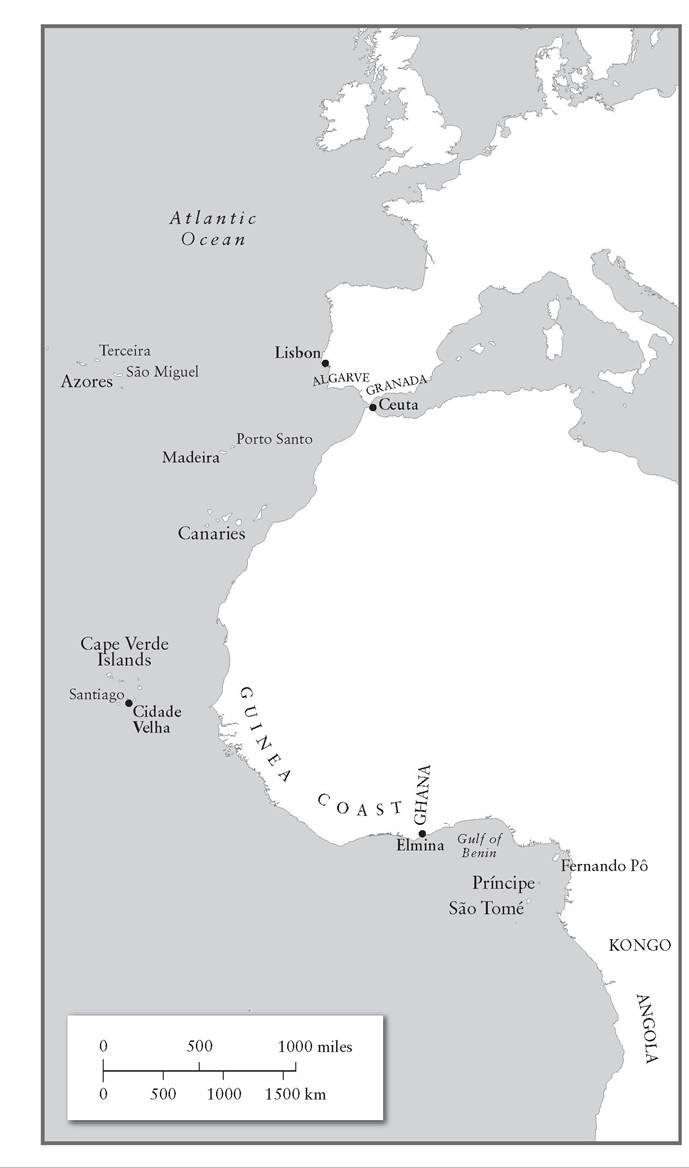
island, Sao Tome.
They also offer insights into the very earliest phases of the European slave trade out of Africa, insights that can now be developed further following excavations in the Cape Verde Islands. For this was a clean New World, the first New World, newer than the New World that was soon to be discovered, because all the island groups in the eastern Atlantic apart from the Canaries were uninhabited. The rape of this virginal world by greedy Europeans is one of the themes of this chapter.Geographers have given these scattered islands the common name of ‘Macaronesia’, derived from the Greek term ‘Fortunate Isles’ (MaKaprav Nqaot, Makaron Nesoi), which was used in antiquity to describe the Canaries; this has too much of the flavour of macaroni and has often been shortened to ‘Macronesia’, by analogy with Micronesia in the Pacific. Some historians have preferred to use the term Mediterranee Atlantique, seeing the eastern Atlantic archipelagoes as an interconnected world that came into existence as merchants and migrants expanded beyond the familiar waters of the Mediterranean and the eastern Atlantic shoreline into open seas that had rarely been navigated before the fourteenth cen- tury.1 The first of the Atlantic islands to be colonized were those in the Madeira archipelago. Although later legend told of a pair of storm-tossed and star-crossed English lovers who had been swept towards Madeira, the islands were uninhabited when the one-eyed Joao Goncalves Zarco and his colleague Tristao Vaz, squires of Prince Henry, explored them in 1420. The low-lying island of Porto Santo close to Madeira was placed under the authority of another sea captain, named Perestrello, whose family had originated in Piacenza in northern Italy but settled in Portugal; later, Christopher Columbus would marry into this family and quite possibly gained knowledge of Atlantic waters by studying information the family had kept to itself.2
The islands were already known to Italian and Catalan navigators of the fourteenth century: Madeira appears on the portolan charts as the ‘Isle of Wood’, Legname, which is exactly the meaning of the Portuguese word ‘Madeira’; and anyone sailing back from the Canaries after a slave-raid would have known how to catch the prevailing winds by swinging out north-westwards, which would have brought them in sight of Madeira, while an even greater swing might bring navigators to the Azores.
It is an extraordinary fact that the colonization of the Pacific had already been completed with the settlement of New Zealand about a century earlier, while colonization of the Atlantic islands lagged far behind. In part this was because the Atlantic islands were fewer and more scattered; in part it was the result of relatively slow advances in shipbuilding. Eventually the Portuguese caravel became the trademark ship of the early Portuguese explorers.This versatile l ateen-rigged ship, of around fifty tons, had a shallow keel that made it suitable for travelling upriver, an important advantage for those seeking the ‘River of Gold’ in west Africa. There were other advantages in its small size, compared to the great naus and cogs that visited Lisbon on their way to and from northern waters, or the ocean-going galleys of the Venetians and the Florentines that linked Flanders to Italy. For Portuguese timber resources were limited, and (as it turned out) the best timber was not to be found in Portugal itself, but out in the Atlantic.
The colonization of Madeira really took off after 1433, when the old king, Joao I, died, and Henry found himself in full charge of the island; even then, he arrogated to himself greater powers than the Crown was willing to concede, and tussles between Henry and the kings of Portugal over jurisdiction in Madeira were still going on in 1451.3 Yet it was thanks to Henry, if his biographer is to be believed, that this small island became an economic powerhouse. According to Zurara, Henry supported the first settlers by sending them seeds and tools. His interest in the island grew as his attempts to gain a further foothold in Morocco met with complete failure; following defeat at Tangier in 1437, he turned his attention to the Atlantic islands. Although he saw these islands mainly as a source of revenue, he also boasted to the pope that he had freed the inhabitants of Madeira from Muslim rule and had brought them back to the Christian faith - a nonsensical statement that reveals more about his love for selfpromotion than about the crusade against the Muslims.4
Madeira lies 350 miles from Morocco and about the same distance from the Canaries.
The island’s abundant hardwood became one of its best exports; it was said to be so strong that the inhabitants of Lisbon could use it to build new storeys on their houses.5 It was of great value to the growing Portuguese fleet; Madeira as well as Lisbon became a centre of shipbuilding. The discoverers divided up the territory, and one-eyed Zarco made his base at the ‘place of fennel’, O Funchal, now the island capital, where he and his followers flourished. The fertile, well-watered soil, left untended since the island rose out of the sea, yielded vast quantities of wheat; since the settler population was small (150 households in 1450, according to Zurara), Madeira offered a lifeline to Lisbon, which was suffering from lack of access to Moroccan grain now that the Portuguese were launching campaigns against the Marinid sultanate. Prince Henry’s Venetian captain, Alvise da Ca da Mosto (or Cadamosto), stated that around 1455 Madeira produced 68,000 bushels of wheat each year. All this meant that the ecology of Madeira underwent massive transformations following the arrival of the first human settlers, and the same applies to the other Atlantic islands that the Portuguese colonized.6Nonetheless, flat land suitable for wheat production was not easy to find on such a mountainous island, and Henry had grander plans. Da Mosto was travelling past Cape St Vincent on a Venetian galley bound for Flanders; the ship had to put in, and Prince Henry lured da Mosto into his service by showing him samples of sugar grown in Madeira, something that would tempt any Italian merchant.7 Demand for sugar was booming, just as supplies of sugar from the eastern Mediterranean were threatened by the Turkish advance to Constantinople; princely courts and prosperous merchants were enthusiastic consumers of luxury foodstuffs, including crystallized fruits and little caskets containing blocks of white sugar.8 Sicily, Valencia and Muslim Granada were among the great sugar centres of the Mediterranean, and Madeiran sugar was cultivated from either Sicilian sugar stocks or southern Portuguese ones recently set up by Genoese entrepreneurs in the Algarve.
But to produce sugar in the subtropical climate of Madeira was an inspired idea; Madeira was superbly equipped for this, with its vast amounts of wood (needed for the boiling of the cane) and of water, running down the steep hills. Its sugar could then be supplied to Flanders via Lisbon, or, before long, directly - many of the splendid Flemish paintings in the Museum of Sacred Art in Funchal were acquired as payment for sugar by Madeiran merchants of the late fifteenth and early sixteenth century.Da Mosto thought that the island was already producing 1,600 arrobas, or about 24,000 kg, of sugar by 1456. But these were small beginnings: by 1498 something like 600,000 kg of sugar were being sent to Flanders alone, with 225,000 bound for Venice and only 105,000 for consumption in Portugal - the total for just these places approaches 1,000,000 kilograms, but that year a decision was made to limit the quantity exported to 1,800,000 kg (120,000 arrobas), which was just as well, as the sugar cane was beginning to exhaust the land.9 Europe had developed a sweet tooth. And the quantity being produced grew and grew. The Portuguese Cortes, or parliament, of 1481-2 noted that twenty large ships and forty to fifty smaller ones were loading sugar and some other goods, ‘for the nobility and richness of the merchandise of great value which they have and harvest in the said islands’. Pope Paul II praised Zarco and his colleagues for all they had done to supply the Iberian kingdoms with sugar, wheat and other ‘comforts’.10
Administering places a long way from Lisbon was a challenge. The ‘sub-donatories’, Zarco and Vaz on Madeira and Perestrello on Porto Santo, who had discovered the islands and were Henry’s agents there, were authorized to operate local courts; they received one tenth of the revenues from their lands, passing the remaining nine tenths to Henry, or rather the Order of Christ. Their share might seem paltry, but it was not paltry so long as the Madeira archipelago continued to export its sugar and wheat on such an enormous scale.
Madeirans at large benefited handsomely from exemption from trade taxes on goods sent to Portugal, which the Crown renounced in 1444 to encourage trade. It is no wonder, then, that, by the end of the fifteenth century, Madeira was attracting settlers from Portugal, Genoa and Tuscany; others arrived from Flanders and Germany, given the close links between Madeira and the sugar trade to Flanders. In 1457, some German settlers were allowed to plant vines and sugar and to build a chapel and houses. The Portuguese imposed few restrictions on settlers, though the Madeirans were keen to expel the enslaved Canary islanders who had been imported to work the sugar mills, and were proving extremely truculent.11 The Genoese brought capital and enterprise, and helped kick-start the sugar industry. Among them was Christopher Columbus, who visited the archipelago in 1478, aiming to buy sugar in exchange for cloth; and his business partner in Madeira was Jean de Esmerault, a Fleming. This mixed population had reached about 15,000 by 1500, which included the full panoply of priests, merchants and artisans as well as the descendants of the original cultivators of the soil. Of this total, some 2,000 were slaves, either from the Canaries or from west Africa. This is a surprisingly low figure, since the sugar industry demanded plenty of cheap labour for back-breaking work; the main labour force was Portuguese and Italian.Another source of stability was the simple fact that the first European proprietors lived a long time, Zarco remaining in charge of southern Madeira for about forty years. It is not hard to see why they lasted so long. They lived far from the centres of plague and other disease in western Europe; their diet was a plainer but healthier one than that of minor nobles in Iberia or Italy; the water was clean; they fought few or no wars. Nature could be remoulded: whether by the planting of sugar stocks or by the cattle and sheep that first populated the Azores. Sometimes, admittedly, this did not work well: when rabbits were introduced to Porto Santo they gobbled up the vegetation and turned the island into a semi-desert; it has never recovered. Madeira lost part of its tree cover as its timber was sent for export or burned in the furnaces of the sugar mills.12
II
The Azores too were evidently known to mapmakers before their colonization; they are recognizable in fourteenth-century Majorcan portolan charts.13 Lying between 800 and 1,000 miles due west of Lisbon, these
nine volcanic peaks gradually became valued for themselves, rather than any notional value in the fight against Islam in north-west Africa. Although they lie much further out from Portugal than Madeira, ships returning from Madeira or the Canaries would have taken advantage of the prevailing winds to follow a great curve that took them towards the Azores before they turned eastwards in the direction of Lisbon; the story grew that the Portuguese had reached the legendary ‘Isle of Brazil’ that was said to lie out in the Atlantic, or possibly the ‘Isle of the Seven Cities’, inhabited by refugees from the Muslim conquest of Spain more than 700 years earlier.14 Impressed by the hawks that hovered over the islands, the Portuguese gave them the name ‘Hawk Islands’, Azores. These islands were completely uninhabited by humans, and attempts to argue that the Phoenicians knew the islands or that stone structures on the island date back to Neolithic times are based on very flimsy evidence. In 1439 Henry the Navigator received permission from the Crown to settle ‘the seven islands of the Azores’, so they already had their name and a number; and, though it was the wrong number, it was the number of units in the Isle of the Seven Cities.
In the 1450s, Henry claimed, with typical bravado, that the Azores ‘had never known any lordship but his’. This was a blatant lie, as the king had earlier insisted he must share the lordship with his brother Dom Pedro, but by the time Henry made his claim Dom Pedro had rebelled against the Crown, had been defeated and had died, so his rights could be ignored. As at Ceuta, convicts were regularly dumped here, though in 1453 one convict was able to argue that he should not be transported to the Azores for the rest of his life, because conditions on the islands were still so primitive. No doubt he had friends in high places, for his argument, which succeeded, hardly stands up - solid buildings existed and dairy products and wheat abounded. The main concern back in Lisbon was not how to punish criminals but how to populate far-off islands and make sure the settlers stayed put.15
Wetter and windier than Madeira, though still blessed with a benign climate, the Azores seemed ideal terrain for cattle rather than for people, and as the islands were opened up to settlement ships would arrive carrying cows, sheep and horses rather than human beings, leaving them awhile until they had bred, spread and cleared some of the meadows. The Azores are still a major source of dairy goods in Portugal, and are famous for their butter and cheese; there was some attempt to produce sugar, but the climate was not quite warm enough and manpower was in short supply - the inhabitants of one island, Santa Maria, had to send their canes to Sao Miguel across the water for processing, since they did not have the machinery themselves. In 1510 the Azores exported only about 6 per cent of the sugar exported by Madeira, and sometimes it was even less than that.16
The Flemish connection was as important as the Portuguese one. Enterprising Flemings came and colonized, but not, as in Madeira, because of a sweet tooth. On the third island to be settled, appropriately known as Terceira, or ‘Third Island’, James of Bruges established a dominion around the little beach of Praia da Vitoria in the north-east, building an elegant church with a Gothic gateway and stone-vaulted side chapels, out of materials that were brought all the way from Europe. Henry sent him a charter urging him to settle the island, ‘which had never before been settled by anyone in the world’, with good Catholics, and in the wake of this so many Flemings arrived that the whole group of islands was often called the ‘Flemish Isles’ rather than the Azores.17 The products they cultivated included the dark-blue substitute for indigo, woad, much in demand in the Flemish cloth workshops; by 1500, up to 60,000 bales of cured woad leaves were exported annually. Gradually, an intertwined network of islands emerged, as the Azores, Madeira and the Canaries exchanged goods and manpower: native Guanches from Tenerife were settled against their will in Madeira; Portuguese labourers emigrated to the Canaries; Genoese and Flemings arrived in all the islands. This network was itself tied to the emerging emporium of Lisbon, no longer a city of moderate size and importance, but the centre of a maritime trading world that stretched across great swathes of the eastern and northern Atlantic.18 By the late sixteenth century, the Azores became the strategic centre of a network of trade routes; ships arriving from South America and round the Cape from India gathered at Angra on Terceira, before proceeding in convoy to Portugal, in order to escape predators such as the English pirates who lurked in those waters. They were also important resupply centres for long-distance shipping.19
III
The exploration of the coast of Africa, the subject of the next chapter, resulted in the discovery of yet more uninhabited islands, west of Senegal. The debate about who first sighted the Cape Verde Islands, around the time of Henry the Navigator’s death in 1460, is not very instructive - maybe it was the Venetian captain of Prince Henry, Alvise da Mosto, maybe a Genoese named Antonio da Noli, maybe a Portuguese named Diogo Gomes, but the fact that two of the three were Italian says something about the reliance of the Portuguese on Italian navigational know-how. After their discovery, the islands were placed under the command of Antonio da Noli as captain-general. He proved to be yet another long-lived colonial master, and he held on to power even though for a brief period in 1486-7, when Castile and Portugal were at war, he was carried off to Spain, where he apparently abandoned his loyalty to the king of Portugal and recognized Ferdinand and Isabella as his overlords.20 He probably never returned to the islands; but neither Spain nor Portugal could really maintain control of such distant possessions, and once Castile and Portugal were at peace again, and once the pope had adjudicated these islands to Portugal, as he did in 1493/4, Portuguese claims to rule the islands could no longer be challenged from Spain.
Like the Azores, these islands were stocked with animals, not so much to feed the exiguous population as the sailors who passed by, heading from Europe to the west. However, when livestock was introduced to the Cape Verde Islands goats and sheep uprooted the plants, the soil no longer retained such water as there was, for rainfall is low; and the landscape became even more parched and bare than it was already. The animals somehow survived; but hopes of making the islands into a second Madeira were foiled. The royal privilege establishing Portuguese settlement in the Cape Verde Islands, dated 1462, grandly talked of the rivers, woods, fisheries, coral, dyes and mines, but the reality was that these islands could offer very little apart from the ubiquitous lichen orchil, used to make purple dye, and salt from the island appropriately known as Sal, which could be used to salt the meat sold to passing ships. One island was being used as a leper colony by the time of Christopher Columbus, and others, including Sal, were left unoccupied.21
Limited resources on the islands themselves were not an overwhelming problem; if anything, these sparse resources stimulated close interest in trade with west Africa as a much more viable source of profit, and the king permitted islanders to trade freely on the Guinea coast opposite, with the result that slave-trading and slave-raiding became their speciality (the arrival of the Portuguese in west Africa will be explained in the next chapter).22 It cannot, therefore, have been easy for the islanders when, during the 1460s, the Crown insisted that only Caboverdean goods, including foodstuffs, could be used in payment if the settlers visited the Guinea coast for trade, but one effect of this regulation was that it stimulated the cultivation of cotton and the weaving of cotton cloth in the islands.23 Horse-breeding became another speciality - mounted troops were a familiar sight in African armies, but obtaining good horses was a headache everywhere.
The main article of trade through these islands was quite simply, and quite horribly, human beings young and old, male and female.24 As the coast of west Africa became a major source of black slaves, the Cape Verde Islands began to be used as a way station for slaves exported from Africa to Europe (and, in the sixteenth century, to Brazil and the Caribbean).25 Although Portuguese merchants penetrated into west Africa, and even set up home there, there were great advantages in using the islands as a base. In Africa, there was always the delicate problem of dealing with the local rulers, and convincing them that the presence of these outlandish Europeans, with their bizarre clothes, was worthy of attention. Living on Portuguese territory and visiting the Guinea coast solely for business was a much more practical option; one might have to pay taxes to Portuguese officials, about whom the merchants naturally grumbled a good deal, but the protection of the Portuguese king, even so far from Lisbon, was preferable to that of African rulers who were often at war with one another - indeed, these wars were the major source of slaves for European buyers. In the three years 1491, 1492 and 1493 around 700 slaves were brought to the island of Santiago, or, at least, that number was recorded; in reality there must have been many more who were sneaked past the royal tax officials, and it is likely that as many as 25,000 African slaves passed through the island between 1500 and 1530, as demand for labour grew not just in Europe but in the newly discovered lands across the Atlantic.
Most of the population lived on the main island, Santiago, and a town called Ribeira Grande, later sacked by Francis Drake, was founded in about 1462; after it was abandoned for the present capital, Praia, it became known by its present-day name of Cidade Velha, ‘the old city’. Taking advantage of the ‘Great River’ that gave the town its original Portuguese name, and that ensured an unusually lush setting in an otherwise arid island, the Portuguese were quick to develop their trading base. They built stone houses, which have now vanished, and churches, beginning with Nossa Senhora de Conceigao, whose construction probably began only a few years after the islands were discovered. The foundations of this church have been unearthed by a team of archaeologists from Cambridge University, marking the site of the earliest European building in the Tropics.26 Only one of the churches in the old capital survives intact, Nossa Senhora do Rosario, built in the 1490s close to the earlier church. It was reputedly visited by both Vasco da Gama and Christopher Columbus, who passed through the Cape Verde Islands in 1498 on his third voyage. Today much of the church has been remodelled, but there are still clear traces of the original building: a side chapel has retained its ribbed Gothic ceiling, manufactured in Portugal for reassembly in Ribeira Grande; for it was common Portuguese practice to send dressed stones to overseas settlements, and the vaulting of James of Bruges’s church in the Azores, also brought from Portugal, is quite similar.
Half a century later Ribeira Grande was still tiny: in 1513 it contained 58 Portuguese citizens, or vezinhos, 56 visitors or foreign settlers, 16 free African males, 10 free African women and 15 churchmen, who were all outnumbered by the uncounted slaves; and the foreigners included Genoese, Catalans, Flemings and even a Russian. (By 1600 it may have risen as high as 2,000, though never higher.)27 The Town Council of Ribeira Grande saw slaves as the foundation of the islands’ prosperity, and stated in 1512 that ‘merchants from Castile, Portugal and the Canary islands would not come to the Cape Verde islands if they were not able to purchase enslaved Africans’; by this time the slavers were already sending captives across the Atlantic to the Caribbean, to replace the native population of Hispaniola and other islands, which was heading towards rapid extinction.28 In 1518 the Spanish king arranged the purchase of 4,000 slaves from Portuguese merchants, to be sent to the Caribbean.29
Ships put in at Ribeira Grande and at a rival town called Alcatrazes, whose location remained unknown until the archaeologists from Cambridge identified the site at the start of the twenty-first century. Archaeology has also come to the rescue of historians of the Atlantic by showing that large numbers of slaves lived in Ribeira Grande just after 1500, many of them apparently converted to Christianity. To judge from the graves found by the same team from Cambridge, there may be as many as 1,000 burials under and close to the church of the Conceigao, and the simplicity of many of the burials, along with preliminary DNA analysis, suggests that half or more were slaves. There were also some free black inhabitants, and they eventually merged with the European settlers to create the Creole, or Krioulu, society that persists. For long, though, a white elite dominated the islands, including New Christians of Jewish descent who hoped to keep the Inquisition at arm’s length; their blood also runs through the veins of many modern Caboverdeans.30
Millet and rice were imported from Guinea, mainly, it seems, to feed the African slaves.31 The islands depended on the income from the sale of slaves and other goods, which provided the cash to buy in the most basic supplies. The manifest of a single ship that carried 139 slaves and a quantity of hides back to Europe in 1513 is very revealing. The Madanela Cansina was a Castilian caravel under the command of Diego Alonso Cansino. It carried a vast variety of products to Santiago in 1512: linen cloth, dark-green Castilian cloth, Flemish cloth, figs, flour, wine, biscuit, raisins, almonds, cheeses, saffron, wheat, olive oil, beans, soap, shoes, tablecloths, bowls, brooms, just to cite selected items.32 In addition, the new excavations at Cidade Velha on Santiago have brought to light pottery from Portugal and Africa (and, rather later, from China), building materials, especially marble, tiles, coins, nails and buckles, once again indicating how dependent Santiago was on finished goods, particularly those from Europe. African ceramics arrived from Senegal and from Berber areas of north-west Africa; European ceramics included small drinking cups and other everyday wares from Portugal, ‘giving’, according to the archaeologist Marie Louise Sorensen, ‘a sense of the attempt to maintain a similarity in daily life routines’ among the settlers.33
IV
There is no reason to doubt the misery of the African slaves who either languished labouring in the Cape Verde Islands or were sent on to Portugal, and from there across Iberia to Valencia and other slave-trading centres in the western Mediterranean.34 As Portuguese expeditions reached further south and east, they made contact with local rulers who were happy to sell them slaves from the Gulf of Benin and from the areas they knew as Kongo and Angola, a little to the north of the present-day country of Angola. Once again the Portuguese made use of uninhabited islands off the coast of Africa as collection points for slaves, while at the same time they tried to work out how they could capitalize on the resources of these fresh territories. In 1472 Portuguese ships reached the island of Sao Tome, tucked into the corner of Africa and lying right on the Equator. Within ten years it had become the collection point for the thousands of slaves who were brought (and bought) from Ghana, while the nearby island of Principe was the major Portuguese base for trade with the Benin coast.35 When they discovered that the third island in the Gulf of Guinea, Fernando Po (modern Bioko), was already inhabited, the Portuguese held back from settling the island. For what they wanted was territories they could mould exactly to their own uses.
It took some years for the Portuguese Crown and Portuguese merchants to express much interest in Sao Tome, whose thick tropical forests left them wondering what they could hope to extract from the island. Its usefulness only became obvious as the slave trade out of Ghana took off in the 1480s.36 Unlike the Cape Verde Islands, this island played an insignificant part in the trade towards the Indies that developed after 1500, lying as it did well away from the great parabolas that carried ships around the southern tip of Africa or up to Portugal from Brazil. Gradually, though, the Portuguese attempted to cash in on the island’s own resources. At the end of the fifteenth century they tried to make Sao Tome into a centre of sugar production.37 Labour was cheap, consisting of Kongo slaves and, as will be seen, Jewish children from Portugal, although Sao Tome offered its first inhabitants little apart from palm oil and yams, leaving them hungry, so that, at the start, staple goods such as flour, olive oil and cheese had to be imported from Portugal and the nearby, better-endowed, island of Principe. That said, the Portuguese made a great effort here, as in other Atlantic islands, to transform their colony into a place suitable for settlement. They brought in all sorts of domestic animals, figs, citrus trees, plantains, and, in due course, American varieties of coconut and sweet potato. By 1510 there was a surplus and they were now feeding, rather than being fed by, the colonists at Elmina, the main Portuguese base in Ghana.38
Sugar came to dominate the economy of the island, along with the handling of slaves brought from the mainland. One item, essential for sugar manufacture, was plentiful: water. Sao Tome has high rainfall as well as plenty of wood for burning; and there are steep slopes off which the water runs. Water was also a problem. It was needed while sugar was being manufactured; but the finished product had to be allowed to dry out, and the humid climate made this much more difficult. What the Sao Tomeans put on sale was far inferior to the highly prized sugar of Madeira. Sugar from Sao Tome was described as ‘the worst in the world’; it often contained live insects that survived transport to Portugal. Moreover, mortality from malaria, overwork and generally unhealthy conditions was extremely high, particularly among Portuguese settlers unused to the tropics; it is hardly surprising that Portuguese churchmen appointed to serve on this island made every effort to avoid setting out. At a rough estimate half of those who came to Sao Tome died from disease and other factors within a few months of their arrival.
The population remained small at the start of the sixteenth century, when about 1,000 heads were counted by a German geographer and printer based in Portugal named Valentim Fernandes. But these were just the settlers; 2,000 slaves resident on the island and 6,000 slaves destined for export have to be included as well. The free settlers included liberated slaves, among whom there were women who bore children to Portuguese men, so that a free mulatto population emerged quite early.39 Like other Atlantic islands, Sao Tome was considered a suitable place of exile for the so-called degredados, people convicted of crimes in Portugal.40 Sao Tome, as a place of exile, had one very special feature to its early population. In 1493 King Joao II decided to settle the island with Jewish children, forcibly taken from their parents in order to ensure that they were baptized and brought up as Catholics. These were Jews who had fled from Spain to Portugal in 1492, at the time of the expulsion of the Jews from Spain, and who had overstayed the eight-month period the king had reluctantly allowed them to remain. This was one stage in a process that culminated in the mass conversion of all Portuguese Jews in 1497.41
The Jewish settlement of Sao Tome is described in several Jewish and Christian sources. The court chronicler Rui Pina wrote soon afterwards of Joao II:
The king gave to Alvaro de Caminha the Captaincy of the island of Sao Tome by right and inheritance; and as for the Castilian Jews who had not left his kingdom within the assigned date, he ordered that, according to the condition upon their entry, all the boys, and young men and girls of the Jews be taken into captivity. After having them all turned into Christians, he sent them to the said island with Alvaro de Caminha, so that by being secluded, they would have reasons for being better Christians, and the king would have a way for the island to be better populated, which, as a result, grew rapidly.42
The Christian writer Valentim Fernandes thought there were 2,000 children, while the estimates of numbers among Jewish authors varied between 800 and 5,000. It appears that they were mostly very young, from two to ten years old, so that they were placed with foster parents, mostly convicted degradados.4 According to the Portuguese Jew Samuel Usque ‘almost all were swallowed up by the huge lizards on the island and the remainder, who escaped these reptiles, wasted away from hunger and abandonment’. Fernandes said only 600 were still alive in 15 10.44 The harsh conditions - the searing heat, the uncleared jungle, the heavy manual work involved in sugar production, along with diseases such as malaria - killed many of the settlers, whatever their origin; and it was for that reason that black slaves began to be imported to work the sugar estates. In the sixteenth century, Portuguese New Christians, descended from Jews, did settle in the island, but the Jewish children were by then long dead, or had merged with the other Portuguese settlers and with the African slaves. Memories of the Jewish connection survived: one bishop reported, as late as the seventeenth century, that he had been awoken by a ‘Jewish’ procession, in which a Golden Calf was being carried along the street underneath the windows of what passed for his palace. His knowledge of Judaism, or indeed of the biblical story of the Golden Calf, was evidently very limited.45
Valentim Fernandes noted that there were about 250 wooden houses in the main town, and that there were stone churches, constructed out of materials sent in 1493 with those early Jewish and Christian settlers. Despite the miserable conditions, the island proved a lucrative source of income, from which the Crown could hope to draw as much as 10,000 cruzados a year at the start of the sixteenth century.46 A privilege to Fernao de Mello and the inhabitants of Sao Tome, dated 20 March 1500, explains the Crown’s thinking:
Since the said island is so remote from these our kingdoms, people are unwilling to go there unless they have great privileges and franchises; and we, observing the expenditure we have ordered for the peopling of the said island and likewise the great profits which would come from it to our kingdoms, if the island were peopled in perfection, as we hope with the help of the Lord it will be, have resolved to grant him certain privileges and franchises, whereby the people who go there, may do this more willingly.47
The basis of this success was initially trade towards the African mainland, using home-made ships, which were quite small (thirty tons) and simple, and which were supplied with cowrie shells rather than metal currency for payments in Angola and Kongo.48 The regular traffic in slaves between Sao Tome and Elmina reached its peak in the thirty years after 1510, when up to half a dozen vessels moved back and forth almost continuously between the two points, laden with African slaves when bound for Elmina. The journey normally took up to a month and departures from Sao Tome occurred about every fifty days; some ships were large enough to carry one hundred slaves, others only about thirty.49
V
The Portuguese began to see the Atlantic as an island-studded ocean. In 1469 and 1474 the king of Portugal had already made generous grants of islands in the far west to two of his knights. One was granted two islands, which suggests some vague reports had arrived of specific places; the other was simply granted the isles ‘in the parts of the Ocean Sea’, which implies little more than a general assumption that there were more places like the Azores to be found. If there were islands, these might well be the islands that were known to lie off the coast of Asia, notably Cipangu, Marco Polo’s Japan, or bits and pieces of the Spice Islands whose costly products were on sale in Alexandria and Beirut.50 The best authorities, such as Admiral Morison, have rejected modern Portuguese claims that there was real knowledge of land to the west, kept secret in Lisbon for fear of Spanish or other competition.51 A good reason for this doubt is the fact that the Crown was not willing to pay the costs of an expedition to find new land. If individual entrepreneurs wanted to apply for a licence to look for land, that was another matter, so long as they reached into their own pockets.
King Joao II therefore had no objection when the Flemish sea captain Ferdinand van Olmen approached him in summer i486 requesting permission ‘to find for him a large island, or islands, on the coast of a continent, situated where it was thought the Island of the Seven Cities was to be found, and that he would undertake this at his own expense’, winning in return hereditary rights of jurisdiction. He would travel in the company of a Madeiran named Estreito, who would provide two caravels; if the land was found and the natives resisted, the king airily promised that he would despatch an armada to keep them in check. Van Olmen thought that the journey could be accomplished in less than forty days. He set out from the Azores full of hope, probably in spring 1487, heading north-west, only to disappear from history. For, even if he had heard rumours of distant lands, vague reports of Greenland or of Bristol fishermen off Labrador, he knew little of the winds and currents out in the open ocean, and he almost certainly sailed into storms he could not manage.52 If anything, van Olmen’s disappearance proved that this route led nowhere. It might indeed be possible to reach the Indies, but the obvious routes were down the ‘River of Gold’ that in some accounts crossed the waist of Africa, or even around the southern tip of Africa - assuming, that is, that it had a southern tip and that the Indian Ocean was not a closed-off Mediterranean completely surrounded by land, as Ptolemy had maintained, and who could quarrel with such a great authority?