25 Portugal Rising
I
The north-east Atlantic was becoming a well-integrated maritime region by the end of the Middle Ages. The history of the early Atlantic cannot, however, be written without paying attention to the shorelines further south.
Even so, the vast expanse from the Canary Islands to the southern tip of Africa remains blank. The Canary islanders, whose ancestors had unquestionably arrived by sea, had lost the art of navigation by the time that European explorers chanced on their islands, in the fourteenth century. The peoples of sub-Saharan Africa did not venture out to sea, and long-distance sea routes down the coast of west Africa were first developed by Europeans - by the Portuguese in the second half of the fifteenth century. The ambitious voyages of the Portuguese southwards along the coast of Africa and westwards towards the Atlantic islands have overshadowed the earlier maritime history of Portugal and Atlantic Spain, for when Prince Henry the Navigator launched the first expeditions southwards the major interest of Portuguese sailors lay in northern waters, in Bruges, Middelburg and England.1 The first aim of this chapter is to see whether the maritime history of Portugal really began well before the fifteenth century.Even before the Portuguese and the Castilians launched fleets in the Atlantic (having secured the service of highly competent Genoese admirals), the ocean waters off Iberia were far livelier than is generally supposed. The Viking raids on Spain prompted the rulers of al-Andalus to create an Atlantic fleet, and to take more seriously the dangers that might threaten from the open Atlantic. In 859 Muslim fleets set out to challenge the Viking raiders, carrying on board flasks of Greek fire and teams of archers; they scoured the seas as far away as the northern coast of Spain, so that the presence of these ‘Moors’ (Mauri) alarmed the Christians who ruled there as much as did the arrival of the Vikings.
But Muslim fleets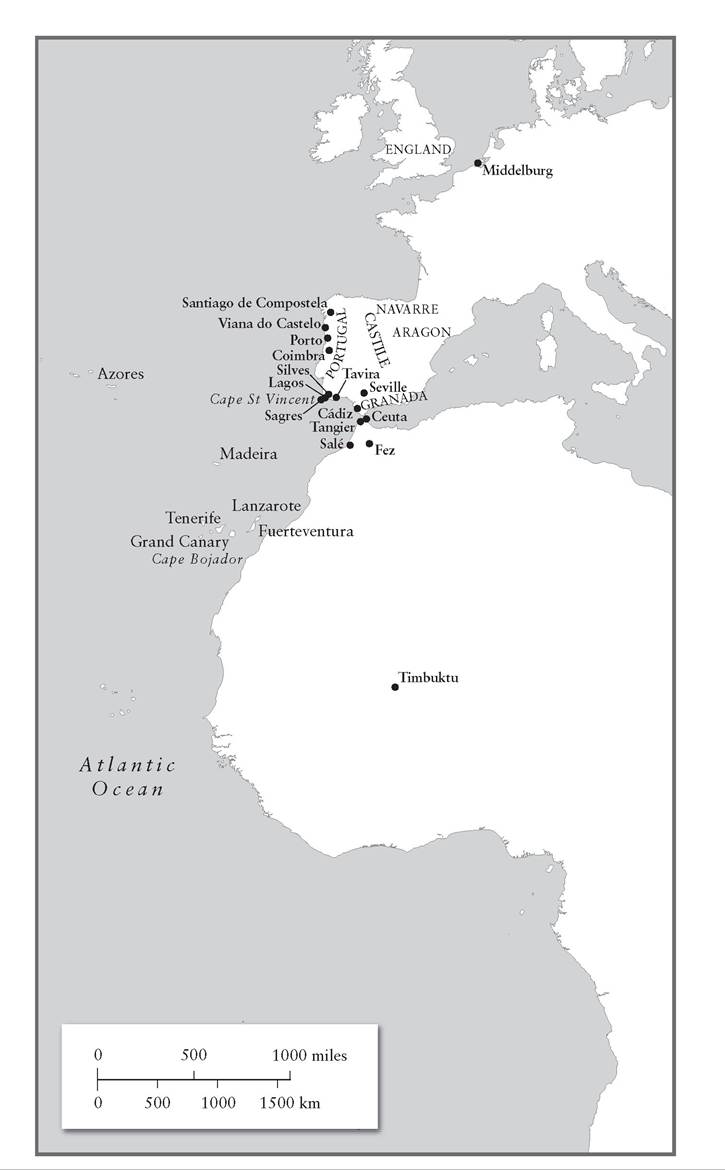
kept up the chase and scored a series of successes, culminating in the destruction of fourteen Viking ships near Gibraltar; in 966 a Muslim fleet from Seville scared off Vikings who had penetrated right up to Silves, an important town that lay a little way upriver in what is now the Portuguese Algarve.2 All this shows that the Muslims were perfectly capable of launching fleets in the Atlantic, often based upriver at Seville; moreover, since the Viking raids were lightning attacks, these fleets were not specially built for the occasion, but were clearly part of the standing forces of the emirs and caliphs of al-Andalus.
The problem with tracing the activities of the Muslim fleets, and still more of Muslim traders, in Atlantic waters is that the evidence is very sparse, mainly consisting of stories about battles that have been reported at second or third hand, or references to rare goods brought to the heartlands of Islam from al-Andalus al-Aqsa, the furthest reaches of Spain.3 Seville, it is true, looked eastwards, and sent the olive oil of southern Spain through the Strait of Gibraltar to the eastern Mediterranean; but this did not mean that the resources of the Atlantic were neglected. In the Muslim period, up to the early thirteenth century, the shores of Portugal and Atlantic Andalusia were scoured for the whale vomit known as ambergris, which, despite its inauspicious source, has long been an expensive ingredient in perfumes, and which could be found washed up on the shore in fatty lumps; this, along with Atlantic coral, was forwarded all the way to Egypt, while the ocean was also exploited for its fish, sold in local markets; the tunny caught off Cadiz and Ceuta was specially prized. The fishermen were both Muslims and Mozarabs, that is, arabized Christians largely descended from the pre-Islamic population of Spain and Portugal.
Wood suitable for shipbuilding could be found in the Algarve. The inhabitants of Silves sold their elegant ceramics far afield, and the town possessed its own arsenal in the eleventh century, when it was ruled by the Muslim kings of Seville.4 Nor did the inhabitants of al-Andalus ignore the coast of Morocco, for they sailed down to Sale opposite Rabat in the twelfth century; and other ports along the Moroccan coast, including Arzila and possibly Mogador, were being visited in the ninth century.5 While the waters off Atlantic Iberia did not match the Mediterranean for intensity of contact, the Atlantic was not a sea of darkness for the Muslims.The relative quietness of the coastal waters off Morocco and Mauritania contrasts with the increasing liveliness of contact between Christian and Muslim in the waters off Iberia itself. In the twelfth century, as the Christian county (later, kingdom) of Portugal carved out territory in western Iberia around Porto and Coimbra, the Muslims found they had to face a challenge on the sea as well as on land. This was just when Muslim power in Iberia seemed to have recovered under the fundamentalist Almo- hads, whose radical revivalist movement originated among the Berbers of the Atlas Mountains. The first shock that the Almohad caliph faced was a surprise attack on Lisbon by a substantial navy, said to have numbered 164 ships or more, which had set out from Dartmouth in England en route to the Holy Land in 1148, following the call to arms of the Second Crusade. When they arrived in Porto the city’s bishop eloquently reminded the English, Flemish and German sailors on board the crusading fleet that they would be coasting past Muslim-held territory even before they entered the Mediterranean. Convinced that an attack on Lisbon would serve the purposes of a grand crusade which was being fought not just in Syria but in the Wendish lands bordering Germany and in the Muslim lands bordering Catalonia, the crusaders eagerly joined a Portuguese expedition against Lisbon and, after great violence, forced the city’s surrender; predictably, this was followed by its sack, and even the bishop of the Mozarabic Christians whom they found within its walls was slaughtered.6 The capture of Lisbon gave the Portuguese a superb base in southern Iberia; in the thirteenth century the weakness and then collapse of the Almohad Empire in Spain and north Africa left them free to chip away at the Algarve, and they were masters of Silves by 1242.
Portuguese sea captains were already harrying Muslim ships and shores well before that date. A Portuguese fleet was built in response to constant raids on central Portugal by the Almohad navy, so it seems that Almohad policy had backfired: the Portuguese began to organize themselves as never before. By the late 1170s an intrepid admiral named Dom Fuas Roupinho was launching his ships into the Atlantic and led attacks on Almohad al- Andalus, all the way down to the coastline near Seville, as well as attacking Ceuta on the northern tip of Morocco. Between 1177 or 1178 and 1184 the two sides fought what a French historian has called ‘a veritable battle of the Atlantic’, marked by dramatic episodes such as the capture of the Almohad flagship and eight other vessels in 1180. In the long term, though, things did not always go well for the Portuguese: in 1181 the Almohads captured twenty, or maybe forty, of Dom Fuas’s ships, and he was killed, while three years later the Almohads attacked Lisbon from the sea, though they were unable to repeat the success of the crusaders thirty-six years earlier.7 Almohad power in Spain was only broken in 1212, in the land battle of Las Navas de Tolosa, in which - uniquely - the kings of Castile, Aragon, Navarre and Portugal set aside their differences and launched a joint attack on a Berber empire that was already suffering from the strains of overextension and abandonment of its founders’ rigid principles.
II
Lisbon benefited from growing interest in routes linking the Mediterranean to England and Flanders at the end of the thirteenth century, as did the ports of northern Spain: Basque sailors become more and more noticeable in the records from this time onwards, while the pilgrim traffic to Santiago, which lay under Castilian rule, brought increasing numbers of pilgrims across the sea. Inland, Portugal remained poor in resources, though demand for its wines grew during the Middle Ages. The ports, notably Lisbon and Porto, but also smaller places such as Viana do Castelo in the north of the country, were the real hives of economic activity.
And the Portuguese kings recognized the importance of these places in one privilege after another: royal letters of 1204 and 1210 mention a ‘commander of the ships’ (alcaide dos navios), and around the same time Portuguese merchants were being made welcome in England by a ruler who was always on the lookout for sources of revenue, King John; his son Henry III was prodigal in safe conducts for Portuguese merchants, dispensing more than a hundred of these privileges in the single year 1226.8 Following the grant of the Carta Mercatoria to all foreign merchants by King Edward I in 1303, the Portuguese, like everyone else, had to pay higher customs dues, but England became even more attractive than before, because the merchants now lay under the protection of the Crown. That was something worth paying for. A commercial treaty in 1353 was followed by the Treaty of Windsor in 1386, a political alliance that reflected the common interests of the two kingdoms during the Hundred Years War, and English support for the dynasty of Aviz that had seized the throne in 1383 (largely to prevent it from falling into the hands of their hated neighbours, the Castilians). Marriage ties also bound the kingdoms together, after Philippa of Lancaster married the king of Portugal; her sons included the pioneers of Atlantic exploration Henry the Navigator and Prince Pedro.9 So began an alliance that both sides in later centuries liked to think had never been sundered.The Portuguese kings were, not surprisingly, even keener to promote Portuguese trade than foreign partners; King Dinis established an innovative mutual insurance scheme in 1293, whereby risks at sea were shared among the trading community. He understood that an effective fleet was needed in troubled times, and in 1317 he hired Manuel Pessagno, a Genoese admiral, to organize the construction of a fleet - the Castilians and even the French also relied on Genoese talent in their fleets.10 Well before then, by 1200, Portuguese products were flowing into Bruges: a burgher
470 THE YOUNG OCEAN: THE ATLANTIC, 22,000 BC-AD I500 of the city wrote that ‘from the kingdom of Portugal come honey, skins, wax, hides, grain, ointment, oil, figs, raisins and esparto grass’.11 By 1237 there was a royal arsenal in Lisbon, though it had surely existed for some time already.
No one could have claimed that Portugal was already a major maritime power, and one should be wary of assuming that these achievements led in a straight line to the successes Portugal was to enjoy in the fifteenth-century Atlantic, but without the groundwork of King Dinis and others it is hard to see how Portugal would have emerged as a naval power on a scale out of all proportion to the size and natural resources of the country.If Portugal was to flourish as a centre of business, it was vital to attract capital to Lisbon; and the obvious source of capital lay in the north Italian cities. The Crown was therefore keen to make the Italian merchants feel comfortable in the capital. In 1365 the Portuguese king generously exempted merchants from Genoa, Milan and Piacenza (a major centre of banking) from the authority of the royal officials who supervised the loading of goods on ships. It would not do to discourage the wealthiest businessmen in Portugal from trading through Lisbon. A few years later another king of Portugal found himself apologizing to the Genoese for Portuguese pirate raids on their ships, which had been seized along with a precious cargo of Flemish and French cloth. These kings offered special privileges for the Genoese and others in Lisbon, without extending them to other ports in the country. The city became home to branches of several of the most powerful Genoese families, such as the Lomellini and the Spinolas.12 Lisbon was being slowly transformed into a major port city.
Notwithstanding these initiatives by the Portuguese Crown, interest in the sea depended on the initiative of the shipowners, sailors and merchants who set out from Lisbon and other ports, bound for Flanders and England in one direction, but also for warmer waters further south. By the fifteenth century Portuguese shipping was making regular appearances in the Mediterranean, bringing dried fruits and other relatively modest goods through the Strait of Gibraltar, over which the wealthy Muslim city of Ceuta, on the northern tip of Morocco, majestically presided.13 The presence in the Mediterranean of ships from Atlantic Iberia - not just Portugal but Galicia and Cantabria, including many Basque vessels - demonstrates how the Strait had ceased to function as a barrier, and had become a link in the chain connecting the vigorous trade of the Mediterranean world with Atlantic networks.14 From the eastern end of the Indian Ocean to the Red Sea, from Egypt and Syria to Venice, Genoa and Barcelona, from there out through the Strait to Atlantic waters all the way to Bruges, and from Bruges to Lübeck, Danzig and Riga, goods were conveyed stage by stage;
and the ports of Portugal were especially well placed to benefit from these world-encompassing connections (world-encompassing at least in an age when the existence of the Americas was not suspected). One stimulus to their interest came from the increasing concern of mapmakers to sketch accurately the shores of Europe and the lands beyond. By the middle of the fourteenth century, maps were being drawn in Majorca, Genoa and elsewhere that showed interesting-looking islands out in the Atlantic, as yet unsettled: certainly Madeira and possibly also the Azores, which lie so much farther out that this would speak for quite bold attempts to sweep the eastern Atlantic in the search for lands to exploit, whether by conquest or trade.
Exploration of the coast of Africa had begun by 1291, when the Vivaldi brothers from Genoa set out by way of Majorca and the Strait of Gibraltar to find a sea route all the way to India. They disappeared somewhere off the coast of Africa, no doubt overwhelmed by waves or wrecked on sandbanks along shores that were still unmapped and therefore extremely treacherous. The idea that they were precocious predecessors of Columbus, bound westwards for the opposite shores of the Atlantic (and for what they supposed would be China) holds no water. Still, their unfinished exploits remained the subject of wonder and speculation in Genoa even 200 years later, in the days of Columbus. The sense that there was something out there was reinforced when ships began to edge their way past Ceuta to ports along the coast of Morocco. As early as 1260 the king of Castile launched a fleet against Sale, the port opposite modern Rabat that for centuries was seen as a hive of pirates. King Alfonso failed to capture the port or to make inroads into Morocco, but peaceful visits by Catalan ships showed that there were good opportunities to make money along this coast. Around Fez, vast amounts of grain were cultivated, and this explains the arrival of ships from Barcelona and Majorca in Moroccan ports. Then the question beckoned: what lay beyond? Visitors to Morocco could not fail to see that this country had close ties with lands much further south, to which it was linked by caravan routes carrying gold and slaves from sub-Saharan Africa. Catalan mapmakers speculated that a ‘River of Gold’ stretched across the Sahara and might be reachable by ships that carried on along the African coast. A Genoese explorer named Langalotto Malocello apparently reached the Canary Islands in 1336, and his name is commemorated in that of one of the easternmost islands - Lanzarote.15
The Canaries had been vaguely known for centuries as the ‘Happy Islands’, Insulae Fortunatae, but they were rarely visited. The twelfthcentury geographer al-Idrisi, who came from Ceuta but had taken refuge at the court of Roger II, the Norman king of Sicily, mentioned failed attempts by the Muslims to conquer the Canary Islands, which were, however, still largely the stuff of myth: he reported that there existed a strange and magnificent temple in the islands, and that the inhabitants sold amber to the Lamtuna Berbers of north-west Africa, who came to trade.16 The islanders, also of Berber origin, had arrived long before Islam swept into north Africa, and had lost the art of navigation, leaving them isolated in their (to all intents) Stone Age existence on all seven major islands, which probably did not even have contact among themselves. The most famous group were the warlike Guanches of Tenerife, whose massive volcano, Mount Teide, was visible from afar and was even mentioned by Dante in the Divine Comedy.17 Langalotto Malocello must have encountered the Majos and Majoreros of Lanzarote and Fuerteventura, who were just as capable warriors as the Guanches, despite the reliance of all the Canary islanders on weapons made of hardened wood and stone.18
After Malocello’s visit, the race for the Canaries began. In July 1341 an expedition set out from Lisbon, apparently funded by Italians and consisting of three vessels manned by a motley crew of Portuguese, Castilians, Catalans and Italians. An extraordinary survival, a letter by the great writer Giovanni Boccaccio based on a report he had received from Florentine contacts in Lisbon, describes what happened.19 The explorers took horses and heavy armaments on the ignorant assumption that they would be waging war against well-defended towns and fortresses. When they first saw the islanders they were astonished: they found rocks and forests inhabited by naked men and women, whom they described as ‘rough in manners’. They obtained some modest goods: goatskins, sealskins, fats; but they were not tempted to create a base there, so they sailed on. What they really wanted was access to the gold of sub-Saharan Africa, which featured prominently on the world maps that were being produced around this time in Majorca and elsewhere. Any delusions they may have had about gold-rich Canary Islands soon vanished.
Moving on, the little fleet reached a second, rather larger island, Canaria, the island now known as Grand Canary. Standing close offshore, their ships attracted the wonder of the natives. The explorers saw a great gathering of men and women, who had come to watch them; most were naked, including unmarried girls, though some wore dyed leather kilts and were obviously of higher status. The islanders seemed welcoming enough, so twenty-five armed sailors went to shore; showing the sort of tactlessness that would be repeated again and again in the history of European overseas conquests, they broke into some stone houses, one of which proved to be a temple made of dressed stone blocks, from which they stole a statue of a naked man. Boccaccio evidently assumed this idol was similar to the classical statues he knew from his native Tuscany, which is hardly likely. The explorers also persuaded or coerced four young Canarians into travelling back to Portugal with them; they were handsome and gracious, and, judging from their kilts, must have been members of the Canarian elite. On board ship, it became obvious that they had never encountered bread or wine, and - to the disappointment of the explorers - they had never seen gold and silver; this suggested that the ‘River of Gold’ was beyond their reach. ‘These do not appear to be rich islands,’ Boccaccio reports, and those who had planned the expedition found that they had to recoup their investment from the sale of goatskins, tallow and dyestuffs picked up on the islands.20 The disappointing outcome of the Portuguese voyage failed to deter the Catalan king of Majorca, James III, a mentally unbalanced ruler who dreamed of creating an island empire embracing both the Balearics and the Canaries. James sent his own heavily armed expeditions to the islands; and then, after 1343, when he was thrown off his throne by his cousin the king of Aragon, further visits by Catalan-Aragonese ships resulted in the creation of a missionary bishop on Grand Canary.21
The voyage of 1341 marks the first time medieval western Europeans had come into contact with isolated Stone Age societies, and Boccaccio’s account wove together an idealized view of a society that lived in a pre- lapsarian state of innocence, of which their unashamed nakedness was a clear and beautiful sign. On the other hand, there was also a darker image: of peoples living in the Canaries as wild men (and women) of the forest, in a state of primitive and naked brutishness. This was the view of Boccaccio’s friend and fellow litterateur Petrarch, and it could be used to justify European conquest both in the islands and, in due course, on the American mainland.22 Another dark aspect of the Portuguese voyage of 1341 was that it planted in the mind of European merchants the notion that these primitive folk could be carried away without compunction and enslaved. Nothing is known of the fate of the four Canarians who were brought back to Lisbon; but documents from the late fourteenth century often speak of Canary islanders who were working as slaves on estates in Majorca, beginning in 1345, only three years after the first Majorcan expedition. In the decades after the Black Death, which hit Europe in 1347 and killed perhaps half the population, manpower shortages stimulated an active slave trade out of the Canaries, operated by Catalans and Castilians who kidnapped islanders without compunction. Intensive raids on the archipelago depopulated Lanzarote, a situation made far worse when Norman adventurers seized Lanzarote and Fuerteventura around 1400, with the intention of setting up an independent lordship there. By the early fifteenth century the papacy was seriously concerned about attempts to carry off islanders who had accepted baptism from the missionary friars in the islands.23
European explorers were much more interested in finding a sea route to the ‘River of Gold’ and in bypassing the camel routes across the Sahara and towards Timbuktu that were off-l imits for Christian merchants. Understandably, they cared rather less about low-profit voyages to remote islands that were a source of truculent slaves and a not very interesting violet dyestuff - orchil, which was made from lichens found across the Canaries. An expedition by the Majorcan explorer Jaume Ferrer, in 1346, may well have reached some way down the African coast, anticipating Portuguese efforts to pass the supposed obstacle of Cape Bojador in the fifteenth century. However, nothing is known for certain, apart from the fact that Ferrer was commemorated on one Catalan map after another, beginning with the beautifully illuminated atlas presented to the king of France in 1375, preserved in the Bibliotheque nationale de France. This shows his solidly built ship, of the type known as an uxer, making headway southwards, carrying on board not just merchants and soldiers but priests ready to spread the word of Christ.24
All this demonstrates that the fascination of later generations of Portuguese with African gold formed part of a longer and wider tradition of thinking about ways of reaching the sources of gold by sea. Even so, it would be wrong to conclude that Portugal was turning away from colder Atlantic waters towards the coast of Africa. Links to England and Flanders, sealed by treaties and strengthened by marriage alliances, were intended to confirm Portugal’s growing importance within the politics and trade of the northern Atlantic. But political convulsions in Portugal during the 1380s brought to power a new dynasty, that of Aviz, and during this turmoil there was little opportunity to challenge the Castilians, Catalans and Normans who were interfering in the waters off Africa. Only after about 1400, as the new dynasty in Portugal gained wide acceptance, not least among townspeople, did new schemes emerge that revealed how a royal family poised on the edges of Europe had begun to dream of grander achievements in the name of God and profit.
III
Ceuta occupies a narrow neck of land that joins the lesser of the Pillars of Hercules, a hill now known as Mount Hacho, to the mainland of Africa. Ceuta still preserves an impressive set of walls, parts of which date back to the long period of Arab domination, from the late seventh century to 1415; and Mount Hacho was also well defended, serving as a beacon (or hacho) overlooking the Strait of Gibraltar. On either side of the tiny isthmus lively harbours could be found, offering shelter to ships depending on whether the winds were easterly or westerly. Many of these ships plied down the coast of Morocco, making headway through the difficult waters of the Strait and then putting in at ports such as Sale, where they loaded with grain from the plains around Fez - Ceuta brimmed with granaries (there were forty-three mills in and around Ceuta), and some of the keenest clients who came to buy this grain were the merchants of Genoa and Barcelona, who would face severe shortages at home if they did not supply their cities with wheat from Sicily, Sardinia and Morocco.25 As early as the twelfth century, whenever political crises, which were frequent, shut off access to the rich wheat fields of the Norman kingdom of Sicily, the Genoese headed for Ceuta to make up the shortfall.26 Fine wool and hides from the Merino sheep, who derived their name from the ruling dynasty of Morocco, were other powerful attractions, though these sheep were eventually bred in vast numbers in Castile.27 In the past - though it is less certain that this was still true around 1400 - Ceuta had been an important terminal for the camel caravans that carried gold dust across the Sahara in exchange for European textiles and Mediterranean salt.28
During the late thirteenth century and early fourteenth, Ceuta enjoyed a period of virtual independence as a city-state controlled by a local family, the ‘Azafids; these ‘Azafids helped keep the Castilians at bay when they tried to conquer Algeciras next door to Gibraltar, but they also, for several decades, managed to steer an independent course between the Marinid dynasty that took control of Morocco during the thirteenth century and the Nasrid dynasty that ruled over Granada, which included the other Pillar of Hercules, the Rock of Gibraltar.29 Fragments of wooden decoration from its public buildings suggest that Ceuta’s palaces and mosques were quite luxurious; besides, the city is said to have contained dozens of madrasas and was home to scholars of high repute, such as the great twelfth-century geographer al-I drisi (before he went off into exile on Sicily), and ibn Sab’in, a philosopher who corresponded (in a rather condescending way) with the thirteenth-century Holy Roman emperor and king of Sicily, Frederick II.30
The strategic value of Ceuta was obvious, and it had been targeted by European navies as well as by the Marinids and the Nasrids. By 1400, when traffic heading from Italy and the Catalan lands through the Strait towards Flanders and England had become quite regular, the city was booming, and was seen as a wealthy prize. Even so, the decision by the Portuguese court to make Ceuta the target of a massive naval crusade took Europe and the Islamic world by surprise. Portugal did not seem to possess the resources for a campaign across the water against a well-fortified city that others had failed to conquer. But the surprise was all the greater because the Portuguese court kept its destination a closely guarded secret. From 1413 onwards it was obvious that something was being planned in Lisbon. A sign of what was in the air that no one seems to have understood was a ban that the Portuguese king, Joao I, imposed on trade with north Africa, targeting not just the export of weapons to Islamic lands, something that the papacy had long, and often fruitlessly, been forbidding, but the export of the dried fruit and other humbler products that Portugal regularly placed on the market.31 This was hardly likely to shake Ceuta, Tangier or any other trading partner of the Portuguese to their foundations, though it would at least discourage Portuguese merchants from being stranded in Moroccan cities when an attack was launched.
Some speculated that the Portuguese intended to launch a raid in the northern Atlantic, as far away as Flanders or northern France, conceivably in conjunction with King Henry V of England, who was about to launch the Agincourt campaign. More probable was an attack on the last Muslim kingdom in Spain, Granada, though there existed a longstanding agreement among the Iberian rulers that Granada was reserved as a future prize for the kings of Castile. Indeed, the Portuguese had signed a treaty with the Castilians in 1411, despite a history of hostility between the two kingdoms that had culminated in a Castilian siege of Lisbon in 1384.32 Letters passed back and forth between the Portuguese and the Castilian court, in which the Portuguese proposed to help in campaigns in Granada, while the Castilians, at that point preoccupied with other matters, gave them no encouragement.33 On the other hand, there were those at court, notably Prince Henry, who remained deeply suspicious of Castilian intentions, and the treaty of 1411 lessened but failed to dissipate tension; to cite a fifteenth-century Portuguese king: ‘after twenty years of bitter war between the two kingdoms treaties of peace cannot remove from the hearts of men so great a foundation of hatred and ill-will.’34 Henry and his brothers, imbued with passion for the crusade and chivalric achievements, were determined to prove themselves on the field of battle, and constantly pressed for action.
The expedition of 1415 cost 33,600,000 reais brancos (‘white royal coins’), and though this was a heavily devalued currency, equivalent to about 280,000 golden dobras. That is still a mountain of gold. This was just the immediate outlay, but there were also loans and purchases on credit that inflated the cost much further. In part the money was raised by demanding that anyone with reserves of silver or copper, the ingredients of the white, or rather off-white, coins, should surrender their bullion to the Crown; the Crown also bought in vast quantities of salt at an artificially low price and sold it on at much higher prices, which was a classic way for medieval kings to make money quickly. Even so, it is hard to believe that such orders can have had much effect; the king was scraping the barrel.35
Then there was the problem of finding a fleet. This involved the expropriation of ships in harbour in Portugal. Half the fleet that set out in August 1415 consisted of non-Portuguese ships. There were many vessels from north-western Spain and from the Bay of Biscay, because Galician and Basque sailors used Lisbon and Porto as stopping points on their way towards the Mediterranean. But there were also twenty-two Flemish and German ships, for it has been seen that the German Hansa had quite close ties to Portugal, and these included a ‘great ship’ from Flanders that displaced 500 tons; there were ten English vessels. As well as the ships themselves, there were the mariners, several hundred of whom were not Portuguese. Among the fighting force there were, again, some north European knights, though the English, despite their alliance with Portugal, were distracted by Henry V’s war in France - Henry landed in France during the very days when the Portuguese fleet was beating its way towards its own destination.36
The participation of knights from outside Portugal exposes one motive for the campaign. Capturing a wealthy city was certainly an objective, but this war was a crusade, a continuation of the conflict between Christians and Muslims in Iberia (the so-called Spanish Reconquista) that was nearing completion now that the small kingdom of Granada was the only Muslim state left on Spanish soil; the conquistadores had long intended to continue their campaigns in Africa once, or even before, all Iberia lay under Christian rule. The problem was that Castile had reserved Morocco for itself, and Aragon had reserved Algeria. This left no space for the newcomer, Portugal. And yet, lacking a frontier with Muslim territory, the kings of Portugal were forced to seek glorious victories in Christ’s name away from their own frontiers. So the army and navy were entertained with crusading sermons from the king’s confessor while they stood off the Algarve, presenting the campaign as King Joao’s act of repentance for shedding so much blood in his wars - wars with Castile, which shed Christian blood, whereas war against the Infidel was quite another moral issue.
In early August the Portuguese fleet moved south-east from the Bay of Lagos in the Algarve and headed into the troublesome waters of the Strait of Gibraltar. Scattered by the winds and currents, only part of the fleet was able to draw near to Ceuta, and before long a storm blew the fleet back towards the bay of Algeciras, the western part of which lay under the rule of the Castilian king, who had become suspicious enough of Portuguese plans to forbid his officials to offer any help. Discouraged by the hostile weather, some of the Portuguese commanders argued that Gibraltar was just across the bay and, since it was in Granadan hands, was a much more accessible target. But others, notably Prince Henry, were fixated on Ceuta; besides, the failed attempt a few days earlier had given the fleet a chance to inspect its fortifications on Mount Hacho and to see what sort of land-walls the city possessed. And by now it was so obvious that Ceuta was the intended target that the Portuguese would have looked silly in the eyes of their Christian neighbours if they had chosen any other target. One advantage of which they were not aware was that the qadi, the governor of Ceuta, had decided that the threat from Portugal had receded once the fleet was blown back towards Spain. He dismissed troops he had brought in from Morocco, and no effort was made to ring the city with Marinid warships. The Portuguese certainly made mistakes in the early stages of their campaign; but the Ceutans made even more serious ones. On 21 August 1415 the Portuguese returned, and the qadi brought his troops down from the battlements to prevent them from landing. He failed to stop them, and left part of his defences exposed.
The battle for the city lasted a whole day, but by evening Ceuta was in Christian hands. So it has remained ever since, allowing for a change from Portuguese to Spanish rule in the seventeenth century. But if the Portuguese expected to take charge of a prosperous and well-connected city they were at once disappointed. The attack had already prompted the great majority of Ceutans to flee into the Moroccan hinterland; maybe they expected to return, but Portuguese victory scared them away - after all, the Great Mosque was converted into a cathedral. Not just the Muslims but the Genoese, who had played such an important part in the business life of the city, disappeared. They were hardly encouraged by what they saw: a Portuguese noble seized all the grain owned by a Sicilian merchant who was residing in Ceuta, and then tortured him until he signed a deed handing over gold coins he had stored away in distant Valencia.37 The Portuguese made Ceuta into a garrison city inhabited by 2,500 soldiers, and sent there all sorts of undesirables, so that it became Portugal’s Siberia; what had once been one of the great cities of the Maghrib had to all intents ceased to exist as a city, and it never recovered its past glories. Lack of access to the interior meant that Ceuta had to be supplied from Tavira in the Portuguese Algarve, which was a constant drain on public finances.38 This victory infuriated the Castilians, alarmed the Moroccans, and boosted the prestige of the royal house of Portugal, and especially that of Prince Henry, the king’s third son, who had displayed bravery to the point of foolhardiness on the streets of Ceuta - even at one point becoming trapped among Muslim soldiers, from whom he was rescued by a loyal knight who lost his own life in the process. Henry was knighted when the fleet returned to Tavira and was made absentee governor of Ceuta as a reward for his bravery. His obsession with chivalry and crusade lasted throughout his life, as his biographer, Sir Peter Russell, showed, to the consternation of the old generation of Portuguese historians, who saw him as the first builder of what became the worldwide Portuguese empire.
The big question, though, is whether the events of 1415 really mark ‘the origins of European expansion’, to cite the title of the conference held in Ceuta to mark the 600th anniversary of its conquest - a rather low-key affair, given the sensitivities in Morocco about the two, now Spanish, cities on the coast of north Africa. It has not been easy to shake off the assumptions about Portugal’s imperial destiny that are enshrined in the greatest work of sixteenth-century Portuguese literature, Luis Camoes’s Lusiads :
A thousand swimming birds, spreading Their concave pinions to the winds, Parted the white, turbulent waves To where Hercules set his pillars.39
Yet a strong case can be made that the Portuguese hoped to expand not across the world, but from this foothold on the northern tip of Morocco down the coast to Tangier and other cities close to the Strait. An attack on Tangier in 1437 proved a total disaster, and Portugal was almost cornered into a position where it would trade Ceuta for one of Henry’s brothers, who had been taken captive; but Henry preferred to let him die in a Moroccan j ail - he loved Ceuta more than his brother. Yet the Portuguese kept coming back to Morocco, well into the late sixteenth century, leading to the extinction of their dynasty when King Sebastian, leading a crusade against Islam with Messianic fervour, died in the Battle of the Three Kings in 1578.40 The Moroccan crusade lay right at the top of Portuguese foreign-policy objectives.
The traditional view of Prince Henry was that he fostered the science of navigation, making him in matters maritime the equivalent of the great cultural figures of the Italian Renaissance. He supposedly established a revolutionary school of navigation in his palace at Sagres, near Cape St Vincent on the southern tip of Portugal, enlisting the help of a certain Jaume de Mallorca, a Majorcan Jew or convert from Judaism, who brought to Portugal the cartographic and astronomical knowledge that Majorcan Jews had been cultivating since at least 1300. It is just possible that he did bring a member of the famous mapmaking family of Cresques to Portugal, but the myth of a fully fledged academy at Sagres does not hold water.41 Thoroughly modern Henry is a myth. The statue of Henry that looms over the quayside at Belem, near Lisbon, pointing the way of his navigators out into the far ocean, was built for an exhibition in 1940 and reconstructed for the 500th anniversary of Henry’s death in 1960. It says more about the imperial myths of Portugal under Dr Salazar than it does about Portugal in the days of Prince Henry.