24 The English Challenge
I
In the fifteenth century, two challenges to the ascendancy of the Hansa emerged, one from within the area where some Hansa towns already existed, the Netherlands, and one from a kingdom that had already become one of their favourite trading destinations in the North Sea, England.
The Hansa monopoly, such as it was, was being slowly broken, even though it had already suffered from strains when Cologne or Danzig challenged Lübeck, or when the Vitalienbrüder harassed shipping in the Baltic and the North Sea. In order to understand the new challenges, it is best to stay for the moment with the Hansa, and to look at the bases that they created in England, not just in London but in Lynn, Boston, Hull and Ravenser, a port near Hull that long ago was washed away by the waves.London, by far the largest city in England, was, not surprisingly, their headquarters. There, they operated from their Kontor next to the Thames at what was known as the Stahlhof, or ‘Steelyard’. The name seems to be a corruption of the term Stapelhof, ‘courtyard for trading staple goods’, and has nothing to do with steel. The site of the German Kontor in London has been covered over by Cannon Street Railway Station, constructed in the middle of the nineteenth century; the builders swept away the entire Steelyard, down to its foundations. Very little was found during excavations in 1987 (even the pottery turned out mainly to be English). However, some plans and descriptions survive from the sixteenth century. There were three gateways, and there was a great hall; there were warehouses and sleeping quarters, as well as administrative offices. Nonetheless, the Steelyard was not a particularly imposing place, compared to the courtyards and quadrangles that existed elsewhere in London, such as the Inns of Court, by now an enclave for lawyers. Rather, the Steelyard was a packed space, a business quarter where hardly an inch of space was wasted.
The Hansards wanted privileges, not fine buildings.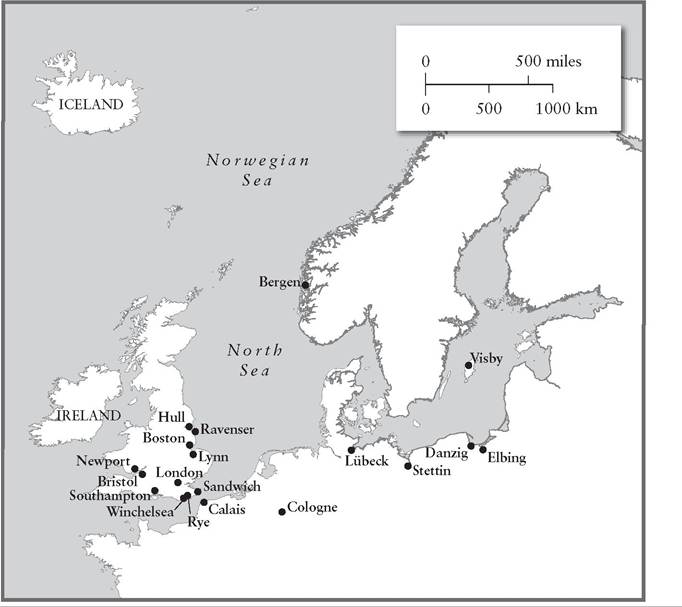
As in Bergen, the London Kontor formed a privileged enclave, enjoying both royal protection and self-government, and, like the settlement in Bergen, it took time to coalesce. In London, recognition of the special status of the German merchants did not take place as a result of the efforts of the Lübeckers, but through the activities of merchants first of Cologne and then of Gotland; in the thirteenth century the English royal administration talked of several hanses, applying the term to groups of Flemings, as well as to those who would eventually become the Hansards. England was a highly desirable market for both Flemish and German traders. The country supplied excellent wool, which was hungrily consumed by the looms of the Flemish cities, while the English had long ago developed a taste for Rhineland wines. Yet wine was by no means the most important item to cross the North Sea from Germany. So strong was demand for English produce that silver flooded into the kingdom, which was able to maintain a high-quality silver currency in the thirteenth century while other parts of Europe constantly devalued their silver coinage by adding base metals. No other European kingdom was as rich in silver and of no other kingdom can it be said that the silver content of its coinage remained stable all the way from the ninth century to 1250. By 1200 the influx of silver, mainly from the rich mines that had been opened up in Germany, led to quite serious price inflation that affected basic commodities such as foodstuffs.1 ‘Sterling silver’, today set at a standard of 925^, has a long history. It comes as little surprise that the one place in northern Europe to match the quality of English coinage was the mint of Cologne, for this was the distribution centre from which English goods fanned out across the Continent; even the availability of local silver supplies could not prevent a serious decline in the quality of the coinage elsewhere in Germany.
The English kings rather took the silver imports for granted, and when they extended their favours to the merchants of Cologne it was in recognition of their accomplishments as dealers in good wines. By the middle of the twelfth century, the men of Cologne lay under the protection of the English Crown, and they were assured of the right to sell their wine on the same terms as French wine merchants; they already possessed a domus, or operations centre, later described as their gildhalla, ‘guildhall’, implying that this was not a random group of visitors but an organized body of men; exactly where this guildhall lay is not clear. Circumstances outside their control brought new advantages to the German merchants in London. King Richard I had been imprisoned by the German emperor, Henry VI of Hohenstaufen, while he was trying to make his way home after the Third Crusade failed to recover Jerusalem. One of the German princes who was willing to give him help was the archbishop of Cologne. The grateful king of England therefore extended the privileges of the Cologne merchants in 1194, so that they would henceforth be free of taxes and tribute. They could operate their own internal customs system among themselves, which would be important if the costs of running their guildhall were to be met. Admittedly, the attitude of later kings to this generous grant wavered, but the political motives never went away: King John also relied on an alliance with the archbishop of Cologne, who supported the same claimant to the German throne after the death of Emperor Henry as did John (with disastrous consequences for the English king). So even the money-grubbing King John was minded to let the Cologne merchants retain their special privileges. These Cologne merchants possessed their own seagoing ships, and they also hired Flemish vessels, acting as intermediaries in the wool trade linking England to the Flemish cloth towns.2
Gradually, the German community broadened its character, as visitors arrived from Visby, Lübeck, Bremen and Hamburg; they came not just to London but to accessible places on the east coast, such as Lynn and Boston, where Lübeckers could be found buying wool in 1271.3 When Emperor Frederick II gave Lübeck its special privileges in 1226, he insisted that its merchants trading in England should be exempt from taxes imposed on them by the merchants of Cologne, and over the next few years King Henry III, who was related by marriage to the German emperor, also took the Lübeckers under his protection.4 The Cologne merchants took umbrage at the presence of these rivals, which serves as a reminder that family disputes often disrupted Hansa brotherhood.
These groups were granted their own corporations, or Hansas, so that during the thirteenth century there was not one consolidated group of Hanseatic merchants, but several sub-Hansas vying for royal favour. The citizens of London complained that the Germans had greater freedoms in their own city than they did.Then, when King Edward I attempted to rationalize all the past grants to merchants visiting his kingdom, the Hansa gave him vocal support; in 1303 he issued the Carta Mercatoria, legislation that levied higher taxes on foreign than on native merchants, but the Germans saw it as a relatively good deal; they wanted guarantees, they wanted stability, and they understood by now that it was more important to work together than to feed the pride of Cologne, Lübeck and other rivals. Unfortunately that was by no means the end of the story, as the next king, the unfortunate Edward II, suspended his father’s law in 1311. The Hansards insisted on their exemptions, and Edward II wanted as much money as he could squeeze out of his subjects for wars in Scotland. Nonetheless, in bits and pieces, and subject to all sorts of temporary reversals, by the middle of the fourteenth century they had clawed back many of the rights they had obtained in 1303.5
It was not all plain sailing thereafter. Once Edward III had taken charge of his kingdom, he launched vastly ambitious wars in France that frequently disrupted movement across the sea. Flanders might be cut off; ships might be pounced upon by rival navies. The English Channel and the North Sea became important, and dangerous, theatres of war.6 Fortunately for the merchants, he needed to borrow funds and, having drained the great Florentine banks of capital in the 1340s, he turned to German bankers, pawning his Crown Jewels; and this meant that he had to be polite to merchants from that part of the world (interestingly, his creditors included Jewish bankers, excluded from England for the past half- century).
There were ugly moments when Germans were accused of piracy against ships bearing English wool across the North Sea, leading to exemplary confiscations of German property in the kingdom. The relationship between the Hansa and the English Crown was not, then, a smooth one, but on balance the two sides needed one another. Not just silver but furs, wax and stockfish were in high demand. By 1400 the English had begun to realize how desirable Baltic herrings were; ships were reaching Hull that carried nothing but herrings, loaded at the expense of English importers. In the past, many of these goods had been supplied by Norwegians, but the Germans increasingly muscled in on this business: by 1300 they had already acquired a commanding position at Bergen. And much the same was true of Flanders, as Hansa cogs plied back and forth between the Flemish coast and England - the Flemings tending to concentrate more on producing cloth.In the fifteenth century the entire space between England and the eastern Baltic was abuzz with trade. Ties were built to Danzig and the towns along the coast of Prussia (which then included Danzig), and direct contact between eastern England and the further reaches of the Baltic became common. Nor did this simply consist of visits by enterprising citizens of Danzig or Elbing to England, for a constant complaint of the Prussians was that their towns were being invaded by English cloth merchants.7 This reflected an important change in the character of English trade at the end of the Middle Ages. Although England had always exported some finished cloth of very high quality, its real speciality in the twelfth and thirteenth centuries had been the export of raw wool, leaving others, in Flanders and elsewhere, to turn it into the fine woollens for which northern Europe was famous, goods that might find their way to Morocco and Egypt. Trade wars with Flanders during the early fourteenth century occasionally blocked the import of Flemish cloth, and even after the trade wars were at an end high tariffs made the import of this cloth unattractive.
This created a strong incentive to manufacture cloth at home and not to rely on imports. Flemings were encouraged to come and settle, importing the secrets of Flemish cloth-making; the wealthy towns of East Anglia became home to many Flemish weavers. By the late fourteenth century enterprising Englishmen had, then, stimulated their own cloth industry into new life, and English woollen cloth rather than unprocessed wool became the export of choice. England was transforming itself from a country that concentrated on the export of raw materials into one that concentrated on the export of finished goods - a process of what might loosely be termed proto-industrialization.8Just as Flemish cloth had been sent deep into the Baltic and all the way to the Mediterranean, English cloth could increasingly be found in places very far from the wool towns of East Anglia and the Cotswolds. The presence of growing numbers of Englishmen in Prussia is not as surprising as it may seem; when things were working well, Englishmen from Lynn and Boston rented Hanseatic ships and carried the cloth of England all the way to Danzig and beyond. Richard Schottun from Lynn was the sort of character who gave English merchants a bad name in Danzig. He boasted about ignoring the tax regulations, and he brought back poor-quality timber known as wrak et wrak-wrak, probably taken from rotting hulks and driftwood, while pretending that he only obtained his timber from Danzig itself. He and three other Englishmen bought a ship, the hulk Krystoffer, in Danzig, but he overextended himself, for he then found himself being pursued for debts there. Even so, his links with Danzig lasted a good ten years, so his reputation was not bad enough to force him out of the city. By 1422 fifty-five English merchants were frequenting the port of Danzig, to judge from existing records. Ordinary folk in England built marriage ties as far away as Prussia; the son of the celebrated English mystic Margery Kempe married a woman from Danzig, and Margery herself visited the city.9
Prussia was also a favourite destination for English crusaders, and joining the Teutonic Knights on one of their sprees into pagan territory was regarded as good military entertainment, whether or not it was also good for the soul. Among the participants was Henry, earl of Derby, who after his return would seize the English throne from the increasingly tyrannical Richard II; he arrived in Stettin (Szczecin) with up to 150 servants and recruits, so keeping him supplied was big business for those who carried him over the waves. Indeed, during the 1420s the Grand Master of the Teutonic Order remained friendly to the English, even when the Prussian members of the Hansa sternly demanded their arrest in return for alleged insults against German merchants in England.10 Relations between the Hansards and the Teutonic Order had plummeted following the massive defeat of the Knights at the Battle of Tannenberg in 1410, when the Knights paid for their folly in turning against what was now, officially at any rate, a Catholic kingdom embracing Christian Poland and newly converted Lithuania. A three-cornered contest for power was taking place between the king of Poland-Lithuania, the Teutonic Knights and the Prussian members of the Hanseatic League. It is hardly surprising that outsiders sometimes found themselves caught up in rivalries that they had no part in creating.11
Between 1469 and 1474 relations deteriorated to the point where England and the Hansa found themselves at war with one another, although predictably Cologne was opposed to action, and the warmongers were Lübeck and Danzig, both of which had suffered from English piracy. The problem was English intrusion into the Baltic, which was of little interest to Hansa cities more connected to the North Sea.12 Underlying all this is a simple fact: there was a greater will for peace and the restoration of good relations than for conflict, and if that involved compromise over the rights of access of the English to the Baltic, it would simply have to be accepted. Once peace was signed between the Hansa and the English Crown in Utrecht in 1474, a decade of peace followed. In reality, though, the English had found a place for themselves on the sea, and were now impossible to shift; the men of Bristol, in particular, had become familiar figures who sailed with impunity across broad swathes of the North Sea and the Atlantic.13 By the 1490s it was obvious that the great age of German trade with England had come to an end. Not just the economic climate was difficult: the complications of early Tudor politics made merchants from the Holy Roman Empire, the subjects of Henry VIII’s rival Charles V, wonder whether they were still welcome on English shores.14
Something remained, all the same. The Steelyard, briefly confiscated, was restored to the Hansards in 1474, and was only closed down by Queen Elizabeth I in 1598. Indeed, the Utrecht treaty for the first time assigned full ownership of the site in London to the Hansa, along with property at Lynn and Boston. The management of the new Steelyard at Lynn was entrusted to the merchants of Danzig, because, the Hansa Diet insisted, ‘your merchants frequent Lynn more than any other Hanseatic merchants, and therefore this matter is of more concern to you than anyone else’.15 The building the merchants received still stands, though it was converted into dreary local government offices. Still, enough of its wooden framework survives outside, and enough of its beams inside, to justify its claim to be the only Hanseatic structure still in existence in England. The building originally contained a kitchen, hall and courtyard, and the property was formed out of seven houses joined together. The great advantage of using Lynn was that it gave access to the riches of East Anglia, which, as has been seen, was drawing great wealth from the production of woollen cloth. The great wool churches of Lavenham and Long Melford stand testimony to the prosperity of the region, and this prosperity depended in significant degree on the sea trade out of the east of England.
II
Wool attracted many besides the Hansards to medieval England. The opening of a sea route from the Mediterranean to the North Sea at the end of the thirteenth century was closely linked to the surge in demand for fine wool in Italy. Florence emerged from relative obscurity during the thirteenth century, making itself famous through the quality of its cloth, and then through its ambitious decision to launch a gold coinage in 1252. As the cloth industry developed, moving from the finishing of other people’s cloth (the cleaning and dyeing of cloth from Flanders and France), to the manufacture of cloth from raw wool, the Florentines understood that they could only rival the high-quality output of Flanders by obtaining the very best wool, even if that meant looking all the way towards England. They lacked a fleet of their own; but by 1277 Genoese ships had learned how to pass out through the dangerous waters of the Strait of Gibraltar and sail on towards Flanders. From 1281 onwards Majorcan as well as Genoese ships began to reach London from the Mediterranean, breaking open a route that, on and off, would be maintained by the Genoese, and later by the Venetians, the Catalans and the Florentines themselves, during the fourteenth and fifteenth centuries. The ships that stood in the Port of London in 1281 are known to have been loaded with wool before they departed. This new route enabled much greater quantities of English wool, or, for ships sailing from the outports of Bruges, many more bolts of fine cloth, to be carried into the Mediterranean; large galleys sent from Venice and Pisa, the port of Florence, in the fifteenth century brought sugar, spices, fine ceramics and exotic silks to northern Europe, including goods that were collected in the ports of the Muslim kingdom of Granada, or in the outports of Seville, which had become the lynchpin linking the trade of the Mediterranean to that of the Atlantic. Italian bankers, from Lucca, Florence and elsewhere, established themselves in England late in the thirteenth century, and until a great crash occurred in the 1340s - partly the result of the bad debts of the English king incurred during his wars against the French - the Italians acquired considerable leverage at the English court.16
London was one target of the Italians; but it made more sense for those who also wished to visit Flanders to stop somewhere on the south coast instead, and this stimulated the development of a town that already had a history of close contact with France (commemorated in its ‘French Street’): Southampton.17 By comparison with the cities of the Mediterranean, or with the greater Hansa cities, Southampton was tiny: its population stood at around 2,500 in 1300, and in the wake of the Black Death it had dropped to a mere 1,600 in 1377.18 Just at this point a distinguished Genoese emissary, Janus Imperiale, came to the court of Edward III with the proposal that Southampton should be declared a staple port, the only point of access for foreign merchants seeking wool. The Genoese clearly hoped to corner the market, but Janus’s body was found outside the front door of his lodgings in London on the night of 26 August 1379. He had been assassinated by his English rivals. For the king
had already established Calais, which he had brought under English rule, as the staple port for wool exports, and his assassins could see that the Genoese project would undermine their own ascendancy.19 However, Italians continued to flock to Southampton in the late fourteenth and early fifteenth century. Fifty to a hundred Italians took up residence in the town, though they lacked a quarter reserved for their use. Sometimes, as in the case of the Florentine agent Christopher Ambrose (Cristoforo Ambruogi), the Italians decided that their future lay in the colder climes of England, and they applied for English citizenship, though there was also a middle status, giving them the right of abode as ‘denizens’, that suited a great many. Ambrose even became mayor of Southampton.20
London hosted Spaniards as well as Italians. Catalans arrived on galleys from Barcelona and Majorca, but pirate attacks often discouraged them.21 Most of the Iberian visitors came from the northern coast of Spain, bringing iron, woad and leather, rather than the sugar, ceramics and silk collected by the Italian galleys as they passed the kingdom of Granada.22 Cantabrians, Galicians and Basques from Atlantic Spain plied the waters around Iberia, also penetrating into the Mediterranean; and they worked their way up the western flank of France towards Bourgneuf, Normandy and Bruges.23 Spaniards such as Andres Perez de Castrogeriz arrived in London from Burgos as early as 1270, and he also traded in Gascony, which lay under English rule and was the major source of wine for English markets; he had many successors. The reward for their hard work came in the form of royal privileges that offered tax exemptions in London and Southampton - the English kings wanted them to keep coming.24 In the early fifteenth century a doggerel poet, the author of the Libelle of Englyshe Polycye, a tract in verse that extolls the foreign trade of England, wrote that:
Bene fygues, raysyns, wyne, bastarde and dates,
And lycorys, Syvyle oyle and also grayne, Whyte Castell sope and wax is not in vayne,
and went on to praise the iron, saffron and mercury that Spain also offered (grayne does not mean wheat but grana, a red dye made from crushed insects, and a Spanish speciality).25
The most prominent communities of foreign businessmen in London were the Genoese and the Germans, but the fifteenth-century city was quite cosmopolitan. From faraway Dubrovnik, Ragusan merchants arrived on their own ships or those of the Venetians, bringing sweet Malmsey wines from Greece. One particularly enterprising Ragusan was Ivan Manevic, who became a naturalized subject of the Crown and a landowner, and also farmed the taxes due to the Crown from the textile workshops of a large area of southern England. By the early sixteenth century, the Ragusans became the masters of the English cloth trade towards the eastern Mediterranean, benefiting from their cosy relationship with the Ottoman court in Constantinople.26 The impression all this might give is that the English played a rather passive role, welcoming the Hansards, the Genoese and the Spaniards (up to a point), while not themselves being very active on the water. If that was ever true, it was certainly not the case in the late Middle Ages, as the examples of Winchelsea and Bristol clearly show.
III
Winchelsea was one of the ‘Cinque Ports’ that had been entrusted with the defence of the eastern end of the English Channel since the eleventh century. Now some way inland, Winchelsea stood alongside an irregularly shaped, shifting, marshy coastline. In the 1280s the town was moved at royal command to a higher site away from the encroaching waves, which meant that it could still function as a port. The new town, with its square street pattern, was modelled on the bastide towns, defensive positions built by the English and the French in the contested lands of south-western France, with which King Edward I was very familiar.27 Its inhabitants and those of Rye, nearby, made use of relatively peaceful times to launch raids on shipping in the English Channel, so that piracy as well as trade created the wealthy community that emerged on the new site. William Longe was a Member of Parliament early in the fifteenth century; he was also one of the Rye officials appointed to keep an eye out for pirates by patrolling the Channel, and yet he himself turned pirate, attacking Florentine and Flemish ships. The courts could not ignore this, and Longe was sent to prison for a while, but his popularity only grew, and he was re-elected to the House of Commons time and again.28 As ever, the borderline between piracy and officially sanctioned warfare was easily crossed.
Outrages were committed on both sides. In 1349 a surprise attack by a Castilian admiral, who had seized English ships loaded with wine off Gascony, created consternation in England; the time for revenge came a year later when a Castilian convoy laden with Spanish wool passed through the Channel on its way to Flanders. This was understood in England to mean that the Castilians were cocking a snook at the English and their commanding position in the wool trade towards Flanders. Led into the fray by a very large cog from Winchelsea, the Thomas, the English pounced on the Castilian fleet as it returned from Flanders. The battle of Winchelsea, as it is known, though ships from Sandwich, Rye and elsewhere also took part, was a resounding victory for the English, even though the Castilian ships were larger than the English ones. This was possibly the first naval battle in the west in which cannon were used. The battle was won, but, to use the old cliche, the war was not: the English Channel remained an unsafe area, and to avoid capture by the French or their Castilian allies the English had to sail in convoy. This was not enough to protect the town, though. In 1380 Winchelsea was sacked by Castilian raiders.29
No doubt the stone-lined cellars that still exist in Winchelsea were often used to store the proceeds of piracy; but this was not a nest of pirates - there was plenty of licit trade. The citizens of Winchelsea were wine merchants; in 1303-4 twelve ships from Winchelsea went to Bordeaux, where they collected 1,575 tuns of wine, very roughly 4,000 gallons. Winchelsea had the most successful wine trade of any of the towns along this coast, and its shrunken state today makes it hard to imagine the thriving, well-connected port that it once was.30 But the town that was best placed to handle the traffic in wine had a much brighter future: it was Bristol, soon to become the third greatest city in the English realm.
IV
Bristol, originally Brig-stowe, ‘the place of the bridge’, is one of the most unusual harbours in the world. It lies beyond the gorges of the River Avon, which narrow where the Avon meets the majestic River Severn. When the tide is in, the water level rises alarmingly, sometimes by as much as twelve metres, or forty feet; ships bound for Bristol would await the high tide and be swept up towards the city. At low tide, the muddy bottom of the harbour was exposed, and ships would balance their keels on the soft ground.31 Bristol lay in a fertile part of England, and in the early days its trade with Wales and Ireland brought the town some wealth; but even in the fourteenth century ships trading with Ireland remained small, reflecting the relatively low volume of business (their capacity was generally around twenty to thirty tons). As the Irish linen industry took off at the end of the Middle Ages, opportunities along this route did improve; but the ships themselves were mainly Irish-owned, and the real prosperity of Bristol was the result of contacts much further afield.32 One reason for the port’s increase in trade was the rise of the English cloth industry, for when it came to the manufacture of fine cloth, the Cotswold villages east of Bristol were keen rivals to the wool towns of East Anglia, while
458 THE YOUNG OCEAN: THE ATLANTIC, 22,000 BC-AD I500 objects carved in alabaster, the waxy stone out of which the English sculpted highly decorated altarpieces, were brought down from Coventry and sent abroad from Bristol. Bristol dealers also kept up their links with Southampton, so that even when they were not sending their cloth through the home port, they despatched it across Salisbury plain towards Italian galleys waiting there, while Bristol cloth was also carried on the roads to London, to be sold to Hansa merchants, who were said to offer better terms than their English counterparts.33
The real reason for Bristol’s success, however, lay with the wine trade.34 This success was built on political as well as commercial links: the acquisition of English rights in Gascony following the marriage of King Henry II to Eleanor of Aquitaine in the twelfth century. Even then, the reputation of Gascony for wine took time to be established. By the end of the thirteenth century, encouraged by the businessmen of Bordeaux, the flat lands of the Bordelais were given over almost entirely to vineyards. This was made possible not just because the soil was suitable for wine production, but because of the ease with which wine could be transported down the little tributaries of the Gironde towards Bordeaux. The merchants of Bordeaux carved out a monopoly for themselves, ensuring that they could tax the wine to their heart’s content as it passed through the city. Since the administration of Gascony was autonomous, despite English rule, the English merchants had to put up with these taxes despite their objections, which reached the House of Commons in 1444; these objections were a little exaggerated, since English merchants did not pay any dues on the goods they imported into Gascony, and the great majority of the ships that plied back and forth between England and Bordeaux were English. At the start of the fifteenth century, something like 200 ships each year could be expected to set out from Bordeaux loaded with wine, arriving in autumn or early spring and leaving in December or March; the voyage normally took about ten days.35
The fortunes of the Bordelais depended on reasonable harvests and, crucially, on the possibility of exchanging these vast quantities of wine for staple foodstuffs. At a time when grain was the staple foodstuff and rising population was placing increased pressure on supplies, the Bristol connection offered a lifeline. There was grain to be had from southern England, and English merchants made every effort to send it to Gascony, even when there were shortages at home, which was common in the early fourteenth century. The size of the wine cargoes grew and grew, right up to the final war that culminated in the French occupation of all of Gascony in 1453. In autumn 1443 six Bristol ships carried almost as much wine out of Bordeaux as would, near the start of the century, have been loaded
in a whole year. As English cloth cornered the market in northern Europe, this too became a prized export bound for Gascony, and the Gascons reciprocated by supplying Bristol with large amounts of woad, the blue dye that was a speciality of south-western France.36 English defeat did not bring this wine trade to an end, for the French king, Louis XI, was not the sort of person who would turn away the opportunity to rake in taxes. By the end of the fifteenth century, as many as 6,000 English merchants are said to have flocked to Bordeaux to buy wine, even though the wine trade had now passed its peak, as had Bordeaux itself.
Other opportunities beckoned for the mariners of Bristol, or for foreign mariners hoping to sell their produce in Bristol. Basque ships, and ships from further along the coast of northern Spain, came to Bristol in growing numbers during the fifteenth century, and Bristol merchants recognized the quality of Basque seamanship by sometimes loading their own goods on Basque vessels; Basques and Bristolians shared curiosity about the open Atlantic and its fish stocks, while the Basques, whose native lands were poor in resources, looked outwards to the open sea and developed an expertise in whaling that made them the unrivalled masters of the sixteenth-century whale industry - a sixteenth-century Basque whaling vessel has been meticulously excavated off Labrador.37
The hull of another Basque ship, from around 1450, has been found underneath the Welsh city of Newport across the estuary from Bristol; it is said to be the largest fifteenth-century hull yet discovered, with a capacity for 160 tons of cargo (quite likely wine). Coins and pottery found on site indicate that it travelled as far as Portugal, which in the midfifteenth century was one of England’s closest trading partners. For a time it may have been operated by a mainly Spanish or Portuguese crew; but it was probably owned by English merchants (possibly even by an English nobleman) by the time that it toppled over and sank in the shipyard at Newport, where it was undergoing repairs, around 1469.38 For a while, English merchants had the good sense to try out the wines of northern Spain, which this ship almost certainly carried. But traffic to northern Spain was not all concerned with trade, and the Bristol ships that set out for its north-west corner, Galicia, carried passengers - pilgrims bound for Santiago de Compostela who preferred not to trek overland on the famous Camino. Beyond the lands that lay under Castilian rule, there were good opportunities in Portugal, whose dynasty was related by marriage to the royal house of Lancaster. As Portugal itself emerged as a maritime power the English were able to take advantage of its successes, importing wine from mainland Portugal, and eventually buying grete salt, that is, sugar, from Madeira, though by way of intermediaries.39
All this generated great wealth, displayed to this day in the great church of St Mary Redcliffe, in which the wealthy shipowner William Canynges built chantry chapels and a tomb for himself and his wife. His endowments resulted from a sad fact: his sons predeceased him and left no heirs. The city of Bristol became his heir instead. He was a member of a trading dynasty whose members had been making their money out of cloth since the late fourteenth century (a much later member of the same family was George Canning, the nineteenth-century British politician). The Canynges traded at first with Bayonne and Spain, but by the middle of the fifteenth century, when William Canynges was in his prime, they were looking much further afield: he despatched ships to the Baltic and to Iceland, as well as Portugal, Flanders and France.40
Another Bristol merchant is remembered for his failures rather than his successes. Robert Sturmy enriched himself by supplying the English army in Gascony with grain. In 1446, his ambitions turned in an entirely new direction, the Mediterranean.41 By the mid-fifteenth century Bristol had become a place where shipowners and seamen planned voyages to the limits of the known world - to Prussia, Portugal, Iceland and eventually right across the Atlantic. The Mediterranean was a better-known area; Sturmy had received news of the expulsion of the prosperous Venetian colony from Alexandria, and he hoped to capitalize on that by creating a direct spice trade from the Levant to England. He had a ship, the Cog Anne, and was prepared to risk it on this venture. He obtained a licence to export wool all the way to Pisa, for the looms of Florence, with the intention of then moving east to the Holy Land. His crew consisted of thirty-seven sailors, but there were 160 pilgrims on board as well, on one-way tickets, since his idea was that on the return journey the hull would be filled with the spices of the East rather than with human beings. The pilgrims disembarked at Jaffa, and made their way to Jerusalem. But his crew showed their inexperience by attempting to cross the eastern Mediterranean as Christmas approached. No doubt they imagined that Mediterranean squalls could never match the high seas of the open Atlantic. As they approached the Venetian naval base at Modon, on one of the southern tips of the Peloponnese, a storm began to blow; they lost control of the Anne and it was torn to pieces on the rocks. Not a soul survived.42
Sturmy had stayed at home, and his wealth had not been lethally dented. Over the next few years, he held high office in Bristol, and was elected mayor. When Parliament asked for help in the war against piracy, Sturmy funded the building of a new ship. All the while, he was listening to news from the Levant, which included the fall of Constantinople to the Turks in 1453. He hoped that, with this new political configuration in the eastern
Mediterranean, he could at last break his way into the highly profitable Levant trade. So in 1457 he put together another cargo bound for Italy and the Levant, including wheat, tin, lead, wool and cloth; the cloth alone was worth an enormous amount, £20,000. All these goods were to be sent ‘beyond the mountains by the straits of Marrok’ on the ship Katharine Sturmy, which had already proved itself the year before by sailing all the way to Galicia with pilgrims for the shrine of St James. The Katharine reached the Levant, where not just spices were loaded aboard but the seeds of green pepper which, it was hoped, would be made to sprout on English soil. On the way back, however, in 1458, his ship was seized by Genoese sailors off Malta and his goods were stolen. Back in England, the news of the outrage stirred up ever-present hostility to the Italians; the Genoese community in London was arrested en masse. Sturmy was never fully compensated for his losses and died towards the end of the year.43 English merchants realized that attempts to penetrate beyond Portugal were simply too risky, and it was another half-century before regular traffic from England to the Levant was established. That still left vast swathes of the Atlantic, up to and beyond Iceland, open for exploration and exploitation.
V
During the fifteenth century the English, particularly the merchants and shipowners of Bristol, became determined to break into the Norwegian monopoly of trade with Iceland, taking advantage of its increasing isolation. Sheer distance meant that the Norwegian king was hardly in a position to maintain tight control of what happened in Iceland, even though it had submitted to his authority in 1262 on condition that the Norwegians send six ships a year to the island; again and again the Icelanders complained that this was not happening.44 The Hansa merchants based in Bergen, who conveyed Icelandic goods further into Europe, were not themselves supposed to enter Icelandic waters. Occasionally, though, they did venture to Iceland, since no one seemed very interested in stopping them.
In these circumstances, the Icelanders had no compunction about welcoming ships loaded with the foodstuffs and other supplies they needed that had arrived from elsewhere than Bergen. King Erik wrote to the Icelanders, grumbling that they were trading with ‘outlandish men’; he might have added that the English found it easier to fish in Icelandic waters because the hirdstjori, or governor, of the island had started issuing his own licences for fishing and for trade on the island itself. The governor carried this letter to the court of King Erik:
Our laws provide that six ships should come hither from Norway every year, which has not happened for a long time, a cause from which your Grace and our poor country have suffered most grievous harm. Therefore, trusting in God’s grace and your help, we have traded with foreigners who have come hither peacefully on legitimate business, but we have punished those fishermen and owners of fishing smacks who have robbed and caused disturbance on the sea.45
His justification cut no ice; he was not sent back to Iceland. Forbidding this trade would hardly help the islanders to survive, particularly if, as is often argued, harsh weather conditions were making access to Iceland (and Greenland) more difficult in the fifteenth century. English ships were ready to face these risks, even when twenty-five vessels sank in storms in one day. At Lynn there was an association of English Iceland merchants.46 What attracted them was the swarms of codfish that had migrated towards the waters off Iceland.
By 1420 the situation had become critical. A German merchant went to Iceland to spy for the Hansa and for King Erik, and insisted that Iceland itself would be lost to the English if the king did not take decisive action. This may sound like exaggeration, but English freebooters did invade the island, ‘in full battle array with trumpets and flying ensigns’. One of their targets was the Danish governor King Erik had appointed; his attempts to maintain tight control of the island’s economy aroused deep resentment, and he catalogued the sins of the English traders, who had been seizing the islanders’ sheep and cattle and even wrecking the island’s churches. The grumbling governor was captured and carried off to England, where he registered a lengthy complaint about the conduct of the English visitors to Iceland, leading to embarrassment at court and, in 1426, official attempts to ban the Iceland trade, a move that went down badly with the merchants of Lynn. The sailings to Iceland simply continued. English smugglers, because in a sense that was what they had become, enjoyed outwitting port officials, and the occasional confiscation of Icelandic goods in English ports did not dent the Iceland trade, which often used out-of-the-way ports like Fowey in Cornwall, though Icelandic stockfish also turned up at Bristol, Hull and elsewhere. Moreover, it was still possible to obtain official approval. An application to the Crown for a licence would cost money, but could be seen as insurance against forfeiture. The Scandinavian king could also be approached in the same spirit. So in 1442, for instance, fourteen English ships were licensed to travel to Iceland; they carried just about everything, from kettles to combs, from beer to butter, from gloves to girdles.47 Over the next few decades, the arguments between the English court, the English merchants, the Danish court and, increasingly, the Hansards continued. It was no help that English raiders killed the governor of Iceland in 1467. King Richard III complained to the city of Hamburg that three English ships had been seized in Iceland by Hanseatic rivals; but the Hansards could tell their own stories of attacks by sailors from Bristol in the very same waters.48
One way of dealing with this constant turmoil was to turn one’s back on Iceland, however desirable its fish might be, and to look for other stretches of the north Atlantic that teemed with cod. In the 1480s, the shipowners of Bristol sought out these waters, and the big question is whether, in the process, they crossed as far as the fishing grounds off Labrador. The claim that English sailors reached America in the 1480s is not simply speculation. An Englishman named John Day addressed a letter to an Admiral of Spain, probably Christopher Columbus, soon after John Cabot’s voyage to Newfoundland in 1497; he wrote:
it is considered certain that the cape of the said land [Newfoundland] was found and discovered in other times by the men of Bristol who found ‘Brasil’ as your Lordship knows. It was called the Ysle of Brasil and it is assumed and believed to be the mainland that the Bristol men found.49
(‘Mainland’ does not mean an entire continent, and could just mean a large island.) This name ‘Brasil’ should not be confused with that of modern Brazil, discovered by the Portuguese in 1500, which became attached to the area because it was rich in brazilwood, much prized as a dyestuff. Rather, ‘Brasil’ was one of the legendary islands of the Atlantic that featured in late medieval maps, and can be traced back to stories of an island out in the ocean woven by Irish mariners in the early Middle Ages.
More important than the name is the evidence that sailors from Bristol were setting out on journeys deep into the Atlantic in the 1480s.50 On 15 July 1480, John Jay sent a ship out from Bristol; its master was a highly reputable mariner named Thloyde, or Lloyd, and its destination was ‘the island of Brasylle in the western part of Ireland’. But after nine weeks at sea it was forced back to Ireland by bad weather and found nothing.51 John Jay or his namesake (this was a prominent trading family) had been importing stokffish from Norway in 1461.52 In 1481, just under a year later, the Trinity and the George, also from Bristol, set out ‘to serch & fynde a certain Isle called the Isle of Brasile’.53 Although their owners also insisted this was not a trading voyage, the ships were loaded with salt, which makes one think that the aim was to catch fish, which would have had to be preserved without delay. There is no evidence that these ships found whatever they were seeking. The master of the Trinity and other ships bound for ‘Brasil’ would not be the first or last to mask their real destination behind a fanciful one. In 1498 the king and queen of Castile, Ferdinand and Isabella, received a report from their agent in England which stated that for seven years the men of Bristol had been sending from two to four ships in search of Brasil and the ‘Seven Cities’, another mythical territory out in the Great Blue.54 If fishing was the aim, then they had very different ambitions to John Cabot, who set out in 1497 to gain access to the fabulous wealth of China and the East, sharing with Christopher Columbus the assumption that Asia could be reached by sailing westwards. Myths of lands such as the Isle of the Seven Cities, inhabited by Christian refugees fleeing from the Muslim invasion of Spain, remained potent, and there were romantic dreams of making contact with long-lost Christian brethren. In the same decade, Ferdinand van Olmen, a Fleming in the service of the Portuguese king, set out from the Azores in the hope of finding the Seven Cities; he was never heard of again.55
There are other possibilities. The Bristol ships may have made their way to Greenland, of which knowledge certainly survived, even though the Norse population had probably vanished by now; they might then have realized that following the currents down the Labrador coast would net them much bigger catches. The explanation might also be more humdrum. Only in 1490 did the king of Denmark relax his ban on direct English trade to Iceland. Some ships did set out from Bristol bound for Iceland in 1481, as the city’s customs records reveal; but there were still people who preferred not to pay for formal licences.56 Even if they did reach Labrador, a secret discovery by men of Bristol was no discovery at all. Another Atlantic destination that was within the sights of Bristol merchants was Portuguese Madeira, with its abundance of fine sugar, to which they were sending goods on Breton ships in 1480, and beyond that the Azores; there were plans to create a route to Morocco, but the Portuguese objected, as they did when English merchants contemplated a trip to west Africa in 1481.57 It is time to see what the Portuguese were doing in Atlantic waters, and how their little kingdom became the seat of a great empire.