23 Stockfish and Spices
The calamity of the Black Death struck first the Mediterranean and then northern Europe from 1347 to about 1351, followed by further periodic visitations of bubonic and pneumonic plague.
The heavy toll on human life - as much as half the population in some areas - reduced pressure on supplies of the most basic foodstuffs, notably grain, but had distorting effects on the production and distribution of food. Land went out of cultivation as villages lost their manpower and became unviable; migration to the towns, where artisans were in short supply, shifted the balance between urban and rural population, so that it was no longer broadly true that up to 95 per cent of the population of western and northern Europe lived and worked in the countryside; and even those peasants who remained in the countryside often managed to cast off what remained of the shackles of serfdom. This was the beginning of a great economic transformation, but the reconfiguration of the economy depended on the easy movement of large quantities of food. Here, transport by sea was of crucial importance, since it rendered possible the movement of really substantial quantities of grain, dried fish, dairy goods, wine, beer and other necessities or desirables, and the ability of the Hansa merchants to exploit these opportunities meant that the years around 1400, often characterized as a period of deep post-plague recession, were for them, as for merchants in many other parts of the Atlantic and Mediterranean, a time when it was possible to reap handsome profits and to answer back to rulers who up to now had seen them as rather troublesome creatures, valuable only as suppliers of prestige items, and greedy and unreliable.It comes as no surprise, then, that within a few years of the Black Death the Hansa merchants began to organize themselves much more tightly, holding regular Diets, or Hansetage (which were also an opportunity for Lübeck and some other leading cities to throw their weight around).
This has generally been interpreted as a shift from the ‘Hansa of the Merchants’ to the ‘Hansa of the Towns’, even the creation of what one might call a‘Hanseatic League’, which (in this view) would be one of a great many city-leagues that were emerging in the fragmented territories of the German Empire at this time, of which the most famous, because it still exists, is the league of cities and peasant communities in southern Germany that we know as Switzerland. Still, these leagues had no pretensions to what might be called statehood, not that the concept of statehood would have meant much to the Hansa merchants. Moreover, the Hansa was different from other leagues since it included a large number of places that lay outside the Holy Roman Empire, such as Riga and Tallinn.1 The first Diet was held at Lübeck in 1356, following pirate attacks, unsatisfied demands for indemnity, and the breakdown of relations with the counts of Flanders and with the city of Bruges; solidarity between cities was the best way to force the Flemings to restore the rights of the Hansards.2 As will be seen, the relationship between the Hansa and Bruges was always a delicate one, because each side needed the other, while complaints about the abuse of existing rights abounded, and the Hansards again and again threatened to move their business to one of Bruges’s lesser rivals. Issues of this order bound the Hansa cities together, and by 1480 seventy-two Diets had been held. It is no surprise that fifty-four of these gathered in Lübeck; and, apart from a single meeting in Cologne, they were always held in towns next to or quite near the sea, such as Bremen.3
This development did not mean that the Hansa had become a state-like body; it remained a loose super-league, bringing together groups of allied cities from regions as diverse as the Rhineland, where Cologne dominated, the southern or ‘Wendish’ Baltic, which was Lübeck’s informal imperium, and the newer cities of the eastern Baltic, of which Riga was the most important.
Minutes of the Diets were kept; but there was no administrative superstructure, and there were no formal treaties that members signed to gain entry to the Hansa. Maybe, indeed, this was one of its sources of strength. On the other hand, the lack of a constitution allowed the citizens of Lübeck to turn their de facto leadership of the Hansa to their advantage, and, despite grumbles from Danzig and Cologne, the special status of Lübeck was never really in doubt; its size, wealth and location gave it formidable advantages. Including every city that at some stage was regarded as a Hansa town, the total comes to about 200, too many to fit into the assembly hall provided by the good burghers of Lübeck; most members were far too small to exercise any political influence, and what they sought was tax advantages and trading opportunities. This was particularly true of the horde of inland towns, such as Hamelin of Pied Piper fame, or Berlin, not as yet a place of great significance. The sections consisting of Baltic members were much smaller in number, but their importance was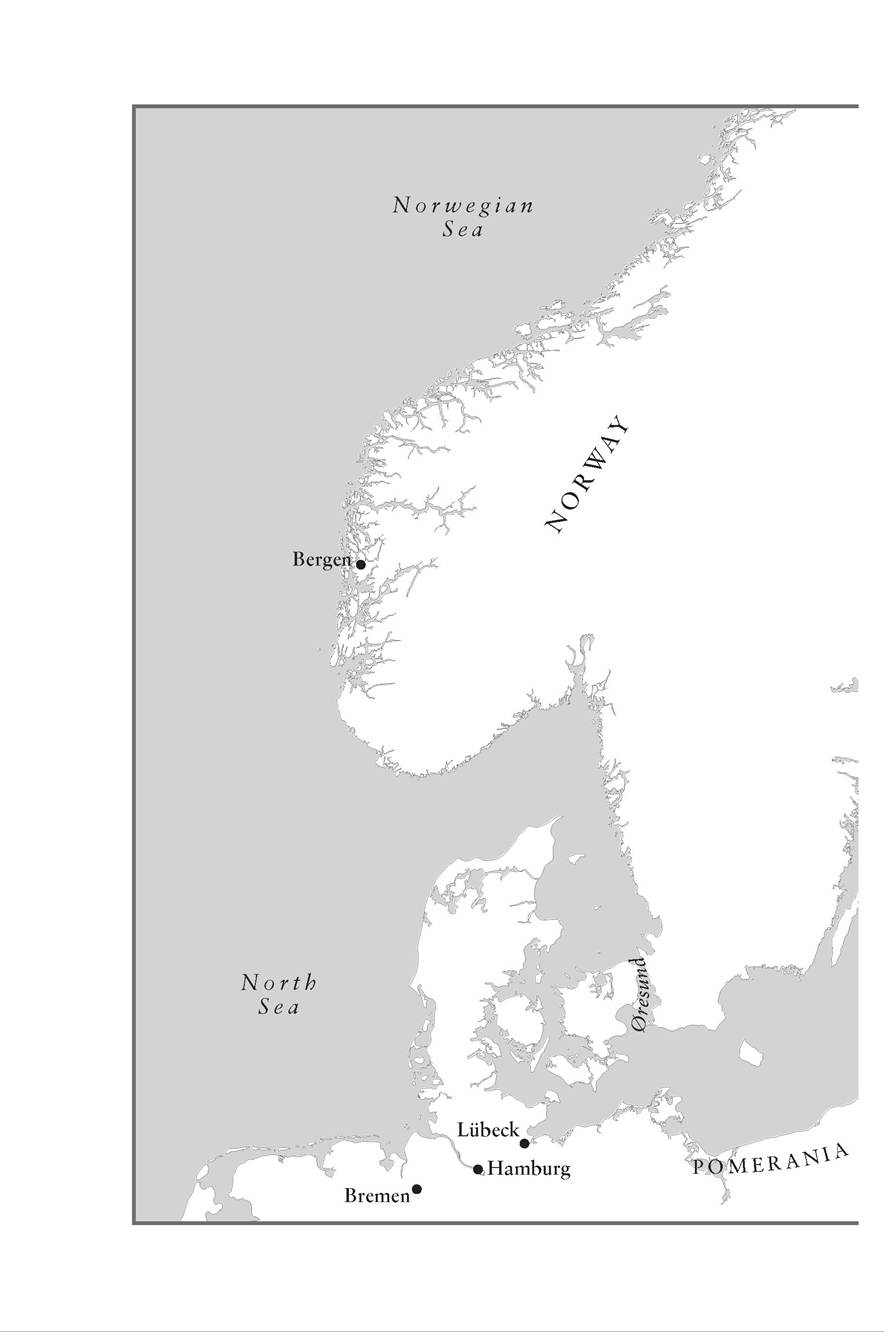
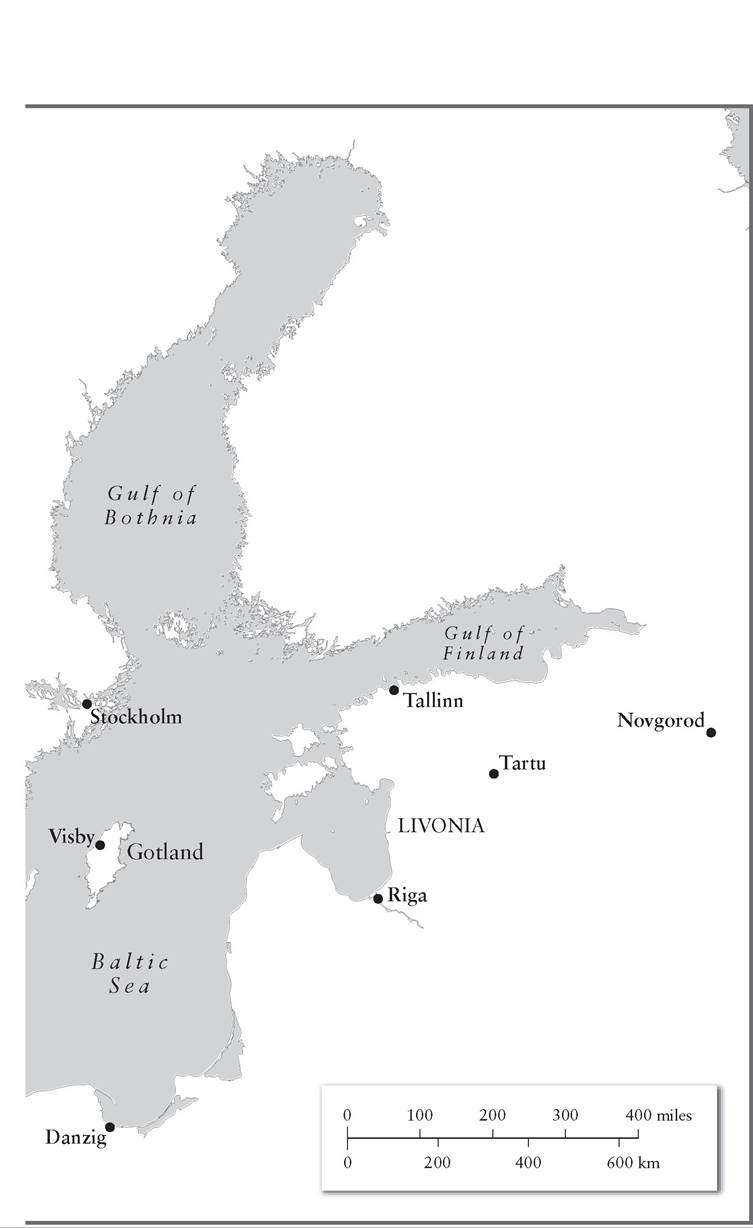
out of all proportion to their slight numbers, given the presence of Lübeck, Danzig, Riga and Visby.4 In addition, the member cities lay under very different political regimes. Further east, the Teutonic Knights exercised overlordship, and the host of inland cities that occasionally sent representatives to the Hansa Diet were by and large subject to a local duke or count, which was not a great problem around 1400, when princely power in Germany was very weak, but did become more problematic once the princes began to claw back their power in the middle of the fifteenth century, sometimes forbidding towns from sending representatives to the Hansa Diet.5
After 1356 the Hansa showed much more muscle, resisting not just the Danes but predatory pirates known as the Vitalienbrüder, who made a nuisance of themselves at the end of the fourteenth century; they probably earned their strange name, the ‘Victual Brothers’, from their role as privateers who kept Stockholm supplied with food during a Danish siege in 1392.
This siege was a dramatic moment in a war of succession that would, by the start of the fifteenth century, see a personal union of the three Scandinavian kingdoms; but the war spilled over into the Baltic, since the major actors included the duke of Mecklenburg as well as an exceptionally capable and determined royal consort, Queen Margaret of Denmark; one of the issues in the Swedish succession was the fear that the arrival of a north German duke as king would extend still further the powerful German influence in the country, which was already strongly expressed through the sizeable German community living in the boom city of Stockholm. Queen Margaret was, however, canny enough to realize that she should cultivate the Hanseatic cities, which were reluctant to be drawn directly into a conflict that was likely to redraw the political map of northern Europe. She had already extended Danish authority over southern Sweden (Skania), the area that had been ruled from Denmark for most of the past centuries.6 Once the siege of Stockholm was over, the Vitalien- brüder held on to their ships and preyed on Hanseatic and other vessels in the Baltic. The herring fisheries fell under threat, and for a few years supplies to the rest of the world faltered. Queen Margaret even appealed to King Richard II of England for naval aid, to help clear the Baltic and reopen the supply lanes. This appeal failed, and if anything the result was to stimulate the search for good-quality herring in the North Sea - admittedly, the quality was never quite as good as that in the Baltic, but thanks to the methods attributed to Beukelszoon the fish could be competently preserved.Queen Margaret gained what she sought, mastery over the three Scandinavian kingdoms, and saw her son Erik, duke of Pomerania, crowned as ruler over this Nordic union in 1397. Even then, everyone wanted to fish in Baltic waters: the Teutonic Knights, not Queen Margaret, expelled the Vitalienbrüder from Gotland in 1394, although fifteen years later they sold the island to the Nordic queen and Erik.
These were years when the Teutonic Knights were at a loose end: the ruler of the great Lithuanian duchy, extending all the way across Belarus and much of Ukraine, at last accepted Christianity in 1385, as part of a marriage treaty with his Polish neighbours, and the Knights found themselves with fewer excuses for the conquest of pagan territory in the east, though Orthodox Russia now came within their line of sight as a land of heretics. The Nazis made heroes of the medieval Teutonic Knights, but over the centuries the Vitalienbrüder have acquired a more romantic image; plenty of novels and films present one of their pirate leaders, Klaus Stortebeker, in a better light than he deserves. When conditions in the Baltic became too risky, they decamped to the East Frisian islands in the North Sea and carried on marauding there. Stortebeker was captured, and in about 1400 he and dozens of his companions underwent a grim execution at the hands of the resentful citizens of Hamburg. Even so, piracy remained a major worry in the North Sea, and the next generation of pirates were making a nuisance of themselves as far north as Bergen in 1440.7All this meant that the Hansa Diets did have matters of real political and military (or rather naval) importance to discuss.8 The Hansa Diet expected to make its decisions unanimously, but delegations would often insist that they had no authority to support a particular position; the Diet was not a parliament where common problems were aired, discussed and resolved, but a place where decisions (often those of Lübeck and its allies) were recorded and announced - that was how late medieval parliaments functioned. Cities might not bother to send delegates to the Hansetag, though not surprisingly the larger and more powerful ones were more careful to do so. Still, it must have seemed that this was Lübeck’s opportunity to show off its commanding position. The effectiveness of the Hansa lay in the expertise of the merchants who inhabited its cities rather than in its institutional structure, which remained fragile.
II
The different communities that made up the Hansa were bonded together by the presence of travelling merchants, some passing through briefly and others settling alongside their fellow Hansards. Hansards felt at home in the ports of a great swathe of northern Europe. In the early fifteenth century, two brothers, Hildebrand and Sivert von Veckinchusen, worked with family members and agents in London, Bruges, Danzig, Riga, Tallinn and Tartu (also known as Dorpat), as well as Cologne and distant Venice, sharing the same work ethic, business methods and cultural preferences. In 1921, a pile of over 500 letters between members of the family was found buried in a mass of peppercorns within a chest that is now in the State Archives of Estonia at Tallinn. In addition, their account books survive. No other Hanseatic family is as well documented. The Veckinchusens are of interest precisely because they were not always successful, and their careers show clearly the risks that needed to be taken if the trade routes were to be kept alive at a time when piracy remained a constant threat, when the Danes were still flexing their muscles in the Baltic, when English sailors were trying to carve out their own niche in the market, and when internal tensions within the Hansa towns threatened to upset the apple cart.9
The Veckinchusen brothers originated in Tartu in what is now Estonia, although they eventually became citizens of Lübeck.10 They are known to have been based in Bruges in the 1380s. They therefore operated between the two most important trading centres of northern Europe, which were linked by the Hanseatic sea route through the Oresund.11 The Hansa community in Bruges operated rather differently from Novgorod, London and Bergen, where the German merchants possessed a reserved space and were closely concentrated together. As befitted a cosmopolitan centre that attracted businessmen from all over western Europe, notably Genoa and Florence, as well as from the Baltic, the Hansards were dispersed across the city, living in rented accommodation, though they did hire a meeting space in the convent of the Carmelite friars, whose church they attended. In 1478 the Hansards began building the handsome ‘House of the Easterlings’, or Oosterlingenhuis, that can still be seen (though much rebuilt) in the heart of the old trading area of Bruges. It possessed its own courtyard and stood on a plot of land that the city fathers had assigned to the Hansa several years earlier. Now they had a base for meetings, and some office space, situated close to the house of the great Florentine trading firm of the Portinari (patrons of Jan van Eyck), and to the Genoese consulate, a fine Gothic building that has been raised to new glories as the Belgian national fried-potato museum. Everyone wanted a base in Bruges, and around 1500 the English, the Scots, the Portuguese, the Castilians, the Biscayans, the Lucchesi, the Venetians, the Genoese, the Florentines and no doubt others as well also possessed business houses in the centre of the city.12 Many of these communities, including most of the Hansards, were to decamp to Antwerp only a few years later; Bruges became less attractive for business as the water channels leading to the open sea silted up and as international politics (the ascendancy of the Habsburgs) favoured the growth of the more accessible port of Antwerp.13
Until then, the concentration of merchants of different backgrounds provided Bruges with its raison d’etre. Bruges was a very large city by medieval standards, with up to 36,000 inhabitants on the eve of the Black Death; but it was not the prime target of all those traders who came there, even though the arrival of large amounts of Baltic rye and herring did help to keep the citizens well fed. In the fifteenth century, one of the main functions of the merchant communities in Bruges was quite simply to settle bills. The city became the major financial centre in northern Europe, which meant that even as its port silted up and fewer goods passed through the city, there was still plenty of work for those well practised in the art of accounting. The Veckinchusens were primarily dealers in commodities, but currency exchange and the provision of letters of credit was a source of profit for them and their peers, even though the Hansards left the creation of international banks mainly to the Italians - the Medici had an important branch in Bruges.14 Generally, the Hansards showed a suspicion of reliance on credit that meant their financial methods never reached the sophistication of those achieved by the Florentines and Genoese. Even so, late medieval Bruges was to the economy of large swathes of Europe what modern London has become within the global economy.15
From the Hansa perspective this had both advantages and disadvantages. The usual pile of grievances - confiscations of goods, quarrels over tax exemptions, the rights of the resident community, interference by the counts of Flanders and their mighty successors the Valois dukes of Burgundy - soured relations between the Hansa and Bruges, and during the late fourteenth century the Hanseatic merchants were thinking seriously about moving their business away from Bruges, northwards towards Dordrecht. In the 1380s the Hansards lost not just property but lives in Bruges, during a period of revolutionary disorder that ended with the assumption of power by Philip the Bold, duke of Burgundy. Yet Philip was not willing to meet their demands for compensation, so in 1388 the Hansards did decamp to Dordrecht. This was not the back of beyond: in 1390 Hildebrand Veckinchusen was there, sending Flemish cloth and a fair amount of wine all the way to Tallinn. After a couple more years, relations with Bruges had been restored, and Hildebrand had become an Alderman of the Hansa community there; he had earned enough trust to be appointed an inspector of weights and measures, a task that was performed jointly with local officials.16 For, in reality, the Hansards and the citizens of Bruges were happiest working closely together.
The Veckinchusens were not wedded to Bruges. Indeed, when Hildebrand found a bride, she was a young woman from a prosperous Riga family.17 Going to Riga for his wedding, which had been arranged by one of his brothers, gave him the chance to experience the route to Novgorod, where the Hansa Kontor, or ‘Counter’, continued to flourish, and where he brought for sale thirteen bolts of cloth of Ypres, in other words a sizeable quantity of some of the best woollen cloth Flanders looms were then producing; each bolt would have been twenty-four yards long and one yard wide (approximately 22 by 0.9 metres). These he sold for 6,500 furs, which gives some idea not just of the high value of Flemish cloth but of the easy availability of squirrel, rabbit and finer skins in fifteenth-century Russia. On another occasion his brother Sivert forwarded 15,000 furs from Estonia to Bruges, where Hildeband had re-established himself - by 1402 he was renting a building in the city that included storage space as well as an apartment for his wife and his seven children.18 In good years, the Veckinchusens could hope for profits in the range of 15-20 per cent.19 Meanwhile his brother Sivert, now living in Lübeck, warned him that he was taking too many financial risks - ‘I’ve warned you again and again that your stakes are too high’ - which led him to send his wife and children to live in Lübeck; but he was convinced he could make money by staying put in Bruges.20 This obstinacy in his business dealings was to cost him dear over the next few years.
Despite his warnings to his brother, Sivert also faced an uncertain future. His reputation in the city stood high, for he was invited to join the Society of the Circle, an influential club to which only members of the merchant elite were admitted. However, Lübeck was facing the same sort of political strife that was creating turmoil in Bruges, Barcelona, Florence and many other European cities in the years either side of 1400.21 Lübeck’s butchers, for instance, had already led two revolts, the ‘Bone-Cutter Rebellions’, in the 1380s, neither of which was successful. Much depended on the solidarity of the rebels, and in 1408 a New Council, on which the city’s guilds were heavily represented, challenged the authority of the existing city council, which was seen as a high-spending and closed elite that spoke more for the Society of the Circle than for the city, and had failed to respond to the economic changes of the late fourteenth century. The increasing prosperity of the urban middle class in the decades after the Black Death, when reduced pressure of population gave access to better food and a higher standard of living, needed to be reflected in the government of the cities. The New Council attempted to keep its membership broad, so Sivert Veckinchusen, whose natural sympathies lay more with the old order, found himself elected to it; but he then followed many of the members of the Old Council into exile in Cologne. The Holy Roman Emperor, Sigismund of Luxembourg, had the unenviable task of sorting out who should govern the Imperial Free City of Lübeck, which was a matter of great importance to the rest of the Hansa, in view of its role as honorary head of the league. Sigismund ignored principles and was inclined to favour whichever side in Lübeck could offer him more money; when the New Council failed to satisfy his insatiable demands (24,000 florins), he sided with the Old Council, although its members had the sense to include some of their rivals in a government of reconciliation that came into being over the next few years; this helped restore much-needed stability to Lübeck.22
Meanwhile, Sivert turned his attention to landward connections between Germany and Italy, setting up a venedyesche selskop, or ‘Venice Company’, in Cologne that supplied the Italians with furs, cloth and rosaries made from Baltic amber (a monopoly of the Teutonic Knights). His brother Hildebrand joined the company; for a time everything looked very promising, but then things began to go awry: they were cheated of money that was owed to the firm, as well as making unwise choices about what to bring to Lübeck and the north (both by sea and overland), and what to send down to Venice, where they proved to have misjudged the appetite for furs and amber. Sivert had to report to his brother that the family should really have stayed with what it knew best, the sea trade from Bruges to the eastern Baltic; ‘I wish I had never become involved in Venice,’ Sivert complained.23 But even the Baltic trade of the Veckinchusens fared less well than expected: woollen cloth despatched to Livonia was found to be riddled with moth-holes; and rice carried from Bruges to Danzig became waterlogged. For whatever reason, market conditions were poor in the years around 1418, whether in Danzig, Novgorod or the inner German cities, so the Veckinchusens were not the only ones to suffer; it seems the markets were saturated with goods, and that the whole decade from 1408 to 1418 saw poor profits.24 In 1420 Hildebrand heard that the salt normally collected in the Bay of Bourgneuf was not available, so he thought he could restore his fortunes by snapping up the salt supplies of Livonia and sending them westwards towards Lübeck; but poor information about where in Livonia he should buy the salt and the simple fact that other merchants had the same idea meant that the attempt to corner the market failed.25
Hildebrand returned to Bruges and tried to keep himself afloat with Italian loans, but he could not repay them, and fled to Antwerp in the vain hope of escaping his creditors. Lured back to Bruges by promises that his friends would help him sort out his affairs, he was thrown into the debtors’ prison, where he lingered in misery for three or four years, during which even Sivert was unwilling to offer any help; meanwhile Sivert was doing rather well, and was elected to the Lübeck Society of the Circle, the club of the wealthy and powerful that had honoured his brother some years earlier.26 Conditions in the prison were not too bad, if means could be found to pay for food and the rent of a private room; but by the time he was released, in 1426, Hildebrand was evidently a broken man. One of his old partners wrote in pity: ‘God have mercy on you, that it has happened to you this way.’27 He set out for Lübeck but he died within a couple of years, worn out by his trials.28 His ambitions had never been matched by his success.
Hildebrand was let down by his family, and family solidarity was the key to the success of these Hanseatic trading families. There is no reason to suppose the Veckinchusens’ rise and fall was unusual; trade was about risks, and in an age of piracy and naval wars the chances of always making a profit were slim. The places that attracted the strongest interest of the Veckinchusen clan were cities on or close to the sea, with the exception of the Hanseatic outlier Cologne and their mistaken ventures overland through the south German cities to Venice. This suggests that the routes across the sea carried the lifeblood of the Hansa, and that the many towns of northern Germany which became members were mainly interested in the goods that traversed the Baltic and the North Sea. When the Kaiser’s historians laid all the emphasis on the Hansa fleets and ignored the inland towns, they were not completely distorting the character and history of the German Hansa.
III
The cod fisheries of northern Norway, and the opportunities for catching the same fish out in the open Atlantic off Iceland or even Greenland, brought prosperity to the Hansa and to the Norwegian rulers. There were several types of dried and salted cod, but the development of wind-drying in little harbours along the coast of Norway, where Atlantic winds turned the supple flesh of these large fish into leathery triangular slabs, created an article of trade that lasted for years without rotting, and that satisfied the increased demand for high protein foodstuffs that the smaller postBlack Death population found itself able to afford. Norway also became a good source of dairy goods, for grain production was poor, while mountain pastures were abundant, and dairy products were exchanged for imported rye and wheat. As diet improved, so did the revenues of the Hansa merchants and the king of Norway. The German merchants had long identified Bergen as the obvious centre in which to concentrate much of their North Sea business. It was the seat of a royal palace, and not much could be achieved without the king’s protection. The town had emerged by the twelfth century - tradition recorded its foundation by King Olaf the Tranquil in 1070, but evidence from excavations shows that the wooden structures that lined the shore began to be constructed around 1120, though again and again (even in very modern times) fire has laid waste this cluster of buildings, the Bryggen, or ‘wharves’, that became the home to the Hansa merchants in the city. Yet the prosperity of Bergen was not created by the German merchants; they chose this site as their base because it was already a flourishing centre of exchange for furs, fish, seal products, and all the other products of the forests, fjords and open sea further to the north; it was already the harbour to which ships moving back and forth to Iceland would come, a ‘natural gateway’ and ‘nodal point of trans-shipment’, to cite a Norwegian historian of the city’s origins.29
Unexpected evidence for the vitality of Bergen as a centre of Norwegian, rather than just German, trade has been revealed following the discovery of many dozens of strips of wood dating from the fourteenth century and inscribed, surprisingly, with runes, which runologists had thought long extinct by this time. Some were just tags, not so very different from modern luggage labels, and in two cases the tags state that they were attached to bales of yarn. One inscription even appears on a walrus skull, pithily stating ‘John owns’; even if the skull was just a curiosity, this can be taken as evidence that a couple of tusks, which would have had real value, had arrived from the Far North, most likely from Greenland. There are also carefully checked receipts marked (in runes) uihi, which is thought to be a corruption of the Latin vidi, ‘I have seen’, the origin of the modern sign ✓. And there are a few longer letters, in one of which Borer Fair despondently writes from southern Norway to his partner, Havgrim: ‘things are bad with me, partner. I did not get the beer, nor the fish.’ He is worried that a certain Borstein Lang, presumably his backer, will hear about his failure; he seems to be suffering from the cold - ‘send me some gloves!’ he adds. But the Bergen runes also contain short love letters: ‘the belt from Fana makes you still prettier’. A few fragments of Latin poems also survive, written in runic script. All this suggests that the art of writing was not confined to a small network of merchants; plenty of people read and wrote runes, taking advantage of the ease with which the mainly straight strokes could be carved into slivers of wood. The vitality of the Norwegian community in Bergen should not be underestimated, even if we know much more about the Germans in their Kontor, and even if the Germans were becoming more and more dominant in the Bergen economy.30
In the years before the Black Death food supplies were under increasing pressure as Europe’s population grew, peaking by about 1315. In the twelfth and thirteenth centuries English wheat and barley were regularly exported to Bergen. King Sverre of Norway gave a speech in Bergen in 1186 in which he said: ‘We thank all Englishmen because they came here, those who brought wheat and honey, flour and cloth. And we further thank those who have brought linen and flax, wax and kettles.’ At the same time he thanked everyone who had come from all the north Atlantic islands, such as the Faroes and Orkney, ‘who have brought here to this country such things as we cannot do without and which are of great use to this country’. He was much less positive about the Germans: ‘the German men who have come here in great numbers and in great boats wish to take away butter and codfish and their export is of great ruin to the country.’ The reason the king resented this German intrusion was not just that they grabbed hold of the best that Norway could offer, but that they brought dangerous produce in the holds of their ships: wine. The people of Bergen have taken to drink; ‘many have lost their lives, some their limbs, some are damaged for their entire life, others have suffered disgrace, have been wounded or beaten, and all this comes from too much drink.’31 It is difficult to know how seriously to take a colourful speech that was recorded in an Icelandic saga (even though the author knew the king personally), but there is an interesting hint here that the German network extended down to the vineyards of central Germany; Cologne and its neighbours would have ferried the wine downriver, where it would have been pumped into the North Sea networks of the early Hansa.
However, England too began to feel the pressure of rising population, and there was greater reluctance to export grain across the North Sea when supplies at home were frequently stretched to the limit. The Norwegian kings became more generous to their German visitors as they began to see how essential their presence had become. Baltic rye was turning into black gold. In 1278 King Magnus assured the Germans - represented by two merchants of where else but Lübeck - that they were welcome to come to Bergen, and encouraged them to buy hides and butter. The German merchants were brought under the protection of the crown; the king insisted that ‘the Lübeck citizens are shown all possible favour and goodwill’.32 Even so, the Hansa merchants were not given an entirely free hand. By 1295, alongside further guarantees of immunity, they were forbidden from travelling north of Bergen into the land where Norwegian traders obtained their wares, and they were forbidden from exporting fish during part of the year unless they had carried grain of similar value to Bergen: ‘such foreigners as sit here during the winter and do not bring flour, malt or rye, shall purchase neither butter, furs nor dried fish between the Cross Masses’ (14 September to 30 May).33
By 1300 the German community in Bergen consisted not just of those who arrived by sea each spring, but the ‘winter-sitters’, and alongside them there were shoemakers and other German craftsmen who had been settling in the town since at least 1250. By 1300 the Hansa merchants in Bergen had learned how important it was to work together in the face of the combination of suspicion and welcome that they faced in their dealings with the kings of Norway. Within Bergen, a corporate identity emerged, and this was recognized by the crown: in 1343, for the first time, the Hanseatic traders were described as ‘the merchants of the Hansa of the Germans’ (mercatores de Hansa theotonicorum). What came into being over the next few years (certainly before 1365) is known as the Kontor, or ‘Counter’, a tightly controlled organization that negotiated for and managed the lives of the German merchants trading through Bergen. It was, in effect, a body of Lübeckers, operating under the commercial law of Lübeck, though there were also members from Hamburg, Bremen and elsewhere: ‘the counter was a branch office of Lübeck’, in effect an extra-territorial enclave.34 The fact that the Germans lived under their own law is just one sign of their separation from the other inhabitants of Bergen, but after the middle of the fourteenth century the great majority of Hansa merchants lived in Bryggen, in the closely packed wooden houses right by the harbour that formed a German enclave.35
Such enclaves were a common feature of the medieval trading world (and probably provided a model for Jewish ghettos); the example of the Peterhof in Novgorod has already been encountered, and that of the Steelyard in London will be examined shortly. They enabled rulers to keep an eye on merchant communities; but they also provided an opportunity for the mother city of the merchants, in this case Lübeck, to set up an administration, ensuring that the running costs of the community were covered by internal taxes, and offering justice according to the legal system with which the members were familiar. Above all, the members of these communities could form a united front whenever they believed their interests were being threatened by the local ruler, as often happened in Bergen.36 In the Mediterranean, these enclaves were usually created by order of kings and sultans, but the creation of the Hansa enclave in Bergen was a gradual process, as the German merchants acquired more and more houses within the wharfside area; and for at least a hundred years there were houses that remained in Norwegian ownership within the area. Besides, the plots of land on which the German warehouses stood were rented from local nobles or from the Church.37
The Bryggen area was a tight fit; around 1400 there were about 3,000 Germans in a city of 14,000 inhabitants. Many were quite young apprentices and journeymen who faced a tough life during the seven to ten years that carried them up a strict hierarchy from the modest status of Stubenjunge to the honourable status of Meister. Living conditions were strictly controlled, and for part of the year apprentices were largely confined to the house where they resided. They were male-only settlements, and the apprentices lived in narrow dormitories, working a t welve-hour day, excluding mealtimes. Many crept out at night, finding their way to the red-light district that lay just behind the Hansa quarter; but to do so meant avoiding massive guard dogs that were placed around the outer edges of the Bryggen houses, to deter not just intruders but escapees. Fear of liaisons with Norwegian women stemmed from the notion that people living in the Kontor would give away to local wives or to whores all the trade secrets they had learned: they might ‘tell the native woman under the influence of her charm, as well as that of liquor, things she had best not know’. On the other hand, the fine for being found with a ‘loose woman’ was a keg of beer - the woman suffered much worse, by being thrown into the harbour. Journeymen were subjected to brutal initiation rituals, which might include such wholesome entertainment as being roasted by a fire while suspended in a chimney, being half drowned in the harbour and being ceremonially flogged, though a little mercy was shown by making sure that they were already drunk.38 These, admittedly, are negative images of life in the community, and back home in Lübeck there was, by the mid-sixteenth century, some concern that the initiation rituals were now out of control. Allowing for feast days and periods when trade was slack, and allowing for the strong sense of community that was created within the Hansa community, life in the Kontor can best be described as harsh and hard, but not insufferable. The Kontor was a place where German merchants learned the art of honest trade, and where they were made fully conscious of the fact that they were Hanseatics (mainly Lübeckers) first, and inhabitants of Bergen second.