22 From Russia with Profit
I
During the centuries of the Iceland trade and the Greenland trade, much more intensive maritime networks were developing further to the east, in the connected space of the Baltic and the North Sea, the ‘Mediterranean of the North’, into which, by way of Bergen, the Arctic luxuries discussed in the previous chapter were fed.1 This became an organized space; that is to say, the activities of merchants were controlled with increasing attention by a loose confederation of towns that had itself emerged out of corporations of merchants.
During this period, from about 1100 to about 1400, the Mediterranean became a theatre for contest between the Genoese, the Pisans, the Venetians and eventually the Catalans, who were often as keen to challenge one another as they were to join campaigns against the real or supposed enemies of Latin Christendom in the Islamic lands and in Byzantium.2 In the ‘Mediterranean of the North’, by contrast, the unity of purpose of the merchants is striking - there were, of course, rivalries, and efforts were made to exclude outsiders from England or Holland, but co-operation was the norm.This confederation of merchants from towns along the shores of the Baltic and the North Sea, and across great swathes of the north German hinterland, is known as the German Hansa. Hansa or Hanse was a general term for a group of men, such as an armed troop or a group of merchants; in the thirteenth century the term Hansa was applied to different bodies of merchants, German or Flemish, from a variety of regions, for instance the Westphalian towns that gravitated around Cologne, or the Baltic towns that were presided over by the great city of Lübeck; but in 1343 the king of Sweden and Norway addressed ‘all the merchants of the Hansa of the Germans’ (universos mercatores de Hansa Teutonicorum), and the idea that this was the Hansa par excellence, a sort of super-Hansa embracing all the little Hansas, spread thereafter.3 The phrase dudesche hanze
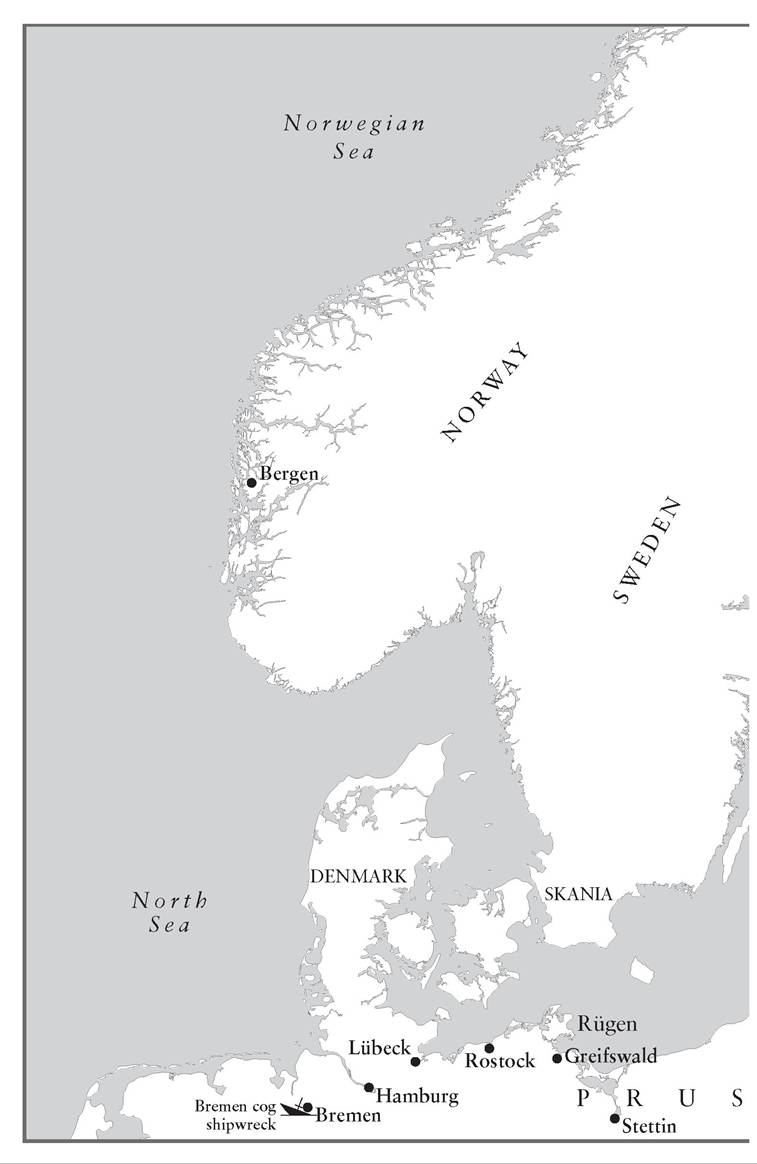
418 THE YOUNG OCEAN: THE ATLANTIC, 22,000 BC-AD I500 (Middle Low German - Deutsche Hanse in Modern High German) was used informally; but the official term that the early Hanseatic (or, as they are sometimes called, Hansard) merchants used for themselves in places where they successfully installed themselves, such as Bergen in Norway or the Swedish island of Gotland, was rather different: in Latin mercatores Romani imperii, or in Low German coepmanne van de Roemschen rike, both meaning ‘merchants of the Roman Empire’.4 For, even in German lands far beyond the Rhine and the Danube that had never fallen under Roman rule nobles, knights and merchants took pride in the imperial authority of the medieval German kings, most of whom received the crown of the Holy Roman Empire.
The major Hansa city in the Baltic, Lübeck, was elevated to the special status of a free imperial city by Emperor Frederick II in 1226, having already received privileges from his grandfather Frederick Barbarossa in the twelfth century. Since the Danish king had been making his own bid to gain control of Lübeck and the neighbouring lands of Schleswig, the German ruler understood how important it was to win the loyalty of the Lübeckers.5To a striking degree, accounts of Hanseatic history have been moulded by modern political concerns. In the late nineteenth century, Bismarck and the Kaisers dreamed of making Germany into a naval power capable of confronting the British at sea. The difficulty was that Great Britain appeared to possess a naval tradition that Germany lacked; with a little probing, however, just such a tradition was discovered, in the fleets of the Hansa cities. That the Hansa was a German, or at least Germanic, phenomenon was easy to demonstrate: there were, it was true, Flemings, Swedes and other non-Germans whose towns took part in Hanseatic trade, but these people shared a common Germanic ancestry, and German merchants in such centres as Visby and Stockholm formed the core of the original merchant community. Such ideas were taken still further by historians writing under the Third Reich. By now the Hansa was associated not just with racial purity but with German conquest, because the cities founded along the shores of the Baltic by merchants and crusaders, of which more shortly, could be presented as glittering beacons of the ‘Drive to the East’ that had subjugated, and would once again subjugate, the Slav and Baltic peoples. Even after the fall of the Third Reich, the politicization of Hansa history continued, though in new directions. Since several of the most important Hanseatic towns, such as Rostock and Greifswald, lay along the shores of the now vanished German Democratic Republic, East German historians took an interest in the Hansa.
They were wedded to Marxist ideas about class structure, and they made much of the ‘bourgeois’ character of these cities, which were by and large self-governingcommunities, able until the fifteenth century to fend off the attempts by local princes to draw them into their political web. East German historians also laid a strong emphasis on evidence for political protest among the artisan class in the Hansa towns, and they asked themselves whether these were places where a precocious proto-capitalism came into existence (whatever that term might mean).6
Following the collapse of the discredited East German regime, interpretations of the history of the Hansa have swung in a different direction, with German historians once again taking the lead. The Hansa is now held up as a model of regional integration, an economic system that crossed political boundaries by linking together Germany, England, Flanders, Norway, Sweden, the future Baltic states and even Russia. Andrus Ansip, Prime Minister of Estonia, celebrated the entry of his country into the Eurozone by declaring: ‘the EU is a new Hansa’. Modern German accounts of the Hansa barely conceal their authors’ satisfaction that German economic dominance within Europe has what appear to be inspiring precedents going right back to the Middle Ages: the German Hansa encouraged free trade among its members and constituted a ‘superpower of money’.7 There was even a degree of political integration, since commercial law followed a limited number of models; at first many maritime cities followed the sea law of Visby in Gotland, but over time the commercial law followed in Lübeck became standard. However, a leading French historian of the Hansa, Philippe Dollinger, took exception to the common term ‘Hanseatic League’, because the German Hansa was not one league with a central organization and bureaucracy, like the European Union, but a medley of leagues, some created only in the short term to deal with particular problems.
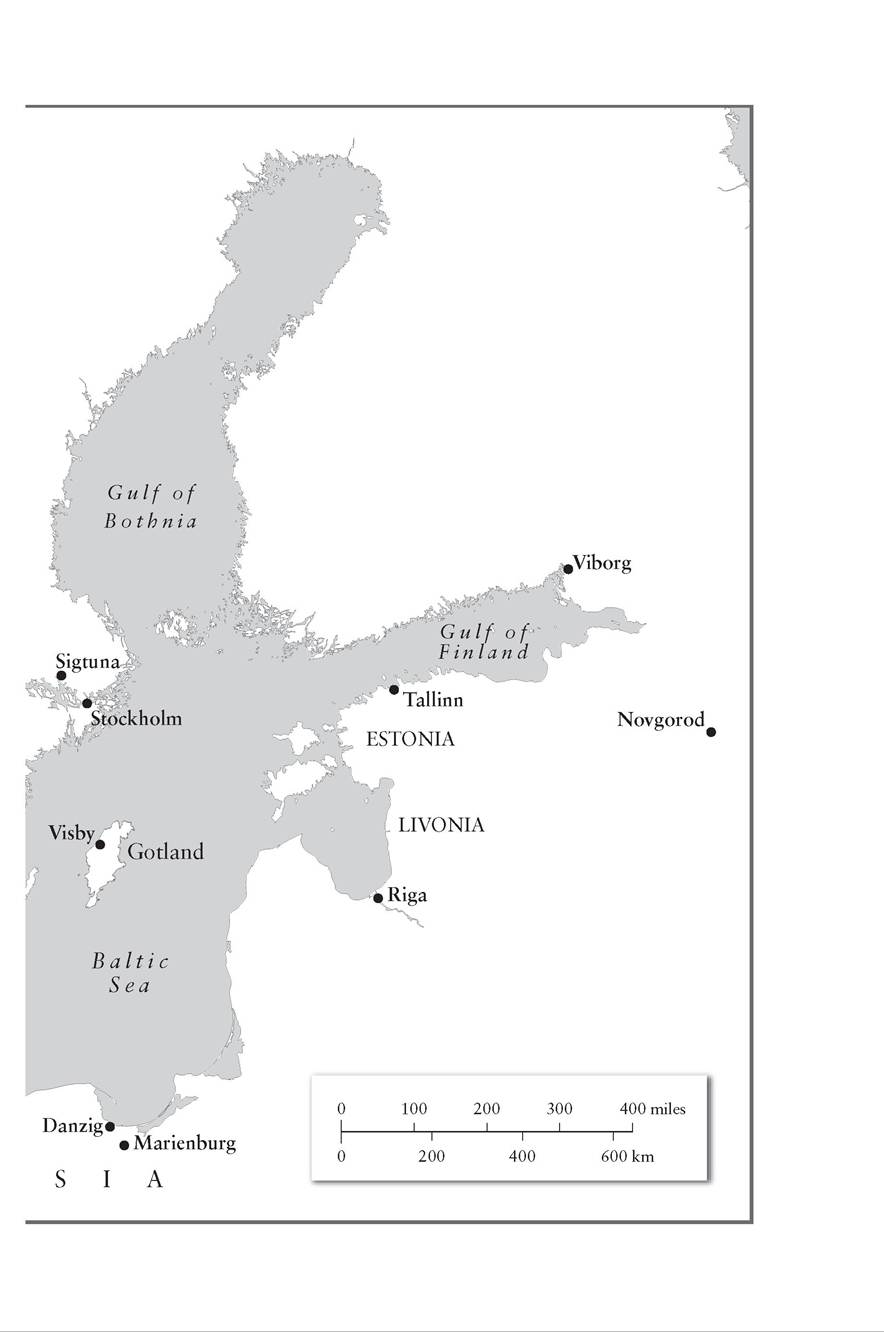
He very sensibly suggested that the term ‘Hanseatic Community’ fits best of all.8All these ways of reading the history of the Hansa distort its past in a broadly similar way. The German Hansa was not simply a maritime trading network. By the fourteenth century it had become a major naval power, able to defeat rivals for control of the waters where its members traded. Less often noticed is the significance of the inland cities that played a very important role in Hanseatic trade with England, operating under the leadership of Cologne.9 Of its three major trading counters outside the network of Hanseatic cities, places where the Hanseatics were permitted to create their own towns within a town, one, Novgorod, lay inland, though the other two, Bergen and London, were only accessible by sea. The Hansa was a land power (or maybe one should say river power) as well as a sea power, and its ability to draw together the interests of cities in the German hinterland and cities that gave access to the sea lent it enormous economic strength. It was a source of supply for luxury goods such as furs from Russia, spices from the Levant (by way of Bruges) and amber from the Baltic; but its members were even more active carrying uncountable barrels of herring, vast supplies of wind-dried cod, or the rye produced along the shores of the Baltic on the lands of the Teutonic Knights. Indeed, the link to this crusading order of knights, lords of large parts of Prussia and Estonia, was so close that the Grand Master of the German Order, to give the Knights their correct name, was a member of the Hanseatic parliament, or Diet. As well as supplying a good part of the food the Hansa cities required if they were to survive and grow, the Grand Master was overlord of several towns that the German merchants had set up along the southern shores of the Baltic.10
The presence of a crusading Military Order in the deliberations of the German Hansa acts as a reminder that the medieval conquest of the Baltic was not simply the result of merchant endeavours.
Just as the Genoese, Pisans and Venetians took full advantage of the crusades in the Mediterranean to install themselves in the trading centres of the eastern Mediterranean, the arrival of German merchants in Prussia, Livonia (roughly Latvia) and Estonia was rendered possible by the victories of the ‘northern crusades’, wars against pagans and sometimes against the Orthodox Russians in which two German Military Orders, the Sword Brethren and the Teutonic Knights, played a leading role, as did the Danish and Swedish kings. The Sword Brethren came into existence at the start of the thirteenth century, when Albert von Buxhovden, an enterprising cleric with close family links to the archbishop of Hamburg-Bremen, arrived in Latvia with twenty-three ships, carrying 500 crusaders. His aim was always to create a permanent German presence in the area, and so he established a trading centre at Riga in 1201. This also became the base for the crusading brethren, whose mission was to convert the local Livs (a people related to the Finns and the Estonians), if need be by force. The ‘northern crusades’ borrowed concepts and vocabulary from the more celebrated crusades to the Holy Land, portraying their wars as the defence of lands dedicated to the Mother of God, just as the expeditions to Jerusalem were conducted in defence of the patrimony of the Son of God; in due course the Teutonic Knights would name their command centre in Prussia Marienburg, ‘the fortress of St Mary’. Without constant supplies of state-of-the-art weaponry brought across the Baltic on Hansa ships, these campaigns against wily, well-trained, obstinate native peoples had little chance of success; as it was, the ferocity of the German onslaught did more to unite the opposition than to break it down.11Very soon the conquest of Livonian territory became an end in itself, and interest in the spiritual life of the Livs waned, if indeed it had ever been strong. A contemporary writer named Henry, who wrote a chronicle of the conquest of Livonia, insisted that all the violence against the Livs was in a good cause; as pagans, they had robbed, killed and committed sexual depravity, including incest, but after baptism they were subject to holy correction, which often seemed to work.
On one occasion Sword Brethren fighting Estonian pagans maintained a siege of a heathen stronghold for several days, calmly killing their prisoners in sight of the besieged, until the Estonians had had enough: ‘we acknowledge your God to be greater than our gods. By overcoming us, he has inclined our hearts to worship him.’ As at the time of the conversion of the Scandinavians, the message was that Christ was a warrior to be respected above all other leaders.12 The Brethren formed part of the bishop of Riga’s entourage until they began to interfere in the Danish lands that had been carved out of Estonia, including the trading city the Danes had created there - Reval, or Tallinn (which may mean ‘castle of the Danes’).13 By 1237, this and other scandals had reached the ears of the papacy, with the result that the Sword Brethren were incorporated willy-nilly into the larger and better- organized Teutonic Knights; but by then the Sword Brethren had already extended the German military presence, and by extension the German trading presence, far along the southern shores of the Baltic.14As the foundation of Tallinn suggests, the thirteenth-century conquest of the Baltic was not solely achieved by Germans. The political ambitions of the Danish and Swedish kings, often in competition with one another, also transformed this area, and offered yet more opportunities to German merchants. From the foundation of Stockholm, around 1252, German merchants were made welcome in the island city, because the Swedish rulers understood that the resources they needed for their wars of conquest had in large part to come from the profits of trade. Scandinavian raids brought the Finnish coast under the rule of the Swedish kings, and Estonia fell under Danish rule for a time, until it was handed on to the Teutonic Knights. Without violence to the evidence, these attacks can be seen as a continuation of the wars fought by earlier Danish and Swedish rulers, and by Viking raiders, in the days when Haithabu and Wolin were major trading bases perched on the edge of pagan principalities.
The history of this period, known largely from German and Scandinavian writings produced by Christians who were fiercely critical of their pagan neighbours, is too easily presented as a one-way movement of ruthless crusading armies and navies eastwards into the Baltic lands. The reality on the ground was more complex. By the twelfth and thirteenth centuries the Slavs, Balts and Finno-Ugrians who inhabited the Baltic
422 THE YOUNG OCEAN: THE ATLANTIC, 22,000 BC-AD I500 shores, mostly pagan, were launching their own Viking-style raids against German and Danish ships and settlements. Just as the Anglo-Saxons had once prayed for deliverance from the wrath of the Northmen, so in medieval Denmark prayers were uttered beseeching deliverance from Curonian raiders, the pagan inhabitants of what is now the west coast of Latvia; in 1187 Estonian raiders reached as far as the important trading base of Sigtuna, on Lake Mälaren, which they sacked, having outwitted the Swedish defences. It was a feat worthy of those Vikings who in earlier centuries had navigated down the Seine or the Guadalquivir with the aim of sacking the rich towns of France and Spain.15 Looking further ahead, the Swedish king, Birger, informed the Hansa in 1295 that he had conquered the Karelians, in southern Finland, and had converted them to Christianity; this was perfectly just, he argued, since they had been launching pirate attacks on Christian shipping, and had routinely disembowelled their victims. He had also constructed a castle at Viborg ‘to the honour of God and the glorious Virgin, both for the protection of our kingdom and for the safety and peace of seafarers’. From Viborg, King Birger proposed to keep a watchful eye on trade towards Russia, even limiting the number of Russian merchants who could board Baltic shipping. What he really wanted was a stake in the fur trade out of Russia, and to extend his political control over the southern shores of Finland.16 As trade across the sea grew in volume, German and Scandinavian ships became more obvious targets for raiders of all descriptions. Imposing order on these dangerous seas would, however, produce handsome returns. Trade and crusade were intimately entangled, whether in the Baltic or in the Mediterranean; but political ambitions also counted for much in the calculations of the crusading kings of Sweden.
II
Why the Germans became dominant in the Baltic and the North Sea is a good question. After all, around 1100, German ships were not seen as often in the North Sea or the Baltic as Scandinavian ones, while the Flemings were a notable presence on the river routes of northern Europe, and further south in Germany there were busy communities of Jewish merchants, especially active in the wine trade; whether deliberately excluded or simply not interested in the far-flung north, the German Jews took no part in the transformation of the Baltic and the North Sea led by the Hansa.17 Until Lübeck began to flourish in the twelfth century there were no German towns on the Baltic, and the area that became the German
Democratic Republic did indeed have a different identity to the rest of Germany: its inhabitants were pagan Slavs, notably the Wends, or Sorb- ians, who still survive in the Spreewald near Berlin. The predecessor of Lübeck, Liubice, or Alt-Lübeck, consisted of a fortress established by a knes, or prince, of the Polabian Slavs, while not far off another very small Slav settlement lay at Rostock, in Abotrite territory; beyond lay Rugians, Wagrians, Pomeranians - Szczecin (Stettin), close to the modern German- Polish border, was famous for its three pagan temples and its strong walls.18 There was an enormous variety of different peoples speaking different languages or dialects, and the fragmentation into small groups rendered all of them much more vulnerable to the organized onslaughts of the Germans and the Danes. But there was plenty of peaceful contact too; several of these Slavonic peoples were happy to trade across the sea, which was also visited by Russian merchants, who were arriving in Gotland off Sweden, and reaching Schleswig in 1157. There can be no doubt that they were arriving much earlier, because links to Russia went back to the period when Scandinavian princes had become rulers of Kiev; Varangian merchants from Sweden had long been familiar with the river routes that extended far to the south, through Ukraine and, with a short hop overland, to the Black Sea. However, the twelfth-century Russian merchants came from Novgorod rather than Kiev, selling furs and pelts from the edges of the Arctic that had filtered down to Novgorod itself.19
The transformation of this region was, however, the work of Germans, by which one means speakers of a group of languages which (in their late medieval written form) goes under the name of Middle Low German, and which, at first glance, looks more like Dutch than the High German of further south, meaning that relations with Flemings and Hollanders were easy to maintain. Two places dominated the Baltic in the early days of the Hansa: Gotland, particularly its largest town, Visby; and Lübeck. It might seem odd that one of these places was not in German territory at all, but on a Swedish island; but, as has been seen, Lübeck too was barely in Germany, if by Germany is understood the area inhabited by German- speakers. Lübeck was not on exactly the same site as the old town of Liubice, which was more exposed.20 The foundation of the new city happened in stages, first with the destruction of Liubice in wars between Slavs and Germans, and then with the creation of a new town by the ruler of Holstein, Adolf von Schauenburg, in 1143. This was a bad moment, since soon afterwards the papacy declared a crusade on three fronts - not just the Second Crusade, which took the French and German kings off to Syria in the vain hope of conquering Damascus, but encouragement to the Christian armies fighting the Muslims in Spain, and a war against the pagan Wends which the pope would have preferred the German king to join.
The pope was rightly worried that two kings on crusade to the East would only obstruct one another, which is exactly what happened. In 1147, during the war against the Wends, the Abotrite ruler, Niklot, attacked Lübeck; but it was already well enough defended to resist him. On the other hand, it proved more difficult to resist the growing power of Henry the Lion - the duke of Saxony and one of the greatest princes in Germany - who refounded Lübeck in 1159, and granted it the iura honestissima, ‘the most honourable charter of town rights’, rights that were confirmed by the German emperor, Barbarossa, even after he had destroyed the power of his rival Henry in the 1180s. This gave the leading citizens power over law-making, and established them as the city elite.21 A German chronicler, Helmold von Bosau, was strongly of the view that Henry was only interested in making money, and did not really care whether the Slavs in the surrounding countryside turned Christian; but Henry certainly had a good sense of what was needed to make his new city flourish:
The duke sent envoys into the northern towns and states, Denmark, Sweden, Norway and Russia, offering them peace and free right of access through his town of Lübeck. He also established there a mint and a market and granted the town the highest privileges. From that time onwards there was ever-increasing activity in the town and the number of its inhabitants rose considerably.22
He was particularly keen to attract merchants from Visby, for he understood that a network linking Gotland, situated right in the middle of the Baltic, and Lübeck, with its access to the interior, would be extremely profitable. From 1163, Gotlanders were allowed to come to Lübeck free of tolls, though Henry expected reciprocal rights for Lübeckers visiting Gotland. Lübeck grew and grew; although the size of its population before 1300 is pure guesswork, the city is thought to have had 15,000 inhabitants at the start of the fourteenth century, and in the late fourteenth century - a time when plague had depopulated much of Europe - the population may have reached 20,000.23
Lübeck looked in two directions. Westwards, a short overland route connected the new city to Hamburg, giving access to the North Sea, and this was guaranteed by a formal agreement between the towns in 1241; by the fourteenth century, the narrow sea passage through the 0resund, or Sound, between Denmark and what is now southern Sweden, took priority. Naturally, use of that route depended on the approval of the king of Denmark, and relations between Lübeck and the Danes were not always easy. In the very early days, Henry the Lion boosted Lübeck by working closely with King Valdemar of Denmark to conquer the coastline that stretched east from Lübeck towards the large island of Rügen, where the statue of the Slav god Svantovit was ‘hacked to pieces and cast into the fire’. That done, the Danish king seized the temple treasures he found there. There was always the danger that the king of Denmark would come to regard these shores as his own little empire. One important result of these conquests was the foundation of satellite towns within the commercial orbit of Lübeck, towns that followed the Lübeck legal code; Rostock has been mentioned, established at the start of the thirteenth century, and a similar story of foundation, with the blessing of local territorial lords, applied at Danzig and elsewhere. These princes, whether German or Slav, were keen to draw in the profits of expanding trade; but the new towns acted as agents for the growing population of the German heartlands, who took the opportunity to settle the countryside alongside or in lieu of the existing Slav population - Netherlanders arrived as far afield as the Upper Elbe, where they introduced drainage schemes they had learned in their own boggy homeland, and left behind Dutch dialects that were still to be heard at the start of the twentieth century. This ‘Drive to the East’, Drang nach Osten, was both maritime and terrestrial.24
Only defeat in 1226 checked the apparently irresistible rise of the Danish coastal empire, which for a time even included Lübeck. The German emperor, Frederick II, looked on, but those who led the assault were the count of Schwerin, one of his often troublesome subjects, and the Lübeckers themselves.25 However, the Danes refused to stop interfering, and the ambitions of Valdemar IV Atterdag, the Danish king, who reigned from 1340 to 1375, drew together the Hansa cities. His relentless attempt to overwhelm Visby and Gotland, and to create a base there for Baltic expansion, was checked amid massive slaughter in 1361; the hideously wounded skeletons of the besiegers are a ghoulish motif of Swedish museums.26 When they at last made peace with the Danes at Stralsund in 1370, the Hansa cities were even able to insist that Valdemar’s successor would need to meet with their approval before he could be crowned king. That was a prestigious prize; but there were other prizes that were more valuable still: the Danes were forced to cede to the Hansa the towns that controlled traffic through the narrow passage of the 0resund - Helsingborg, Malmo and other places.27
This, then, was a glorious future, whose triumphs were expressed in the handsome Gothic buildings that the Lübeckers constructed at huge expense out of brick; there were grand churches, such as the Marienkirche and Sankt Petri in Lübeck, but also streets of gabled merchant houses, and these became the model copied by the masons of Rostock, Greifswald, Bremen, and of city after city along the great arc that stretched from Bruges to Tallinn. The design of these houses was determined by the simple need to incorporate a warehouse as well as an office and living quarters, because the Hanseatic merchants looked after their own goods rather than depositing them in central warehouses, as often happened in the Mediterranean. Yet the most successful merchants also sought to show off their wealth with Gothic frills and other touches of grandeur, such as a facade coated in imported stone to distinguish their home from the frontages on either side.28 Artists from Lübeck such as Bernt Notke and Hermen Rode, the creator of massive carved altarpieces, were in great demand as far away as central Sweden, so that cogs sometimes carried not just rye and herrings but carefully wrapped masterpieces destined for the churches of Stockholm and elsewhere.29 A common legal standard, the maritime law of Lübeck, ensured that commercial disputes would be solved by similar means in places very far apart. A common language, Low German, took over from Latin as the medium in which to record business transactions. The middle classes in the Hansa towns did not learn letters in order to dispute the ideas of St Augustine or Thomas Aquinas, even though Lübeck and other cities had their share of wealthy convents, and both Rostock and Greifswald acquired universities that still survive, founded in 1419 and 1456; an ability to read and write oiled the wheels of commerce.30
III
Late medieval Lübeck gloried in the title Caput Hanse, ‘head of the Hansa’, but in the early days of what was to become the German Hansa, Visby exercised more influence than Lübeck, benefiting from its excellent position in the middle of the southern Baltic.31 A self-governing community of German traders began to coalesce; on its seal it proudly proclaimed itself to be the universitas mercatorum Romani imperii Gotlandiam frequentantium, ‘the corporation of merchants of the Roman Empire visiting Gotland’. This word universitas had not yet become a term of art for places of advanced learning, and retained its generalized meaning of ‘community’, ‘corporation’, not so different from the vernacular term Hansa. In the thirteenth century, enough Germans had settled permanently on the island to form a second, parallel, self-governing group, using a similar seal, but with the word manentium, ‘remaining in’, replacing frequentantium, ‘visiting’. The Germans had their own very magnificent church, St Mary of the Germans, which now serves as Visby cathedral; the Germans also, as was typical at the time, used it as a safe place to store goods and money. In addition to a quite formidable line of walls, more than two miles (about 3.5 km) in length, Visby contains over a dozen sizeable medieval churches, but following the city’s decline at the end of the Middle Ages all but St Mary’s fell into disrepair. Birka may have been the first town in Sweden, but Visby was its first city.
One of Visby’s grandest churches, Sankt Lars, betrays the influence of Russian architectural styles, and a small church in the south of the island contains frescoes in a Byzantine-Russian style; there was also a Russian Orthodox church in Visby, though this is now buried underneath a cafe. For Gotland was the great emporium where Russian goods such as furs and wax were received, having travelled part of the way by river, through Lake Ladoga and up the Neva into the Baltic, and then across what could be dangerous waters to Gotland itself. At the other end of the route, in Novgorod, the Gotlanders possessed their own trading colony, or ‘Gothic Court’, which included a church dedicated to the Norwegian king, St Olaf, in existence by about 1080.32 Novgorod was not an ancient city, as its name, ‘New City’, suggests: tests carried out on the wooden streets of medieval Novgorod, excavated in the 1950s, take the city’s history no further back than 950.33 The Baltic connection was thus of great importance to Novgorod, just as the Russian connection was of great importance to Gotland; and Henry the Lion and the Lübeckers were keen to tap into that. At first, the Germans rode on the backs of the Gotlanders. In 1191 or 1192 Prince Yaroslav III of Novgorod entered into a treaty with the Gotlanders and the Germans, but it mentions an earlier treaty, now lost - whether this included the Germans is unknown.34
Within twenty years another prince of Novgorod, Konstantin, granted the Germans the right to operate from their own courtyard, dedicated to St Peter - the Peterhof. Actually they had already set themselves up there, and had built a stone church. The use of stone was a necessary luxury, since the merchants stored their wealth here. Then they would go back to Visby at the end of each winter, carrying the chest containing the funds of the community until their return in the summer. Between the winter, when trade in ermine and other Arctic goods was brisk, and the summer, which was a good time to collect wax or buy the luxury goods arriving circuitously from the Black Sea and beyond, German merchants would be absent from Novgorod. Attempts were also made to build ties to other Russian cities, but they were never as successful as the links to Novgorod, which had the advantage of lying not too far inland. Once again, the sea is only part of a bigger story, since Cologne absorbed many of these Russian goods before they were sold on to Flemish and English businessmen.35
There was enormous demand throughout Europe for high-quality Russian wax, most of which evaporated into the atmosphere when it was used in church ceremonies; and the range of furs that could be obtained from Russia and Finland was unmatched: not just plenty of cheap rabbit and squirrel furs, but pine marten, fox, and at the top of the scale white ermine (de rigueur at princely courts).
IV
Benefiting from their links to German cities as far away as Cologne, the early Hansa merchants could raise the capital they needed for ambitious ventures into Russia, carefully managed through legally binding contracts. This gave them an advantage over traditional Scandinavian traders, who operated with less sophisticated methods. The purchase of shares in ships rather than ownership of an entire ship meant that one could spread the risks associated with sea voyages across a number of investments. Contact with Russia provided essential priming for the rise of the German Hansa; but the Baltic and the North Sea became increasingly important to the Hanseatic traders, as England and Norway became the focus of their l onger-distance sailings, while within the Baltic rye, herrings and other basic foodstuffs became ever more important as the German cities grew, and as their persistent demand for food outstripped local resources. These towns had been founded as centres of trade and industry, but their very success turned them into major consumers of agricultural goods. This was greatly to the advantage of those who produced such food, above all the Grand Master of the Teutonic Order, who was also master of extensive estates where subject Prussians and Estonians laboured on behalf of the Christian conquerors in slave-like conditions. Trade in grain, principally rye, became the lifeline of cities as far afield as Flanders and Holland, and this dependence would only increase over the centuries, long after the Grand Master of the Teutonic Order had become a distant memory in Prussia and beyond.36
The ships that the Hansa merchants used were, in the early days, mainly cogs, with their shallow draught but generous cargo capacity; they had developed in the North Sea and the Baltic over several centuries. A l ate fourteenth-century example was found in the mud of the River Weser in 1962 and has been carefully restored for the German Maritime Museum in Bremerhaven. Her timbers can be securely dated from their tree rings to 1378. She was twenty-four metres long, three times her maximum breadth, and her capacity was somewhere in the region of 100 tons. She originally possessed a square sail and a rudder at mid-stern. But she never went to sea, to judge from the fact that not much was found on board apart from the tools of a shipwright, so it is likely she was dragged underwater during a tidal surge. Her construction was slightly odd (carvel planking around the keel, with planks laid flush, rather than the clinker planking one generally expects in northern Europe); but this was a fairly old-fashioned type of ship by 1380: the Hansa fraternity were making increasing use of larger vessels, mounted with ‘castles’ at each end, the ‘hulks’ that appear on many a medieval town seal from this part of the world.37 All this has set off technical arguments about when a cog is really a cog, though quirks of construction are only to be expected; the term kogge was a generic description, and these ships were not produced on an assembly line, unlike the big Venetian galleys of this period. They were no more uniform than modern city trams, but were perfectly recognizable as the same object; and what mattered was their seaworthiness first and their capacity second.38
Typical or not, the Bremen cog represents the humble realities of Hansa seafaring; silk and spices certainly reached the ports of northern Germany, whether they had been carried all the way from the Mediterranean down elongated sea routes favoured by the Venetian, Catalan and Florentine galleys of the late Middle Ages, or humped overland from the warehouse of the Germans (Fondaco dei Tedeschi) in Venice, past Bolzano and over the Alpine passes until they reached the rich cities of southern Germany - Nuremberg, Augsburg, Regensburg - and then embarked on further travels to reach Lübeck and its neighbours. A modern visitor to Lübeck who did not visit the famous marzipan emporium of the Niederegger family, founded in 1806, would be missing a great treat; but before Niederegger the city attracted ginger, sugar and cloves as well as almonds, and - most probably during the golden age of the Hansa - the north Germans discovered how they could manufacture sweetmeats and spicy sausages from the exotic trade goods that reached their cities. Fine Wurst is a Hanseatic legacy.
The fortunes of the Hansa were not, however, built out of marzipan and gingerbread. Fish, grain and salt, apparently humble animal, vegetable and mineral staples, were not quite such modest sources of profit as might be supposed when they were traded in the astonishing quantities handled by the German Hansa. Herrings had a special place in the diet of European Christians, as far away as Catalonia: when Lent arrived, they provided the perfect substitute for forbidden meat, all the more because methods of preserving them became more sophisticated. The difficulty with herring is that it is a very oily fish, and oily fish rot much faster than those with a very low fat content, notably cod. For this reason it was possible to produce wind-dried cod, which remained edible for a good many years (after soaking), whereas herring had to be salted and pickled as quickly as possible after it was caught.39 Tradition records that a Dutch sailor, Willem Beukelszoon from Zeeland, transformed the future of the herring fisheries in the fourteenth century, when he devised a method of pickling partly eviscerated herrings and placing them between layers of salt in great barrels, which had to be done immediately after they were brought on deck (the secret was to leave the liver and pancreas in place, which improved the flavour, while removing the rest of the guts). This seems already to have been standard Hanseatic practice, and it was adopted in Flanders only around 1390, when fighting in the North Sea interrupted the flow of herrings to Flanders.40 Pioneer or plagiarist, Beukelszoon has been rated as the 157th most important Dutchman in history, not surprisingly in a nation that loves its Nieuwe Haring so much, but also in tribute to the fortune that the Dutch made out of exporting this humble fish in later centuries.
Nothing, though, compared to the quantities of herring to be found in the Baltic when the fish spawned off the coast of Skania, now the southernmost province of Sweden but during the Middle Ages generally under Danish rule. It was said that you could wade into the sea and scoop them out of the water with your hands; rather than sea, there was a mass of wriggling fish: ‘the entire sea is so full of fish that often the vessels are stopped and can hardly be rowed clear through great exertion’, to cite an early medieval Danish writer.41 All this gave great impetus to the fair held on the shores of Skania, which dealt in many goods, but was most famous for its herring market; temporary shacks were set up as housing for the thousands of people who came to the fairs, also providing factory space for the labour force that cured, dried and, in a myriad of other ways, treated the fish. The fairs became an ever more attractive centre of trade as demand for these fish expanded and as the reputation of Skania as the unsurpassed centre of this business became known: visitors arrived from northern France, England and even Iceland.42
In the course of the fifteenth century, the herrings began to gather further north, for an unexplained reason (maybe connected with climatic conditions), and the glory days of the Skania fairs came to an end. But at its peak it was not unusual for 250 ships all loaded with herring to come into port at Lübeck alone, as happened in 1368. Annual totals just for Lübeck may have reached 70,000 barrels.43 Yet none of this could have happened without the availability of salt to preserve the silver harvest of herrings - indeed, some Dutch observers went further, and less poetically called it a ‘gold mine’. Here lay Lübeck’s great advantage. Not far away, near Lüneburg Heath, lay very extensive supplies, consisting of strong brine that was boiled down to produce salt; this was not the cheapest process, and when in the early fifteenth century rivals in western France began to flood the market with their own cheaper salt (sometimes half the price, even after long-distance transport), Lüneburg fell into decline, and Hansa merchants proved happy to range much further afield, all the way to the Bay of Bourgneuf or even Iberia.44
This Hanseatic world, at once contentious and co-operative, thus extended its sights far beyond the Baltic and the North Sea. It has been seen that the search for cheap salt took German ships all the way to western France. There they might encounter ships from another land that were learning their way around the Atlantic: the Portuguese, whose own base in Flanders lay at Middelburg, close to the modern Belgian-Dutch frontier. But by the fifteenth century the Hansards were travelling even further, reaching Portugal itself, which they recognized as another source of salt (including the flat lands around Lisbon); and they also recognized that Portugal was short of grain, which they could easily supply from the rich reserves of the Baltic. They brought all sorts of other foods to Portugal, including beer and beetroots, and even salted fish, which was something the Portuguese could supply to themselves in vast quantities. After the Portuguese captured the Moroccan port of Ceuta in 1415, in the campaign where Prince Henry the Navigator won his spurs, German ships began to bring grain as far south as Ceuta itself, which was desperate for supplies as it was cut off from the rich grain fields that still lay under Muslim rule. Nor was this a casual relationship: Hansards interested in Portugal included prominent burghers of Danzig experienced in trade with Scotland, England, Flanders and France.45 As Portugal emerged as a significant maritime power in the fifteenth century, its Hanseatic connections gave it access to a much larger world than the waters off Iberia.