21 White Bears, Whales and Walruses
I
Greenland is often described as the world’s biggest island.1 Geologically, though, it forms part of North America, and to include Baffin Island as one of the American discoveries of the Norse navigators, while excluding Greenland, is another example of what might portentously be called ‘the social construction of continents’.
Even in the sixteenth century it was sometimes assumed that Greenland was somehow linked to Asia, which had already been the view of Adam of Bremen in the late eleventh century, while around 1300 an Icelandic geographer remarked that ‘some people think’ the American continent must in reality be part of Africa; Adam, on the other hand, took the view that it was part of Asia, a view that survived up to and beyond the days of Columbus and Cabot.2 This was hardly the issue that worried navigators, however. The seas that lap Greenland are as unsafe as the environment, dominated by a truly vast ice cap, is hostile and impenetrable. Only a small part of the island was suitable for settlement, and it is a tribute to the persistence of its first Norse explorers that they searched out the fjords that gave access to grasslands, even though they lay on the western flank of the island.To reach these distant lands in the types of ship that the Norse operated was a challenge of endurance: when Eirik the Red led the first settlers across the sea to Greenland in around 986, he set out from Iceland with a fleet of twenty-five ships, but only fourteen reached Greenland, some sinking and others having to turn back.3 Although an awning would be spread over the crew and passengers at night, space was tight in the hold, especially when it was as crowded with animals as it was with humans. The journey from Norway to the east coast of Iceland was estimated at seven days’ sailing, and from western Iceland to the Norse settlements in Greenland took four days, while from Iceland to Ireland was a five-day voyage.
By the thirteenth century, Norse ships had discovered lands even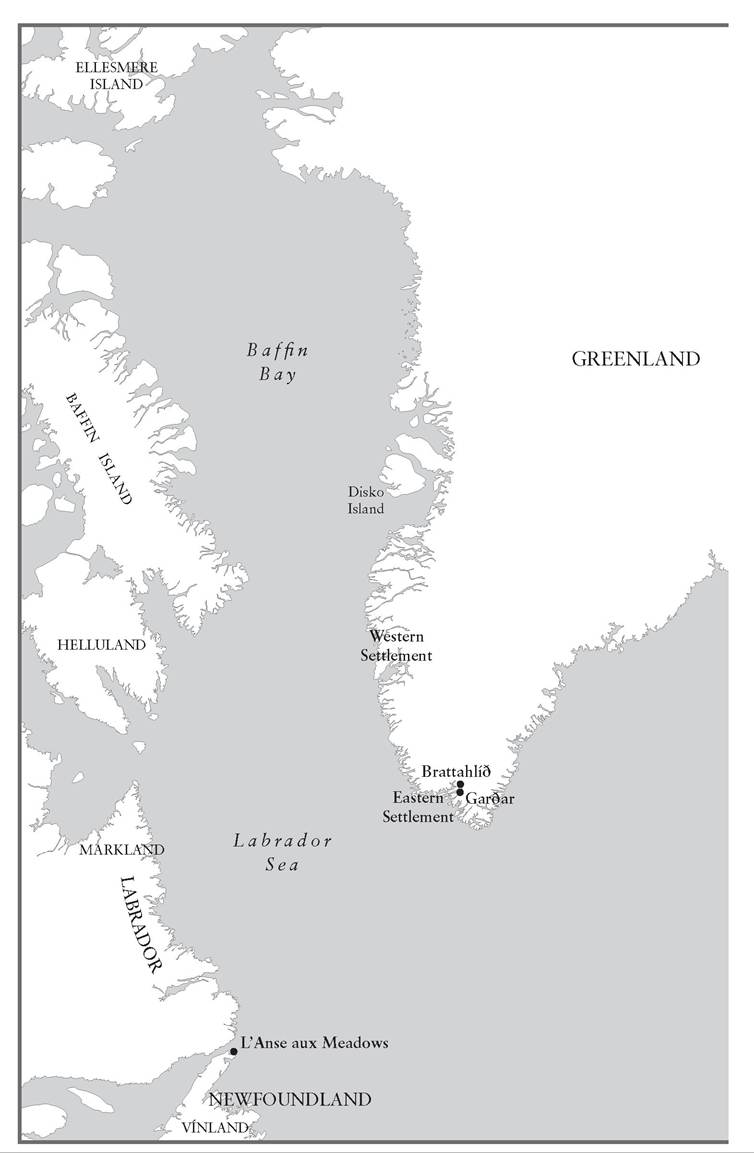
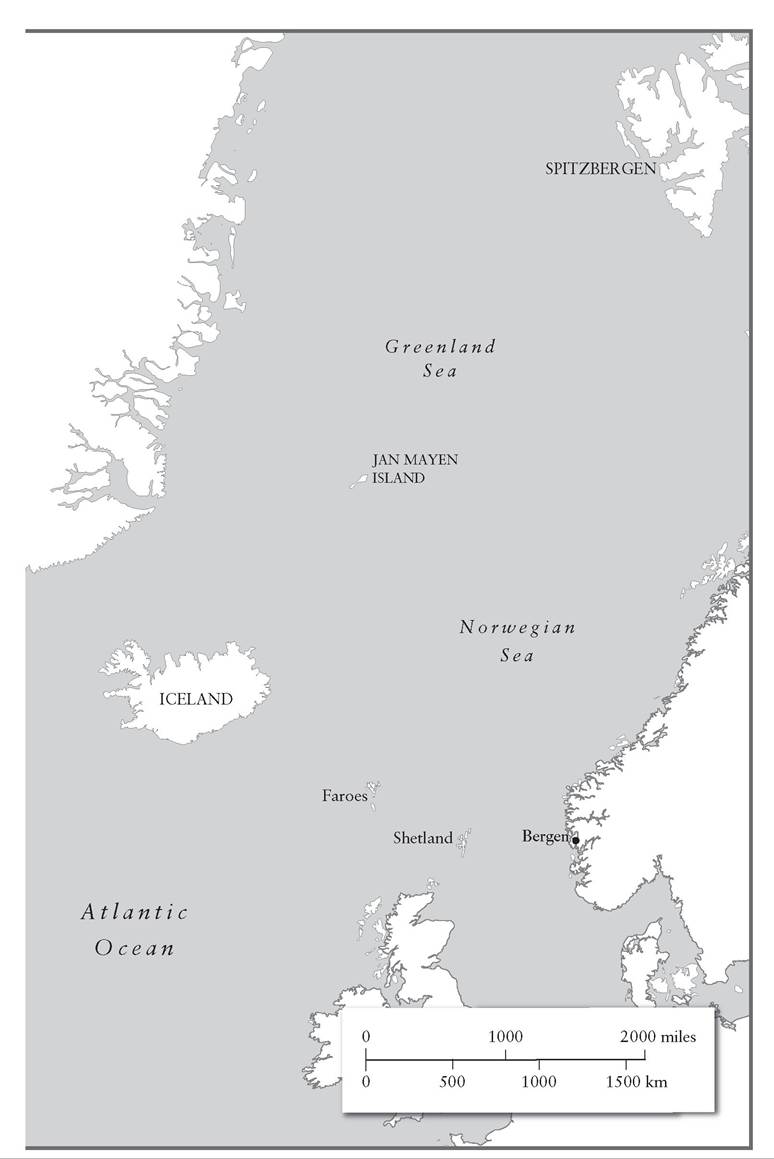
further north than Iceland, reaching Jan Mayen Island and Spitsbergen (which lay four days’ travel north of Iceland), though these were not places the explorers tried to settle - the environment was too hostile. Another very hostile environment was the east coast of Greenland, even though it took a single day to reach it from the nearest point in Iceland. Once traffic was moving regularly towards Greenland, Norwegian captains also learned to bypass Iceland entirely, taking a course due west from a place in Norway called Hernar, and sailing straight on between Shetland and the Faroes, ‘so that the sea looks halfway up the mountainsides’, and then on to Greenland without calling at any ports in Iceland.4
Judging from the sagas, Greenland was discovered by accident; bearing in mind stories of ships that were swept westwards by the winds, this makes perfect sense. Early in the tenth century a nephew of Naddob, one of Iceland’s discoverers, named Gunnbjorn Ulf-Krakuson, was blown off course on a voyage from Norway to Iceland, and saw a group of skerries west of Iceland, together with a landmass beyond; it is now thought that what he actually saw was an Arctic mirage, but even if he did see Greenland he would have found its steep east coast extremely forbidding.5 Although he did not explore further, and was not interested in founding a settlement, Gunnbjorn’s family seem to have been proud enough of what he had achieved to continue to talk about the land that lay to the west; and in the 970s one settler in Gunnbjorn’s neighbourhood, Eirik the Red, clearly listened attentively to the story. Eirik and his father had been outlawed from Norway and had arrived in Iceland in the vain hope of obtaining the sort of broad estates that earlier Norse settlers had acquired.
But by the time they reached the island the best land had long been occupied by the gqdar and their followers.6 Eirik had killed one man in Norway, and before long he was sucked into feuds in Iceland. By 983 he was an outlaw there too; the sentence was for three years, but if he appeared in public any of his foes could attempt to kill him with impunity.Leaving Iceland was the obvious option and, since he required land, Eirik chose not the Norse lands in the British Isles but the far-off ice-bound land that Gunnbjorn had sighted. The east coast, with its towering i ce- covered cliffs, was quite unsuitable for settlement. Many tales survive of Norse sailors washed up on this shore, some of whom were lucky enough to be found, some of whom tried to trek across country to the settlements but were defeated by the cold, their bodies being found and identified as much as fourteen years later. In one case wax tablets were also found on which a traveller from Bergen recorded how his journey to Iceland had gone awry.7 Eirik avoided these ‘unsettled wilds’, as they came to be known, and worked his way beyond the southern tip of Greenland, identifying two areas suitable for settlement: to the south, following watercourses away from the rocky coast, and navigating past islands teeming with bird life, he found the grassland of the so-called Eastern Settlement (though it might better have been called the Southern Settlement). Four hundred miles to the north he identified another area, much cooler, which he thought would make a good base for hunting expeditions, and this became known as the Western Settlement, and was always smaller than the main base further south. It is likely that he returned from this area laden with sealskins, walrus tusks and other polar prizes, all of which advertised the wealth that skilled hunters could draw from the region. The promise of the Eastern Settlement, with its green fields, led him to name the territory Greenland, ‘for he argued that men would be drawn to go there if the land had an attractive name’.8 It was not really dishonest to use the name Greenland, for the part he proposed to colonize was indeed green, and a global rise in temperatures made the land even greener.
After three years he returned to Iceland, no longer an outlaw; a severe famine in 976 had demoralized the Icelanders, and, with his brightly painted oral prospectus for Greenland, he had little difficulty in recruiting somewhere around 400 settlers from Iceland.9Following convention, as he approached the lands marked out for the Eastern Settlement, Eirik threw his high-seat pillars overboard, watching to see where they would be washed ashore; he thus relied on the gods to show him where to settle. The place he chose, BrattahliS, has been identified and excavated, for it was occupied for hundreds of years; it lay some way back from the water, in a broad plain that led down to a fjord giving access to the sea. The settlements were not real towns, any more than the Icelandic settlements were; they consisted of a scattering of nearly 200 farms in the Eastern Settlement, while the Western Settlement possessed ninety. Some of these farms were occupied by later waves of settlers who had heard good reports of the opportunities this new land offered.10 The Eastern Settlement also contained a cathedral at Gardar, following the Christianization of the Norse settlers, and there were several churches in the other settlement too. The hardy inhabitants of the two settlements would sometimes head north in small six-oared boats, which many of the farmers owned. They might go as far as Disko Island (70oN), in search of walrus, polar bears and narwhal, whose spikes were often believed in Europe to be unicorn’s horns. The famous Lewis chessmen were made out of walrus ivory, though they are thought actually to have been made in NiSaros on the coast of Norway.
In the mid-fourteenth century this commerce in walrus tusks began to fall away, and one can only wonder whether the exploitation of these
398 THE YOUNG OCEAN: THE ATLANTIC, 22,000 BC-AD I500 resources had reached such a fever pitch that the walrus population had begun to vanish. Another explanation that has been mooted is the increasing ease of access within Europe to elephant ivory, by way of west Africa and the Red Sea, but, at least as far as west Africa is concerned, this was a development of the fifteenth and not the fourteenth century.
Walrus hide was valued in northern Europe because it could be twisted into tough rope. Two tiny amulets preserved in the National Museum of Denmark are in the form of a polar bear and a walrus.11 A Greenland falcon made a perfect gift for the falcon-crazy Emperor Frederick II in thirteenthcentury southern Italy; twelve Greenland falcons are said to have constituted the ransom paid for the crusading son of the duke of Burgundy when he was captured by the Turks in 1396.12 Greenland did, therefore, play a role in the international trade of the Middle Ages, and was by no means a disconnected territory inhabited by Norse exiles. A thirteenthcentury Norwegian writer explained that there were three good reasons to sail to Greenland: curiosity; the search for fame; and the search for wealth - precisely because Greenland was so remote, and was visited less often than other lands, it offered ‘a good profit’. This was not just because it was a source of rare Arctic products; traders could also exploit the shortage of iron and timber, for ‘everything that is needed to improve the land must be purchased abroad’.13The great difference between Greenland and Iceland was the fact that part of the western coast of this vast land was already inhabited, not, as in Iceland, by a handful of chaste priests but by Eskimo peoples. The term ‘Eskimo’ has gone out of fashion, because it was a native American word meaning, rather contemptuously, ‘raw-meat eaters’; but it is used here as a blanket description of different people with different cultures: the so- called Dorset people, named after a small island off Baffin Island, and then the more familiar Inuit, who still inhabit Greenland and who have sometimes been called ‘Neo-Eskimos’ instead. The term ‘Inuit’ simply means ‘human beings’, for (not unreasonably) many peoples have no name for themselves other than ‘ourselves’.14 The Dorset Eskimos may have been clinging on to Greenland at the time of the Norse discovery, for the ‘Iceland Book’, the tslendingabok, relates that Eirik and his companions ‘found many settlements, towards the east and towards the west, and remains of skin boats and stone implements’; and the author assumed that the people who had lived in these places were of the same origin as the troublesome inhabitants Eirik would later encounter in Vinland, some way down the eastern flank of America.15 Archaeological evidence is less secure, and the ‘Iceland Book’ may well have been embroidering the account of Eirik’s discoveries with information gathered much later; still,
Dorset Eskimos may have been present in Greenland up to about 1000, though further north than the two areas settled by the Norse migrants.
Legends circulating among the next wave of Eskimo settlers, the Inuit, recorded seal-hunting landsmen who had been pushed southwards as the Inuit entered Baffin Island, between Greenland and the Canadian mainland; these predecessors of the Inuit would have crossed over to Greenland in kayaks, but they were not really a maritime people, and they were defeated by conditions in Greenland: they lived in lightly constructed houses warmed by open hearths, and fuel was hard to find in a land so poor in timber as Greenland.16The Inuit, on the other hand, learned to work the waterways of the Arctic in increasingly well-constructed kayaks, and made their way from Siberia and Alaska along the far northern coasts and islands of Canada into north-western Greenland, which they entered by about 1000, that is, at the same time as the Norse settlements took hold. By about 1200 these Inugsuk Inuits (to give them their exact name) had made themselves known to the Norse Greenlanders. Contrary to the popular image of Eskimos living in igloos built out of i ce-blocks, the Inuit lived in slightly sunken houses entered through narrow passageways, and made out of piled-up stones, stone flakes, turf and whalebone; like the Norse, they hunted walruses and seals, and they were very active whalers who were armed with heavy but handsomely crafted harpoons and who could even capture massive baleen whales. Objects of Norse origin found on Inuit sites in Greenland - a piece of tusk with symmetrical decoration, a fragment of a bronze spoon and of a bronze pot, and so on - indicate that trade (or possibly plunder) connected the Norse and Inuit communities. Contact became much more frequent as the Inuit moved slowly southwards, and as Norse explorers searched ever further north; on the other hand, very few Inuit articles have turned up on Norse sites in Greenland.17
In the larger Eastern Settlement, there was more of an attempt to create a self-sufficient community. As in Iceland, this was not really possible, as there was no hope of sowing large areas with grain, and the mainstay of the Greenland settlers was their flocks. A thirteenth-century Norwegian text, the King’s Mirror, described how the settlers were rich in cheese and butter, and raised cattle for meat, as well as hunting reindeer, whales and seals, which they turned into meat or fat, as well as local fish (notably cod) and Arctic hares. The milky drink known as skyr was a favourite food. Timber was sparse and of poor quality; even the driftwood that came down from Siberia along the ocean currents was not suitable for building ships, though it burned well as fuel. They would have to go in search of wood - which, as will be seen, took them still further west. But they, like the Icelanders, produced heavy woollen cloth that found its way along the trade routes; a warp weight found in Greenland was decorated with a hammer, the symbol of the god Thor, suggesting that the pagan gods still had their attraction among the Norse settlers. So little grain was grown that (if the King’s Mirror is to be believed) most Greenlanders had no idea what bread was.18 The settlers were tough: when Eirik the Red called on his cousin Forkell the Far-Travelled, Forkell needed to offer him dinner but realized he had no boat available to travel to the island a mile away across the water where his sheep were pastured. So he swam to the island and killed a ram, which he then heaved on to his back, before swimming the whole way back and serving a meal of roast mutton.19
The first settlers were pagan, and the circumstances of Greenland’s conversion to Christianity are not clear. According to the Saga of Eirik the Red, the founder remained a convinced heathen, and was disconcerted to find that his family was keen to adopt the new faith. His son Leif the Lucky had spent some time at the court of Olaf Tryggvason in Norway, and the king urged him to go back to Greenland and to spread Christianity there; Leif was no doubt thinking of his father when he objected that this would be a difficult task, but the king was persistent, and on his arrival (having first been blown to North America) he immediately converted his mother, whereupon she refused to live with Eirik, and ‘this annoyed him greatly’. The annoyance was magnified when his family built a small church, only six metres long by three metres broad, that has been excavated at Brattahlib.20 It is probably an exaggeration to suppose that King Olaf added Greenland to the list of countries he converted, and the story of his involvement was intended to boost still further the reputation he developed by the thirteenth century of being the father of Norse Christianity. No more than he succeeded in imposing the new religion on the more remote corners of Norway did he succeed in stamping out paganism in Iceland and Greenland; but gradually the population was won over, and the effects can still be seen in the remains of the cathedral at Gardar and in the intermittent line of succession of bishops of Greenland, sent out to the Eastern Settlement from the early twelfth century onwards. The church at Brattahlib was built, for lack of good timber, out of chunks of turf set around a sparse wooden frame in the same way as the farmhouses of both Greenland and Iceland.21 For a long time, Greenland was not a dependency of Iceland; its system of government was closely modelled on that of Iceland, with a Ping that brought together the leading inhabitants and that passed laws under the direction of its Law-Speaker. This territory had the same ambiguous relationship with Norway as did Iceland, and by 1261 it, like Iceland, had accepted the authority of the king of Norway, not that he was able to do much to control its affairs.
A charming tale from medieval Iceland recounts the career of an Icelander named AuSun, who travelled all the way from Norway to Greenland, where he bought a bear, ‘an absolute treasure’, with all the money he possessed. He decided to return to Norway and then to travel south, with the aim of presenting his bear to Svein, king of Denmark. But when he reached Norway the Norwegian king, Harald, a rival of the Danish one, heard that AuSun had arrived and summoned him to his court. The king courteously asked AuSun, ‘You have a bear, an absolute treasure?’ AuSun gave as non-committal an answer as he could, because he could guess what was coming next: ‘Are you willing to sell him to us for the same price you gave for him?’ AuSun politely but firmly refused. So the king asked what he did propose to do with the bear, and when he heard that Audun wished to present it to the king of Denmark he expostulated: ‘Is it possible that you are such a silly man that you have not heard how a state of war exists between our two countries?’ Still, King Harald was polite enough to let him go on his way, so long as he promised to tell Harald on his return about the reward King Svein would give him. As he travelled south, AuSun realized that he had no money left and no way to feed either himself or his bear. He persuaded the steward of the Danish king to sell him some food, but the price was half-ownership of the patient bear. After all, the steward pointed out, if the deal was not struck the bear would die of starvation, and what profit would that bring to AuSun? ‘When he looked at it that way, it seemed to him that what the steward said went pretty close to the mark, so that was what they settled on.’
Audun entered the royal presence with the steward, and explained why he had come, and that there was now a new problem: he could not present the bear to the king, because he only owned half of it. The king scolded the steward for his lack of generosity to a traveller who had come to court with such a fine gift, when even Svein’s enemy King Harald had let him go on his way in peace. The steward was exiled forthwith, while AuSun was invited to stay at court as long as he wished. After a while, Audun’s love of travelling reasserted itself, and he decided to go to Rome with a group of pilgrims; the king offered him every support. But by the time he returned to Denmark he was once again destitute, and he skulked around outside the feasting hall, not daring to show himself in his rags. Eventually the king realized that there was someone who was hanging back, and worked out who he was. Yet again Audun was invited to stay for the rest of his days. Once again AuSun’s wish to be on the move triumphed: ‘God reward you, sire, for all the honour you would do me, but what I really have in mind is to return to Iceland.’ He was worried that his mother was living in poverty on the island while he might be carousing at court.
One day, towards the end of spring, King Svein walked down to the jetties, where ships were being overhauled in readiness for voyages to many lands, to the Baltic and Germany, Sweden and Norway. He and AuSun came to a very fine ship which men were making ready, and, ‘What do you think of this for a ship, AuSun?’ asked the king. ‘Very fine, sire,’ was his answer. ‘I am going to give you this ship,’ said the king, ‘in return for the bear.’
But the Danish king was worried that the ship might be wrecked on the dangerous shores of Iceland, so he gave him a purse full of silver and a gold arm-ring that he himself was wearing, charging him only to give it to someone to whom he found himself under a very special obligation.
First AuSun sailed to the court of King Harald, and received a hearty welcome. He told the king how his rival had willingly accepted the bear and had given such handsome gifts in return. AuSun said: ‘You had the opportunity to deprive me of both of these things, my bear and my life too; yet you let me go in peace where others might not’, and saying this he presented the Danish king’s arm-ring to King Harald, and then set off for Iceland, where ‘he was thought to be a man of the happiest good for- tune’.22 Alas, the tale does not relate what happened to the bear. However, the story of AuSun does not simply present evidence for the capture of Greenland polar bears, which were carried all the way to Scandinavia; it also conjures up a trading world that linked Greenland to Norway, sometimes by way of Iceland and sometimes directly. The story of the gift of a polar bear to a great prince is corroborated by evidence that both the eleventh-century German emperor Henry III and King SigurS of Norway, known as ‘the Jerusalem Traveller’, who went on crusade to the Holy Land early in the twelfth century, received just such a gift. The idea behind the gift to this Norwegian king was that he would support the creation of a Greenland bishopric.23
II
Contact between Greenland and Europe began to diminish in the fourteenth century. Even so, contact was maintained to a greater degree than used to be supposed, proving that over a period of more than 400 years Greenland was linked to Europe by regular trade; by the late Middle Ages only one kngrr a year was reaching Greenland, and maybe not even that, for no ships are known to have reached Greenland between 1346 and 1355, which was just as well, since Greenland was out of touch with Norway just at the time when Europe was being ravaged by the Black Death. By the fourteenth century, only ships granted a royal licence were permitted to trade towards Greenland. If anything, though, this proves that the king of Norway saw real value in the Greenland trade, and was keen to hog a large share of the proceeds. The arrival of ships from Greenland tended to be noted down in Norwegian annals, as was the case in 1383 when a ship loaded with Arctic goodies reached Bergen directly from Greenland (the ship itself was owned by an Icelander); it brought news that the bishop of Greenland had died a few years earlier, which suggests contact was intermittent. It turned out that the captain had never obtained a royal licence to trade in Greenland; but the crew insisted that the ship had been blown accidentally towards Greenland, and that no one had really intended to go there. The tax authorities preferred to believe what was probably a tall story - the cargo was too interesting for the Norwegians to complain. This sort of thing happened several times, and was conveniently overlooked; another Icelander turned up in Greenland in 1389 with four ships full of Norwegian cargo, and the Icelandic merchant breezily claimed that the Greenlanders, led by the king’s agent in Greenland, had absolutely insisted that he unload his cargo and take on board Arctic goods.24
Still, the very insistence of the Greenlanders on their need for European goods shows that contact was less intense than it had been. The last bishop of Greenland officiated there from 1365 to 1378. There are several possible reasons for the decrease in contact: the end of the Middle Ages may have seen a cooling of temperatures, with the result that pack ice appeared ever further south, so that the voyage to Greenland became increasingly perilous; the Greenlanders themselves were more and more reluctant to pay the papal tax known as Peter’s Pence (paid in vadmal cloth or walrus products); the king of Norway faced a cash crisis and became heavily dependent on the merchants of the German Hansa, who had not been involved in the past with the ambitious route across the north Atlantic; the Black Death reached Iceland in 1402 - much later than in Scandinavia - and sailings to Greenland were at least for a time suspended.25 The warm period stretching from about 800 to about 1200 was at an end. Drift ice certainly was an increasing problem: around 1342 the Norwegian priest Ivar Bardarson, who had been sent to Greenland to look after the lands of the bishop of Garbar, described the sea route from Iceland to Greenland. He took as his point of reference the skerries Gunnbjorn had discovered when he accidentally came across Greenland centuries earlier. The priest knew of an old set of sailing instructions, for he went on to say: ‘This was the old course, but now ice has come down from the north-west out of the gulf of the sea so near to the aforesaid skerries, that no one without extreme peril can sail the old course, and be heard of again.’26
The Western Settlement succumbed to a combination of worsening weather and to competition between the Inuit and the Norse for access to hunting grounds; the Inuit had been moving south as the seals they hunted tried to escape the bitterly cold weather of the very far north. When the Norwegian priest Ivar Bardarson visited the Western Settlement in 1342, he found that it contained only ‘horses, goats, cattle and sheep, all wild, and no people, either Christian or heathen’, though he had heard rumours that the Skr^lings, that is, the Inuit, had been harassing the inhabitants of the settlement.27 Its rationale had always been the supply of walrus ivory and other Arctic products to Europe. It has long been assumed that the smaller settlement had therefore ceased to exist by 1342. Rather different, though, is the evidence from archaeology. The ‘Farm beneath the Sand’, excavated after its discovery by Inuit in 1990, survived all the way from the eleventh to the fifteenth century. No evidence was found of furniture, suggesting that the last human inhabitants had taken most of their possessions away when they left. However, animals continued to roam the farmhouse, for an unburied goat was found beside an inside wall, having starved or frozen to death when its owners left it behind.28
Although a papal letter from 1492 proclaims that ships had ceased to travel to Greenland since the early fifteenth century, archaeological evidence suggests otherwise: fragments of fifteenth-century Rhenish pottery have been found in the walls of a Greenland church. The Eastern Settlement, or at least some of the homesteads, kept up contact with the outside world well into the fifteenth century, as the remarkable costumes excavated in graves from a farm at Herjolfsnes prove: l ate fifteenth-century Burgundian fashion is reflected in a headdress, and more generally the cut of the clothes accords with fifteenth-century European styles. The harbour at Herjolfsnes was the first port of call that ships were likely to encounter as they approached the Eastern Settlement, for it lay, unusually, directly on the sea coast, and further south than the other homesteads.29 A small silver shield from the early fourteenth century carries the coat of arms of Clan Campbell, suggesting some sort of connection between Greenland and the British Isles. The obvious conclusion is that, even when Norwegian shipping failed to set out for Greenland, and even when contact with Iceland was lost for years at a time, there were other visitors to Greenland, most probably English and Basque sailors who by the end of the Middle Ages were exploring the superbly stocked fishing grounds of the northern Atlantic. By 1420 English ships dominated the approaches to Iceland.30
Still, this was not enough to save the Norse settlements from extinction. A mass grave at Herjolfsnes may be evidence that when, as was almost bound to happen, the Black Death spread from Norway and Iceland to Greenland it wiped out a large number of people. Amid all the explanations that have been offered - the Black Death or other disease, famine and malnutrition, climate change, Inuit attacks, a European preference for elephant ivory, sheer lack of interest in sending supplies from Europe - nothing quite explains the evidence, which has all the character of an Agatha Christie mystery.31 In 1769 a Lutheran minister from the north of Norway named Niels Egede recorded a legend he had heard in Greenland. This told of Inuit who came to trade with the Norse settlers, and of how one day three small boats arrived carrying men who attacked the Norsemen, though they managed to fend them off; meanwhile the Inuit fled in terror. Then a year later a fleet came over the sea; the raiders massacred the Norse inhabitants and carried off their cattle. After another raid the following year the Inuit returned to the coast and saw that the settlement had been ravaged; the Inuit found some Norse women and children and took them away; the women married into the Inuit community, and harmony prevailed. After a long while an ‘English privateer’ arrived in the same region, but the Inuit were happy to find that all he wanted to do was to trade with them. Since the settlement that is described here lay right on the coast, it is once again assumed that it must have been Herjolfsnes. This is very late testimony from an oral source that could have been embroidered over the centuries, and further embellished by Niels Egede, who must have been influenced by conditions in his own day, when English pirates were known to be roaming the Atlantic.32 Even so, the idea that a third party, neither Inuit nor Norse, had a role in the downfall of the Greenland settlement is an interesting solution to the mystery.
The mystery is compounded by archaeological finds at a farmhouse at the end of one of the fjords that led down to the main part of the Eastern Settlement. This was a sizeable building, with fifteen rooms; in a passageway a skull and human bones were found, leading to the unprovable claim that maybe this was the last Norse Greenlander, who had no one to bury him - the skull has been identified as that of a Norseman. The evidence is made still more mysterious when one takes on board the report of Jon Gronl^nder, from Iceland; he had taken passage on a German ship bound for his home in about 1540, but the ship was blown off course towards Greenland. There, deep within a fjord, he saw houses ranged along the beach, as well as huts for drying fish; then he found the body of a man dressed in woollen cloth, a fine hood and sealskin, who seemed to have collapsed and died right there.33 So here is another candidate for the title of last Norse Greenlander, though he could have been a lost visitor
406 THE YOUNG OCEAN: THE ATLANTIC, 22,000 BC-AD I500 from somewhere in Europe, or even an Inuit who had managed to acquire Western clothes. For the Inuit certainly raided Norse farmhouses, which was easily done since the settlers continued to live in scattered homesteads rather than in a town. In 1379, for instance, the Skrslings killed eighteen Norse Greenlanders and enslaved two boys.34
A simple but important question is why the Inuit survived and flourished, while the Norse population disappeared. The Inuit proved much more adaptable than the Norse; they had the whole coastline of western Greenland, and the Arctic islands beyond, as their domain, whereas the traditional economy of the Eastern Settlement was based more on pastor- alism within the small area of what was truly green Greenland than on hunting and fishing.35 It was long assumed that the Norse colonies in Greenland died out because the unbalanced diet left the population physically weak, a sign of which was the poor state of several skeletons recovered at Herjolfsnes. This degeneration was supposedly visible in the small size of the skulls of the Greenlanders (457 skeletons having been analysed). Much of this research was based on questionable assumptions, not just about the date of the bodies but about how representative they were of the wider population, and about the imagined difference between six-foot-tall Viking warriors and the shorter folk actually dug up from the ground. After all, one would expect to find similar evidence of physical ill-health in any medieval European cemetery, without assuming there was a process of constant degeneration. On the other hand, the high proportion of young women found in the graves suggests that death in childbirth was higher than in western Europe, or maybe that women stayed put while men went further afield - more of this in a moment. Evidence for malnutrition in the bones is very slender. The most convincing demographic explanation for the extinction of the Greenland colonies is a slow but steady trickle of emigration, as the inhabitants, particularly young males, went to search for a more profitable livelihood in Iceland or Norway.36 In that case, the ships carrying Arctic products back to Europe were also, very probably, carrying Greenlanders who had no intention of returning to the land where their ancestors had lived since the year 1000. Moreover, these Arctic products were more difficult to obtain as access to the hunting grounds was cut off by the Inuit, who were happy to trade bearskins and walrus tusks but expected more in exchange than curdled milk and woollen cloth. Meanwhile, manpower became a major problem: the fields around Brattahlfd, Eirik the Red’s original settlement, were allowed to revert to meadow, suggesting that there were fewer people around to work the soil, and perhaps fewer mouths to feed. Some Greenlanders may have merged into the Inuit population, for it has been seen that the Inuit
themselves preserved tales of intermarriage. Some, it has been suggested, went in search of pastures new in America, an opinion that can be traced right back to a seventeenth-century Icelandic bishop, who insisted they all turned pagan as well.37
The routes from Iceland to Greenland and then from Norway to Greenland had been in regular use during the summer months throughout the eleventh to fourteenth centuries; there was an occasional hiatus, but the fact that Pope Alexander VI wrote about his spiritual concern for the Greenlanders in the year that Columbus reached the Caribbean indicates that memory of this vast island did not evaporate: ‘the church at Gardar is situated at the world’s end’, he stated.38 By 1492 the Greenland settlements were deserted. But, if they ended around then, they had been in existence for half a millennium, about as long as the period between the Portuguese rediscovery of Greenland at the start of the sixteenth century and the writing of this book.
III
The volume of European trade with Greenland and the size of the Norse colonies that were established there may have been small, but knowledge of the north Atlantic was widely diffused, in works of geography produced in northern Europe, and the discovery of Greenland and of lands beyond was narrated in two sagas, the Greenlanders’ Saga and the Saga of Eirik the Red, both of which were copied and edited over the centuries, with the unfortunate effect that it is difficult to recover the original story amid later embellishments.39 These sagas are richer in information about the Norse discovery of what came to be known as America than they are in information about Greenland. Even so, they only reveal the first phase of contact; Norse mariners certainly continued to visit Labrador long after Leif Eiriksson sailed down the coast of North America around the year 1000, in search of timber and other raw materials. But, whereas the settlement in Iceland proved permanent, and that in Greenland lasted for centuries, it proved impossible to create anything more than temporary settlements in North America. The Norse voyages to America testify to the skill of these navigators, but they proved to be a dead end.
Before looking at the much more famous voyages to the east coast of America, to the lands the Norse called Helluland, Markland and Vinland, a word needs to be said about voyages northwards from Greenland that brought the Norse to the edges of the Canadian Arctic. Here, a mass of islands vast and small, from Baffin Island and Ellesmere Island to tiny Dorset Island, offered opportunities to Greenlanders of the Western Settlement in search of narwhal and walrus ivory, polar bears and seal or whale blubber (used in lighting as well as in food). On at least one occasion in the thirteenth century or later Norse Greenlanders penetrated as far as 72°55'N, leaving a runic inscription: ‘Erling Sigvabsson and Bjarni Eordarson and Enribi Asson on the Saturday before the minor Rogation Day [25 April], built these cairns.’ In 1266 an expedition to the north saw Inuit houses but was frightened off by the large number of polar bears, which prevented the Norsemen from landing; and a couple of small Inuit carvings from sites in western Greenland are thought to portray a European with whom the Inuit came into contact.40 An arrowhead found on a farm in the Western Settlement was manufactured out of meteoric iron obtained in north-western Greenland, which suggests that the Norse traders sometimes obtained iron from the Inuit, not just from Norwegian merchants.41 A case has been made for Norse visits to an improbably welcoming environment, Ellesmere Island, at 83oN, one of the northernmost large islands in the world, which turns out to be largely free from snow (though not from ice), and in past times hosted a large population of musk oxen, as well as plenty of plants and lichens on which they can graze; in some areas, summer temperatures hover between 10 and 15oC. Fragments of Norse chain mail and an iron rivet have been found there, underneath the remains of an Inuit house; but, despite the enthusiastic assertions of some writers, these and other bits and pieces do not prove the Norse went there - rather, they suggest that Norsemen traded with Inuit who travelled up to Ellesmere Island.42 There were no doubt extreme cases where adventurousness carried Greenlanders beyond their normal hunting grounds, but trips to Disko Island were much more regular: here a great amount of driftwood would arrive, carried down from Siberia.43
A tiny fragment of larch assumed to be from a ship tells a story that is in its own way as rich as the two sagas. Found in Greenland, it comes from a tree that did not grow in Greenland, Iceland or Norway, but existed in profusion in north-eastern Canada.44 It is not driftwood: that was not of sufficient quality for building anything large and strong, and it degrades in the water. Then there are the tiny traces found at the ‘Farm beneath the Sands’ on the Western Settlement in Greenland: fragments of bear fur, not from local polar bears but black or brown bears, of the sort that inhabit northern Canada, as well as bits of bison hair. An arrowhead found near graves in the same area originated somewhere around Hudson Bay. Moreover, two sets of Icelandic annals tell of a ship that arrived unexpectedly from a place beyond Greenland called Markland; this was in 1347, and it had been blown off course: ‘There came also a ship from Greenland, smaller in size than the small Icelandic boats; she came into the outer Straumfjord, and had no anchor. There were seventeen men on board. They had made a voyage to Markland, but were afterwards storm- driven here.’45 The assumption is that the ship had sailed to Markland in search of timber. The place name would have been familiar to an Icelandic, and indeed a Scandinavian, audience.
The geographical treatise from Iceland which suggests that Africa somehow embraced lands to the west of Greenland seems to go back to the twelfth century, even though the surviving text dates from around 1300. This states:
To the north of Norway lies Finnmark [Lapland]; from there the land sweeps north-east and east to Bjarmaland [Permia], which renders tribute to the king of Prussia. From Permia there is uninhabited land stretching all the way to the north until Greenland begins. To the south of Greenland lies Helluland and then Markland; and from there it is not far to Vinland, which some people think extends from Africa.46
This describes a closed Atlantic (rather in the way that Ptolemy had assumed there existed a closed Indian Ocean), with Greenland linked to Europe by way of an Arctic landmass. The statement may be even older than the Greenlanders’ Saga, of about 1200, and the Saga of Eirik the Red, written down in the mid-thirteenth century. Of these, the Greenlanders’ Saga claims to record the memories of one of the key participants in the discovery of the three territories of Helluland, Markland and Vinland, horfinn Karlsefni, while the Saga of Eirik the Red is richer in obvious fantasy, such as an attack launched on Norse visitors to these new lands by a Uniped, a single-footed humanoid who was supposed to inhabit Africa - hence, in part, the assumption that Vinland was linked to Africa. And this betrays the influence not just of medieval bestiaries and other imaginative literature, but of classical writers since, as has been seen, the Icelanders were devouring Latin texts from Europe with an enthusiasm barely matched anywhere else (a possible source is Isidore of Seville, writing around ad 600).47
Medieval fantasies about lands to the west are well matched by modern fantasies about who ‘discovered’ America. That the Norse reached North America is not in doubt. But, in one version, Norsemen reached as far as Minnesota, where a bogus rune-stone clearly manufactured in the nineteenth century proves their presence in 1362. In another version, a forged fifteenth-century map bought in an uncritical moment by Yale University supposedly demonstrates that exact knowledge of parts of North America was circulating in Europe in the fifteenth century, information that might
410 THE YOUNG OCEAN: THE ATLANTIC, 22,000 BC-AD I500 have reached the ears of Columbus, who probably visited Iceland as a young man. A little more attention might attach to a late eleventh-century Norse penny found on a native American site in Maine in 1957; it has excited great interest, but it had been perforated for use as jewellery and had almost certainly worked its way south along the existing trade routes, passing from hand to hand.48 It is better to turn to the sagas and to try to make sense of what they say and of how it fits with archaeological evidence from North America.
IV
In the Greenlanders’ Saga we learn that new land to the west of Greenland was first spied out by Bjarni Herjolfson, who was trying to reach Greenland from Iceland in around 985 but was blown off course. He realized that the hills and woodland that came into view could not be craggy, icy Greenland and refused even to land to take on water and wood. He also saw what he called a ‘worthless’ land, with mountains and a glacier, before putting in at Herjolfsnes, which was named after the farm of his father, Herjolf. ‘People thought he had showed great lack of curiosity, since he could tell them nothing about these countries’; on the other hand, ‘there was now great talk of discovering new countries’.49 The most enthusiastic Greenlander was Leif Eiriksson, the son of the colony’s founder, Eirik the Red, who was by now too old and tired to take part in new adventures. Leif has been described as ‘a tremendous sailor, and the first skipper reported to have made direct voyages between Greenland, Scotland, Norway, and back again’.50 The sagas disagree whether there were six or three expeditions to the new lands, and the Saga of Eirik the Red does not even mention the incurious Bjarni.
Leif and his men came first to the land Bjarni had considered worthless, and they agreed with that view; it was given the name Helluland, meaning ‘the land of slabs of rock’. Further south, though, they discovered white sandy beaches that fringed a flat, forested interior; this land they called Markland, ‘the land of forests’. After another two days at sea they reached an island and a headland; ‘in this country, night and day were of more even length than in either Greenland or Iceland’, and the river they saw teemed with salmon. There was an abundance of rich grass, and when one day a German slave named Tyrkir staggered back to their camp drunk from eating too many wild grapes they decided to call this land Vinland, ‘the land of wine’. They built some large houses, and wintered in Vinland.51
At this point one can see how the saga-writer or his source added colour
to the story. Eating grapes does not make one drunk, though those living so far north of wine-producing lands might be forgiven for imagining that this could happen. The naming of the land and the story of Tyrkir have set off a debate about where the Norse explorers landed and whether vin in Vinland really means ‘wine’; the term vin for ‘fertile land’ is sometimes presented as the true etymology, but in Old Norse the vowels i and i were quite distinct, and it really does seem that the travellers reached a land where fruit that at least looked like grapes grew in profusion. One suggestion is that they actually found gooseberries, which do resemble a rather hairy grape, or that Old Norse confused currants and grapes. If, on the other hand, they did find wild grapes, they must have arrived in southern Nova Scotia or the borderlands of Canada and the United States, while it is possible they reached as far south as modern Boston.52
A second expedition, led by Leif’s brother Lorvald, returned to Leif’s houses in Vinland, and the prospects for settlement seemed good, until they found three skin-covered boats that lay upturned on a beach, with three men underneath each boat. There is no evidence these men meant any harm, but they killed eight, though one escaped; and then they realized that there was some sort of settlement not far off, and before long they came under attack from a swarm of skin-boats, manned by people they called ‘Skillings', a term that they also came to apply to the Inuit. Its meaning was something like ‘wretches'.53 Leif was known as ‘Leif the Lucky' after he rescued a shipwrecked crew off Greenland; but Lorvald might have been called ‘the Unlucky', because, while he was away from Leif's camp, he was hit by an arrow that passed through a narrow opening between the gunwale of his ship and his shield. Lorvald died in Vinland; and this was a portent of future trouble between the Greenlanders and the native Americans.54
Soon after, back in Greenland, Lorfinn Karlsefni, a successful Norwegian trader, went to stay with Leif Eiriksson and fell in love with the beautiful widow Gu3ri3, whom he married. They became a formidable pair; stories of Vinland continued to be told, and Gu3ri3 urged her husband to fit out an expedition - in the end he recruited sixty men and five women. ‘They took livestock of all kinds, for they intended to make a permanent settlement there if at all possible.' They based themselves at Leif's camp, cutting a cargo of timber and living comfortably off the land. Only after one winter did they encounter the Skrslings. At first things went badly. The Norse settlers had brought a bull that became excited by the great number of Skr^lings who suddenly appeared out of the woods. Bellowing at them and charging, the bull frightened many of them away.
Curiosity and the wish to trade (rather than fight) gained the upper hand, and the Skrslings returned, offering furs and pelts in return for weapons. Karlsefni, sensibly anticipating the trouble that trade in weapons would bring to much later generations of settlers in North America, insisted that the Norse could only offer milk, which the women in the colony carried out to the Skrslings, who were delighted by this - ‘the Skrslings carried away their purchases in their bellies.’55 Just in case relations turned sour, Karlsefni had a palisade built around the settlement, and Gu3ri3 gave birth to the first European known to have been born on American soil. However, the Skrslings were turning troublesome; they were caught trying to steal weapons, and before long a battle broke out between the Norse and the Skrslings. Karlsefni decided that the time had come to load his rich cargo of furs and pelts on his ship and return to Greenland; his instincts as a trader came to the fore. Eventually he took his cargo all the way to Norway, where he sold his wares, ‘and he and his wife were made much of by the noblest in the country’.56
As he was about to sail back towards Iceland a German from Bremen called on him. He wanted to buy a decorative wooden carving that was displayed on Karlsefni’s ship. ‘I do not want to sell it,’ Karlsefni replied. ‘I shall give you half a mark of gold for it,’ said the southerner. Karlsefni realized what a good offer this was and agreed. But he did not know what type of wood it was; however, ‘it had come from Vinland’.57 Maybe it was the work of a native American, and that was why the Bremen merchant thought it so remarkable.
Another attempt at settlement in Leif’s camp followed later, and now Freydis, the illegitimate daughter of Eirik the Red, went out with the colonists. However, this time the trouble that flared was between the settlers themselves, with one group being reproved for storing their wares in the houses Leif had built. They went off and set up their own settlement not far from Leif’s original one, but Freydis, whose brutality places her at the other end of the spectrum from the firm but good-natured Gu3ri3, had them killed, and when she found that none of her male companions would kill her victims’ womenfolk, she took an axe and murdered five women as well, a ‘monstrous deed’ for which she was never punished in Greenland, but which brought her disgrace. Maybe one reason she escaped punishment was her heroic behaviour diring a Skrsling attack, recounted, perhaps fancifully, by the Saga of Eirik the Red: ‘when the Skrslings came rushing towards her she pulled one of her breasts out of her bodice and slapped it with the sword. The Skrslings were terrified at the sight of this and fled back to their boats and hastened away.’ She was a l atter-day Brunnhilde. However, the saga says, ‘although the land was excellent they could never live there in safety or freedom from fear, because of the native inhabitants. So they made ready to leave the place and return home.’ On the way they captured a couple of Skr^ling boys in Markland and took them home, learning something about the ways of the people they had encountered. These boys may well have been Inuit, but further south they had probably met the Mic-Mac Indians, who would see Europeans once again when John Cabot landed in Newfoundland in 1497.58 Gu3ri3 had a much more honourable life than Freydis, and eventually went on pilgrimage to Rome, and the longhouse where she lived after her return from Vinland and Greenland has been plausibly identified. She ended her life as an anchorite living in Iceland, celebrated for her Christian piety. Through her American son, Snorri, and another child, she was also the ancestress of generations of distinguished Icelanders.59
So much for the information contained in the Greenlanders’ Saga, and to some extent the Saga of Eirik the Red. Even so, the fantastic elements throw the reader off balance. Did Forstein Eiriksson and his wife, Grim- hild, really sit up in bed after they had died of a plague that ravaged Forstein’s crew - maybe some disease they had picked up in America?60 And that is a story from the less fanciful of the two sagas about Vinland. This is where archaeology has once again come to the rescue, even if the physical remains are rather less impressive than those still standing in Greenland. In i960 Helge and Anne Stine Ingstad, who had spent many years scouring the areas of North America within reasonable range of Greenland, identified a site on the northern tip of Newfoundland as a Norse settlement, even though it became obvious that it was only occupied for a score of years at the start of the eleventh century. It would be tempting to identify L’Anse aux Meadows as the place where Leif Eiriksson struck camp, although the location does not match the description in the sagas: this is some way north of the area where wild grapes can be found, and questions have been raised about its suitability as a harbour and about the mildness of winter weather, which was a point made in the saga description of Leif’s camp. A harbour it must have been, though, as the finds included boat sheds in which rather small boats could be stored, the sort of vessel that, as has been seen, was often used by Norse hunters travelling north from the Western Settlement in Greenland.
There can be no doubt that this was a Norse site. As well as a bathhouse, there was a charcoal kiln and a forge; the site contained a deposit of bog iron, which may be why the Norse stopped here - this was certainly something the native population never used, and yet access to iron and to smelting facilities would make a settlement much more viable: ships could be repaired, tools could be made, altogether the settlers would become less dependent on Greenland, which in any case could not offer them iron. A spindle whorl indicates that women inhabited the site, as spinning was women’s work. It is certainly possible that the buildings were constructed by another group of Greenlanders than those we hear about in the sagas; but the best bet is that the sagas were optimistic about the resources of Vinland, or at least the area around Leif’s settlement, and that this was indeed where the explorers created a base. From this base they did travel further south, as remains of butternut squash, which does not grow at such a high latitude, were found on the site. Thus, even if it originated as Leif’s camp, it became a service station on the route south; but whether the Norse built other settlements in the south, or simply travelled down for trade (as they travelled up Greenland for hunting) is an open question, as is the question whether they would have counted this area as Markland or Vinland.61 The obvious conclusion is that, for a brief period, there did exist trade in American furs and pelts, against which the Norse increasingly preferred to offer strips of cloth (according to the sagas); but dealing with the Skr^lings was not straightforward, and the risks were rapidly seen to outweigh the advantages. On the other hand, the Norse stay was so short that there was no need to create a cemetery: no skeletons have been found on the site.
Whether or not Norsemen reached as far north as Ellesmere Island, it is certain that Markland supplied the Greenlanders with wood. It was easily reached by following currents that headed north from the two Greenland settlements and then curved round, taking ships themselves built out of Markland wood past Baffin Island to the coast of Labrador and, eventually, the forested areas close to the sea. Unlike the voyages linking Greenland to Iceland and Norway, then, the Norse voyages to Vinland and Markland did not become regular, and settlement among hostile native inhabitants was not an option. The Norse traders’ presence in America did not transform the maritime world in the way that the expeditions of Columbus, Cabot and Vespucci would do 500 years later, yet links to North America did not cease. This is not to claim that the Norse traders knew that Markland and Vinland were anything but large islands comparable to Iceland and Greenland - or maybe part of Asia, but this was not something about which they greatly cared.