20 New Island Worlds
I
It has been seen that the attack on Lindisfarne Abbey in 793 attracted special attention because it was the work of heathen raiders who desecrated a Christian shrine. That does not mean that the history of Viking raids began on the north coast of England.
Quite probably raids across the North Sea reached Orkney and Shetland before they penetrated England, and it is even possible that the raiders of 793 arrived from the Scottish isles, rather than from Norway. Heading westwards, Vikings began to harass the Hebrides and to work their way into Irish waters, as far south as the Isle of Man and western Ireland. Under the year 794, the Annals of Ulster state that there was ‘a laying waste by the heathen of all the islands of Britain’. Viking graves on Orkney and Shetland, and a hoard of silver found in the Shetlands, can be dated back to about 800, while the Scandinavian settlement at Jarlshof in Shetland included a substantial farmhouse that dates back to the early ninth century.1 This does not prove that the northern isles were settled before raids on England began, but settlement is very likely to have followed a period of raiding and exploration, so we can safely say that it was at the northern tip of the British Isles that the Vikings first arrived; and their descendants would remain loyal to the Norwegian Crown right up to the fifteenth century. They created a maritime empire, if that is not too grandiose a term, that stretched down into the Irish Sea, and that was ruled at various times by earls, or jarls, of Orkney and by kings of Man.Neolithic Orkney, with its rich archaeological sites, lay towards the end of the ‘Atlantic arc’ that stretched all the way down to the coast of Portugal. In the early Middle Ages, the importance of Orkney lay not in its position at the end of a line, but its position in the middle of a line; this line linked Norway, Scotland, Ireland, the Faroe Islands, Iceland and lands even beyond that.
The islands offered plenty of pasture, and sheep-rearing rather than fishing or agriculture was probably the main activity. Still, as one can see from the career of Svein Asleifarson (mentioned earlier), Vikings living in the Orkneys took care to sow grain and to reap the harvest, in his case between his spring and autumn Viking raids: ‘he stayed till the cornfields had been reaped and the grain was safely in. After that he would go raiding again.’2 With the extension of rule from the Orkneys and Shetland to parts of the Scottish mainland, the supply of food must have been adequate, while heavy cloth could be produced from the wool of local sheep. In Orkney and Shetland, the production of oats increased significantly when the Norse colonists arrived, reflecting its use both as food for humans and as fodder for animals; it is a hardy grain, well suited to a northerly environment. Shellfish were sought out as food, and cod became ever more popular, to judge from finds of fish bones. Linen too was hardy enough to flourish this far north, as archaeological evidence from Quoygrew in the Orkney Islands has revealed.3 The great virtue of the islands was their strategic position, both from the perspective of naval power and from that of commercial networks - under Norse rule trade links developed towards Ireland and Iceland, Norway and York.4The early history of the Orkney Islands was recorded, with a good amount of elaboration, in the Orkneyinga Saga, one of the liveliest of all the Icelandic sagas. There, of course, is the problem, for it was written a long way from Orkney around 1200, which means that its coverage of events in the twelfth century, such as the pilgrimage of Earl Rognvald, is based on exact knowledge; but its account of the ancestors of the first earls of Orkney conjures up fantasies of a half-remembered pagan world in the far north inhabited by Finns and Lapps as well as by Norsemen. Yet the story of how the kings of Norway gained overlordship in the Scottish isles is plausible.
In the ninth century King Harald Fairhair became irritated by Viking raiders who set out from Orkney and Shetland, their winter base, and reached as far as Norway itself. Determined to teach these raiders a lesson, the king seized control of lands much further to the west than any of his predecessors, right down to the Isle of Man. He agreed to install a certain Sigurd, whose nephew Rolf later became the first Norse ruler of Normandy, as earl of Orkney and Shetland, and Sigurd then pressed ahead with his own local empire-building; the result was that the shores of Scotland to the south of Orkney, Caithness, fell under Norse rule.5 Over time, the earls of Orkney would acknowledge the king of the Scots as their overlord in Caithness, while continuing to accept the king of Norway as their overlord in the islands; and this was easier to do as the Scots and the Norwegians sealed their own relationship in marriage alliances - the real problem was not so much rivalry between those two kings, though that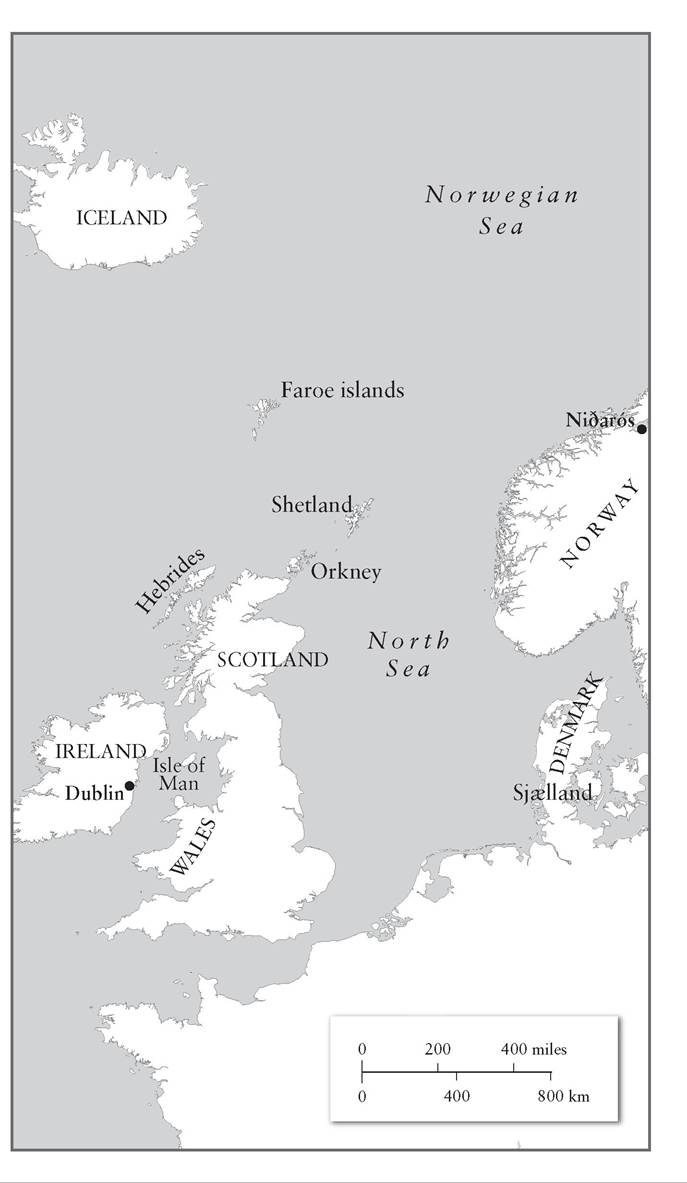
did break out, as the internal strife within Scotland whose ripples sometimes reached as far as the Orcadian realm. The word ‘realm’ is appropriate, since the authority of the Norwegian king was exercised through what has been called ‘indirect lordship’, leaving Sigurd’s descendants largely free to conduct their own affairs so long as they acknowledged Norwegian supremacy. This continued until 1195, when the king took the islands under direct control. The title jarl, or earl, can be translated as ‘chieftain’ or even ‘prince’, and a jarl was not very different in status from a king. The earls of Orkney, like the kings of Norway, waged gruesome struggles against rivals to gain and hold on to power, and being burned to death in one’s house was an occupational hazard, as in other parts of the Norse world.6
Sigurd’s mainland conquests generated tension with Mmlbrigte, earl of the Scots (as the Orkney Saga calls him), and the dispute could only be resolved by battle.
Sigurd, victorious, decapitated Mmlbrigte and attached his head to the saddle of his own horse. While he was riding around with this ghastly trophy, his leg was grazed by Mmlbrigte’s tooth, and sepsis set in. Sigurd was soon dead, and although the succession was sorted out, Orkney fell prey to groups of marauding Danes and Norwegians with nicknames such as Tree-Beard and Scurvy who would take up residence on the islands and launch their Viking raids from there.7 Once order was restored, the Norsemen in Orkney established their own reputation as raiders: ‘Earl Havard had a nephew called Einar Buttered-Bread, a respected chieftain with a good following. He used to go plundering in the summer.’8 At the end of the tenth century the earl of Orkney became involved in bigger issues than control of northern Scotland, as the warlord Olaf Tryggvason went on the rampage in the British Isles, partly on his own account and partly in support of Svein Forkbeard, king of Denmark, who eventually overwhelmed the Anglo-Saxon kingdom and handed it on to his more famous son Cnut.Olaf was baptized (in the Scilly Isles, if the Orkney Saga is to be believed) and suddenly decided to insist on the baptism of his putative subjects as well. During Olaf’s own bid for the crown of Norway, which he held until 1000, his five longships reached Orkney, where they encountered three ships that the current earl of Orkney (another Sigurd) was leading on a Viking raid. Sigurd was summoned to Olaf’s ship. ‘I want you and all your subjects to be baptized,’ Olaf demanded. ‘If you refuse, I’ll have you killed on the spot, and I swear that I’ll ravage every island with fire and steel.’ ‘After that,’ the Orkney Saga tersely relates, ‘all Orkney embraced the faith.’ This must have made it possible for Sigurd to marry the daughter of Malcolm, king of the Scots; Sigurd’s mother was an Irish Christian, and such mixed marriages between Scandinavians and Celts were common in Ireland as well - further evidence that the Viking raiders were often a mixture of Scandinavians, Celts and Celto-Scandinavians.
Sigurd’s mother, described in the Orkney Saga as a ‘sorceress’, did not close her mind to magic, and bestowed a magical raven banner on her son; it would bring victory to the person in whose honour it was carried, but death to whoever carried it. Sigurd, on campaign in Ireland following his baptism, found that none of his followers would carry it; so he decided he would have to do so himself, whereupon his mother’s prophecy came true, and he was cut down.9Naval power enabled the lords of the isles to hold their own, and to extend the long arms of their reach as far as Man. An eleventh-century earl, Porfinn, defended his territory in Caithness with ‘five well-manned longships’, described in the saga as ‘a considerable force’. Unfortunately the king of the Scots, Karl Hundason (possibly the king who is also known as Macbeth), came upon his fleet with eleven longships, and their navies engaged:
Confronting the foe, Porfinn’s
fleet of five ships steered, steadfast in anger against Karl’s sea-goers.
Ships grappled
together; gore, as foes fell, bathed stiff iron, black with Scots’ blood;
singing the bows spilt blood, steel bit; bright though the quick points quaked, no quenching Porfinn.10
This was a real sea battle, with the ships coming up close to one another and catching hold of the enemy’s ships with grappling hooks; after a tough fight, Porfinn’s men tried to gain hold of the king’s ship and Porfinn followed his banner on to the deck of King Karl’s longship - Karl escaped, but most of his crew were killed.
Even allowing for some artistic flourishes in the saga’s account of this battle, the description of a fight at sea is important, because it proves that warships were not simply used for the rapid transport of warriors and their booty, but were used as platforms on which to fight bitter contests in open waters. If we take the size of the Oseberg ship as a very rough guide, we can expect that about thirty oarsmen powered each vessel,
377 though there must have been other troops on board as well, ready to change shift.
This might leave us with a figure of about 300 warriors in fiorfinn’s company, with more than twice as many in King Karl’s fleet, so it is possible that around 1,000 troops were involved in this sea battle, and at the very least half that number. fiorfinn became one of the most successful and most powerful earls of Orkney, exercising control in the Hebrides and even in parts of northern Ireland. His career demonstrates how the Orkney islands were very well situated as bases for control of much wider spaces of ocean.The strategic significance of Orkney was not lost on the kings of Norway. In 1066 Harald Hardrada decided to support the claims of Tostig, who was challenging the right of his half-brother Harold Godwinsson to the throne of England. The Norwegian king took ship for Shetland and Orkney, collecting new recruits to his army there, before edging his way southwards to defeat and death at Stamford Bridge in October 1066. At that time power in Orkney was shared between two brothers; they too had accompanied Harald to Yorkshire, but they survived the invasion, only to find themselves outmanoeuvred by a later king of Norway, Magnus Barelegs (d. 1103), who decided to impose Norwegian rule over a wide swathe of territory stretching as far as Anglesey; he set out with a fleet in 1098. He deported the two earls from Orkney and installed his young son in their place, though he placed the government of the islands in the hands of regents. His reversal of earlier policy, which had left the earls responsible for the day-to-day running of Orkney and Shetland, formed part of these wider ambitions, for he needed a naval base from which he could control lands further away. Meanwhile he took with him to Wales the heirs to the earldom, one of whom, Magnus Erlendsson, proved irritatingly unco-operative:
When the troops were getting their weapons ready for battle, Magnus Erlendsson settled down in the main cabin and refused to arm himself. The king asked him why he was sitting around and his answer was that he had no quarrel with anyone there. ‘That’s why I have no intention of fighting,’ he said. ‘If you haven’t the guts to fight,’ said the king, ‘and in my opinion this has nothing to do with your faith, get below. Don’t lie there under everybody’s feet.’ Magnus Erlendsson took out his psalter and chanted psalms throughout the battle, but refused to take cover.11
This was an early sign that Magnus was destined for sainthood; in Orkney some years later, as disputes with his co-earl flared, his rival’s chief cook stove his head in, and he became a martyr for the faith, capable of working miracles. Whether or not his life was as holy as his supporters insisted,
the cathedral that was built in Orkney was named in his honour, and his wrecked skull has been unearthed in the church.12 Magnus Barelegs ‘took an intense dislike to him’, even though young Magnus was his cupbearer. As the fleet moved northwards past Scotland, Magnus Erlendsson was able to sneak away at night and swam to shore. He was in his night clothes, and he scratched his bare feet badly as he stumbled through the undergrowth. That morning at breakfast the king noticed his absence and sent a man to his bunk to find him. When they discovered that he was no longer on board they sent a search party out on land, supported by bloodhounds; but young Magnus was up a tree and he scared off the one dog that had found him. He made his way to the Scottish court and to England and Wales, where he was made welcome, and awaited the news of King Magnus’ death.13
The king was more interested, however, in gaining Anglesey, ‘which lies as far south as any region ever ruled by the former kings of Norway and comprises a third part of Wales’ - that, at least, is what the anonymous saga-writer believed.14 Magnus’ intervention in the Isle of Man formed part of a wider contest for control of this small but strategically valuable territory, with its command over access to central and southern Ireland; there was a local king, Gu3ro3 Crovan, who reigned from 1079 to 1095, and who was of mixed Norse and Irish descent, while enough Gaelic names have been found on inscriptions from the island to indicate that either the old population or Irish settlers played a large part in the life of Man. After his death, Magnus saw an opportunity to gain control, but his plans were challenged by Irish rivals, and by 1103 Gu3ro3’s son was in charge, founding a line of succession that lasted until 1265.15 However, Man was only the key to a vaster space, and King Magnus of Norway had limitless ambitions. It was even alleged that the king was being urged to avenge the death of his grandfather Harald Hardra3a by invading England. Later, in 1103, he was to die in battle in Ulster.16 Magnus Barelegs was one of a series of Norwegian kings who, during the eleventh century, transformed the predatory and diffuse raiding of the Vikings into a co-ordinated project: there were still plenty of opportunities for booty and glory, but control of the Norse expeditions was becoming centralized, and raids were now a means by which royal power was extended across the north Atlantic, though with questionable success: after Barelegs was killed the Orkney islands reverted to rule by local earls.
How Norse rule affected these islands, and other British islands that came under Norwegian sovereignty such as the Hebrides, is not entirely clear. The pre-existing native population may well have been enslaved or absorbed through intermarriage. Ancient Celtic systems of land division were perpetuated. On the other hand, there is no evidence for the survival of Celtic Christianity in these islands after the Norse conquest; as with the Anglo-Saxon conquest of England, paganism triumphed for a while, and the conversion of Sigurd is not likely to have brought the old cult to an end - more important in that respect was the spread of the cult of St Magnus, which gave Orkney, and the Orcadians, a distinct religious identity. That the Norse character of the Orkneys and Shetlands is not a modern affectation should be clear from the long survival of a Norse dialect, Norn, in the islands; it only died out in the mid-nineteenth century, and appears to have been spoken across the water in Caithness during the Middle Ages, in the mainland territories under Orcadian rule.17
The distinctive mixture of Norse and Celtic culture can be seen most clearly in Ireland, whose very name was forged by the Vikings.18 Rather than chronicling the successive waves of Viking attacks on Ireland, it makes sense to look at the pattern of Norse penetration into that country. It is striking that the early raids, at the very end of the eighth century, came down from the north, as Viking ships swept down the great arc linking the fjords of Norway to Orkney, the Hebrides and then down to Ulster and as far south as the Isle of St Patrick (Inispatrick), close to the site of what would become the major seat of Norse power in Ireland, Dublin. Not surprisingly, early targets included monasteries, even though the Vikings also carried away women and children, whom they enslaved; many of these women gave birth to a new generation of Vikings who were of mixed ancestry. A major settlement lay at Duibhlinn, ‘Blackpool’, but other towns as well as Dublin, right across the island, owe their origins to the Vikings. They were thus creators as well as destroyers. Endemic warfare between the different Irish kings was complicated by the involvement of Scandinavian settlers, who were sometimes the target of Irish attacks, but who were increasingly active alongside Celtic armies. In 871 a boastful Scandinavian warlord named Ivar styled himself ‘king of the Norsemen of all Ireland and Britain’. Yet by the middle of the tenth century the Norse in Ireland were at each other’s throats, even though Dublin flourished as a great centre of trade within the Irish Sea - some of this trade being fed, to be sure, by plunder from continuing raids deep into the island and across the sea towards Wales, for Welsh captives were in good supply in its slave market.19
The Viking raids caused great damage to the flourishing Celtic Church on the island, even though the Scandinavians learned something from the intricate styles of decoration in the fine manuscripts they pillaged; ‘Viking art’ was not immune to Celtic influences. When the Irish king and ‘high priest’ Brian Boru led his armies to victory over the Norsemen at Clontarf in 1014 (though he himself died in the battle), the Norse were not expunged from Ireland. They continued to meld into Irish society, and one of the most significant markers of their assimilation was the adoption of the religion they had so mercilessly pillaged: Christianity was restored throughout the island, but it also needs to be said that Irish kings had seen the rich monasteries of Ireland as fair game, and the devastation reported in the Irish annals was as often the work of Celtic as of Norse armies.20
II
It is a moot point whether one can seriously use the word ‘Viking’ to describe the complex maritime world that was brought into being across the northern Atlantic by Norse settlers in long-i nhabited lands such as Orkney and in barely inhabited lands such as Iceland and Greenland, where the Norse created brand new societies on virgin soil. The age of the marauders was still far from over when Greenland and North America were discovered; but Greenland was inhabited by the Norse for over 400 years, long past the time when violent Viking raids occurred. Moreover, the term does harm by emphasizing images of violence that appeal to those who like their history well spattered with blood. In Iceland, certainly, bloody conflicts between neighbours, conjured into the vivid tales of the sagas, show that Norse men, and indeed Norse women, were perfectly capable of creating havoc at home, without needing to take their weapons across the open seas. But settled societies did emerge out in the Atlantic, prospering through trade: in the Faroes, in Iceland and in Greenland.
The colonization of the Faroe Islands is said to have begun under Harald Fairhair at the end of the ninth century, a good hundred years after the first raids on England, so it probably resulted from King Harald’s attempt to impose rule across great swathes of Norway, and from the decision of unruly Norsemen to escape from the taxes he was trying to impose.21 On the other hand, the first colonist mentioned in the admittedly jumbled saga record was a certain Grim Kamban, whose second name is Gaelic, which suggests once again that there had been a continuous injection of Celtic blood into the Norse community ever since the Scandinavians entered British waters. The other implication is that many of the early settlers came not from Norway but from the Scottish isles, Ireland and the growing ‘Viking diaspora’. The obvious attraction of this chain of rocky islands was pasture, and the meaning of the name Faroe is ‘sheep island’, F&reyjar.22 Cultivable land is very limited, amounting to only 5 per cent today, but there was plenty of driftwood available, which was carried across from America, while better- quality timber had to be brought from Norway or Britain. There was nothing to take away as Viking booty. The climate was milder than one might expect so far north, as the Faroes are bathed by warm currents coming across the Atlantic.23
Whether or not these islands had been seen by Pytheas centuries earlier, the only regular visitors when the Norse settlers began to take an interest in them were Irish hermits, who may already have been living in the Faroes by 700. It is now known, from the carbon-dating of some peat ash and burnt barley grain, that there were settlers there in the fourth to sixth centuries, and again in the couple of centuries thereafter, but their presence was almost certainly spasmodic - conceivably they were seasonal migrants moving north from Shetland.24 They were not sitting on the spectacular wealth that had been accumulated in abbeys such as Lindisfarne. According to the Irish monk and geographer Dicuil, the monks still felt threatened by the occasional Viking visits to their remote hermitages:
On these islands hermits sailing from our country Scotia [Ireland] have lived for nearly a hundred years. But just as they were always deserted from the beginning of the world, so now because of the Norse pirates they are emptied of anchorites and filled with countless sheep and a great variety of sea fowls.25
The anchorites would have brought sheep to the islands, and these, along with seabirds, eggs and fish, provided them with a rich diet; moreover, just about every part of a sheep can be used for some purpose, whether making cloth, fashioning tools out of bone, manufacturing cheese, butter and tallow, or (less likely among the monks) a feast of roasted lamb. Whales were driven ashore, a thirteenth-century Faroese law code says, but once they were above the high-water mark the owner of the land could claim a large share of the animal, and the hunters would only receive one quarter.26
These references to ancient anchorites raise issues concerning the voyages of the Irish monks, which have generated an interest out of proportion to their real significance. One of them, St Brendan, has been presented as the first navigator to cross the Atlantic, so that the Irish voyages have become entangled with the hoary, and in many ways unenlightening, question of who reached America first. Irish saints’ lives tell of adventurous monks who, in their wish to escape normal human company, set out in small leather-hulled currachs for islands in the open sea, from at least the sixth century onwards: ‘thrice twenty men who went with Brendan to seek the land of promise’, to cite an ancient document known as the Litany of Oengus. St Brendan became associated with a good many points along the western flank of Ireland and Scotland which he is said to have visited in the early sixth century. The list is so long that it sounds as if it was formed out of ‘the collective sea experience of successive generations of Irish mariners’, which suggests that one or another Irish saint did indeed set foot at these places.27 In other words, St Brendan the Navigator was not one person but several, based on the image of a real Brendan of Clon- fert (the home of a monastic school), who inspired his followers to take ship with him and sail into the open ocean. Brendan was of noble birth - indeed, his birth in the Irish kingdom of Munster was accompanied by miracles and prophecies.28
Brendan’s search for paradise is recorded in the short text known as the Navigatio Brendani, which tells how Brendan was inspired by the stories of the adventures at sea of a fellow monk to find some of the communities that were said to be scattered across the open ocean. He decided to take fourteen monks on his own expedition to find the ‘Land of the Promise of the Saints’, but all the detail in the text is generic: rocky islands with steep cliffs; islands crowded with flocks of pure white sheep; a barren island that proved to be the back of a whale; an island where the birds sang psalms in praise of Jerusalem for an hour; but also an island inhabited by devout monks who never suffered from illness and never grew old, and another one inhabited by three classes, boys, young men and old men - the absence of women does make one wonder where all the boys came from. The Navigatio Brendani eloquently portrays the dangers of the seas, such as fogs and waterspouts, not to mention battling sea monsters and angry savages on remote shores, as well as ‘Judas the most miserable of men’, who was given a day’s rest from the torments of Hell every Easter Sunday.29 It is hard to see how anyone can read the description of Brendan’s voyage as an account of a real journey across the Atlantic, rather than a series of exhortations about the life a devout monk should lead.
Monks did set off across the open sea without much idea of where they were heading, other than a desire to find ‘a desert in the ocean’ (sought out by a certain Baitan), or Cormac ui Liathain, who repeatedly set out in his currach on a voyage that took him from Ireland up to Orkney; Cormac also penetrated far into the ocean, without finding land, but turned back when he was confronted by a great shoal of red jellyfish.30 Another intrepid monk, St Columba, sailed ‘through all the islands of the ocean’, according to his Irish biographer, and once again communities of monks came into being on the spurs of rock and offshore islands that he visited, including the windswept Aran Islands off the coast of Galway and Skye off western Scotland. These achievements are certainly more credible than those attributed to St Brendan; and the voyages were the work not just of the famous monks celebrated in the saints’ tales but of their crews (presumably monks) as well, for, paradoxically, the foundation of solitary hermitages on remote islands had to be teamwork. On the other hand, through its popularity the tale of St Brendan stimulated speculation about what lay out in the Atlantic Ocean, and ideas about Islands of the Blessed, which were fed by classical as well as by Christian writings, continued to fascinate medieval navigators throughout the Middle Ages; the isles supposedly visited by St Brendan were freely confused with the Canary Islands, for instance.31 Rather than those sunny islands, which were already inhabited by Berbers, the Irish monks found distinctly cooler places in the north Atlantic: first the Faroes, and then Iceland.
Settlement by monks was obviously incapable of generating permanent colonies, unless there was a constant stream of new arrivals (rather as the monastic houses on Mount Athos are sustained to this day). Unfortunately for the monks, the new arrivals, who did bring women with them, were pagan Scandinavians. The paganism of the first Norse settlers in the Faroes is reflected in the name of the capital, Torshavn, ‘Thor’s harbour’. However, the islands had accepted Christianity by the early eleventh century, possibly at the insistence of the same Olaf Tryggvason who had engineered the Christianization of the Orkney Islands. They eventually fell under the ecclesiastical control of the archbishop of Nibaros (modern Trondheim), which was the northernmost archdiocese in the world. This encroachment reflected the growing power of the Norwegian monarchy in the north Atlantic during the late twelfth century, but until then the Faroe islanders managed their own affairs at the annual parliament, or Ping, which was dominated by the wealthiest local families. These islands did not possess the strategic advantages that had made possession of the Orkneys a matter of close interest to the Norwegian court. Even when shipping from Norway to Iceland became very regular, the direct route bypassed the Faroes, although once a route from Norway to Greenland had become established ships did stop there. All this may lead to the conclusion that the Faroes were not of major significance; but their interest lies in the creation of a brand new society on what was to all intents empty land (the sheep apart), a social experiment that was to be repeated on a much larger scale in Iceland.32
III
Iceland has been described as the ‘highest point’ of Norse civilization, not just because there were virtually no previous inhabitants to disturb, but because of its cultural achievements, represented by the remarkable saga literature, recited in dark winters when Icelanders took the opportunity to recall and to embroider their past history, and that of their ancestors in Scandinavia. The sagas are one of the great literary achievements of the Middle Ages, and all the more extraordinary for having been produced almost at the limits of the world then known to Latin Christendom.33 Iceland was probably discovered from the Faroes. The stories that survive about the discovery of Iceland tell one more, no doubt, about the twelfth, thirteenth and fourteenth centuries, when they were recorded, than they do about the ninth century - more about an island under increasing threat of a takeover by the Norwegian crown than about an earlier community of independent farmers and sailors. Thus there is an emphasis in many of the texts on the tyranny of Harald Fairhair, king of Norway, but perhaps the Icelandic authors had contemporary Norwegian kings in mind instead.34 In one reasonably plausible version, preserved in an Icelandic history of the ‘land-taking’, or Landnam, a settler in the Faroes named Naddob was swept off course early in the ninth century and came upon a land in the far north; noticing snow on the mountains, he named it Sn&land, ‘Snowland’. Another story tells of a sea-roving Swede named Garbar Sva- varsson who lived on the Danish island of Sj^lland (Zealand), although his wife came from the Hebrides; he had heard about ‘Snowland’, and his mother, a sorceress, urged him to go and look for it. He sailed all round Iceland, proving that it was an island, and then he spent what must have been a tough winter there in a roughly built house. Later, his son travelled to Iceland, hoping that the Norwegian king would make him its earl, rather as earls had been appointed in Orkney, but this idea did not meet with the approval of the other settlers, who had arrived with him and who were careful to keep Norwegian power at arm’s length.
Both Naddob and Garbar thought very highly of the land they had discovered. This was not true of a ‘great Viking’, Floki Vilgerbarson, whose visit to Iceland ended in disaster when his men failed to make hay and all his sheep died from lack of fodder; meanwhile he and his companions had been happily living off fish and had failed to think about their animals. ‘When asked about the place, he gave it a bad name.’ That name, Iceland, is the one that stuck. Finally, according to Icelandic writers, a certain Ingolf Arnarson was inspired by news of Floki’s discovery to look for Iceland, and when he had scouted out the south coast he returned to Norway, and then went back with his foster-brother, a Viking raider named Hjprleif, some time around 870; Ingolf took care to sacrifice to the gods before setting out, and once he was close to shore he threw into the sea the high-seat pillars that had been set up in his house back home.
These were pillars that were placed either side of the ceremonial seat of the head of a Norse household, and they would probably have been carved with images of Thor and other gods. He watched to see where they would land, for this would reveal where the gods were sending him (they ended up at the spot that is now the capital of Iceland, Reykjavik, ‘Smoke Inlet’, named no doubt after the steam rising from its hot springs). His brother had not bothered to sacrifice and was set upon by his slaves. They were furious because he had yoked them to his plough, for lack of enough oxen - he had only brought one along with him. They seized the women and goods in Hjprleif’s ship; but when his own slaves found Hjprleif’s battered body, Ingolf was horrified at what had happened, chased after the slaves, and killed all of them.35 It is impossible to prove that events unfolded in quite this way, but the image of a ship arriving loaded with some farm animals, supplies, slaves and women (whether free or enslaved) is credible.
The land they had discovered lies athwart the tectonic North American and European plates, though this does not mean that half of Iceland is geologically part of America, since the island was spewed out of the sea (as were the Faroes) by volcanic eruptions that continue to this day. Unlike other volcanic areas, it is not particularly fertile, owing to its location just below the Arctic Circle; but much more pasture land existed when the Norse settlers arrived than can be found nowadays, and the effects of overgrazing were soon felt - sheep grazed lands that had little time to recover from the harsh island winters. Farmers harvested grass and made it into hay; some barley was produced, but the islanders had to import grain, or else had to feed themselves from their sheep and from the rich local wildlife: seabirds and their eggs; seals; whales too - ‘Forgils worked hard at acquiring provisions, and every year he went out to the Strands, an area on the northern tip of Iceland. There he collected wild foods and found whales as well as other driftage.’ One summer he found a beached whale, but a pair of dishonest traders, landless men, arrived in their cargo ship and tried to take control of the parts of the whale that Forgils and his companions had not already cut up. A fight broke out and Forgils was killed.36 Whales were valued for their blubber as well as their meat, while walrus had the additional advantage of ivory.37
The first settlers left Norway not in Viking longboats but in tubby kngrrs, sailing vessels that were capable of carrying thirty tons of goods, sheep and whatever else the colonists required to build a life from scratch. For they were leaving their old home for good. Some of the settlers came on ships they already owned, so these people were not impoverished refugees; rather, it seems, they were escaping the tough regime of Harald Fairhair.38 Maybe 20,000 people, and certainly more than 10,000 people, migrated to the island between about 870 and about 930, principally from Norway, although the colonists also included Swedes, Danes and people of mixed Norse and Celtic origin. DNA testing has revolutionized our understanding of the ancestry of the Icelanders, particularly now that it is possible to trace both matrilineal and patrilineal ancestry (through analysis of mitochondrial DNA and Y-chromosomes respectively). About two thirds of modern male Icelanders appear to be of Norse descent, and one third of Celtic descent; but when one looks at the matrilineal line the proportions are reversed. This confirms how very substantial the Celtic element was, represented by female slaves whose children by free parents were accepted into Icelandic society, as well as by the Celtic wives of Vikings from the Scottish isles and Ireland. A similar picture can be drawn in both the Faroes and the Western Isles of Scotland (but not in Orkney and Shetland, where matrilineal and patrilineal lines are to an equal extent of Norse origin, suggesting that entire families migrated from Norway, not just warrior males).39 The name of the hero of one of the finest of the Icelandic sagas, Njall, is of Irish origin (Niall, Neil). The Icelandic records of settlement from the twelfth and thirteenth centuries also mention Irish settlers, Iskr, such as a certain Ketill; and most of the slaves who arrived against their will were probably Celtic too.40 It is generally accepted that by the end of the eleventh century there were about 40,000 people living in Iceland, and maybe even twice that number. They could benefit from the fact that the climate was relatively benign in this phase of the Middle Ages, but even so there were occasional famines caused by volcanic ash, a bad summer and the failure of supplies to arrive from Norway. The life of the Icelanders was not exactly precarious, but (as in much of western Europe) it was all too easy to run out of basic food supplies.41
As in the Faroes, the first settlers found some inhabitants, people they called the papar, and these too were Celts, more Irish hermits who left their imprint on the island not in the bloodline but in place names such as Papey, a small island off southern Iceland. Some of them migrated back and forth each year in their simple leather boats, avoiding the Icelandic winter, and probably guided by their faith more than by sophisticated navigation. Dicuil, the Irish monk whose description of the Faroes has already been cited, marvelled at the midnight sun: ‘a man could do whatever he wished as though the sun were still there, even remove lice from his shirt, and, if one stood on a mountain-top, the sun perhaps would still be visible to him.’42 Irish monks returning from Iceland may have carried with them tales of a land of fire and ice that fed the appetite of Irish listeners, and it has been suggested that the Irish monks first learned of the existence of Iceland when Arctic mirages projected an image of the coast of Iceland as far south as the Faroes, which can happen soon after dawn at that latitude.43
The landnam, the Norse settlement of the land, was recorded with great care in later Icelandic tradition. For the land was divided up according to strict rules; and a curious tradition attributes the division of the land to the king they were trying to escape, Harald Fairhair. He is said to have persuaded the settlers that ‘no man should take possession of an area larger than he and his crew could carry fire over in a single day’, although female settlers, who were also welcome, could only claim the area they could walk around during a spring day, with a two-year cow in tow.44 The fundamental principle was that each landowner should be free to run his or her own affairs, subject to the laws that were agreed in the Alping, the parliament that met every June from the year 930 onwards, when there was plenty of light in the sky, and that was attended by the wealthy and powerful landowners known as the ggdar (literally, ‘gods’); they were not just political leaders but priests, charged with maintaining sacrifices and other rituals on behalf of the community over which they presided. It was not the democratic people’s assembly that many would like to imagine, but it enabled this distant island to govern itself according to laws its own inhabitants made, without any but the loosest recognition of the authority of the Norwegian king. To describe Iceland as a ‘republic’ or ‘Commonwealth’ is therefore quite acceptable.45
Most Icelanders were pagan during the first century of the island’s history; but there were also Christians who lived there, including many of the settlers and slaves who had come from Ireland. One Norse Christian was Ketill the Fool, so named because his pagan neighbours ridiculed his beliefs. He lived on Church Farm (Kirkjubcer), which had earlier been an Irish hermitage. The story went about that pagans could not live there, and after Ketill died a pagan arrived to occupy his farm. No sooner had he crossed the boundary than he fell dead.46 With the conversion of Iceland to Christianity in 1000, the ggdar were not displaced; the landowners built their own churches, seeing them as private property in just the way their pagan shrines had also been their personal possessions. King Olaf of Norway knew that Iceland depended on trade with Scandinavia to keep itself fed, and he banned trade with the island so long as it remained staunchly pagan. This, as much as the longstanding presence of Christians on the island, prompted urgent discussion in the Alping, where the winning argument was that the refusal of pagans and Christians to live together would destroy the entire community. The Alping declared law; but there could only be one law. So it was agreed that baptism would be universal and compulsory, although individuals could still continue to worship the pagan gods privately; they could also carry on eating horsemeat, which was one of the few forbidden foods of the Catholic West. A bishop only arrived in the middle of the eleventh century, and until then the gqdar retained religious functions, serving the new religion. As in other parts of the world, religious ideas moved across the sea and helped transform the societies they penetrated. That did not make the Icelanders more peaceful, as one can see from the tales of feuding and violence in the sagas, which hailed from a world that was, by now, Christian, but still well aware of its pagan past and still fascinated by the stories of the Norse gods.47
The Faroes and Iceland are precocious examples of a phenomenon that would become widespread in the Atlantic by the end of the Middle Ages: the creation of a brand new society on uninhabited (or virtually uninhabited) islands. In the fifteenth century, the Portuguese became pioneers in exploiting virgin islands. Both the Scandinavians and the Portuguese brought into being societies that were in some respects similar to the mother country, but that all possessed very distinctive features - they were not clones of the Old World. The political structure of Iceland, built around the principle of local autonomy under powerful ggdar, expressed a conscious rejection of royal interference; the islanders were trying to create an idealized society, based on the Norway they would have liked to inhabit, and perhaps imagined that their forebears had inhabited before royal power began to intrude into the fjords. Even so, they learned that an annual assembly and a common system of law was necessary to ensure a degree of order among communities riven by feuding and competition for territory. Although they were proud of their autonomy, the Icelanders were also obsessed by the history of the Norse ancestors, to the point where they celebrated Viking raiders and their pagan cult, long after Iceland had accepted Christianity. They told tales about the Norwegian kings and their mental horizons extended as far as Constantinople, Spain and the Baltic. As the next chapter will show, these mental horizons also extended westwards, right across the Atlantic Ocean.
IV
The sea provides a constant backdrop to many of the Icelandic sagas, whether they are concerned with events in Norway and Europe, or with the affairs of Iceland and the lands to the west. Since they were written down in the thirteenth century and after, the sagas tell us more about how Icelanders of the central and later Middle Ages viewed their relationship with the sea than they do about conditions at the time of the first settlement. One of the best-known sagas, Egil’s Saga, was written down in the early thirteenth century, and is full of tales of bloodthirsty treachery set alongside honourable displays of loyalty. Woven into its fabric are matter- of-fact accounts of conditions at sea as its main characters journeyed from Norway to Iceland, supposedly at the time when Harald Fairhair was imposing his will on the Norwegians, leading his opponents to seek their fortune in distant lands. Thus Kveldulf, a sea captain, dies on board his ship and his body is cast overboard in a coffin. The ship approaches Iceland with an accompanying vessel and enters a fjord, but before the crews can steer to land heavy rain and fog separate the two ships and they lose sight of one another. Then when the weather turns better they wait for the tide and float their ships upriver, beach their boats and unload their cargo. As they explore the shoreline they find Kveldulf’s coffin where it has washed ashore and place it under a mound of stones.48 This series of events, told to add local colour to a much bigger story of rivalries among the settlers, surely reflects the everyday experiences of travellers from Norway to Iceland.
Notable too is a casual account of how a ship bound from Shetland to Iceland, with a crew of men who had not sailed the route before, was blown quickly across the ocean towards its destination, but was then caught by a contrary wind and sent westwards beyond the island.49 These contrary winds or dense fogs would, as will be seen, lead to some extraordinary discoveries in the waters to the west of Iceland. An image that must be from the thirteenth century shows how trading ships would arrive and be berthed in rivers, channels and streams.50 Another image, perhaps from earlier centuries, presents Egil as a Viking who goes plundering and killing as far away as the Baltic, along the coast of Courland, in present- day Latvia, though by the thirteenth century Scandinavians (mainly Danes and Swedes) were still raiding the Baltic coasts, now under the banner of crusades. Egil is said to have burned down the house of a prosperous Courland farmer who was drinking with his companions, and thought nothing, apparently, of killing all these people; he had, however, seized a treasure chest which turned out to be full of silver. After that he decamped to Denmark: ‘they all sailed to Denmark later that summer and sat in ambush for merchant ships, robbing wherever they could.’51 On another occasion, Egil visited the English king, Athelstan, who presented him with ‘a good merchant vessel, and a cargo to go with it. The bulk of the cargo was wheat and honey.’52 This and other Icelandic sagas are impregnated with the smell of the sea.
Yet Iceland did not, at this period, possess any towns; nor did there exist a distinct group of merchants whose livelihood was derived solely from trade, even though those who raided also traded, sometimes to sell their plunder, and sometimes to make some profit on the side.53 Norway, it is true, possessed very few towns in the Viking period - the foundation of Nidaros on the site of present-day Trondheim was a deliberate royal act, providing an opportunity to detach the Church in Norway from the oversight of the see of Lund, which (though now part of Sweden) then lay in Danish territory. There were one or two trading stations, such as that at Kaupang, near Oslo, which was well situated for access to the silver and other fine items coming up through the rivers of eastern Europe in the early Viking age. By the thirteenth century, though, Bergen had become an important centre both of royal power and of North Sea trade, with 5,000-10,000 inhabitants, and it established itself as the major port for the Iceland trade.54 This trade had several peculiarities. The Icelanders did not mint coins, though they were happy to use hack silver. If you wanted to buy goods on the island, you normally resorted to barter. But as trade with Norway took off in the eleventh and twelfth centuries it became obvious that some sort of standard of value was needed. Since the major Icelandic product that was in demand in Scandinavia was the heavy woollen cloth known as vadmal that is still the most prized export of the island, this was chosen. Vadmal made up in warmth for what it lacked in softness. The ell, or gln, was adopted as the standard measurement of cloth; it is said to have been based on the length of the arm of King Henry I of England, from his elbow to his fingertips. Two ells made a yard. The Alping decreed that all vadmal woven in Iceland would be two ells broad; a piece of cloth measuring two ells by six counted as a ‘legal ounce’ of silver, though over time there were changes in ratios and different types of ells as well - the fundamental point is that the ‘money’ of early Iceland consisted of pieces of woven cloth. Documents sometimes speak of vadmal cloth as a monetary unit, and sometimes as a physical article of trade.55 Overall, the system seems to have worked well - better, anyway, than having to depend on imported (or plundered) silver. Sheep were Iceland’s silver mines.
Cargo ships of the kngrr type found near Roskilde (Skuldelev I) could carry about three tons of vadmal, thirty tons of fine meal grain or five tons of coarse unmilled barley, and grain was one of the European products that the Icelanders craved, for lack of suitable soil at home. The Icelanders were familiar with a variety of ships, operated increasingly by Norwegians rather than by islanders; after all, wood was in poor supply on the island, as was metal for nails and rivets and much else that was needed in shipbuilding. As well as the kngrr they were visited by the buza,
or buss, a ship with high gunwales that was better suited to rough seas, and that came into fashion in the early eleventh century; its high sides meant that there was a deeper hold, with more space for cargo, but its deeper draft, accentuated by its heavier cargo, made this type of ship slower and less well suited to the shallow waters in which the knqrrs tied up. Still, the use of bigger ships shows that this trade was growing in value.56 Above all, this was entirely licit trade, in an age when piracy was rampant, and it took place under the protection of the king of Norway, who had his uses even for republican-minded Icelanders. Around 1022 the king of Norway entered into a commercial treaty with Iceland, to guarantee the arrival of woollen cloth in return for grain. Icelanders visiting Norway were to be granted the same privileges as free Norwegians; they could even take wood and water from the king’s forests; the interests of Norwegians visiting Iceland were also protected, for instance their property was to be kept safe if they died there. Admittedly, the Icelanders did have to pay quite heavy landing fees in Norway (in vadmal should they so wish); but the king would not interfere even when they traded with third countries. This agreement remained in force for a couple of centuries, and its origins no doubt lay in an attempt by the king to demonstrate his authority over Iceland, though in the most benign way.57
Providing grain to Iceland became less attractive as Norway’s population grew, and as its new towns placed pressure on food supplies. The English, who exported grain to Norway, came to the rescue; Egil’s going- away present from the king of England was, as has been seen, a boat loaded mainly with wheat.58 In 1189 a priest turned up in Bergen aboard a ship that had set out from England loaded with grain, wine and honey, and the intention was to sail on all the way to his native Iceland; but it turned out that the cargo had been stolen.59 Norway could obtain heavy cloth from many sources; the relationship with Iceland was vital to the islanders but hardly essential for Norway. However, there were other items that made it worthwhile to brave the seas on the route to Iceland (a route that could only be taken in the late spring and throughout the summer). Iceland was the only source of sulphur for northern Europe, and its falcons, along with those of Greenland, were in demand at the great courts of Europe.60 It has been suggested that polar bears sometimes arrived off Iceland on ice floes, were captured and were taken to Europe - the charming tale of the white bear that Aubun wanted to present to the king of Denmark will be examined shortly. Walrus tusks were probably brought from Greenland by this stage, since the Icelanders appear to have exterminated what walruses there were around the shores of the island within a few decades of their arrival. Since Iceland lacked reliable sources of iron, this was imported from, or by way of, Norway, along with all sorts of implements and articles of clothing.61
The maritime route from Norway to Iceland formed part of a remarkable trading network that survived long after the Vikings had become a memory, though, as it was expressed in the Icelandic sagas, a very powerful one. For this network extended still further afield, however, right across the north Atlantic, all the way to the shores of North America.