19 This iron-studded Dragon’1
I
Changes in ship design elevated the level of threat posed by the Scandinavian raiders to a new level. This can be seen thanks to the remarkable excavations in Norway and Denmark that have brought to light both sunken and buried ships, while memorial stones from the Swedish island of Gotland carry images of ships that are rich in information about the parts that do not survive - sails and rigging.
Then there is archaeological evidence for the towns and trading networks of the Scandinavians, extending far from their homeland, which helps answer the question whether these attacks had economic motives.2The other evidence that has attracted continuous attention comes from the written texts that describe the first arrival of the ‘Danes’ on the shores of England, and the horror of monks and others at the first appearance of ‘heathens’ and ‘Danes’, a generic term that also included raiders from ‘the Northern Road’, the meaning of the name ‘Norway’, and occasionally from Sweden as well. These accounts of murder and theft are interspersed among accounts of equally bloody conflicts among the competing kings of Anglo-Saxon England, so that the main source of information, the Anglo-Saxon Chronicle, which in any case survives in several versions, leaves the reader puzzled as to how England could have become the prosperous and well-ordered state that it eventually did become under Anglo-Saxon rule: in 878, we are told, a ‘great part of the inhabitants’ of Wessex fled across the sea, while the English king, Alfred, took refuge in the woods and marshes.3 England’s prosperity was one of its attractions, as far as the Vikings were concerned. They perhaps realized that they should not kill the goose that laid the golden egg, though some accounts of Viking devastation give the impression that great swathes of territory were ‘harried’ to the point of ruin.
The Viking raids on England began, according to the Anglo- Saxon
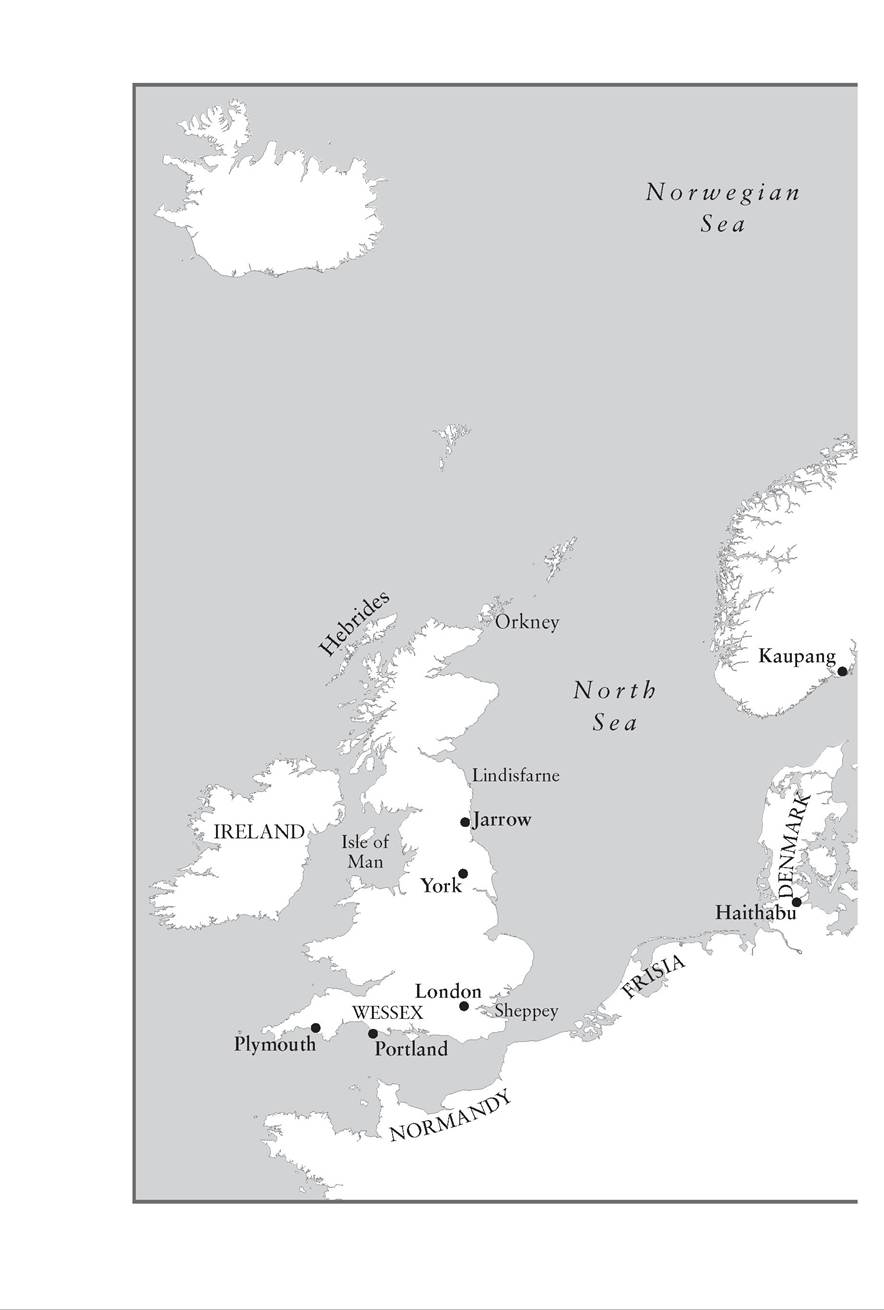
Chronicle, in 789, with a small Norwegian, or possibly Danish, raid on Portland in Dorset: ‘these were the first ships of the Danes to come to England.’4 But terror struck in 793, when, amid great portents (‘fiery dragons were seen flying in the air’) and severe famine, heathens came and laid waste the monastery at Lindisfarne on the coast of Northumbria, the pride of the Northumbrian Church. The next year the monks of Jarrow were attacked, though the chronicler recorded with satisfaction that some of the Danish ships were wrecked in stormy weather and that a good many Danes were drowned or killed.5 The Viking raids became intense by the 830s, and a striking feature was their range: the Isle of Sheppey, off Kent, was a target in 835, and a group of Vikings wintered there in 855; but they also appeared close to Plymouth, where the Danes entered into an alliance with the Cornish Britons, and where King Egbert of Wessex scored a victory in 838; and this victory was all the sweeter as the year before Egbert had been defeated by a Danish warband that had arrived off Somerset aboard thirty-five, or possibly twenty-five, ships.6 How big these warbands were has been a topic of controversy. The authors of the Anglo-Saxon Chronicle referred several times to the mycel h&pen here, ‘the great heathen host’, that arrived in 865, although massive Danish fleets were recorded earlier too, as in 851, when 350 Viking ships penetrated the Thames, ravaging London and then marching inland, where they were soundly defeated. This is exactly ten times as many ships as were recorded in 843, so either the scale of the attacks had changed dramatically, or the monks who wrote about the attacks became more and more prone to exaggeration.7 The Vikings had learned what rich pickings were to be found in England, as also along the northern coasts of the Frankish Empire, and their ambitions began to expand in new directions: in Kent the Vikings were promised money in the hope that they would remain peaceful, but this was to underestimate the lure of war booty, and they devastated eastern Kent nonetheless.8
Danish ambitions became ever greater, as groups of Scandinavian settlers arrived, and as plans evolved for the conquest of parts of England.
The individual raids of the early ninth century, where a group of l ike- minded warriors set out in search of booty and adventure under a war-leader, often in just a few ships, gave way to much larger expeditions led by kings and other great lords, although as early as 810 the Danish king, Godfred, invaded Frisia, nearby, with 200 ships and carried off 200 pounds of silver as tribute from one of the most prosperous provinces of Charlemagne’s great empire. No doubt the idea of earning a pound of silver for each ship had a certain attraction, quite apart from helping to cover the cost of putting together such a large fleet. This, however, has to be understood from the perspective of regional politics, as a conflict between neighbours. Still, it provides evidence that Danish kings could mobilize large fleets if they chose to do so; further away, in Norway, royal control was yet to be imposed, and individual enterprises were the norm.9 A Scandinavian kingdom was established at Jorvik, or York, while King Alfred, later in the ninth century, agreed to divide much of England between himself and the Viking ruler Gudrum, who, however, did accept baptism. On the English side, there was some awareness that preventive action at sea would be more effective than attempts to overwhelm the mycel here on land, and Alfred’s newly formed fleet managed to defeat a small Danish squadron in 882; one result was that the ‘great host’ was deflected away from Alfred’s realms and travelled instead up the River Scheldt, to make a nuisance of itself in northern France and Flanders.10 So, by 896, King Alfred built up his naval defences, and in some accounts of British naval history this was the moment when the English navy was founded:the kingordered warships to be built to meet the Danish ships: they were almost twice as long as the others, some had sixty oars, some had more; they were both swifter, steadier, and with more freeboard than the others; they were built neither after the Frisian design nor after the Danish, but as it seemed to himself that they could be most serviceable.11
Exactly what these ships looked like remains a mystery, as we are only told what they did not look like, although their size sounds impressive.
Thereafter, well into the reign of King Athelstan, an English navy was able to defend the shores of the Anglo-Saxon realm. However, one difficulty was that raids did not simply start in Scandinavia.12 Even after 911, when the Frankish ruler conceded control of what would henceforth become Normandy to the Northmen from whom it took its name, sea raiders arrived in southern England from northern France, sailing up the River Severn; they also raided the Welsh coast, for the Celtic lands, notably Ireland, were constant targets of Viking attacks and, in the case of the area around Dublin, long-term settlement.13A detailed chronicle of Viking raids on England would show how, even as the Christianization of Scandinavia was under way, the raids did not cease; the arrival of Svein Forkbeard and his son Cnut in England early in the eleventh century, followed by the submission of England to these rulers and by the creation under Cnut of an empire that embraced England, Denmark and Norway, did not mean the end of Scandinavian raids.14 In 1066 the Norwegian king, Harald Hardrada (‘hard ruler’), brought the claimant to the English throne, Tostig, across the sea to northern England,
362 THE YOUNG OCEAN: THE ATLANTIC, 22,000 BC-AD I500 where both were defeated and killed by Tostig’s half-brother king, Harold Godwinsson, just as Duke William of Normandy (himself of Scandinavian descent) launched his own combined assault on southern England.15 Viking raids only gradually petered out, for when conquest was not the motive there was always the lure of being paid off with handsome bribes. Like all forms of blackmail, a gift of what came to be known as Danegeld simply acted as an invitation to return later and to demand more.
So far, then, a bare chronicle of some of the most vicious Viking raids tells a story of murder, theft and eventual partial conquest. But this does nothing to explain who the raiders were and why the attacks were launched in the first place.
Even the word ‘Viking’ has been the subject of debate. The most reasonable explanation is that it means ‘men of the vik ’, that is, the inlets from which raids were launched, whether the majestic steepsided fjords of Norway or the low-lying creeks of Denmark and southern Sweden. The term vikingr was used in Scandinavia to mean a pirate; these people went i viking, that is, raiding across the sea, and were celebrated for doing so on the runestones that commemorated their life.16 This term has been applied rather too widely, so that even the Scandinavian settlements in late medieval Greenland (of which more later) are often presented as ‘Viking’, a term best applied instead to the raiders who have been described in this chapter. Within the Baltic, the Swedish Vikings who raided the southern coasts and sent their ships down the river systems of eastern Europe, to reach Mikelgarb, ‘the Great City’ (Constantinople), are often described as Varangians, another term of uncertain origin, derived from the Greek word Varangoi, which was applied particularly to the Scandinavian and also Anglo-Saxon mercenaries who were greatly valued by the Byzantine army. Raiding within the Baltic did not cease in the late eleventh century, and later Swedish wars of conquest along the shores of what are now the Baltic states had much in common with the Varangian raids of earlier centuries, even if a strong element of Christian mission sometimes intruded.17It is already obvious that the raids did not have a single cause, and that attempts to ascribe them to overpopulation or political strife within Scandinavia (leading to an exodus of dissenters) may fit some of the evidence, but fail to account for the great variety of Viking attacks: lightning strikes from the sea, aiming at wealthy monasteries where the raiders could seize great treasures in gold and silver; attempts at political conquest; migrations in which women as well as men crossed the sea (as in the case of Iceland and the lands beyond); to which should be added peaceful trading expeditions in the sort of ship that will be described shortly.18 The colonization of Iceland was apparently launched after King Harald Fairhair
gained control of large swathes of Norway in the late ninth century and demanded the payment of new taxes, so that discontented Norsemen who had lived free from royal interference set off to create their own new commonwealth in a virtually empty land across the ocean.19 But it is impossible to ignore one very distinctive feature of Viking society (using the term to mean the select group of those who went raiding).
Far from possessing a sense that stealing treasure and murdering one’s victims was disgraceful, the Vikings gloried in their achievements. They expounded a cult of the violent hero:Cattle die, and kinsmen die, And so one dies one’s self; But a noble name will never die, If good renown one gets.20
A good name was to be won through heroic deeds, and death in battle brought the glory of fame, which was more valued than life itself.
The greatest glory was to be found through winning a reputation not just as a great war leader but as a generous host. Indeed, it was impossible to become a generous host without raiding. Arriving back at home laden with booty and distributing prizes to one’s followers marked the high point in the Viking year. The Orkney Saga describes an eleventh-century Viking named Svein Asleifarson who used to take Hakon, whose father was earl of Orkney, on raids ‘as soon as he was strong enough to travel with grown men... doing all in his power to build up Hakon’s reputation’. Svein would spend each winter in Orkney, ‘where he entertained some eighty men at his own expense’. After a winter of hard drinking and carousing, and a spring spent sowing the soil, he would go off raiding, once in late spring and again in the autumn, reaching the Hebrides, the Isle of Man and Ireland. As well as raiding on land, Svein and his men would attack merchant ships, such as two English vessels they found crossing the Irish Sea; these ships carried a rich cargo of fine cloths, which the Vikings seized, hoisting some brightly coloured pieces of sailcloth as a visible boast of their success.21 Piracy and plunder sustained an aristocratic lifestyle, and one’s greatness was measured by one’s generosity as well as by deeds in war, but that generosity could only be funded through war.
The Vikings shared their culture of warfare and feasting with neighbours around the North Sea, including the Anglo-Saxons and the Celtic peoples of Scotland and Ireland, with whom they often intermarried. Scandinavians based in such places as the Orkney Islands were as content to plunder Norway as they were willing to raid the Scottish isles or Ireland.
Scandinavian Vikings shared a language (already fragmented into mutually comprehensible dialects), though they could probably make sense of Anglo-Saxon speech as well. The major distinction between Vikings and their neighbours was not so much ethnic origin or the culture of feasting and warfare; it was their paganism - for their victims, the most important feature of the raiders who attacked Lindisfarne in 793, and Irish monasteries in later decades, was not that they came from Scandinavia, but that they were heathens, lacking all respect for Christian holy places and for the accumulated treasures of the Anglo-Saxon and the Irish Church.22 Yet the Viking raids continued even in the eleventh century, when the Scandinavian kings had adopted Christianity (which is not to say that all their subjects had abandoned paganism). The Orkney Saga saw no contradiction between belief in Christ and a life of raiding; indeed, the twelfth-century earl of Orkney, Rognvald, went on pilgrimage to Jerusalem, travelling out by sea, and returning home by way of Rome. The culture of raiding was very deeply ingrained.
II
One question is whether larger changes in economic relationships across Europe and western Asia stimulated the Vikings into action. So long as the routes across the Baltic and down the river systems were open, the Varangians managed to make contact with prosperous, urbanized societies in the Steppes, and conveyed large quantities of silver northwards, either in the form of coin or as silver bullion (including hack silver, silver objects cut into pieces and valued by weight); Varangian merchants reached as far as the shores of the Caspian Sea, while several widely read Arab writers noted their peculiar ways, including boat burials and the custom of sacrificing a slave girl at the funeral of her master, after her master’s companions had one by one taken advantage of her.23 More than 100,000 Islamic coins have been unearthed in Scandinavia, and the number of finds is still growing.24 The Caspian gave access to northern Iran, with its silver mines, and beyond that to the Abbasid empire in Iraq.
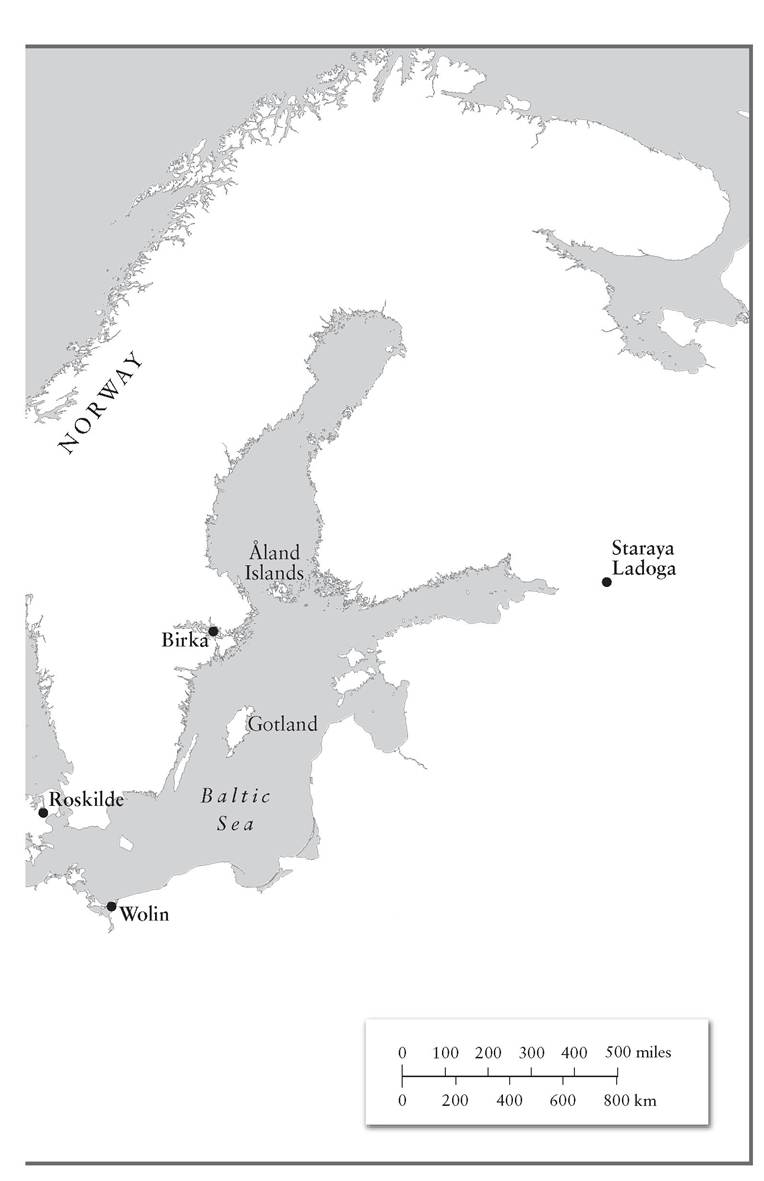
All this coincided with the emergence of the first towns in Scandinavia. Sweden’s oldest town was Birka, which lay on a small island in Lake Malaren, the large i sland-studded lake that extends westwards from present-day Stockholm; in this period, many of its islands had not risen out of the sea or were much smaller (Birka’s own island was half its present size), while the lake consisted of saltwater and was in effect an extension of the Baltic Sea. Across the many thousands of islands of the Stockholm archipelago small settlements came into being that were linked to one another by boat traffic, and every community had its little fleet of boats, from small fishing vessels to larger ships suitable for Viking raids or longer-distance trade. All this meant that Birka was quite easily accessible from the open sea by boat. The town benefited from the protection of the king of central Sweden, who maintained a manor house just across the water on the larger island of Hovgarden. Without royal protection, who would ensure the safe passage of Birka’s boats through a dense network of islands, stretching far beyond the coast of Sweden, each of which might provide a base for Viking pirates? On the other hand, if one could make the journey across the Baltic in safety, the riches that were now to hand were the stuff of fable: furs from Russia and the silver of the Orient, accessible in such places at Staraya Ladoga only a little distance down the rivers that led towards the principality of Kiev, also known as Rus. By the tenth century, Birka was home to about a thousand people, boat-builders, artisans, sailors and merchants, who lived in sturdy wooden houses on little plots of land. A similar story can be told of the nameless trading centre not far from modern Oslo that looked out towards the North Sea; known to archaeologists by the convenience name of Kaupang (‘trade centre’), it was the first town to emerge in Norway.25
The history of another town, the port of Hedeby, or Haithabu, situated on the Baltic side of Schleswig where Denmark and Germany meet one another, helps us connect the Baltic to the North Sea world. It has been said that ‘the remains of Haithabu lie in one of the richest archaeological zones in all of Europe’.26 Although an earlier and much smaller trading settlement may have existed nearby, the foundation of Haithabu can be securely dated to the war between King Godfred of Denmark and his neighbour Charlemagne around 810, since timbers found on the site date from 810 or soon after. While campaigning on the eastern side of Denmark against Charlemagne’s allies, Godfred raided a port established by the Slav people known as the Obodrites close to present-day Lübeck, and deported its merchants to his own new town of Haithabu. The Obodrites had obligingly provided the Frisian merchants from the North Sea, and their customers in northern France, with goods that came through the Baltic, most importantly furs and amber.27 Godfred’s idea was, then, to create a Danish entrepot that would dominate traffic between the Baltic and the North Sea. Charlemagne regarded this as intolerable interference and set off with an army (accompanied by the elephant that Harun ar-Rashid, caliph of Baghdad, had presented to him). Godfred built up his defences, but there was rivalry at court and he was murdered by Danish foes.
All the same, Haithabu survived and flourished, particularly between about 850 and 980. It was a centre of amber crafting, and its mixed population included Scandinavians, Slavs and Frisians, who found the town’s location much better than anything that had existed before: it lay on an inlet as close as one can get to the western flank of Jutland, so that goods unloaded in the North Sea could be funnelled through to Haithabu very easily - the analogy in the ancient Mediterranean would be with two- facing Corinth. Haithabu was surrounded on its land side by a strong defensive wall, while its harbour offered plenty of jetties to incoming boats. Among goods that reached this port were tin and mercury that may have originated in Spain or England.28 A canal ran through the middle of the town and, rather as at Dorestad, the houses were built of timber and wattle, on their own little plots of land connected to one another by narrow pathways. The expansion of Haithabu marked the first stage in the creation of commercial networks that linked two regions which were experiencing exponential economic growth: the North Sea and the Baltic.29
The Baltic was coming alive. Its many chains of small islands fostered sea traffic by their very nature. The Aland Islands between Sweden and Finland became a meeting point between Scandinavians from the west and Finno-Ugrians from the east; many of the stories in the Finnish national epic, the Kalevala, only recorded in the nineteenth century, probably originated in the watery world around these islands.30 Nowhere was the liveliness of Baltic networks more obvious than on the island of Gotland off the southern coast of Sweden. The decline of Birka brought Gotland to the fore, for the island was beautifully situated with easy access across the sea to all the shores of the Baltic. Silver dirhams from the Abbasid caliphate have been found at Paviken on Gotland, which was only one centre among many for the trade of the Gotlanders.31 The Got- landers hoarded even greater quantities of German and other continental coins, and this thesaurisation of bullion that flooded into the region, whether it was acquired through trading or raiding, must have placed quite a severe strain on the economies of both western Europe and western Asia. Exotic luxuries sometimes reached Scandinavia along with the silver - the most famous example is a small Buddha cast in Kashmir that turned up in central Sweden. 32
Generally, the fate of Islamic dirhams was to be melted down, for the only Viking coins before the end of the tenth century were some imitations of Carolingian money made in Haithabu soon after it was founded.33 Sometimes, as the Anglo-Saxon Beowulf poet shows, precious metals were deployed in gift exchange, as kings and famous warriors conferred armbands and other signs of status on one another. Often too European coins were sent back to Germany as payment for Rhineland wines, for one constant feature of the Viking world was its love for strong drink, confirmed by the mass of fragments of Rhenish wine jugs found in Scandinavia. What the merchants of Haithabu, Birka and Gotland knew was that there was persistent demand for the goods they sent out of the Baltic and brought into the Baltic, demand that extended to England, France and beyond, and that servicing this demand provided them with a good livelihood.
That this trade was conducted by sea goes without saying, but the connections with the Muslim world were only rendered possible by the penetration of the river systems that flowed south towards the Steppes, and by the creation of a Varangian-ruled polity based at Kiev, the principality of Rus; Scandinavian merchants trading towards Staraya Ladoga and Novgorod pioneered routes into the interior that gave access to seemingly limitless supplies of furs and that were once again to become important in the heyday of the German Hansa.34 One important town that linked the Baltic to the Eurasian landmass was Wolin, whose site lies just across the present-day German-Polish border; it flourished from the tenth to the twelfth century, and, like Haithabu, it was no mere village: its houses were strung along four kilometres of wooden pathways, and they were impressive structures, sizeable and handsomely decorated. Wolin supplied the Baltic and areas beyond with goods from the interior, and vice versa, but it also had its own lively potteries, amber workshops and glass-makers. Adam of Bremen, who wrote in the late eleventh century, claimed that ‘it is truly the largest of all cities that Europe has to offer’, and insisted that the inhabitants even included Greeks. But the local population ‘all still remain captive to their pagan heresies’, which he regretted, as they were in all other respects as trustworthy and friendly as it was possible to imagine. Christians were best advised to keep their beliefs secret.35 Adam of Bremen wrote a history of the archbishops of Hamburg, and he played up the success of the Christian Church in defeating the heinous pagan beliefs of its opponents - he wrote with lurid fascination of Viking human sacrifice at Uppsala. The fact that he lived not very far away should not mask his delight in exaggeration; but there was an underlying truth about the importance of Wolin.
III
Ships were a matter of exceptional pride to the Vikings. Memorial stones for dead warriors often depict Viking longboats, carrying a complement of warriors, with their big square sail fully set. The island of Gotland has yielded large numbers of these stones, portraying the entry of the warrior into Valhalla and scenes from Norse mythology, as well as one stone showing a majestic ship, battle scenes and the sacrifice of a human victim on an altar - a brief Swedish history of Gotland known as the Gotlanders’ Saga also tells of human sacrifices conducted by a supreme council of the entire island.36 The evidence from the Gotlandish picture stones goes back before the Viking period, beginning around ad 400; the Gotlanders at first used these stones as grave markers, but, as with the inscribed rune stones found across Sweden, they were increasingly set up at the roadside to draw attention to the person they commemorated. In the Viking world it was entirely appropriate that the journey to the next world should be aboard a ship, even if not everyone merited the elaborate ship burials that were already conducted by the Angles in England. If one could not be buried in a ship, then to be buried under or near a stone that displayed a ship in bright colours was the next best option. In the Bronze Age (before about 500 bc), the Gotlanders already buried their dead in boat-shaped graves lined with stone, and there and on the mainland carvings on rock showing oared ships were common currency. The picture stones from the Viking period include sails and rigging, and are detailed enough to show that sails were being made out of strips of cloth plaited together, because local looms could not produce single pieces of cloth wide enough to serve as sails. Plaiting was a more efficient way of bonding the strips than sewing, because it meant that there were no seams and the wind would not tear the sail apart; in the 1980s a replica Gotlandish boat was built and sailed all the way to Istanbul, and its plaited sails, though heavy, were well up to the task and did not disintegrate. The strips out of which sails were made were of different colours, arranged in a lozenge or chessboard pattern; the striped sails beloved of modern film-makers did exist, but appear less often.37 More importantly, the masts that carried these sails were now sturdy enough to function as the main source of propulsion when the wind was favourable.
Such advances in shipping technology rendered possible the great Viking voyages in the North Sea and the Atlantic. The Vikings continued the tradition of clinker-built ships, constructing the hull out of overlapping strakes before they inserted a relatively light frame which was bonded to the hull by rivets or nails.38 As has been seen, this method of shipbuilding produced flexible boats that were well suited to the high seas of the Atlantic. Fortunately, several magnificent examples survive, of which the oldest is the Oseberg ship from Norway, built out of oak around 820 and used for a ship burial roughly fourteen years after that; one of the two skeletons found in the boat was that of a woman who died around the age of eighty, and must have been either a queen or a high priestess.39 The Oseberg ship was excavated at the start of the twentieth century, and nearly all the original boat survives; in addition to superb carvings decorating the prow and stern, it contained a burial chamber with a wonderful assortment of grave goods. On the other hand, its mast cannot have been particularly strong, and its low sides made it unsuitable for journeys across the high seas. It has been suggested that it was a ‘royal yacht’, used for display, but rarely sent out to sea. It is 21.5 metres long and a maximum of 4.2 metres wide, and there were fifteen oar-holes on each side, as well as a steering oar, so the size of its crew can easily be calculated.40 Another very fine ship, the Gokstad ship, unearthed around the same time, is a little longer and wider, with one more oar-hole on each side; this was constructed towards the end of the ninth century and buried around 910; its sides were built up rather higher, and the fact that little round shutters were attached to each oar-hole, so they could be closed off in high seas, suggests that this vessel did venture across the ocean. The mast and keel were strong enough to take the strain of a large and heavy sail.41 But whether its greater seaworthiness compared to the Oseberg ship reflects increasing sophistication in shipbuilding, or whether it reflects different use, cannot be said for certain.
In the early ninth century, it is quite likely that Viking ships were used indiscriminately for raiding and trading. The Oseberg, Gokstad and other ships offered plenty of space in their hull for the storage of goods, whether obtained by trade or seized as booty. The ‘longship’ was well suited to quick and devastating ventures across the open sea, and it could penetrate deep into rivers such as the Thames and the Seine, allowing its crew to wreak havoc far inland. The sturdiest Viking warships reached Spain and entered the Mediterranean. The geographer az-Zuhri, who wrote in Muslim Spain (al-Andalus) in the mid-twelfth century, knew of Viking raids by Viking ships in earlier times:
There used to come from this sea [the Atlantic] large ships which the people of al-Andalus called qaraqir. They were big ships with square sails, and could sail either forwards or backwards. They were manned by people called majus, who were fierce, brave and strong, and excellent seamen. They only appeared every six or seven years, never in less than forty ships and sometimes up to one hundred. They overcame anyone they met at sea, robbed them and took them captive.42
The term qardqlr passed into European languages as ‘carrack’., though carracks were late medieval cargo ships that looked quite different to Viking longships. The fearsome nature of these people was further emphasized by the use of the term majus to describe them; originally applied to Zoroastrian magicians (or Magi), it was now being applied to ruthless heathens from the edges of the known world. The terror they brought with them extended as far as southern Spain.43 In 844 they sailed by way of Lisbon and Cadiz to the mouth of the Guadalquivir River, and then made their way, still aboard their ships, to Seville, where they are said to have looted the city for a whole week, enslaving or killing men, women and children - modern research shows, however, that the often lurid descriptions of the havoc they created are embroidered accounts of embroidered accounts of embroidered accounts of an attack that did, for sure, take place.44
This ability to reach southern Spain, and on later occasions the Mediterranean as well, speaks for advanced skills in navigation, although the leidarstein, or lodestone, a very basic form of compass, is only mentioned in texts from the fourteenth century or later. It is a little more likely that Norsemen navigated with the solarstein, also, however, first mentioned in texts from the late Middle Ages: these were light-sensitive crystals of cordierite that enabled sailors to locate the sun even through thick cloud; an Icelandic saga relates how a king challenged a certain SigurS to tell him where, above snow-laden clouds, the sun actually stood. SigurS was sure he knew, and so the king asked for the ‘sun stone’ to be brought, which enabled him to verify Sigurd’s claim: ‘then the king made them fetch the solar stone and held it up and saw where light radiated from the stone and thus directly verified Sigurd’s prediction.’ Viking navigators were helped on their way at night by close observation of the Polar Star, while in the Faroes the inhabitants developed a system for measuring the declination of the sun over the year, though, once again, it may not have been known to their Viking ancestors.45
The discovery of a group of ships at Skuldelev near Roskilde in Denmark has enlarged our understanding of the types and functions of the vessels used in this period. Roskilde lies at the end of a short and shallow fjord, and at some point in the Viking age several ships were scuttled to block sea access to Roskilde itself.46 These ships, which survive in a much more fragmentary state than those preserved in Oslo, were built rather later than the Oseberg and Gokstad ships, and several date roughly from the time of the Norman Conquest of England - the Bayeux Tapestry includes images of ships not very different from the Roskilde ones, though one especially large longship from Roskilde may have been constructed somewhat earlier in the eleventh century for King Cnut, ruler of Denmark, Norway and England, or for one of his successors.47 Cargo ships, less obviously associated with the image of Viking marauders, have received less attention, but one of the ships found at Skuldelev was a cargo boat, eleven metres long, and built in western Norway in the early eleventh century. It is thought to have been manned by only a dozen oarsmen, though it also had a mast, and its shallow draft was well suited for navigation around the sandbanks and creeks of the Danish and Frisian coasts. Another, rather larger, Skuldelev ship built out of Norwegian pine in the early eleventh century had a carrying capacity of about twenty-five tons, and sat lower in the water, so that it would have needed to make use of the jetties at Haithabu or other ports it might have visited; and Haithabu has yielded fragments of a trading vessel that might have been able to load as much as sixty tons of cargo. This is the type of ship that would have been described as a kngrr ; they were ocean-going cargo ships that were well suited to voyages to Iceland and beyond, carrying not just colonists but cattle and even household furniture. The deeper draught of the kngrr made it much safer in unpredictable seas.48 Scandinavian ships, whether they were built for war or trade, possessed flexible shells of a sort that seems not to have been perpetuated in later centuries. As ships grew in size, so did it become necessary to make them sturdier. Lightness gave way to solidity.
In the early days of the Viking raids, then, light longships best suited the tactics of hit-and-run raiders who swooped down on the monasteries of Northumbria or the little ports of northern France. With the growth of Haithabu and the emergence of a lively trading network which in some respects replicated that of the Frisian merchants, it became more likely that the colourful Scandinavian sail poking over the horizon belonged to a rather tubby cargo boat whose passengers proposed to pay for what they wanted, rather than seizing it, and who were Christian rather than pagan. Moreover, these ships, whether longships or cargo vessels, were making more and more ambitious voyages, carrying them over the top of Scotland and out of the North Sea, towards Orkney, Shetland, the Faroes, Iceland, and far beyond. This was the ocean that, in Norse mythology, was encompassed by the vast body of the MiSgarSr serpent; when the monster released its tail from its mouth, the world would come to an end. These were risky waters.49
More on the topic 19 This iron-studded Dragon’1:
- 19 This iron-studded Dragon’1
- Abulafia David. The Boundless Sea: A Human History of the Oceans. Oxford University Press,2019. — 1088 p., 2019
- 12 The Dragon Goes to Sea