12 The Dragon Goes to Sea
I
When the rulers of China and Japan thought about trade they were constantly aware of the distinction between tribute, received in exchange for gifts, and private trade. Buddhism tended to encourage moneymaking, and even Buddhist monasteries traded actively, including those in Kyoto.
In ancient and medieval China, attitudes were more complicated. From the perspective of some of the most influential exponents of Confucian thought, as in ancient Rome, trade was something inherently rather disreputable. Tribute, on the other hand, expressed acknowledgement of the superiority of Chinese (or Japanese) civilization over those who brought it, and fitted very well into Confucian ideas of hierarchy and the respect of those lower down the social and political scale for those higher up. Nations had to be ranked just as courtiers were; and calling many of them ‘barbarian’ was a way of saying that, if they knew their manners, they would pay tribute. Japan and Korea were occasionally treated as civilized nations, but this was not automatic, and the assumption that they were culturally inferior remained firm. The condescending attitude to Roman envoys, which was mentioned earlier, reflected both an awareness that there did exist another great empire far to the west, and an unwillingness to treat it as the equivalent of the Heavenly Kingdom ruled by the Chinese emperor. Tribute had another function beyond the political: the imperial court genuinely craved exotic luxuries, either for its own use or for redistribution to members of the ruling clan, great nobles and the army of scholar-officials who had earned their place at court by passing the most difficult examinations in human history. The imperial court was not greatly interested in the availability of foreign luxuries to the wider population, while the vast majority of the emperor’s subjects in any case lived barely above subsistence level. For many of them, ship-borne trade meant the thousands of large rivercraft that carried huge amounts of grain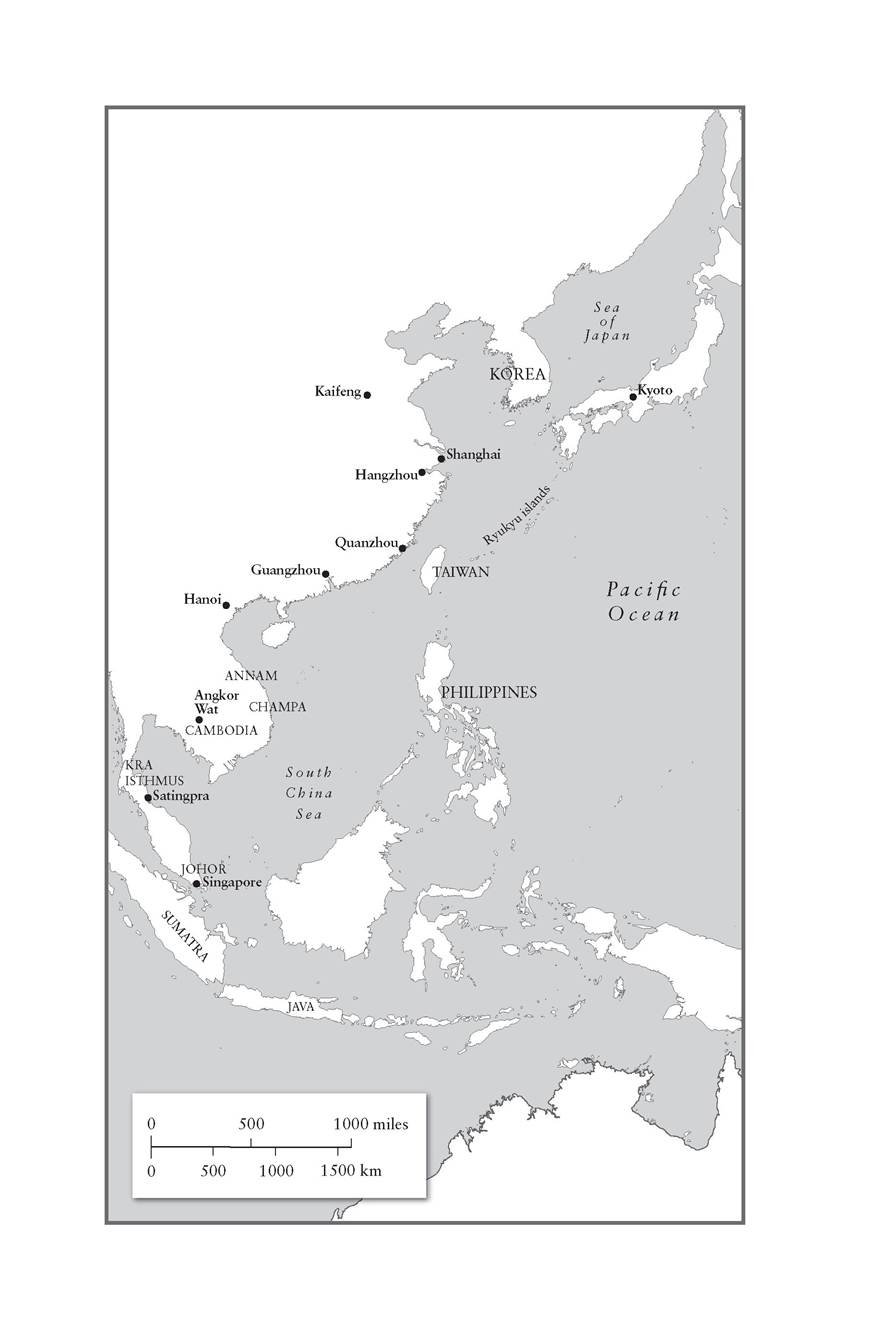
238 THE MIDDLE OCEAN: THE INDIAN OCEAN AND ITS NEIGHBOURS from the estates where they toiled to the big cities that - particularly from the tenth century onwards - were gobbling up the grain and rice they cultivated.
All this should not be taken to mean that trade was outlawed when the Chinese emperors demanded that exchanges should consist of tribute. Embassies were large and their members carried goods that they traded privately. Besides, there were plenty of opportunities to escape the surveillance of the Chinese customs offices, or shibo, whether one was a Chinese, a Japanese, a Korean, or even a Malay or Indian merchant. The tribute/ trade alternative was a fiction maintained at some periods at the Chinese court and revived by historians who had perhaps read too many official documents, and who did not yet have access to the rich archaeological evidence showing that vast amounts of copper and porcelain left medieval China by sea, to which one can confidently add goods that have not tended to survive so well underground or under water, notably silk textiles. In reality, there was no period in Chinese history when overseas trade consisted solely of exchanges of tribute against gifts; nor did the court want that to be the case, so strong was demand at court for exotic goods from the Indian Ocean, the interior of Asia and beyond: emeralds, rock crystal, lapis lazuli, only to mention a few types of precious stone. The best cobalt for making the famous blue-and-white porcelain of the Ming period came from Iran. Although some was produced in China itself, sugar, which was first cultivated in Borneo, became a favourite import as well, for it still had great rarity value, and was prized in the medicine cabinets of the Chinese nobility.1
Only at the start of the third millennium has China energetically begun to build a large navy, at the same time as it has been reasserting l ong- forgotten claims to rule over most of the South China Sea.2 Yet in the Song period, from the tenth to the thirteenth century, China did turn towards the sea and did encourage overseas trade; interest in trade became even stronger after 1126, when the north of China was lost by the Song and the ‘Southern Song’ reigned in their capitals first at Kaifeng and later at Hangzhou.
Kaifeng is famous as the major centre in China of Jewish merchants, who over the centuries became quite assimilated into Chinese culture (while still avoiding pork, like the Muslims, with whom they were often confused); these Jews appear to have arrived from Persia and India, and continued for centuries to speak a form of Persian among themselves, and some are thought to have arrived by sea, since there were also communities in Quanzhou, Hangzhou and other cities close to or beside the sea.3 This is just one example of the different ethnic and religious groups that filtered into China as its trade to the wider world opened up.4Meanwhile, Chinese merchants established themselves in overseas ports as far south as what is now Singapore; there, they were rather modest folk, and rather than trading all the way to China they made it their business to wend their way back and forth across the strait, visiting the Riau islands (now part of Indonesia) and Johor (the southernmost province of mainland Malaysia), working closely with Malay partners and with the big-time Chinese traders who passed their way every now and again. A Chinese colony in Korea can be traced back to 1128. Sometimes these expatriate Chinese married local women, as in Japan. This also occurred in Champa, in I ndo-China; there, some of the Chinese women were wealthy enough to invest in trade, though it is unlikely that they would have taken the risk of actually travelling long distances on board ship.5
The Song dynasty presided over what has been called a ‘commercial revolution’, during which a major international centre of trade emerged at Quanzhou, which will be examined shortly; and it was a time during which the central government reaped rewards in sizeable tax revenue.6 Still, the scale of this revenue should not be exaggerated. It stood at less than 2 per cent of total revenue from all the economic activities in lands under Song rule.7 That said, the wish to foster overseas commerce reflected new attitudes: the imperial dynasty did not simply require luxury goods for itself; it also had to find the means to pay for its exceptionally heavy spending programmes, which were consumed as much by grandiose projects at Hangzhou and other centres of power as by constant warfare on the Song frontiers, notably with the Chin dynasty that held on to power in northern China.
By encouraging trade and industry (including the production of silk and porcelain, both of which were exported in large quantities), and by building shipyards and harbours, the Song emperors moved a little way towards closing the large gap between income and outlay.8The turn to the sea took place gradually. The first Song emperor, Taizu, had experience of naval warfare before he gained the throne in 960; he maintained a war fleet and enjoyed staging mock sea battles, although most of this force was deployed along the rivers and close to shore. Naval wars against Annam and Korea took place during the tenth century, suggesting that the knowhow for ocean voyages did exist; however, the major task of the navy, which was treated as an auxiliary service lower in status than the army, was the suppression of piracy. Piracy betokens trade. Trade was the motive for the majority of sea journeys away from the coast of China in this period - either that or pilgrimage, which accounted for much smaller numbers of travellers.9 In 982 the imperial court gave way to pressure from Chinese consumers, who were complaining that they could not
240 THE MIDDLE OCEAN: THE INDIAN OCEAN AND ITS NEIGHBOURS buy the foreign aromatics they craved. No doubt the need to use these perfumes in temple worship influenced the decision to permit thirty-seven different perfumes to be released from government control. Merchants could now trade in them without having to take them to official markets. This did not bring about a business revolution, but it marked the beginning of gradual relaxation of control over the movement of goods. Within a few years, the government had doubled customs duty from 10 to 20 per cent, while withdrawing further from control of the markets. The imperial court now saw commercial taxes rather than the direct management of goods as the best way to profit from trade.10
All this was accompanied by a shift away from reliance on tribute to an acceptance that overseas trade was profitable not just for merchants but for the government: foreign merchants were increasingly welcomed in ports along the coast of the South China Sea, and, from 989 onwards, Chinese merchants were given the freedom to sail abroad.
They still had to register their arrival and departure, and they were expected to return within nine months to the port from which they had originally sailed, so that their goods could be weighed and taxed. This meant that they could only be absent for a single monsoon cycle, and that they could not range as far as they would have wished, beyond the Strait of Malacca and into the Indian Ocean. A very intense network of exchanges within the South China Sea came into existence, as Chinese merchants with their substantial amounts of cash boosted existing networks within the area, and as Song traders did business alongside Malays, Thais and other non-Chinese peoples.11 At the start, only two ports, Hangzhou and Mingzhou, were designated as departure points, with Guangzhou added later; but it became obvious by 1090 that these restrictions did more harm than good, and thereafter ships could set out from any prefecture that was willing to issue permits. In the middle of the eleventh century foreign products officially imported into China were said to be worth over 500,000 strings of cash, and the amount continued to rise, reaching 1,000,000 before 1100. Meanwhile, in 1074 a century-long ban on the export of copper cash was abolished, enabling Chinese merchants to satisfy strong foreign demand for Chinese bullion; payment in cash became the normal way to settle foreign bills, rather than barter and exchange, though every now and again paper money was issued in the hope of stemming the flow of copper outwards, and there were schemes to mint iron coins for the use of foreign merchants.12 Liberalization of maritime commerce worked; a commercial revolution was indeed under way. The fact that another commercial revolution was under way in the Mediterranean and northern Europe (particularly in Italy and Flanders) at the same time is a curious coincidence. However,both commercial revolutions would have a similar effect in the Indian Ocean and south-east Asia: demand for spices and perfumes grew exponentially, and the produce of the Indies was sucked north to China and west towards the Red Sea and the Mediterranean.
What has been described so far was not simply a change in economic orientation. It was also a change in China’s attitude to the outside world. The land routes that traversed the long and fragile Silk Road across Asia were too vulnerable to withstand the pressure of nomadic raiders; their importance, always overestimated by romantic historians, diminished still further, though there was a revival later during the Mongol period (from the late thirteenth to the late fourteenth century). But the sea was the great highway, and in the Song period Chinese travellers as well as Malays and Indians followed its routes. The Song period stands out as a period of three centuries during which China remained more accessible, and took more interest in contact with its neighbours, than at any other time. This openness, though only relative, became more obvious after 1126, when the Song capital at Kaifeng was captured by northern nomads, the Jurchen, who created an empire of their own in large tracts of northern China, with the result that the Song court decamped from Kaifeng and made Hangzhou its centre of operations.13 The northern lands were the very areas that had been afflicted by floods, droughts and wars, and their wealth seemed to be in sharp decline, while southern China flourished: new irrigation works boosted the production of rice, and stimulated population growth, while gold, silver and copper flowed into the Song court from taxpayers in the southern provinces.14 This boded well for the maritime traders, as Hangzhou lay near the coast and already functioned as a licensing station for ships setting out across the South China Sea.
The imperial court was not blind to the opportunities that now loomed. Honours (consisting of an official rank) were showered on merchants who brought in foreign goods worth 50,000 strings of cash, and tax officials who had managed to collect more than 1,000,000 strings from the massive trade in frankincense were also accorded higher rank. Lists were compiled of the types of goods that were arriving by sea, and differential rates of tax were imposed, depending on whether they were regarded as high- or low-value commodities. Reversing earlier decisions to cash in on trade by sea by charging high customs rates, the imperial court pushed these rates down to 10 per cent, and to 6% per cent for lower-value items in 1136; and, far from depressing revenues, this acted as a stimulus to private shipowners, so that by the middle of the twelfth century the imperial court could congratulate itself on revenues of 2,000,000 strings of cash each year. Oddly, the rates on some luxury goods required at the imperial court, such as rhinoceros horn, were increased in 1164 and remained at the same level until the Mongols overthrew the Song in 1279; but this only pushed the maritime traders towards a greater emphasis on the lower-value goods, such as drugs and perfumes, which were moving around in much larger quantities and which were in demand beyond the narrow circles of the imperial court.15
The effects of urban growth reached much deeper into Chinese society. As people moved towards the cities and as the balance between urban and rural population changed, demand for foodstuffs in the cities soared. This led to the development of commercial networks in the countryside as well, as farmers produced for the urban market.16 Foreign demand for Chinese goods stimulated the industries for which China was most famous: silk production and the ceramics industry. Other exports to south-east Asia included Chinese metalwork, iron ore (sometimes found in wrecks) and rice wine, contained in ceramic jars.17 But copper, whether as ingots or as cash, was in constant demand.18 One way to ensure that the outflow of copper cash did not drain all the bullion out of coastal China was to dump vast amounts of ceramics in foreign markets (though the term ‘dump’, favoured by economic historians, should not be taken to indicate that what was dumped was rubbish - the ceramics were much appreciated, but the quantities were massive).19 Commercialization proceeded rapidly. The coastline grew in importance as a source of wealth for rulers and ruled. China was being transformed. All this seems uncannily similar to what has been happening in China since the 1980s, even if the scale of economic growth in modern times is immeasurably faster and vaster.
II
The great transformation that occurred under the Song was the emergence of a large class of native Chinese merchants willing to brave the open seas. It is important, though, to remember that the term ‘native Chinese’ has to be understood very broadly, for some of the leading businessmen and government agents entrusted with the care of commerce were of non-Han descent. Several were of Muslim descent, of either Arab or Persian origin, like the ruthless Pu Shougeng, who was superintendent of maritime trade at Quanzhou when the city fell to the Mongols in 1276; an eager collaborator with his new masters, he authorized the massacre of 3,000 members of the Song imperial clan.20 As well as the favours shown to Chinese merchants, a policy existed that encouraged foreign merchants to come to China. Early in the twelfth century a Chinese businessman, Cai Jingfang, recruited foreigners to the port of Quanzhou; he brought Quanzhou’s maritime trade office a profit of 980,000 strings of cash over the six-year period from 1128 to 1134. One of his recruits, Pu Luoxin (Abu’l-Hassan), was an Arab merchant specializing in frankincense; he brought incense to the value of 300,000 strings to the port, and around the same time frankincense from Sri Vijaya was imported that was valued at 1,200,000 strings; demand was insatiable. Impressed by Cai’s success, the Song government enthusiastically offered an official rank to Chinese merchants who persuaded foreign merchants to ship large amounts of goods to China.21 Yet what this case shows is that private initiative spurred the government towards the encouragement of yet more private initiative. This was not a setting in which those in power deplored or discouraged trade across the sea.
The sea had, then, come into focus as never before. Chinese and foreigners worked side by side; China was not simply the passive recipient of goods brought across the South China Sea. Much of the shipping that reached Chinese ports was foreign, but there were also large Chinese junks; and this was a period of technological innovation during which the Chinese developed a type of marine compass using a magnetized needle suspended on a string: ‘the ship’s pilots are acquainted with the configuration of the coasts; at night they steer by the stars, and in the daytime by the sun. In dark weather they look at the south-pointing needle’, to cite a text from the start of the twelfth century.22 Knowledge in China of magnetism and direction-finding went back to around 500 bc, so that this was old knowledge that had taken a very long while to be applied; in earlier centuries the main interest in direction-finding lay in divination and in the doctrines of feng shui, so that a magnetized piece of iron made it possible to align a building properly towards north and south. The late development of the marine compass shows that demand for navigational skills had grown as the Chinese became accustomed to sea voyages. Contrary to the passionate beliefs of the famous scholar of Chinese science, Joseph Needham (who managed to combine Maoism, Daoism and High Anglicanism in his long life), the use of lodestones by Vikings, sailors of Amalfi and others was almost certainly the result of independent discoveries far to the west, and not the diffusion of Chinese technical knowhow through the Islamic lands into Europe.23 Undoubtedly, the use of the compass resolved a longstanding problem in Pacific navigation, for cloudy skies in the rainy seasons meant that it was all too easy to become lost on the open sea. Even then, there is a hint in the passage just cited that the Chinese still preferred to hug shores.
Many of these foreign merchants gathered in a port whose reputation
244 THE MIDDLE OCEAN: THE INDIAN OCEAN AND ITS NEIGHBOURS was to travel all the way to medieval Europe, where it was known under its Arabic name of Zaytun, ‘Olive City’. However that name came into existence, it was known to Chinese-speakers as Quanzhou (in older spelling, Ch’uan-chou), and lies across the strait that divides Taiwan from the Chinese mainland. The rise of Quanzhou was the result of a power vacuum in that corner of China; its sustained role as a great centre of trade was the result of its eventual incorporation into the Song Empire. For Quanzhou first emerged as an alternative port where merchants could hope to escape the supervision of Chinese customs officials, since during the mid-tenth century the region of Quanzhou lay under the rule of an independent warlord. However, as this area was brought forcibly under Song rule and as imperial power in the region grew, so did the ability of the imperial court to supervise what was happening there. This was all to the immense advantage of the central government, which began to receive greater and greater tax income from Quanzhou’s foreign trade: half a million strings of cash around 980, but 1,000,000 at the start of the twelfth century, rising to 2,000,000 by around 1150. Merchants could expect to pay about 40 per cent in taxes and were expected to collect a certificate from the shibo official in charge of customs; but even so they flourished as business boomed.24 Some merchants arrived from as far away as Bahrain, though the majority of ships travelled to Quanzhou from the shores of the South China Sea, including the Philippines, Sumatra, Java and Cambodia, or from Korea, whose traders carried gold, silver, mercury and their own silk cloth.25
Tamil merchants reached the city, and the Muslim community possessed several mosques, the oldest of which, the Qingjing or Ashab Mosque, was built soon after 1000 and still survives; it is the oldest mosque in China. Tombstones recording visitors from far to the west survive not just in Arabic but in Persian and Turkish.26 Satingpra, a Siamese port on the shores of the South China Sea, enjoyed a brisk trade with Quanzhou, importing masses of porcelain; it lay close to the narrow neck of the Malay peninsula, the Kra Isthmus, thereby giving access to the Indian Ocean as well.27 It is not really surprising that the ambitious rulers of the Khmer Empire in Cambodia should have encouraged maritime trade with Song China; in the first half of the twelfth century, King Suryavarman II was himself a shipowner, and he was also happy to receive silk and porcelain carried to his realms on Chinese ships; Song pottery has been found at Angkor.28 Ceramics from the towns around Quanzhou turned up in the Ryukyu island chain.29 Encouraged by what they saw happening at Quanzhou, the Song emperors built harbours elsewhere along the long coastline of China, for instance at Shanghai and along the rocky shores
between Guangzhou and Hanoi, where underwater reefs were torn away to make the passage of shipping safer. These harbours were also vital refuges when typhoons blew.
Quanzhou became the unrivalled centre of trade; it became a distribution centre from which goods were transferred along the rivers and canals of eastern China all the way to the great city of Hangzhou, now the Song capital. Public works enabled this great economic boom to gain further momentum: canals and rivers were dredged, breakwaters were built, warehouses were put at the disposal of foreign and native merchants. As more and more traffic crossed the sea, the temptation to pirates grew exponentially, and convoy escorts were sometimes provided to protect merchant ships; a navy came into being, and commanders such as Weng Chao were given the task of clearing pirates from the waters around the Yangtze estuary, while the corsair Zhu Cong, defeated in 1135, merged his fleet of fifty ships and 10,000 sailors into the Song navy; he was rewarded with the rank of admiral, and others followed the same course. A brief poem circulated: ‘if you wish to become an official, kill and burn and accept a pardon.’ One early twelfth-century official blamed the government for actually stimulating piracy by offering such generous amnesties: ‘the officials are incompetent and seek to placate the pirates by granting them amnesty and, in more flagrant cases, by conferring on them rank and offices.’ Merchant ships had to register their departure and were expected to travel in small convoys, and the government was careful to control the traffic to different destinations. Officially, only two ships a year were supposed to go to Korea, returning the next year, and the merchants trading there were supposed to be extremely wealthy, possessing 30,000,000 strings of cash (surely a mistake for 30,000 or 300,000); but there were colonies of merchants from Quanzhou in Korea, and in Vietnam too.30
While 30,000,000 strings seems a gigantic amount, there is the story of Wang Yuanmao from Quanzhou, who vastly enriched himself in the late twelfth century. There were several Buddhist monasteries in the city, and the sons of the well-to-do often took monastic vows. Wang, however, was a servant or handyman, and of low social status. But the monks taught him how to read ‘the books of the southern barbarian lands’, perhaps Indian Buddhist scriptures, as well as Chinese books. He was sent on a mission to the kingdom of Champa, in Indo-China. Champa was an old trading partner of China: as early as 958 the Cham king had sent the Arab merchant Pu Hesan (Abu Hassan or Husain) to the emperor with an explosive gift: flasks of an inflammable weapon similar to Greek fire (in Champa, the expectation was that the elite would be Hindu, the ordinary population Buddhist and the merchants Muslim). Once in Champa, Wang
246 THE MIDDLE OCEAN: THE INDIAN OCEAN AND ITS NEIGHBOURS came to the attention of the king, who was so impressed that Wang could read both Chinese and foreign books that he offered him a post at court and even married him to one of his daughters; the trousseau was worth 1,000,000 strings of cash. After ten years in Champa, ‘his lust for gain became still fiercer, and he next went trading as the master of an oceangoing junk’. Before long senior Chinese officials noticed him and married their own children into his family. He sent an agent overseas for ten years between 1178 and 1188 on one of his ships, and when his crew returned ‘they had obtained profits of several thousand per cent’. But then an argument broke out after a sailor tried to cheat Wang of half the profit; the sailor was murdered, though not by Wang, but Wang was blamed and duly disgraced.31
Stories about Quanzhou merchants stress the extraordinary social mobility that agile businessmen could achieve. Chinese tales from this period emphasize again and again how people described as ‘serfs’ or ‘penniless’ could break free of their humble origins, accumulate great wealth and marry into grand families. This is further testimony to the transformations that took place in the society of the Quanzhou region during the Song period. And one significant effect of this economic expansion was what has been called ‘the generalisation of the consumption of luxury items’, as those who rose up the social ladder became somewhat contemptuous of the simple life their grandparents had led:
I would rather say that after three generations of holding government office, the sons and grandsons are bound to be extravagant, and given to the utmost indulgence. They will be unwilling to wear coarse cotton, coarse silk, coarse padded garments, worn-out hemp quilting or any clothes that have been laundered or patched, insisting on openwork silk, thin silk, damask silk, crepe silk, figured silk, natural silk and fresh, fine and luxurious linens and silks... They will be unwilling to eat vegetables and will look on greens and broth as coarse fare, finding beans, wheat and millet meagre and tasteless, and insisting on the best polished rice and the finest roasts to satisfy their greedy appetites, with the products of the water and the land, and the confections of human artifice, set out neatly before them in ornamentally carved dishes and trays. This is what is meant by ‘being able to dress up and dine’!32
Rice, tea and pepper, previously upmarket items, were increasingly seen as three of the ‘seven necessities’ of life, along with more obvious items such as firewood and salt.33
Yet Quanzhou did not lie in a particularly fertile or wealthy part of China. Although some high-quality products such as lychees and oranges
were cultivated, the lack of extensive arable land and poor returns from the soil made the region depend on imported supplies of rice and grain.34 Lack of good local resources has often been a stimulus to commercial expansion, for obvious reasons - in exactly the same period Genoa and Venice were becoming great centres of trade, but relied on imported food as supplies nearby were restricted. The parallels between the ‘commercial revolution’ in Song China and in the medieval Mediterranean are quite striking.35 Trade through its harbour created the Quanzhou phenomenon; but as the city grew, so did its role in the most famous Chinese industries. Notwithstanding the arrival of silk from Korea and Japan, Quanzhou became a centre of silk production, but nothing compared in scale with the export of fine porcelain, produced in the smaller towns in the hinterland behind Quanzhou and exported en masse to clients as far away as the Middle East: beautiful celadon wares carrying floral decorations in light relief, many produced in Dehua, a town that lay just across the mountains to the north of Quanzhou.36
Ill
Shipbuilding was another industry that kept Quanzhou prosperous - many of the ships built for Khubilai Khan came from there.37 A wreck found in the approaches to the harbour of Quanzhou has been identified as a Chinese junk and can be securely dated to 1277. Its cargo consisted in large part of precious woods, but there were also ceramics on board that carried inscriptions identifying the owners as the ‘Southern Family’, that is, the branch of the Song imperial clan that governed this part of China on behalf of the emperor.38 There was no evidence that anyone on board had drowned, and its sinking remains a mystery. A reasonably cogent theory about this ship is that it reached Quanzhou just as the Mongol armies overwhelmed the city, and that its crew scuttled the junk rather than allowing it to fall into the hands of the new masters of China or the bloodthirsty superintendent of trade, Pu Shougeng. It was more than twenty-four metres long and more than nine metres wide, and the hull contained thirteen cabins.39 Chinese junks did not possess a pointed bow, and the stern too consisted of a flat end.40
The interest of this wreck lies not just in its physical remains but in its similarity to what Marco Polo described in his book of travels in a chapter that follows directly after his account of Zaytun/Quanzhou. There he spoke of ships with as many as sixty cabins and two or three hundred sailors, capable of loading up to 6,000 baskets of pepper; by contrast, the Quanzhou boat was only of middle size, and could be an example of one of the ‘large barks or tenders’ that he said travelled alongside the bigger ships. But in some versions of his book he mentioned ships constructed around thirteen compartments stacked with cargo, with the aim of affording greater strength to the hull and of reducing the danger of sinking if the hull were pierced ‘by the blow of a hungry whale’ or by a rock (a similar technique used on the Titanic did not work). Other medieval travellers such as the Arab explorer ibn Battuta, of the fourteenth century, offered very similar descriptions of these large Chinese ships.41 But Marco Polo is helpful in other ways too. His description of Zaytun does not match in enthusiasm his account of Hangzhou, known in medieval Europe as Quinsay, but it does match quite neatly the evidence from Chinese writers and from archaeology. Zaytun is ‘frequented by all the ships of India, which bring thither spicery and all other kinds of costly wares’; but the inhabitants of Manzi (that is, southern China) also flock to the city, in search of precious stones and pearls, ‘and I assure you that for one shipload of pepper that goes to Alexandria or elsewhere, destined for Christendom, there come a hundred such, yes, and more too, to this haven of Zaytun; for it is one of the two greatest havens in the world for commerce’ - maybe he thought the other one was his native Venice. He knew that the porcelain produced in a town nearby was not merely of superlative quality, but very inexpensive. And he described a lucrative system of t axation obviously inherited by the Mongols from that of the Song emperors.42
Even so, Quanzhou had reached its peak by the time the Mongols overwhelmed the city in 1277. Khubilai Khan was not responsible for its relative decline, though it remained a place of note under his Yuan dynasty as well. Nor was this decline the result of pirate raids on the all-too- successful merchant fleets of Quanzhou and other ports. War with the Chin or Jin dynasty in northern China was certainly a factor, but not so much because of the military outcome; it was more a question of the strain this constant conflict, renewed in 1160, placed on state finances. The commercial policies of the Mongol rulers of China may also carry some blame. In 1284 the Yuan court tried to ban private foreign trade, reverting to the classic position whereby contact with the outside world was carried out under state auspices. But the ban, despite strict penalties, only lasted ten years; and then twenty years later it was reimposed, only to be followed by its relaxation, reinstatement and final relaxation (1323) - all of this generated great uncertainty. Following the ban, Quanzhou did become the headquarters of the Mercantile Shipping and Transportation Bureau, which oversaw government-sponsored expeditions across the seas, but the freedom of Quanzhou merchants to come and go as they pleased had been curtailed. Another development was the creation of the Bureau of Ortaq Affairs, the Ortaqs being a guild of traders from central Asia who were actively patronized by the Mongol rulers, but who then, in the early fourteenth century, found themselves challenged by factions at court that resented their tight hold on Chinese trade. The Ortaqs hoped to create a shipping monopoly, but they had no experience of the sea, and therefore relied to a significant degree on the Arab and Persian merchants they encountered in Chinese ports. These developments do suggest that the trading community of Quanzhou lay under increasing pressure by 1300.43 However, most explanations of the decline of Quanzhou stress the fiscal legacy of the Song dynasty, which had never managed to ensure that revenues matched expenditure. In part this was because the trading system they had helped to create contained some fundamental flaws.
The very success of Quanzhou resulted in a massive outflow of copper coinage; those figures of millions of strings of cash speak for themselves, since constant demand for Indonesian spices and Indian Ocean jewels percolated down to the urban middle class. By the middle of the twelfth century the Song rulers tried to meet this deficit by taking advantage of their mastery of the printing press, issuing a form of paper money. Marco Polo described the paper money of the Mongol rulers of China, which was used as currency throughout China and completely substituted for cash. But the Song paper money took the form of IOUs, credit notes that could be exchanged at some time in the future for hard cash. Merchants very much wanted to be paid in cash, as copper had a stable value based on the fact that it was a commodity in its own right, and in high demand in Japan and elsewhere; merchants knew perfectly well how to smuggle it to small ports from which it could be collected after their ships had been inspected in Quanzhou to see if they were carrying bullion.44 Meanwhile, the temptation to print more and more notes grew. The result was inflation, which comes as no surprise nowadays, but which crept up on an unsuspecting Song Empire. The imperial court had developed an intelligent economic policy when it improved harbours and cleared rivers; but when it came to the effects of issuing paper money it had no experience of what to expect. The long-term effect was to dampen the enthusiasm of foreign traders. What were they supposed to do with these printed chits that had no value outside China itself? But there were other factors that made life more difficult in Quanzhou. A Mongol attack on Korea at the end of the twelfth century damaged a profitable maritime link. Champa was embroiled in power struggles with its famous neighbour, the Khmer kingdom of Angkor, and disorder there made that part of Indo-China a
250 THE MIDDLE OCEAN: THE INDIAN OCEAN AND ITS NEIGHBOURS less attractive destination. Èri Vijaya had passed its peak by the midthirteenth century, though there were good business opportunities for spice merchants in Java.45 All this meant a contraction but certainly not a collapse in the maritime network that had been dominated for nearly three centuries by Quanzhou.
One unanswered question is how typical or exceptional Quanzhou was. The Song capital at Hangzhou was a larger and grander city; but everything suggests that Quanzhou was the prime gateway into China for people coming across the sea with the luxury articles that the Song rulers were so eager to obtain. Looked at in a much wider setting, taking one far beyond the shores of China, Quanzhou can be seen as the command centre of a network of trade and navigation that extended right across the South China Sea, the East China Sea and into the Indian Ocean. At the start of the fifteenth century interest at the imperial court in these waters was to revive with results as remarkable as the rise of Quanzhou, though much more temporary.
More on the topic 12 The Dragon Goes to Sea:
- 19 This iron-studded Dragon’1
- Located northeast of the Mediterranean Sea, the Black Sea is different from its bigger neighbour, whose sky and water are famed for their hues of blue. Except for days of bright sunshine,
- The Sea of Japan/Korea’s East Sea
- Introduction: A Sea with Many Names
- THE SEA OF DEATH
- Discovering the Red Sea
- Acting upon the landscape: the Dead Sea as a colonial resource
- Medieval and Modern Notions of the Baltic Sea
- The Coral Sea
- Imagining the Red Sea: Boundaries, Mobility and Spatial Integration
- A Sea in Trouble: A Case Study
- Carriers by Sea, Innkeepers and Stablekeepers