13 Light over the Western Ocean
I
It has been seen that the Chinese emperors tended to treat Japan as a subordinate nation, while according it more honour than most other kingdoms. The shogun Yoshimitsu was roundly condemned by his son and successor for admitting that he was China’s inferior.
When writing to the Ming court at the start of the fifteenth century, Yoshimitsu had described himself as ‘king of Japan’, and the term ‘king’ was understood to mean that he accepted the sovereign authority of the Son of Heaven in China. After all, the Chinese emperor, Jian-wen, wrote to Yoshimitsu:You have sent envoys to come to the court, crossing over waves and billows... You make tribute of precious swords, fine horses, helmets and armour, paper and inkstones, together with pure gold, with which We are well pleased... Keep your mind on obedience and loyalty and therefore adhere to the basic rules.
And the shogun wrote a letter that, following the overthrow of Jian-wen, was received with gratitude by the new emperor, Yong-le:
Your subject, the king of Japan, submits: your subject has heard that when the sun rises in the sky, there is no dark place not lighted by it; when the timely rain soaks the earth, there is nothing that is not moistened... Thus the ten thousand directions come under his influence, and the four seas adhere to his benevolence.1
This emperor, the third in the Ming dynasty, which ruled China from 1368 to 1644, is a figure of exceptional interest. Earlier known as Zhu Di, he took the regnal name Yong-le (Yung-lo), meaning ‘Perpetual Happiness’; the name of the dynasty, ‘Ming’, meant ‘light’, and had been chosen by his father. Yong-le was a ruthless and extravagant ruler with grandiose plans - not just naval expeditions and land campaigns, but the
254 THE MIDDLE OCEAN: THE INDIAN OCEAN AND ITS NEIGHBOURS beautification of Beijing and the active patronage of culture.
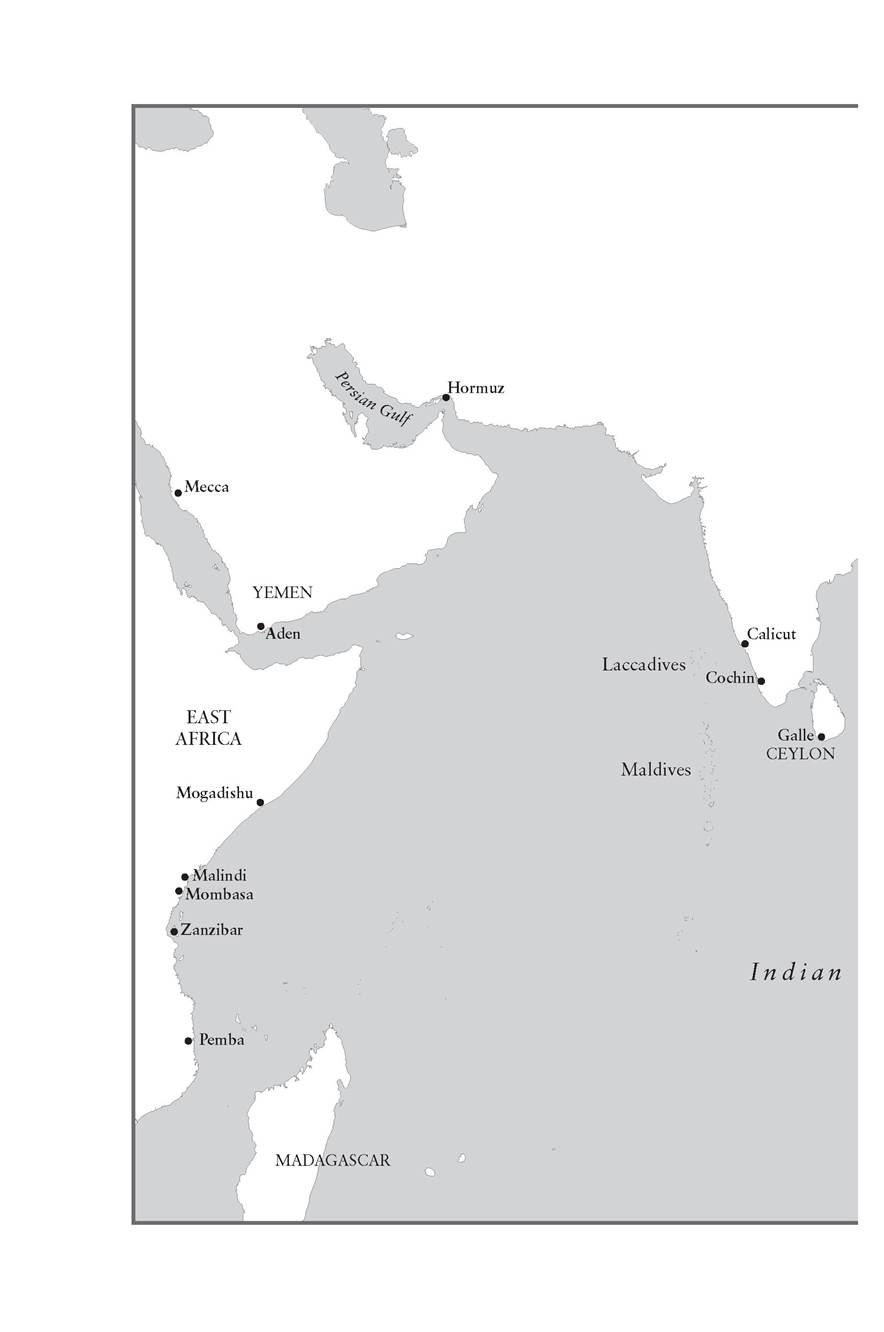
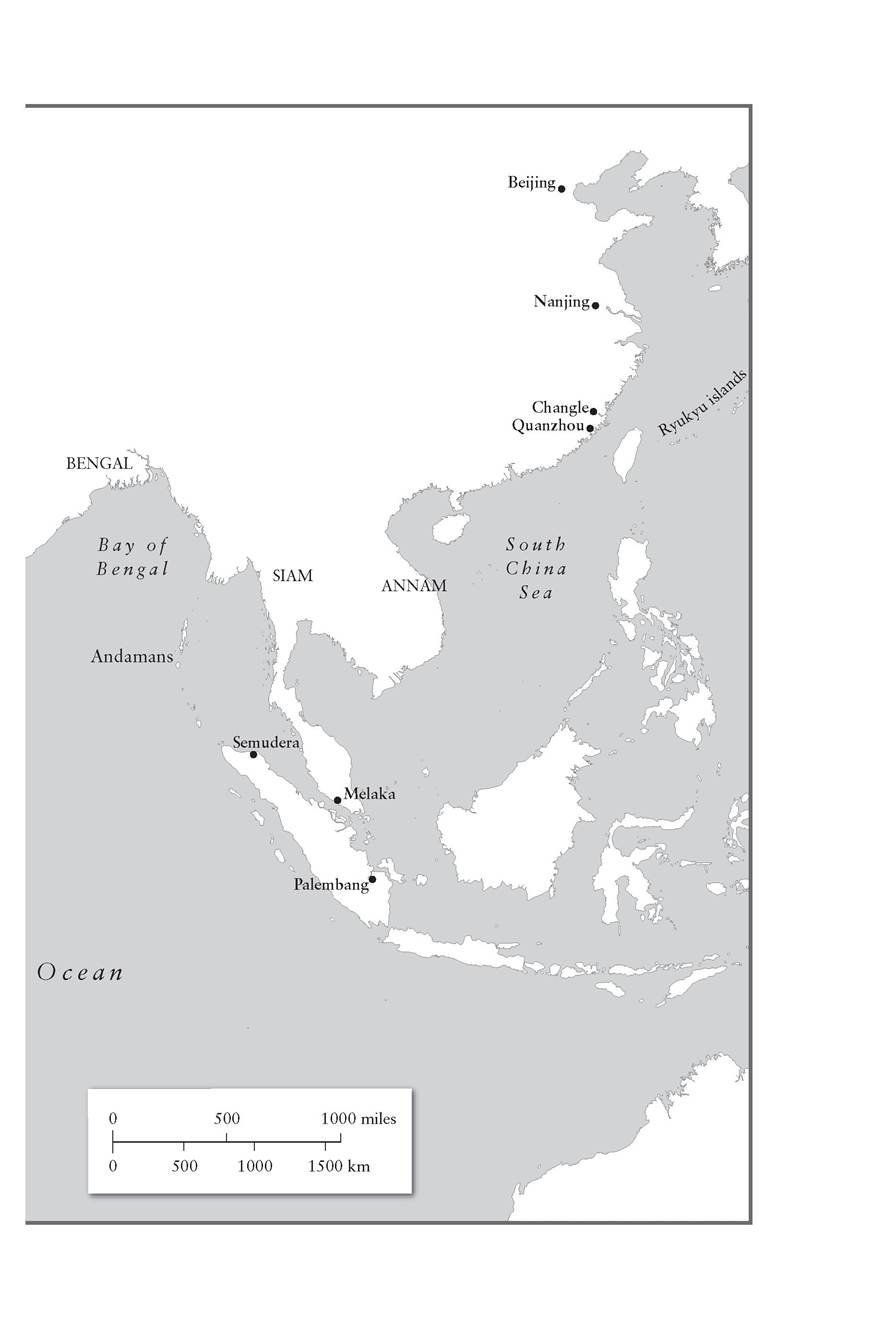
He rebuilt the Grand Canal linking Beijing to the Chinese rivers and assuring the capital of regular grain supplies.2 His overseas expeditions, led by Admiral Zheng He (Cheng Ho) have attracted attention not just in modern times but under later Ming rulers - a certain Luo Mao-deng wrote a novel about the Ming voyages that was published in 1597 under the title The Grand Director of the Three Treasures Goes Down to the Western Ocean, and, despite its obvious fantasy, including a visit to the Underworld, attempts have been made to use it as a reliable source for all those aspects of these voyages that are not recorded in the official histories and inscriptions that survive.3 Precisely because of the sheer scale of the Ming voyages, Zheng He has attracted most of the attention from historians of Yong-le’s reign: there were 255 ships on the first voyage and 249 on the second, and a total of seven voyages, according to his biographer, Edward Dreyer, who counts 27,550 men on the final voyage, roughly the same as the first. Some of these figures will be questioned later; but, when they read about the voyages, later generations were astonished at the number and size of the ships, the number of those on board and the distances traversed: Chinese ships reached east Africa, Yemen, Hormuz, Ceylon and the lands around the South China Sea, and Zheng He created a spacious Chinese base at Melaka.4The Ming voyages have attracted comparisons with Christopher Columbus, very much to the detriment of the latter, where the point is made that Columbus’s flagship, the Santa Maria, was a small fraction of the size of Zheng He’s treasure ships, and his initial fleet consisted of only three ships. That is to assume that Columbus and Zheng He had similar objectives, which was far from being the case. Nonetheless, the failure of the Ming emperors to repeat these very expensive expeditions after 1434 raises that hoary question in Chinese history: if Chinese technology was in many respects so far in advance of that of western Europe in the late Middle Ages, why did China fail to create a world empire, or have an Industrial Revolution, or indeed open up to the world? This question lay at the heart of the Marxist-i nspired account of Science and Civilization in China composed by Joseph Needham.5 Needham speculated about visits to South America, Australia and around the Cape of Good Hope towards Brazil in the Ming or some other period; his enthusiasm for things Chinese was literally unbounded.
However, the voyages have also been unscrupulously exploited by a sensationalist writer who has woven together a vast narrative in which Zheng He’s ships went much further than Africa and Arabia, and supposedly discovered Antarctica, Alaska, the Atlantic and just about every corner of the world long before the arrival of the Spaniards, Portuguese, Dutch or British; in addition Zheng He’s arrival in Italysupposedly kick-started an Italian Renaissance that was already well under way. Needless to say, this ‘research’ is utter nonsense and pure fantasy, and the truth is far more interesting.6 Equally, the claim that Marco Polo knew about, and perhaps even visited, Alaska, making him the first European since the Vikings to set foot in North America (though the other side), is unfounded, this time based on what may be sixteenth-century manuscripts rather than modern-day fancy.7
The first question is why seven massive expeditions were sent out from China between 1405 and 1434, when nothing on that scale had been tried before. Yet there had been some seafaring activity before Zheng He. A Chinese envoy, the eunuch Yin Qing, had visited Melaka in 1404, a year before Zheng He set out; the town’s founder and rajah, Paramesvara, was granted the title of king, legitimizing his position as master of the Malacca Strait and of the trade route linking the Indian Ocean to the South China Sea.8 Yong-le was as active in securing the submission of his neighbours in central Asia by means of land embassies as he was in winning that of maritime nations on the routes Zheng He followed. Landlocked kingdoms as far away as Samarkand were expected to assimilate into Chinese culture. However, its monarch proved less than happy at being treated as a vassal and sternly insisted that Yong-le would be best advised to stop talking nonsense about being ruler of the world and should instead become a Muslim.
The Middle Kingdom over which Yong-le directly ruled was supposed to be surrounded by a ring of subordinate barbarian states.
He was also determined to recover lands that had once been ruled from China and to draw them into the Chinese cultural world. Like the Mongol rulers of China in the thirteenth century, he aimed to gain control of Annam, roughly northern Vietnam, even though his father, the first Ming emperor, had warned against ever trying to achieve this (and he gave the same advice about Japan and the Ryukyu islands).9 Yong-le put together a large fleet, supposedly of at least 8,600 ships, captured from Annam, but he had to face tough resistance that was accentuated by the policies he adopted after victory, such as the requirement to wear Chinese dress.10 Another area best reached by sea that Yong-le eyed was Bengal, where his ambassador intervened to head off a war with the ruler’s neighbour; the king became a fan of the Chinese emperor, sending rare animals such as one which was identified as the qilin known from Chinese mythology, and which was a giraffe, obtained from distant Africa by the ruler of Bengal.11 Yong-le did in fact describe his aims very clearly during the very first year of his reign:Giving and nourishing lives is the utmost virtue of the Heavens. A humane ruler needs to learn from Heaven; hence, loving the people should become the principle of his rulership. The four seas are too broad to be governed by one person. To rule requires delegation of powers to the wise and the able who can participate in government... My late father Hong-wu received the mandate of heaven and became the master of the world. During the thirty years of his rule, there was peace and tranquillity within the four seas. There was neither catastrophe nor tumult.12
On the one hand, the Chinese emperor was master of the world; on the other, he could not actually rule over the entire world - a difficulty all claimants to universal imperial power have had to face. But that did not mean he should pass by the opportunity to demand from countries right across the world recognition of his superiority.
Once again, what comes through powerfully is the insistence of the Chinese on their superiority as a moral force - Confucian ideas blended with those of Yong-le’s Mongol predecessors, with their ruthless demands for recognition of their own ‘Mandate from Heaven’. Ming court culture owed much to the Mongols, including many of the costumes worn at court and the passion the Ming emperors showed for hunting and archery.13Sending fleets overseas under the command of Admiral Zheng He was, then, a highly conspicuous and extremely expensive way of doing what earlier Chinese emperors had long been trying to do. Some historians have looked for quite different explanations. The most peculiar is that Yong-le was trying to run to ground his predecessor and rival, Jian-wen, who, according to one rumour, had escaped to a remote island across the sea.14 Other arguments that have been advanced include the simple idea that Zheng He’s voyages were motivated by curiosity. In other words, Zheng He was an explorer, even more so than Columbus, who, after all, was certain of his destination (China or Japan) and had read a book (by Marco Polo) that told him what to expect.15 The arrival at court of the giraffe would have prompted questions about the land from which it came, somewhere in the outer reaches of the ‘western sea’.16 The emperor required exotic goods from all over the known world, for tribute was supposed to contain things that could be treasured - rare animals, precious jewels - as well as disposable items such as spices and perfumes. That is not quite the same as curiosity about the human and physical geography of the Indian Ocean. Chinese advances in technology, such as the use of the maritime compass and of woodblock printing, did not form part of a wider scientific endeavour built around the pursuit of knowledge for its own sake.
Those who went on the voyages did have exciting experiences to remember; and the short books left by two travellers on several expeditions, Ma Huan, an Arabic and Persian interpreter, and the soldier Fei Xin, are rich in details about the customs, religion, products and topography of the lands of the Indian Ocean.17 Although Ma Huan claimed to come from a modest background, describing himself as a ‘mountain woodcutter’, he knew his Chinese classics and had read Buddhist literature.
Yet his account of the ‘Western Ocean’ took several years to be printed and published (probably in 1451), and was little read. Fei Xin aroused more interest among sixteenth-century Chinese scholars, which may reflect the continuing interest in Zheng He, about whom Ma Huan said rather less, his main concern being the countries he visited in the Indian Ocean. Fei Xin also paid attention to the lands around the South China Sea, which, as near neighbours and past targets of military campaigns, aroused special interest.18The argument that the aim of the voyages was to create a trading network is easy to challenge. Yong-le forbade private trade. Earlier attempts to ban private trade had been widely ignored, all the more so when the imperial throne was in contention.19 Yong-le was only interested in the exchange of tribute for gifts, which was a political act in the first place. It is true that a well-established custom existed that when the government had claimed its share, members of a diplomatic mission could trade the remaining goods placed on board ship for local produce, and this made participation in overseas embassies very desirable - there were big profits to be made and some prestige to be gained from bringing, say, Chinese ivory to the court in Japan or Java. But the prestige Yong-le sought was his own prestige, as emperor of the Middle Kingdom; he ‘wanted to display his soldiers in strange lands in order to make manifest the wealth and power of the Middle Kingdom’, and sent his ships ‘to the various foreign countries, proclaiming the edicts of the Son of Heaven and giving gifts to their rulers and chieftains. Those who did not submit were pacified by force.’20 Setting aside Vietnam, which was seen as a borderland within range of Chinese areas of settlement, this ‘pacification’ did not involve the sending of governors or sinicization. Ports would only be visited if they acknowledged Chinese sovereignty, so that those that failed to do so lost out on the chance to obtain Chinese goods and to offload their own products.21 These are by no means the only interpretations of the Ming voyages. Another view of the voyages, which took place around the time of the conversion of the ruler of Melaka to Islam, is that they stimulated the spread of Islam in what are now Malaysia and Indonesia; but this is doubtful, and at best it would have been an accidental effect of the voyages, and obviously not their intention. Buddhist hopes of acquiring a sacred relic in Ceylon have also been brought into play, without any real evidence.22
The role of Islam in Zheng He’s life is an interesting problem. The admiral (though he did not actually hold such a title) was born a Muslim in 1371. He hailed from south-western China, from the province of Yunnan,
258 THE MIDDLE OCEAN: THE INDIAN OCEAN AND ITS NEIGHBOURS which had a large Muslim population descended from traders who had been arriving throughout the Middle Ages. His own family had rather distinguished antecedents: they originated in Bukhara, making him more a son of the Silk Road than of the Silk Route of the Sea, and had been in the service of the early Mongol khans. His father and grandfather must have been quite devout Muslims, as they were known as Hajji, ‘the pilgrim’, implying they had both visited Mecca. As a boy, Zheng He was taken prisoner after his father was killed resisting the Ming invasion of Yunnan. He was castrated and sent to the Chinese imperial court; and there he rose among the ranks of the court eunuchs, whose closeness to the emperor was often a great source of irritation to the bureaucrats who expected to gain their ruler’s ear.23 He became head of the Directorate of Palace Servants, a government office heavily involved in building projects, and these, like shipbuilding, required the use of enormous quantities of wood. It was his experience in organizing construction rather than his experience as a naval commander, which was non-existent, that made him a very suitable choice to take charge of the emperor’s fleet.24
All this time, his links to Islam must have been weakening, and, like the Chinese around him, he became eclectic in his religious practice, joining his crew in praying to the sea goddess Tianfei at the start of his expeditions. To cite an inscription he laid down in 1431, ‘the divine majestic spirit of the Heavenly Princess, who is entitled by imperial edict “she who defends the country and shelters the people, whose miraculous spirit responds visibly to prayers, and whose vast benevolence saves all”, spreads across the oceans’. The goddess, also known in local dialect as Mazu, was said to have been the daughter of a humble fisherman; she was born in ad 960 and possessed the power of prophecy; she could therefore warn her brother that he was at risk of being drowned at sea, and so saved his life.25 Zheng He became very large, supposedly seven feet tall and ten feet around the waist, though the Chinese ‘foot’ was shorter than the twelve-inch foot of today. He had a small nose but high cheekbones and a broad forehead. There are a good many pictures and statues of him, the product of imagination, as he was deified after his death and has been worshipped by expatriate Chinese as their patron ever since - his cult continues in the oldest surviving Chinese temple in Malaysia, the Cheng Hoon Teng temple in Melaka, built in 1645.26
II
The story of Zheng He has grown in the telling, then, and the question that needs to be asked is whether the size of the fleet and the number of
those on board have also been exaggerated. The novel by Luo Maodeng fantasized about the size of the ships, but many of those who subsequently wrote about the voyages assumed that Luo had access to precise information. Fei Xin, who was there, wrote of ‘27,000 government troops’ aboard the fleet that set out in 1409, and the numbers given for each expedition are broadly comparable. Very large figures in the thousands were just a Chinese way of saying ‘innumerable’; it is quite reasonable to insist on scaling down these numbers, which represent a large medieval city on the move, and which raise insoluble problems about how it was possible to feed all these people, even if the fleet put into port every week or two. Interestingly, Fei Xin also mentioned ‘48 sea-going ships’, and that looks a very tight fit for 27,000 troops and an entire storehouse of fine porcelain, silks and other gifts (even bulkier on the return, when the tribute included a menagerie of lions, giraffes and zebras).27 And yet other estimates for these fleets suggest that at least 250 ships set sail, so one could try to argue that Fei only counted the Treasure Ships. One has to distinguish big junks from small sampans, lighters and supply ships, including those filled with fresh water and towed behind larger vessels. Marco Polo’s description of the largest Chinese ships insists that they were manned by 200 sailors, even, in one text of his book of travels, by 300. He describes tugs that were used to help these great junks along, with fifty or sixty sailors at the oars. Ships were constructed out of fir wood, to the best of his knowledge, though evidence from underwater archaeology and the written sources we have indicates that cedar and camphor wood were often used as well, and they would have lasted better; the Yuan shipbuilding industry had denuded parts of China of tree cover, and Yong-le’s schemes, if they were really on the scale that was reported, must have had the same disastrous effect. Polo described capacious vessels, bigger than those that sailed the Mediterranean, and others who saw or heard about them knew that they contained many cabins for the wealthier or more important passengers. They do seem to have been much more comfortable than European ships, where everyone was crowded together under the open skies and living, sleeping and cooking space was very confined.28
A reconstruction in print of the ships by Edward Dreyer sets the size of the largest vessels in these fleets, the so-called Treasure Ships, at around 400 feet long and about 170 feet broad, with nine masts.29 It is generally assumed that those who built these ships adapted the design from the traffic that regularly sailed up and down the Yangtze and the other broad Chinese rivers and canals, where big ships were constructed with flatter bottoms than one would expect to find at sea and with large numbers of masts. Detailed records of shipbuilding survive from this period, and the sheer scale of the industry is very impressive; even so, most vessels never ventured into saltwater.30 What was suitable for the relatively calm and shallow waters of a river would certainly not suit the open ocean, where a proper keel would be needed to guarantee stability, and where too many sails could make ships more difficult to manoeuvre in storms. A displacement of over 18,000, or even 24,000, tons would make these ships into the very largest ones constructed out of wood, setting aside one or two of the vanity vessels built for the Ptolemaic rulers of Hellenistic Egypt that probably never ventured out of the harbour at Alexandria.31
All this sounds incredible, especially since there are no references to the loss of ships at sea during the expeditions, though that must have happened occasionally. The arguments in favour of smaller fleets with fewer people on board are compelling. At 200-250 feet in length, manned by about 200 crew, these ships enter the realms of plausibility.32 This scalingdown of the size of the ships and of the fleets and their crews should not suggest that the arrival of a grand imperial navy in Melaka or Calicut or Aden was anything less than an extraordinarily impressive event, as ship after ship came into sight offshore, unfamiliar in its rigging, with dragon pennants flying. Even if we reduce the size of the company to, say, 10,000 on each expedition, we still have that sizeable medieval town on the move, with all the logistical problems of supplying water and food and of maintaining discipline and health on board during voyages that reached as far as Africa and Arabia.
III
The first expedition took place in 1405-7, soon after Yong-le had gained power. The sixty-two Treasure Ships built in the Lonjiang shipyard in Nanjing and floated down the Yangtze River to reach the sea stood at the heart of the fleet; these were the ships on which the gifts to China’s vassals were to be loaded. From Champa, which was happy to recognize Yong-le’s authority as a defence against its neighbour and rival Annam, the first voyage headed towards Java, where the local kings had been a source of trouble to Hong-wu, but where a large community of Chinese merchants lived, servicing the island’s booming economy based on spices and other rare goods. The current king was ‘arrogant and disrespectful and wanted to harm Zheng He. He heard about this and went away.’33 For the moment Zheng He was content to parade his ships and awe the Javans, as his destination lay through the Strait of Malacca, past Melaka itself and around the Andaman islands (described by Marco Polo as a wild and dangerous place) and right across the Bay of Bengal to Ceylon, where he expected no favours from the local ruler, so he pressed on up the western coast of India to Calicut and Cochin. Calicut made a good impression on Zheng’s officers, to judge from positive comments by Ma Huan: ‘the people are very honest and trustworthy. Their appearance is smart, fine and distinguished.’ He called Calicut ‘the great country of the Western Ocean’, while Fei Xin noted that ‘it is also a principal port for all the foreigners of the Western Ocean’. Ma Huan also reported a garbled story about ‘Mou-xie who established a religious cult’ and the Golden Calf that he heard in Calicut, not realizing that this was the same person as the Musa, or Moses, revered by his fellow Muslims. And yet he also recognized that there were very many Muslims in Calicut; a past king of Calicut had said: ‘You do not eat the pig; I do not eat the ox.’34
After spending winter 1406-7 in Calicut, Zheng He made his way back past Melaka, with an eye on the troubled situation in Sumatra, where a Chinese pirate named Chen Zu-yi had taken control of Palembang. The old capital of Sri Vijaya was no longer the great trading centre it had once been, a role that was passing even now to Melaka, but the town had recovered something of its lost importance at the end of the fourteenth century, as closer ties with China were created.35 The Ming ban on private trade seems to have caused no problems, for it was easy to ignore commands from Beijing in far-off Sumatra. However, the presence of a powerful Chinese pirate threatened this special relationship, and Zheng He was determined to assert Ming authority over the South China Sea; as a result, the Chinese merchants in Palembang greeted the Ming fleet with delight. However, Zheng was unimpressed when Chen Zu-yi came to offer his submission. Suspecting that this was simply a ruse to gain time before Chen and his pirate fleet could slip away, Zheng He attacked the pirates, who had at least seventeen ships - no match for Zheng’s fleet. An official history of Yong-l e’s reign claims that more than 5,000 pirates were killed, while Chen Zu-yi was carried back to Beijing and beheaded by imperial order; ‘after this the seas were restored to peace and order’.36 This was the one violent confrontation in what had otherwise been a peaceful mission, or rather a display of Chinese power so impressive that no one in his right mind would oppose the power of the Ming emperor. The Ming navy had taken advantage of the monsoons to time its journeys out and in, but even so on the final leg a great storm arose and the sailors were struck with fear. They prayed fervently to Tianfei and were rewarded with a miraculous light that settled on the top of the mainmast of one of the ships and that they knew was a sign of the goddess’s protection (St Elmo’s Fire, a common electric effect during storms at sea). To cite a later inscription on which Zheng He recorded his memories of earlier expeditions:
We have traversed over a hundred thousand li of vast ocean and have beheld great ocean waves, rising as high as the sky and swelling and swelling endlessly. Whether in dense fog and drizzling rain or in wind-driven waves rising like mountains, no matter what the sudden changes in sea conditions, we spread our cloudlike sails aloft and sailed by the stars day and night. Had we not trusted her divine merit, how could we have done this in peace and safety? When we met with danger, once we invoked the divine name, her answer to our prayer was like an echo; suddenly there was a divine lamp which illuminated the mast and sails, and once this miraculous light appeared, then apprehension turned to calm.37
Zheng He’s fleet arrived back in Nanjing in October 1407, accompanied by emissaries from around the South China Sea and from as far away as Calicut and Melaka, who presented their tribute to the imperial court and were rewarded with copper cash and paper money, though it is not clear what use paper money would have had in far-off kingdoms.38
Aware that the gifts of money were not entirely what was expected, the emperor began to plan Zheng He’s second voyage, of 1407-9, whose declared function was to present letters of appointment to the king of Calicut, including a silver seal of office, and to present gifts of silk robes, caps and belts to the king and his chief advisers, who would be ranked in best Chinese fashion. Similarly, the rulers of territories en route to Calicut, such as Siam, Java and Melaka, were to be honoured with imperial letters.39 The expedition probably split up into squadrons that visited different ports and then regrouped. However, a particular show of force was needed in Java, whose king had resisted Chinese authority in the past and was wise enough to agree to a tribute payment and compensation for past offences.40
The wish to discipline those who were reluctant to accept Ming overlordship was also apparent on the third voyage (1409-11), which this time did not avoid Ceylon. The king of Ceylon, Alagakkonara, was accused of insulting Zheng He and even of trying to assassinate him, luring Zheng inland and plotting to send his own ‘bandits’ to raid the Chinese fleet. Zheng’s way back to his ships was blocked by felled trees, though messages were sent to his fleet via unblocked roads. Zheng led his soldiers into battle across back roads and launched a surprise attack on the capital; he captured the king, who was carried back to China, although the emperor decided he was just an ignorant barbarian, and did not execute him. Instead, in a show of Ming authority, he nominated a replacement for him
from the royal family of Ceylon, ‘in order to continue the sacrifices of the kingdom of Ceylon’.41 The Sinhalese version of these events is rather different, and reveals that the court in Ceylon was trying to save face: here, Chinese envoys arrived at the royal palace loaded with gifts; but this was just a ruse, and once inside the compound they seized the king and carried him off.42
It has also been suggested that the real aim of the attack on Ceylon was to steal a tooth relic of the Buddha, one of the most important of all Buddhist relics on the island. In 1284 Khubilai had already despatched ships to Ceylon requiring this relic to be handed over; the king of Ceylon demurred. A later account of the voyages does claim the relic was carried back to China, and attributes the calm seas through which the fleet passed to its magical power.43 The story is surely a fable; but this would fit well with the idea that Yong-le’s political programme was moulded as much by Khubilai’s ambitions as by those of his father. The nearest one can reach to the argument that this expedition was a Buddhist project is the text of an inscription that Zheng He left at Galle on the coast of Ceylon. The inscription uttered praise to Buddha for watching over the fleet:
Wherefore according to the Rites we bestow offerings in recompense, and do now reverently present before the Lord Buddha, the World-Honoured One, obligations of gold and silver, gold-embroidered jewelled banners of variegated silk, incense-burners and flower-vases, silks of many colours in lining and exterior, lamps and candles with other gifts in order to manifest the high honour of the Lord Buddha.44
But that was only the section in Chinese; the text was repeated in Persian and in Tamil, and there it was Allah and a Hindu god who were invoked. Allah, Buddha and the Hindu god are all offered 1,000 pieces of gold, 5,000 pieces of silver, as well as silk, perfumes and temple ornaments. Taken as a whole, we witness here ‘a co-ordinated imperial offensive to persuade the heavens and their diverse deities to smile on Chinese maritime activities’.45 This eclecticism was typical of Chinese attitudes to religion.
IV
The three first expeditions had happened in rapid sequence. After Zheng He’s return in mid-1411 the emperor, distracted by plans for a land campaign against the Mongols, waited until December 1412 before he ordered Zheng He to set out once again, bearing gifts for sundry kings in the South China Sea and beyond. Among the places visited were Palembang and its replacement as the main trading centre near the Malacca Strait, Melaka, ruled by Paramesvara. A lengthy inscription left there by Zheng He included an eloquent poem:
The vast south-western sea reaches unto the Middle Kingdom,
Its waves cresting high as the heavens, Watering the earth, the same way for countless aeons... Its righteous king, paying his respects to imperial Suzerainty, wishes his country to be treated as one of Our imperial domains and to follow the Chinese way...46
Melaka was developing into an important base for Zheng He’s activities, thanks to its strategic position and to the creation of the Chinese settlement there. Zheng He needed to find a place where the fleet could be serviced, and Melaka was as much a naval base as a centre of Chinese trade.47 The rise of Melaka thus owed a great deal to Chinese influence, and to the patronage of Zheng He just at the moment when Rajah Paramesvara was bringing the city into existence. Fei Xin saw Melaka when it was still ‘a single hill with few people on it’, located in an unproductive area, with simple houses; but once Zheng He had brought it under Chinese sovereignty and had raised it to the status of an imperial county things clearly improved.48 Still, it had its rivals, notably Semudera on the northern tip of Sumatra, ‘the most important port of assembly for the Western Ocean’. On his return from the Indian Ocean, Zheng He would display another rare show of force and send in his troops to suppress a rebellion against the king of Semudera, thereby showing what advantages could be gained from submission to the Chinese emperor.49 Yet India was not the intended destination. The Chinese fleet majestically sailed past the Maldive and Laccadive islands, but its target was a place the Chinese must have heard about at length when they visited Calicut, Hormuz at the gateway of the Persian Gulf.50 The voyage from Calicut to Hormuz took thirty-four days, which was rather slower than the norm (about twenty- five days), but this was surely due to the need to keep a fleet together and to the less flexible manoeuvrability of the very largest ships, by comparison with Arab and Persian dhows.51 The mystery is what Zheng He can have wanted from a trading city so far from China. Perhaps, then, it would be wrong to rule out curiosity entirely, or even the traditional Ming contempt for trade, since the Chinese court was fascinated by exotic goods from the ‘Western Ocean’ and beyond. The interpreter Ma Huan was impressed with the place and took special interest in the jugglers, acrobats and street magicians, above all by acrobatic goats that could balance on a couple of tall poles and dance a jig up in the air.52
One voyage generated another, as tribute was received, as ambassadors from foreign kingdoms were received at court, and as Zheng He was ordered to return to distant waters with letters of appointment and seals of office. He departed on his fifth voyage by way of Quanzhou in summer, 1417, leaving behind a tablet on which he recorded his offering of incense to the sea goddess; he took on board a massive cargo of porcelain, of which more shortly. He was now sent beyond Hormuz (‘Ho-ru-mo-ssu’) to a town on the southern shores of Arabia called Lasa, thought to have been a port in Yemen. In Luo Maodeng’s romanticized account of the voyages, Zheng He encountered greater resistance as he ventured into uncharted waters, and had to blast the walls of Lasa with his cannons, though there is no other evidence for that happening.53 But a much more important destination was the Rasulid kingdom of Yemen, whose capital, Aden, had for centuries been a control centre for traffic heading up to Egypt, down the coast of east Africa and across to western India, including Calicut. Its prosperity boomed in the fourteenth and fifteenth centuries, partly thanks to the lively India trade of the Egyptian merchants of Cairo and Alexandria, but also thanks to its command of a surprisingly fertile interior. It has been seen already that this was an area where frankincense and myrrh were easy to obtain, and tribute paid in this form would please the Ming court enormously, in view of the difficulties and expense of obtaining these luxuries overland or by way of endless intermediaries along the ‘Silk Route of the Sea’. It is hardly surprising that its rulers were determined to protect their independence in the face of attempts by the Mamluk rulers of Egypt and Syria to extend their power right down the coasts of the Red Sea, and accepting Chinese claims to overlordship, and subsequently sending a series of missions to Beijing, did not seem a ridiculous idea, when Zheng He could come all that way with his grand fleet.54 Ma Huan thought that ‘the people are of an overbearing disposition’ and noted that the sultan had a large, well-drilled army. He was impressed by the wealth of Aden, visible for instance in large precious stones he called ‘cat’s eyes’, and in the fine filigree jewellery worn by women.55
Zheng He’s purpose was not, however, to intervene directly in the politics of Yemen. His fleet was bound for Africa; the arrival at the Chinese court of the giraffe sent by the king of Bengal had already alerted the Ming dynasty to the extraordinary treasures of Africa, and on past expeditions there had been plenty of chances to examine African ivory and ebony. Mogadishu in what is now Somalia was named on the sailing instructions given to Zheng He, and it was the first African town his fleet reached. The Chinese were unimpressed by the arid setting of a city that lacked supplies of wood, and in stark contrast to Chinese towns was entirely built of stone, even if the buildings were several storeys high. The Chinese considered the Somalians rather stupid, and were only interested in what they could bear away: frankincense, ambergris and wild animals, including lions, leopards and zebras. Further south, at Brava, they saw more of the same type of housing but were able to add myrrh, camels and ‘camel-birds’, that is ostriches, to their booty, and as they reached the Kenyan coast at Malindi they acquired African elephants and rhinoceroses, as well as the much-vaunted qilin, or giraffes, so that the returning Treasure Ships must have resembled Noah’s Ark.56
The Chinese were not totally ignorant of Africa. The earliest Chinese reference to Africa so far identified dates from the ninth century; there, as in the accounts of the Zheng He voyages, the Horn of Africa is presented as an arid land, and the inhabitants are described as nomads who drain blood from the veins of their cattle and drink it mixed with milk, rather as the Masai have continued to do. By the thirteenth century, the Chinese had heard of Zanzibar; in 1226, it was mentioned under the name ‘Cengba’ by the geographer Zhao Rugua, who even understood that the name ‘Zanzibar’ was derived from the term Zanj, which indicated black-skinned people. Zhao was aware of the River Nile and of Alexandria (Egentuo) with its great lighthouse, so anyone reading his work would have understood how Aden was linked to a wealthy land to the north.57 By the fourteenth century, Egypt had become a great consumer of Chinese pottery and metalwork, to the extent of making reasonable imitations of Chinese bronzes in order to satisfy ever-rising domestic demand.58 Large amounts of Chinese ceramics also reached Zanzibar, as the archaeological evidence clearly shows. Zhao also looked at the coastline south of Zanzibar and knew that black ‘savages’, as he condescendingly called the inhabitants, were carried off by Dashi, that is, Arab, slavers. He imagined that these black Africans lived on Madagascar, which was an error (Madagascar was even now being colonized by people of Malay and Indonesian origin); but he had time for stories about a great bird similar to Sindbad’s rukh whose massive wings blotted out the sun, and whose diet included camels swallowed whole. He knew too that this was a land that produced rhinoceros horn and elephant tusks.59 One might conclude from the Chinese coins that have turned up all along the coast from Mombasa northwards that Africa was already the target of Chinese merchants well before the arrival of Zheng He; a hoard discovered by a farmer in Zanzibar in 1945 consisted of 250 Tang and Song coins, dated between 618 and 1295. At Mogadishu six coins of Yong-le have been found, so it is quite possible that they arrived on board Zheng He’s fleet. As for porcelain, the island of Pemba, like Zanzibar an important centre of trade, has yielded pieces from the Song and Ming dynasty, and African demand for Chinese pottery grew during the fourteenth century.60 But to say that they were interested in African produce and that Chinese cash has been found along the coast is not the same as saying that Chinese traders travelled as far as this. Chinese cash remained in circulation long after it was manufactured (normally by casting rather than striking); a Song coin might have arrived in Ming times.
Once again Zheng He brought back to the Ming court ambassadors, including representatives of Hormuz, but they were kept waiting a couple of years for their return trip. Meanwhile, forty-one Treasure Ships were fitted out from October 1419 onwards, setting out at some point in mid- 1421. However, the emperor was losing interest in the voyages, and concentrated his energies on the construction of his new capital at Beijing and on war in Mongolia instead. Around the same time he ordered the suspension of further voyages, although he let this one depart. After they entered the ‘Western Ocean’, the ships did not stay together; a eunuch named Zhou Man led part of the fleet to Aden, but much of the fleet apparently stayed behind in India, based at Calicut. By September 1422 the fleet had returned to China, bringing envoys from Siam, Semudera and Aden. But, after spending so much on Beijing, the emperor had run out of money to pay for these great worldwide displays of Chinese magnificence. Then, in 1424, Emperor Yong-le sent Zheng He on a further voyage, but this was a much more modest expedition than those Zheng He had commanded earlier, and it went no further than Palembang, a territory which happily acknowledged Chinese supremacy; Zheng delivered the letter and seal appointing the head of the ‘Pacification Commission’ at Palembang, the figure who was responsible for managing the large Chinese community there. But by the time Zheng He returned home, his patron was dead.61
This was not quite the end of Zheng He’s naval career. The new emperor, Hong-xi, only lasted a few months, and he was hostile to these projects; on the very day of his accession he abolished the expeditions to the ‘Western Ocean’, and a day later he released an opponent of Zheng He from prison, Xia Yuan-j i, who had been warning of the excessive cost of the maritime expeditions.62 Hong-xi’s successor, Yong-le’s grandson Xuan-de, also had other plans for Zheng He, including a military command at Nanjing and the building of the great Bao-en Temple at Nanjing, also known as the Number One Pagoda, which became a seat of Buddhist scholarship and the main temple in the city. So a perhaps disconsolate Zheng He was sent back to his duties as overseer of construction projects, and languished in prestigious but not politically important tasks, while his foe Xia Yuan-j i held the emperor’s attention and counselled against further expeditions; as Minister of Finance, Xia could see no justification for the waste of money they involved. However, Xia’s death in February 1430 prompted a rethink; Xuan-de became worried that the prestige of his empire was suffering because ‘the foreign countries, distantly located beyond the sea, still had not heard’ of the stable and successful rule he had inaugurated. The ships built for the expedition he launched bore names that set out the fundamental principles Xuan-de was trying to broadcast: Pure Harmony was one, Lasting Tranquillity another.63
Once again Zheng He set out to proclaim Chinese overlordship across the Western Ocean, and once again he left inscriptions that helpfully set out the aims of the expedition. One of these inscriptions was carved on a tablet in the Temple of the Heavenly Princess Tianfei at Liujiagang on the Yangtze River, newly constructed by Zheng He in honour of his divine patron, while the other was erected on the admiral’s behalf by the chief Daoist priest of Changle, 400 miles from Liujiagang, just as the fleet was about to set off from the coast of China. Both date from 1431, and both reveal how happy the Muslim eunuch was to worship other gods (whether traditional Chinese ones or Buddhist deities) rather than Allah: ‘if men serve their prince with the utmost loyalty, there is nothing they cannot do, and if they worship the gods with utmost sincerity there is no prayer that will not be answered.’64 Zheng He commemorated his past voyages ‘to the various barbarians’ aboard ‘over a hundred seagoing ships’, and carrying ‘several tens of thousands’ of soldiers. Just to give an idea of how easily numbers were inflated, when he mentioned the number of countries he had visited the figure for 3,000 crept in where modern scholars believe the intention was to write ‘thirty’. Zheng He had no objection to the lively trade between ‘barbarian’ peoples, and even thought of himself as its protector: ‘the sea routes became pure and peaceful and the foreign peoples could rely on them and pursue their occupations in safety. All this was due to the aid of the goddess.’65 Yet the second inscription makes abundantly plain the unique achievement (so it is claimed) of the Ming dynasty, which has surpassed the Han and Tang dynasties in encompassing the peoples of the world: ‘from the edge of the sky to the ends of the earth there are none who have not become subjects and slaves’.66 Their reward has been not just material gifts but, more importantly, imperial favour. For these voyages had a more important moral than material purpose.
The main fleet headed first for Champa and then across the South China Sea to Surabaya on Java, which meant the Chinese had arrived in the heartlands of the Majapahit kingdom. They arrived on 7 March and only left Java after more than four months, suggesting the need for ship repairs as well as politicking; they visited Sumatra next, calling in at Palembang, but they only stopped there for three days, for they had had plenty of time to resupply their ships in Java. At the start of August they were in Melaka, where they halted for another month, and then on to Semudera, where they remained for about seven weeks. No doubt they were also factoring into their calculations knowledge of the monsoons and of the typhoon season, but that was not enough to save them from severe storms as they headed through high seas into the Indian Ocean. Zheng He’s boasts in the two inscriptions that described how the goddess Tianfei had saved them on earlier expeditions must have seemed like wishful thinking. But they found safe anchorage in the Nicobar Islands and bought plenty of coconuts from the friendly natives. Once calmer weather arrived, they headed straight for Cochin and Calicut, and then on to Hormuz. Possibly detachments were sent further, as far as Aden or even east Africa, but without Zheng He on board; ambassadors from Arabia and Somalia travelled back with Zheng He after joining his fleet at Hormuz, but someone must have been sent to fetch them.
Even earlier, several ships had been sent off to Bengal, which lay well to the north of the route the Ming fleets always took towards India but which, as has been seen, was ruled by kings who cultivated friendship with the imperial court, and had even sent a giraffe as a present. Fortunately, the chronicler of this voyage, Ma Huan, joined the Bengal-bound squadron; he admired the country’s fertility and its fine textiles, but was less pleased by the heat. Fei Xin enjoyed a feast of roast beef and lamb but was a little surprised that no wine was drunk, ‘for fear that it might disturb someone’s character and prevent him from conforming to the ceremonial’. So they drank sweetened rose-dew or sherbet instead.67
Yet the most remarkable connection was yet to be made. In Calicut the Chinese found a ship bound for Mo-qie, that is, the kingdom of Mecca (by way of the Red Sea port at Jiddah). Some Chinese, including Ma Huan, were allowed on board, and returned in due course with plenty of wild animals, some of which were oddly un-Arabian (giraffes and ostriches, though lions still existed in the Middle East); these were marvellous things they had bought rather than been given, but along with the animals came tribute-bearing ambassadors, or so the Chinese sources claimed. Ma Huan, who was himself a Muslim, also called Mecca Tianfang, or ‘Heavenly Cube’, referring to the shrine of the Ka‘aba (which indeed means ‘cube’), and he described the Great Mosque and some of the hajj ceremonies.68 However, he does not give the impression of knowing a great deal about
270 THE MIDDLE OCEAN: THE INDIAN OCEAN AND ITS NEIGHBOURS his religion, without being quite as detached from Islam as Zheng He; he rather distanced himself from the Muslims of Arabia by noting that they were punctilious in their religion, ‘not daring to commit the slightest transgression’.
In early July 1433 the fleet was back at Liujiagang. On board were ambassadors from ten countries around the Indian Ocean. The official history of the reign of Xuan-de quotes the words of the emperor himself, which, were he not an emperor, one might describe as churlish: ‘we do not have any desire for goods from distant regions, but we realise that they are offered in full sincerity. Since they come from afar they should be accepted, but their presentation is not cause for congratulations.’69 Indeed, having revived the Ming voyages, Xuan-de sent no more expeditions to solicit submission from the peoples of the Indian Ocean. A year or two after his return, Zheng He died and around the same time Emperor Xuan-de also died, leaving a vacuum, since his heir was only eight years old. The eunuchs, who are usually supposed to have favoured lavish spending, lost influence at court, and interest in maintaining a navy plummeted. Foreign ambassadors arrived bearing gifts, but the Ming emperors received tribute from Siam, Java and elsewhere without any longer sending their fleets to collect it.70 Once again China looked away from the sea. Foreign adventures went out of fashion as domestic difficulties accumulated. The sea voyages had always been controversial, and even those who strongly believed in the special place of the Middle Kingdom under Heaven were not necessarily convinced that they brought much gain. Indeed, it is quite likely that the emperor’s words quoted a moment ago were put in his mouth by a later chronicler, who wanted to cast doubt on the wisdom of the Ming voyages without showing disrespect to the emperor.
Modern Chinese historians like to insist that there was a great difference between Zheng He’s voyages and those of the Portuguese and Spaniards (which were just beginning in the 1420s and 1430s, in the case of Portugal): the Iberian voyages aimed to conquer territory, if need be by force, and to impose trade networks under their exclusive control, whereas the Ming voyages were by and large peaceful - allowing for the eradication of pirates - and aimed to show the flag rather than to create colonies. Zheng He is seen as the potential star of a counterfactual history in which ‘Vasco da Gama and his successors would have found a powerful navy in control of the Indian Ocean’; and even ‘Christopher Columbus might have encountered Chinese junks exploring the Caribbean’.71 This contrast between Europe and China involves an oversimplification of Iberian aims, which evolved slowly; but this view also underplays the imperial dimension to the Ming voyages. Although the settlement of foreign lands by
Chinese soldiers and sailors was not on the Ming agenda, a Chinese compound was created in the new trading town of Melaka, and support was offered to the sizeable community of Chinese merchants in Java and Sumatra - i ndeed, the Chinese in Palembang were governed by a Commissioner whose power clearly extended beyond his own ethnic group. The emperor expected, demanded and received recognition of his superiority. But this came at a price, for the tribute brought back did not compensate for the cost of fitting out the expeditions, nor for the value of the gifts generously bestowed on the emperor’s vassals in the South China Sea, India, Arabia and Africa. Even if fewer and smaller ships than is often assumed set sail, these voyages were an impressive technical achievement for a navy that had little or no knowledge of the Indian Ocean.