14 Lions, Deer and Hunting Dogs
I
At the centre of vast webs of trade and tribute, feeding their products into the routes leading towards both China and the Indian Ocean - and beyond that to the Red Sea and the Mediterranean - there lay what Marco Polo called ‘the greatest island in the world’, 3,000 miles in circumference and ruled by a great king who, he confidently asserted, paid tribute ‘to no one else in the world’.
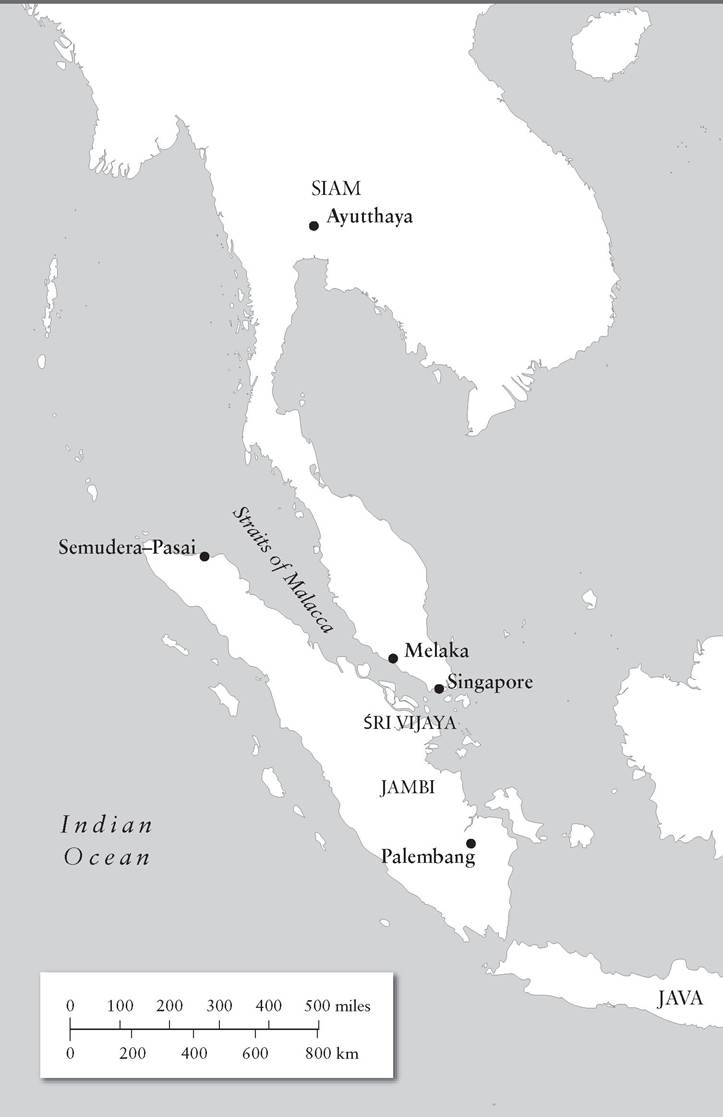
Inhabited by ‘idolaters’, Great Java was of ‘surpassing wealth, producing black pepper, nutmegs, spikenard, galingale, cubebs, cloves, and all other kinds of spices’. It was visited by huge numbers of ships, and the merchants who traded there, including many from Quanzhou and other southern Chinese cities, made an enormous profit. But in reality, as the exaggeration about its size implies, Polo was confused between the real Java (Java Minor) and an imaginary landmass of great wealth lying to the south (Great Java).1 In modern works Java tends to be subsumed into a large mass of East Indian islands that were famous for the production of high-quality spices, some of which ended up on tables in Venice and Bruges. The truth is a little more complicated and rather more interesting, especially as it helps explain the eclipse of the maritime state of Èri Vijaya and the emergence of Singapore and Melaka as important links between the Indian Ocean and the South China Sea. The success of Java was built upon its rivalry with Èri Vijaya. The rulers and merchants of both kingdoms aimed to supply high-grade spices to the Chinese to the north and the Indians, and little-known peoples beyond them, to the west. At first, Èri Vijaya proved stronger than Java. In 1016 the Èri Vijayans sent their fleet against Java, and scored a notable victory. This was not a battle for territory but for command of the trade routes across the South China Sea and of the many subordinate towns that acknowledged the higher authority of the rajah of either Èri Vijaya or Java.However great the success of Palembang may have been in the heyday of Èri Vijaya’s trade, by the time of its victory over the Javans its glory days were coming to an end. One reason was that its very success had brought upon Èri Vijaya the envious attention not just of the Javans but of a ruler much further to the west, in southern India, whose subjects knew Sumatra through their lively trade there, and the lively trade of the Indonesians in the Tamil-speaking kingdom of Còla, or Chola. Chola had a long reach; objects in the Chola style dating to the tenth and eleventh centuries have been found in the Kra Isthmus, the narrow strip of land attaching the Malay peninsula to the great landmass of Asia; and in 1025 the king of Chola launched a violent attack on Èri Vijaya that has been credited with permanently disrupting the kingdom’s trade. Èri Vijayan bases beyond the Strait of Malacca were also in the firing line. After the Chola invasion, even though it did not result in permanent occupation, Èri Vijaya was no longer able to count on its tribute-bearing dependencies in northern Sumatra and the western Malay peninsula.2 In addition, for whatever reason, the Èri Vijayans shifted their capital away from Palem- bang towards another city, Jambi, that took advantage of its position closer to the Strait of Malacca to become a new centre of trade, though it too lay some way upriver (which in a time of raids and counter-raids made good sense). The Chinese continued to write about San fo-chi, their transliteration of Èri Vijaya, and both Jambi and Palembang were still visited by Chinese merchants; but the kingdom had lost its leadership to its rivals. That said, the rajah of Èri Vijaya made every effort to foster good relations with China, sending tribute to the Song emperors in 1137, 1156 and 1178, while the Èri Vijayans also asked the customs administration at Guangzhou to reduce the duty payable on frankincense from 40 to 10 per cent, suggesting that the flow of aromatics from south-east Asia continued to be managed in part from Jambi.
In 1156 a native of Èri Vijaya was invited to act as the official head of the community of foreign merchants in Guangzhou, with five Chinese assistants appointed to serve under him.3Song liberalization of trade had allowed a hundred flowers to bloom: there were now Chinese as well as south-east Asian competitors to Èri Vijaya’s dominance of the sea routes. Among those who benefited from this were sundry petty kings who had previously operated in the shadow of Èri Vijaya, notably the rulers of Semudera - Pasai on the Indian Ocean tip of Sumatra, with which, as has been seen, Zheng He had a sometimes difficult relationship. According to legend, its first ruler chose the site of his new town at Semudera when he saw one of his hunting dogs being attacked by a mouse deer - apparently a good augury. However, similar tales explain the choice of other city sites in virgin territory, notably
id="Picutre 97" class="lazyload" data-src="/files/uch_group78/uch_pgroup313/uch_uch7308/image/image097.jpg">
276 THE MIDDLE OCEAN: THE INDIAN OCEAN AND ITS NEIGHBOURS Melaka; deer, lions and what may be an orang-utan all appear in these stories.
Semudera - Pasai, founded late in the thirteenth century, was a double entity, with a port on the coast and a capital at Pasai a little way inland, but it had developed in an area that once had fallen under the sway of Palembang. Now, however, elaborate court ceremonials at an increasingly magnificent court expressed the power of the ruler over subject tribes in the Sumatran interior; and they were also intended to show that the sultan of Semudera - Pasai could hold a candle to other petty kings in south-east Asia who might have liked to gobble up his territories. The Malay Annals relate that the chief minister of Pasai built a ship, bought ‘Arabian merchandise’, dressed in Arab clothing ‘since at that time all the people of Pasai knew Arabic’, and went on a visit to another kingdom on a secret mission; this says something about the intensity of Pasai’s relations with lands at the other end of the Indian Ocean.4 Its rulers may already have adopted Islam by 1300, although there is no evidence that the rest of the population followed suit.
Semudera was a staging post for ships on their way deeper into the Spice Islands, but it also provided pepper from its own hinterland as well as other spices which it acquired from lands around the South China Sea; and it lay in just the right position to provide basic supplies to ships bound through the Malacca Strait or around the southern shores of Sumatra. Rice and grain for sailors and their passengers, as well as fresh water, were as much the foundation of its wealth as luxurious spices.5
II
There were plenty of rivals both to Sri Vijaya and to Semudera. A major city emerged in the middle of the fourteenth century a little inland from Bangkok. Ayutthaya, or Ayudhya, was formally founded by the king of Siam in about 1350 and for more than four centuries it was the capital of Siam, not just its political capital but also a great centre of trade, well protected because it stood in the midst of a river complex that ensured access to the sea but made access difficult for raiders from the sea. Sometimes, admittedly, the maze of waterways that led to Ayutthaya was itself the hazard - in the mid-sixteenth century the ship on which the Portuguese poet Camoes was sailing entered the wrong river mouth when its captain tried to make headway towards Ayutthaya; the ship then ran aground and broke up, so that Camoes was lucky to escape on some driftwood, all the time supposedly holding on to the manuscript of the Lusiads.6 The flood
plain on which it was constructed had only risen out of the sea during recent centuries, so when the rivers were in full flood the area around the city became completely waterlogged; but this was exactly what the rice fields needed, since the heads of grain kept above the level of the flood and the grain itself could be conveniently reaped from boats. Villagers round about lived in houses built on stilts so that they would be safe whenever the waters rose.
The town was not brand new - a massive golden Buddha was installed in the area a quarter of a century before the city was founded, as a thankoffering for the prosperity brought to the area by Siamese trade with China.
As with its neighbours, how it was founded soon became the stuff of legend. In one version, the site had been visited by Buddha himself before it was founded by Prince U Thong, who displayed his talents by eating iron and by revealing that he was the reincarnation of a famous ant that had lived at the time of the Buddha and had been praised by Buddha for carrying a single grain of rice; that was all he could possibly do, whereas if a horse carried one grain of rice this was a worthless act involving no effort. In another version, recorded by a Dutch visitor, Ayutthaya was created by Prince U Thong, who was really Chinese, and who had been disgraced at home after he seduced the wives of the emperor’s courtiers. He turned up in Siam, where he also supposedly founded Bangkok, a rather smaller settlement downriver from Ayutthaya. But when he discovered the magnificent but empty site that was to become Ayutthaya he was nonplussed. Why was it empty? He learned of a great dragon that breathed noxious fumes and lived in the marshes; all the inhabitants of an earlier settlement had been suffocated. Of course, U Thong killed the dragon and drained the marshes, on which he built his city.7This was a different sort of city to the great Chinese ports of Hangzhou, Quanzhou and Guangzhou that hummed with officials and merchants. Ayutthaya was vast, but it was also surprisingly empty: the perimeter of the city was over eleven kilometres long. Much of the capital was given over to temples and pavilions, with a few streets of merchants, and there were plenty of open spaces, some still swampy.8 Ayutthaya was a seat of government and the base from which the fourteenth-century rulers of Siam extended their control over lands to east and west - as far to the east as Angkor, for the great Khmer civilization had fallen on hard times. The Siamese kings were keen to show the surrounding world that they were the masters, and they expected those who came to trade with them, such as the inhabitants of the Ryukyu islands south of Japan, to bring gifts which they saw as tribute.
Like many rulers in the region, they exercised close control over trade, imposing monopolies on the most desirable items278 THE MIDDLE OCEAN: THE INDIAN OCEAN AND ITS NEIGHBOURS such as pepper and sapanwood. By the seventeenth century, when the Dutch were active at Ayutthaya, Siam was exporting formidable quantities of elephant ivory: in sixty years, the Dutch sold 53,000 pounds of ivory to the Japanese, and the volume sent to Taiwan was much the same. An exotic perfume was made from Thai ‘eaglewood’, a type of aloe-wood that was scraped from rotting trees. Not surprisingly, given its use in Chinese medicine, rhinoceros horn was another favourite export, while millions of deer hides were also carried away by the Dutch. Tiger skins and shagreen, that is, shark-skin, also had a place in this trade.9
It may sound anachronistic to make use of much later evidence from a time when Dutch capital was being injected into the region, but the evidence for close links to China is not simply the product of foundation legends. Lacking a maritime tradition of their own, the Siamese kings were happy to employ Chinese merchants and sailors, so that ‘Siamese’ ships were not actually crewed by Siamese sailors. The readiness of the Chinese to serve is easy to explain. So long as the Ming government in China itself forbade its Chinese subjects to trade overseas, those who wished to do so ended up living in settlements away from home, and away from the everyday interference of the Ming government. So there were plenty of Chinese merchants in Siam, not to mention neighbouring lands.10 In the 1370s the king of Siam sent several embassies to China, loaded with remarkable gifts, such as six-l egged turtles and elephants. The Siamese king was not simply motivated by awe at the might of the Ming, nor by the lustre that would accrue to him when the Chinese emperor recognized him as a legitimate king; he also had commercial instincts of his own since he would expect to receive silk cloth and fine ceramics, and his agents would be able to pick up plenty of desirable goods in the marketplace of Guangzhou as they made their way home. Some of these were sold on to private traders for a handsome profit. Embassies were sent year in, year out with only a few exceptions, during the last years of the fourteenth century and the first half of the fifteenth, and ties were strengthened further when the large fleets of Chinese junks commanded by the eunuch Zheng He made their appearance in the South China Sea at the start of the fifteenth century.11
Ayutthaya would remain a centre of power and a focal point for the trade of the South China Sea until it was sacked by the Burmese in 1767. Although the documents tend to record the movement of exotic goods back and forth to China and other western Pacific lands, its strength also lay in local resources, notably its rice, which Thai boats (not this time manned by Chinese sailors) carried up and down the coasts of Malaya and Indo-China. This too helped to integrate Ayutthaya into a network
of maritime routes that stretched towards the Strait of Malacca in one direction, towards the East Indies in another direction, and upwards towards southern China and even beyond - to Okinawa and Japan.
III
Java was always a rival to Èri Vijaya, whether the kingdom’s capital lay at Palembang or Jambi. In 1275 the ruler of Singhasari, a kingdom in eastern Java, sent his forces against Jambi, which was sacked.12 Meanwhile, with the Mongol conquest of the Song Empire, an outside power began to take an unhealthy interest in the little states of south-east Asia. Even before the Mongols launched their naval expedition against Java in 1292, they had been issuing commands to the rulers of states such as Semudera, which were told to send tribute to the Yuan emperor; the Mongols did not wait for their rajahs to volunteer. Jambi, rebuilt after its sacking, sent three missions to the Mongol emperor between 1281 and 1301, this time anticipating the demand for tribute, rather than awaiting the command to deliver it; but if the Èri Vijayans hoped to gain favour at the Yuan court there is no evidence that they succeeded, for the Mongols, unlike the Èri Vijayans, were not as interested in trade as they were in proclaiming the universal authority of the Mongol khan. Mongol rule brought no obvious advantages to Jambi, Semudera or any other towns around the inner edges of the South China Sea.13 Another potent threat emerged in Siam, whose Thai rulers extended their influence by land and sea as far south as an island that will feature prominently later in this chapter: Temasek, soon to be known as Singapore. A Sumatran tradition tells how a Thai army led by a renegade Èri Vijayan prince sacked Jambi, while Sumatra’s own chroniclers praised the ports of Semudera-Pasai for their efforts in repelling Thai attacks. The impression that all this disorder conveys is of rampant piracy and of the fragmentation of the Èri Vijayan political network. The Strait of Malacca was particularly dangerous, according to an early fourteenth-century Chinese writer named Wang Dayuan.14 Getting spices out into the Indian Ocean was therefore not at all straightforward, and this was where the authority of the sultans of Semudera was of some help. In the longer term, the answer would have to be the foundation of a control centre within the strait itself.
The beneficiary from all this chaos was the rajah of Java. The Javanese kingdom of Majapahit came into existence in the thirteenth century, around the same time as Semudera. While Semudera’s success, though impressive, was rooted in control of its own local area, Majapahit sought
2.8c THE MIDDLE ocean: THE INDIAN OCEAN AND ITS NEIGHBOURS to replicate the trading empire of Sri Vijaya. At its peak, its network of vassals extended as far as Singapore.15 Its rulers favoured Hinduism and Buddhism, and they liked to portray themselves to their awed subjects as semi-divine beings. But they were also very pragmatic: untouched by the Confucian dislike for trade, they enthusiastically fostered trade, as a means to support themselves and to pay for their ambitious building programmes. For, although the great temple complex at Borobodur had been built around ad 800 and had been abandoned to the jungle a couple of centuries later, the royal passion for l arge-scale building did not fade, particularly in eastern Java.16 Ports, markets and roads carried the lifeblood of their kingdom, so much so that a Javan epic poem of the fifteenth century celebrated the sacred character of a set of crossroads that lay close to the royal palace.17 Among the documents that survive from this kingdom is the ‘Canggu Ferry Charter’, dated 1358, which was a royal privilege inscribed on metal plates; it offered protection to those carrying goods up the River Brantas to the town of Canggu, which would later be mentioned as a place of note in Ma Huan’s account of Zheng He’s visit to Java. With this decree, the royal court detached the ferrymen of Canggu from the noble lords on whom they had earlier depended, and placed them under the direct protection of the royal court, which - of course - wanted to gain special access to the goods they carried from the coast to the king’s palace.18 These road and river networks within Java are the key to the success of the Majapahit kingdom. From the interior, rice was humped down to the ports along the coast, loaded on boats and transported to other ports, often beyond Java itself, in the easternmost Spice Islands such as Sulawesi, Bali and Irian. There, it was exchanged for pepper, cloves and other exotic products, which were carried back to what Marco Polo had called ‘Great Java’ and put on sale in the ports along its north coast. In other words, the commercial system of the Majapahit kingdom was very well integrated; and the ruler was well aware of the advantages - some of the other royal charters preserved on metal plates dealt with taxes payable to the crown, and royal interest in business initiatives even included partownership of a fish farm.19
The kingdom of Majapahit was, then, wealthy; during much of the fourteenth century it also remained quite stable. As with the Chinese rulers, its success depended on the devolution of power in the provinces to local nobles, often members of the royal family. But the internal tensions were obvious when Zheng He visited the island during his first and second voyages. At the start of the fifteenth century civil war broke out between a nephew and a son of King Hayam Wuruk of Majapahit (d. 1389), who had divided Majapahit between them, and several hundred Chinese
merchants were killed. During his first voyage, Zheng He had not even tried to intervene in the conflict, though he had noted the rudeness of one of the kings towards the Ming emperor.20 After one of the two Javanese kings had been captured and beheaded by the other, Yong-le demanded 60,000 ounces of gold in satisfaction from the victor.21 In fact, the king was hardly in a position to make this massive payment.
Along the coast, merchant communities took advantage of the contest for power to take charge of their own affairs. The faster these towns detached themselves from the central government, the more royal revenues, which had been so heavily based on trade, began to shrink, and royal troubles were magnified still further when local nobles also exploited the chaos to insist on their own independence; sometimes they worked with the towns, assuring them of vital food supplies in return for help fighting their rivals, but just as often the port cities waged war against the nobles in order to conquer the land they needed for rice cultivation.22 What all this meant was that Java’s brief ascendancy came to an end in the early fifteenth century. The authority of the semi-divine kings was further eroded by the spread of Islam in Indonesia. As disorder increased, the Chinese court began to wonder how it could secure peace in the South China Sea. This attempt to bring stability helps explain Zheng He’s voyages, and in particular the close connection that the Ming court developed with the new town of Melaka. But before looking at the rapid rise of Melaka it is necessary to examine its antecedents in Singapore, which have been exposed to view by archaeological discoveries that have transformed knowledge of the ‘Silk Route of the Sea’.
IV
Fort Canning Park consists of a hill in the middle of the colonial heart of Singapore, rising above what one might imagine to be the buildings of old Singapore - the Armenian Church, the synagogue, Raffles Hotel, and what remains of the creeks and river that once connected this part of Singapore island to the sea. From its paths one can look across at the cluster of giant office buildings and hotels that delineate the skyline of new Singapore, located next to land reclaimed from the sea. The history of this city is commonly assumed to have begun in the early nineteenth century, when Sir Stamford Raffles chose it from a shortlist as the site for a British trading station commanding the entrance to the Strait of Malacca. Yet his motive for settling on this site was not simply its convenient location; he was deeply interested in the history of south-east Asia, and the fact that a trading city had once stood here fascinated him, even though little or nothing remained of medieval Singapore.23 Raffles acquired a copy of the most important chronicle of the early history of Malaya, the Sejarah Melayu; generally known as the Malay Annals, the title should really be translated as The Malay Genealogical Tree. Amid legends about the foundation of Singapore and then Melaka, this chronicle wove together fact and fancy so as to extol the dynasty that had brought both cities into existence. It has also served as a key text for those in Malaysia who have, since the country’s independence, insisted upon its predominantly Malay (rather than Indian or Chinese) identity, and on the special place of Islam in Malaysian history. A constant theme is how the resourceful and crafty Malays were able to outwit their rivals in Java and Siam, and even in China. Although the text we have was written at the start of the seventeenth century, the Sejarah Melayu incorporated a great amount of much older material, going back centuries - or indeed well over a millennium, if one believes the claims the book makes.24
The legitimacy of the later rulers of Melaka could (according to the Sejarah Melayu ) be traced right back to Alexander the Great, who appears as ‘Rajah Iskandar, the Two-Horned, son of Rajah Darab, a Roman of the country of Macedonia’.25 This supposed fact betrays the strong cultural influence of India and Islam on Malaya at the end of the Middle Ages; the early stories in the book are about India, not south-east Asia. But gradually the history of that area comes into focus. The author told how an Indian prince called Rajah Chulan decided to attack China, for ‘the whole of India and Sind was subject to him and every prince of East and West was his vassal’ - every prince except the ruler of China, here cast not as an emperor but as a weakling who pretended to be ‘Lord of the Earth’, but who knew that if the army and navy of Chulan arrived, ‘assuredly this country of ours will be destroyed’. The Chinese could not rely on greater military force, so they had to rely on a ruse. When the rajah was already at Temasek (later known as Singapore) a Chinese ship came to meet him; to the surprise of the Indians it carried a crew of very old men, and on board they found a number of fruit trees. The men claimed that they had boarded the ship when they were twelve years old, when the trees were mere seeds. That was how long it took to sail from China to the Strait of Malacca. The rajah reflected on this and decided that ‘China must be a very long way away. When should we ever get there?’ Instead of advancing against China, he decided to explore the sea. He had a sort of glass submarine made in which he visited underwater cities and was received with honour at the court of one of the sea princes. The two rajahs became good friends, and the sea prince offered Chulan the hand of his daughter; they married, lived under the sea for three years and had three sons, before Chulan decided he had to abandon his distraught family so that his kingdom on earth would continue to be ruled by his dynasty. A winged steed carried him out of the sea, and once back home he took another wife, who came from Hindustan.26
Surprisingly, this fable does have some historical value. There is the simple fact that the sea fascinated the Malays, in this and other stories in the same book. More specifically, Rajah Chulan is thought to be a distant memory of the same Chola king who launched an attack on Èri Vijaya in 1126; and this legend not merely mentions the site of Singapore but it immediately precedes a story about the old capital of Èri Vijaya, Palem- bang: ‘formerly it was a very great city, the like of which was not to be found in the whole country of Andelas [Sumatra]’. The three princes born under the sea were adopted by the ruler of Palembang and became rajahs in their own right; the youngest, blessed by a miraculous being who emerged out of sea foam, took the name Sri Tri Buana, which has strong Buddhist overtones and means ‘Lord of the Three Worlds’ in Sanskrit; he took up residence in Palembang, whose ruler abdicated in his favour.27 But one day he announced: ‘I am thinking of going to the coast to find a suitable site for a city. What say you?’ He set out with a great navy:
So vast was the fleet that there seemed to be no counting it; the masts of the ships were like a forest of trees, their pennons and streamers were like driving clouds and the state umbrellas of the rajahs like cirrus. So many were the craft that accompanied Sri Tri Buana that the sea seemed to be nothing but ships.28
During his travels, Sri Tri Buana went hunting; and one day, while chasing a deer, he climbed a high rock and found himself looking across a stretch of water towards a pure white beach in the distance.29 He asked what that land was and was told that it was called Temasek; archaeology confirms that a white beach would have fringed the southern shores of what was then Temasek island during the Middle Ages. The channel separating Temasek from where he was (which would be one of the Riau islands, now under Indonesian control) proved much more difficult to cross than he could have imagined; a storm blew, and the rajah’s ship began to fill up with water. The best the sailors could do was to throw overboard all the goods on board, to lighten the vessel; but one item, the rajah’s crown, was kept on board. The boatswain insisted that this too should be cast in the sea, and Sri Tri Buana replied, ‘Overboard with it then!’ So over it went and the storm abated.
None the worse for this experience, Sri Tri Buana went on land and
284 THE MIDDLE OCEAN: THE INDIAN OCEAN AND ITS NEIGHBOURS saw a strange animal bigger than a he-goat that had a red body, a white breast and a black head. Mystified by this, the rajah was told that it was some sort of lion, though the description hardly matched that of a lion, and it has been suggested that the author might have been thinking of an orang-utan instead. Whatever the animal was, it was considered a good augury, and Sri Tri Buana decided to build a city on that site, which he named ‘Town of the Lion’, Singapura. Like Sri Tri Buana’s new name, this was a Sanskrit rather than Malay word, and was intended to show that the ruler and his court were in contact with the high civilization of the Buddhist and Hindu lands to the west.30 ‘Singapura’ was a common name for towns in this region, but that a new town came into existence on this site somewhere around 1300 cannot now be doubted.31 The Sejarah Melayu reported that ‘Singapura became a great city, to which foreigners resorted in great numbers so that the fame of the city and its greatness spread throughout the world.’32
In south-east Asia that was not entirely good news. The ruler of Majapa- hit enters the story told by the Malay chronicler at this point. He had ‘heard that Singapura was a great city but that its ruler did not acknowledge the Batara [rajah of Majapahit] as its overlord’. This made him exceedingly angry. He sent a strange gift to the rajah of Singapore, an extremely thin wood shaving seven fathoms long, rolled up to look like a girl’s earring. At first confused and irritated, Sri Tri Buana realized that he would have to show that his own carpenters were just as skilled as those of Majapahit, and he ordered a carpenter to shave a boy’s head with an adze rather than a razor, which proved he was as adept with his adze as the Javan carpenter had been. On hearing of this, the rajah of Majapahit jumped to the conclusion that the ruler of Singapore was threatening to invade and to shave the heads of all the Javans. He ordered a fleet of a hundred warships to be prepared, and launched a vicious attack on Singapore. Nonetheless, he was beaten off.33 So too were equally vicious garfish (a type of small swordfish) that leaped out of the sea and stabbed anyone who was on the seashore; in modern times, fishermen in the waters around Singapore have been attacked and killed by these fish, which jump out of the water when they see the bright lights of lanterns aboard the fishing boats, and woe betide anyone in their way. The ruler was unable to work out how to stop these attacks, and thousands died until a young boy suggested the Singaporeans should make a barricade out of the stems of banana trees along the beach; after that, each time a garfish jumped out of the water it buried its snout in the foliage, and could be cut down and killed. However, the ruler was jealous of the boy who had come up with a solution that had eluded him, and put him to death, after which ‘the
guilt of his blood was laid on Singapura’.34 The story therefore foreshadows the fate of Singapore, which the rajah was soon to lose to his old enemies.
This event was an unpleasant interlude before the next Javan attack, which was prompted by dissension at the court of the current ruler of Singapore, Iskandar Shah. One of the king’s mistresses, who was the beautiful daughter of the royal treasurer, was accused of carrying on with other men; the angry rajah ordered her to be displayed naked in the town marketplace. Her father would have preferred her to be put to death rather than let her face this humiliation; and he wreaked revenge by sending a letter to the rajah of Majapahit, promising his help if the Javans attacked again. So the Javans made ready 300 large ships and countless smaller craft, bearing (supposedly) 200,000 soldiers. Soon after their arrival the treasurer opened the gate of the fort that was supposed to protect Singapore, and the Javans streamed into the city; the fort was flooded with the blood of those killed on either side.35 Yet Iskandar survived, and fled from the city, which remained in the hands of the ruler of Majapahit. The lesson of these events was that Iskandar had lacked wisdom: he had been unable to deal with the garfish, and he provoked his treasurer into treachery when he disgraced the daughter of a loyal officer of the crown.
These extraordinary tales established not just a dynastic genealogy going back, it was claimed, to ancient Macedonia, but a genealogy of cities: Palembang was the mother city of Singapore, which itself, as will be seen, was the mother city of Melaka. By the time the author reached the end of the fourteenth century, his knowledge of the past became much more precise; the magical atmosphere of his early chapters gave way to a more factual, though not entirely credible, account of what happened, without underwater princes and prophets born out of sea foam. The general picture of Singapore as a thriving emporium in the fourteenth century can now be confirmed, thanks to broken sherds, a shattered inscription, and bits and pieces of brick foundations. Moreover, there is other written evidence, this time from far beyond Singapore, that speaks of Temasek before it took its new name, and that shows how it had already become a centre of trade and piracy by the early fourteenth century.
V
Wang Dayuan was a merchant who was born in 1311 and who lived for a time in Quanzhou. In the 1330s he set out twice across the South China Sea, and recorded his impressions in a book entitled Description of the Barbarians of the Isles. Although his style is considered poor, he enjoyed composing poetry and was a keen geographer - writing from the perspective of someone who had sailed the seas, he divided the world into two oceans, an eastern one and a western one, corresponding to the Pacific and the Indian Oceans. Dan-ma-xi (his transcription of Temasek) in his view marked the point where the two oceans met. He described the people who lived there and whom he had visited: they tied their hair in a bun and they manufactured rice wine; they wore short tunics made of cheap cloth coloured dark blue; but this was a place where one could trade gold, silk, metal vessels and fairly ordinary ceramics. However, the goods they traded ‘were obtained by piracy’. Ships sailing out into the Indian Ocean would be permitted to pass without interference, because what the pirates wanted was for them to return laden with goods. As these ships came back past Temasek ‘the sailors have to install arrow guards and special cloth screens and sharpen weapons to prepare for defence’. With a fair wind, one could sail straight through and escape being attacked, but if the pirates did manage to seize a ship, they ruthlessly killed those on board and took their possessions. The most dangerous place was Longya-men, ‘Dragon’s Tooth Strait’, a narrow passage off the southern tip of Singapore, separating a small skerry from the main island. And yet Wang also described how the governor of Temasek insisted that everyone should ‘live in harmony with the Chinese people’, or, in an alternative translation, ‘men and women reside beside Chinese people’.36 In other words, a Chinese settlement existed on Temasek in the early fourteenth century, at a time when the town lay under Javanese dominion. Precisely because it was so exposed, the town was very vulnerable and at the same time in a good position to reap great benefits from the sea trade that passed its doors - which, in the early days, it chose to do by piracy, although the presence of pirates would also draw the armies and navies of Siam and Majapahit towards the Malacca Strait. The people of Temasek, for their part, tried to make friends in the region: there is evidence that they sent gifts to the king of Vietnam.37 In the end, as will be seen, it was the Ming Chinese who cracked this nut, and not at Singapore but at its replacement, Melaka.
Before that, however, the Ming dynasty set off a crisis in the region. The accession of the first Ming emperor in 1368 was followed by tighter and tighter restrictions on foreign trade, aimed at Chinese traders or Chinese settlers overseas, who were ordered to return to their native land, but evidently did not do so. Under the new regulations, Chinese worshippers were expected to burn Chinese rather than foreign incense. This might have greatly eased the outflow of bullion, which had been a serious problem under the Song, but it also undermined the relationship that had been built up with the rulers of Java and other lands around the South China Sea, as well as Japan and Korea. By 1380 the relationship between Java and China had worsened still further. The Javans intercepted and put to death Chinese ambassadors who were on their way to Jambi to invest the maharajah of Èri Vijaya as a vassal king. The ruler of Majapahit insisted that the rajah of Èri Vijaya was his own vassal, and it seems that this rajah was hoping to free himself from Javan tutelage by turning to China instead. The attempt backfired; Java asserted its control over Sumatra. Following this outrage, the Ming emperor wanted nothing to do with the peoples of Indonesia.38 This left the Javans free to pursue their own aggressive policies.
Meanwhile Sumatra was in turmoil. At Palembang, a prince named Paramesvara had taken charge; this is the figure the Malay Annals named as Iskandar, although, to add confusion, the real Iskandar may have been his son. There are as many versions of who was who and what happened as there are accounts of Paramesvara’s stormy life. Palembang, as has been seen, was no longer the great emporium that it had been in the glory days of Èri Vijaya, but Paramesvara aimed to throw off Javan overlordship. The Majapahit navy attacked Palembang; after only three years in charge there, Paramesvara fled westward, landing in Singapore. His tenure of power there was brief: enemies would unseat him in 1397, and he would acquire his third princedom with the foundation of Melaka.39 Before looking at early Melaka, a close examination of early Singapore is required.
The Malay Annals described how Sri Tri Buana was buried on the ‘hill of Singapura’, and the author of the Malay Annals and other writers mentioned additional royal burials in what is now Fort Canning Park.40 Memories of these tombs remained alive, and the area came to be known to those living there when Raffles arrived as the ‘Forbidden Hill’; it was a taboo area, perhaps because of the graves, and it was also credited with being the site of the royal palace. One story told how earlier rulers had forbidden anyone to ascend the hill unless the king summoned them; and there was a stream where the queen would bathe, and that too was forbidden ground. Here, in the time of Raffles, the first antiquarians to take an interest in the remote past of Singapore found tumbledown sections of ancient walls and brick foundations; since most buildings, including the royal palace, would have been of wood, and since many would have stood on stilts, the lack of extensive remains is no surprise. But with the coming of British rule no one bothered to investigate further; the sacred hill became the British headquarters, and the ground was levelled.41 Over the years other discoveries have taken place, but by accident: some elaborate gold jewellery in an Indian style, including a bracelet and earrings, was turned up in 1928 and evidently belonged to someone of very high rank.
One potentially important written record inscribed on stone (the so- called Singapore Stone) was blown to smithereens by the British army, which needed the site near the mouth of the Singapore River where it lay for a new fort. No one has deciphered the writing on the small surviving fragment that is proudly displayed in the Singapore History Museum.42 Here myth and history once again become entangled. The Malay Annals mention a giant named Badang who came to Singapore and challenged a rival strongman from nearby Kalinga to a contest:
Now in front of the hall of audience there was a huge rock, and the Kalinga champion said to Badang, ‘Let us try our strength in lifting that rock. Whichever of us fails to lift it is the loser.’ ‘Very well’, answered Badang, ‘you try first.’ Thereupon the Kalinga champion tried to lift the rock but failed. He then put forth every effort and raised it as far as his knees, then he let it down again with a crash, saying, ‘Now it’s your turn, sir.’ ‘Very well’, said Badang, and he lifted the rock, swung it into the air and hurled it as far as the bank of Kula Singapura [Singapore River]. That is the rock which is there to this day.43
The Kalinga champion had to hand over the seven ships laden with goods with which he had arrived in Singapore, and, humiliated, he headed back home. More importantly, perhaps, Badang was credited with stretching a chain across the river mouth, to block free access to the port of Singapore - evidence, for what it is worth, that efforts were being made to create a working harbour, and one that could be closed off when pirates or enemy navies threatened.44
Only in the 1980s and after did serious investigation of what remained under the surface of the hill begin, confirming that this was an important fourteenth-century centre of trade.45 The evidence mostly consists of fragments of pottery, in their thousands, though plenty of glass beads and coins complement the pottery, and all point in the same direction: fourteenth-century Singapore was an important trading emporium with links to China, Java and the lands around the South China Sea, and westwards to the Indian Ocean. The most striking feature of the discoveries on the hill is the predominance of Chinese ceramics even over local ones; those from China nearly all date from the Yuan dynasty, that is, before the Ming dynasty threw out the Mongols in 1368.46 Chinese silence after then reflects the new Ming hostility to foreign trade; there is simply not much early Ming porcelain to show from the excavations. But before the trade with China dried up the Singaporeans made much use of good-quality Chinese porcelain: light-green celadon, some of it from Fukien province in the neighbourhood of Quanzhou; white porcelain, very typical of the Chinese export trade and produced in large quantities at Dehua not far from Quanzhou; the famous blue-and-white porcelain, one piece of which is especially remarkable, as it carries the Chinese characters for compass directions.47 This bowl is more likely to have been used in divination, for feng shui, than at sea, but at least it is clear that it arrived along the sea lanes. These good-quality bowls, vases and cups were found in the area where the royal palace must have stood, so they give a clue to the standard of living of the princely court during the fourteenth century.
Bearing in mind that other small-scale discoveries of pottery, glass and metalwork have been made on the flat ground below Fort Canning Hill, now occupied by buildings of the colonial era and by the new parliament house, it becomes clear that Singapore was a place of note, with a palace on a hill and trading quarters down below by the river exit. Its rulers ably took advantage of its excellent position astride the trade routes and - remembering Wang’s slightly obscure words - Singapore seems to have started life as a pirate base and then to have transformed itself into an honest trading settlement. As it grew it attracted the envy of powerful neighbours in Java and Siam, while the Ming ban on foreign trade had a dampening effect on its fortunes.
VI
The sixteenth-century Portuguese writer and traveller Tome Pires described in his Suma Oriental the foundation of Melaka by ‘Paramjgura king of Palembang’, or Paramesvara. The word means ‘Supreme Lord’ in Sanskrit, and was an epithet frequently attached to the Hindu god Siva, though there was also a god called Paramesvara, and the name was often used by royalty.48 Really it was not so much a name as a title, one that expressed the link between a royal prince on earth and the Hindu gods in heaven. Stories linking Palembang, Singapore and the new foundation at Melaka, which Paramesvara ruled in succession to one another, bestowed a special legitimacy on the later rulers of Melaka, creating a genealogy that in theory stretched back to ancient Èri Vijaya and even to Alexander the Great, for the Malay Annals call him not Paramesvara but Iskandar, an arabized form of Alexander.49 However, Tome’s Paramesvara does not emerge as a particularly savoury character, any more than Iskandar does in the Malay Annals. In the Portuguese version, apparently
290 THE MIDDLE OCEAN: THE INDIAN OCEAN AND ITS NEIGHBOURS derived from tales current in Java, Paramesvara was ruling Palembang when he rebelled against his overlord, the Javanese ruler, at the end of the fourteenth centry. He was soundly defeated and fled from Sumatra to Singapore, where he murdered the rajah and seized power, which he held for only six years at most. During his reign, Paramesvara relied on the support of the piratical ‘Sea People’, in Malay Orang Laut. They did not actually live with him in Singapore, but on an island that stands astride the strait between Sumatra and Singapore, and therefore astride the main trade routes from the South China Sea up the Strait of Malacca, a good location from which to prey on merchant shipping.50
Speculation about what happened at the end of Paramesvara’s brief reign in Singapore, somewhere around 1396, ranges from a Javanese attack, which fits with the Malay account, to a revenge attack by Malay allies of the Thais who had been benefiting from a marriage alliance with the previous ruler.51 All this adds up to a picture of vigorous piracy and local conflicts, into which every now and again more substantial powers - the rajahs of Majapahit and the Thai rulers based at their lively capital, Ayutthaya - threw themselves, because interference with their shipping was proving intolerable. No doubt the Sea People entered into agreements with various neighbours to allow them passage, in return for some material benefits, but the coming of Paramesvara signalled a return to the piratical ways of the founders of Singapore: ‘he had no trade at all except that his people plundered their enemies.’52 Hunger for Chinese and other goods only increased as the Ming emperors made it more difficult to obtain them legitimately.
The existence of two names, Paramesvara and Iskandar, in accounts of the foundation of Melaka has caused endless confusion, and there are grounds for believing that the real Iskandar was in fact the founder’s son and successor. Further confusion results from the similarity between the account of the foundation of Melaka and the accounts of the foundation of both Semudera-Pasai and Singapore, all contained within the Malay Annals. But even if the annals are fanciful they record the legends in which the inhabitants of Malaya believed, which have influenced the way the early history of Melaka is written even today. The Malay Annals, where he is called Iskandar, describe his search for a new home after he was thrown out of Singapore. He edged up the coast of the Malay peninsula until he came to a river mouth that looked promising.
And as the king, who was hunting, stood under a tree, one of his hounds was kicked by a white mouse-deer. And Sultan Iskandar Shah said, ‘This is a good place, when even its mouse-deer are full of fight! We shall do well
to make a city here.’ And the chiefs replied, ‘It is indeed as your Highness says.’ Thereupon Sultan Iskandar Shah ordered that a city be made, and he asked, ‘What is the name of the tree under which I am standing?’ And they all answered, ‘It is called Melaka, your Highness’; to which he rejoined, ‘Then Melaka shall be the name of this city.’53
What is not said here is that there were striking physical similarities between the site of Singapore and that of Melaka, which has been described as a ‘mirror image’ of Singapore. Just as Fort Canning rises above the city of Singapore, St Paul’s Hill - though smaller and lower - is the high point of Melaka; these hills were defensible vantage points, and they were also good locations for a royal palace. They were seen as sacred places to which access had to be specially granted. Moreover, both towns were situated close to a river mouth, which provided a convenient berth for shipping.54
The Malay annalist was well aware that ships transformed the fortunes of Melaka. The book describes the success of the city’s rulers in fostering trade, which also meant that it attracted many foreign merchants and settlers, who were made welcome there.55 There were endless naval engagements with neighbours in the strait, such as the rulers of Siak across the water in Sumatra. After all, everyone wanted to gain control of the lucrative trade that passed through the strait. Not just goods arrived from the other end of the Indian Ocean. Rajah Tengah, who according to these annals would be the grandson of the founder of Melaka, ‘showed in the treatment of his subjects such justice that no other rajah of his time in the world could equal him’. So it is little surprise that he was chosen to fulfil an important part of Melaka’s destiny. He had a dream in which he was visited by none other than the Prophet Muhammad, who taught him the Muslim declaration of faith, or shahadah, and gave him a new name - appropriately, Muhammad. The Prophet told him: ‘tomorrow, when it is time for the afternoon prayer, there will come hither a ship from Jiddah; and from that ship a man will land on this shore of Melaka. See that you do whatsoever he tells you.’ When he awoke, he found that he had been circumcised. He spent the day repeating the shahadah, and his ministers thought he had gone mad. They informed the Bendahara, or vizier, who was reluctant to accept the miraculous circumcision as proof, but who agreed that if a ship came from Jiddah at the promised time he would know that the dream was true. Sure enough, the ship did arrive, and one of the people who disembarked, the Makhdum (or teacher of Islam) Sa’id ‘Abdu’l-aziz, began to invoke Allah on the quayside.
And all who saw him were astonished at his behaviour and said, ‘What means this bobbing up and down?’ And there was a general scramble to see him, the people crowding together so thickly that there was not a space between one man and another and there was such a disturbance that the noise of it came to the ears of the rajah inside the royal apartments of the palace. And straightaway the rajah set forth on his elephant escorted by his chiefs and he perceived that the Makhdum’s behaviour in saying his prayers was exactly as in his dream. And he said to the Bendahara and the chiefs, ‘That is exactly how it happened in my dream!’56
The Makhdum was invited to mount the elephant and was borne back to the royal palace with the rajah. The Bendahara and the chiefs all became Muslims, ‘and every citizen of Melaka, whether of high or low degree, was commanded by the rajah to do likewise’.
Whatever actually happened, Melaka was always, and remains, a city inhabited by people of several faiths. But there is no reason to doubt that the rajahs became Muslim early in the fifteenth century. Rather than a sudden event, this conversion was the product of years of contact and of pondering the advantages of such a conversion. Even before Tengah’s time, the rajahs had flirted with Islam. Pasai, not far away, had a reputation as a beacon of Islam in south-east Asia. Tengah/Muhammad had actually married a princess from Pasai. In fact, earlier in his career he had quarrelled with the sultan of Pasai over whether he should convert. He tried to draw towards Melaka Javanese Muslim merchants who traded regularly with Pasai, but he found that the sultan was unwilling to let them trade with Melaka unless Tengah converted to Islam; after all, if they made heavy use of Melaka, these merchants would contribute less to the tax revenue of Semudera-Pasai. For the moment Tengah was reluctant to convert; but the quarrel did not last long, and eventually Muslim merchants from Pasai went to live in Melaka as he had hoped; they built the town’s first mosques. But Tengah’s ambitions extended further: he encouraged Muslim merchants from Java itself to come to his city. Islam and trade were two sides of the same coin. The Portuguese writer Tome Pires wrote: ‘trade began to grow greatly and the king derived great profit and satisfaction from it... The Moors were great favourites with the king, and obtained whatever they wanted.’57 The conversion of Melaka marked a major step in the emergence of the city as the centre of commerce in the region.58 The sultan of Pasai, allied to the newly renamed Sultan Muhammad, acquiesced in the erosion of Semudera-Pasai’s commanding position in the Strait of Malacca, where the upstart town of Melaka now seized the initiative. After all, its location, actually within the strait, was better, not just because it lay right along the direct trade route but because it was better placed to challenge pirates.59
This is not to say that Tengah was uninterested in his new religion; his conversion may appear opportunistic, but it may just as well have been the result of a slowly dawning conviction that he wanted to become a Muslim. Quite apart from the influence of his wife, Tengah had visited China, where he met the ambassadors sent to the Ming court by Muslim rulers, including the envoys of Pasai. The Melakans would have been perfectly familiar with people ‘bobbing up and down’ five times a day. Yet the conversion of this and other rajahs in south-east Asia changed the religious balance significantly. Buddhism and Hinduism, as well as local cults, had become interwoven, and religious syncretism was the general rule. Islam, as the rajah’s supposed insistence on the conversion of all his subjects makes plain, was exclusive; while there was still space for Hindus and Buddhists in these lands, the Muslim population could not, officially at least, share their festivals, customs and in certain cases their food. But to be seen as the patron of Muslim merchants right across the region would greatly enhance the prestige of the sultan of Melaka, and he could present himself as the champion of all Muslims whenever the conflict between Melaka and Siam flared up again.
The guarantor of Melaka’s security was Ming China. Contact was established between Melaka and China within a few years of the creation of the new town. Even before Zheng He set off on his great voyages, the imperial eunuch Yin Qing arrived in Melaka in 1404 on a friendly visit, offering Paramesvara a crown; and Paramesvara responded by sending tribute to the Ming court.60 Here was an opportunity to throw off the overlordship of Siam by accepting as new overlord a far greater power. But this was not without risks: Siam was a local power, and China was very far away. The fact that Zheng He’s voyages were on such a large scale - even if the scale has been exaggerated - meant that for a time the Melakans could develop their trade and send campaigns against local pirates without too much fear of Siamese intervention. The Chinese came past Melaka again and again during Zheng He’s voyages; but they also made it more secure by their actions in cleaning up Palembang, suppressing Chinese piracy off Sumatra and holding the Javans in check. The Chinese presence thus acted as a brake on the rivalries that had, until the start of the fifteenth century, made the Strait of Malacca one of the most dangerous sea passages in the region. Paradoxically, then, the Ming emperor’s great distaste for overseas commerce resulted in greater freedom of the seas, as the tribute-seeking expeditions of Zheng He proclaimed a Chinese peace, a Pax Sinica, across the South China Sea and beyond. The moment it was shattered can be identified easily enough. When Xuan-de suspended further voyages, the sultan of Melaka was himself in China, on the third visit by a Melakan ruler, and hoping to present tribute to the emperor. He and other ambassadors, from as far away as Ceylon, were embarrassingly stranded far from home; and in any case Xuan-de died soon after. His successors were not interested in spending vast sums on fleets bound for the ends of the earth.
Looking back from the start of the seventeenth century, the author of the Malay Annals was unwilling to admit that this was the real shape of things. From a Melakan perspective, it seemed to be Melaka rather than China that exercised thalassocracy:
When news reached China of the greatness of the rajah of Melaka, the rajah of China sent envoys to Melaka: and as a complimentary gift to accompany the letter he sent needles, a whole shipload of them. And when the envoys reached Melaka, the king ordered the letter to be fetched from the ship with due ceremony and borne in procession. And when it had been brought into the palace it was received by a herald and given by him to the reader of the mosque, who read it out. It ran as follows: ‘This letter from His Majesty the Rajah of Heaven is sent to the Rajah of Melaka. Of a truth there are no rajahs in this world greater than ourselves, and there is no one who knows the number of our subjects. We have asked for one needle from each house in our realm and those are the needles with which the ship we send to Melaka is laden.’61
Needless to say the rajah then sent back his own cargo, this time of grains of sago, to make an identical point, so that the emperor had to admit: ‘Great indeed must be this rajah of Melaka! The multitude of his subjects must be as the multitude of our own. It would be well that I should marry him with my daughter!’62 The annalist was well aware that a Chinese trading settlement across the river from the hill on which the royal palace stood, known as Bukit China, dated back to these times, and occasional finds of objects in that area, around the Cheng Ho Museum that commemorates Zheng He’s voyages, prove the point further: not just fragments of pottery but what seems to have been a well used by the Chinese community.
Siam was a constant thorn in the flesh of the rajahs of Melaka, as it had been to the rulers of Singapore. It is, as ever, difficult to disentangle the involved stories in the Malay Annals, and it might make more sense to look at what can be described as the received version of the history of Melaka, as it is portrayed in the impressive displays of the Melaka Historical Museum on St Paul’s Hill. The Siamese attacks of 1445 and 1456 are presented as a response to the prosperity and commercial rivalry of Melaka. On the second occasion, the Bendahara is said to have lit up the
river mouth, deluding the enemy into thinking that a massive force lay in wait. The enemy exclaimed: ‘What a vast fleet these Malays must have, no man can count their ships! If they attack us, how shall we fare? Even one of their ships just now was more than a match for us!’ After that the Siamese kept well clear of Melaka.63 Melaka’s own historians like to present the image of a heroic city whose defence of its independence laid the foundations for an Islamic nation consisting of Malay people, strict in their adherence to Sunni Islam but also willing to permit Hindus and Daoists, among others, to settle and erect the ancient temples in Melaka that still stand. In fact, the situation was not so clear. Sometimes the Melakans found it convenient to pay tribute to Siam (forty Chinese ounces of gold each year, at one point); sometimes they could get away without doing so. A small but wealthy city surrounded by enemies was not in a position to declare itself independent of all higher authority. It was much safer to accept an overlord so long as he did not interfere greatly with day-to-day business, which was what really mattered: ‘the ships, large and small, were past counting in number; for at that time the rajah’s subjects in the city alone numbered 90,000’, though the Malay annalist, who wrote those words, then went on to claim that there were 190,000 people in the city alone, not to mention the coastal areas it controlled, and foreigners also flocked to the city.64
The sultan began to boost his standing in the world by introducing elaborate protocol at court and by building a spacious and stately palace on the present-day St Paul’s Hill. The wooden palace, with its beautifully carved panels, no longer survives, but it has been reconstructed, partly from the description in the Malay Annals. The ceremonies that were held there drew on both Indian and Chinese models. There were strict rules about who might wear yellow robes or be shaded by umbrellas, for yellow was the Chinese imperial colour, reserved for members of the ruler’s family. Gold ornaments, including anklets, were the prerogative of the sultan and his close advisers. The sultan sat enthroned with ministers on either side, rather as the Chinese emperors did; everyone who was permitted to attend upon the sultan knew exactly where to stand or sit in the throne room.65 The pirate kingdom of Paramesvara, for that is what Melaka had originally been, had been transformed within a couple of generations into an emporium that linked the Indian Ocean to the Spice Islands and to Ming China.66
If an outside force intruded itself into the Strait of Malacca, everything would be set spinning once again. And this is what happened when the Portuguese arrived at the start of the sixteenth century: ‘there came a ship of the Franks from Goa trading to Melaka: and the Franks perceived how prosperous and well-populated the port was.’ Those are, once again, the words of the anonymous Malay annalist, but the Portuguese too were impressed, as Tome Pires bore witness and as the greatest Portuguese poet, Luis de Camoes, would write in his epic of his country’s overseas expansion, the Lusiads : ‘farther on lies Malacca, that your countrymen will make known as a great emporium for the wealth and merchandise of all the territories bordering on this vast ocean.’67 Before long the Portuguese came back to Melaka with an armada and captured the city, after a tough fight, in 1511. To understand how they arrived there it is necessary to return to the far-off waters of the eastern Atlantic.
More on the topic 14 Lions, Deer and Hunting Dogs:
- Paratuberculosis in Wild and Farmed Deer
- ROE DEER AND OTHER UNGULATE PAPILLOMAVIRUSES
- Evidence for Disease Susceptibility Differences in Deer
- ADENOVIRUS HAEMORRHAGIC DISEASE OF DEER
- Hunting
- Hunting and Warfare
- Hunting, Poaching and the Chase
- Northern Hunting Religions
- Hunting communities
- Paratuberculosis in Deer, Camelids and Other Ruminants
- One of the most common ailments of dogs seen in a veterinary practice is ear disease.