A Sea in Trouble: A Case Study
In the 1980s, the comb jelly Mnemiopsis leidyi (FIGURE 10.1) was introduced into the Black Sea, most likely by the discharge of ballast water from cargo ships. The timing of this invasion could hardly have been worse.
At that time, the Black Sea ecosystem was already in decline due to increased inputs of nutrients such as nitrogen from sewage, fertilizers, and industrial wastes (and, as we'll see in this chapter's Connections in Nature, overfishing may also have contributed to the ecosystem's decline). The increased supply of nutrients had devastating effects across the northern Black Sea, where the waters are shallow (less than 200 m deep) and prone to problems that stem from eutrophication (an increase in the nutrient content of an ecosystem). As nutrient concentrations increased in these shallow waters, phytoplankton abundance increased, water clarity decreased, oxygen concentrations dropped, and fish populations experienced massive die-offs.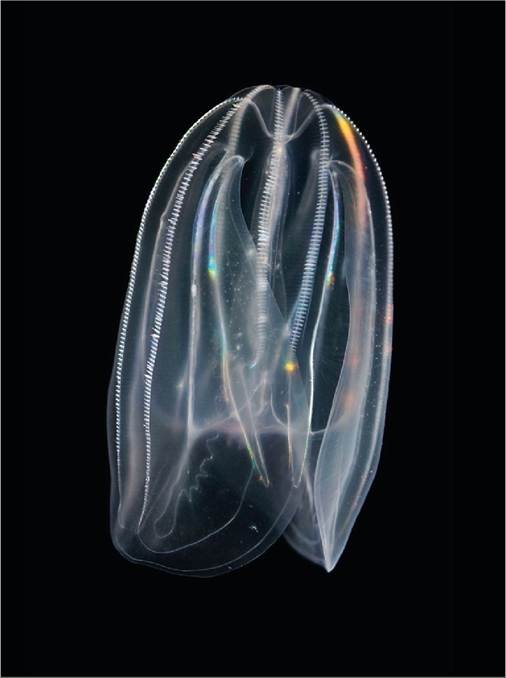
FIGURE 10.1 APotentInvader The comb jelly Mnemiopsisleidyiwas introduced from the east coast of North America to the Black Sea, wreaking havoc in its new ecosystem upon its arrival. © Super Nova Images/Alamy Stock Photo View larger image
Such was the situation when Mnemiopsis arrived. This marine invertebrate species is a voracious predator of zooplankton, fish eggs, and young fish. Furthermore, Mnemiopsis continues to feed even when it is completely full, which causes it to regurgitate large quantities of prey stuck in balls of mucus. Small prey encased in mucus survive poorly. As a result, the negative effect of Mnemiopsis on its prey outstrips even its considerable ability to digest food.
Following its arrival in the Black Sea in the early 1980s, Mnemiopsis gradually increased in numbers.
Then, in 1989, Mnemiopsis populations exploded (FIGURE 10.2A), reaching astonishing biomass levels (1,500 kg/m2)throughout the sea. The total biomass of Mnemiopsis in the Black Sea was estimated at 800 million tons (live weight) in 1989—far greater than the world's entire annual commercial fish catch, which has never exceeded 95 million tons.
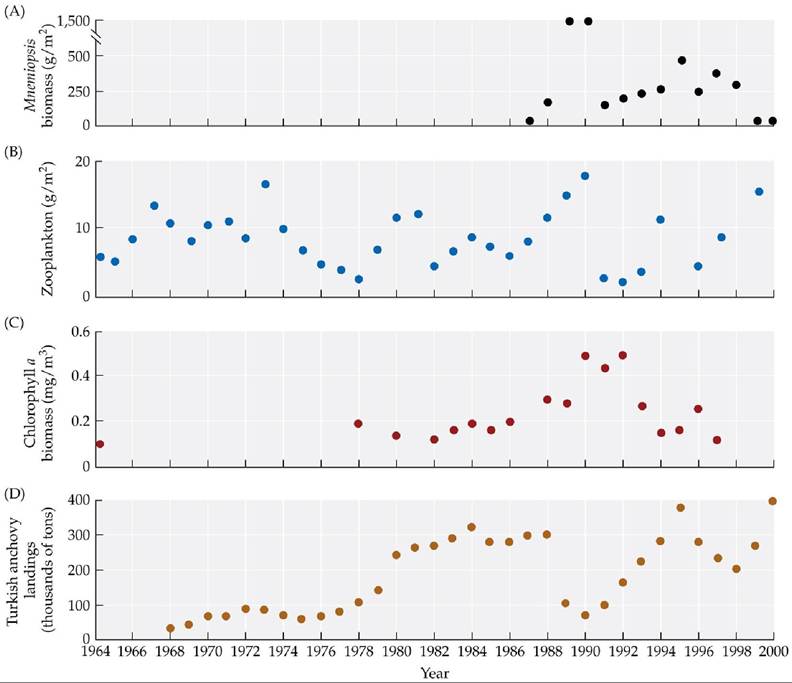
FIGURE 10.2 Changes in the Black Sea Ecosystem The graphs track long-term changes in four components of the Black Sea ecosystem: (A) mean biomass of the invasive species Mnemiopsis leidyi (first measured in 1987), (B) mean biomass of zooplankton, (C) mean biomass of chlorophyll a (an indicator of phytoplankton abundance), and (D) Turkish anchovy landings. (After A. E. Kideys. 2002. Science 297: 1482-1484.) View larger image
The enormous numbers of Mnemiopsis present in 1989, and again in 1990, compounded the effects of the Black Sea's ongoing problems. Mnemiopsis ate huge quantities of zooplankton, causing their populations to crash (FIGURE 10.2B). Zooplankton eat phytoplankton, so Mnemiopsis indirectly caused phytoplankton populations to increase even more than they already had because of nutrient enrichment (FIGURE 10.2C). Upon their deaths, the phytoplankton and Mnemiopsis provided food for bacterial decomposers. Bacteria use oxygen as they decompose dead organisms, so as bacterial activity increased, oxygen concentrations in the water decreased, harming some fish populations. In addition, by devouring the food supplies (zooplankton), eggs, and young of important commercial fishes such as anchovies, Mnemiopsis led to a rapid decline in fish catches (FIGURE 10.2D), causing extensive losses in the Turkish fishing industry.
The combined negative effects of nutrient enrichment and invasion by Mnemiopsis posed a serious threat to the Black Sea ecosystem. Although it covers a large surface area (over 423,000 km2), the Black Sea is nearly landlocked and exchanges little of its water each year with other ocean waters. In addition, the Black Sea is unusual in that only the top 150 to 200 m of its waters (~10% of its average depth) contain oxygen, which effectively makes the entire sea “shallow” for species that require oxygen. Its limited water exchange and anoxic deep waters make the Black Sea particularly vulnerable to the negative effects of nutrient enrichment.
Native Black Sea predators and parasites had failed to regulate Mnemiopsis populations. Thus, in the early 1990s, the future of the Black Sea ecosystem looked bleak. Fortunately, by the late 1990s, there were signs of improvement: Mnemiopsis and phytoplankton populations had fallen, paving the way for the recovery of the Black Sea. How did this happen?