Introduction
In the last chapter, we focused on how and why the distribution and abundance of populations and species vary across landscapes. But population abundance can also change over time, displaying different patterns of population growth.
This is true whether abundance is measured on a small spatial scale, such as the number of plants found in a restricted area along a riverbank, or on a much larger spatial scale, such as the number of cod found in the North Atlantic Ocean. Some populations differ little in abundance over time and space; others differ considerably.For example, Richard Root and Naomi Cappuccino (1992) studied abundances of 23 species of herbivorous insects that fed on tall goldenrod (Solidago altissima). They studied these insects for at least 12 consecutive years at each of 22 sites in the Finger Lakes region of New York (FIGURE 10.3). These sites were no more than 75 km (47 miles) apart; hence, in any given year, all the sites experienced roughly the same climate conditions. Nevertheless, insect abundances varied from one site to another and from one year to the next. For example, maximum abundances of the beetle Trirhabda virgata varied considerably in abundance (ranging from 0.03 to 10.1 insects per stem), both from one site to another and over time (see Figure 10.3).
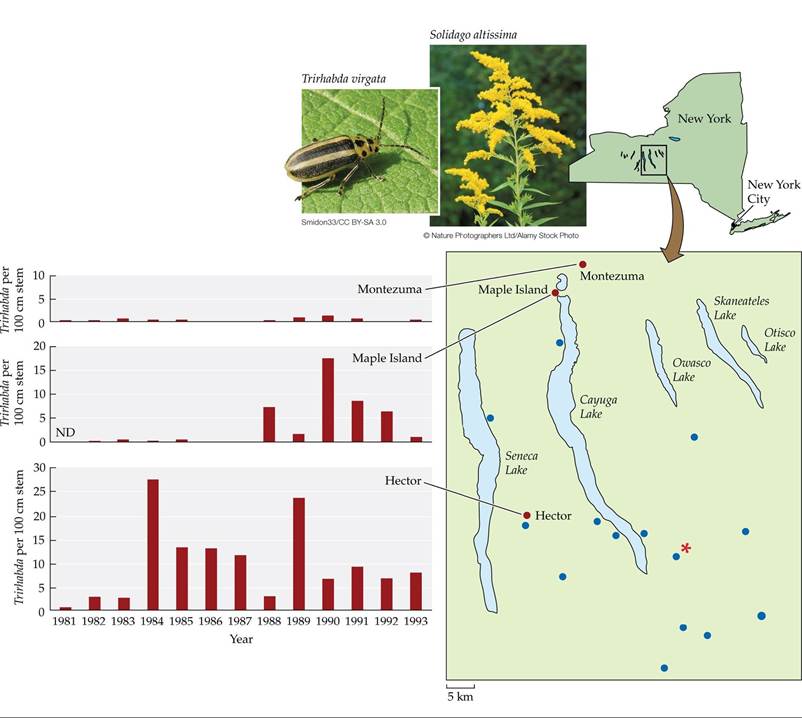
FIGURE 10.3 Populations Are Dynamic Changes in abundances of the beetle Trirhabda virgata on tall goldenrod plants over time at Montezuma, Maple Island, and Hector, 3 of the 22 sites used in the study. Five of these sites were located close to one another and are indicated on the map by an asterisk; all other sites are indicated by dots.
In what year or years did Trirhabda abundance vary greatly over space? Explain.
(After R. B. Root and N. Cappuccino. 1992. Ecol Monogr 62: 393-420; additional data from R. B. Root, personal communication.) View larger image
Ecologists typically use the term population dynamics to refer to the ways in which population sizes change over time. In this chapter, we'll consider the dynamics of populations in more detail, placing special emphasis on the patterns of population growth and the risk of extinction for small populations. In Chapter 11, we'll narrow our discussion of population dynamics by using quantitative models to understand and measure population growth patterns. But first, we'll begin our discussion of population dynamics by surveying patterns of population growth in nature.