11 Now the world is the world’s world
I
The term ‘insularity’ conveys a sense of isolation and looking inwards. Sometimes historians seize upon any word ending with -ity out of an unbridled love for abstract terms that are supposed to bring sophistication and ‘theory’ to their writings.
But much of what has been said so far in this book demonstrates how lacking in that sort of insularity island societies were. Even when contact with the mainland was restricted by order of a court or government, ways were found to elude these rules, and such official contact as there was could be both intense and productive. Japan provides the perfect example of this apparent but unreal insularity during the early Middle Ages. The nature of its ties across the sea changed significantly in the twelfth century, and is richly documented. A new era of more open trade began, and the continuous presence of foreign merchants, nearly all Chinese, became a fact of life, especially around Hakata. Maritime trade within the Japanese archipelago also flourished; the seat of government at Kamakura (from 1185 onwards) possessed a viable port and consumed so much sake that a decision was made to ban its sale. 32,274 jars of the drink were confiscated, while around the Inland Sea port towns mushroomed, serving the megalopolis of Kyoto. The Japanese became much more expert shipbuilders too, although this was a slow development and even in the early thirteenth century the shogun only trusted a Chinese shipbuilder to construct a vessel capable of reaching China.1 The government, or bakufu, became worried by the rapid growth of trade from Hakata through the Inland Sea to Kamakura, partly because there were government ships to which the bakufu wanted to give priority; Chinese interlopers seemed to be winning the competition to dominate this sea passage.2 Overall, contrary to the view of Japan as a society that was not greatly involved in or influenced by its maritime links to Asia, what emerges is a picture of a society that revelled in its outside contacts, which were now mainly with China.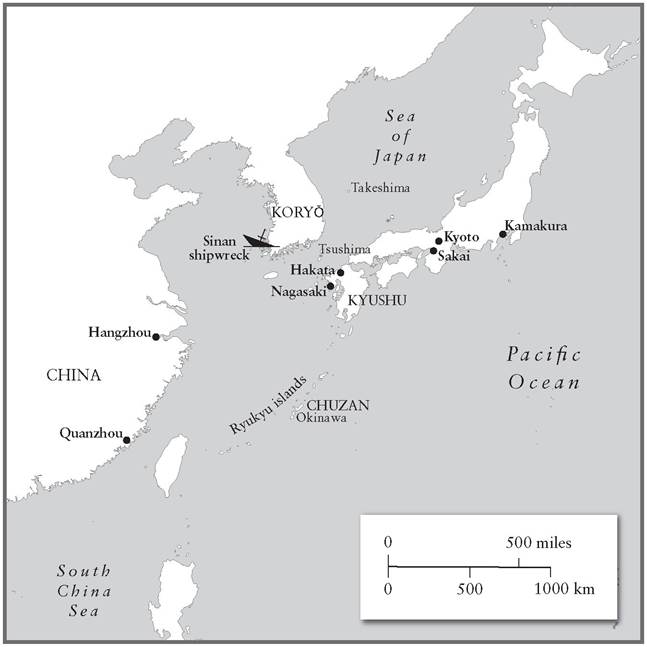
These contacts did not affect the lives of the very poor - the peasants who planted rice for demanding masters, whether warlike nobles or wealthy monasteries, or the fisherfolk or ‘People of the Sea’ whose livelihood depended upon the sea, but who did not take part in the trade networks that reached towards the great cities of China under the Song, Yuan and Ming dynasties. The People of the Sea owed the imperial court tribute in seafood and salt, for consumption of fish was much more common among richer members of society, while Buddhist disapproval of killing animals for meat made fish even more desirable. The People of the Sea operated boats up and down the coast under the protection of emperors, nobles and abbots to whom they owed allegiance. Under the patronage of nobles and abbots, guilds, or za, became a feature of town life.3 All this was part of a process of commercialization that transformed medieval Japan between about 1200 and 1400. Gradually, markets and fairs took on a more cosmopolitan character; one could buy textiles, paper and metal goods, even luxury items and weapons made in the big cities of Japan and, occasionally, in China.4
Mostly one bartered for goods in the market, but copper coinage was used more and more often by more and more people, including peasants; a delightfully painted scene on a temple scroll from this period portrays people buying and selling in the market and holding strings of cash.5 This reliance on cash can be traced back to the middle of the twelfth century, if not earlier. The coins were themselves Chinese, for - despite a short-lived plan to mint coins in the emperor’s name in the early fourteenth century - the Japanese rarely produced their own coins. The Japanese government had its doubts, because the massive influx of cash stimulated inflation; attempts to ban the import of copper coins from China, at the start of the Kamakura period, had no effect, and by 1226 the government was encouraging the use of coin rather than pieces of cloth in everyday trade.
Vases containing tens of thousands of Chinese coins have been turned up by Japanese archaeologists.6 As economic links were forged across ever larger expanses of Japan, bills were settled and loans made in Chinese cash. As in contemporary Europe, observers did not quite know whether to admire those who accumulated wealth through moneylending or to condemn them as exploitative usurers (though, interestingly, Buddhist monks and Shinto priests tended to favour moneylending, unlike the Catholic Church in medieval Europe).7The Chinese deplored the constant outflow of bullion to feed the growing economy of Japan; Japanese traders were accused of hoovering up all the coins in the coastal towns they visited within twenty-four hours of their arrival. When China tried to limit the number of Japanese ships that could trade in its ports to five each year, the decree was rendered useless by the willingness of customs officers to accept bribes, so the number of ships was closer to fifty. It was easy to hide coins in the hold or simply to wait for the customs officers to disappear before taking the cash on board.8 This passion for Chinese coins was stimulated by a simple, obvious feature of cash: copper coins did not deteriorate, whereas payment in silk, common earlier, involved the use of material that could be soiled, torn or burned; and an alternative to silk was rice, which was far more bulky and no less likely to deteriorate. The use of coin reduced transaction costs for itinerant merchants, as it was no longer necessary to shift bulk goods around in order to make payment.9 Besides, there was a sense of connecting to Chinese culture when using Chinese coins, and this was felt as much in Korea or Vietnam as it was in Japan; these coins may have been plentiful, but they possessed prestige.
The Japanese court came to prefer private trade to formal exchanges of tribute for gifts, but that did not mean they were keen to see foreign merchants turning up all over their empire.
In the tenth century, suspicion of these outsiders led the government to control the number of times a merchant could visit Japan - Chinese visitors were limited to one trip every three years and trips overseas by Japanese traders were strongly discouraged. The obvious way round this for Chinese merchants who were stopped by the Japanese authorities was to claim that the fierce currents of the open sea had carried them willy-nilly to Kyushu. And, once they had arrived, local officials declared they could not go back until the winds turned, a polite way of allowing them to stay without breaking out-of-date rules. Or Chinese merchants might simply claim on tenuous grounds that they were acting on behalf of a high official.10 Hakata Bay remained the point of contact with China, and the government made up for the disappearance of handsome gifts from the Tang court by insisting on the compulsory purchase of the luxury goods it required, setting its own price.11Chinese books were in special demand at court, including Buddhist religious texts such as the Lotus Sutra and collections of Tang poetry; in the early eleventh century the regent Fujiwara no Michinaga was given the Tang anthology three times, and in 1010 he gave a printed copy, with commentary, to the emperor. The first printed book to arrive in Japan was brought by a monk named Chonen in 986, and consisted of a collection of the main Buddhist texts that had recently been produced in Chengdu after twelve years spent laboriously preparing the woodblocks. Thereafter the Japanese fell in love with printing.
Buddhist rituals also demanded specific perfumes for different occasions, so any chance to obtain these across the sea needed to be seized, while fine perfumes appear again and again in The Tale of Genji.12 Admiration for Chinese culture remained the key to Japanese trade with China. In the later Middle Ages a more self-confident Japan became less embarrassed at presenting itself as culturally the equal of its old teacher, while Japan remained hungry for Chinese goods, so that trade burgeoned, achieving much greater volumes than in the years around 900.
Yet the appetite for Chinese books, though strong, weakened somewhat as the Japanese began to produce their own court literature, in their own script and language.One of the most lasting influences across the sea was the popularization of tea, which was originally a very special drink; the Zen Buddhists spread knowledge of tea-drinking in the twelfth century, as an aid to contemplation. Tea parties enhanced by a tasting of fine dishes made of rice, noodles, tofu and exotic fruit, as well as poetry readings, became fashionable in high society from 1185, during the Kamakura period. Japan began to produce its own excellent tea (the imperial court demanded tribute in tea as early as 815); but it was common to sample both Chinese and Japanese teas at these events, and high-quality Jian bowls were imported all the way from southern China for just this purpose. Rather later, in the eighteenth century, the tea lodge and tea ceremony came into fashion, and the rituals were codified. At first, tea was drunk after steeping the leaves, or part of a brick of powdered tea, in water; tradition attributes the arrival of whisked matcha, powdered green tea drunk thick and strong, to the traveller Eisai, who had tasted something similar in China at the end of the twelfth century. Both documents and material finds (Chinese tea bowls) show that this type of tea was known earlier.13 Still, the crucial point is that the sea route from China continued to bring ideas and practices to Japan. Tea, with its close links to Buddhism, had a special impact, but there were other favourite luxuries that came across the waves. Imported parrots had already fascinated the Heian court in the eleventh century, especially since they seemed to be perfectly capable of learning Japanese. Even while the imperial court in Tang China officially disapproved of private trade across the sea, the desire for gold, in which (as Marco Polo later pointed out) Japan was rich, richer than much of China, made tolerance of this traffic inescapable; and the same applied to pearls, whether from Honshu or from the island of Tsushima, a product that is still the pride of Japan:14 ‘Their trade ships arrive on our shores by a north-easterly wind, and they bring us all sorts of merchandise: products of high value - gold leaf, gold dust, decorative pearls, pearls for medicinal use, mercury, stag horn...’15 To these could be added lacquered boxes and folding fans.16 All this testifies to the fact that not just Japanese merchants but Japanese mariners were gaining in confidence after the disastrous China voyages of Ennin’s time.
It proved impossible to control foreign traders once they began to arrive in large numbers. At Hakata, a town began to develop where, in the early days of the Korokan, there had been only very limited facilities. Moreover, Hakata contained a large colony of Chinese settlers, some of whom married Japanese women and produced a generation of mixed parentage, who could then claim to be Japanese and exempt from any restrictions on foreigners. Good connections helped; in 1150 just such a merchant exchanged Chinese books for thirty ounces of gold dust from the Minister of the Left, the senior minister at court, and was asked to bring even more Chinese books to his patron. In the twelfth century 1,600 Chinese families are said to have lived in Hakata Bay; meanwhile the Koreans gradually disappeared from the maritime trade routes.17 During the excavation of the metro at Fukoaka, the city on Kyushu which incorporates the medieval port of Hakata, 35,000 fragments of native and Chinese pottery were found, the latter coming mainly from centres of production on the Chinese coasts. Some of this pottery was of very high quality. The fragments included sherds of pale green celadon wares, as well as the white pottery of Yuezhou which was known sometimes under the name hisoku, or ‘forbidden object’, because it was originally reserved to the Chinese imperial family alone, but here it was in Hakata on its way, presumably, to the imperial court at Kyoto (also known as Heian, which had replaced Nara as the seat of government several centuries earlier).18 Everyone tried to cash in on this trade. At the start of the eleventh century, the Fujiwara clan were happy to obtain foreign goods such as furs, medicines and perfumes by way of the estates they held on Kyushu, even though direct contact with foreign merchants had until recently been officially prohibited. Among these luxury imports were pigments such as verdigris, a by-product of oxidized copper used to make green paint.19
This trade between Japan and the mainland underwent a series of distinct phases in the Middle Ages. By the eleventh and twelfth centuries, there is fuller evidence for regular commercial exchanges. At least one well-laden vessel a year reached Hakata full of luxury goods for the Japanese elite.20 This does not sound like very much, and the presence of Chinese settlers at Hakata, not to mention the mountains of pottery, suggests that there was much more movement back and forth to China. Some of the settlers were keen to introduce their own artisan skills to Japan, whether in pottery, metalwork or woodwork, and (as the objects in the Shoso-in depository at Nara reveal) the court collected both objects from distant parts of Asia and local copies of them. Hakata stood at some remove from the centres of power at Nara and Kyoto. Hakata stood even further from the new power base that was created after 1185 at Kamakura, beyond modern Tokyo, following a brief but violent civil war between the Minamoto and Taira clans.21 The bakufu based at Kamakura was less well able to control the day-to-day affairs of Kyushu island; provincial nobles gained greater power in areas far from the centre, and towns and trade and fairs expanded under their patronage.22
The wreck of a Chinese junk found off the Korean coast, the Sinan wreck, provides eloquent testimony to this commercial expansion. Over the centuries, half the hull had been destroyed by the waves; but the area below decks had become buried in mud, and beneath the hatch, within a hull divided into seven partitions, there survived a treasure trove of Chinese goods, some of which were still neatly packed in the wooden containers in which they had been loaded on board. Twenty-eight metres long and about a quarter of that at maximum width, the ship could carry up to 200 tons of cargo. Eighteen thousand pieces of pottery, predominantly Chinese (including about 2,900 celadon wares), were found on board, along with thin-walled, high-quality porcelain bowls made in China and vases with pedestals that had originated in south-east Asia. The light-green celadons, from the period of Mongol rule in China (the Yuan dynasty) include delightful jars with dragon-shaped handles and with floral relief, as well as the classic plain bowls whose trademark is their sheer simplicity. On the other hand, the lack of the famous blue-and-white porcelain among the finds suggests that these wares were still jealously confined to China itself, on the eve of the great expansion in their production that would make them the favourite product of China, exported all over the known world.23 Another impressive part of the cargo consisted of eighteen tons of Chinese copper coins, generally strung together and carrying a wooden tag with their owner’s name, making a total of more than 8,000,000 coins; this gives some idea of the sheer scale of the drainage of bullion out of China.24 One chest had been packed full of pepper. Very few Korean goods were found in the cargo, so it is unlikely that the ship stopped for any length of time at a Korean port, even though it coasted past Korea itself. The ship was apparently wrecked while it was sailing from Ningbo on the Chinese coast to Japan, on the account of the Tofuku-j i Zen Buddhist monastery of Kyoto, whose name appears on several of the wooden tags, as does a date corresponding to 1323, which is the probable date of the disaster at sea. This was one of the great monasteries of Kyoto, but it had burned down a few years earlier and was seeking to finance its rebuilding programme by investing in a grand trading expedition.25 Korean experts think that the ship was actually bound for Okinawa and south-east Asia after it called in at a Japanese port, presumably Hakata.26
The private trade was increasingly compromised by the activities of the pirates from Tsushima and western Kyushu known as wako ; this became a particularly severe problem from the fourteenth century onwards, and provides further evidence that trade was flourishing, since there was clearly good business to be done by interlopers.27 Once they had seized other people’s cargoes, these pirates would turn into merchants and sell the goods for profit. Surprisingly, since it is such a narrow space that one would have expected it to be easy to supervise, the Inland Sea through which shipping had to pass to reach the outports of Kyoto from Hakata was a particularly pirate-infested area. It had long been a lively zone of exchange where large quantities of goods such as rice were transported from the islands of Shikoku and Kyushu to the province of Kinai, where Nara and Kyoto lay; it has been seen that the Japanese had excellent experience of short-range navigation, but for a long time were hopeless navigators out in the open ocean. However, by the late Middle Ages there is plentiful evidence of lively trade out of one of those outports, Hyogo, in a customs register of 1445, which reveals that nearly 2,000 vessels passed through one tollgate in a year, heading in the direction of Kyoto.28 One historian speaks of the twelfth to the fourteenth centuries as a time of active free trade, culminating in the fifteenth century in a balance of trade that was favourable to the Japanese.
The end of the Middle Ages saw major political transformations in Japan, Korea and China, as earlier dynasties were supplanted - the Mongol Yuan were replaced by the longlasting, native Ming dynasty in 1368, and an even longer-lasting royal house, the Li, took charge in Koryo (Korea). Fourteenth-century Japan was a battleground between rival clans that sought political power, though not the imperial throne, for the emperors had been pushed to one side by the shoguns and had become ciphers. These conflicts within Japan seem actually to have fostered trade; the shoguns encouraged trade since they were keen to raise ever larger sums from taxation, and the land alone could not meet the expense of maintaining the military establishment they required. During this period, the coastal village of Sakai, on Osaka Bay, with its ready access by road to Kyoto, grew into a commercial city trading as far afield as China, and enjoyed the support of the Ashikaga shoguns. Sakai grew and grew and in the early sixteenth century it was home to 30,000 people; it retained a degree of autonomy, while remaining dependent on the favours of the warlords who controlled the area around Kyoto that Sakai was well placed to service.29
Contact with China was not always peaceful, and the first Ming emperor, Hung Wu-ti, delivered a severe telling-off to the Japanese when he sent a messenger to Kyushu in 1369, carrying a letter that complained bitterly of Japanese piracy. The sending of a mission was not a signal that Japan was being treated as an equal: the Ming emperor was determined to reclaim Chinese sovereignty over the entire expanse from Java and Cambodia to Korea and Japan; and Hung was also conscious of his peasant origins and therefore anxious to present himself as an emperor in the great Chinese tradition. And yet, paradoxically, the Chinese emperor banned Chinese merchants from trading overseas, preferring to revert to the old system of tributary embassies - those from Korea were welcome to come several times a year, and those from other kingdoms, such as Okinawa, much less often. The Japanese rulers did not react kindly to the reproofs that kept coming from their Ming counterparts, which even included hints that China would invade Japan:
The Chinese Minister of Rites: You should look into the events of the past thousand years for reference. Examine them carefully!... If you really wish to find out who would win and lose and which of us is right or wrong, and which side is the stronger or weaker, I am afraid it would not be to your advantage. Examine this carefully!
Prince Kanenaga: Heaven and earth are vast; they are not monopolised by one ruler. The universe is great and wide, and various countries are created each to have a share in its rule. Now the world is the world’s world; it does not belong to a single person.30
Defiance, which was very rare, only made relations more difficult, and the Japanese learned that the political price was an occasional admission that even the Japanese emperor was a vassal of the Chinese one. However, this admission could bring great dividends: at the time of the early Ming voyages, around 1400, the Chinese sought to take tribute from a vast swathe of east Asia and the Indian Ocean; but the Japanese were compliant and were rewarded with gifts of silk, silver and lacquer, and were able to maintain their exports of horses and armaments to the mainland. Later, in 1432-3, these included over 3,000 sabres, and nearly 10,000 sabres in 1453. And then there was the massive political dividend, for acceptance of Ming overlordship, which involved no interference in the government of Japan itself, helped secure the claims of the Ashikaga shoguns to rule Japan.31
This was a period in which control of the shipping routes off the Asian coasts shifted away from the Chinese, who had dominated navigation for several centuries, into the hands of other peoples, including the Japanese, though many of these were wako pirates. The ban on foreign travel that applied to Chinese merchants and mariners left others free to ply the seas, and opportunities were seized by all the peoples of the islands that flank China, from Japan to Java. Japan was visited by ships from Siam and Java around 1400. In 1406 a Javan ship bound for Korea was carrying parrots, peacocks, pepper and camphor, and not surprisingly it was seized by Japanese pirates; however, five years later a Javan mission reached Kyushu safely.32 A particularly important role was played by the autonomous kingdom in the Ryukyu islands, with its centre at Okinawa, on the southern edge of this Japanese Mediterranean; this region provided southward links, connecting the Japanese seas to some of the longer-distance trade routes as far as the Malacca Strait (home to Melaka, Palembang and Temasek, the modern Singapore), which had become once again a very significant centre of the spice trade in the fifteenth century. Chinese withdrawal thus had the paradoxical effect of opening up the seas.
II
Although there are occasional accounts of sea battles off Korea, and although the wako pirates became an increasing worry, the maritime history of the waters between Japan, China and Java is mainly a history of relatively peaceful relations. There were many tensions, revealed by the attempts to ban private trade by Japanese merchants, or to prevent the export of coin from China, but mass invasions were a rarity. The great exception is the Mongol attacks on Japan, news of which reached as far as western Europe, thanks to Marco Polo; indeed, his account of what happened furnishes valuable details that have been corroborated, as will be seen, by marine archaeologists, and by remarkable illustrated scrolls dating from between 1294 and 1316 that were copied again and again over the centuries for Japanese scholars.33 The Mongol attacks both were the product of the Mongols’ own insistence that the Great Khan was appointed by Heaven to rule the world (and woe betide those who opposed the divine command), and also betray the influence of earlier Chinese ideas about the superiority of the Middle Kingdom over all other territories. The Chinese ideas were adopted and adapted by Khubilai, the member of the Mongol royal house who seized control of China and established the Yuan dynasty, conquering the Southern Song capital at Hangzhou in 1275.34 Khubilai also coveted Japan’s famed wealth in gold and pearls. He proposed to tap into the wealth of Japan by exacting a large tribute, if at all possible, but if that were to prove impossible, the single-word answer any Mongol khan was bound to give was ‘war’.
Although doubt has been cast on the claim that Khubilai Khan and Marco Polo even met, Polo’s account of Japan must reflect stories that he heard somewhere out in the East:
I will tell you a wonderful thing about the palace of the Lord of that island. You must know that he has a great palace which is entirely roofed with fine gold, just as our churches are roofed with lead, insomuch that it would scarcely be possible to estimate its value. Moreover, all the pavement of the palace, and the floors of its chambers, are entirely of gold, in plates like slabs of stone, a good two fingers thick; and the windows are also of gold, so that altogether the richness of this palace is past all bounds and belief. They have also pearls in abundance, which are of a rose colour, but fine, big, and round, and quite as valuable as the white ones. They also have quantities of other precious stones. Khubilai, the Great Khan who now reigns, having heard much of the immense wealth that was in this island, formed a plan to get possession of it.35
A contemporary Buddhist monk from Japan, Togen Eian, thought that the Mongols were awestruck by the quality of Japanese armour and the excellence of Japanese archers: ‘our armour makes even the gods tremble... Once Japan’s warriors are under their control they will be able to conquer China and India.’ He argued that ‘with the strength of Japan and the Mongols combined, no country could resist. That is why the Mongols now desire to subjugate Japan.’36
Even so, Khubilai might well have left Japan alone and might have concentrated more on Vietnam (another obsession), but for the breakdown of Mongol relations with Koryo, whose king was now master of all Korea. At the start of the thirteenth century, as Mongol power spread over vast tracts to east and west, the Koreans had co-operated with the Mongols, even sending troops to help them subdue troublesome neighbours in northern China in 1219, though they had to agree to send a heavy tribute to the Mongol khan, and the Mongol treatment of the Koreans swung between extremes. The Koreans had their own grievances against the Japanese as a result of the raids by the wako pirates, which carried on until 1265.37 A Korean supporter of the Mongols named Ch’oe-I fed information to Khubilai, who seems to have been impressed by Ch’oe-I ’s account of the sophisticated customs of the Japanese. He suggested that Khubilai Khan might like to send an exploratory embassy to Japan, and when a letter from the khan reached Japan, at the start of 1268 (though it had actually been written in August 1266), the message was unusually friendly from a Mongol perspective, even though the letter threatened war if the Japanese did not agree to cordial relations, with the not so diplomatically phrased question: ‘it will lead to war, and who is there who likes such a state of things? Think of this, O king!’38 There was a second letter from the king of Koryo begging the Japanese to take heed, and pointing out that Khubilai had no intention of interfering with the running of the Japanese Empire. At this stage Khubilai was not inclined to go further than mild threats. He still had to take control of the lands of the Southern Song in China’s deep south, and was building up his power in Korea. He may have felt that he could not ignore Japan, because of its strong trade relations with his Southern Song enemies; the Japanese were probably sending essential supplies to the Song, such as weapons. Song refugees who reached Japan included dozens of very influential Buddhist monks of the Zen school; in a sense, the Japanese kept Song culture alive when China lay under Yuan rule, for the bakufu, the Japanese military elite, wished to project an image of themselves as refined followers of Chinese fashion able to compete with the scholars and poets of the closeted imperial court at Kyoto. On the other hand, Khubilai had no particular quarrel with Japan, which posed no direct military threat.39
The shogun’s government was, however, wise to Mongol wiles; precisely because there was now regular contact across the sea with the Song, the shogun knew perfectly well what the Mongols demanded of their subjects, notably punitive amounts of tribute. The islands themselves seemed safe. The Mongols had never ventured across the sea. Why should one concern oneself with empty threats? So the bakufu in Kamakura chose to send back the envoys with no reply. There was the same reaction at Kyoto from the court of the emperor, in whose name any recognition of Mongol superiority would have been made, even though real power rested with the shogun and bakufu. In 1269 seventy Mongols and Koreans turned up on Tsushima and demanded an answer to the khan’s letters; once again the shogun did not deign to answer and the mission returned home with a couple of captives, who were allowed to visit Khubilai’s palace before being sent home, in the hope that their reports of his power and grandeur would shock the bakufu into a response; even then there was silence in Japan.40 But after rejecting the khan’s approach and hearing rather more about Khubilai’s character and aims the Japanese began to show signs that they were more rattled than they had been willing to admit while the original envoys were in their midst. They even drafted a reply at long last; but it was never sent. They required prayers for peace to be recited, and they issued a ritual curse against the Mongols. In addition, the Japanese laid plans for a raid on the coast of Korea, to knock out whatever facilities were in place for building a fleet to attack Japan. When it became more obvious that the Mongol threat was not an idle one, the Japanese decided that attacking Korea would only make things worse.
In October 1274 the first Mongol assault duly struck Japan. In fact, it was a joint attack by the Mongol khan’s army and navy and by the army and navy of his vassal the king of Koryo. Nine hundred ships took the predictable route past Tsushima island to Hakata Bay, the shortest direct route from the southern tip of Korea.41 There were said to be nearly 30,000 men on board, though this figure should be taken with a pinch of salt. To strike terror into their foes, the Mongols are said to have nailed the naked corpses of Japanese women to the thwarts of their ships.42 Hakata was set on fire, but the Japanese put up a very tough resistance. The samurai Takezaki Suenaga recorded in his illustrated scrolls how he encountered another Japanese warrior who had had a productive day:
I met a warrior on a dapple grey horse at Komatsubara. He wore purple armour with a reverse arrowhead design, and a crimson billowing cape and, having just defeated the invaders at their encampment, was returning with a hundred horsemen. The pirates had fled. Two had been taken. He looked most brave and had two retainers walking before him on his left and right carrying heads - one pierced on a sword, the other on a naginata [rather like a halberd].
‘Who passes here looking so brave?’ I asked, and he replied:
‘I am Kikuchi Jiro Takefusa of Higo province. Who are you?’
‘I am Takezaki Goro Hyoe Suenaga of the same province. Watch me attack!’
Saying so, I charged.43
After a day of fighting against such highly motivated heroes, the Mongol- Korean forces withdrew discomfited.44
Khubilai was even more determined to conquer Japan after the humiliation of the rapid defeat suffered in 1274; but for the moment he concentrated on a much more important target, the conquest of southern China. The year after the Japanese fiasco he could take pride in the occupation of Hangzhou; in 1277 the great port of Quanzhou, which Marco Polo claimed to know well, surrendered, after its leaders realized that any hope of maintaining its prominent position in maritime trade would be left in ruins by a Mongol assault on the city. In 1279 the Mongols proved that they could win a major battle at sea: only nine Song ships escaped destruction or capture, out of a fleet of 900; and the admiral not merely committed suicide by jumping into the waves, but threw the child emperor into the sea as well. The Song dynasty was extinguished.45
The second attack on Japan took place six and a half years after the first; the Mongols conscripted large numbers of former Song soldiers into their army for the new attack on Japan. This time the Great Khan intended not just to impose Mongol overlordship but to settle the land, for the ships carried farm tools as well as weapons. Those awaiting death sentences were released so long as they agreed to serve in the vast army Khubilai Khan was putting together. But the Japanese were once again confident, to what might seem a foolhardy degree, in their ability to survive this assault. They decided to admit the Mongol ambassadors to Kamakura, which must have seemed a good sign; but once the ambassadors arrived, they were beheaded and their heads were put on display, rendering attack inevitable.46 Painfully aware that Hakata had been destroyed during the brief attack in 1274, the government ordered a long stone wall, twelve and a half miles long, to be built around Hakata Bay, bits of which still survive.47 And Hakata Bay became the scene of intense fighting on sea and on land, as the Japanese ships and ground troops harried the much larger invasion force that had come by way of the islands of Tsushima and Iki, while a second wave of attackers gathered at the western tip of Kyushu, off the little offshore island of Takeshima.48
Among acts of bravery those of Kawano Michiari stand out; he had already helped resist the invaders in 1274, and this time he showed how brave he was by standing outside the defensive wall and engaging directly with the invaders. One day he saw a heron pick up an arrow and drop it on one of the Mongol ships. This was surely an augury of Japanese victory; so he and his uncle decided the time had come to strike a blow at the heart of the Mongol fleet. They set out across the bay in a couple of small boats; they had no difficulty penetrating the Mongol fleet, because the Mongols thought they must be bringing an offer to submit; so they came alongside one of the flagships whose astonished crew surrendered after Kawano had killed a fearsome giant of a soldier.49 Kawano took one of the Mongol generals prisoner, even though he was wounded in the shoulder, and even though his uncle was killed. Kawano then had time to write a poem commemorating his achievement while he was heading back to dry land.50 These exploits made him a Japanese hero. Under the military rule of the bakufu, esteem for the martial prowess of the samurai had risen to new heights; one or two defenders of Japan against the Mongols were even worshipped as gods by later generations.
All these efforts were not enough to hold back the waves of invaders. Korean ships arrived in Tsushima; the islanders tried to escape to the hills, but the cries of their children gave away their hiding places, and the Koreans ruthlessly massacred the islanders. The invaders then bombarded the inhabitants of Iki, the next island between Korea and Japan, with exploding ceramic spheres launched from catapults. On the other hand, the cramped conditions on board the Mongol navy helped disease to spread, with the loss of 3,000 men, as Chinese sources admitted. The Mongol commanders found it impossible to co-ordinate the actions of the different detachments arriving from Korea and from much further south, and they realized that Hakata Bay was well defended and not suitable for a mass landing. The naval detachments that had arrived near Hakata Bay lashed their ships together to create a continuous line of boats, a sort of counterwall, facing off the Japanese but without very clear objectives about what to do next.51 Small Japanese boats pestered the Mongol fleet like wasps, crowding the waters. Takezaki Suenaga described the chaos in Hakata Bay:
‘I am acting on secret orders. Let me on the boat!’
I brought my boat by Takamasa’s.
‘The shugo [provincial governor] did not order you here. Get your boat out of here!’
Having no recourse I replied: ‘As you know, I have not been called up by the shugo. I am the deputy shugo but arrived late. Heed my command.’
‘Lord Tsumori is on the boat. There is no more room.’52
In the end, Takezaki was allowed to board, and fought with vigour, even though he was wounded.
Nonetheless, all was going quite well for the Mongols, who managed to hold a patch of land for a while, though they were beaten back to the offshore islands. That was not the same as seeing them off; the threat remained real. And then, in answer to the defenders’ prayers, ‘a green dragon raised its head from the waves’, the sky darkened and suddenly a great typhoon struck. Many ships, still fully loaded with soldiers, were tossed around the sea or on to dry land, and others collided with one another. It has been suggested that it was no more than an easterly wind that blew the Mongol ships back to the Asian mainland just when they were inclined to withdraw anyway. Some Japanese writers, notably the warrior Takezaki Suenaga, who was there, do not mention this ‘divine wind’.53 Yet the hard physical evidence that will be confronted in a moment tells a different, and more traditional, story. Japanese, Chinese and Korean descriptions of what happened largely concur, so the fact that this ‘divine wind’, or kami-kaze, became such a powerful Japanese legend should not obscure its historical foundation. It is said 100,000 men drowned and 4,000 ships sank, for which read perhaps 10,000 men and 400 ships.54
One of the most fascinating accounts of the Mongol invasion was provided by the Venetian Marco Polo. He was only aware of one attack on Japan, the second one - he knew the name of one of the commanders of the second invasion force, Abacan; Chinese whispers apparently transformed the name of the other, Fan Wenhu, into Vonsainchin.55 According to Marco Polo, these two ‘barons’ in charge of the expedition deeply disliked one another. They were ‘able and valiant men’, and they set out as ordered from the ports of Zaytun (Quanzhou) and Quinsay (Hangzhou), important centres of trade towards south-east Asia. They landed in Japan, and Polo tells a vivid atrocity story in which eight Japanese men were sent for execution, but it proved impossible to cut off their heads or to inflict any wound whatsoever, as they possessed a magic stone inserted under their skin; and as a result the cruel Mongols beat them to death instead. Before long, however, a very great wind came and the Mongols were forced to leave; many ships sank, but 30,000 men under the command of one of the barons took refuge on an uninhabited desert island, hoping that the remaining fleet, which was under the command of the other baron, would come and rescue them. They could see the fleet moving ahead under full sail, but ‘the baron who escaped never showed the slightest desire to return to his colleague who was left on the island’. Thereupon the Japanese sent their own fleet to this island; the shipwrecked army fled into the hills and, while the Japanese sought them out, the Mongols crept
227 down to the Japanese ships and commandeered them; they then sailed with Japanese banners flying to what he calls ‘the Great Island’, where they were greeted as returning Japanese heroes. So they landed and marched on the Japanese capital, which they seized. The Japanese counterattacked and besieged the capital, and after seven months the Mongols agreed to surrender, ‘on condition that their lives should be spared’. Meanwhile, the fate of the two barons was much grimmer: they did manage to reach home, but they were sent off to be executed, because one had fled and the other ‘had never behaved as a good soldier ought to do’.56
It is obvious that Marco Polo’s stories of Japan are a mixture of truth and fiction, as are his stories of other parts of east Asia. At some points in his account of the Mongol attack he seems to inhabit the world of fairy tales, with magic stones and a non-existent occupation of Kyoto or another city. Polo’s account of the rivalry between the commanders is certainly credible; and the Japanese chronicle mentions their disappearance, presumed lost at sea. In the Japanese version a commander fell ill and the other did not quite know what to do; the impression is of chaotic lack of leadership rather than a falling-out between rivals. Polo should not be ignored, then, but the best evidence for what happened comes from the physical remains of the Mongol fleet and army. One clue was a bronze Mongol seal dating from 1277, the property of an army commander, that was found on the island of Takashima, visited by the second wave of Mongols en route to Japan. This seemed to confirm that the anchors, catapult balls, pottery and other equipment discovered offshore by a team of divers were the residue of the shattered Mongol fleet. When pieces of wood were raised from the deep, it proved possible to date them to the twelfth or thirteenth centuries, and the presence of white porcelain from southern China also seemed to confirm that this was the fleet the Great Khan had sent from there against Japan. These were very large ships, as much as 200 feet long, and they were largely constructed out of camphor wood. As proof that the archaeologists had not simply found the shipwreck of a merchant vessel carrying fine ceramics, there were the swords, arrows, crossbow bolts and bombs made of baked earth and packed with shrapnel - and even part of the skeleton of a warrior surrounded by his helmet and the remains of his leather armour. There were the anchors of ships that had broken their cables, which pointed towards the shore, suggesting that the ships had been hurled by the wind towards the coast, where those that had survived so far had been smashed into pieces. The decision to lash the ships together and to create a floating wall had proved utterly disastrous. As one ship was picked up by the surging seas, it carried along its neighbours.57 But the most telling evidence of all came from analysis of the wooden fragments of the ships themselves. Rust marks showed that the planks had been nailed together in a rather haphazard way. Either the ships had been poorly repaired after previous outings, or they had been incompetently constructed from the start. Preparing a vast fleet against a deadline had an inevitable consequence: ships were approved for service when they had not been properly checked (even though one piece of wood found underwater was an inspection certificate issued after something, very probably a ship, had been repaired). Many pots taken on board were poorly made, as if they had been rushed through the kilns, and there are doubts about the efficiency of a large stone anchor made in two pieces, again in apparent haste.58 The conclusion is that the Mongol fleet may well have been overwhelmed by a storm, but that the ships had much less chance of surviving a typhoon because they had been so poorly constructed, and they fell apart under stress. The discovery of part of the remains of the Great Khan’s fleet is one of the major achievements of marine archaeology, and fits well with the narrative accounts.
When the second attack failed, Khubilai Khan turned his main attention to Vietnam and Java, with no more success. Marco Polo knew that Khubilai’s efforts to conquer Java had failed. Here again Khubilai’s interest was surely prompted by the wealth of the island and its close trading links to China, which Polo particularly stressed. In the case of Vietnam, his excuse for conquest was that the kingdom of Dai Viet had offered refuge to leading members of the Song government, while another Indo-Chinese kingdom, Champa, was an important centre of trade and piracy. The defenders of Dai Viet also witnessed the destruction of a Mongol fleet, during the battle of Bach Dang, which was fought in a river mouth against tens, maybe hundreds, of thousands of invaders in 1287; but this time the destruction of the fleet was accomplished by human efforts, after the Vietnamese attacked the fleet with blazing arrows and then sent burning bamboo rafts towards the ships.59
The Yuan dynasty not surprisingly played down the embarrassment of its defeats at sea, in Japan, Vietnam and Java. Relations between China and Japan recovered remarkably quickly after 1281. Trading ships moved back and forth between the two countries as if nothing much had happened; the Yuan government licensed regular visits to China by Japanese ships. However, their victories against the odds became the subject of great pride for the Japanese, who were convinced that their prayers to the gods had been answered; at the imperial court in Kyoto, it was argued that the prayers of the Shinto priests at the great shrine of Ise had persuaded the gods to send the great black cloud that emerged out of a clear sky; out of it sped the arrow of the gods that roared like a typhoon, while the sea rose up in a great mountain of a tsunami and crushed the invasion fleet into splinters.60 The victory not merely brought prestige to the imperial court and the Shinto establishment, but confirmed the wisdom of the warrior bakufu in Kamakura, with their links to the Zen Buddhists. Both sides in the complex system of rule therefore benefited. More than that, continuing mobilization, made necessary by the threat of a third invasion, justified the extension of Kamakuran authority over larger areas of Japan, including tracts of the islands of Shikoku and Kyushu. It has been argued that ‘the bakufu became a truly national power only after this war’.61 And the ‘divine wind’ would be invoked nearly seven centuries later by the kami-kaze pilots of the Japanese imperial air force.
iii
The chain of the Ryukyu islands, of which the best-known is Okinawa, is a perfect example of a small and apparently insignificant archipelago that profited from its middle position to acquire wealth and influence. Its rulers insisted that they lived on poor and barren islands, which was precisely the reason that their subjects learned to make money by acting as intermediaries with the rest of the west Pacific rim. In 1433 the king of Chuzan in the Ryukyu islands wrote to the king of Siam: ‘this country is deficient in articles of tribute’, and proceeded to send a ship to Siam loaded not with local goods but with Chinese porcelain.62 There were a few local products that were admired overseas: horses, mother-of-pearl and red dye, but the products of Chinese and Japanese craftsmanship took priority when loading a cargo.63 What was distinctive about the people of the Ryukyu islands was that the inhabitants took the initiative themselves, seizing the opportunity created by the withdrawal from the sea of their mighty neighbour Ming China. The Ryukyu islands were colonized from many directions in the very remote past, but links to Japan have always been especially strong; one can sail in good weather from the island chain towards Kyushu without losing sight of land, and over the centuries settlers arrived in the islands from southern Japan. Early in the seventh century ad the Chinese emperor, perhaps seduced by the idea that these islands were the Land of Happy Immortals, sent an expedition in this direction and carried off many prisoners, and Chinese coins from this period prove that there was indeed contact with the mainland at this stage.64 Even so, it was only at the end of the seventh century that Japanese officials began to take serious notice of their southern neighbours. No doubt a particular reason for doing so was that the Japanese
230 THE MIDDLE OCEAN: THE INDIAN OCEAN AND ITS NEIGHBOURS emperor was keen to show that he, like the emperor of China, received tribute from subordinate peoples.65
Bitter strife between the great noble clans of Taira and Minamoto in Japan in the middle of the twelfth century spilled over into the Ryukyu island chain. A keen opponent of the Taira named Tamemoto no Minamoto was a skilled archer; he had been brought up on Kyushu and he joined a Minamoto assault on Kyoto, only to be captured. He was lucky to escape execution, but his punishment was still cruel: the sinews of his bow-arm were severed, and he was sent to the Izu islands off the tip of Kyushu, where he spent fourteen years of dull exile. From there, in one tradition, he is said to have been blown across to Onigashima, ‘Devil’s Island’, which may be Okinawa, after his boat was caught in a storm. He had only intended to travel the small distance between two Izu islands, but now he seized the opportunity to make friends with the king, and ended up marrying his daughter. A child, Shunten, was born who would later rule the Ryukyus; but Tamemoto was always keen to return to the fray, and so, leaving behind his wife and child, he sailed back to Japan, where the Deputy Governor of Izu smashed his little army to pieces. Rather than submitting, Tamemoto committed seppuku, better known as hara-kiri, a ceremony that was coming into fashion about now. That, at least, is the story, but it probably elaborates a less dramatic history of wandering warriors who offered their services to the chieftains of Okinawa, of whom the partly Japanese Shunten was one.
Japanese influence grew on the islands, marked by the arrival of a writing system based on the syllabic signs of Japanese script. However, the Ryukyuans did not adopt the additional and complex Chinese characters that had become locked into Japanese script, and relied on the plain syllables only - something most people staring at Japanese writing would consider a very wise decision.66 The Japanese port of Sakai entertained very close trading ties with Ryukyu in the fifteenth century, and contact was stimulated by tea-drinking - this generated a passion for tea bowls and other tea equipment that passed into the islands, while Zen vegetarianism seems to have brought new fashions in food and new types of shredding bowl suitable for ascetic Zen menus. In return, the Japanese could acquire Chinese paintings, pottery and metalware, which also passed through the islands.67 Once again one has to rely on late traditions, but Buddhism is said to have spread within these islands only after a monk named Zenkan was shipwrecked there around 1270.68 Uniting the islands, which stretch over hundreds of miles, was beyond the capacity of the chieftains of Okinawa, much the largest island, which stands two thirds of the way down the chain and lies closer to Taiwan than to Kyushu.
Further fragmentation of power in fourteenth-century Japan had serious consequences in the Ryukyus. The Ashikaga shoguns recognized a noble family from Kyushu as ‘Lords of the Twelve Southern Islands’, though they had already been holding that office for a while. This did nothing to solve internal problems in Okinawa (the ‘kingdom of Chuzan’), for Chuzan, like Japan itself, was divided among competing warlords. One of these, Satto, had seized power after the death of the king in 1349, and was dazzled by a Chinese embassy that arrived in 1372 with the intention of asserting the imperial authority of the Ming dynasty, which had launched a coup against the Mongols four years earlier. Satto was evidently impressed with the gifts he received, along with those that arrived following a trip to the Ming court by his brother, who returned with a seal of investiture, as if the Chinese had conferred the crown that Satto had usurped nearly twenty years before the Ming revolution had even succeeded. The Okinawan ambassadors won praise for their punctilious observance of the exacting rituals that tributary embassies had to undergo, including the nine ritual prostrations known as koutou (kowtow); they were the first people to accept Ming claims, before the Vietnamese, Siamese and others, and they continued to pay tribute for many centuries without complaint.69 Not for nothing did the king of Choson in Korea write to the king of Chuzan in Ryukyu: ‘we reaffirm that every nation washed by the oceans is under the influence of China.’70
The pay-off was the lively trade conducted through official channels, as well as a certain amount of surreptitious trade: in 1381 the interpreter attached to the Ryukyu mission was discovered attempting to smuggle a sizeable cargo of spices out of China. Other prized products were porcelain and silk.71 Yet the Okinawans did not simply look towards China; they could offer little from their own resources, so the answer was to create a much wider network that tapped into the supplies available in Korea and Japan to the north, and the South China Sea to the south. The creation of this network was deliberate; these words were inscribed on a bell which in 1458 was deposited in a temple on the islands:
The kingdom of Ryukyu is a place of pure beauty set in the southern seas. Gathered together there, the treasures from three countries, Korea, the Ming Empire and Japan, are to be found. It is a fabled island, which arose from the seas between China and Japan. Its ships are a bridge between 10,000 nations.72
To cast this bell, metal had to be imported and the techniques of bronzecasting to be learned. On the other hand, at the start of the sixteenth century, when he was about to send off an expedition to Melaka, the king of Chuzan reflected on the fundamental problem the Ryukyu islands faced:
This country’s products are meagre and inadequate as articles of tribute, causing great inconvenience. For that reason, we are now despatching Chief Envoy Kamadu, Interpreter Kao Hsien, and others aboard a seagoing ship... with a cargo of porcelain and other goods, to proceed to the productive land of Melaka in order to purchase such products as sapanwood and pepper through mutually satisfactory arrangements, and then to return to this country to make preparations for the presentation of tribute to the Ming Celestial Court in a subsequent year.73
The capital of Okinawa, Naha, became a flourishing and cosmopolitan centre of trade, comparable to Hakata and Melaka, with a significant immigrant population from Japan, though many Chinese preferred to live in their own town, Kunemura, a little way off, and included mariners and scribes, who were always chosen to compose diplomatic correspondence with China and south-east Asia. Coins, copied from Ming examples, were produced as Chinese metal flowed into the island, so that the economy was increasingly monetized, rather as was the case in medieval Japan.74 Excavations on ten sites in the islands have revealed a great variety of ceramics that arrived from all directions: among the finest pieces there are pale green celadons, blue-and-white pottery and whiteware, all from China, as well as Imari blue-and-white from Japan, Korean celadon, and both Thai and Vietnamese pottery.75 At the northern end of the island chain, a base was created for commerce with the Inland Sea in Japan; Ryukyuans brought the spices and other luxuries of south-east Asia to Nagasaki in western Kyushu, obtaining a range of delicacies for home consumption, some of which sound not very appetizing - sea slugs, shark fins, abalone and seaweed - and also weapons and Japanese gold.76
Meanwhile, the king of Chuzan was corresponding with neighbours in Siam, Melaka, Indonesia (including Palembang) and Korea; the oldest known letter in the Ryukyu archives dates from 1425 and reports an embassy to Siam in 1419, though there is other evidence that links went back at least as far as the reign of Satto.77 The Ryukyu archives once contained an extraordinarily rich collection of correspondence, conducted in Chinese, between the kings of Ryukyu and their neighbours; however, the letters were destroyed in the Second World War during the American assault on Okinawa before they had been closely studied. The patient reconstruction of the documents from decaying photostats and scattered transcriptions has brought to light a lively network of political and commercial contacts in which Ryukyu functioned as a centre of princely demand and a hub for redistribution.78 Porcelain, raw silk, Indian cloth and perfumed sapanwood all reached Ryukyu, while gifts sent by the king of Ryukyu to the ruler of Korea in 1470 included peacock feathers, glass vases, ivory, ebony, cloves, nutmeg and one mynah bird.79 Siam was particularly attractive, since it offered spices, perfumes, ivory and tin. The letter of 1425 told how the Ryukyuans were chided by the Siamese for attempting to conduct private trade in sapanwood and porcelain, which the king of Siam regarded as royal monopolies. The affronted king of Chuzan requested that his merchants and mariners should be treated equably: he hoped that ‘you will offer sympathy to the men from afar who have to undergo the hardships of the voyage’, for ‘it is enough of a difficulty to go through the winds and the waves’, before discovering on arrival that they have to follow the strict instruction of Siamese government officials.80 It was a dangerous route, as the Siamese discovered when the Ryukyuans sent an embassy to Siam in 1478, losing their ship, whereupon the next year the king of Siam ordered a new ship to be prepared at his end: ‘when the ship approached Ryukyu, it again encountered a storm and sank into the ocean, its men being lost and its property scattered... Such is the will of Heaven.’81
As junks from the islands became more visible across the sea routes, the Ming court issued letters of protection to ships of Ryukyu. The idea that the royal court should monitor contacts with the outside world had some attraction in Ryukyu as well, and the local rulers began to issue their own voyage certificates, whose seals had to be reconciled with government ledgers as proof that the voyage was officially approved. The court of Chuzan also imitated the Chinese and Japanese by according special ranks to those it sent abroad on government missions. This, it was hoped, would bring them greater respect when they arrived at the court of Siam or wherever.82 Generally, the crews of Ryukyuan ships are thought to have included Japanese and Chinese sailors as well as locals, reflecting the ethnic mix in the islands themselves. During the fifteenth century, a lively trade network encompassed Sumatra for a time and saw dozens of sailings between the island chain and Siam.83 From 1432 onwards, the kings of Chuzan were in contact with, and by 1463 they were sending trading expeditions to, lands as far distant as Java and the newly established Malay trading centre at Melaka, the gateway to the Indian Ocean, which could normally be reached in about fifty days; however, out of twenty known journeys in this direction between 1463 and 1511, four culminated in shipwreck. They brought the sultan of Melaka gifts of blue satin, swords, big blue vases, fans and similar objects, begging him to ‘accept them with a smile’; they also brought flattery: ‘we know well that the people of your country lead
234 THE MIDDLE OCEAN: THE INDIAN OCEAN AND ITS NEIGHBOURS a rich life and that your products are abundant. We ascribe these virtues to you, the Wise King.’84’85
In 1439 the islanders were granted a permanent trading station at Quanzhou in China, which included areas in which to store goods, to reside and to receive visitors. Thereafter they stuck stubbornly to it, and it was last used in 1875, a trading history of 436 years. This was the base where Okinawan students absorbed Chinese culture, which was no mere veneer, and their home islands developed a culture all of their own that was more influenced by Chinese than by Japanese models. Okinawan textiles imitated Chinese examples, and other influences on the design, colour and material of Okinawan cloth came from Malaya and Indonesia. Important Buddhist texts reached Ryukyu from Korea as well as China - between 1457 and 1501 the Great Collection of Buddhist Sutras was presented to Ryukyuan envoys in Korea on five occasions.86 Overall, the impression is of a society that was open to outside influences, ruled by a royal court that was remarkably cosmopolitan and that appreciated the importance of trade to the point where the kings of Chuzan saw token tribute payments to foreign rulers not as demeaning but as practical, profitable and prestigious.
The final voyage from Ryukyu to Melaka, licensed in September 1511, and yet again carrying porcelain to be traded against pepper and sapan- wood, brought the islanders into contact with western European interlopers, the Portuguese, for the first time. The Portuguese had only captured the town a few weeks earlier, so that news of their victory cannot have reached the court of Chuzan before their ship sailed. Disconcerted by the sudden change of regime, the Ryukyuans sailed away, never to return.87
Tome Pires, a Portuguese chronicler of his nation’s conquests in the Indian Ocean, reported that his fellow countrymen met some people called Guores at Melaka; they hailed from islands known as the Lequios, which sounds like a corruption of ‘Ryukyu’, bearing in mind the way the letter ‘l’ is pronounced in Chinese and Japanese. They sent three or four junks, the limit of their small capacity, to trade along the Chinese coast, near Guangzhou, and they also visited Melaka. ‘They are great draftsmen and armourers,’ he said, famous for their swords, fans and gilt boxes - he obviously confused what they brought with what they produced. They are truthful and dignified and detest the slave trade. Even so, ‘the Lequios are idolators; if they are sailing and find themselves in danger, they say that if they escape they buy a beautiful maiden to be sacrificed and behead her on the prow of the ship.’88 Probably this says more about the lack of direct contact with the Ryukyuans than about his knowledge of their way of life.
iv
In late medieval Japan, a distinction remained between official and unofficial trade, but by this period it was clearly impossible to prevent the movement of unauthorized vessels. Under shogun Yoshimitsu, legitimate shipping bound for China was provided with government seals, using different colours to indicate whether the cargo was official or private, and under this scheme two ships each year crossed to the mainland between 1401 and 1410. The shoguns and the wealthy monasteries such as the Kofuko-j i at Nara were great patrons of such l arge-scale enterprises throughout the fifteenth century. Although the focus of the Japanese trade in luxury items was the court and the great monasteries, the impact of trade on the wider economy of medieval Japan should not be underestimated. The French scholar of Japanese history Pierre-Frangois Souyri has shown how trade helped transform quite a conservative society.89 To this should be added the overwhelming impact of Asian religion and the exceptionally powerful influence of Chinese culture: books, images, social values. All this had been carried across Japan’s Mediterranean, and had been carefully filtered, in the formative period of the early Middle Ages, by government control and by attempts to keep contact with the mainland within carefully prescribed limits. The result was the creation of a distinctive society that combined indigenous with mainland Asian features. By the late Middle Ages, Japanese society was able to produce significant quantities of goods that were in demand on the mainland and to reverse the balance of trade, which was now in favour of Nippon.