10 The Rising and the Setting Sun
I
As well as merchants and travellers from the Far West, merchants and travellers from lands further east - Japan and Korea - converged on China. It has long been assumed that trade had little impact on daily life in Japan.
A classic account of Japan in the years around iqqq simply states: ‘trade and commerce played a minimal part in the country’s economy.’1 In this view, everything really depended on the cultivation of rice and other basic necessities, and we see the gradual emergence of a society in which power was exercised through control over landed estates, a system with many similarities to the feudalism of medieval Europe. But this is greatly to simplify a much more complex picture. At court, whether in Korea or Japan, the desire for access to Chinese culture was overwhelming; and that contact was effected by sea and was made real through the transfer of people, objects and texts. Moreover, Chinese cultural influence became so powerful that these neighbours started to imitate the Chinese imperial court and began to see themselves as imperial powers in their own right. By virtue of his mastery, real or imagined, over parts of Korea, the Japanese ruler asserted in a cheeky letter sent to the Chinese emperor in 607 that ‘the Son of Heaven in the Land of the Rising Sun sends this letter to the Son of Heaven in the Land Where the Sun Sets’.2 Even so, the Japanese emperors were realistic: they still sent occasional tribute to their supposed Chinese counterpart. The Chinese paid no respect to these claims to equality, and the Japanese learned that it was more diplomatic (in the modern sense of the word) to use a Japanese term, sumera mikoto, ‘Great King who rules under All Heaven’, for their own emperor in the credentials their envoys presented, which the Chinese conveniently pretended was just his personal name.3It is hardly surprising, then, that the history of Sino-Japanese relations begins cordially, turns sour and ends with a break.
The mariners who set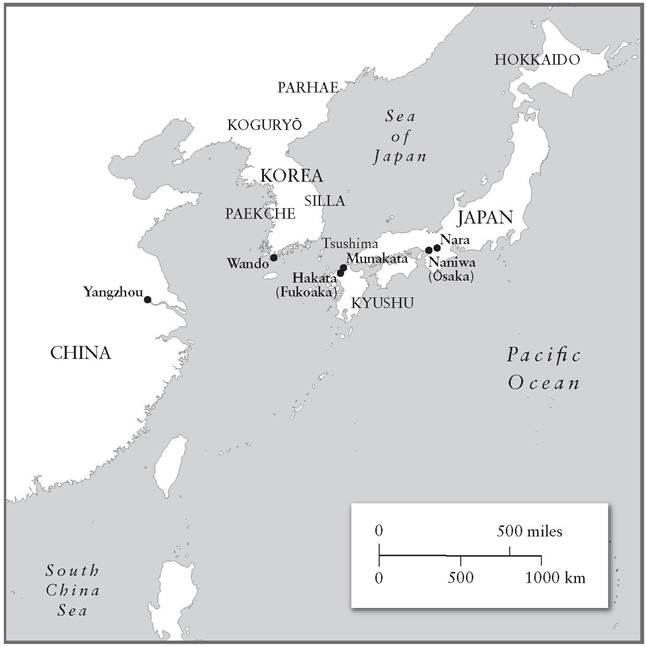
out from Japan towards Korea and China, across often difficult seas, were Japanese and Korean; once again the Chinese took a passive role, and embassies from China to Japan were a rarity.4 As Sir George Sansom pointed out, ‘the phenomenon of Japan’s isolation is a comparatively late feature in her history.’5 On the other hand, there is little to say about Japan’s links to the Asian mainland before the first millennium ad. Japanese raids across the sea afflicted Korea in the first century bc and are recorded in the official Korean chronicles: ‘Year 8 [50 bc], the Wae [Japanese] came with troops intending to invade our coastal region but, hearing of the Founder Ancestor’s divine virtue, they withdrew.’6 There was some contact with the Han Chinese at the start of the millennium, with embassies reaching China and Korea in the first century, but Japan was not of enormous interest to the Chinese: it was seen as a land of warring kinglets (which it would become again in later centuries); its inhabitants ‘are much given to strong drink’, but many of them live till they are a hundred, and robbery and theft are rare - certain things have changed little in Japan.
One important feature of early Japan was its great ethnic variety, with native peoples in north and south (Hokkaido and Kyushu islands) refusing to submit to central authority. Only in the late seventh century did the rulers of much, though not all, of central and southern Japan begin to use the name Nihon, or Nippon, ‘Land of the Rising Sun’, from which the Western term ‘Japan’ is derived; and even then the ancestors of the Ainu, now few in number, dominated the cold expanses of Hokkaido. Korean culture had an enormous impact on early Japan, and there were close, and not always friendly, ties between the rulers of Japan and those of Silla, one of the Korean kingdoms that lay close to Kyushu island.
The small island of Okinoshima, close to Fukoaka in northern Kyushu, was a cult centre visited by fishermen and other sailors, for the produce of the sea has always mattered a great deal in the Japanese diet (the sea was also a good source of fine pearls); since very early times Japanese men (but not women) have gone there to pray for the safety of those at sea. Archaeological finds from the island include artefacts from Korea and even the Middle East, as well as many jade symbols in the shape of an apostrophe, whose exact function is unclear. The great shrine at Munakata was dedicated to the sea gods and now attracts travellers of all sorts, including those who wish their cars to be blessed by the Shinto deities.7 And then, beyond Okinoshima and halfway to Korea, the island of Tsushima was regarded as the outer boundary of the Japanese Empire.8 Tsushima provided a base from which Japanese sea raiders repeatedly attacked the coast of Korea during the fourth century.9It goes without saying that the entire population of Japan had arrived from elsewhere at some time, even though the Japanese themselves long believed that their emperors were descended from the sun goddess Amit- erasu, and noble families claimed descent from lesser gods.10 A series of peoples moved into various corners of the archipelago over several millennia. Migration from Korea was easiest, across a relatively narrow stretch of water, and a wave of refugees arrived from Korea in the fourth and fifth centuries ad, a time of turbulence in their homeland; they were welcomed by the Japanese court, for they brought skills that were lacking in Japan itself, until then a largely rural society with a subsistence economy. The immigrants taught the art of silk cultivation; they were experienced weavers; they were metalworkers; they also brought the art of writing, though at this stage this was Chinese writing, which was ill-suited to the polysyllabic language that had taken root in Japan.11 Korean culture was itself heavily influenced by that of China, so Korea was really a filter through which a more advanced civilization moulded the culture of Japan.
By the ninth century ad, though, increasingly regular direct contact with China itself reduced Japanese dependence on Korea as an intermediary. Japan’s maritime horizons took many centuries to expand, as this chapter will show.Cultural dependence on Korea was not matched by political dependence; indeed, later tradition insisted that the three Korean kingdoms of Silla, Koguryo and Paekche began to pay tribute to Japan in the sixth century, as did some of the islands to the south of Kyushu. These tales grew in the telling, and claims that early Japanese emperors ruled the territory of Mimana, on the strait between Korea and Japan, from the third to the seventh century, were used by early Japanese chroniclers to support the right of their emperor to tax the inhabitants of southern Korea.12 This points to a fundamental paradox in Japanese history: on the one hand, the island identity of the Japanese reinforced the idea that Japan was an empire set apart by the gods from the rest of humanity; and, on the other hand, the Japanese sought to draw the nearest parts of mainland Asia under their influence. This sense that Japan too was an empire was heavily compromised by an awareness that China was the seat of a more ancient, powerful and sophisticated civilization that the Japanese tried hard to emulate. This l ove-hate relationship has endured over many centuries of Japanese history.
Korean contact with Japan was quite intense during the seventh century ad. The Japanese even took sides in an armed struggle between the two kingdoms in southern Korea, Silla and Paekche. The Tang dynasty in China was wooed by Silla, and Paekche turned to Japan for help; in 663, a naval battle between the Chinese and Japanese off the coast of Korea, known as the Battle of Hakusuki, proved the decisive superiority of the Chinese fleet over that of Japan, and henceforth Japanese aggression in these waters was limited to pirate raids.13 The rulers of Silla succeeded in suppressing Paekche and became a significant regional power in their own right.
At first, they failed to realize that the Tang emperor intended to absorb Silla once he had helped finish off the other Korean kingdoms. However, between 668 and 700 twenty-three embassies arrived in Japan from Silla, which was now trying to keep its distance from the rulers of China, and saw the Japanese as useful allies. These diplomatic exchanges were an important conduit along which mainland cultural influences reached the island empire. Handsome gifts of Korean, Chinese and east Asian luxury goods could be understood as tribute (though that was not the idea in the king of Silla’s mind); on one occasion, in 697, Emperor Monmu even invited the Korean emissaries to his New Year audience, alongside the ‘barbarian’ peoples of northern Japan, and presumably the envoys from Silla were not quite sure whether to be flattered or embarrassed by what was obviously an attempt to flaunt Japanese imperial authority. And when, in 752, the Sillan prince T’aeryom turned up with seven ships and 700 men, the Japanese records insisted that his precise purpose was to bring tribute to the empire of Japan, for he is said to have said:‘The king of Silla addresses the court of the empress who rules gloriously over Japan. The country of Silla has from long times past continuously plied the waters with ships coming to serve your state... There is nowhere under Heaven that is not part of the royal domain, and no one on even the furthest shores of the realm who is not a royal subject. T’aeryom is overcome with happiness to have been blessed with the opportunity to come to serve you during your divine reign. I respectfully present some small items coming from my own land.’14
Oddly, or perhaps not oddly at all, there is no mention of this voyage, or other embassies to Japan, in the Korean annals of the Silla kingdom, which are quite detailed. They only mention T’aeryom as a leader of a rebellion against the king, in 768, which ended with the execution of the prince and ‘their three generations: paternal, maternal, and wife’s relatives’, clearly a traditional method for dealing with opponents of the regime that is still loyally maintained by the Kim dynasty in North Korea.15 However, the Korean annals do mention Japan very occasionally: ‘the country of Wa changed its name to Japan.
They say they took this name because they are near to where the sun rises’, which is indeed the meaning of Nihon.16 And the Koreans noted embassies from Japan, even though they actually consisted of protocol officers sent to accompany Sillan embassies to the Japanese emperor back to their homeland. Nonetheless, the Sillans did not feel it was beneath their dignity to admit that they were sending embassies to the Tang court in China.Most curious is the embassy from Japan that arrived in Korea in 753. This was surely another visit by protocol officers accompanying Prince T’aeryom back home, but the Sillans were upset at something - perhaps the long delays in receiving T’aeryom at the Japanese court. The Korean annals state: ‘Year 12 [753], autumn, eighth month. An envoy arrived from Japan. As he was arrogant with no propriety, the king did not receive him, so he returned home.’ Relations were better in the ninth century when, we are told, the Japanese presented the king of Silla with large amounts of gold, having ‘concluded an agreement for the exchange of envoys and friendly ties’ some years earlier, in 803.17 Everything really depended on whether the Japanese were friendly to other Korean kingdoms, and whether the Sillans were keen to make friends with Tang China. Relations with Japan were based on the principle ‘my enemy’s enemy is my friend’.
The ‘small items’ conveyed by ambassadors were not in reality quite so small. Descriptions of Korean embassies mention rather curious gifts: in 599, Korean envoys presented a camel, a donkey, goats and a white pheasant from the kingdom of Paekche; the Paekche embassy of 602 had a more lasting effect, since this time a monk named Kwalluk brought exciting books that dealt with exorcism, astronomy and the calendar; besides, Kwalluk remained in Japan and trained three Japanese followers in his esoteric knowledge; he was followed by other Buddhist monks from the different Korean kingdoms who displayed an impressive range of knowledge - not just how to manufacture ink, paper and colouring materials, but even how to build a watermill. Embassies from Silla brought gold, silver, copper and iron, as well as bronze statuettes of the Buddha. The northern Korean kingdom of Parhae, which stretched beyond the present borders of North Korea towards present-day Vladivostok, sent tiger-skins and other rare pelts to Japan, so that when Japanese painters portrayed tigers and leopards they were not totally dependent on Chinese artistic models. In 659 an envoy from Koguryo was seen in the market trying to exchange a bearskin for silk floss, which for some reason the Japanese thought was highly amusing. That, perhaps, was on his private account, since gifts to the Koreans in return for tribute lavishly demonstrated the growing wealth of the Japanese emperor: dozens of bolts of silk in any number of forms and colours; hemp cloth, furs, axes and knives.18
Some, perhaps most, of the trade with Korea took place outside the narrow confines of official embassies, and one ‘register of products purchased from the Koreans’, of 752, lists products from all over east Asia, not just from Korea itself: gold, frankincense, camphor, aloe wood, musk, rhubarb, ginseng, liquorice, honey, cinnamon, lapis lazuli, dyestuffs, mirrors, folding screens, candelabra, bowls and basins. A special feature of these imports is that Japanese nobles were allowed to petition the court for permission to buy goods brought by the envoys who accompanied T’aeryom. The petitions they submitted were later used to line folding screens that have been preserved in the remarkable eighth-century imperial treasury at the Shoso-in, still kept at the Todaiji temple in Nara. Their letters reveal a less stuffy world than the highly formalized rituals of Japanese diplomacy might suggest, for the official visits masked a more mundane reality: people traded on the side, with the blessing of the imperial court.19 Their goods also helped shape Japanese civilization - one has only to think of the white lead used in the face-paint of court ladies in the era of The Tale of Genji.
This relationship between Japan and Korea, of necessity conducted by sea, did not, then, take the form of a continuous flow of shipping back and forth across the strait between Japan and Korea. Embassies could be made to wait months, even years, before being rudely told to go away. Permanent diplomatic representatives based in foreign capitals simply did not exist.20 Nor was diplomacy the only way Korea and Japan came into contact. All these accounts of embassies underestimate the scale of piracy and open warfare in the seas between the two lands. Although not much can be said about the ships that fought in these waters, Wa (later known as Japan), Silla and other states in the region could mobilize navies when they wanted to do so. Japanese raids on Korea had a long history, and Kyushu, the southern island of Japan, was seen as a defensive barrier against Korean aggression; in the seventh and eighth centuries, thousands of recruits known as sakimori were based in Kyushu and on Tsushima to defend imperial territory against invaders. The Japanese were worried that Kyushu was so easily accessible from the continent: ‘various foreign countries come there to pay tribute, their ships and rudders face to face with ours. For this reason we drill horses and sharpen our weapons in order to display our might and prepare for emergencies.’ An eighth-century poet described the agony of leaving home and family (‘his mother of the drooping breasts’ and ‘his wife like the young grass’), for:
A great ship is set with myriad true oars
In the royal bay of Naniwa
Where men cut reeds, On the morning calm They row out in cadence, On the evening tide Pull the oars till they bend. ‘May you who set off rowing To the boatman’s chant, Thread your way between the waves And safely reach your port. May you keep your spirit true As ordered by our sovereign lord, And when your time of sailing round From cape to cape is done, May you come safely home,’ Thus his wife must pray, Setting a jar beside the bed,
Folding back her white hemp sleeves, Spreading out her seed-black hair- Long days she waits with yearning.21
II
Prince T’aeryom’s visit to Japan took many months. These long, exhausting and not very comfortable trips across the sea were frequent enough for the Japanese court to set up a reception centre for foreign visitors in Hakata Bay, within the precincts of the large modern city of Fukoaka (earlier known as Hakata). No one knows what route T’aeryom followed towards Nara (Heijo-kyo), the imperial capital, but the fact that he stayed at Naniwa, on the site of modern Osaka, while returning to Hakata strongly suggests he travelled mainly by sea. En route to Nara, ‘the guests must not be allowed to converse with people. Nor should officials of the provinces and districts they pass through be allowed to look at the guests and vice-versa.’22 His problem was not so much getting to Nara as getting out of Hakata, where he and his entourage were penned in the foreigners’ compound under the strictest supervision.
This compound, whose site lies underneath an old baseball stadium, was excavated in 1987-8, exposing structures from the late seventh to ninth centuries, as well as massive quantities of Chinese ceramics, the latest of which date from the eleventh century. It was known as the Korokan, and in the eighth century, the ‘Nara period’ of Japanese history, a channel to the sea probably reached as far as the building, before sedimentation spread Fukoaka well beyond the early medieval shoreline. The Korokan contained two quadrangles of the same size (seventy-four metres by fifty-six metres). Presumably the VIPs stayed under cover while the great majority of the party bedded down in the large courtyards, or even outside the gates and on board the ships that had brought them to Hakata Bay. Analysis of latrines discovered within the compound revealed that one latrine was used by people who followed a diet not far distant from the traditional Japanese diet of fish and vegetables, while two upper-class latrines showed high consumption of pork, including wild boar. Even more pungent evidence was provided by small wooden slats that had been attached to food shipments and that indicated what was in each cargo and where it came from (they survived because they were used to wipe one’s behind before being thrown away). Here was proof that fish, rice and venison were carried to the Korokan from northern and central Kyushu - the centre of the island, containing the vast caldera of Mount Aso, offered rich volcanic soil. The sea provided an important part of the diet of the inhabitants of eighth- and ninth-century Kyushu: shellfish such as oysters and abalone, as well as jellyfish, tuna, whale, salmon and, as now, seaweed such as kelp. Occasionally the more distinguished emissaries would be summoned from the lodge and taken to Dazaifu for feasts at which the governor of Kyushu was their host. Isolation was not total.23 Yet the Korokan was different from the inns that existed in, say, the medieval Mediterranean, which were situated within ports. Hakata Bay was an empty area at this time; the Korokan was not simply a large, enclosed quadrangle but an isolated, distant place; in this sense it was also different from the more famous enclosure at Deshima, the island off Nagasaki where Dutch merchants were permitted to trade in the seventeenth and eighteenth centuries.
The physical isolation of the lodge meant that the Japanese authorities had to supervise the Korokan from their administrative centre thirteen kilometres inland, at Dazaifu. This was the command centre for the defence of Kyushu as well. All this points to the deep-seated fear that Kyushu would fall under the sway of foreigners, and that it was a border region in constant need of protection. Prince T’aeryom and other ambassadors came with more than 700 followers; and there was an uneasy feeling that several hundred foreigners could just as well be warlike marauders as peaceful envoys. It was vexing for the visitors to have to suffer the long wait as Japanese protocol officers travelled back and forth between Hakata and Nara, bringing news of whether the embassy was actually welcome at the imperial court.24 The fear of contact was also fear of contamination. The Japanese court developed a sense of the distinct purity of the Japanese race, which culminated in the purity of the emperor himself. This was in part an elaboration of the Chinese attitude to other peoples, who were seen as ‘barbarians’, but another source of these ideas was the Shinto conception of pollution, often also associated with the dead. One must distinguish these theories from everyday practice: in time large numbers of Chinese would settle in Hakata and marry Japanese men and women. But in dealing with official delegations the imperial court had, by the eighth or ninth century, become aware of the distance separating the emperor and his great nobles from foreign peoples, especially those of Korea, who were regarded as a political threat as well as a source of pollution.25
By the end of the eighth century the Koreans of Silla had made clear their rejection of any idea that their official trade with Japan consisted of tribute payments to a greater power. The area that remained in regular official contact with Japan was the kingdom of Parhae, in the north of Korea, spilling over into what are now the borderlands of China and Russia, and surviving until it was overthrown by marauders from the interior in 926. The inhabitants of Parhae were of varied origins, some related to the Mongols, some more closely related to the Koreans. They were useful
198 THE MIDDLE OCEAN: THE INDIAN OCEAN AND ITS NEIGHBOURS allies when, as happened early in the eighth century, the rulers of Silla decided to link their fortunes to Tang China rather than Japan; but they had less to offer in gifts: furs rather than silk, and none of the spices that Silla had obtained from further south and west. Trade with Parhae was not exactly encouraged, at least at the Japanese court: in the ninth century a mission from Parhae was only allowed to visit every six years, an interval which was soon increased to every twelve years, because the Parhaeans were bringing more than the court really wanted. The king of Parhae was unhappy with this arrangement and continued to send embassies even when they were unwelcome, whereupon the Japanese authorities sent them back with their goods, which, in 877, included two exceptionally beautiful sake cups made out of tortoiseshell and carved in the ‘South Seas’ that some at court would have been delighted to keep in Japan.26
The relationship between Korea and Japan soured, but not before the peninsula had implanted some fundamental features of mainland Asian culture in the islands, notably Buddhist beliefs. With the fall of Parhae, however, Japan lost interest in attempting to assert its influence on the mainland. Memories of the links with Korea persisted, and a Korean embassy appears in the very first pages of the great tenth-century Japanese novel, The Tale of Genji; there, a wise Korean physiognomist skilled in Chinese poetry recognizes the great talent of the young boy who will one day become the hero Genji.27 As will be seen, in the long term the cooling of ties with Korea fostered a new type of relationship across the sea, based on everyday trade rather than formal diplomatic exchanges, but in the meantime the weakening of ties between Japan and its closest neighbours left the Sea of Japan and the East China Sea open to pirates capable of operating their own fleets and of preying on such merchant shipping as existed.
Early Japanese rulers appealed to the Chinese for help against local rivals; and often these appeals were directed at Chinese governors of parts of Korea that had fallen under Han control.28 But increasingly they turned to the Chinese imperial court. This was with certain reservations: the journey there was regarded as very risky - every embassy but one experienced serious danger at sea or on land; and they were uneasy about Chinese claims to superiority, since the Japanese preferred to think of themselves as the civilized subjects of a sovereign empire comparable in status, if not in size, to Tang China.29 The sea was an important part of a world view that was, nonetheless, firmly centred on the Japanese islands. Most eloquent of all are the dramatic scenes of ships amid the storm-tossed waves that appear in medieval Japanese paintings.30 In the eighth century the embassies sent to China were already elaborate affairs, with whole teams
of participants: a principal ambassador with two or three deputies; scribes and interpreters; craftsmen such as carpenters and metalworkers; a specialist in divination - always useful if one wanted to turn up at court on an auspicious day. A hundred people would constitute a rather small embassy; in this period four ships each capable of carrying 150 people might not be unusual (twelve embassies are known in the years between 630 and 837). To guard against illness a vast pharmacopoeia was carried on board, including pills made of rhinoceros horn, plum kernels and juniper, more often of Chinese than of Japanese origin.31
The route started in the bay of Osaka, through Japan’s Inland Sea, and along the Korean coast, though a direct route to the mouth of the Yangtze (close to the trading city of Yangzhou) became common as navigators gained greater experience; moreover, sailing past Korea was risky when local rulers, such as the king of Silla, were hostile. From Yangzhou, part of each delegation would head much further inland to the imperial capital at Changan, so their journey was by no means over when they reached Yangzhou. However, Yangzhou was a collection point for goods that came overland or along the coast from Canton (Guangzhou), so there they could choose from the luxury goods of the Indian Ocean route and from those that arrived along the Silk Road. They still had to face the horrors of the return journey. On one occasion, in 778, the high seas washed a Chinese envoy coming to Japan with gifts off the deck of his ship, along with twenty-five members of his entourage and one of the Japanese ambassadors who was on his way home. The same ship broke in two but each part stayed afloat, and the exhausted survivors made land on Kyushu.32
With such experiences on record, Japanese travellers regarded sea travel with awe, and made sure that they prayed to the gods of the sea before setting out, celebrating with feasts if and when they managed to return. A litany that used to be recited at an event known as the Ceremony of National Purification conjures up a vivid image of Japanese seafaring: ‘as a huge ship moored in a great harbour, casting off its stern moorings, casting off its bow moorings, drives forth into the vast ocean... so shall all offences be swept utterly away.’ In a prayer to the sun goddess the Shinto priest described the lands bestowed on the emperor ‘by the blue sea-plain, as far as the prows of ships can go without letting dry their oars and poles’. 33
The dividends for Japan were enormous. The coming and going of monks ensured that Japanese Buddhism was firmly rooted in Chinese and Indian Mahayana Buddhism; the Lotus Sutra, a very lengthy lecture by the Buddha on the theme of eternal bliss, was a particular favourite in China, and consequently became one in Japan as well.34 Cultural influences across the sea were not confined to Buddhism. Something was learned from Confucianism about hierarchy and filial respect, though public examinations for government service did not quite follow the Confucian model: opportunities to be trained for office were confined to the sons of the well born rather than being open to all talents. The Chinese model extended to town-planning as well: the handsome new capital at Nara was constructed around a grid, like the major Chinese cities. At the start of the eighth century the imperial court began to issue silver and then copper coins, in imitation of Chinese practice, but silk was used as the medium of exchange in high-l evel dealings with Japan’s neighbours.35
The influence of China on the fine arts was incalculable, even if Japanese artists developed their own sensitive eye. The texts that Buddhist monks studied were in Chinese, and the creation of a workable Japanese script took time; when it did come into being, it made use of a great many Chinese characters, while also using syllabic signs better suited to the phonetics of Japanese. Until then, Chinese was the language of administration, and Chinese books on astronomy, divination, medicine, mathematics, music, history, religion and poetry were eagerly devoured by civil servants, monks and scholars in Japan; a ‘catalogue of books currently in Japan’ of 891 knew of 1,759 Chinese works.36 At the same time, traditional cults, the ‘way of the gods’ or Shinto, ensured that native traditions remained alive. Still, the cultural flow was nearly all one way: in later centuries, as will be seen, there were a few Japanese articles that attracted the attention of Chinese buyers, especially high-quality paper, which was made according to a different formula in Japan. But Japanese admiration for Chinese culture was not matched by Chinese admiration for Japanese culture. The Japanese could not escape from being classed as barbarians by those they sought to emulate; one effective way of dealing with this was to treat others (such as the Koreans, rather ungratefully) as barbarians in relation to themselves.
The evidence from the embassies to China is as good a way as any of measuring the steady growth in Chinese influence, and the build-up of trade as well as official exchange across the Japan Sea and the Yellow Sea. Yet here, as with Korea, the tributary relationship did not last; after 838 no more embassies were sent to Tang China. In any case, these embassies had been sent at very long intervals. Twenty-seven years separate the embassy sent by Emperor Kammu to the Tang court in 804 from its immediate predecessor, and thirty-four years passed before the next embassy was sent to China, one that is very well documented and that will be examined shortly. During the rest of the ninth century, the Japanese showed no interest in sending an embassy to the Tang emperor, and by the time they did decide to send one, in 894, the Tang empire was beginning to disintegrate. In the event, that embassy was cancelled when Sugawara no Michizane, the notable who had been chosen as ambassador, advised the Council of State to think again:
Last year in the third month, the merchant Wang No brought a letter from the monk Chukan, who is in China. It described in detail how the Great Tang is in a state of decline, and reported that the emperor is not at court [because of the rebellion] and foreign missions have ceased to come... Investigating records from the past, we have observed that some of the men sent to China have lost their lives at sea and others have been killed by pirates... This is a matter of national importance and not merely of personal concern.37
Maybe that final sentence should not be taken too seriously; the ambassador evidently did not want to risk his life. He was perhaps the greatest Japanese expert on Chinese culture, and a skilled poet who enjoyed exchanging verses with the ambassador of Parhae.38 Yet his reluctance to lead an official delegation masks the reality of day-to-day contact across the sea. In another letter Michizane reported that ‘many merchants have told us of conditions in China’, so there were more people crossing to China than the Wang No he mentioned in his appeal to the Council of State. Private traders were coming and going with ever greater frequency and, to judge from Wang No’s name, many or most or even all were Chinese. As a result, at the end of the ninth century the character of Chinese trade with Japan was changing decisively. The cancellation of the embassy in 894 was not a sign of isolationism, but rather the opposite: these very formal exchanges of goods by extremely large embassies were not costeffective. Japan was becoming more and more integrated into the ‘Asian Mediterranean’ that stretched south beyond Taiwan and joined the South China Sea to the seas around Japan itself.
Silk dominated the list of goods sent from the Japanese court to China, while large quantities of silver also featured, and the distinctive silky paper the Japanese manufactured also impressed the Chinese, though for the moment it was more an object of curiosity than a common article of exchange. The diplomatic team would also bring to China large quantities of silk that each member had been awarded by the emperor of Japan, and would use this to finance the voyage, selling goods in the ports and cities the envoys visited. Chinese gifts, not just to the emperor of Nihon but to the envoys, included suits of armour and books - one Japanese visitor to China, who stayed there for eighteen years at the start of the eighth century, brought home a handbook of court ceremonial, which must have had quite an impact in his homeland.39 But the best evidence for the impact of China and east Asia upon eighth-century Japan comes from the extraordinary collection of artefacts still preserved at the Todaiji temple in the new capital of Japan, Nara, which are placed on exhibition once a year. This collection was formed in 756, when the widow of Emperor Shomu presented his treasures to the Great Buddha. Further gifts in the next few decades brought the number of items in the collection to more than 10,000. Influences from the West can be traced both in designs imitated from Persian, Indian and Chinese models (for instance, in painted screens that recall Tang iconography), and in actual objects brought across the seas (such as lapis lazuli belt ornaments from Afghanistan). Musical instruments from the eighth century, including flutes and lutes, Chinese board games, writing cases, brushes and inkstones, furniture and caskets, armour, glass, ceramics and magnificent court robes testify either to the quality of the gifts received and objects bought through trade, or to the manner in which Japanese artists copied faithfully the models they saw - over time modifying them in a distinctively Japanese way.40 The more the Japanese studied Chinese art and customs, the more they were inclined to stress their own special identity. Physical separation from China meant that these powerful influences operated at a court level; movement back and forth by sea, across difficult waters, constrained contact but also sustained a regular flow of goods from the high culture the emperors in Nara secretly envied, and never dared to despise.
III
The Japanese Buddhist monk Ennin (793-864) became an important religious leader, and was later known to the Japanese as Jikaku Daishi, ‘Great Teacher of Compassion and Understanding’. The diary of his pilgrimage, which took place between 836 and 847, offers a unique record of the delicate relationship between China and Japan in the early Middle Ages, and has much to say about the journey across the treacherous waters between the two empires. Only one medieval manuscript survives, finished in wobbly characters in 1291, and copied by a Buddhist monk named Ken’in when he was seventy-two years old and was ‘rubbing my old eyes’, which was his way of apologizing for the errors of transcription in the text he transmitted. These errors were magnified because he was not copying his native Japanese, but a text written in Chinese, which remained the literary language of the intellectual elite at Nara.41 Ennin was already forty-one years old when the imperial court appointed members of the diplomatic team it was sending to China, which was to be led by Fujiwara no Tsu- netsugu, a member of the great Fujiwara clan. It was to set out in four ships under the direction of ‘Ship’s Loading Masters’; the title suggests that they were responsible for the cargo of tribute. Two of the loading masters were of Korean descent and one claimed to be descended from a past Chinese emperor, no less. However, there were also skilled navigators who captained the ships while they were at sea, as well as scribes and Korean interpreters, whose task was less to translate from Japanese into Korean than from Japanese into Chinese.42 It was a motley band of envoys that included a ‘Provisional Professor’ from the government university, who was also a skilled painter and waited upon the ambassador himself. Several archers who travelled in the convoy were of good birth, one of them serving in the imperial bodyguard, though there were also many artisans, including carpenters, porters and simple sailors who were clearly of more modest origin. Altogether there were 651 people on board the four ships, which, judging from the size of the earlier Korean embassies to Japan, was the expected size of an embassy designed to create a good impression. Alongside the diplomats and their support staff, another important component of this great party consisted of the monks and laymen who were travelling to China to deepen their knowledge of Buddhist beliefs and practices and of Chinese art and letters. The monks represented various sects of Buddhism that existed in Japan, for one feature of Japanese Buddhism was the relative ease with which the different strands of Buddhism, the ‘greater’ (Mahayana) and ‘lesser’ (Hinayana), co-existed side by side, one stressing the role of Buddhism in society at large and the other concentrating more on inner perfection.43
This team was put together from 833 onwards, but it took a few years to set off on the voyage. For, in addition to those sailing to China, there was another large team at work on land. The ships were not actually ready; Ship Construction Officers were needed who could supervise their building. The imperial court was also well aware that making a good impression on the Tang emperor would depend on the rank of the people sent into the Chinese ruler’s presence. Therefore in the New Year Honours List several of the envoys were raised to higher ranks in the complex court hierarchy; the ambassador himself now attained Senior Fourth Rank Lower Grade, which was a little more than halfway up the cursus honorum. Previously he had held the rank of Junior Fourth Rank Upper Grade. Solely while he functioned as ambassador he was an acting member of the Senior Second Rank. Progress up the ladder took place at a snail’s pace.
There were handsome gifts of silk and other cloths for the leading participants. One reason for this largesse was the simple fact that the journey was thought to be perilous, which, as events would prove, was an accurate judgement.44 If contrary winds blew, it was quite possible that the ships would be blown on to the shores of Korea, so a further embassy was despatched to the king of Silla, with whom relations had been poor, to guarantee safe passage for the Japanese embassy to China. The Koreans sent back this embassy with a flea in the ambassador’s ear. Silla was full of tension at this time, as rivals contended for the throne and as fighting spread into the palace compound itself. Meanwhile a pirate king named Chang Pogo had established himself as master of the waters off southern Korea, and Ennin mentioned the threat that he might pose to the ships carrying the embassy - more of Chang Pogo shortly.45 It is not surprising, then, that the Koreans had other preoccupations than the renewal of ties with Japan.46 The Sillan court even suggested that the envoy who had arrived at their court, Ki no Misu, was some sort of mischievous impostor, and he was roundly blamed for his failure when he returned to Nara.47
The first part of the voyage, which began in the middle of 836, was easy enough. The four ships set out from Naniwa, not far from Nara, and sailed down the Inland Sea, reaching the coast of Kyushu after four days. Problems began to mount when they set off from Kyushu for the coast of China, on 17 August 836. The weather had been calm, but the typhoon season was imminent. Everything suggests that the Japanese mariners were hopelessly optimistic about their chances of all arriving unscathed on the mainland, and that their expertise was limited to navigation between the islands of their home archipelago across small distances. The four ships were beaten back by the fierce winds; three of them made land on Kyushu once again, but the fourth was smashed to pieces, and a raft carrying sixteen survivors was washed up on Tsushima island, followed by a few other survivors who floated ashore later - a total of twenty-eight survivors. The story they told was horrifying: its rudder broken, their ship had been at the mercy of the high sea, and the captain had ordered his crew and passengers to break the ship to pieces, so that they could escape on rafts; but nearly all these rafts were lost at sea, with over a hundred men. When the emperor heard of these events, he sent orders for the repair of the three remaining ships; Fujiwara no Tsunetsugu assured him that he was still keen to make the passage, even though he and his men felt half-dead after their experiences (this, in true Japanese fashion, was expressed as a humble apology for failure, even though the circumstances had clearly been well beyond Fujiwara’s control). A second attempt to reach China, in 837, fared little better, for the ships were blown back to Kyushu and to islands off
Japan; the imperial court had sent offerings to the shrine at Ise of Amit- erasu, the sun goddess and notional ancestress of the imperial family, but to no avail.48
With no obvious help from the Shinto gods, the opportunity was taken to redouble spiritual efforts before sending the party to sea a third time. This was achieved by bringing into play the Buddhist monasteries as well as the Shinto shrines of Kyushu, while right across the Japanese Empire there were to be daily readings of a Buddhist sutra, The Scripture of the Dragon-King of the Sea, who was a cult figure in Korea, Japan and parts of China. The envoys felt very doubtful about setting out yet again: they had witnessed the perils of the sea, and had lost a ship on the first attempt. Takamura, the deputy ambassador, fell sick with a diplomatic illness and - while Fujiwara insisted that he was ready to die 10,000 times to serve the emperor - his deputy and several other high-ranking envoys were sent into exile for disobeying imperial orders, which was at least a better fate than being strangled to death, the penalty the emperor could have imposed.49
What has been said so far is based on the reconstruction of events from the Japanese official archives by the editor of Ennin’s diary, Edwin Reischauer. But at this point the words of Ennin himself become audible, as he describes the third voyage towards the coast of China, cutting across the open sea so that the Japanese ships did not have to coast along the mildly hostile shores of Korea. Off the coast of China, however, the ships encountered a fierce east wind, and Ennin’s vessel was blown on to a shoal, whereupon its rudder snapped in pieces. To add to their confusion, their Korean interpreter was worried that they had already overshot the entrance to the canal that would lead them down to the Yangtze River and towards Yangzhou, the first city they hoped to reach en route to the Tang capital further inland. Ennin, the ambassador and their fellow passengers were stranded offshore on a ship that was breaking up. The ambassador managed to reached the shore in a lifeboat, but Ennin was among those left on board: ‘The ship eventually fell over and was about to be submerged. The men were terrified and struggled to climb on to the side of the vessel. All bound their loincloths around them and tied themselves with ropes here and there to the ship. Tied thus in place, we awaited death.’50
The broken ship shifted back and forth in the mud, and Ennin and his companions were forced to switch from one side to another as the waves pushed it from side to side and as ‘the mud boiled up’. When a small Chinese cargo vessel came alongside, the first act of those still on board was to pass across the ‘national tribute articles’ destined for the emperor of China; but in reality they lay very close to the shore and eventually they landed on terra firma, dried out the tribute items that had been soaked in seawater, and made their way upriver, finding out that the ambassador and his secretaries had survived their own harrowing experiences and were heading in the same direction. Two other ships experienced easier crossings, though one of them did begin to break up, and several crew members died of mysterious and sinister ‘body swellings’ before being rescued by more Chinese ships.51 Not surprisingly, members of the party of monks were keen to present gifts of gold to a monastery where they were lodged for a while, as thanksgiving for surviving the perils of the sea, and as they travelled they offered simple feasts of vegetarian fare to monks they visited.52
The disasters at sea prove that the Japanese had not mastered the art of ship construction. Ennin’s terrifying account of his shipwreck is not the only report he offers of a rudder that broke under strain, nor of ignorance of the art of navigation. The Japanese were a maritime people, but the sheer proximity of their islands meant that long journeys across the open sea were rare, although there is good evidence that the Koreans could handle more ambitious voyages. Ennin had come to China to make contact with fellow Buddhists, and his travels along the rivers and roads of the Tang Empire took him far from the sea, but he says that the crew of one Chinese boat, carrying Fujiwara himself back to Japan in 839, was Korean, and the crew was knowledgeable about the coastline of northern China and about the best routes towards Japan.53 While it is no surprise that they prayed to the Shinto and Buddhist gods on setting out on a voyage, the Japanese were willing to rely on a soothsayer for information about weather prospects. Ennin described how the sailors on board one ship lost all sense of direction once they could not see the sun, and ‘wandered aimlessly’; when they saw land the soothsayer first declared it was Silla and then decided it was China - the matter was resolved when two Chinese were found who knew where Korea actually lay.54 The Japanese attitude to the open sea can be summed up in Ennin’s terse comment: ‘we saw the ocean stretching far and mysterious to the east and south.’55 It was not an inviting place.
Following the disasters of the outward journey, from which only one ship had survived, new ships had to be commissioned in Yangzhou, the great commercial city that was China’s gateway to the open ocean. It was vital to find people ‘familiar with the sea-routes’, and more than sixty Korean sailors were hired, along with nine Korean ships.56 The larger fleet suggests that the ships themselves were smaller, or that a rich cargo of gifts and surreptitious purchases was now ready for loading. However, when members of the delegation attempted to trade privately in the marketplaces of Yangzhou they were arrested and held overnight; they had ‘bought some items under imperial prohibition’; and other delegates were in such a hurry to escape the market inspectors after detection that they left behind more than 200 strings of cash, each made up of 1,000 copper coins and threaded together through the hole in the middle. Unfortunately, there is no record of what they were trying to buy, which may have included the rare medicines, spices and incense that wealthy Japanese consumers craved. When they set out, the crews underwent purification according to Shinto rites, praying to the sea gods for a safe journey; and at one point a Japanese sailor was prevented from boarding because he had polluted himself by having sexual relations with another man. Once the ships were at sea, a sailor who was thought to be dying was placed on land so that his dead body would not pollute the ship on which he was sailing. The fearsome sea had to be treated with punctilious respect.57
At the last minute, Ennin and a few of his fellow monks decided to stay in China, with the approval of Ambassador Fujiwara but without permission from the Chinese authorities; the ambassador tried to warn Ennin that the Chinese authorities would be furious at his breach of the imperial order that the delegation should now depart, but he understood that Ennin’s first priority was to study Buddhist scriptures. So Ennin conspired with Korean merchants to be left on the shore of the Shandong peninsula, which sticks out of China to the west of Korea. A bribe of gold dust and a Japanese girdle helped; the Korean response was a gift of powdered tea and pine nuts, which seems a rather modest exchange.58 And yet thick matcha tea, widely known for its use in the tea ceremony, was valued by Buddhist monks, as it kept them awake through long hours of study and meditation; documents preserved in the Shoso-i n at Nara show that it remained extremely costly in the late eighth century, worthy of being brewed by the abbot himself before it was offered to the emperor as he processed past the great temples of central Japan.59
Ennin felt it was important to send some Buddhist scriptures back to Japan, which he asked to be placed on board one of the Japanese ships in a bamboo box.60 But the embassy had not satisfied his craving for deeper knowledge of Buddhist law and lore. He hoped to reach the holy places of Chinese Buddhism, and he and his companions tried to pose as Koreans. How this worked when they met some Korean sailors is a mystery - what language did they speak? They had not gone very far when they encountered a village elder called Wang Liang, who sent them a written message:
You monks have come here and call yourselves Koreans, but I see that your language is not Korean, nor is it Chinese. I have been told that the ships of the Japanese tributary embassy stopped east of the mountains to wait for favourable winds, and I fear that you monks are official visitors to China who have fled to this village from the ships of your own country. I dare not let official visitors stay.61
So in China, as in Japan, envoys from afar were expected to be tightly controlled and shepherded from place to place. When the police arrived Ennin claimed to have been suffering from beri-beri, and insisted that he had come ashore with his companions because he felt so ill; but now they wished to join the Japanese ships, which were said to be anchored not far away. They were duly accompanied to one of the Japanese ships that stood close to a temple of the Dragon King of the Sea, and put on board.62 Ennin was in despair at the failure of his plans: ‘we have tried every idea, but we cannot stay. The officials are vigilant and do not permit the slightest irregularity.’63 No doubt Ennin’s wish to stay was also prompted by fear of what lay before him as he crossed the open sea once again. Once he was back on board ship, fog rather than wind proved to be the greatest danger; becalmed, the passengers found that supplies were running low, and Ennin made offerings to the Shinto sea gods, an act which was seen as perfectly compatible with his Buddhist faith. Then they faced storms that left the ships sheltering off the Shantung coast. Still desperate to stay in China, Ennin made his way to a Korean monastery and the ships carried on without him - seven reached Kyushu within three weeks or so, though those aboard the ninth ship took nine months to find Japan: ‘find Japan’ because, with a broken mast, it wandered all over the western Pacific, and may even have floated as far south as Taiwan, ‘the region of the southern brigands’.64 It is surely significant that this ship was manned entirely by Japanese sailors, whereas the others carried Koreans as well. After an attack by hostile islanders, new boats were fashioned out of the ruined hull of the ship, and some of the exhausted travellers eventually reached Kyushu.
Ennin’s difficulties with the Chinese authorities resumed. Fortunately the Korean prior of the monastery on Mount Chi where he had taken refuge was willing to support his request to stay in China; this monastery had been founded by the great Korean warlord Chang Pogo, who had endowed it with estates rich in rice.65 However, in Tang China, Confucian bureaucracy reigned supreme, and Ennin had to battle with a sequence of officious jobsworths before he could gain the credentials and travel permits he needed; the fact that he wished to study Buddhism was at first largely ignored.66 Ennin would spend nine years in China, during which he witnessed a fearsome persecution of Buddhist monks and nuns at the behest of Emperor Wuzung, a fanatical supporter of the Daoist faith; the suppression of the Buddhist monasteries by the ‘Commissioners of Good Works’ and other imperial officials has even been described as ‘the most severe religious persecution in the whole of Chinese history’.67 Ennin submitted requests for an exit visa which were repeatedly ignored, until the persecution reached a point where foreign monks were being expelled. At one point a ship was being built on his behalf to take him back home, or so he claimed, but there were endless bureaucratic obstacles. Ships came and went but he was not aboard them.68 He finally left China in 847 and sailed back to Japan, where he arrived at the imperial court the next year, to face a hero’s welcome. His return voyage past Korea to Hakata Bay was uneventful compared to the trials experienced on the way to China, and, predictably, the ship in which he sailed was under Korean ownership.69
Ennin’s vivid account of his experiences not merely lights up the social and religious history of Tang China, but helps one understand the distant yet watchful relationship between Japan and China at this period. His simple references to ships sailing back and forth between China, Korea and Japan break through the silence of many official records to show that, despite the infrequency of the Japanese embassies to Tang China, dedicated to the formal presentation of tribute and to the receipt of handsome gifts, the waters between the two empires were populated, if not exactly crowded, with shipping. Much of it was operated by Korean sailors whose prime purpose was undoubtedly private trade. These boats tramped up and down the coast between Yangzhou or other towns in northern China and the coasts of Silla and Kyushu. Nonetheless, these seas were not calm: not just the storm winds and periodic fogs but the depredations of pirates made these waters dangerous, and no doubt many of these Korean shipowners were happy to turn to piracy when trade failed to pay. Among the pirate lords of the waters off Korea the most famous was Chang Pogo, who appears several times in Ennin’s diary, and also in the Korean chronicles.
IV
Chang Pogo, or Jang Bogo, has become a national hero in South Korea, and has even been made the hero of an adventure film; well before that, he was worshipped as a god. His Korean name was Kangp’a, and his status at birth, in a land very conscious of rank, is unknown; but he began his career as a soldier in the service of the Tang Empire before returning to his native land in 828. By then he was already a wealthy man, and he set up a garrison said by the Korean chronicler to have numbered 10,000 men (that is, a large number) at Ch’onghae-j in on Wando island, an important command post off south-western Korea that lay alongside the sea routes linking Silla to Tang China.70 In a thirteenth-century collection of legends about the Korean past, he appears as Kungp’a, ‘a man of chivalrous spirit’.71 When he was living in Tang China, he had witnessed the wholesale import of Korean slaves by Chinese traders, and, with the approval of the king of Silla, he used Wando as a base for attacking the slavers. The king appointed him his Commissioner at Ch’onghae-j in, so officially, at least, he acted as a crown agent. The problem was that as his command of the sea grew so did his independence from the king of Silla. He had taken up residence on Wando to suppress piracy; but his role there had made him into the greatest pirate of all. This was an era during which powerful local lords were intruding themselves into the turbulent politics of the Sillan court, and Chang Pogo too was tempted to try his hand there; what distinguished him was that his power was based more on the sea than on land and that he managed to exercise such power in Silla, for a few years that coincided with Ennin’s stay in China.
Ennin thought of him as an independent warlord who might well interfere with his sea voyage. On the other hand, Ennin had plenty of reason to be grateful to him, as the founder of the Korean monastery that gave him asylum when he was trying to stay in China and to escape from the prying Chinese authorities. Chang Pogo was a merchant-prince as well as a warlord; he tried to set up a triangular trade linking China, Korea and Japan, but an attempt to interest the Japanese court in 841 was rebuffed when his merchants were accused of inventing tales about what was going on in Korea and were refused permission to trade.72 However, he had his own commercial agent at his monastery whose task, Ennin relates, was to sell goods in China. This agent, Ch’oe, became a good friend to Ennin, and offered to provide transport on a Korean ship so Ennin could travel south along the coast of China towards the Buddhist centres he really wanted to visit. Ennin was overwhelmed by this kindness, even if this did not actually come about. He wrote a series of letters to Chang Pogo himself:
Although I have never in my life had the honour of meeting you, I have for long heard of your great excellence, and I humbly respect you all the more... I find it difficult to express in words anything but great happiness... I do not know when I shall have the honour of meeting you, but in my humble way I think of you all the more from afar... In order to seek the Buddha’s teaching, Ennin has come here from afar, moved by your virtue, and has tarried in your region. He has been fortunate enough to enjoy your benevolence. Being a mere nobody, he is overcome with gratitude.73
Ennin even suggested that he might call on Chang in Ch’onghae-jin. However, just at this moment, in 839, Chang Pogo was busy at the court in Silla; he helped a royal ally seize the throne, declaring, ‘a person who sees an injustice and does nothing is without courage’.74 According to Korean accounts, he would have married his daughter to the king, had not the Korean nobles vigorously opposed the wedding of the daughter of a mere ‘islander’ or ‘low-ranking commoner’ to a princess. He duly paid the price of being an interloper and was assassinated in 841 or 846. A Korean tradition described how he plotted a dastardly coup against the king, and then was deceived by a refugee courtier named Yomjang or Kim Yang whom he had taken in, having failed to realize that this man’s flight from the court was just a ruse intended to win his confidence:
‘I have offended the king,’ Yomjang repeated, ‘and so I have come to seek asylum under your command in order to escape death.’
‘You are lucky,’ Kungp’a [Chang Pogo] said. ‘Raise your cup. I drink to your health and your successful flight.’
When Kungp’a was fairly in his cups, Yomjang suddenly drew the long sword from the scabbard which hung at the rebel’s waist and cut off his head with a single stroke. When they heard of this, all of Kungp’a’s officers and men prostrated themselves before Yomjang in fear and astonishment.75
Before long Yomjang had married his own daughter to the king and been promoted to a high rank, for he was worthy whereas Chang Pogo definitely was not, in the hierarchical society of early medieval Korea.76
The career of Chang Pogo offers another reminder that the commercial networks across the sea have often been maintained by maritime nations that stood between great empires, rather than by the inhabitants of those empires. Silla in the north and Sri Vijaya in the south were home to skilled mariners who effected links between great civilizations such as Tang China that looked inwards away from the sea, but also saw opportunities across the sea to obtain precious goods and flattering recognition of their political power. The Koreans, Malays and Indonesians prove to have been the real pioneers in crossing the open sea.