9 I am about to cross the Great Ocean
I
Èri Vijaya lay at one end of a route that stretched from Alexandria through the Red Sea and around Arabia and India to the Spice Islands. The Red Sea lost and gained primacy during the early Middle Ages, because a rival passageway, the Persian Gulf, also flourished for a while.
Which of the two narrow seas was the more important depended on the political convulsions that were taking place within the Middle East, but the really significant point is that the sea route, whether it passed Aden bound for Egypt or the Strait of Hormuz bound for Iraq and Iran, remained busy, functioning not just as a channel along which fine goods from East and West were passed, but as an open duct along which religious and other cultural influences flowed: Buddhist monks, texts and artefacts; and Muslim preachers and holy books. Islam was a new arrival, but Buddhism too intensified its contact and influence in south-east Asia during the early Middle Ages, as it became increasingly fashionable at courts in India, Sri Lanka, Malaya, Indonesia and, along the shores of the Pacific, in China, Korea and Japan. The crisis of the Roman Empire within the Mediterranean during the fifth to seventh centuries, even if it shrank the market for eastern perfumes and spices in the West, did not fatally damage the networks that had come into being in the days of Pliny and the Periplous, and the overall sense is of continuity of contact across the seas.In the decades before the emergence of Islam in the early seventh century the southern Red Sea was a turbulent area.1 The opposing shores were the seats of kingdoms with radically different religious identities. On the African side, around Axum, a Christian kingdom, Ethiopia, warily watched developments in Himyar, roughly corresponding to Yemen, where the rulers had chosen to adopt Judaism, or possibly were descended from ancient Jewish tribes.
Yusuf, also known as ‘he of the locks’ (Dhu Nuwas), was the Jewish king of Himyar; he was accused of massacring‘l AM ABOUT TO CROSS THE GREAT OCEAN’
167 hundreds of Christians and of desecrating churches. As reports of these killings spread, enthusiasm for a holy war against the Jewish unbelievers mounted. It is important to stress that the accounts of the massacre are found in Christian writings, and - despite the excitement of several modern historians at the sight of Jews ruthlessly persecuting Christians, rather than the other way round - no one really knows whether these reports were just a trumped-up charge to justify an invasion of South Arabia that has been seen as nothing less than a ‘crusade’.2 For in 525 the Ethiopian ruler, encouraged by the Byzantine emperor, invaded with an army said to number 120,000 men; a great navy was constructed and the troops set out from Somalia as well as Ayla at the top of the Red Sea. Yusuf ordered a massive chain to be stretched across the water, to prevent the enemy from landing; but this ruse did not prevent the Ethiopians from penetrating into Himyar. The Christians gave as good as they had got, not just destroying synagogues but apparently killing large numbers of Himyarites in revenge. This and other campaigns back and forth across the southern Red Sea must have greatly disrupted traffic; and the war of 525 certainly destabilized the region, which became a battleground between the great powers of the Middle East, the Byzantine Empire and the Sasanian Empire in Persia.3
Despite these severe crises, there are enough references in Mediterranean writings to traffic from Ethiopia and Yemen reaching as far north as Ayla to suggest that contacts remained alive, added to which finds of Axumite coins and pottery at Ayla confirm the literary evidence. This trade route would have fed into the land routes that passed through the famous city of Petra. Following his conquests in Syria and Palestine, in the early seventh century, Caliph ‘Umar promoted Ayla as a centre of maritime trade, and a grid-shaped new town was constructed next to the old Byzantine port.
Ayla had easy access to the minerals of Sinai and the Negev that had already captured the interest of past rulers, maybe even King Solomon. By the mid-eighth century, after some interruptions, trade through Ayla was once again in full flow, as was the exploitation of copper mines in the region (the Negev Desert); there was gold there as well. Fragments of textiles made from cotton, linen, goat’s hair and silk have survived in the dry desert setting, and they testify to a lively trade reaching Yemen and well into the Indian Ocean. An overland route joined Ayla to Gaza, at this time a major port which functioned as an intermediary between the Mediterranean and the Indian Ocean.4 Even if the sixth, seventh and eighth centuries appear to have been a relatively, but not totally, quiet period in the trade of the Red Sea, the foundations were being laid for the network linking the Mediterranean to the Indian Ocean that is clearly visible by the tenth century, and that would expand and expand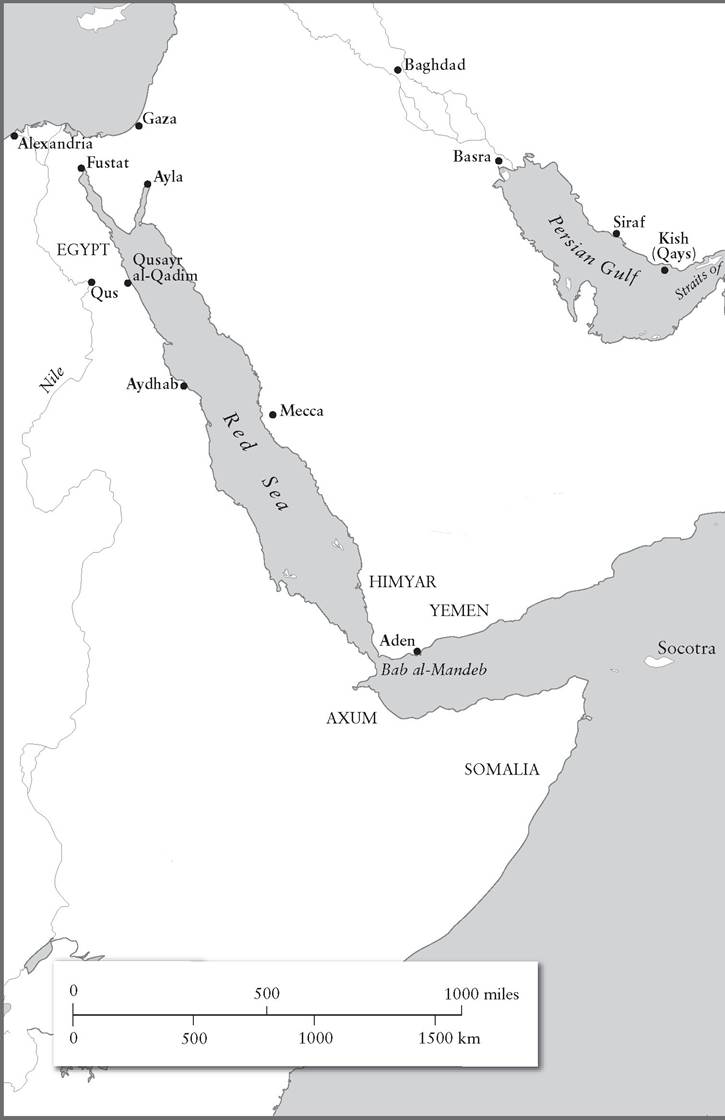
I/O THE MIDDLE OCEAN: THE INDIAN OCEAN AND ITS NEIGHBOURS (as demand in the Mediterranean also expanded and expanded) throughout the Middle Ages.5
II
But it was not, to use an obvious cliche, all plain sailing. In the middle of the eighth century, the dissensions and rivalries within the Islamic caliphate saw a new centre of power emerge in Iraq, at Baghdad, not far from ancient Babylon, where the Abbasid dynasty ruled in place of the Umayyads of Damascus, the last of whom had fled to the very ends of the earth, to found the emirate of Cordoba in al-Andalus, Muslim Spain. Damascus had been a glorious city, drawing in luxuries from the Indian Ocean and artists from Byzantium (such as those who decorated the Great Mosque with mosaics). Nothing much survives of mud-built Baghdad from its early days, but the new dynasty became even more exposed than the rulers of Damascus to Persian cultural influence, and their court was observed and envied across the world.
This was particularly true around 800, in the days of Harun ar-Rashid, whose reign coincided with that of Charlemagne, to whom he sent gifts of an elephant and the keys to the Church of the Holy Sepulchre in Jerusalem.6The poet Horace wrote of Rome: ‘captive Greece captured her rude conqueror’; and much the same could be said of the Arab invasion of Persia, which did not displace the Persian language and took a long while to displace the Zoroastrian religion.7 The scintillating couturier, hairdresser and choir-master Ziryab brought the Persian fashions of the Abbasids all the way to Spain in the eighth century, introducing underarm deodorant, bouffant hairstyles and artichokes to the all-but-barbarian lands close to the dark ocean of the West. Yet the rise of the Abbasids had even greater impact on the Indian Ocean world. The Persian Gulf re-emerged as a lively passageway bringing goods from the Far East; ‘Persian’ (Basi) merchants were already familiar in the coastal towns of China, though, as will become clear, this was a catch-all term that must have included plenty of Jews, Arabs and even Indians as well.8 This is not to deny that much of the silk and many of the perfumes, precious stones and spices that reached Baghdad came overland through Persia, beyond which, in Transoxiana and Uzbekistan, lay rich silver mines whose ore was purified and minted as coin in Bukhara. These were places that pointed towards the overland route, the Silk Road, leading across the deserts of central Asia to Tang China, a network of interconnected routes that at this period was still flourishing.9 Other routes led across western Asia towards Scandinavia, taking vast
amounts of silver and swatches of Chinese silk through the empire of the White Bulgars and that of the Jewish Khazars towards the gloomy and frozen lands of the Swedes and their neighbours.10
That there were links to China is plain from a statement by the tenthcentury Arab geographer ibn Hawqal.
Here he is describing the port of Siraf on the Iranian shore of the Persian Gulf:Its inhabitants are very rich. I was told that one of them, feeling ill, made his testament; the third part of his fortune, which he had in cash, amounted to a million dinars not counting the capital which he laid out to people who undertook to trade with it on a commission [commenda ] basis. Then there is Ramisht, whose son Musa I have met in Aden, in the year 539 ah [ad 1144-5]; he told me that the silver plate used by him was, when weighed, found to be 1,200 manns. Musa is the youngest of his sons and has the least merchandise; Ramisht has four servants, each of whom is said to be richer than his son Musa. I have met ‘Ali al-Nili from the countryside of al-Hilla, Ramisht’s clerk, and he told me that when he came back from China twenty years before, his merchandise was worth half a million dinars; if that is the wealth of his clerk, what will he himself be worth! It was Ramisht who removed the silver water-spout of the Ka‘aba and replaced it with a golden one, and also covered the Ka‘aba with Chinese cloth, the value of which cannot be estimated. In short, I have heard of no merchant in our time who has equalled Ramisht in wealth or prestige.11
The same Ramisht appeared in letters written by Jewish merchants based in Cairo and in India as the fabulously wealthy owner of massive ships, the sort of businessman whose palatial style of life is celebrated in the Thousand and One Nights (as in the case of Sindbad the Sailor, loaded with wealth after his return from his voyages).
Sirafi merchants implanted themselves in many corners of the Indian Ocean: some traded to Zanzibar, while the head of the Muslim community at Saimur, near Bombay (Mumbai), was from Siraf.12 Other Arab writers describe complex maritime routes carrying dhows laden with goods beyond Ceylon to the Spice Islands and China itself. A ninth-century Arab merchant, whose name was probably Sulayman of Basra, knew China particularly well, and he reported that Siraf was the departure point for the ships carrying goods all the way to China.
Whether these were actually Chinese ships is very doubtful, and whether they often went all the way to China is also uncertain, despite a reference to a ship leaving Siraf for China. Very long voyages that involved waiting out the monsoons were best conducted in stages, as the same manuscript indicates later on (‘the trading voyages from Oman go, these days, as far as Kalah, thenI72 THE MIDDLE OCEAN: THE INDIAN OCEAN AND ITS NEIGHBOURS return from there to Oman’). However, Sulayman (or whatever he was called) insisted, against the other evidence, that few Chinese goods reached either his home city of Basra or the Abbasid capital at Baghdad, and that attempts to export cargoes from China had been hampered by fires in the wooden warehouses in China, by shipwrecks and by piracy.13
Another author, Abu Zayd Hassan of Siraf, added extra chapters to Sulayman’s book, in which he complained that all maritime ties between Siraf and China had been sundered after a rebel named Huang Chao seized power in Guangzhou in 878: ‘because of events that occurred there, the trading voyages to China were abandoned and the country itself ruined, leaving all traces of its greatness gone and everything in utter disarray.’ His conquest was accompanied by ruthless massacres: ‘experts on Chinese affairs reported that the number of Muslims, Jews, Christians and Zoro- astrians massacred by him, quite apart from the native Chinese, was 120,000.’ Moreover, the conqueror did the trade and industry of southern China no favours when he cut down the mulberry trees that provided raw silk: ‘owing to the destruction of the trees, the silkworms perished, and this, in turn, caused silk, in particular, to disappear from Arab lands.’ The rebel leader was defeated, but damage of this order could clearly not be repaired overnight.14 On the other hand, this writer was perfectly familiar with Chinese copper cash which had turned up in Siraf inscribed with Chinese characters. He was surprised that the Chinese had little interest in gold and silver coinage, but relied instead on strings of vast numbers of very low-value coins; the Chinese took the view that it was much more difficult to steal large amounts of money if it consisted of heavy strings of copper coins, each of which was worth only a tiny fraction of a gold dinar. He was also familiar with Chinese painting, drawing and craftsmanship, which, he admitted, was the finest in the world.15
Siraf is especially interesting, because, in addition to the testimony of these writers, there is the evidence from excavations conducted by the British Institute of Persian Studies in the 1960s. Siraf turned out to be rather older than had been assumed: inhabited by Zoroastrians, the town acquired the distinctive red pottery of the Roman Empire, and a gold coin of a mid-seventh-century Byzantine emperor, Constans II, was found as well. Its high point was in the ninth to the tenth centuries, but it was already a lively centre of business soon after ad 700. In the eighth century coins from Iraq, Afghanistan, Persia and even Spain were buried in a coin hoard, only to be rediscovered 1,200 years later. During the excavation of what had been the platform of the Great Mosque, plenty of Tang pottery from the same period was found. However, in 977 an earthquake damaged the town, and thereafter merchants trading up the Persian Gulf
concentrated their attention on the island of Kish (or Qays), which became the seat of a small but successful pirate kingdom, and by the end of the twelfth century Siraf had disappeared off the map. Ramisht lived at a time when Siraf was long past its best. Another factor, to which this chapter will return, was the increasing importance of the rival route taking spices up the Red Sea, following a political revolution in Egypt. At its peak, Siraf was rather less than half the size of the circular inner core of Baghdad, but that actually speaks for its very great size, given the vastness of the Abbasid capital. Shops and bazaars stretched along the seafront for a kilometre or more, which was about half the length of the town. Two- storey buildings with paved courtyards were probably the residences of prosperous merchants and officials, but one building, said to be larger than Hatfield House in southern England (an odd comparison), was, one would imagine, the palace of someone like the merchant-prince Ramisht.16 The town lay in an unpropitious setting, dry and stony. It was not easy to produce food locally. But, as a citizen of another city set in a rocky landscape, Dubrovnik, argued several centuries later, the very sterility of the surrounding countryside made trade an imperative.17
While it would be a mistake to underestimate the importance of the Persian Gulf in the eleventh and twelfth centuries, changes further west stimulated the revival of Red Sea commerce from the tenth century onwards. The Abbasid Empire began to fragment; the greatest challenge came from the rise to power of the Shi‘ite Fatimid dynasty, first in Tunisia (where they founded the city of Qayrawan, ‘the caravan’, with its Great Mosque), and then in Cairo, where they were able to compete for domination over the Levant. Partly as a result of these political changes, the Mediterranean began to reawaken, and this reawakening was further stimulated by the emergence of Christian trading republics, first Amalfi and Venice, then Pisa and Genoa, that eagerly bought the spices of the East and passed them across the sea to Europe, and then along land and river routes that reached as far as Flanders, Germany and England. And all of these developments had major repercussions in the Indian Ocean as well. The sea routes across the Mediterranean have already been traced in the accompanying volume on ‘the Great Sea’.18 But now it is time to trace a sea route that leads all the way from the Nile to Indonesia and China.
Ill
By 1000 Persia and Mesopotamia lost their primacy; the Gulf did not exactly become a backwater, for it was home to the pirate kingdom of Kish, but the old Greco-Roman routes down the other coast of Arabia were reborn. The Red Sea revival is plain from the archaeological record along its shores. From the late ninth century onwards, sherds of Chinese celadons and of white porcelain from distant Jingdezhen appear in excavations as far north as Ayla.19 Goldmining in Sudan began to produce handsome returns. Egyptian emeralds were exported in the direction of India, and were traded by Chola Tamils from there towards Sumatra and beyond. Further afield, Chinese ceramics arrived in Cairo. An off-white ewer, decorated with an engraved portrait of a phoenix, arrived there by 1000, but now lies in the British Museum. Hundreds of thousands of sherds from shattered Chinese pots have been found on medieval sites in Cairo. As time went by, the strong demand for Chinese porcelain in Egypt prompted Egyptian potters to manufacture their own imitations, but they never compared seriously with the genuine article.20 Another sign of growing familiarity with celadons and white wares from the Far East was the request to a rabbinical court to investigate whether the impurity attributed in Jewish law to a menstruating woman would be communicated to a porcelain cup were she to touch it. Different categories of goods - earthenware, glass, metalwork - were deemed susceptible to impurity in differing degrees, but what about fine glazed wares from the East?21
This curious request comes from the mountain of papers, or rather fragments of paper, that make up the Cairo Genizah documents, most of which were sold to Cambridge University following their discovery in the attic storeroom of the Ben Ezra Synagogue in Fustat, or Old Cairo, at the end of the nineteenth century. The Genizah is not an ordered archive, but a giant rubbish basket, a random assortment of documents thrown away because no one could be bothered to sort out those that might contain the divine name (and thus need to be preserved with reverence, or buried if too dilapidated). Precisely for this reason, the documents, including merchant letters, pages of account books, rabbinic decisions, or responsa, magical, medical and religious texts, shed a brilliant light on the daily life of Jews and also Muslims in Egypt between the tenth and the twelfth centuries. In particular, they expose the business affairs of Egyptian Jewish merchants who traded westwards into the Mediterranean, particularly towards Tunisia and Sicily, but who also had very substantial trading interests in the Red Sea and the Indian Ocean up to the late twelfth century.22 The first scholar to conduct intensive research on this material, S. D. Goitein of Princeton, rather assumed that the character of the trade of these merchants was static, whereas the Red Sea and Indian Ocean trade became increasingly important during the twelfth century, in response to growing demand within the Mediterranean for exotic eastern products used as food flavourings, dyestuffs and medicines. There is a flipside to this argument: the increasing dominance of the Genoese, Pisans and Venetians in the spice trade linking the Levant to Europe, and the success of their navies in dominating the Mediterranean sea routes, prompted the Genizah merchants to turn away from the Mediterranean and to look with greater interest at the opportunities offered by the Red Sea and the route bringing spices from India, where some of them even installed themselves. The letters left by these merchants trading towards Aden and India permit an intimate portrait that goes beyond their account books and reveals their daily life, their contacts with Muslim and Hindu merchants, and the trials and tribulations of those seeking to bring goods across what were for those times vast distances.
In the late tenth century Fustat, long the nucleus of Cairo, was displaced by a new city built a couple of miles away by the new Fatimid caliphs. The new Cairo lay around the imposing citadel of Ptolemaic Babylonia. The creation of a new capital transformed Fustat into a suburb inhabited by non-Muslims: one of its Coptic churches was said to stand on the site where Joseph, Mary and Jesus had taken refuge following their flight into Egypt. Competing legends about the Ben Ezra synagogue went much further back in time, so that it became known as the synagogue Moses had used when he was living in Egypt. Be that as it may, it was certainly the synagogue where another famous Moses, the philosopher Moses Maimon- ides, based himself after his own flight to Egypt, which had taken him from Cordoba and Fez, both ruled by the hardline Almohad caliphs, all the way to Egypt. Not surprisingly, then, the Genizah documents contain several handwritten letters and discarded notes from the great Maimon- ides. His brother David was one of the India traders, and when he was drowned in the Indian Ocean in 1169 Maimonides was plunged into despair for several years. David had set out on his journey by sailing down the Nile and then crossing the desert in the company of a caravan to reach Aydhab. Or, rather, that was the intention; David and another Jewish merchant became detached from their companions, and had to make their way to Aydhab without anyone to protect them from bandits. David wrote back to Moses, admitting that everything had gone wrong because he had acted in ignorance:
When we were in the desert, we regretted what we had done, but the matter had gone out of our hands. Yet God willed that we should be saved. We arrived at Aydhab safely with our entire baggage. We were unloading our things at the city gate, when the caravans arrived. Their passengers had been robbed and wounded and some had died of thirst.23
Anyone reading those documents, or indeed this book, might well conclude that robbers, pirates and typhoons made these long- distance journeys risky to the point of foolhardiness.24 David ben Maimon seems to have thought that when he wrote to his brother from Aydhab. He was also worried about how the boat was built: the sight of an Arab dhow whose planks were tied together by ropes, in the traditional way, could shock a traveller familiar with the vessels that sailed the ‘Sea of Tripoli’, that is, the Mediterranean: ‘we set sail in a ship with not a single nail of iron in it, but held together by ropes; may God protect it with His shield!... I am about to cross the great ocean, not a sea like that of Tripoli; and I do not know if we will ever meet again.’25 They did not, for, once out in the ocean, David’s ship went down with all hands.
The Genizah documents have transformed knowledge of the India trade and have shown how torn and discarded letters thought to be of no value can shed more light on the conduct of trade than official records. Yet this material, though quite plentiful, is not unique. And one is bound to ask whether the Jews of Fustat were typical of a society in which, after all, Jews were only a minority. It was obvious, for instance, that Jews were not especially interested in the grain trade, but were very interested in flax and silk. No one can say whether the family ties that bound together Jewish trading families from Sicily, Tunisia, Egypt and Yemen were replicated among Muslim trading families - probably not. That is why it was so exciting when the excavators of the so-called Shaykh’s House at Qusayr al-Qadim on the Red Sea found the remains of about 150 documents that had mostly been torn to shreds, but could nonetheless be reconstructed.26 This material is a little later than the vast bulk of the Genizah documents, but should be looked at now, as the maritime route down the Red Sea into the Indian Ocean is followed stage by stage. The Qusayr documents reveal the business affairs of an early thirteenth-century merchant named Abu Mufarrij, and the information they contain can once again be compared with the archaeological record, including evidence that ceramics arrived in the Red Sea from as far away as China, and gold probably came up the African coast from Kilwa and Zanzibar.
The sheikh was very seriously interested in flour and other foodstuffs, which marks him out from the Jewish merchants of the Genizah: ‘to be delivered to Sheikh Abu Mufarrij from the south are: one and a quarter loads of grain and an oil strainer, to be loaded on the vessel Good Tidings.’27 Qusayr was another place in a barren spot, so there was a constant need for basic supplies. It is not surprising that wheat was much more expensive in Qusayr than in the great Egyptian cities; it could cost four times what one would expect to pay in Alexandria and twice what people paid in Cairo.28 The letters from Qusayr al-Qadim fill out our picture of trade in the region by shifting the emphasis away from the spices and fine goods enumerated in the Genizah documents towards humbler but more vital products such as wheat, chickpeas, beans, dates, oil and rice, the staples of daily existence. The wheat sometimes came in the form of grain, sometimes ground down into flour. The quantities mentioned were considerable: as much as three tons in one document, which was enough to feed four or five households for an entire year.29 In view of the arid setting in which Qusayr al-Qadim stands, the grain may well have been grown some distance away, whether in the Nile valley, arriving by way of Qus, or in Yemen, in the corner of south Arabia exposed to the monsoon rains. Qusayr was known to Arab writers as Qusayr furda al-Qus, meaning ‘Qusayr the gateway of Qus’ (the word furda had overtones of ‘government checkpoint’, a place where tiresome customs officers would tax everything that came and went).30 Yemen was certainly seen as an especially important trading partner; the geographer Yaqut ar-Rumi, who was of Greek origin and who died in 1229, wrote of Qusayr: ‘there is a harbour for ships coming from Yemen’.31 Unfortunately it is often hard to work out whether Abu Mufarrij was exporting or importing the products he handled.
Using these documents, we can see what was happening in the upper reaches of the Red Sea, in a port that gave access to the Egyptian trading station at Qus on the Nile, and thence by way of the River Nile to Cairo and Alexandria.32 Qusayr lay at the closest point to the Nile of any of the Red Sea ports. This did not make Qusayr into a truly major centre of Indian Ocean traffic, and some of its business was directed at other ports within the Red Sea, including those directly opposite that led into the Arabian desert, and pointed towards the holy city of Mecca, which - because of its barren environment - drew in supplies of wheat and other basic necessities from Qusayr and similar small ports. One constraint on Qusayr’s growth was the lack of good-quality water; in the nineteenth century, drinking water was brought from a well six miles away, although the water stank of sulphur, while another spring in the area produced saline water laced with phosphorus, which was only good for animals, if that.33 Still, one should not underestimate Qusayr’s importance: fragments of ships have been found there, sometimes used to line graves, and they were taken from both sewn-plank and nailed-plank ships similar to dhows.34 Ships that arrived in Qusayr would sometimes be taken to pieces and carried on the backs of camels across the desert to Qus, where they would be reassembled and refloated, this time on the Nile.
Sheikh Abu Mufarrij had the support of loyal servants who wrote to him regularly, reporting on what they had despatched:
By God, by God! Anything you want, let me know. Whatever you, the Master, need, write me a memo and send it through the porters; I will ship off your orders. Upon the delivery of the crops as ordered hereby, you should send us the full payment. Peace be upon you. God’s mercy and blessings.35
Physical remains from Qusayr confirm the passage through the little town of a great variety of foods brought from all around the Indian Ocean. Some tubers of taro, which is a south-east-Asian vegetable, have been found, along with coconut shells, as well as citron, the large lemon-shaped citrus fruit that was much in demand in Jewish communities, for use during the rituals of the Feast of Tabernacles. Dates, almonds, watermelons, pistachios, cardamom, black pepper and aubergine all appear among the finds from Islamic Qusayr.36 Archaeology fills out the picture that can be drawn from the sheikh’s correspondence. Almonds and eggs comprised a third of one cargo handled by Abu Mufarrij; the letters testify that the town bought fresh and dried fruit, including watermelons and lemons, which were not for export, except perhaps to supply ships in port. The sheikh’s overriding desire for grain is nicely matched by the finds of seeds on the site of Qusayr al-Qadim.
The sheikh’s agents bought and sold humdrum items such as hawsers and mattocks; but perfumes and pepper were also of interest. Thousands of finds of fragments of cordage confirm that the sheikh’s interest in supplying ropes continued over the centuries, and many were evidently used on board ship.37 So too were clothes, some quite ordinary, such as goodquality galabiyahs, and others ‘decorated with gold and gems’, or woven from pure silk, or ‘Ethiopian gowns’. Slaves were not one of his strong interests. Like the Jewish merchants, he was interested in buying large amounts of flax, and he handled fine coral too, probably of Mediterranean origin, because that was where very good coral, bright red in colour, could most easily be obtained.38 Abu Mufarrij ran something grander than the Qusayr General Stores, but his interests were very eclectic, and he was evidently one of the town’s main provisioners, whether in food (especially grain) or in what would have been called fancy goods in the nineteenth century. And now and again he revealed that he was interested in more ambitious trading enterprises. One letter sent to the sheikh explained how some valuable Persian goods would soon arrive by sea on a couple of ships: ‘semi-precious stones, pearls and beads’.39 Abu Mufarrij was well versed in the commercial practices of his day, offering credit and arranging transfers, which avoided the need to handle cash.40
The fascination of the Qusayr letters derives from their sheer ordinariness. The sheikh was a wealthy man, at least by the standards of his small, hot, dust-blown town, and the grand trade routes that linked Aydhab and Qusayr to the Far East were not his real concern. Those routes produced great profits for some people, but they had to be serviced, and Qusayr was a convenient service station. It was not a place of high culture - even less so than its ancient predecessors Myos Hormos, on whose remains it stood, or Berenike, with its profusion of temples to many gods. But eastern influences seeped into Qusayr. These links to a wealthier and more exotic world are well represented by an inscribed ostrich egg, bearing a funerary poem:
Leave your homeland in search of prosperity; depart! Travelling has five benefits: dispelling grief, earning livelihood, seeking knowledge, good manners and accompanying the praiseworthy. If it were said that in travelling there is humiliation and hardship, desert raid and overcoming difficulties, then certainly the death of the young man is better than his life in degradation between the slanderer and the envious.41
A pious pilgrim had perhaps died en route to or from Mecca, and was being commemorated with high honour on a giant African egg - the egg being the symbol of resurrection. Exotic links are also well represented by the fragments of Chinese pottery recovered at Qusayr al-Qadim. The types of pottery found are typical enough: green celadons and white or bluish white wares, the sort of pottery that was becoming familiar on the streets of Fustat in the eleventh, twelfth and thirteenth centuries. If anything, Qusayr produced fewer Chinese objects than one would expect; most of the porcelain passed through the port en route to the great cities - around 700,000 sherds of Chinese pottery have been found at Fustat.42 However, one influence from China was block-printing. A few Arabic texts have been found in Qusayr which were printed from a carved wooden block, rather as Chinese printed texts were created in this period, and the view has even been hazarded that the blocks used for printing were made in China, and texts were then printed off there and exported to Middle Eastern consumers. These printed texts were used as amulets: ‘he who wrote this amulet, and he who carries it, will stay safe and sound.’43 These amulets may seem banal: praying to stay safe and sound was a natural reaction to the perils of the open sea. Yet they are a reminder that the account books of Abu Mufarrij, or of the Genizah merchants, only tell part of a human story of worries about how to survive in a maritime world full of danger from storms, reefs, pirates and capricious rulers.
IV
Heading down from Aydhab and Qusayr al-Qadim, the strait linking the Red Sea to the Indian Ocean (the Bab al-Mandeb) was of crucial strategic importance. Just beyond the strait, ships entered a small gulf that debouches into the Indian Ocean. There the major centre of exchange was Aden, a thriving town sunk in the crater of an extinct volcano that was well situated to watch comings and goings through the strait.44 Aden possessed its own resources, which were in part derived from the sea and the coastline: salt, fish and the highly prized whale product ambergris, which was occasionally washed up on the shore and was used in the production of perfume. Water, however, was in short supply, and an ingenious feat of engineering exploited the fact that the town lay within a crater by channelling water that had fallen on higher ground into a series of cisterns. There were even filters that removed some of the impurities from the water as it flowed downwards.45 Inland and further up the coast towards Oman, there were some fertile and well-watered areas that in good years produced plenty of grain to feed not just Aden but places further away such as Mecca.46 The overall picture is, then, not vastly dissimilar from that of Siraf: the city flourished as a centre of trade precisely because local resources were rather meagre; and Aden was very well placed to supervise the traffic heading out of the Red Sea towards India, as well as down the coast of east Africa.
This attracted the envy of rivals. The rulers of Kish, or Qays, just inside the Persian Gulf, hoped to gain control of the trade routes not just through the Gulf, which had withered by the mid-twelfth century, but along the southern flank of Arabia, past Oman and Yemen. So in 1135 they attacked Aden, hoping at the very least to seize the port installations and customs house; Aden was already divided between two cousins, one of whom was in charge of the port. The lord of the port offered to surrender and then plied the attackers with so much food and wine that they were unable to resist when the lord’s men waded into the staggering mass of invaders, and it was later said that they beheaded so many of them that this district was henceforth known as ‘The Skulls’. In reality, Aden was besieged for a couple of months, and relief arrived in the form of two large ships that belonged to Ramisht of Siraf; these were boarded by Adeni troops who were able to attack the aggressors from the rear:
Finally, Ramisht’s two ships arrived. The enemy tried to seize them, but the wind was good, so that they were dispersed on the sea to the right and to the left. The two ships entered the port safely, where they were immediately manned with troops. At this juncture, the enemy could do nothing more, either in the harbour or in the town.47
So wrote a Jewish merchant based in Aden to a business partner in Egypt.
Its rulers were well aware that Aden was the jewel in their crown. There were eagle-eyed customs officers who prodded and probed the merchandise that passed through the government checkpoint, or furda ; detailed records were kept as every piece of cloth was patiently counted in front of the no doubt impatient merchants. This was the sort of treatment Genizah merchants were familiar with from the customs house at Alexandria, and all this acts as a reminder that the high cost of spices was less the result of rarity or even the long voyage that brought them to Aden and Alexandria, than of a sequence of payments to one government after another, not to mention bribes and sweeteners - it would be good to know how much smuggling took place, but Aden looks as if it was the sort of walled and well-guarded city where that was well-nigh impossible.48 Jews, Christians and other non-Muslims were supposed to pay twice the taxes of the faithful, but the rule was rarely applied. From the furda, one door gave on to the harbour front and the other on to the city streets with their multi-storeyed merchant houses built of stone - whether they were quite as tall as the town houses of modern Yemen is uncertain, but the most desirable houses stood near the sea, from which cooling breezes blew that could not reach the lower depths of the crater.49 The general impression is of communities of diverse origins living peacefully side by side, but the atmosphere changed at the end of the twelfth century, when the sultan insisted that all the Jews of Aden and the rest of Yemen must accept Islam, though foreign merchants passing through seem to have been exempt (presumably because they were the subjects of other rulers, whom the sultan preferred not to annoy). A few Adeni Jews resisted and were beheaded, but even the head of the Jewish community embraced Islam. This event stirred the Jewish world. Maimonides wrote a famous tract in which he counselled the Yemenite Jews to be patient; he saw this forced conversion as a sign that the coming of the Messiah and the redemption of Israel were imminent. However, the persecution waned and the community recovered.50
Aden was also a base from which the Cairo merchants sent letters eastwards to India, with information about the state of the pepper market - anticipating where prices would be profitable was fundamental to the business practice of these merchants, who were not mere passive agents.51 The sailing season out of Aden was, by natural circumstances, well co-ordinated with that of the Mediterranean, with ships setting out for India at the start of autumn, which gave time for goods that were being carried down the Red Sea to reach their eastern Mediterranean destinations from as far away as Sicily, Tunisia and Spain. Aden was therefore a nodal point not just in the Indian Ocean maritime networks, but in what can reasonably be called (before the discovery of the Americas) a global network that stretched from Atlantic Seville to the Spice Islands of the Indian Ocean. Broadly speaking the port was very lively from the end of August to May of the following year. Ships converged on Aden from India, Somalia, Eritrea and Zanj (east Africa), so that Aden became a market where the produce of Africa, Asia and the Mediterranean was exchanged.52
V
Moving deeper into the Indian Ocean, the Egyptian merchants who had called in at Aden took advantage of the monsoons to head across the open sea to India. At first sight, the chances of reconstructing the maritime world of India in the tenth to thirteenth centuries might seem slim. Apart from some inscriptions and occasional literary references, the lack of letters and account books appears to be a fundamental obstacle. But this is not the case if the letters of the Jewish merchants from Fustat are taken into account, particularly letters to and from figures such as Abraham ibn Yiju, who actually lived for a while on the coast of India. The Fustat traders had plenty of contact with Indian princes, merchants and shipowners. For instance, Pidyar was an Indian, or possibly Persian, shipowner with whom they dealt; he possessed a small fleet, and employed at least one Muslim captain, of whatever ethnic origin.53 There were also local Jewish and Muslim shipowners, such as the head of the Jewish community in Yemen, whose brand new ship named the Kulami sank five days out of Aden even though it had set out with a sister ship, the Baribatani :
The sailors of the Baribatani heard the cries of the sailors of the Kulami and their screams and shrieks in the night as the water inundated them. When morning came, the sailors of the Baribatani did not encounter any trace or evidence of the Kulami, because from the time the two ships had left Aden they had kept abreast of each other.54
Distressing as this was, it was a less disastrous fate than that facing a certain ibn al-Muqaddam, whose religion is unknown; after several voyages from Aden to the Malabar Coast he lost his ship at sea, replaced it, and lost the replacement. These were not everyday occurrences; they are known from the legal cases that then arose - it was very important in Jewish law to be able to certify that those who had been shipwrecked had indeed died, so that any widows could remarry without fear of the particularly severe but fortunately quite rare bastardy that any new children would bear if the first husband were still alive.55
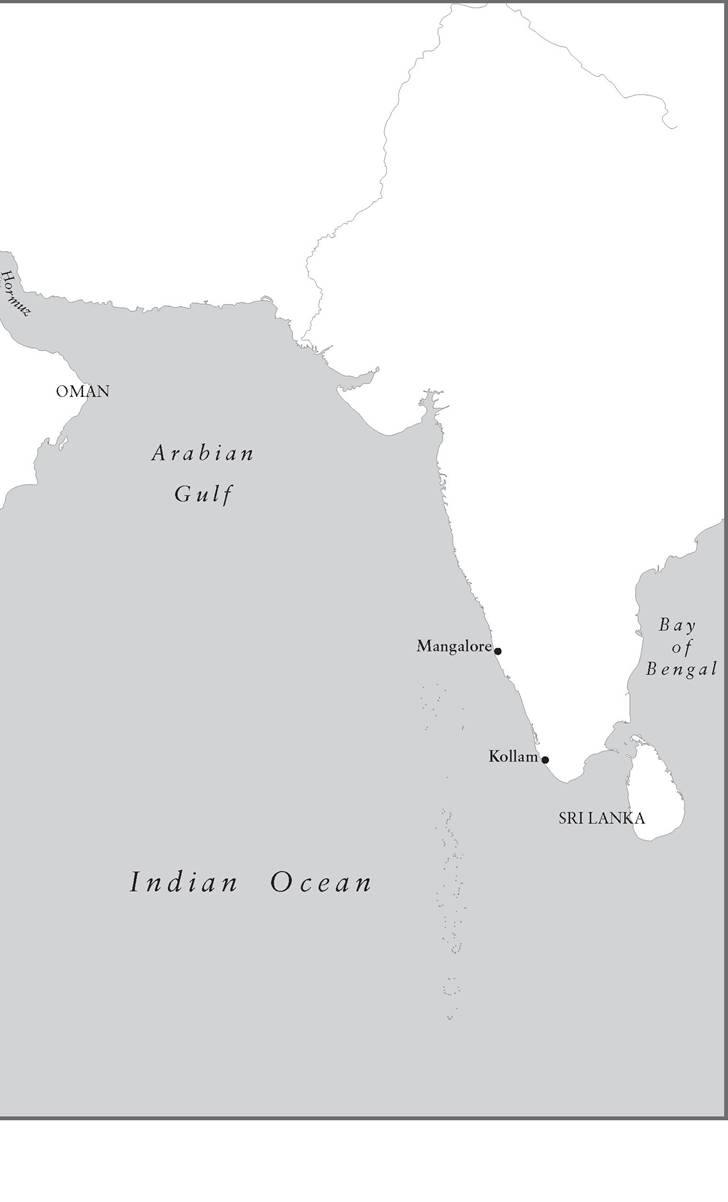
Remarkable Indian inscriptions survive that shed light on the maritime connections and town life of the Indian coast around this time. The light they shed is obscured by the great difficulty in making sense of a series of copper plates in the difficult Malayalam language. They are legal documents, such as a royal grant of land and privileges to a Christian church, and they were inscribed in the port city of Kollam, or Quilon, in the far south-west of India not far from Ceylon, in ad 849. Important privileges were preserved in this permanent form in order to express the intention that they would hold ‘for as long as the Earth, the Moon and the Sun shall endure’. The simple fact that the texts carry signatures in several scripts brings into focus the ethnic and religious diversity of the major trading towns along the coast of India at this period: twenty-five witnesses to these texts wrote their names in their everyday alphabet and language, whether Arabic and Middle Persian (written in Arabic script) or Judaeo-Persian (written in Hebrew script); some were Jews, others Christians, Muslims, Hindus or Zoroastrians, who described themselves uncompromisingly as ‘those of the Good Religion’. The copper plates mention the two guilds that brought together merchants trading out of Kollam; one, called ‘Mani- graman’, specialized in Sumatra and the Malay peninsula, and the other, ‘Ancuvannam’, looked in the other direction entirely, towards Arabia and east Africa. While the Sumatra-bound merchants were themselves south Indian Tamils, those trading towards Asia were Arabs, Persians and Jews, the sort of people who signed the copper plates. The guilds operated under royal supervision; as one of the plates states: ‘all royal business whatsoever, in the matter of pricing commodities and suchlike, shall be carried out by them.’ What this meant was that the guilds, on behalf of the rajah, would collect taxes on the goods that came and went through the port and out of the land-gates.56 This also shows that the rajah believed he could trust both native and foreign merchants to act responsibly on his behalf; it was only natural that he should show such a warm welcome to the foreign traders, because without them Kollam would have been nothing, and his own income would have shrivelled.
In 851, at almost the moment when these plates were being prepared, the Muslim merchant probably named Sulayman placed on record his voyages around the Indian Ocean and beyond, as far as China, to which he devoted most of the space in his book. Sulayman knew about the place
184 THE MIDDLE OCEAN: THE INDIAN OCEAN AND ITS NEIGHBOURS he called Kulam of Malaya (which here signified Malabar, not the Malay peninsula), that is, Kollam; he placed it a month’s sailing beyond Muscat in south-east Arabia. He knew that ships arrived here from as far away as China. He saw Kollam as the major interchange point between the trade of the eastern and the western Indian Ocean, which matches closely what is known about the activities of the two merchant guilds.57 As far as he was concerned, the sea route was the obvious way to China. No doubt different places along the Malabar Coast enjoyed greater success at different times. In Sulayman’s time, the route from Siraf and the Persian Gulf to India was particularly active; but Sulayman was active before Fatimid Egypt took command of the maritime routes across the western Indian Ocean. Therefore it is no surprise that the copper documents mention Muslims and Jews of Persian origin, while the Genizah letters survive from an era when Jews and Muslims of Egyptian or even Tunisian origin were just as likely to be found in the coastal cities of southern India.58
The risks of travel did not prevent ambitious Fustat merchants from reaching India, rather than simply relying on the Indian and Muslim shippers who reached Aden. The greater the risks, the higher the profits. In the mid-twelfth century a group of Jews, including Salim ‘the son of the cantor’ and several goldsmiths, set out from Aden to Ceylon in partnership with a very wealthy Muslim merchant named Bilal. Ceylon was considered a good source of cinnamon. A north African merchant who had been living in Fustat, Abu’l-Faraj Nissim, went to India to buy camphor. He wrote to his family saying the voyage had been a terrible experience, but he managed to buy plenty of camphor, worth at least 100 dinars, and sent it to Aden, where it arrived safely. Two years passed and nothing was heard of him, so it was time to divide the profits from his shipment.59 A happier fate awaited the ben Yiju family, very active in Mediterranean trade but also seriously interested in the produce of the Indies. This family provides a marvellous example of how spices were transmitted all the way from India to major Mediterranean cities such as Palermo and Mahdia, a flourishing centre of exchange on the coast of Tunisia. Abraham ben Yiju set out for India in around 1131, and one of his correspondents commiserated with him for his difficult journey, but prayed that God would ‘make the outcome good’, that is, bring him great profit.60
In 1132 Abraham found himself at Mangalore on the Malabar Coast. This area was known as far away as China, where, in the early thirteenth century, the geographer Zhao Rugua described the people as dark brown, with long earlobes; they wore colourful silk turbans and sold pearls fished locally, as well as cotton cloth; they used silver coins and they bought silk, porcelain, camphor, cloves, rhubarb and other spices that
arrived from further east, but in his day (he claimed) few ships made the long and difficult journey from China.61 This was a pessimistic judgement, echoing, consciously or otherwise, the reservations of the ninth-century merchant Sulayman about Chinese trade with Iraq, because the quantities of Chinese goods found in Egypt and other parts of the Middle East prove that contact was intense and continuous, and also very profitable. For Abraham ben Yiju prospered while he was based in Mangalore. He bought a slave girl there; he then freed her, which had the effect in Jewish law of converting her to Judaism (he gave her the Hebrew name Beracha, or ‘Blessing’), and after that he married her and raised a family. Meanwhile, he was sending goods up and down the coast of western India; he made a lengthy visit to Aden around 1140, but he stayed most of the time in India until 1149.
Abraham set up a factory where bronze goods were produced - trays, bowls, candlesticks, sometimes quite intricate in design, to judge from a letter from Aden ordering some custom-made metalwork from him. He imported arsenic from the West, for he was told there was strong demand for it in Ceylon, where it was used in medicine. He brought in Egyptian cotton, and sent out iron, mangoes and coconuts, working with Muslim, Jewish and Banyan, or Hindu, partners. The Muslim partners of ben Yiju included the wealthy merchant of Siraf, Ramisht, whose large ships were well trusted; but even then things could go badly wrong, for one letter says that two of his ships were ‘total losses’, including valuable cargo belonging to Abraham ben Yiju.62 Wealthy merchants needed some resilience; it was important not to place all one’s eggs in the same basket. Not for nothing did they interest themselves in a variety of goods, for one never knew what would prove most profitable, however closely one read letters coming in from Palermo, Alexandria, Fustat and Aden, with their information about prices, political conditions and which merchants should be trusted.
Among the goods that Abraham ben Yiju appreciated most were consignments of paper, which was in short supply in India and even in Aden, for, as his correspondent in Aden wrote, ‘for two years now, it has been impossible to get any in the market’.63 Foreign merchants such as ben Yiju preferred using paper to writing on palm leaves or cloth, and ben Yiju had special reason to want more paper, as he was something of a poet in his spare time, and, even if his own poetry was not much good, he admired the great Spanish writers who in his day were producing beautiful religious poetry that was soon to be incorporated into the Jewish liturgy. He dabbled in Jewish law and took part in a religious court of law, or bet din, in India - there seems to have been another Jewish court at Barygaza, the ancient centre of the Indian Ocean trade in the north-west corner of India.64 All this suggests that he was far from alone in Mangalore; there were other Jews up and down the coast, and there must have been even larger communities of Muslim merchants, not to mention the Indian merchants who sailed westwards but also (along with the Malays) ensured that connections to Malaya and Indonesia, and even China, were maintained. The news network of which he was part extended all the way from India to Sicily and perhaps Spain. Now wealthy, he had hoped to settle for the rest of his days in Mahdia or somewhere near there; but just after he left India for Aden he heard that the king of Sicily had conquered the coast of Tunisia (he assumed that there had been massacres, but the conquest was relatively peaceful).65 It is hard to recover a sense of what it was like to live in Mangalore, so far from home; but the nostalgia for north Africa that ben Yiju showed when he had made his fortune reveals that he saw his trading career in India as just that, a career which would eventually, if luck held, make him rich enough to return to the land of his ancestors, taking with him his Indian wife and his children, for whom this would be a new world.
The Malabar coast looked in two directions, as it had in Roman times. The Chinese geographer Zhao Rugua remarked that one could reach that part of India from Sri Vijaya ‘in little more than a month’.66 Not very often, but sometimes, Jewish traders ranged far beyond India. A tenthcentury book called Wonders of India was composed by a Persian author called Buzurg, but written in Arabic. Buzurg told the ‘curious tale’ (his own words) of Isaac the Jew who was sued by a fellow Jew in Oman and took flight to India somewhere around ad 882. He was able to take his goods with him, and for thirty years no one back in the West knew what had happened to him. In fact, he had been making a fortune in China, where he was taken for an Arab (as Jewish traders often were). In 912-13 he turned up in Oman once again, this time aboard his own ship, whose cargo was estimated to be worth 1,000,000 gold dinars, and on which he paid a tax of 1,000,000 silver dirhams. This may have amounted to a tax of about 12 per cent and it kept the local governor happy, but it also aroused the jealousy of other merchants who had no hope of supplying treasures of comparable quality. (Since a lower-middle-class family could subsist quite well on twenty-four dinars per annum, 1,000,000 dinars can be thought of as comparable to nearly 1,000,000 pounds sterling or more than a billion and a half dollars, though such comparisons are not particularly meaningful.)67 Silks, Chinese ceramics, jewels and high- quality musk were just some of the exotic goods he brought to Arabia. So after three years he decided he had experienced enough hostility, and commissioned a new ship, which he filled with merchandise, and sailed east in the hope of reaching China once again. This meant that he had to pass ‘Serboza’, which must be the maritime kingdom of Sri Vijaya. Its rajah saw a good opportunity to mint money, and demanded a fee of 20,000 dinars before he would let him leave for China. Isaac objected and was seized and put to death that very night. The rajah expropriated the ship and all the merchandise.68
Later generations were more circumspect about making such ambitious voyages. The Genizah merchants were generally content to stay in India or even Aden, and to wait for Chinese goods to reach them; these included the glazed porcelain bowls that aroused such concern about their ritual purity should they be touched by a menstruating woman.69 India was the interchange point between what at first sight appear to be two trading networks, or even three: from Egypt via Aden to the Malabar Coast, and from the Malabar Coast to Malaya and Indonesia, with a further extension to Quanzhou and other Chinese ports.70 But when the goods traded come under consideration this looks more like a single line of communication linking Alexandria in the Mediterranean to China, along which silk, spices, porcelain, metalwork and also religious ideas were transmitted, along with all those humdrum materials - wheat, rice, dates, and so on - in which the sheikh of Qusayr, among many others, mainly dealt.
VI
The twelfth century saw important changes in the character of the merchants who passed up and down the Red Sea, even though the goods they carried probably did not alter very significantly, except to increase in volume. The increasing sensitivity of the Muslim rulers to the presence of non-Muslims in the Red Sea was in large part the result of the attempt by a crusader lord, Reynaud de Chatillon, to launch a fleet on the Red Sea during the 1180s, with the aim of attacking Mecca and Medina, and of launching pirate raids on traffic passing through the Red Sea. Although Reynaud’s activities were suppressed, his pirates came dangerously close to Medina; this resulted in the closure of the Red Sea to non-Muslims.71 A corporation of Muslim merchants was created in Egypt who excluded the old generation of Genizah merchants from the India trade. These karimi merchants, as they were known, benefited from the goodwill of the government in Cairo, which saw how profitable taxation of the spice traffic could be.72
Yet the intimate relationship between Egypt and India continued, and the flow of precious metals that resulted from these exchanges can be likened to a pair of rivers that converged on India. India was, as it always has been, a land in which a rich elite lived a luxurious life far removed from the daily grind of the poor, and the same picture can be painted of medieval China. Payments for Indian luxuries continued to flood into the coffers of the rajahs, in gold and silver, and some of this income was spent on courtly magnificence and warfare. But the thesaurisation (to use a handy French word) of bullion flowing in from the West and from China proceeded apace, as the treasuries of Indian princes immobilized the precious metals that came into the country; Egypt, Syria and north Africa found themselves short of silver, which was needed for smaller payments, though expedients to solve the problem included glass tokens and lead coins. They could obtain silver from northern Iran, to some extent; but Iranian silver tended to drain towards Baghdad. They could obtain silver from western Europe; and the growing demand there for eastern spices, from the late eleventh century onwards, meant that merchants from Venice, Genoa and Pisa were keen to establish a presence in Alexandria and other Levantine cities, and to pay in white money for prodigious amounts of pepper, ginger and other Indian or Indonesian goods. It will be seen too that vast amounts of Chinese cash were being taken out of the Middle Kingdom towards surrounding lands, including Japan and Java. It is often said that the beating of a butterfly’s wings can affect the climate of the whole world. It can at least be said that the transactions which took place along a series of maritime trade routes that stretched from Spain - and eventually the Atlantic - to Japan had knock-on effects capable of reaching far down the line. Setting aside the Americas, still unknown to the inhabitants of other continents (ignoring for the moment the Norsemen), a global network existed, one that had gained in strength and permanence since the days of the Greco-Roman trade towards India.
More on the topic 9 I am about to cross the Great Ocean:
- The Indian Ocean ranks among the most long-lived spaces of historical memory and the present burst of historiographical attention to this ocean should be interpreted in this context.
- PART TWO The Middle Ocean: The Indian Ocean and Its Neighbours, 4500 bc-ad 1500
- 1 Cross-compliance and payment conditionality
- 10 Cross-compliance and the Polluter Pays Principle
- CROSS-SECTORAL LINKS
- Cross-cultural Perspective
- An Ocean of Whales and Whaling
- Cross-country evidence
- 3. Cross-country growth regressions: from theory to empirics
- Establishing the Ocean
- 36 The Fourth Ocean
- A CROSS-CULTURAL COMPARISON OF SECTORAL LINKS: MALACCA
- CHURNING THE MILKY OCEAN
- A CROSS-CULTURAL COMPARISON