8 A Maritime Empire?
I
At the eastern end of the Indian Ocean and in the South China Sea, the sixth and seventh centuries saw transformations that turned the spasmodic contact between lands bordering the western Pacific and the Indian Ocean into a two-way traffic lane.
This brought prosperity to lands on the southern fringe of the South China Sea that had previously lain on the outer margins of the trade routes. The kingdom of Èri Vijaya, based around Palembang in Sumatra, has been mentioned already. Early in the twentieth century French archaeologists and orientalists were convinced that they had brought to light a great trading empire of the early Middle Ages, whose impact could still be felt in the fifteenth century when the founders of Melaka (Malacca) traced their descent to the ancient rulers of Palembang.1 The difficulty was that material remains were few; on the other hand, literary references were rich, allowing for the constant problem of the Chinese transcription of foreign place names. Compared to Oc-èo, the physical evidence for a great trading station at Palembang was virtually non-existent.2 It is therefore no great surprise that more recent research into the history of early south-east Asia has cast doubt on the very existence of this trading empire, which has been described by one of its detractors as a ‘vague supposed thalassocracy’.3That a kingdom existed in Sumatra, flanking the South China Sea, is not in doubt; but how long it flourished, and whether it achieved such great wealth as has been assumed, is now less certain. One of its first historians, Gabriel Ferrand, admitted that ‘one will search in vain for the name of Èri Vijaya’ in books of geography and history, while he also argued that the empire enjoyed no less than seven centuries of prosperity; its reputation was carried across the South China Sea to the Heavenly Kingdom.
This place was visited by Chinese travellers such as Da Qin, described as a master of legal study, who followed in the tracks of a Chinese ambassador in ad 683, to reach the island of Shili foshi (a Chinese attempt to transcribe Èri Vijaya), where, interestingly, he immersed himself in Sanskrit books. Only six years later the Buddhist monk Yijing (or I- Ching) set out from Guangzhou on a merchant vessel, and coasted along the shores of Annam, eventually reaching Foqi, evidently the same place, as is the Sanfoqi mentioned by a historian writing for the Song dynasty between 960 and 1279.4 According to the Chinese geographer Zhao Rugua, writing in the thirteenth century, this land lay between Cambodia and Java, which fixes its location in Sumatra, the great island to the south of the Strait of Malacca. Moreover, when he wrote of Arab lands, Zhao Rugua noted that ‘the products of this country are for the most part brought to Sanfoqi, where they are sold to merchants who forward them to China’, making this place the intermediary between the trade of the Indian Ocean and that of the South China Sea.5Nor was this a remote place of mystery, to judge from continuing evidence for the exchange of ambassadors, though we can be sure that the Chinese treated the envoys of Èri Vijaya as supplicants. These embassies came laden with gifts from Sumatra and further afield.6 In 724 the Èri Vijayan ambassador brought two dwarves, a black African slave, a troupe of musicians and a parakeet with feathers of five different colours. He received in exchange a hundred bolts of silk, as well as a title of honour for his master in Sumatra. Yet there were occasions when the Èri Vijayans made demands of the Chinese authorities, and got their way, which was unusual in these unequal relationships. Around 700 the Èri Vijayans ‘sent several missions to the court to submit complaints about border officials seizing their goods, and an edict was issued ordering the officials at Guangzhou to appease them by making enquiries’.7 The Chinese authorities clearly valued their relationship with Èri Vijaya, then.
Nor were the contacts solely with the Chinese mainland. An account of a voyage from Sri Lanka in 717 suggests that the traffic heading back and forth across the Indian Ocean was also regular. The monk Vajrabodhi arrived aboard a fleet of thirty-five ships, and then stayed in Fo-chi for five months, while awaiting favourable winds.8 Èri Vijaya benefited directly from the monsoons: the north-east monsoon that blew throughout the winter prevented travel back from there to China for several months, but the south-west monsoon that blew in the summer rendered the journey swift and direct. Coming from China, equally, one had to take advantage of the winter winds to head south and then west. As a result, journeys towards Malaya and India were slow; there was little chance of returning in one year if one wanted to do business in remote markets, and a trip from India to China and back was a three-year affair; however, the monks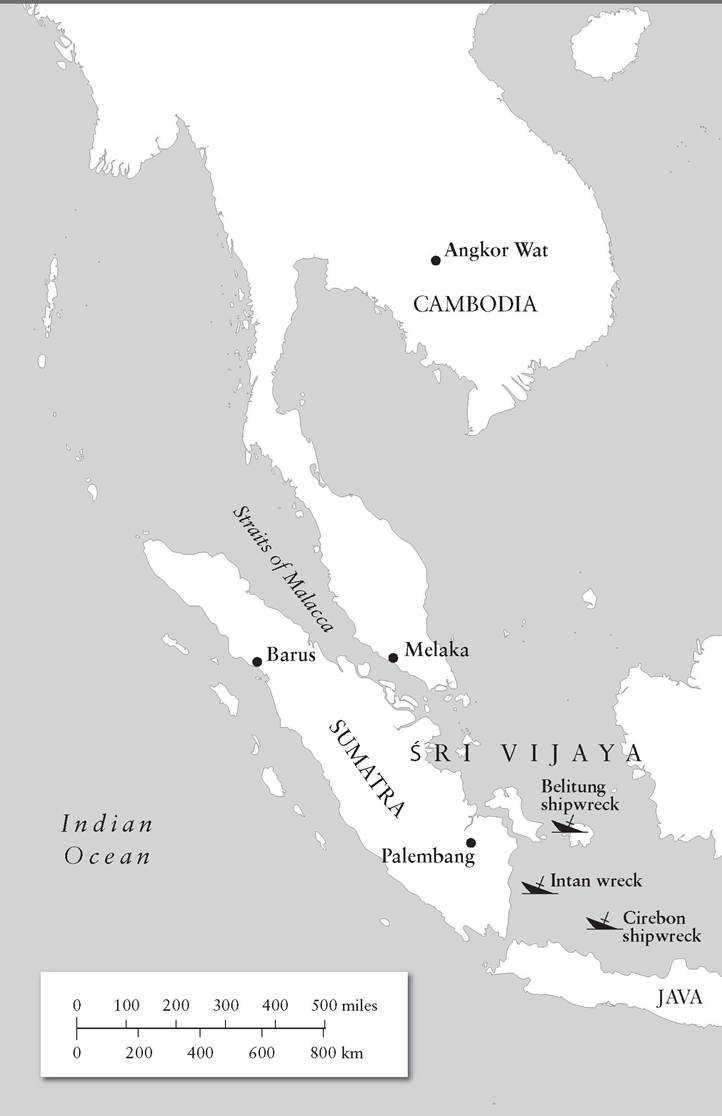
I52 THE MIDDLE OCEAN: THE INDIAN OCEAN AND ITS NEIGHBOURS who took this route were in no hurry to return - Yijing spent eighteen years in India.9
This had important cultural repercussions. Not just a certain amount of trade but the desire of Far Eastern Buddhists to gain access to fundamental texts brought India, China and even Japan into regular contact. Lengthy stopovers by Buddhist monks in Èri Vijaya as they moved back and forth between China and India meant that their religion became well established in Èri Vijaya; Yijing proudly recalled that the kingdom contained a thousand monks who followed Indian Buddhist rituals to the letter. He also remarked that the political reach of Èri Vijaya extended along the east flank of Sumatra, even reaching Kedah in western Malaya. Kedah was by now an important and prosperous link on the trade route tying India to the Strait of Malacca, which, as will be seen, was one of the main props of the Èri Vijayan economy; and Yijing had enough experience of the open sea not to take it for granted; he described a voyage by another monk that took him down from Hanoi or Guangzhou as far as Sumatra, where the overloaded ship sank in a tempest.10 Much is known about these ships, as a result of underwater excavations, and the remarkable evidence from their cargoes will be examined shortly.
Èri Vijaya is certainly not a mirage. Inscriptions from its capital city, Palembang, state the name of this kingdom and say a little about its political structure. It is difficult to be sure how accurate Chinese or Arabic reports of life in Èri Vijaya were; some of the most colourful detail was supplied by Zhao Rugua in around 1225, by which time the kingdom had certainly passed its peak. But his comments were in large part recycled from earlier material; and even if they are not based on intimate knowledge, they testify to the exotic reputation that Èri Vijaya obtained. He wrote of a kingdom with many provinces or dependencies, though it is impossible to believe that they included Xilan, Ceylon; more to the point, his reference to Ceylon is further proof that the reach of Èri Vijaya extended far to the west, as Malay and Indonesian mariners sailed back and forth to India and Sri Lanka. Reports reached him of a sizeable capital city surrounded by solid walls, ruled by a king who processed under a silk umbrella to the accompaniment of guards carrying golden lances. The king, who only bathed in rose-water, was not permitted to eat cereals, but only sago; the Èri Vijayans believed that if he did eat cereals, this would bring drought and high prices. At grand court ceremonies (assuming that his diet of sago brought him sufficient strength), the king was expected to wear a very heavy crown adorned with hundreds of jewels. The succession was decided by choosing from among his sons the one who could bear its weight on his head; and the new king would dedicate a golden statue of
the Buddha, to which the king’s subjects would bring offerings such as golden vases. The death of a king was treated as a national calamity: the people shaved their heads and many courtiers even immolated themselves in the royal funeral pyre.11
The Èri Vijayans used Sanskrit letters, in which one of the rare inscriptions from Palembang was written (though in an early form of the Malay language); but there were experts who could read and write Chinese characters, required when writing to the Chinese court.
The inhabitants of the main city lived not within the town walls but around it in suburbs, and even on riverboats - it will be seen that the Chinese writers were actually describing a snake-like town that stretched for miles along the riverbank. The image was conveyed of a state that was ready to go to war against troublesome neighbours, with a competent army and brave soldiers. Rather than adopting the currency favoured by the Chinese, the copper coins known to Europeans as ‘cash’ that were threaded together through a central hole, the Èri Vijayans made use of hack silver, pieces of silver that were cut into pieces and weighed. (The term ‘cash’ is apparently derived from the Portuguese word caixa, ‘cash-box’, and the Chinese word was wen.)1 They imported both silver and gold, and also acquired - certainly from China - porcelain and embroidered silk, as well as rice and rhubarb. Camphor, cloves, sandalwood, cardamom, civet perfume, myrrh, aloes, ivory, coral and many other spices and luxuries were for sale on the island. Its markets sold both local products, including some of those spices such as aloe wood, and goods brought from further afield, such as cotton goods carried across the Indian Ocean by Dashi, Muslim merchants from Persia and Arabia; and one could also find slaves brought all the way from Kunlun, the coast of Africa.13 There must have been a lively traffic from the smaller Indonesian islands towards south-eastern Sumatra, bringing the resins and spices that the Chinese and Arabs keenly sought. By about ad 500, the Chinese valued benzoin resin from Indonesia as much as or more than Middle Eastern myrrh, while pine resin from Èri Vijaya was used, honestly or dishonestly, as a substitute for Arabian frankincense. One Chinese writer described the trade in frankincense, some no doubt genuine, some adulterated, some substituted by similar resins:The Arabs bring their goods by ship to San-fo-chi and exchange them for goods.
Thus this perfume is usually found in great quantities at San-fo-chi. Each year great ships leave San-fo-chi for Guangzhou or Quanzhou. At these two ports the shipping officials examine the amounts of perfume and establish its value.14Zhao Rugua thought that Èri Vijaya and China began to make contact in the Tang period, at the start of the tenth century; but it has already been seen that contact can be traced back two centuries earlier. And the Song histories mention a whole series of embassies sent to China around 960, which were taken as recognition of Chinese overlordship; it is interesting to find sugar listed among the gifts, for at this period sugar stocks were only slowly becoming known in India and further west, and they are native to Indonesia. These gifts were regarded as tribute, to be sure; but the ambassadors received rewards for their efforts, including such wonders as yaks’ tails and white porcelain. As well as official visits, which conformed to the Chinese idea of what trade with the imperial court was all about, there were visits by merchants of San-fo-chi: in 980 a Èri Vijayan merchant reached the south coast of China after a sixty-day voyage, carrying rhinoceros horns, perfumes and spices. This was a rather longer voyage than many experienced - a month was normal, or even three weeks.15
One might ask why the Èri Vijayans were so keen to acknowledge the distant ruler of China as their lord. Precisely because the emperor was so distant, the chance of direct interference was slim, but imperial approval would enhance the authority of the king of Èri Vijaya over sometimes troublesome vassals; it might even be of some use in fending off claims from independent neighbours with their own ambitions to create a commercial network, such as the Javans, who invaded Sumatra in 992, and who sent a particularly magnificent embassy to China the same year, conveying the message that Java (rather than Èri Vijaya) was the place with which to cultivate friendships and do business.16 So it hardly comes as a surprise that in 1003 the Èri Vijayan king sent the Song emperor an embassy, declaring that he had erected a Buddhist temple in his home town specifically to pray for the long life of the emperor. Nor is it a surprise that the emperor sent temple bells in return, as well as a title of honour for his faithful subject. A few years later the favours of the emperor extended even further. Instead of the belts adorned with gold embroidery that most ambassadors received on taking leave of the emperor, the Èri Vijayan ambassadors were given belts entirely covered in gold. In 1016 Èri Vijaya was granted the rank of ‘first-class trading state’, though Java also received the same promotion.17
The value that the Chinese emperors placed on ties with Èri Vijaya becomes more and more obvious; and the main motive, without a doubt, was the desire to channel perfumes, spices and exotic goods from Sumatra to the Tang court and its Song successor. In the best tradition of the Chinese bureaucracy, officials such as the ya fan bo shih, or Superintendent of Barbarian Shipping, were established in the ports along the Chinese coast; they registered the goods being brought into the Heavenly Kingdom and provided essential services such as translation to and from Chinese to the ‘barbarian’ merchants who flocked to these ports as early as the eighth century. One term used for port superintendents, shiboshi, may be derived from the Persian word shahbandar, with a similar meaning, providing further evidence of the links between China and the western Indian Ocean. In one Chinese port, ‘rhinoceros horns were so numerous that bribes were offered to the servants and retainers’. The local governor was unimpressed by some of the practices he observed. The goods of foreign merchants who died in China were confiscated if they were not claimed within three months; but the governor pointed out that it could take much longer to reach China, from barbarian lands, so this practice was unfair and should be banned.18
All this supervision of trade does little to explain why Èri Vijaya was such an important place in the early Middle Ages; and Zhao Rugua provided a clear answer: ‘the country is an important thoroughfare for the traffic of foreign nations, the produce of all other countries is intercepted and kept in store there for the trade of foreign ships.’ This statement suggests a rather aggressive policy on the part of the kingdom’s rulers, who were as careful as the Chinese to check ships, cargoes and merchants that arrived in their lands.19 Elsewhere, they blocked one of the straits that gave access to their waters with an iron chain, to keep at bay pirates from neighbouring lands. With the coming of peace, the chain lost its usefulness; it now lay coiled up on the shore, and people travelling on passing ships treated the chain as a god and sacrificed to it, rubbing it with oil until it glistened; ‘crocodiles do not dare pass over it to do mischief.’ However, the Èri Vijayans too behaved no better than pirates. Zhao Rugua accused them of attacking any ships that tried to pass by without coming into port, for they would rather die than let unaccounted ships through their domains.20 Yet it might be asked whether their location was quite so perfect. The capital, Palembang, does not even lie on the seashore, while the area of Sumatra in which it lies is some distance from the strait that, in later centuries, would form the vital link between the Pacific and the Indian Ocean: the Strait of Malacca. Somewhere like Singapore, at the entrance to those straits, might seem a much better location from which to control trade.21 Bearing all this in mind, it makes sense to look elsewhere for clues to the special attraction of the kingdom of Èri Vijaya.
II
The answer to the puzzle can be found in writings produced much further west, in Arab and Persian lands. In the ninth and tenth centuries, Arabic works of geography expressed wonder at the kingdom of Zabaj, which was visited by the merchant Abu Zayd Hassan in the tenth century; he hailed from Siraf on the coast of Iran, at a time when trade through the Persian Gulf, and particularly Siraf, was very lively. This writer claimed that the normal sailing time from Zabaj to China was one month.22 Although a Tamil inscription of 1088 uses the term Zabedj to describe the inhabitants of the camphor-laden lands of north-western Sumatra, and accuses them of being cannibals, this was a word whose meaning was much wider. Zabaj can best be translated as ‘East Indies’ or Indonesia, and is related to the name ‘Java’, while the name Sribuza, obviously a corruption of Sri Vijaya, was used for the main island, Sumatra. Arab travellers were impressed by a fiery volcano in the lands of Zabaj, but they also noted that its king ruled over a considerable empire, which included the trading emporium of Kalahbar, thought to have lain on the western flank of the Malay peninsula, and therefore some distance from Palembang.23 Zabaj’s other wonders included multilingual white, red and yellow parrots that had no difficulty learning Arabic, Persian, Greek and Hindi, and ‘beings in human form who speak an incomprehensible language’ and who eat and drink like humans - perhaps a description of the Orang-utan, or perhaps another example of a common fantasy about lands over the horizon.24 Around the same time, the maharajah of Zabaj, ruler of the isles, was reputed to be the richest king in the Indies, thanks to his massive revenues, derived in part from the extensive trade between Zabaj and Oman, which had begun to flourish in the early tenth century.25 An earlier king had been so rich in gold that a ceremony was concocted to prove the point: every morning the head of his household stood before the king and threw a gold ingot into a tidal inlet beside his palace. As the water receded a golden glow would arise from the inlet. His successor had a more practical attitude, and trawled every last piece of gold from the water; however, he then distributed it to his family, his staff, the royal slaves and even the poor of his kingdom.
Arab writers also knew that Zabaj faced China, which could be reached by sea in a month, or less when favourable winds blew. It lay midway between China and Arabia. Not just its position but its own resources - large brazilwood plantations, massive camphor trees, rich supplies of benzoin resin, and so on - brought it great commercial wealth. In the Arabian Nights, Sindbad the Sailor’s graphic description of how camphor was extracted has its origins in tales told of Arab merchants who ventured across the Indian Ocean to Indonesia, as the reference to rhinoceros horns (another very desirable item) makes plain:
And on the morrow we set out and journeyed over the mighty range of mountains, seeing many serpents in the valley, till we came to a fair great island, wherein was a garden of huge camphor trees under each of which a hundred men might take shelter. When the folk have a mind to get camphor, they bore into the upper part of the bole with a long iron; whereupon the liquid camphor, which is the sap of the tree, floweth out, and they catch it in vessels, where it concreteth like gum; but after this the tree dieth and becometh firewood. Moreover, there is in this island a kind of wild beast, called ‘Rhinoceros’, that pastureth as do steers and buffaloes with us... It is a great and remarkable animal with a great and thick horn, ten cubits long, amid- dleward its head; wherein, cleft in twain, is the likeness of a man.26
Arab writers were struck by the simple fact that the rich, fertile countryside covered the whole of the island of Sumatra on which the maharajah resided. There are no deserts! one of these writers exclaimed. The rare spices that could be obtained from Zabaj included cloves, sandalwood and cardamom - indeed, ‘more varieties of perfumes and aromatics than any other king possesses’.27 Stories of Zabaj grew in the telling, and Mas‘udi, a tenth-century traveller, asserted that two years would not be sufficient to visit all the islands under the rule of the maharajah. By the tenth century the fame of the maharajah of Zabaj had reached as far west as Muslim Spain. Al-Idrisi from Ceuta in northern Morocco, writing at the court of Roger II, the Christian king of Sicily, in the middle of the twelfth century, was an enthusiastic geographer whose description of the world was more ambitious than anything that had been attempted before. For sure, he knew about Èri Vijaya, even if he had never been near there; he knew that the natural resources of Sumatra attracted merchants keen to obtain its spices; but he also knew why Èri Vijaya had become such an important market:
It is said that when the affairs of China were affected by rebellions and when tyranny and disorder became too great in India, the Chinese transferred their business to Zabaj and the other islands dependent on it, and became friendly with its inhabitants, for they admired their equity, their good behaviour, the agreeable nature of their customs and their good business acumen. This is why Zabaj is so well populated and why it is visited by foreigners.28
Yet this was only part of the story, as al-Idrisi also indicated. The inhabitants of Zabaj were not simply passive recipients, who took advantage of their geographical location to host visits by Chinese, Arab and Indian merchants, and sold them the perfumes and spices of their islands. They were also busy navigators, whose voyages reached as far as Sofala on the
158 THE MIDDLE OCEAN: THE INDIAN OCEAN AND ITS NEIGHBOURS south-east coast of Africa, where they bought iron that they carried back to India and to their homeland. They were accompanied to these African markets by people from Komr, Madagascar, which makes sense since, as has been seen, the first settlers on the island were not of African origin but hailed from the islands of Indonesia, whose language they carried with them.29
This rich evidence for a wealthy kingdom is derived almost entirely from the writings of those who lived outside Èri Vijaya, though a few Arab travellers did visit the kingdom and recorded their impressions. Its own records are few - some inscriptions from Palembang and elsewhere that extol the king of Èri Vijaya as a maharajah (literally, ‘great king’) above many other kings, and records of conflicts with island neighbours in Java and with mainland neighbours in the Khmer kingdom, whose greatest city was Angkor Wat in Cambodia. One important inscription in Malay dates from the seventh century, when Palembang already possessed ‘overseers of trades and crafts’; it also mentions sea captains.30 And it has to be said that Arabic writers, prone to repeat one another, can leave the impression that there was a wide consensus about a fact or a place, when they actually go back to a single rumour made real; in other words, they are not independent voices.
The capital, Palembang, has yielded rather few significant finds, though the modern city stands on top of the ancient site, rendering very difficult any attempt to identify its medieval buildings. After a team from Pennsylvania declared that there was nothing on the site that was really ancient, further investigation turned up Tang pottery and demonstrated that there were wharves and warehouses all along the northern bank of the river on which Palembang stood, the River Musi. These installations stretched across a distance of twelve kilometres. The archaeologist John Miksic has pointed out how similar this long, narrow town of wharves is to the extraordinary town described in the nineteenth century by the great naturalist Alfred Russel Wallace. What he found at Palembang was a ‘city’ about half as long as the medieval evidence suggests, but one that consisted simply of a strip along the river bank; the houses stood on stilts above the River Musi, and Zhao Rugua had already pointed out that everyone in Èri Vijaya lived either ‘scattered about outside the city, or on the water on rafts of boards covered over with reeds’, which enabled them to claim exemption from government taxes.31 In the nineteenth century, only the sultan and a couple of his chief advisers lived on land, on low hills close to the river. The building material was wood, which decays easily; however, it can be taken for granted that the maharajah lived in some style, in a large wooden palace with finely decorated timbers, the lineal ancestor to the fifteenth-century royal palace at Melaka described in the Malay Annals and now handsomely reconstructed in modern Melaka.32 As for
159 the extensive town walls described by Zhao Rugua, sections of earth ramparts, probably from the seventh century, have been discovered. The use of brick and stone was rare, though in 1994 the stone foundations of a seventhcentury temple were uncovered by French and Indonesian archaeologists. And yet there was enough debris to indicate that Palembang had trading links with both China and India; 10,000 fragments of imported pottery were excavated in the centre of Palembang, though only 40 per cent were actually of Èri Vijayan date. The temple contained sixty Chinese bowls, admittedly from the twelfth century and therefore deposited after Èri Vijaya had passed its peak; other sites have produced an impressive range of green or white Chinese ceramics, though nothing dating earlier than about 800; the Èri Vijayans particularly liked the glazed greenware fired in Guangdong, in southern China. But another source of fine glazed pottery lay far to the west: iridescent lustre-wares from Arab lands and turquoise pottery made in Persia also arrived in Èri Vijaya during the ninth and tenth centuries. Several statues of the Hindu god Vishnu have also been found, though that is not to say they were actually made in India. A statue of a Buddhist divine being, Avalokitesvara, may date from the late seventh century.33
This, then, was a city on the water, a city with length but no breadth whose raison d’etre was water traffic. Yet the river poses a problem: a significant objection to tales of the great glories of Palembang is that the site lies some way inland, beside a river, in what was a marshy area - the distance from the coast is eighty kilometres, but more if river traffic had to wend its way upriver - and arguments that the coastline lay much further inland in the early Middle Ages have not won universal approval.34 Still, a major oceanic port can develop some way inland. Seville is a perfect example, and neither Canton nor London stands on the coast. The shores of Sumatra were no doubt dotted with settlements that provided ready services to shipping that did not come all the way up to Palembang itself. Èri Vijaya was not a myth, but that does not mean that its period of efflorescence was as long as has often been assumed. Palembang was at its peak in the seventh to ninth centuries. Later, competitors in Java, Malaya and elsewhere blunted the power of the maharajah.
That is to assume the power of the maharajah was in some sense ‘imperial’. Here too care is required. Rather than thinking of a centralized empire stretching over hundreds of islands and as far as the Malayan peninsula, one should think of a commercial hub at Palembang, a wealthy and militarily powerful city ruled by a widely respected king; but whether, as the oriental scholars who first translated Sanskrit, Chinese and Arabic texts concerning Èri Vijaya assumed, these texts speak of empire and provincial governors is a moot point. Maybe the term vanua Sri Vijaya on one of the Sanskrit inscriptions from Palembang was intended to convey the impression not of an ‘empire’, as once translated, but of a much more modest region under the direct authority of the maharajah. Maybe too the idea that this inscription talks of ‘provincial governors’ is a misconception, and it really describes autonomous regional lords who, given half the chance, would reject the authority of the maharajah, but were kept under sufficient pressure to maintain their ambiguous and insincere loyalty. The Javanese rulers also received tribute from lesser rulers in Borneo, the Moluccas and eventually Malaya and northern Sumatra, while not neglecting the usefulness every now and again of sending an embassy to the Son of Heaven in China and acknowledging his remote and very loose overlordship.35
Sometimes, as in 853 and 871, embassies from Indonesia to China came not from Èri Vijaya but from rival states, suggesting that Èri Vijaya did not enjoy a total monopoly on trade with China. Malayu, later known as Jambi, fell under the control of Èri Vijaya, according to the monk Yijing; and yet it had earlier sent its own embassies to the Tang court. On Java, a number of rulers did the same, and occasionally fought wars against Èri Vijaya.36 And then there were parts of Sumatra and lands nearby that became rich because of their association with the ruler of Palembang. Barus stood on the opposite side of the island from Palembang, facing the Indian Ocean. Here, as at Palembang, archaeologists have begun to unearth goods brought from as far away as Egypt, Arabia, Persia and India, including not just ceramics but pieces of glass in nearly all the shades of the spectrum, precious stones and other beads, as well as coins, not forgetting 17,000 fragments of Chinese porcelain from the late tenth century up to about 1150. The character of the ceramics found at one of these sites in Barus is remarkably similar to the character of the ceramics accumulated by the inhabitants of Fustat, or Old Cairo, in the same period. So we could think of Barus as one of the links in the chain connecting southern China to the capital of the Fatimid Empire on the River Nile. Barus was also a centre of production, where one could buy bronze caskets and statuettes, made locally from Sumatran copper and tin. As for the inhabitants, they must have been a varied bunch of people, Sumatrans alongside Arabs, Nestorian Christians from Persia and Tamils from India, though many merchants and other travellers were temporary residents, waiting for favourable winds. It would be good to know how Barus was linked, politically and commercially, to Palembang; and the obvious, simple answer is that ties varied in intensity as the power of the maharajah waxed and waned.37
All this begins to make the ‘empire’ of Èri Vijaya look rather like a loose feudal relationship, when it worked at all. It was a political network generally dominated by Èri Vijaya, in which the maharajah had to accept the autonomy of his neighbours, who for the most part recognized his general claim to be their sovereign, but carried on as far as possible without allowing him to interfere, and were perfectly prepared to challenge his authority at the first sign of weakness - hence, indeed, his large armies and navies. In return, these neighbours were allowed to take part in the trade that linked Èri Vijaya to India and China, but in a subordinate role. And this explanation of how Èri Vijaya functioned also makes sense because it shows how the greatest resource of the maharajah, his prosperous riverside port at Palembang and the region close by, kept him afloat politically and financially - it was an enormous source of strength, backed up by his armies and, as will be seen, his navies too. In this view, Èri Vijaya flourished and survived precisely because it was not an empire, and not even a centralized state, but the focal point of a trading network with offshoots around the southern edges of the South China Sea and even as far west as Kedah on the Indian Ocean shores of Malaya.38
Ill
This uncertainty about whether the Arabic and Chinese accounts of the empire of Èri Vijaya are grossly exaggerated (for they are certainly exaggerated in some degree) does not compromise the basic argument: that Èri Vijaya flourished as a mid-point between China and India, looking in both directions and servicing the trade of both great landmasses; and in doing so it functioned both as an entrepot where the goods of India and China could be exchanged by visiting merchants, and as a place to which to turn in search of the spices and perfumes that were native to Indonesia and Malaya. Yet there is still an important element missing. Who were these merchants? Some were clearly Indian and Arab, and Chinese also arrived as knowledge of these waters grew. References in Chinese writings to the Bosi led the pioneers of the history of south-east Asia to conclude that they were Persian, which is the literal meaning of the Chinese term. Some certainly were Persian like Yazd-bozed, a late eighth-century merchant whose name appears on a jar found in a shipwreck off Thailand in 2013. But identifying merchants is never simple. Cargoes of Bosi goods were carried across the Indian Ocean, and the term in that context evidently meant not just the exotic produce of Persia and the Persian Gulf, but goods from the Muslim world as a whole. Bosi was a generic term for Arabs as well, since the Chinese often failed to distinguish between these two sets of people, even though the Arab lands were also known as Dashi and there were large settlements of Muslim merchants within China itself.39
Ethnic muddles of this sort are exceptionally common, and the earnestness with which scholars of the Orient have chased these will-o’-the-wisp terms round and round provides more entertainment than enlightenment. However, accepting that the term Bosi refers to Western goods, one then needs to ask who actually carried them towards Èri Vijaya; and here, alongside Indian and Arab merchants, a prominent place has to be found for Malays or Indonesians who, as has been seen, ventured as far as Madagascar and east Africa at this period, and were also found in China - in ad 430 an Indonesian embassy took ship for China with gifts of cloth from as far away as India and Gandhara. The king of Java wanted the emperor to promise not to interfere with his ships and merchants.40 Indonesian and Malay sailors looked in the other direction too, and the crucial link between the Indian Ocean and the South China Sea, the Strait of Malacca, fell for a time at least under the sway of the ruler of Èri Vijaya.41 Although it is not possible to describe the Malay and Indonesian ships in any detail, it comes as no surprise that the inhabitants of the peninsula and islands around the South China Sea should have taken to the water, first to exchange goods among themselves, and then to range much farther afield.42
Several shipwrecks discovered at the end of the twentieth century in Indonesian waters have, in a very short period of time, massively enlarged knowledge of how the connections between China, Indonesia and India worked. The word ‘massively’ is doubly appropriate, since the quantity of finds is staggering: 55,000 ceramic objects were recovered from the Belitung shipwreck out of an estimated cargo of 70,000 pots weighing twenty-five metric tons; and roughly half a million pots were raised from the Cirebon shipwreck found off the north-west coast of Java. The estimated weight of the cargo carried by this ship is as much as 300 metric tons.43 The shipwrecks of the South China Sea compensate handsomely for the lack of finds on land, especially at Palembang itself.
The Belitung shipwreck was found off the coast of an Indonesian island midway between Sumatra, Borneo and Java.44 The wreck took place not far from Palembang, but due east of the town; it is more likely, as will be seen, that the ship was Java-bound. Its date can be established without much difficulty: there is a mirror that carries the Chinese date equivalent to 759, a bowl from Changsha in central China that carries the date 826, and there are coins of a type minted from 758 to about 845.45 It lay in shallow waters, where it was discovered by divers looking for sea cucumbers, and it had apparently struck a reef about three kilometres offshore; since no human remains were found in the shipwreck, it seems that the crew and passengers
163 managed to escape to dry land.46 It had not suffered violent damage; its cargo of pottery was nearly all intact - the pots and bowls had been carefully packed in larger storage jars by people who knew how to protect fragile ceramics from the turbulence of the sea.47 It was constructed out of a variety of woods, but some of this material came from east Africa, and the planks were lashed together in the traditional Indian Ocean way.48 The ship was not Chinese, but one passenger must have been Chinese, and perhaps a monk, for an inkstone, engraved with the image of an insect, of the sort used in Chinese calligraphy, was found in the wreck. Something too can be said about life on board: bone dice and a board game filled idle hours.49
As revealing as the ship itself are the goods carried on board. The first item to bear in mind is one that is too fragile to have survived centuries of immersion in seawater, but one that is known from Chinese and Arabic writers to have been a favourite import from China into the Indian Ocean: silk cloth. An inscription from a Buddhist monastery at Nakhom Si Tham- marat, an ancient city in Thailand on the shores of the South China Sea, refers to ‘banners of Chinese silk’, and dates from a period when the region was under the influence, or possibly dominion, of Èri Vijaya; but Chinese silk travelled much farther afield, and on occasion the covering of the Ka‘aba in Mecca was made from Chinese silk.50 Turning to what has actually survived on the site, the ceramics command immediate attention. The early ninth century saw a vigorous expansion of trade in Chinese glazed ceramics, both from northern China (whence they were ferried by river and canal down to ports in the south, especially Guangzhou), and from Changsha in central China, a city located a long way from the sea, but famous for its quite massive industrial output of pottery. Demand for good-quality ceramics was closely linked to the spread of a new and important fashion: tea-drinking.51 The Belitung wreck contains the largest collection of late Tang pottery ever found: white pottery from northern China, green wares from southern China, as well as gold and silver vessels and bronze mirrors. A single blue and white bowl is the ancestor of the blue and white porcelain that came to dominate the external trade of China over many centuries, and was imitated centuries later in Portugal and Holland.52 Another unique bowl shows a ship being attacked by a massive sea monster; this is the earliest depiction of an ocean-going ship in Chinese art.53 The wreck contained several beautiful examples of the Chinese goldsmith’s art, unquestionably objects of high luxury.54
The cargo is so impressive that it is easy to conclude that at least part of it consisted of the return gifts sent by the Chinese court upon receipt of tribute from the ruler of Èri Vijaya or from one of the Javanese kings - there were at least six embassies to China from Java between 813 and 839.
A Javanese gold coin was found in the wreck. The ninth century was the golden age of Java, the period during which the great temple complex at Borobodur, decorated with more than 500 statues of Buddha, was constructed under the Sailendra dynasty; it is the largest Buddhist temple anywhere.55 The exchange of gifts, as has been seen, provided the official and very formal framework for bilateral trade overseen by the imperial court, also intended to demonstrate the submission of lesser rulers to the imperial throne. But the quantity of goods, especially pottery, on board the Belitung wreck was so vast that it is clear other interests were also involved: merchants, whether Malay, Indian, Persian or Arab, who sent their orders for fine pottery to the kilns of distant Changsha by way of agents in Guangzhou, and who took advantage of the sailing of an important cargo vessel to book space on board for their own consignments.
This vast cargo of Chinese ceramics has prompted the question whether the ship was bound for the Indian Ocean, rather than Java or Èri Vijaya, particularly since it is quite likely the crew was from there. Moreover, demand for Chinese ceramics had reached such a fever pitch that Abbasid potters in Iraq in the age of Harun ar-Rashid, the period when this ship sank, began to imitate what they saw arriving from the Far East. Still, there was no substitute for the real thing.56 Some of the pottery found on board was clearly for everyday use, by passengers and crew, and is similar to the turquoise glazed wares produced at this time in Iraq and Iran, which might suggest that the ultimate destination was Siraf deep within the Persian Gulf. Examples of this pottery have been found not just at Siraf but at Barus in Sumatra and at Guangzhou, so it certainly travelled along the entire sea route.57
The Belitung shipwreck is not unique. The Intan wreck, found off south-eastern Sumatra, was probably heading to Java, laden with pottery and metal goods, which included many tin ingots, which are likely to have originated in Malaya. Coins found in the wreck date its voyage to between 917 and 942. The combination of Chinese ceramics and Malayan tin suggests that the goods were loaded in some great emporium that gathered together goods from all around the South China Sea, or that the ship itself tramped around the same sea. The variety of the cargo has been described by one of its excavators as ‘astounding’: small bronze staffs that Buddhist monks used as symbols of a thunderbolt; bronze masks representing the Demon of Time, sometimes used as door fittings; some gold jewellery. It was common practice for merchants from Èri Vijaya to bring copper to China and to have temple decorations cast in bronze there. The presence of tin, the other ingredient of bronze, in the hold of the Intan ship confirms the importance of this movement of raw metal back and forth until it was transformed into gleaming objects in bronze or other metals. For the ship also carried iron bars and silver ingots, plus as many as 20,000 pots and bowls, some of a high quality, and much of it from southern China. Fragments of resin indicate that the ship had called in at a port in Sumatra, while the presence of tiger teeth and bones suggests an interest in rare medicines. The ship itself was not Chinese; but its construction differed from that of the Belitung ship, and it is thought to have been Indonesian, with a displacement of roughly 300 tons and a length of about thirty metres.58 Its circuit was most likely limited to the South China Sea, whereas the Belitung ship, smaller in size, was better suited to the long voyage that had brought it all the way from Arabia or Persia. Yet another wreck, discovered in Chinese waters, is the so-called Nanhai I, a very large vessel that contained 60,000-80,000 pieces of pottery, mainly porcelain from the Song dynasty, as well as 6,000 coins, the latest of which date from the early twelfth century, although some may be as old as the first century ad. The impression given by the wreck is that this was a Chinese ship and that it was bound from Guangzhou or another port in southern China for a destination in the South China Sea.59
This evidence for goods being collected from different corners of the South China Sea on sizeable ships affects how one might think about this space. It has often been compared to the Mediterranean, but the Mediterranean is not an ideal model, for three large continents meet there, while the southern and eastern rims of the South China, Sea are chains of islands separating the sea from the open spaces of the Pacific; and the mainland to the north has always been dominated by China which, even when fragmented, has possessed an economic and political weight far in excess of anything that rulers over Èri Vijaya could hope to achieve.60 Yet the South China Sea has also been an area in which the great power to the north has taken a relatively passive role in the conduct of trade, compared to the inhabitants of Indonesia, Malaya, Thailand and Vietnam. China, with its massive continental concerns, often looked away from the South China Sea, and yet its rulers valued enormously the produce of far-off lands that came through that sea. And this provided the perfect opportunity for Malay, Arab and other traders to take charge of the maritime trade routes. These, by the seventh century, were routes that spanned vast distances, from the coasts of Arabia and Africa to southern China, bringing together the Indian Ocean and the western Pacific more intimately than had been the case even in the days when Greco-Roman traders penetrated to India and transmitted some of their goods to the Far East. In the era of Èri Vijaya, a network had come into existence that linked together half the world.