7 Brahmins, Buddhists and Businessmen
I
Looking at the Indian Ocean from the perspective of the Periplous and Berenike presents one overwhelming difficulty. The illusion is created that its ports interacted when the Greco-Roman ships arrived with merchants on board who craved the spices of the East.
When Berenike and Myos Hormos were in decline, it might then be assumed, the whole of this network crumbled away. Without the Romans, it is true, the Indian kings would not be able to accumulate so much treasure; but whether they actually put much of this gold and silver into circulation remains doubtful. Fragments of evidence suggest that Barbarikon and Barygaza, or at any rate ports in their vicinity, remained lively centres of trade and industry in the fifth and sixth centuries, and that many of the stopping places and links that would be described by late medieval travellers such as the Venetian Marco Polo and the Arab al-Mas‘udi were already in place.1 In a word, the question concerns continuity, and relates directly to the idea that the opening of the Indian Ocean routes, whether it was achieved by Romans, Indians or Malays, or all of them in collaboration, should be seen as the first step in the creation of global networks of trade, in which sea routes functioned as the major links. In that case the India trade of the Cairo Jews around 1100, which will be examined before long, or the irruption of the Portuguese in the Indian Ocean in 1497-8, were only further stages in the bonding together of the Indian Ocean with the Mediterranean and with the markets of Europe that lay beyond.When the evidence for Roman trade is so rich it is tempting to dismiss that for ‘native’ trade as mere disconnected fragments. But the fragments can be connected, and they tell a remarkable story in which the Romans no longer appear as the main actors. To make sense of this story, places very far apart will have to be examined - as far apart as Madagascar and Malaya, and beyond Malaya to the very edges of China.
This will reveal the sheer expanse of the area that was tied together by navigators in the first half of the first millennium ad. It will also show how the links in a chain that stretched all the way from southern China to the Mediterranean were being forged and attached to one another, so that the spice trade that had already obsessed the inhabitants of imperial Rome extended far beyond India and Ceylon. In particular, the mariners of Indonesia and Malaya became the great intermediaries sailing regularly between China and India; it was they who knitted together the networks that had previously functioned apart from one another; and it was they who made traffic by sea, rather than the arduous overland route, first of all worthwhile and then supreme.The subject of this chapter is a dizzying expanse of sea, then, encompassing the entire Indian Ocean and, beyond that, the South China Sea, which is ringed by southern China, Vietnam, the Philippines, Indonesia and the Malay peninsula. But the place to begin is a relatively small island very far from there, in the north-west of the Indian Ocean, with an area of 3,800 km2 (which still makes it the second largest island in the western Indian Ocean, after Madagascar). Socotra lies about 240 miles south of Arabia and the same number of kilometres east of Africa.2 It was not, therefore, visited by coast-hugging vessels, but by those who had mastered the monsoons and were willing to range out of sight of land, which was worth their while, since it functioned as a trading hub linking east Africa, the Red Sea and the routes to India. Even so, the local currents were difficult to manage; in addition, it could not offer a decent harbour and ships had to anchor off the coast. Between May and September it was unreachable, because the south-west monsoon was blowing. It was often chosen as a pirate base, though the pirates must have been constrained by the same difficult conditions as the traders. Yet the traders came.
The Peri- plous gives an impression of exact knowledge garnered by a merchant whose passion for tortoiseshell knew no bounds:In the open sea is an island called Dioskourides; though very large, it is barren and also damp, with rivers, crocodiles, a great many vipers, and huge lizards, so huge that people eat the flesh and melt down the fat to use in place of oil. The island bears no farm products, neither vines nor grain. The inhabitants, few in number, live on one side of the island, that to the north, the part facing the mainland; they are settlers, a mixture of Arabs and Indians and even some Greeks, who sail out of there to trade. The island yields tortoise-shell, the genuine, the land, and the light-coloured varieties, in great quantity, and also the oversize mountain variety with an extremely thick shell... The so-called Indian cinnabar is found there; it is collected as an exudation from the trees.3
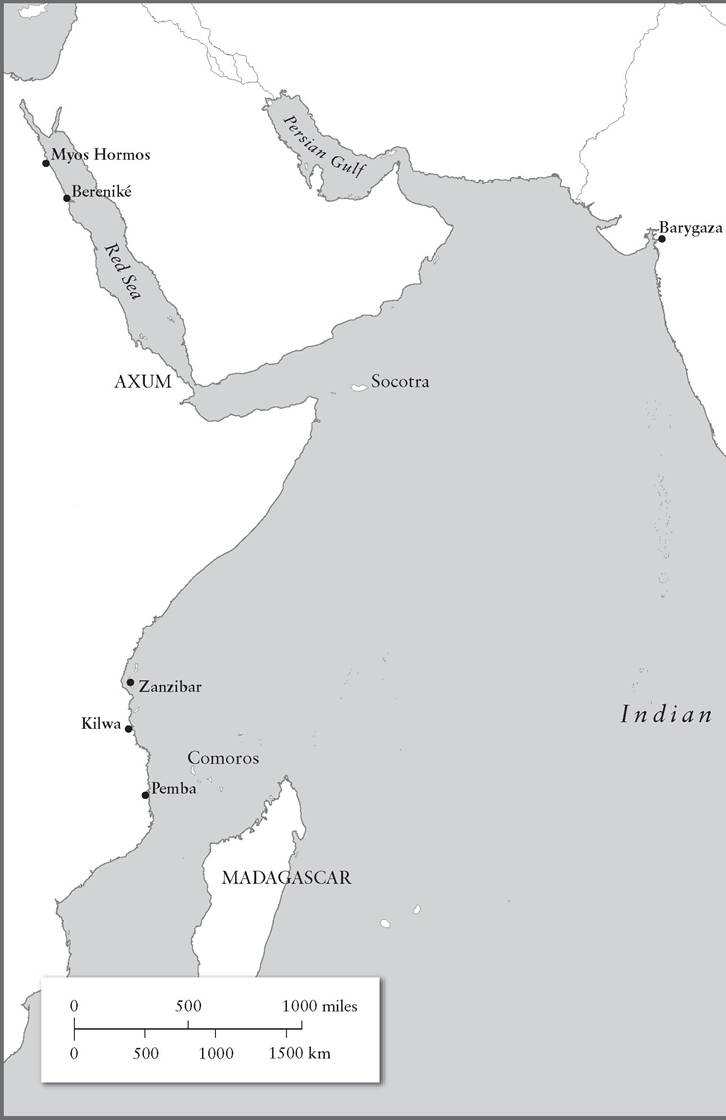
The Periplous also explains that the island was ruled by the king of the opposing shore of south Arabia (Hadhramawt); it has often fallen under the control of the rulers of south Arabia, and at present it forms part of the Republic of Yemen. It used to be visited regularly by sailors from southern India and Barygaza; ‘these would exchange rice, grain, cotton cloth, and female slaves’, against great quantities of poor-quality tortoiseshell. The author then states, mysteriously, that ‘the kings have leased out the island, and it is under guard’. There are strong hints here that this island is neither worth visiting for its tortoises, nor worth the trouble of having to negotiate with the current tenant, who seems to discourage trade.4 Reading between the lines, it sounds as if the island had once again become a pirate base, for which its position suited it very well, in seas that are still notorious for piracy.
Over the centuries, though, this island was visited by large numbers of travellers, for they have left about 250 inscriptions and drawings incised on the walls of a cave discovered in 2000, all of which happily confirm the insistence of the Periplous that Socotra was visited by people of very diverse origins. These inscriptions are in a great variety of languages, Indian, Iranian, Ethiopic, south Arabian, even Greek, and date from the period between the first century bc and the sixth century AD.The Hoq cave is very long - two and a half kilometres - and at some points as much as a hundred metres wide and thirty metres high, so it must have appeared an awe-inspiring place, and a cool one on an island baked by the sun. It was apparently a cult centre for one god or more, and the graffiti on its walls are not so very different from those that can be found on tourist sites today: bhadra prapta, ‘Bhadra arrived’, or simply the name of the visitor, most often in Sanskrit characters.5 One can imagine that sailors and other travellers who had braved the seas to reach Socotra were keen to offer their thanks to the gods for a safe journey there, and their prayers for a safe journey home. Who these gods were is far from clear, but the fact that the vast majority of inscriptions are in Sanskrit suggests that they were Indian gods, linked to Hindu or Buddhist cults; quite possibly the cave contained an image of Buddha himself. For at this period in Indian history the links between religion and trade were close; the Buddhist monasteries, in particular, saw no evil in honest profit. They discarded the caste system that relegated merchants to a less respectable role in society than the priests and warriors who were acclaimed as the leaders of the Hindu communities. The spread of Buddhism is generally thought to have stimulated the Indian economy.6
The evidence that this island was visited over several centuries by Indian merchants is overwhelming; the earliest inscription is thought to date from before ad 100, but after 400 the number declined and the visits, or the practice of recording them, gradually died out - more likely the latter, for, as will be seen, the coming of Christianity rendered the cave cult obsolete.
Amid the names there are several that speak loudly of contact with India: ‘Samghadasa, son of Jayasena, inhabitant of Hastakavapra’ had reached Socotra from a town close to Barygaza on the Gulf of Cambay; the town is still there, under the name of Hathab, but it was already known to the author of the Periplous and to Ptolemy under the name Astakapra. The Periplous mentioned it in its description of the hazardous approach to Barygaza, and excavation there shows that it flourished from the fourth century bc to the sixth century ad.7 Even more noticeable among the inscriptions are direct references to Barygaza: ‘Sesasya Visnusena from Bharukaccha arrived’; or a graffito simply saying Bharukacchaka, ‘the Barygazan’; and best of all: ‘the sea-captain Visnudhara from Bharukaccha’.8 Evidently, ships bound from north-west India for the Horn of Africa often stopped in Socotra. At a village now known as Kosh, archaeologists discovered Indian artefacts but could produce little or no evidence of links between Socotra and the Mediterranean; Kosh lies on the northern side of Socotra, confirming the statement in the Periplous that this was where the inhabitants chose to settle. It is even possible to say something about the boats that reached Socotra, as the Hoq cave also contains several drawings, the clearest of which shows a boat with two rudders and maybe three masts. This compares closely to a sixth-century image of a boat in the famous Ajanta caves in India, where a triple-masted ship with two rudders can be seen.9Some of those who came into the cave to worship were not Indians. The inscriptions include a sizeable wooden tablet in the Aramaic language of Palmyra far away in Syria. The tablet records the prayers of a Nabataean sea captain. The arrival of a Nabataean on the island makes sense: there were Indian embassies to the rulers of south Arabia, whose main motive must have been to discuss the trade in incense; and south Arabian pottery was found by a team of Soviet archaeologists who were let loose on Socotra.10 Some Nabataeans, then, ventured out across the sea and did not rely on the camel caravans across Arabia.
And then there were the westerners. One mysterious scrawl says: ‘of the Yavana Cadrabhutimukha’, which is certainly not a Greek name, even though the term Yavana generally means Greek, Roman or someone from the Roman Empire. A perfectly good explanation would be that a Yavana living in India had become assimilated into Indian culture, so much so that he bore a Sanskrit name and used the Brahmi script in which Sanskrit was written. Certainly, there were real Greeks on the island as well, not just because the PeriplousI30 THE MIDDLE OCEAN: THE INDIAN OCEAN AND ITS NEIGHBOURS and others insisted they were there. Early in the third century a Greek naukleros, or sea captain, left an inscription in Greek in the cave: ‘Septim- ios Paniskos the naukleros kneeled before the gods and before that [or those] of the cave.’11 Greeks had worshipped Indian gods in far-off Bactria since the time of Alexander the Great. To show them respect while sailing around the outer edge of the world was to follow the natural instinct of the Greeks, Romans and many other peoples.
The history of Socotra was also a story of change. An uninhabited island had been transformed into a centre of exchange, but its people could only survive by trading the tortoiseshell and incense they produced for foodstuffs from Arabia, India or Africa. The greatest change occurred when the inhabitants became Christian, some time around the fourth century; and Socotra remained largely or partly Christian until the seventeenth century. This conversion (assuming it was that, and not a mass migration) took place at a time when the southern Red Sea was becoming the scene of bitter confrontation between the Jews, who had converted the kings of south-west Arabia, and the Christians, whose power was based across the water at Axum in Ethiopia. As Axum flourished, it attracted trade from across the Red Sea and sent its own merchants overseas to sell ivory and other prestige products of the Ethiopian highlands, and to buy incense and spices for the Axumite court; over a hundred Indian coins of the late third century have been found at the monastery of Dabra Damo in Ethiopia (though there is a mysterious complication: the monastery was only founded a few centuries later). Socotra benefited from this renaissance of trade; the Hoq cave offers proof that Ethiopians visited the island around the sixth century, for one or two left their own names there.12 The early Byzantine traveller Kosmas Indikopleustes (meaning ‘Kosmas who sailed to India’) wrote his own Periplous in the sixth century, in which he described how the Socotrans spoke Greek, ‘having originally been colonists sent thither by the Ptolemies’, and noted that the local priests were ordained by bishops in Persia. Kosmas did not land there, though he coasted past the island; however, he met Greek-speakers from Socotra on the coast of Africa who had evidently come to believe this version of their history.13 His story circulated widely, as the Arab geographer resident at the court of King Roger of Sicily, al-Idrisi, said much the same in the middle of the twelfth century, as did the tenthcentury traveller al-Mas‘udi, whose works were widely read. Al-Mas‘udi also mentioned that Socotra was a nest of pirates, and that was one recurrent feature of its history; the pirates he mentioned were Indian ones, who chased after Arab ships bound for India and China, but Greek and Arabian pirates must also have been installed there at different times.
All this proves that a historian ignores the smaller, apparently insignificant places at his or her peril. Socotra was no Barygaza or Berenike; but this improbably remote island has thrown up evidence for the real nature of contact by sea that is, in its way, as rich as anything in the Peri- plous or in the excavations at Berenike and Myos Hormos. The names of its visitors, generally unadorned by profession or origin, still provide enough evidence to remind us what sort of people lived on what they must have thought to be a place on the outer edges of the world.
II
All this is rich evidence for the routes that were not dominated by seafarers from the Roman Empire, but by dhows from Arabia, sewn-plank vessels from India, and ships manned by Malay and Indonesian sailors. Malays would certainly play a prominent role at the end of the Middle Ages, but much changed in a thousand years, with the rise and fall of trading empires on Sumatra and on the Malay peninsula. There is, however, extraordinary evidence that people travelled all the way to east Africa from the eastern end of the Indian Ocean, speakers of the Austronesian languages that include Filipino, Malay and the Polynesian languages. They arrived not just in the ports that marked the southernmost limit of Roman trade, around Zanzibar, but much further south, where they first visited and colonized the Comoros archipelago off the coast of Africa (later famous for its ylang-ylang perfume), and then settled in the greatest of all the Indian Ocean islands, Madagascar. Whether they took a direct route across the ocean to discover Madagascar, until then empty of humans, or edged around the coasts of the Indian Ocean has been much debated. The general consensus is that Malay-speakers gradually made their way along more and more ambitious trade routes leading them to southern India and far beyond. Mostly these Malays were absorbed into host populations over the centuries; but in Madagascar they were alone, apart from Bantu slaves they themselves brought from east African ports such as Kilwa and Zanzibar. So what they created was a Malay - Indonesian society in African waters. Later European observers recognized the distinctive features of Malagasy society when they expressed the view that Madagascar was really part of Asia, not Africa.14
Language provides rich evidence for the links between Madagascar and the opposite end of the Indian Ocean. Glottochronology is, among other things, the science of dating the moments when languages began to diverge into dialects that gradually became mutually incomprehensible, to the
I32 THE MIDDLE OCEAN: THE INDIAN OCEAN AND ITS NEIGHBOURS point where they can be described as separate languages. It has been seen that Maoris and Hawai’ians could still make sense of what the other side said in the eighteenth century. It is clear that the first settlers in Madagascar spoke a language close to Malay; Malagasy is a language whose cousins mainly lie on the far edge of the Indian Ocean or deep within the Pacific, and the closest relative to the Malagasy language is a dialect spoken in Borneo. Glottochronology suggests that the time of their arrival was late in the first millennium bc; and the evidence of language is confirmed by that of DNA - mitochondrial DNA reveals that 96 per cent of the population is descended at least in part from Asiatic settlers. However, over the centuries the island has received Bantus, Arabs and many others, so that there are other elements in both the bloodline and the language; the Bantu settlers probably arrived from the start of the second millennium ad onwards. There is also similar evidence to suggest the presence of Austronesians on the coast of east Africa, around Pemba and Zanzibar. Finally, there is the unspoken evidence of the plants that have thrived on Madagascar since humans arrived: rice, saffron, coconuts, yams, plus, very probably, a humble addition to the otherwise exotic animal population - chickens.15
Part of the fascination of both Socotra and Madagascar is that these were uninhabited islands far from the mainland that were settled by humans who had to work out what sort of society they would establish there. On Socotra, which was frankly desolate, they could only hope to set up a trade counter to sell what little it offered, and maybe to careen the hulls of passing ships, or send out pirates to capture them. Madagascar offered a very different opportunity. This was a landmass that had floated away from India and had been isolated from the rest of the world for maybe 88,000,000 years, so that, rather like Australia, its animal population developed independently from that of the rest of the world; the lemur, a very early primate, is found nowhere else in the world. The richly forested interior took centuries to tame, but around the coast early visitors may have been attracted by apparently unlimited supplies of spices and resins.16 That is to assume with Philippe Beaujard that Madagascar was a happy discovery of Indonesian merchants in search of spices, following on from a series of what he calls strategic commercial voyages; they would then have left behind a core population of settlers, who would have supplied spices to the traders as they came year after year in search of the natural wealth of Madagascar. Why people from what became known as the Spice Islands would go in search of spices on the other side of the ocean then becomes a mystery; taking these spices home would have been the equivalent of carrying coals to Newcastle; but there have been attempts
to link this demand to the emergence of the great trading empires of the South China Sea, especially the early medieval kingdom of Sri Vijaya, based on Sumatra, which will be examined shortly.
According to this theory, the settlers expanded in numbers and moved ever inwards into the heart of the island, which they gradually denuded of its thickest tree cover, and where they exterminated some of its most remarkable inhabitants - giant lemurs and massive elephant birds, which may be the enormous rukh that appears in the late medieval tale of Sind- bad the Sailor.17 Meanwhile other Indonesian settlers arrived who were attracted by the tales they heard from seafarers who described the lush paradise of Madagascar.18 That is one plausible scenario; another view would present the Indonesians as seafarers similar to the Polynesians, setting out in their catamarans in search of new lands to settle, without a particular interest in the Indian Ocean spice trade. Unfortunately, Malagasy archaeology is in its infancy, and the results of excavations shed little light on this problem. One promising site in the north of Madagascar cannot be dated further back than ad 420, and evidence from earlier times is very patchy. Fragments of locally made pottery from roughly ad 700 have emerged from a rock shelter that may have been used by sailors stopping over on the island before making the long voyage back to Malaya.19 This could be taken to prove that waves of Austronesians arrived over many centuries, with contact continuing right through to the fourteenth century or later, by which time Arab travellers were reporting the existence of this extraordinary miniature continent.20 The settlers knew iron, and their technology was therefore much more sophisticated than that of the Polynesians, who around this time were reviving their colonization of the farther reaches of the Pacific. What their boats looked like and where else they sailed is far from certain, though big ships with outriggers feature among the sculptures at Borobodur in Indonesia, and outriggers are still used on boats both in Indonesia and in east Africa, including Madagascar.21
Even if the first Austronesians to reach Madagascar were not spice merchants, and even if contact between the island and the inhabitants’ mother country was spasmodic, there is enough evidence to show that the Greco-Roman merchants were not the only pioneers in navigating the Indian Ocean at the end of the first millennium bc and the start of the first millennium ad. The great arc from south-east Africa to the East Indies was a space in which human beings moved impressive distances far out of sight of land. They may not have possessed the extraordinary navigational skills of the Polynesians (though conceivably the discoverers of Madagascar possessed some of that knowledge), but the navigators of the
Indian Ocean required and acquired a detailed knowledge of its shores and islands.22 The different corners of the Indian Ocean were slowly becoming more connected to one another, and beyond that to the seas that lap the shores of Vietnam, Java and China.
III
These Malay navigators are the unsung heroes of trade and migration in the Indian Ocean and in the South China Sea: unlike the Indian travellers, they are not praised in the Brahmin poems and, unlike the Greco- Roman travellers, they have left no Periplous ; the earliest written history from Malaya, the so-called Malay Annals, dates from the early seventeenth century and is rich in stories about fifteenth-century Singapore and Melaka (Malacca), but for earlier centuries it only offers garbled legends about Indian ancestors.23 The boats of the Malays and Indonesians are impossible to describe in any detail, though finding the right woods was no problem: no one knows whether they resembled dhows, junks or catamarans (and the simple term ‘dhow’ is a broad description of a variety of roughly similar ships, varying greatly in size and equipment). Yet they played a crucial part in transforming the links between furthest Asia and the Mediterranean, so that south India became a transit point rather than a terminus, and the terminus shifted eastwards as far as the East Indies and even at times southern China. The decades when Berenike was beginning its slide under the sand were also those in which south-east Asia and its Malay sailors became a powerful force on the oceans.
The first question is what was known of this region and its inhabitants by those who lived outside it. The Periplous was vague about a ‘golden land’, Chryse, beyond the Ganges; this indicates that contact with its inhabitants was still quite limited, in the first and second centuries, whether that contact was effected through very rare visits to the land of Chryse (for example, by embassies trying to reach China, such as the Antun embassy mentioned earlier), or through meeting Malay sailors in the ports of southern India, such as Arikamedu/Poduke. Sometimes Chryse simply appeared in l ate classical writings as an island beyond India, on the very edge of the habitable world, but not too distant from the land of the Seres, that is, the silk-weaving Chinese.24 Chryse and another island called Argyre were said to be so rich in gold and silver that the metals had given their names to these two islands; around ad 40 the Roman writer Pomponius Mela reported a legend that one had soil that consisted of gold, and the other had soil made of silver, but he was not so
credulous as to believe the tale.25 This rumour was repeated by the sixthcentury Spanish encyclopaedist Isidore of Seville, who knew his classical sources extremely well, and who became the first port of call for many who wished to understand the shape of the continents in later centuries. The Jewish historian Josephus assumed that this was where one could find Ophir, to which King Solomon had sent his ships a thousand years before his own day.26 Ptolemy, as preserved by later Byzantine editors, who may have added their own knowledge and opinions, had a different view: he presented Malaya as a lump sticking out of south-east Asia, so that its shape is closer to that of Indo-China than to the Malay peninsula. He arrived at this conclusion more by accident, no doubt, than because of confusion between precise information about the two neighbouring regions.27 As for information about the people who lived in and around Chryse, this was the usual mish-mash of startling tales of dark-skinned peoples with barbaric customs, largely conjured out of thin air.
The people outside the region who knew the area and its inhabitants best were the Chinese. They have not appeared often in this book before now. Chinese civilization had developed along the great river systems of east Asia, and the Chinese connection to water involved freshwater more often than the open sea. There were important maritime links to Japan, of which more will be said; and there was plenty of coastal navigation in sizeable junks, ‘storeyed ships’, or louchuan, the sea being a source of fish and salt.28 Evidence for regular long-distance voyages by Chinese sailors is hard to come by in the early centuries of the first millennium ad. Boat traffic was dominated by ethnic groups other than the Han Chinese, who lived in the north and would eventually rule vast expanses of China; perhaps the most practised sailors were the Yueh in southern China, whose culture fell under increasingly strong influence from Han China, but who were not yet fully sinicized. The Yueh created lively commercial links to the coasts of central China.29 Around 221 bc, when the Han dynasty was founded further north, there existed four Yueh kingdoms, maybe more; one of them possessed a capital somewhere in the region of Hanoi, at a place known as Lo Yueh. Here, one could obtain luxuries that were much in demand at the Han court: ‘rhinoceros horns, elephant tusks, tortoise-shells, pearls, fruits and cloth’, as well as kingfisher feathers, silver and copper, which were brought to the Yueh city of Panyu near Guangzhou (Canton) and bought by Chinese merchants who, according to a Chinese writer of the first century ad, enriched themselves greatly.30 Links to western Asia were maintained across the famous but difficult Silk Road, which took caravans across great swathes of empty desert and through the lands of the Sogdian merchants to the north of
Iran, until the route reached trade centres north and south of the Caspian Sea. Exotic products, of which silk was only the most famous, arrived by this route; but it was a hard and slow journey whose safety could only be assured by plenty of guard posts along the way.31 The Silk Road functioned effectively in the first century bc and up to about ad 225, while the Han dynasty could provide this degree of protection.
However, the third century bc was also a period of intense conflict among the ‘Seven Warring States’ of China, and this conflict deflected the Chinese from expansion southwards. Then, between 221 and 214 bc the ruler of the Qin Empire extended his rule over Yueh territory in the face of tough Yueh resistance, and briefly gained control of much of the coastline of the South China Sea, around the Gulf of Tongking. The conquest of the Yueh towns was accompanied by the settlement in the region of ‘criminals, banished men, social parasites and merchants’, according to a snooty Chinese historian of the time, but the long-term effect was that the Han Chinese population grew, particularly in the cities, and flourished through trade with Chinese lands further north. How much of this trade was carried by sea is unclear, as is the degree of contact between the Yueh or the Chinese merchants living in their lands and the inhabitants of the Malay peninsula. Such goods from the Indian Ocean as arrived dribbled through passageways linking the South China Sea to the Indian Ocean.32
This marked the beginning of a much closer relationship between the Han Chinese and the sea. Its characteristics were trade, but also naval warfare. In 138 bc a Chinese navy sailed south from the River Yangtze to fend off Yueh pirates. Over the next few years a series of Chinese naval attacks maintained firm pressure on the Yueh statelets along the coast of the South China Sea. Guangzhou, the capital of the Nan Yueh, fell to the Chinese and was used as the base for a raid into the Gulf of Tongking; the king of Guangzhou was captured as he tried to flee by sea. This was a period when the Han Chinese could confidently extend their power as far south as Vietnam; but holding the Han Empire together was only possible by firmly suppressing the centrifugal tendencies of all the many regions and peoples that lay under Han domination. When Han power disintegrated, Chinese refugees flooded south; they had already begun to do so during a crisis in northern China between ad 9 and 25, and this further stimulated the emergence of Guangzhou as a major centre of trade and culture, a city that was able to draw up from Vietnam exotic birds and animals and tropical plants.33
The Han Empire divided, and the Wei in the north found themselves at odds with the Wu dynasty, who came to control the south from ad 220 onwards. As a result, the Wu were cut off from the land routes. On the other hand, the Wu state acquired a long coastline facing out towards the South China Sea, which the Chinese began to exploit more intensely than before. Wu Chinese began to look in new directions for the luxuries they had known while they lived in the cities of the north.34 These even included the frankincense and myrrh of Arabia, as well as coloured glass from Phoenicia and amber that might well have originated in the Baltic, all of which had once percolated down the Silk Road.35 The question was how they could obtain these goodies, and the answer lay in their relations with the regions between China and India, in other words Indo-China and Malaya/Indonesia. As will be seen, they also hoped to create a series of links to the land of birth of Buddhism at a time when Buddhist texts and relics were enormously prized in China.
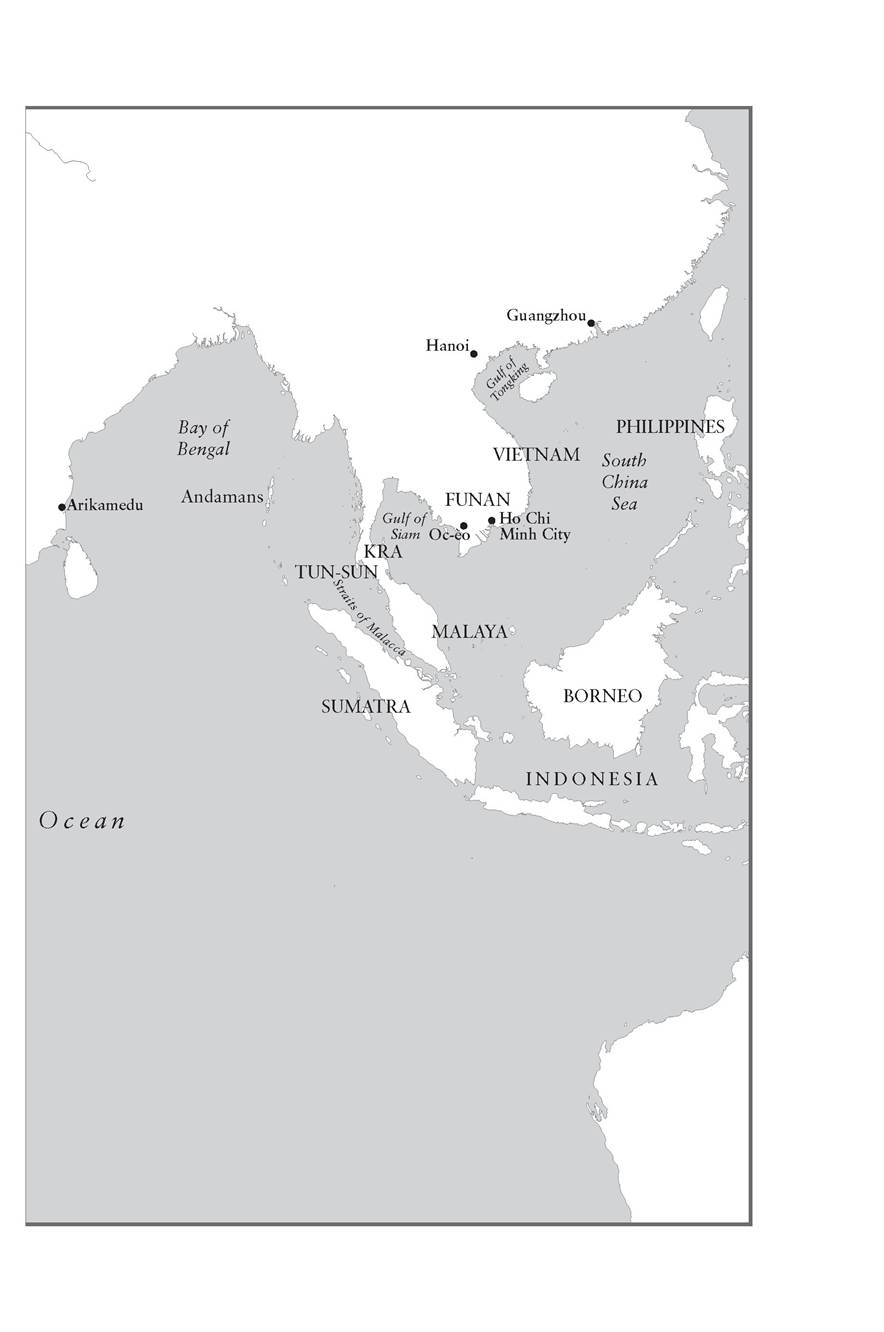
These links could be laid down in two main directions. One route led from the ports of southern China and along the coast of what is now Vietnam, to the territory the Chinese called Funan.36 From there one could follow the coast right round till one reached the Isthmus of Kra, the narrow neck of land that links the Malay peninsula to Asia. After crossing the isthmus by land, which could take a good ten days as the terrain was covered with forests hilly and, travellers could take ship once again in southern Thailand and then leap across the Bay of Bengal from Burma to north-eastern India. For a while Funan was able to maintain a stranglehold on the movement of people and goods from the South China Sea towards the Indian Ocean, and the isthmian route, despite its awkwardness, was preferred. The alternative route went all the way by sea from Indo-China along the Malay coast, past what is now Singapore and through the Strait of Malacca, jumping across the Bay of Bengal from somewhere on the western side of Malaya.37 Chinese ships avoided the open sea, to judge from a text known as the Liang shu : ‘the Zhang hai [South China Sea] is of great extent and ocean-going junks have not yet crossed it directly’.38 The dividends for those in power were considerable. Around ad 300, Shih Chong was the governor of a region that lay along the trade routes towards Canton and Hanoi, and he accumulated enormous wealth by taxing merchants and ambassadors who passed through his lands laden with goods; he also traded on his own behalf, sending out merchants to collect ivory, pearls, scented woods and perfumes, while he was particularly proud of half a dozen coral trees that stood three or four feet high and were beautifully coloured. He also possessed thousands of beautiful female slaves:
He asked a few tens of them each to hold various scents in their mouths; and when they talked and laughed, the fragrance was wafted by every
I38 THE MIDDLE OCEAN: THE INDIAN OCEAN AND ITS NEIGHBOURS breeze. He then had powdered gharu-woods as fine as dust sprinkled over an ivory bed, and asked those that he specially loved to step on it. Those who left not a trace he presented with a hundred p’ei of pearls [50,000 pearls!]. Those who moved the fine powder were ordered to eat and drink less in order that they might be lighter.39
Although he was not typical of his contemporaries, the South China Sea trade had brought Shih fabulous wealth - fabulous in the sense that accounts of his wealth no doubt grew in the telling. And yet Guangzhou and Hanoi derived their wealth from the fact that these towns were collection points, rather than centres of production - ‘prosperous frontier towns’, in the words of Wang Gung-Wu, and the luxurious life of Shih Chong and his successors was rendered possible by the remoteness of these provinces from the central imperial government. As with other frontier regions, the area around Guangzhou, Guangdong, was plagued by pirates and bandits who hoped to set up their own fiefdoms along the coast. This held back the expansion of trade across the South China Sea. One of these pirates, Lu Xun, was resoundingly defeated at the start of the fifth century, a victory that ushered in a period of quiet in Guangdong. Strife further south, along the coast of Annam, left Guangzhou largely free to develop its trade across the South China Sea, so that ‘the governor of Guangzhou need only pass through the city gates of Guangzhou just once, and he will be enriched by thirty million strings of cash’.40 By the sixth century ad Guangzhou was at its peak, and the local officials operated a tax system that, for all its severity, did not slow down the economy, was tolerated and became normal practice: the goods of foreign merchants were bought at half the official price and then sold on at the full price. It seems unlikely that the beneficiaries were anyone other than the greedy officials.41
An early Chinese description of the sea route to India survives in the Qian Hanshu, a compilation of Han history created in its present form after the fall of the Han, but incorporating older material. It is very difficult to identify the places in India whose ancient names, now imperfectly known, if known at all, were rendered into Chinese sounds. That they included Barygaza and Muziris is very likely. The Han history does contain the earliest surviving description of Malaya, or at any rate the Kra Isthmus, in any language.42 But the voyage towards India was slow, each stage taking months at a time, as one would expect when the monsoons were blowing; what made the endless wait worthwhile was the produce that could be found:
These countries are extensive, their populations numerous and their many products unfamiliar. Ever since the time of the Emperor Wu [141-87 bc]
they have all offered tribute. There are chief interpreters attached to the Yellow Gate [the Department of Eunuchs] who, together with volunteers, put out to sea to buy lustrous pearls, glass, rare stones and strange products in exchange for gold and various silks. All the countries they visit provide them with food and companionship. The trading ships of the barbarians transfer the Chinese to their destination. It is a profitable business for the barbarians, who also loot and kill. Moreover, there are the hazards of wind and wave to be encountered and the possibility of death by drowning. If these are avoided the outward and return voyages take several years. The large pearls are at the most two Chinese inches in circumference.43
The impression that had to be created was that of subject peoples, but the pretence could not be maintained; much of this description is concerned with trade for profit. Around the third century ad, the clear aim of the ‘chief interpreters’ was to reach India; officially, at any rate, they were the emperor’s agents sent on a diplomatic mission, but in reality they had gone west to buy the rarest of luxury goods from far-off lands.44 Malaya was an inconvenient barrier with nothing obvious to offer, whereas Indian products were rare and unusual. The transformation of Malaya into a desirable destination would be slow; but, even before that, Malay seamen had become active. The essential point is that the Han Chinese remained wary of the open seas, and everything suggests that the Malays were emerging as one of the most active seafaring nations of east Asia. There is every reason to suppose that they, not Indians and certainly not Chinese, sailed the boats that took ‘chief interpreters’ and other Chinese merchants from the west coast of Malaya to eastern India; the historian Wang Gung- Wu, writing in 1958, expressed puzzlement at the fact that his Chinese sources did not specify that ships reaching the Indian Ocean were Chinese or Yueh or Indian, and the answer that he missed is that they were operated by Malays. As will be seen, we even have detailed descriptions of them, with their measurements (over 200 feet long, 20-30 feet high, and with four adjustable sails).45 In the fifth century the ‘southern barbarians’ provided everything from rhinoceros horn and kingfisher feathers to pearls and asbestos (then regarded as a mysteriously wonderful mineral).46 For Malays who ranged further and further across the ocean, as far as Africa, the journey across the Bay of Bengal was nothing special.
For a few centuries Funan in southern Vietnam was the main intermediary between China and India. It is thought to have been the largest kingdom lying between China and India, and to have dominated the coasts of the Gulf of Siam and the eastern shores of Malaya.47 Only the Chinese name of this territory is known; but many of its inhabitants were probably
I40 THE MIDDLE OCEAN: THE INDIAN OCEAN AND ITS NEIGHBOURS related to the Mon-Khmer people who later built the great temple cities in Cambodia.48 Funan’s maritime successes date to a period when the shipping that moved through the South China Sea carried Chinese passengers, Indian monks, and merchants and Malay sailors, with, no doubt, a good sprinkling of local Vietnamese hands on board as well. By the middle of the third century Funan was attracting admiring comments from Chinese travellers. At this period a king of Funan named Fan-man or Fan Shiman by the Chinese expanded his power over his neighbours and created a kingdom that combined lively international trade with the successful exploitation of large tracts of land suitable for rice and other foods. Funan’s cities were walled, they were rich in libraries and archives, and its taxes, it was said, were paid in gold, silver, pearls and perfume. Funan was also a centre of shipbuilding.49 In short, the Funanese met Chinese criteria for being classed as reasonably civilized barbarians.
The origins of Funan were said to have lain in the sea, so its vocation was always trading. According to a legend recorded in China, at some time in the first century ad a local queen sent a pirate raid to attack a merchant ship, but those on board defended themselves well, and the ship was able to put in to land. A passenger from ‘beyond the seas’ with the Brahmin name Kaundinya set foot on dry land, drank some of its water (this symbolized taking possession of the lands of the water queen) and married the queen. Thereupon he became king of Funan, acting as overlord over a group of seven chieftains in different towns around the Mekong delta. The marriage between a sky god and a princess born, rather like Aphrodite, in the foam of the sea was a longstanding motif of Malay and Polynesian mythology, and the story presented here bears the imprint of these earlier legends.50 Even so, the story has been interpreted as evidence that Indians arrived in Vietnam by sea and inserted themselves into the highest echelons of local society, which they increasingly indianized and indeed commercialized. The kingdom of Funan was a joint enterprise of Indian merchants and colonizers, with an interest in maritime trade, working alongside native Vietnamese with an interest in harvesting the produce of the fields.51 However important the sea was to the prosperity of Funan, the inland regions were also of great economic importance, and the capital, which still needs to be identified, lay some way inland.52 Its indianized character was acquired more by osmosis than by colonization; and when colonization took place it occurred in the port cities, and was the work of merchants and Brahmin priests who merged deliberately with the local population, as will be seen. Indian culture fascinated the Funanese, as it did later rulers of lands around the South China Sea; the Khmer kings of Cambodia, the builders of the great temples at Angkor Wat, claimed
descent from Kaundinya and the kings of Funan. This does not mean that the townsmen were all Indians. Rather, as in other port cities around the world, the ports of Funan hummed with the bargaining of Indians, Chinese, Malays, Indonesians, Vietnamese, Burmese and many other ethnic groups.
The remains of one of their trading ports, at Oc-eo at the top of the Gulf of Siam, confirm Chinese reports; it had originated in the first century ad as a Malay fishing harbour, but soon afterwards it underwent a spectacular transformation, and it remained a great centre of trade until the early seventh century. Just as no one knows the local name for Funan, no one knows the original name of the town that has been excavated at Oc- eo, which lies not far from Ho Chi Minh City, or Saigon. Oc-eo is not simply one site among many, though other Vietnamese ports of this period await discovery; everything suggests that it was the earliest trading port of any significance in the history of south-east Asia, and it is the first place in the region where writing has been found, in the form of Sanskrit inscriptions, not just on stone but on gold rings. The site itself is large, covering 450 hectares.53 The inhabitants lived in houses partly built of stone and brick but raised on piles above the ground, to avoid flooding, as is still so often the case in south-east Asia. Larger palaces for the elite had two storeys.54 Oc-eo did not actually lie on the seashore but twenty-five kilometres inland, and was connected to the open sea by canals. These canals were a typical feature of the south Vietnamese landscape; they ran through the waterlogged countryside and serve as a reminder that the rulers of Funan were able to mobilize a considerable labour force to construct and maintain a whole network of waterways. It has been well said that one word describes the Funanese environment: ‘watery’.55
Oc-eo tied the sea to the Funanese possessions that lay down the watercourses of the Mekong River, and it had access to vast paddy fields sown with rice that flooded naturally when the Mekong rose; if nothing else, Oc-eo was a place mariners would want to use to resupply their ships on the long haul from southern China to Malaya and back.56 Objects found there have included coins of the Antonine emperors of Rome, from the second century, Chinese bronzes of the first to sixth centuries, and polished gems thought to have been brought from Sasanid Persia, though many of these items would have been carried to Funan in stages and passed from hand to hand over a long period. Imported materials were used to manufacture ornaments, jewellery and utensils, including silver dinner plates: the people of Oc-eo fashioned gems from diamonds, rubies, sapphires, topaz, garnets, opals, jet and much else, and they imported gold, probably in the form of gold wire, which they then melted down to make rings, bracelets and other high-value objects. More modest metals
I42 THE MIDDLE OCEAN: THE INDIAN OCEAN AND ITS NEIGHBOURS moved around the South China Sea, such as iron, which arrived from north-east Borneo.57 Interestingly, more goods have been found that originated in the Roman Empire than from China, even though China was much nearer and more accessible, so Oc-eo, although it lay beyond the Indian Ocean, was certainly linked to those trade routes that brought ‘Roman’ merchants at least as far as southern India - the question is who then transported these goods to the South China Sea. But Funanese relations with Wu China were constantly being sealed by embassies that carried tribute to the imperial court. In the fifth century embassies to China arrived again and again, bearing gold, sandalwood, ivory and incense.
During much of this century and the early sixth, contact between Funan and China was especially lively. Not just state emissaries but monks were sent back and forth between China and Funan; on one occasion the king of Funan sent a Buddhist monk to southern China with the text of 240 sutras that he wanted to share with the imperial court. Funan thus acted as a bridge between the birthplace of Buddhism and the great empire that was at this period enthusiastically embracing Buddhist doctrines. Even so, the Funanese ambassadors were not always welcome, and occasionally, as in 357, they were kept waiting and then sent back without the tribute being accepted, perhaps because the emperor preferred other allies in the region, or perhaps because the tribute itself was regarded as paltry. One reason the Wu emperors cared about Funan was not because of an interest in the trade in fine gemstones but their love for Funanese music, which was still greatly appreciated at the Tang court in seventh-century China. Unfortunately neither the instruments nor the sounds are known; but an ‘Office for Funan Music’ existed at Nanjing in 244, so the infatuation lasted many centuries.58
The ships of Funan were described by Chinese writers, and fell into two categories. There were ships whose average length was said to be twelve xin, or eight Chinese feet, which were also six xin broad. They would therefore have been quite tubby in shape; a striking feature was the bow and stern, said to look like fish, so the boards were evidently gathered together into something like a point. They were powered by oars and the largest ones could carry about a hundred people. Relatively small vessels of this sort would have been suitable for carrying low-bulk, high-value goods such as jewellery, rare spices and incense. Another account describes much larger vessels, able to carry 600-700 passengers and crew and a very large cargo (more than 10,000 ho ), and these ships were powered by four sails. They sound more like the junks that traded along the coast of China, and may have been copied from foreign ships by the shipbuilders of Funan. The Chinese texts call the Funanese ships bo, which has been
linked to a Malay word, perahu, that the Chinese language would have struggled to turn into a manageable sound. And this has led to the assumption that the ships and sailors were Malay, which makes a great deal of sense, particularly bearing in mind the description of the smaller ships, which have a strongly Malay feel. For the descriptions that survive of the people of Funan suggest that there were many Malays living in the area where the Chinese would have had contact with this kingdom - the port cities. The Chinese texts speak of dark, curly-haired people, whom they found ugly (though that was a common enough way of expressing superiority over ‘barbarians’); they were big people who wore their hair long at the back and went around virtually naked, with nothing on their feet, and like many who display their flesh they adorned their bodies with tattoos.59 They do not sound like the handsome Khmers who lived further inland in Funan. Oc-eo in particular was a place where people of varied origins came together - Khmers, Indians, Malays, Chinese, only to mention the most obvious among the very many peoples of south-east Asia - a large cosmopolitan port city whose identity was created by generations of settlers and their descendants, and whose daily life was dominated by trade across the seas and by the need to prepare goods, such as gems, that could be sent on its ships to China and elsewhere.
A place of this significance could not be missed by commentators even as far away as the Roman Empire. When Ptolemy mentioned Kattigara in south-east Asia, visited by the Greek sea captain Alexander in the second century, he may have had one or all of the ports of Funan, including Oc-eo, in mind, but he set off a debate about where Kattigara lay that was to fascinate scholars and explorers in sixteenth-century Europe. However, Ptolemy confidently placed Kattigara on the Indian Ocean rather than near the South China Sea.60 For Kattigara may well have been a name created by Greco-Roman merchants out of a misunderstanding. An eleventh-century Brahmin collection of tales is known as the Kathdsaritsdgara, meaning ‘ocean of streams of story’, and an earlier version of that word, or Kathdsdgara (‘oceans of story’) may well have been heard as ‘Kattigara’; the name would then signify something like ‘fabled place across the seas’.61 Oc-eo and Funan remained prosperous until the fifth century, with the peak of their prosperity probably in the second century, under the warrior king Fan-man. During the fourth century, the growing attractions of spices and resins from the Moluccas and other parts of Indonesia gradually rendered the south coast of Vietnam less interesting to sea traders; and this change in direction had major consequences not just for the history of the region but, as will be seen, for the history of the oceans and of the entire world.
Fan-man’s wars of conquest resulted in the creation of a land and sea realm that encompassed large areas of Indo-China. His empire spilled over into the Bay of Bengal after he led victorious armies into the Kra Isthmus, conquering a Malay kingdom called Tun-sun (in Chinese); it lay in the innermost north-west corner of the South China Sea, at the top of the Malay peninsula, where it joins Thailand. Chinese commentators were impressed by this victory, because they knew that the Malay peninsula was an inconvenient barrier to access to India. Once Tun-sun was in Funanese hands, the journey to the Bay of Bengal became a little easier; one could arrive in Tunsun’s main port by sea, and then trek across the isthmus through lands that were now all under the sovereignty of the king of Funan. The Chinese were also impressed that the main city of newly conquered Tun-sun was a port where ‘East and West meet together so that every day great crowds gather there. Precious goods and merchandise - they are all there.’62 There were 500 Indian families in the town and 1,000 Brahmins, who were encouraged to marry local girls, ‘consequently many of the Brahmins do not go away’. Chinese observers were dismayed by these parasites, as they saw them: ‘they do nothing but study the sacred canon, bathe themselves with scents and flowers, and practise piety ceaselessly by day and night.’63 The Indianization of Vietnam meant, therefore, not just the presence of Indian traders and settlers, but the arrival of Hindu and Buddhist cults, which spread in Indo-China from this time onwards. An early Sanskrit inscription from Funan dates from soon after Fan-man’s death, showing how the sacred language of India was beginning to take root in Indo-China.
IV
Trade and religion were closely intertwined. Beyond Funan, the Brahmins had their rivals. From the first century ad Buddhism began to take a strong hold on China, and Chinese Buddhists regularly travelled to India to study Sanskrit texts and acquire mementoes of the life of Buddha. Faxien (or in older spelling Shih Fa-Hsien) was a Buddhist monk who spent about fifteen years away from China at the start of the fifth century; he took an overland route to India, and returned to Guangzhou by sea from some place in India.64 By now mariners were not interested in hugging the coast of I ndo-China, and Faxien was forced to confront the terrors of the open sea. His description of how he reached China by sea from India is full of the dramatic images that so many pilgrims included in their travel diaries. But, even allowing for exaggeration, it offers precious details: there were 200 people on board what he calls a large merchant ship, ‘astern of which there was a smaller vessel in tow in case of accidents at sea and destruction of the big vessel’. That, at any rate, was the theory. But after two days of good sailing eastward, propelled by fair winds, they ran into a severe gale in the Bay of Bengal, and the main ship began to take on water.
The merchants wished to get aboard the smaller vessel; but the men on the latter, fearing that they would be swamped by numbers, quickly cut the tow-rope in two. The merchants were terrified, for death was close at hand; and fearing that the vessel would fill, they promptly took what bulky goods there were and threw them into the sea. Faxien also took his pitcher and ewer, with whatever he could spare, and threw them into the sea; but he was afraid the merchants would throw over his books and his images, and accordingly fixed his whole thoughts on Guanyin, the Hearer of Prayers, and put his life into the hands of the Catholic Church [i.e. his Buddhist sect] in China, saying, ‘I have journeyed far on behalf of the Faith. O that by your awful power you would grant me a safe return from my wanderings.’65
It took thirteen days for his prayers to be answered, whereupon they reached an island, probably one of the Andamans, and were able to plug the leak in the ship. Even so, he says, pirates abounded in the vast sea, for ‘the expanse of ocean is boundless’, and navigation by the sun or stars was only possible when the skies were clear; ‘in cloudy and rainy weather our vessel drifted at the mercy of the wind, without keeping any definite course’. The sea was too deep to cast anchor; and it was full of threatening sea monsters that showed themselves, somehow, in the middle of the night.
Finally, after ninety days, the ship arrived in a land known as Yepoti, thought to have been northern Borneo, or possibly southern Sumatra, which was not bad navigation; they had evidently passed through the Strait of Malacca and had followed the broken south and east coastline of the South China Sea. Yepoti disappointed Faxien, because it was full of Hindus and ‘the Faith of Buddha was in a very unsatisfactory condition’. He did not notice any Chinese merchants in this land, which suggests, yet again, that the trade of the South China Sea was dominated by other peoples.66 Despite his misgivings about this place, he stayed there for five months, and then boarded a different merchant ship that was large enough to carry 200 passengers. They sailed for Guangzhou, but after a month they encountered another tempest, and Faxien immersed himself yet again in prayer. This nearly became Faxien’s involuntary Jonah moment. The Hindu Brahmins on board (whose purpose in travelling to China can only be guessed at) decided that it was precisely because a devout Buddhist was on board that the gods had sent storms against the ship. They did not suggest throwing him overboard, but had a more humane solution: ‘We ought to land the religious mendicant on some island; it is not right to endanger all our lives for one man.’ But Faxien had a protector on board who promised to report the Brahmins to the ruler of China if they treated him this way; Faxien’s friend insisted that the Chinese ruler was also a devout Buddhist who favoured Buddhist monks. ‘At this the merchants wavered and did not land him just then.’67 In any case, they were lost in a typhoon in the middle of the South China Sea, so there cannot have been any islands upon which to abandon the poor monk. For seventy days they wandered, even though they had provisions for only fifty, the normal amount of time required to reach Guangzhou. They had to cook their food in seawater. And when they reached China it was far to the north of Guangzhou, way beyond Taiwan, closer to Shanghai and Hangzhou than to the Wu domains in the south.
The stories of Faxien and other monks who followed the same route are not just picturesque accounts of the terrors of the open sea. They are also valuable testimony to the way the opening of sea routes stimulated the spread of cultures and religions. Later, there will be a chance to examine how Buddhism jumped across the relatively narrow space of the Japan Sea to challenge and then co-exist with the native cults of ancient Japan. The seaways from India eastwards played a particularly important role in the spread of religious ideas, and the art associated with them, as Hindu texts and practices struck roots in Indo-China and Indonesia (so that Bali remains an isolated Hindu island to this day); and after that Buddhism and eventually Islam spread eastwards along the trade routes, refertilizing China, which had also received Buddhist texts along the Silk Road. In the third century over 500 monks lived in twenty or more temples by the Red River delta in Vietnam, and this spot became a favoured halt for pilgrims and merchants bound for and from China. Statues of the Buddha as Dipamkara, ‘calmer of waters’, have been found on many sites in south-east Asia, often dating from this time.68 Chinese writers also spoke of the ivory images, painted stupas and even a Buddha’s tooth, all of which arrived from the Malay peninsula and the islands, notably from the land of Panpan in what is now southern Thailand.69 These are excellent testimony to the spread of Buddhism along routes favoured by the merchants.
V
By the sixth century the fortunes of Funan now began to turn dramatically: a neighbouring ruler, the king of Zhenla (in whose temples human sacrifice was said to be practised), invaded Funanese lands and shoved the local economy further into decline; at its greatest extent Funan had exercised suzerainty over Zhenla.70 Even allowing for the disappearance of Funan, the increasingly important ties between India and China transformed the role of Indo-China, Indonesia and Malaya in the maritime networks of the first half of the first millennium. Their role was not reduced but enhanced by the gradual decline of Roman trade in the Indian Ocean. Others began to enter the ocean, notably the people the Chinese called the Po-ssu or Bosi, subjects of the Sasanian emperors of Iran, who sailed down the Gulf and were present in Ceylon, or Si-tiao, by the sixth century; their main interest was the trade in silk. A Chinese text avers that ‘the Bosi king asked for the hand of the daughter of the king of Si-tiao and sent a gold bracelet as a present’. Yet the Persians did not penetrate further than this, and sense can only be made of their undoubted success in Ceylon by deducing that others brought Chinese silk to the island; and those others were, or included, the mariners of Malaya, Sumatra and Java. This is apparent from the comments of Chinese writers about the constant arrival at Guangzhou, several times a year, of foreign ships, while the Chinese sent their own ships no further than western Indonesia. These Indonesians managed at last to intrude their own produce into the trading network between India and China that they so effectively serviced; the first Indonesian product to be rated highly was camphor, used as a perfume at the Sasanian court (rather an overpowering one, perhaps) and later as a drug. Some unfortunate Arabs who were celebrating the sack of a Persian-held city on the Tigris in 638 sprinkled camphor on their food, thinking it was salt, and were taken aback by the taste.71
What might seem to be a curious footnote to the history of food takes on a much greater significance when the gradual adoption of camphor by merchants and their wealthier customers is seen as the first step in the emergence of south-east Asia as the home of most of the world’s finest spices. Already expert in the handling of pepper and other spices from the coasts of India, and even perhaps the spices they garnered in Madagascar and east Africa, the Malays and Indonesians were becoming the true masters of the international spice trade. In the centuries that followed, they would substitute their own resins and flavourings for those that had been handled by the Greco-Roman traders. This would be the foundation of the wealth of the great maritime trading kingdom of Sri Vijaya, with its capital at Palembang on Sumatra. The ripples of its influence reached not just China and India but the heartlands of Islam and even medieval Europe.