6 Mastering the Monsoon
I
Strabo’s remark that there was now constant traffic between Egypt and the Indies is all the more remarkable because this traffic must have built up in a relatively brief period of no more than a century and a half.
This was exactly the period when major changes within the Mediterranean were taking place, which saw first Rhodes and then the much smaller holy island of Delos become the focal points of commercial networks that tied together Alexandria, Rome (which was becoming the master of wider and wider tracts of the eastern Mediterranean) and the Syrian coast. Perfumes carried by the Nabataean merchants filled the market stalls on Delos, which was described as ‘the greatest emporium on earth’, and boasted a population of 30,000 people crammed into not much more than one square mile.1 Alexandria, with its teeming population of Greeks, Jews and Egyptians, buzzed with business, and that business looked not just towards Syria, Greece and Rome but towards the Red Sea and, at last, the Indian Ocean. A tariff list from Alexandria, probably from the start of the second century ad, offers a pungent list of the spices and aromatics that mainly arrived from the Indian Ocean; to read it is to enter the spice markets of the modern as well as the ancient Middle East, before moving to the jeweller’s souk: cinnamon, cardamom, pepper, ginger, myrrh, cassia wood; and then pearls, diamonds, sapphires, emeralds, beryl, turquoise; and beyond that silk, raw and processed, as well as wild animals - l ions, leopards, panthers - and, amid all these wonderful cargoes, Indian eunuchs.2The route across the desert linking the Nile to the Red Sea ports was made as safe as possible by setting up watchtowers manned by Roman soldiers, and by providing inns for caravans where both people and camels could be watered and fed, and goods could be stored safely overnight.
According to Strabo, the Romans invested funds and energy in digging great cisterns to collect the sparse rainwater of the desert.3 When trouble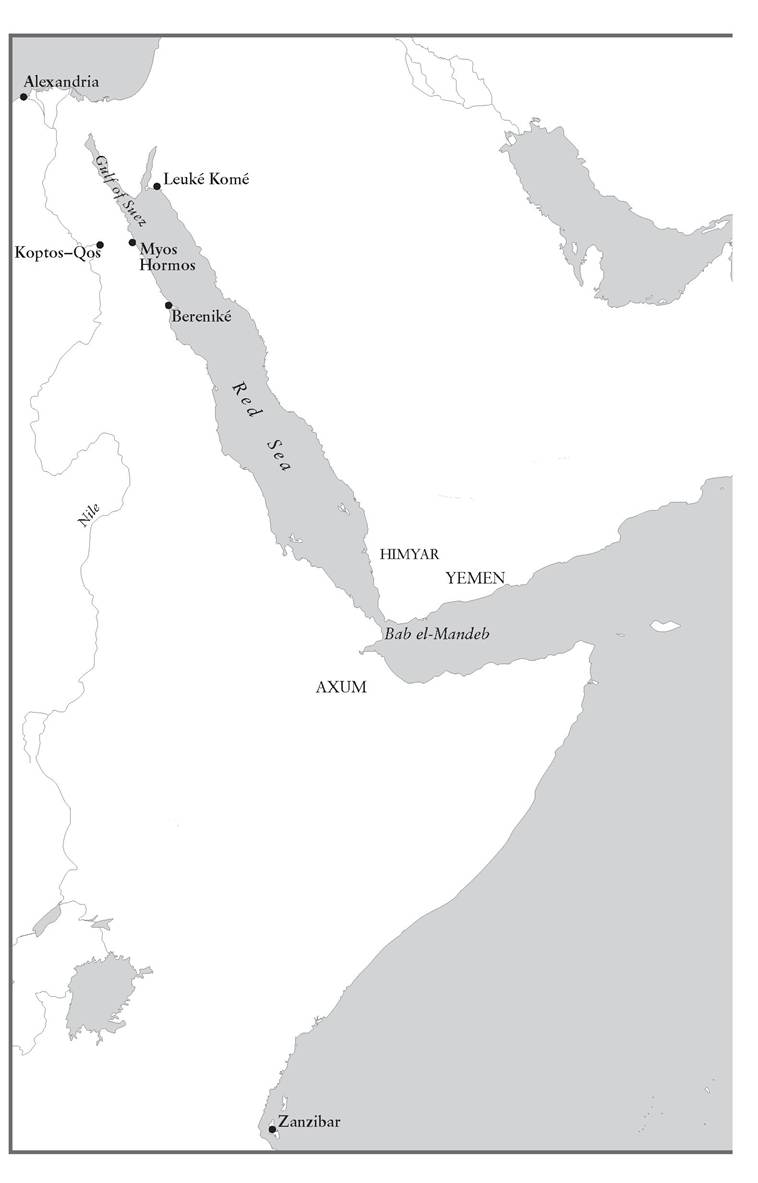
was taken to clear the easily clogged canals that linked the Nile to the Gulf of Suez, it was even possible to travel directly from the Nile to Klysma (modern Suez) and then down the Red Sea, generally changing boat at Klysma. The satirist Lucian of Samosata, who wrote in the second century ad, told the tale of a young man who went down the Nile to Klysma and decided to take ship for India; meanwhile his friends, puzzled at his disappearance, assumed he had been drowned while travelling downriver.4 By the reign of Augustus, who died in ad 14, the India trade was already booming. By the reign of Tiberius (ad 14-37), coins were flooding into northern and western India, and were even reaching Ceylon and some parts of eastern India. They were used as money or as bullion, or even as ornaments (some were pierced, so they could be worn on a necklace).5
Mastering the ocean would only become possible when the monsoon season was properly understood, and this was the work of Hippalos, whose discovery of the way these winds worked led to the south-west monsoon being given the name ‘Hippalos’ by later generations of Greek sailors. Eventually they forgot that the wind was named after a pioneering navigator who showed some of the adventurousness of a Columbus. Hip- palos was a Greek merchant who made his voyage somewhere around ad 20. He already knew the coast of India; and he understood the basic pattern of the monsoons, whose seasonal switch was by now familiar. The question was not when these winds usually blew, but how they could be exploited to make faster journeys out of sight of land, shooting past Arabia to India.6 A Greek merchant whose description of the Indian Ocean will be examined in a moment wrote: ‘the ship captain Hippalos, by plotting the location of the ports of trade and the configuration of the sea, was the first to discover the route across open water’.7 Setting off from the south-west corner of Arabia with the monsoon wind behind him, Hippalos headed out across the open sea and struck land near the mouth of the Indus.
An express route from Egypt down the Red Sea and straight on to India was now open, and Greek and Roman traders were quick to take full advantage. As time went by they learned to strike out for points further and further south along the west coast of India, right down to its southern tip.8Soon after Hippalos braved the open sea, an unnamed sailor who knew not just the sea but the coastline of the western Indian Ocean wrote, in Greek, a detailed description of the sea route to India. He was clearly a merchant rather than a professional sailor, because he was much more interested in the products of the lands he visited than in detailed information about navigation.9 The author was also an Egyptian Greek, because he talks of Egypt as home, mentioning ‘the trees we have in Egypt’; but
he was no armchair traveller: he described how his ship set a course and put on speed. His style was matter of fact and lacks grace, but he was capable of literary flight as well, for he offers a dramatic description of the fearsome tides off Barygaza in north-west India. Sir Mortimer Wheeler enthused: ‘I should describe it, indeed, as one of the most fascinating books to have come down to us from antiquity.’10 The original title of this work is Periplous tes Eruthras thalasses, ‘Sea journey around the Red Sea’, for the term ‘Erythraean Sea’ literally meant that, though what he intended is what is now called the Indian Ocean. What is now known as the Red Sea was often termed the ‘Arabian Gulf’, not least by the author of the Periplous.11 Around ad 900 someone in the Byzantine Empire thought it worthwhile to make a rather messy copy of this work, which is how it has survived; but when it was originally written is not certain, and some of those who reject a date in the first century ad would prefer to assign a date in the early second or even early third century instead.12 The Periplous describes a thriving network of trade that begins at the Red Sea ports of Myos Hormos and Berenike, which will be discussed later since they have yielded superb archaeological finds.
But Berenike was devastated by an epidemic in ad 166, after which its trade withered, so the Periplous was surely written before then. Moreover, the author became very vague when he attempted to describe the waters beyond India, and the little book must have been written before ships under the Roman flag began to pass beyond Ceylon, and before Ceylon was identified as an island rather than the tip of another continent, as he believed.13 It is clear that the tentative exploration of the early Seleucids had been transformed, perhaps within a century, into regular, intensive traffic. Not merely the scale was unprecedented; the creation of links between India (and also Ceylon) and Alexandria, a connection that would thrive during many later centuries, vastly expanded the range of contact by sea. For, even if Greek and Roman merchants did not venture into the eastern Indian Ocean at the time when the anonymous author sailed the seas, by reaching southern India he and his contemporaries made contact with the spice merchants from barely known lands much further to the east.One cannot do better than follow the author on his Periplous, before backtracking to examine some equally eloquent archaeological sites and what contemporary Romans, such as Pliny the Elder, had to say. This way one can gain an idea of which areas were valued by sea traders and which they tended to avoid, whether because they produced little or because the inhabitants were regarded as hostile barbarians. Interestingly, such people could be found not far south of Berenike, well within the Red Sea (following modern use of the term). Overall, the image of the Red Sea is of an unwelcoming place, a passageway that for long stretches offers little of its own apart from tortoise shell at a harbour-less port, suitable only for small boats, named Ptolemais Theron, whose name indicates that it had been founded before the Romans conquered Egypt, and while the Ptolemies ruled there. The south-western shores of the Red Sea were much more promising.
The big attraction of Adulis was that elephant ivory and rhinoceros horn were carried there from the lordly city of Axum and from the Ethiopian highlands; sometimes the great beasts themselves wandered down to the shore near Adulis. But the serious drawback to Adulis was that raiders interfered with shipping, and it was vital to moor by an offshore island for safety’s sake.Further south lay the realm of King Zoskales, ‘mean in his way of life and with an eye to the main chance, but otherwise high-minded, and skilled in writing Greek’.14 Greek cultural influence had, then, penetrated far south, and it is easy to see why: the author lists the goods that the Adulians bought, including Egyptian cloths, linen goods, glassware, brass, copper pans, iron for the spears with which they brought elephants low, and some, but not much, olive oil and Syrian or Italian wine. They clearly craved the products of Egypt and the Roman Mediterranean, but their parsimonious king was not terribly interested in gold or silver objects, unless the price was low.15 That, however, was only part of the story. You could also sell them goods you had brought from India. They liked Indian steel and iron, as well as Indian cotton fabrics. Carrying on southwards, the Periplous mentioned harbours either side of the Bab al-Mandeb Strait that offered cassia, myrrh and sometimes frankincense. It noted too that shipping would arrive regularly from India bearing basic foodstuffs such as grain, rice, clarified butter (ghee) and sesame oil. There is a particularly precious reference to ‘the cane honey called sakchari' - cane sugar, still an exotic product of India and lands even further to the east, which the Romans used therapeutically rather than as a sweetener.16 Ships from Egypt might tramp up and down the coast, making up and disposing of their cargoes as they went, or they might head straight for one of the ports the Periplous singled out.
The Indian Ocean of the Periplous stretched in two directions.
The author was keen to explain what can be found along the east coast of Africa as well as to spell out the route to India. The whole arc from somewhere near Zanzibar to western India was becoming a single, vast trading zone. Indeed, the king of part of Yemen, Charibael, also ruled part of the African shore. Unfortunately it is impossible to be sure where the last port of trade in ‘Azania’, that is, east Africa, that the author mentioned might have stood; it could be Pemba island, or it could be Zanzibar itself. The name he used was Rhapta, which means ‘sewn’, and referred to the sewn-plank boats that the locals used for fishing and for hunting turtles.17 A remarkable feature of this piece of coast is, the Periplous says, that it is ruled by the Arabians of Mouza, which corresponds to part of Yemen. This relationship was to last many centuries; in the nineteenth century the sultans of Oman based themselves at Zanzibar. When the Periplous was written, the main attraction of this region was ivory, rhinoceros horn and very good tortoiseshell. But beyond that lay an unexplored coastline, of which the Periplous could only say that the land tended westwards, until finally the Indian Ocean joined the ‘western sea’, that is, the Atlantic. This traveller was not, then, convinced by the argument that the Indian Ocean was a sealed sea surrounded by a greatly elongated tongue of land that stretched from southern Africa to the Golden Chersonese (Malaya). However, this view gained great influence in later centuries, as it was confidently supported by the great Alexandrian geographer Ptolemy.18 Finds of Roman and Indian coins along the African coast, mainly of the fourth century ad, confirm that contact with ‘Azania’ was maintained over a long period.19Arabian captains sailed back and forth from Mouza, and some of them intermarried with the native population, among whom the men were bigbodied and independent-minded; these Arab sailors learned to speak the local language.20 The author of the Periplous was impressed by the Arabian merchants. Describing Mouza itself, he says that ‘the whole place teems with Arabs - shipowners or charterers and sailors - and is astir with commercial activity. For they share in the trade across the water and with Barygaza, using their own vessels.’21 Barygaza is Bharuch in north-western India, so this acts as a reminder that the arrival of Greek and Roman merchants in the Indian Ocean did not mean that the newcomers gained a monopoly on business. At some stage, impossible to determine, Arabian and Indian seafarers had followed or anticipated Hippalos, and had forged links across the Indian Ocean.22 Local Indian rulers decorated their coins with pictures of ships, notably in the Satavahana Empire between ad 88 and 194; this empire embraced large tracts of central India as well as part of the east coast.23 The ocean was awakening; and this was the work of its own inhabitants as much as, very probably more than, it was the work of subjects of the Roman emperor.
II
The author of the Periplous was aware that something new had been happening. He talked of a seaside village on the site of present-day Aden, named Eudaimon Arabia, or ‘Happy Arabia’, that had previously been a proper city, ‘when, since vessels from India did not go on to Egypt and those from Egypt did not dare sail to the places further on but only came this far, it used to receive cargoes of both, just as Alexandria receives cargoes from overseas as well as from Egypt’.24 He thought it had been sacked by someone named in the manuscript as ‘Caesar’, which could be a reference to an attempt by Augustus to attack Aden with 130 warships. Strabo believed this expedition had been a success, but all the evidence suggests the opposite.25 The author of the Periplous was much more interested in offering a vivid explanation of how frankincense formed on the bark of trees, in a mountainous, misty corner of Arabia that was so unhealthy that slaves and convicts were put to work collecting the gum; it was dangerous even to pass this coast on a ship because it was so disease-ridden, and the frankincense workers died of either sickness or malnutrition. This would be the western corner of modern Oman, celebrated today precisely because it is cool and misty, and unusually fertile by comparison with the rest of Arabia. The local ruler had the foresight, though, to construct a sturdy fort and warehouse in which to store the frankincense.26 The rulers of southern Arabia were beginning to become not just prosperous but powerful. Describing a bay on the south coast of Arabia, the Periplous declared that frankincense can only be loaded with the king’s permission; royal agents exchanged frankincense for grain, oil and cotton textiles.27 Maritime trade was drawing a great variety of people to their land.
The Greco-Roman merchants who sailed in the wake of Hippalos were keen to make the fast connection between Egypt and India, and had no interest in the Persian Gulf. For the Periplous, the Gulf was best avoided; the best one could say of this ‘vast expanse’ was that there were plenty of pearls to be had near its opening.28 The author of the Periplous was happy to jump across the strait and to reach a Persian port called Omana, which was not the same as modern Oman. Wherever it was, Omana gave access to a hinterland rich in dates, wine and rice, even though the coastline only produced bdellium, not that this was to be despised - it is another aromatic resin, a close cousin to myrrh. This was one of the ports to which merchants of Barygaza, in India, sent ploia megala, large ships, loaded with fine woods such as teak, as well as copper and ebony. They took away large numbers of pearls of modest quality compared to those of India itself, cloth, including luxurious purple textiles, gold from the Persian interior and slaves.29
Then, following the coast, one eventually reached ‘the mightiest of the rivers along the Erythraean Sea’, the Sinthos, or Indus, which emptied so much freshwater into the ocean that long before you reached terra firma you could see the river water coming out to meet you. One of the seven channels linking the Indus to the ocean was home to Barbarikon, whose exact location, after centuries during which the Indus has dumped silt all around its mouths, is unknown. Barbarikon gave access overland to Minnagar, a major city lying inland, whose royal court was hungry for textiles, plain and coloured, glassware, silverware, frankincense, coral and gems that were probably the attractive light green stones now known as peri- dots.30 At such points the author of the Periplous most clearly revealed that what he had written was more a manual for merchants than a book of sailing instructions. But the attractions of Barbarikon were as much in buying as in selling. Bdellium, nard, turquoise, lapis lazuli, indigo and Chinese skins, cloth and yarn were all mentioned. These Chinese cloths, however they reached the mouth of the Indus, were made of that rarest and most coveted of fibres, silk.31
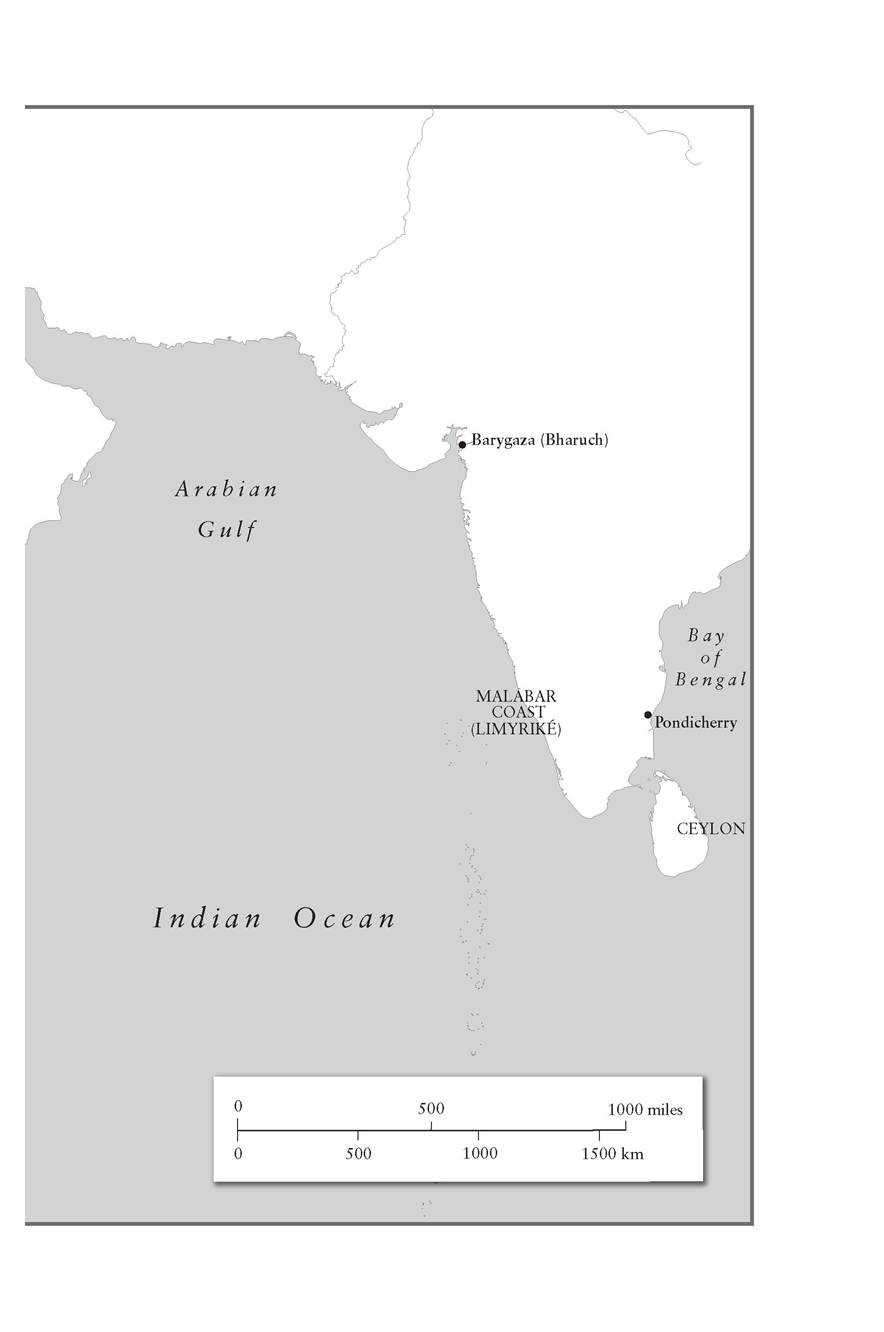
Yet even the excellent opportunities offered by the marketplace at Barbarikon were not enough. The Periplous braved difficult seas, full of whirlpools, sea snakes and turbulent waves to edge down the coast of India as far as the Gulf of Barygaza.32 Sailing into the port at Barygaza was a challenge; ships had to negotiate a narrow gulf, with sharp reefs on the righthand side, and a rocky, rough sea bottom that could slice through anchor cables. This took one through to a desolate landscape where it was hard to see the low-lying shore, and shoals made navigation even more difficult. For this reason fishermen in the king’s service would come out to pilot ships through these waters; oarsmen attached their boats to incoming vessels and tugged them along, playing along with the tides, which were critical for access, but also extremely dangerous: ‘they are much more extreme in the area around Barygaza than elsewhere’. At the flood tide, when there was a great rumbling, hissing rush of water upstream, one would suddenly see the sea floor, and channels used by ships would turn completely dry. During the flood tide ships would be ripped from their anchorage. Not for the only time in history, a major port was built in an unpromising, seemingly inaccessible location (compare Bristol, with quite similar tidal problems).
Barygaza was the real focus of attention in the Periplous. Known in Sanskrit as Bharukaccha, and nowadays called Bharuch or Broach, it ought to be an important archaeological site, for its great mound awaits adequate excavation. It must be one of the most promising but neglected archaeological sites in the world; occasional finds in the general area include late Roman pottery and Roman coins.33 From lands to the east of Barygaza ‘everything that contributes to the region’s prosperity’ arrived in the port; this included semi-precious stones, such as onyx, and Indian cotton cloth, both fine and ordinary, as well as ivory, nard and bdellium transported from upcountry. Long pepper, Piper longum, was readily available; this was a type of pepper that was greatly prized in Rome, where in the first century ad it sold for fifteen denarii per pound against four denarii for standard pepper.34 Pliny the Elder could not understand what attracted people to pepper, and even less could he understand why anyone should spend vast amounts of time and money bringing it all the way from India.35 At the top end of the scale, there were Chinese silks to be had too.
It is worth pausing to think about the implications. Roman citizens in Egypt, and beyond that the Mediterranean, were being supplied with clothing from as far away as India, and it was not necessarily luxury clothing. It was worth the while of ordinary merchants trading in the Indian Ocean to carry these goods by sea past Arabia and up the Red Sea. More than once in its description of India the Periplous remarked, in an entirely matter-of-fact way, ‘for those sailing to this port from Egypt, the right time to set out is around the month of July’.36 Here are the first signs of what, with a little exaggeration, can be called a global maritime network, linking the sea entirely controlled by Roman authority, in the west, to the open spaces of the Indian Ocean; and how far into that ocean these routes penetrated would be revealed as the Periplous made its way ever further east. The same considerations apply when one looks at the trade coming by sea from the west. Wine arrived not just from Arabia but from Laodicea in Syria and from Italy too. What condition it was in when it reached India is a question better not asked, all the more because it was often treated with salt to preserve it. But the Indians also had an insatiable appetite for copper and tin, the ingredients of bronze, as is shown by many of the beautiful cast figurines that survive from this period; the Barygazans were happy to buy the same coloured or plain textiles as the inhabitants of Barbarikon, as well as coral and peridot. Away from the royal court, they preferred cheap perfumes to anything costly. They were very happy to accept Roman gold and silver, which, as will be seen, was said to haemorrhage out of the Mediterranean into India. The royal court also purchased slaves, both to play music and to sleep in the king’s bed.
Barygaza, in the north-western corner of India, seems like the obvious final destination for India traders coming down from Egypt; for many no doubt it was, just as this area had been the normal limit of the ships bound from Babylonia for Meluhha nearly two millennia earlier. But Greco- Roman captains headed further south as well to official ports of trade (the word the Periplous uses is the familiar emporion, ‘emporium’). One kingdom after another along the Indian coast established ports of trade; these were places where foreign merchants could be both welcomed and supervised. Rulers wanted to encourage them, because, quite apart from the goods they brought, luxuries and necessities, they were worth taxing; and yet once one started taxing merchants, a system had to be in place to make sure that smugglers were kept under control, and that the quality of goods was adequately guaranteed.37
Having braved more sea snakes, black ones with blood-red eyes and heads like a dragon - whatever these beasts really were - Greek ships could stuff their holds full along these shores: ‘ships in these emporia carry full loads because of the quantity of pepper and malabathron’. Malabathron, already encountered in the Egyptian tale of the shipwrecked sailor, is the leaf of the cinnamon tree, rather than its bark, though ancient authors did not make the connection between the spice they also knew well and the dried leaves that were used in medicine, perfumes and food recipes, and to dispel mouth odour. Malabathron was also ideal for making mothballs. The drawback in ancient Rome, though not for merchants such as the author of the Periplous, was that the best-quality malabathron was hideously expensive, as much as 300 denarii per pound. On the other hand, ordinary Greeks and Romans could buy adulterated malabathron much more cheaply, for as little as one denarius per pound. Top-grade malabathron was by a long distance the most expensive spice to come out of India, followed by the best nard at a third of the price.38 One reason for the high cost was that it was probably gathered some way into the interior, while much of the pepper was local.
The Periplous jumps quite quickly from north-western India to the far south of the country; the book enumerates several ports, but the account of what they supply or buy becomes monotonous, despite occasional vignettes that show, for instance, Hindu ‘men who wish to lead a holy life for the rest of their days’ and are celibate.39 This may well reflect the ease with which ships setting out from south Arabia could strike the coast some way below Barygaza, if they heeded the advice of Hippalos about when to sail. A route running directly east-south-east from Arabia to the kingdom of Limyrike in south India would arrive near the bottom tip of the subcontinent.40 The big question is how far Greek and Roman merchants penetrated beyond Ceylon, into the eastern Indian Ocean, in the first century ad. The author of the Periplous knew a fair amount about the eastern shores of India. He identified Ceylon, under its ancient name of Taprobane, but he imagined that it somehow stretched ever westwards till it came close to Azania, that is east Africa; his Ceylon was, in a sense, the precursor of the great, semi-mythical Southern Continent of later centuries. Ceylon was rich in pearls, gemstones, cotton textiles and tortoiseshells, about which he was so enthusiastic throughout his book that they must have been one of his specialities.41 Beyond Ceylon he evidently relied on hearsay. He had heard of barbarian peoples with flat noses, and others called the Horse People, who were reputed to eat human flesh. The change in the character of the Periplous from fact to near fiction is entirely typical of travel literature throughout the centuries; it is found in Marco Polo, for example. When the author of the Periplous described the Ganges, which he knew was ‘the greatest of all the rivers in India’, comparable, he said, in its rise and fall to the Nile, he was clearly relying on rumour: ‘it is said that there are also gold mines in the area’.
He had heard too that beyond the mouth of the Ganges there lay ‘an island in the ocean, the furthest extremity towards the east of the inhabited world, lying under the rising sun itself, called Chryse’, that is, ‘the golden place’. And, not surprisingly, it attracted his attention because it produced the best tortoiseshell in the whole Indian Ocean. Whether this land was pure fancy, or a distant acknowledgement of what later generations would call the Golden Chersonese (the Malayan peninsula), or perhaps Sumatra, does not greatly matter, as he was by now well out of his depth, and the short tract ends with the admission that there are remote, cold and stormy lands far out to the east that nature and the gods have made impenetrable. But the conclusion that he or people with whom he had worked knew south-western India is inescapable. This was the real limit of knowledge and, for the moment, it was the limit of navigation by the so-called Roman merchants, though not for south Indian or Malay ones.
III
Recent archaeological research in the Red Sea, at the Roman port of Berenike, has transformed our understanding of the scale and intensity of Indo-Roman trade that passed up the Red Sea on its way to Alexandria and the Mediterranean. Berenike Troglodytika was founded by the Ptolemies in the third century bc, and its site was chosen with close attention to the currents in the Red Sea, from which a convenient cape protected it. Its greatest asset was, however, water, for even the Eastern Desert receives rain in the autumn, and as the wadis either side of the town swelled with water a strong, if sandy, flow became accessible.42 Still, it was hardly the most comfortable place in which to live. Drawing no doubt on plenty of horrible experiences, its excavator has written with feeling of the ‘adverse weather, with almost constantly blowing winds carrying stinging and blinding sand, swarms of biting and annoying insects - both terrestrial and airborne - scorpions, termites, snakes, large spiders, mice, and rats’.43
The Ptolemies knew what they wanted from Berenike, and as early as the late third century bc they were taking delivery there of the African elephants they so greatly prized. The animals were carried on short, broad, deep sailing ships called elephantegoi that were a challenge to the best captains, because their deep draught placed them at risk in a sea filled with sandbanks and coral reefs, and one classical writer, Diodoros the Sicilian, comments that they were often shipwrecked. A papyrus from 224 bc tells of an elephantegos that was wending its way south from Berenike when it was shipwrecked; fortunately it was travelling in convoy and, since it was on the outward journey, had no elephants on board. An urgent message was sent to land and another boat was promptly despatched from Berenike, so these ships were not in short supply.44 On at least one occasion elephants were transferred from the Red Sea to the Nile through the canal that linked the two stretches of water; but the strong prevailing winds in the upper reaches of the Red Sea made journeys to its two northern tips hazardous, and it made much more sense to stop off at Berenike or one of its rivals, and to send goods overland to Koptos on the Nile.45 Excavation of Berenike’s harbour has revealed that (at least by the Roman period) the berths had been built for large ships, bigger than those one might expect to find in the contemporary Mediterranean, including those elephantine elephant transports.46 Berenike was, then, already prospering under the Ptolemaic rulers of Egypt, who actively promoted new economic initiatives, including shipbuilding; their main ambitions lay in and around the Mediterranean, where they built some vessels so large that there is some doubt whether they could have floated, but the Red Sea and Indian Ocean entered their calculations too.47
It would be rash to suggest a population figure for Berenike. Its size fluctuated over the centuries; its site moved as accumulated silt transformed the shape of the harbour; its merchants came and went. It is wisest to be vague and to talk of a population of several thousand, concentrating instead on who the inhabitants were. For this was a true ‘port city’, a place where Egyptians, Greeks, Africans from Axum, south Arabians, Nabataeans, Indians, even visitors from Ceylon, found a temporary or permanent home. A tax collector from the early Roman period was named Andouros, a name harking back to Gaul or Germany. People with Latin names also appear, and some at least must have been from Italy. The illustrious and powerful Jewish family of Marcus Julius Alexander had agents here - more of this family shortly. Some naukleroi, or shipowners, were women; around ad 200 Aelia Isadora and Aelia Olympias used that Greek word to describe themselves, and operated from Berenike or nearby. Many languages were spoken, or at least incised as graffiti - Greek appears most often, as one would expect in the eastern Roman Empire; but Latin, the south Arabian language, Tamil from south India, the language of Axum in east Africa all appear. A high-protein diet was available to many of these people: fish, sea mammals (dugong), turtles, beef, chicken and pork, which was a favourite in the Roman army. Garum sauce was made locally from the innards of Red Sea sardines. Nile catfish were also consumed in Berenike, probably dried and then reconstituted; edible snails were a firm favourite in the town’s kitchens. The inhabitants tried to make Berenike an attractive place to live, decorating their houses with textile hangings; and the richer citizens owned gems, even pearl and gold earrings.48 Temples to deities such as the composite Egyptian god Sarapis were scattered around the town. By the sixth century Berenike possessed a pillared church with space for about eighty people, as well as side rooms used in part to prepare meals.49
The difficult conditions along the shores of the Red Sea were no deterrent, then, and other settlements also came into being on the sea’s inhospitable western shore. Myos Hormos was an important base for Roman trade towards India, and revived to become a lively centre of trade once again in the thirteenth century, when it was called Qusayr al-Qadim; it too has been excavated, with truly impressive results that confirm Strabo’s impression of the place; he heard that 120 ships sailed every year from Myos Hormos to India.50 Fortunately, the history of Berenike can be traced not just in the physical remains of the town but in papyri and ostraka; these were broken fragments of pottery used for recording notes, contracts and several remarkable customs passes issued in Koptos and then carried to the Red Sea ports, where they had to be presented to the authorities. These customs passes mention particular goods: ‘Rhobaos to those in charge of the customs gate, greetings. Let Psenosiris son of Leon pass with eight italika of wine for loading.’51 Here the merchant, Psenosiris, has a thoroughly Egyptian name, though his father sounds Greek. And the goods being carried are wine brought all the way from Italy. Myos Hormos too was home to a mixed population: one building constructed out of limestone and mud brick, with stucco decoration, was perhaps a synagogue, though to base this identification on a single fragment of pottery inscribed in Hebrew may be wishful thinking.52
Sometimes not just objects found on site, but ostraka and papyri from other parts of Egypt, talk of links to the Red Sea ports. An Egyptian papyrus known as the ‘Muziris Papyrus’ tells the story of the transfer of cargo all the way from Muziris in southern India, where it was loaded on board a ship called the Hermapollon, a good Greek name celebrating two gods; then it was sent across the desert to the Nile and up to Alexandria. This papyrus records a value of 9,000,000 sesterces for the goods brought back from India on the Hermapollon, of which the state could be expected to claim 2,000,000 in taxes. At Koptos a whole archive of ostraka has been unearthed, known as the Nikanor archive. Nikanor was the head of a small transport company that specialized in the carriage of goods across the desert, and every time he sent goods to the Red Sea ports, or anywhere else, he expected a receipt to be sent back, written on a piece of broken pottery. While it is always interesting to watch the ordinary businessmen like Nikanor in operation, his ostraka also reveal links to the Alexandrian plutocracy, notably Marcus Julius Alexander, the nephew of the Jewish philosopher Philo and the son of the official who administered customs and excise in the desert east of the Nile. Around ad 40 Marcus Julius maintained agents in Koptos and the Red Sea ports. His wife, Berenice (Berenike), was a member of the Herodian royal family, and would later earn notoriety as the mistress of Titus, the general in charge of the suppression of the Jewish revolt in Palestine.53 That someone of great wealth and power should become seriously involved in the India trade indicates both its prestige and its profitability.
The impression, both at Roman Berenike and at Myos Hormos, is that these were intermediary ports, and not in themselves significant centres of consumption; they did not contain splendid buildings, even if their better houses were comfortable enough; and they owed their existence entirely to the need to have somewhere on the dusty shores of the Red Sea where it was possible to do business and to sit out contrary winds. These ports were funnels through which trade from the Red Sea and far beyond reached Egypt and the Mediterranean, and vice versa - as far away, indeed, as Vietnam, Java and Thailand, to which some beads found in Roman levels at Berenike have been attributed. The express passage first navigated by Hippalos, or other routes that struck India even further south, became the standard routes to and from India, and the lack of finds from the Persian Gulf in Berenike underlines this fact: ships bypassed the Oman peninsula, and headed across open water to Barygaza and southern India. Some of the Indian pots found at Berenike were no doubt used by Indian merchants who had taken up residence there, for the port acted as host to a varied population; inscriptions in Indian scripts and the distinctive script of south Arabia are no real surprise, and there are such close similarities between some south Arabian inscriptions found at Berenike and others from Myos Hormos that it seems the same Arabian merchant was author of both sets, and moved back and forth between these two ports and his homeland in Yemen.54
The principal Indian product to reach Berenike was pepper, particularly black pepper from south India, for there can be no doubt that traders regularly set out from Berenike for India in search of this commodity. This
114 THE MIDDLE OCEAN: THE INDIAN OCEAN AND ITS NEIGHBOURS is confirmed by passages in Tamil poetry dated somewhere between 300 bc and ad 300 that tell of the Yavanas, broadly meaning ‘westerners’ (though derived from the term ‘Ionians’), ‘whose prosperity never waned’. They were not just merchants but mercenaries, ‘the valiant-eyed Yavanas whose bodies were strong and of terrible aspect’; they wielded ‘murderous swords’, with which they guarded the gates of the south Indian cities. The Yavana merchants paid in gold for what they called black gold, that is, pepper: ‘rich Muziris, the place where the large and well-crafted ships of the Yavanas come with gold and leave carrying pepper’. Muziris, we are told, ‘resounded with the noise’ of this trade.55 One poem speaks of ‘the gifts of gold brought by the ships’ to the port of Muziris, and ‘those who crowd the port in the turmoil created by the sacks of pepper piled up in the houses’.56 Late in the first century ad, the Horrea Piperataria, or ‘Pepper Warehouses’, were built in Rome; the ground floor alone had capacity for 5,800 tons of pepper, though it was also used for other spices and for storing incense. The aroma of all these spices, rather arbitrarily mixed together under one roof, turned into a stink, and the Horrea were fitted with troughs of water that were intended to increase humidity and somehow offset the pungency.57
The evidence from Roman and Indian literature is confirmed by the excavations at Berenike, which have unearthed two Indian storage jars in the temple of the Egyptian deity Sarapis, dating to the first century ad; one of these contained considerable quantities of peppercorns (7.55 kg). Nowhere else in the Roman world have so many peppercorns been found as in Berenike, where they appear not just within the temple precincts but on house floors, in the street and in piles of refuse. Many were burnt, notably within another shrine dedicated to a number of gods ranging from the Roman emperor to a god worshipped in Palmyra, in Syria, called Yarhibol; they were almost certainly used in religious rituals.58 The archaeologists were also able to identify grains of Indian rice, and they surmise that rice-based meals were eaten off the Indian plates aplenty they found on the same site. Sorghum, a staple foodstuff of east Africa, was also found, indicating connections with Africa as well as India, as do finds of the Ethiopian pea. Other Indian products included coconuts, Indian sesame, mung beans and Indian gooseberries. But there was also plenty of evidence that fruits arrived from the Mediterranean, including walnuts, hazelnuts, almonds, peaches, plums, apples, grapes and olives. The presence of these foods does more than add colour to the picture of life in the Red Sea ports. It serves as a reminder that the Periplous, with its elaborate lists of luxury items, does not tell a complete story. Spices, gems and exotic luxuries such as ebony and ivory were certainly a great attraction for
India-bound merchants. But even the pepper they brought back was for general consumption. The standard of living in the greatest cities of the Roman Mediterranean - Rome, Carthage, Alexandria, eventually Constantinople - was perhaps higher than at any time before the eighteenth century, and the India trade contributed to the comfort of the wealthy, the urban middle classes and, in some measure, people of more modest means as well. Meanwhile the inhabitants of Berenike and other Red Sea ports had their own expectations, of south Italian wine and olive oil among other items. These reminded them of their homes in Egypt, Syria, Greece and further afield, and could also be passed on to the towns and courts of India to their great profit.59
The identification of these foods shows how archaeology has applied ever more sophisticated methods to analyse the smallest finds, those that would once have been discarded or not even noticed. Traditionally, pottery has been the humble but trustworthy source of information. At Berenike it is certainly a rich source of data. Among the finest pottery from Berenike are pieces of ‘rouletted ware’, which hails from eastern India. The Indian ceramics are not the only evidence of exotic contacts. There is pottery from the kingdom of Axum, which, as has been seen, possessed a port on the Red Sea at Adulis. Not much pottery arrived from south Arabia before the fourth century, when a fair amount reached Myos Hormos and Ayla (Aqaba-Eilat) at the very top of the Red Sea. From the first century bc onwards a Roman port on the Arabian side of the Red Sea, across from Berenike and Myos Hormos, serviced sea traffic from Yemen towards Petra - ships would dock at Leuke Kome, ‘White Village’, and unload Arabian incense for carriage overland. Here is proof that sea transport, with the opportunity to load very large amounts of goods in each vessel, had now become entirely standard and was regarded as a safe, efficient way to keep goods on the move.60 Some marble slabs were brought up to Berenike from south Arabia. At the same time, the fine red tableware of the Mediterranean, much of it made as far away as Gaul, was also used in Berenike, while the amphorae used for storing wine and oil came from all around the Mediterranean - southern Spain, Italy, Rhodes, and maybe Gaza, as well as Ayla. Berenike merchants were active in the jewellery trade as well. Gemstones could be found in the hills around Berenike itself, notably at Mons Smaragdus, ‘Emerald Mountain’, a source of rather indifferent emeralds and of beryl stones; and peridots have also been found. The best evidence for a trade in gemstones comes from a couple of sapphires which are thought to have been brought from Ceylon.61
It is important to distinguish the different phases in the relationship between Berenike and the Mediterranean. In the early phases, the Red Sea ports could obtain all they liked from the Mediterranean; Roberta Tomber remarks that ‘essentially everything that was available in Alexandria was found along the Red Sea coast in varying amounts’. It has been seen that among the most exciting finds from Berenike are inscribed ostraka dating to the first century ad that were issued as customs passes in Koptos. Several of these mention amphorae filled with Italian wine. Some of this wine may have been consumed locally and some of it may have been drunk by sailors. But a reference in a Tamil poem to ‘cool fragrant wine brought by the Yavanas' leaves little doubt that wine, whether Italian, Greek or Syrian, was gratefully received in India. Up to fifty sites in India have yielded fragments of amphorae from the Mediterranean, and Roman writers insisted that Indian kings greatly enjoyed a tipple. Hard physical evidence of the wine trade also comes from the rare wrecks that have been discovered in the Red Sea: one boat from the early first century ad that sank near Myos Hormos was carrying south Italian wine amphorae; and another, wrecked off the coast of Sudan, apparently carried wine of the Greek island of Kos, another source of wine treated with salt.62 All this confirms the claim found in the Periplous, which at first reading seems extraordinary, that wine was exported all the way from the Mediterranean to the Indian Ocean. So was olive oil, to judge from the ostraka, and the stinking fish sauce known as garum, to judge from amphorae found at Arikamedu in southern India.63 In this sense, the label ‘Indo-Roman’ trade makes sense, even if the merchants whom historians obstinately call ‘Roman’ were predominantly Greeks and Hellenized Egyptians. This was not just trade between Egypt and the Indies, but between the Roman Mediterranean and the Indies. Investors lived as far away as Italy, whether they were spice merchants in Rome or prosperous citizens of towns such as Puteoli near Naples; there, the Annii, a prominent business family, extended the sweep of their maritime trade far beyond the Mediterranean and took a healthy interest in the Indian Ocean as well.64
It was a trade route that, according to the Elder Pliny, sucked valuable specie out of the Roman Empire:
Each year, India, China and the Arabian peninsula take at the very least one hundred million sesterces from our empire; that is what our luxuries and women cost us. For what fraction of these imports is intended for sacrifices to the gods, I want to know, or on behalf of the spirits of the dead?65
Pliny wanted to make a traditional patrician point about the way love of luxury eroded established Roman values, and whether quite so much was paid for the goods of the East is doubtful. Even so, there were Roman senators whose wealth can be valued at 600,000,000 sesterces, in which case the amount of money lost to India was not as vast as it sounds.66 Pliny’s comment has given the business affairs of Greco-Roman traders such a high profile that it becomes easy to forget the role of the Indians themselves, or other intermediaries; this is particularly true of the routes that stretched beyond Ceylon towards the Malay peninsula. The excavator of Berenike, Steven Sidebotham, has hazarded a guess that Roman objects found as far afield as Korea and Thailand may have arrived through the Red Sea, though they would have been passed down a lengthy chain of merchants rather than being carried most of the way by a single merchant.
IV
Most of what has been written about navigation in the Indian Ocean at this time has been constructed around the assumption that the term ‘Roman trade’ carries some meaning. It does, in the sense that links between the Indian Ocean and the Mediterranean heartlands of the Roman Empire were forged by generations of hardy sailors and traders who funnelled pepper and the exotic produce of the East up the Red Sea into the Mediterranean. But, as one historian wrote, ‘to the Indians Rome and Roman meant Alexandria and Alexandrians’, so that Egyptian merchants, and the Jews who now began to arrive on the Malabar coast, were all ‘Romans’.67 It is always important to remember that the economy of coastal India was not sustained simply by contact with the Roman Empire. Whispers about native merchants are frustrating, because much more needs to be known about them, not least in order to place the ‘Romans’ in perspective. A t welfth-century writer from southern Italy, Peter the Deacon, quoting a fourth-century pilgrim named Egeria, mentioned Indian merchants who regularly brought their fine ships all the way to Klysma in the Gulf of Suez, though braving the stiff north winds of the northern Red Sea was always a challenge, and that was one reason why Berenike and Myos Hormos further down the Red Sea coast were preferred.68
To write about the opening of the Indian Ocean solely from the perspective of Roman trade is to look at the sea through blinkers. But the evidence from the Indian side is too fragmentary. One must work with the evidence that is there, and at least 90 per cent of it concerns the ‘Romans’. Indian historians have debated the impact of these long-distance connections on the development of the urban civilization of their country. Such controversies are part of a much wider debate, often intertwined with increasingly obscure ideological discussions, about the way external economic factors can generate social change; they can be inspired as much by Karl Marx as they are by the hard evidence. The neatest argument is that the Romans reached India because it was worth their while to visit already flourishing towns, whose business life had been stimulated by demand for fine products at the courts of local kings and at the Buddhist monasteries that were spreading in the region, for the monks, with their substantial resources, were not averse to a little luxury. After all, the vast majority of objects found on these ancient sites are not connected with Roman trade but are the day-to-day products of local industry and shortdistance commerce.69
Two areas should be examined more closely, because they provide clues to the presence or absence of the Roman navigators known to the Tamils as Yavanas. One is Ceylon, or Sri Lanka, and the other is the great expanse of sea between India and the Malay peninsula, including the Bay of Bengal. The second-century geographer Ptolemy, who was fascinated by the Indies, said a great amount about Ceylon. Sometimes his imagination triumphed; his assumption that one could capture tigers there was simply wrong. But he knew that the island was a source of ginger, sapphires, beryl, precious metals and a type of ‘honey’ which must be sugar; and Strabo reported that ivory and tortoiseshell were sent from Ceylon to the Indian towns where Roman merchants picked up these goods. The impression from Ptolemy is that Ceylon had only just become well known to the Roman emperor’s subjects, and it is striking that the Roman coins that have been found in Ceylon are mainly later than his own time, dating from the third to the seventh centuries ad. As well as Roman coins, some coins of the Sasanian kings of Persia and even the rulers of Axum in east Africa have turned up.70 So by the end of this period Ceylon had become the hinge of Indian Ocean trade and navigation, looking both eastwards to Malaya and westwards to Arabia, Byzantine Egypt and the Horn of Africa. In the early twentieth century, those who found these coins, mostly of base metal and well worn, would often pass them into circulation, so one might receive money of Emperor Arcadius in one’s small change.71 As in the Periplous, Ptolemy magnified the island; but he only made it fourteen times its true size, and he abandoned the idea set out in the Periplous that it was the tip of a great southern continent. His southern landmass consisted, rather, of a belt of uninhabited, uninhabitable, land stretching from the southern tip of Africa eastwards to the Golden Chersonese that transformed the Indian Ocean into a closed sea, a massive Mediterranean.
Beyond Ceylon, the presence of these Yavanas was surely more intermittent, as the more enterprising, or perhaps foolhardy, captains tried their luck in less familiar waters. In the second century ad, the geographer Ptolemy named nearly forty Tamil towns and kingdoms that lay inland, and the sheer detail of his knowledge of southern India has led to speculation that Romans (by whom should be understood subjects of the emperor, probably Greek or Egyptian) lived in some of these places, and continued to spread eastwards into the Bay of Bengal. The Periplous described how Kamara (Puhar), Poduke and Sopatma were the home ports of local ships which sailed as far as Limyrike, which is the author’s name for the far south-west of India, and this is precious evidence that the mastery of the seas was shared by ‘Romans’ and Indians. A Tamil poet eulogized Puhar and its trade in these words:
The sun shines over the open terraces and the warehouses near the harbour. It shines over the turrets that have wide windows like the eyes of a deer. In different places at Puhar the gaze of the observer is attracted by the residences of the Yavanas, whose prosperity is without limits. At the harbour there are sailors from distant lands, but in all appearance they live as one community.72
The town was ablaze with colourful flags and banners, and contained fine houses with platforms above street level that were reached by ladders. However, this was not for fear of robbers; the Tamil poets were sure that it was a safe and prosperous city, and they delighted in the comings and goings of the great ships that came into port. Some may have come from the Red Sea, but most must have been Indian and Malay vessels, Arab dhows, maybe even the occasional ship that had wended its way from the South China Sea - links to the Pacific will be examined in the next chapter. Archaeology has not offered much help in confirming the vivid images of the Tamil poet. Puhar seems to have disappeared beneath the waves around ad 500; a tsunami may well have destroyed the city in a few hours, and one theory places the blame on an early eruption of Krakatoa in 535, even if it was less violent than the astonishing one of 1883.73 Both Puhar and Poduke began as Indian towns; they were not created by the Yavanas, and it was the Yavanas who came to seek them out.
One place thought to have been settled by merchants from the Far West lay at Arikamedu, a village that stood just inside the small enclave of Pondicherry, ruled by France for roughly two centuries until 1954. Seventeen years earlier a French collector had become excited when some children showed him what may have been a cameo carved with a portrait of a Roman emperor, though it was carried away to Hanoi and has now vanished. Then a few years later a trial excavation there uncovered wine amphorae brought from the area around Naples, as well as olive oil jars from the northern Adriatic and jars of fish sauce from Spain. It has been suggested that the oil and garum sauce were for foreign settlers, and the wine (which was often resinated) was for everybody, as further fragments of wine amphorae have turned up inland. Setting aside doubts about whether Western goods betoken Western settlers, which have been expressed by the most recent excavator, Arikamedu looks like a classic ‘port city’, a meeting place for locals and foreigners, including some who had come from very far away.74 This was a town where different communities intermingled and probably i ntermarried - i n the first century ad a woman called Indike, ‘the Indian woman’, who lived in Egypt, wrote a letter on papyrus to a female friend or relative, and there must have been many women like her.75 In these emporia, there were plenty of opportunities to mix in social life, in religious cults and in doing business. The excavators found pieces of the typical red pottery made in Roman Arezzo, in faraway Etruria, dating from the first quarter of the first century ad - the date of the settlement can probably be pushed still further back in time, as far back as the third century bc.76 As they probed further into a site that has, unfortunately, been partly washed away by the river on which it stands, the archaeologists also brought to light Greco-Roman glassware. There were upmarket objects too: a gem made of rock crystal and decorated with a figure of Cupid and a bird may have been made in the Mediterranean or, more likely, be of local workmanship, but in the latter case that would still show the cultural influence of the Greco-Roman world as far away as south-eastern India.77
The settlement expanded, becoming a pole of attraction for Indian and foreign merchants. No doubt it was at first simply a place beyond the normal range of Greco-Roman shipping that accumulated Mediterranean goods as they were passed on from hand to hand through the ports on the western flank of India, most often in Indian boats. With time Arikamedu drew these westerners to its harbour, and what some like to think of as a Roman settlement in the Bay of Bengal came into existence, during the reigns of Augustus and Tiberius, when the town had already been flourishing for a century or more. It seems to have remained a lively place until the mid- to late second century ad. Among the excellent facilities it offered was a warehouse close to the river, 150 feet long. There were areas given over to industry, easy to identify from the large number of beads, bangles and cheap gemstones that are said to ‘litter the area’, and there were what excavators identified as vats for dyeing cloth, where the inhabitants manufactured the fine muslins that are mentioned in the Periplous as favourite exports of south India. Oddly, Roman coins are absent from Arikamedu.78 They were either sucked into royal treasuries or melted down; yet this did not inhibit intensive trade. Arikamedu was convincingly identified by Sir Mortimer Wheeler (who helped excavate the site) as one of the emporia in south-eastern India mentioned in the Periplous, specifically Poduke. This name also appears in almost the same form in Ptolemy’s Geography, and is a corruption of the Tamil word Puduchcheri, which simply means ‘New Town’, so one can imagine that the Greeks may also have called it Neapolis, which means exactly the same. Then, over time, the Tamil name was corrupted by the French and British into Pondicherry.79
The lure of the Ganges can already be detected in the Periplous. Once this area became known by repute, the temptation to sail there in search of silk, pearls and other luxuries became overwhelming, though numbers were probably much smaller than in the western Indian Ocean.80 Strabo talked of traders who sailed from Egypt to the Ganges; he described them as ‘private merchants’, suggesting that these were people who went under their own steam; and he did not believe everything they told him, so whether they had actually reached as far as the mouth of the Ganges he could not really say.81 Ptolemy knew a fair amount about the city of Patna, on the Ganges; and he was aware that a thin tongue of land stretched downwards from south-east Asia, which he called the Golden Chersonese. This area was explored early in the second century ad by a sea captain named Alexander who may well have rounded the southern tip of Malaya, by way of the Strait of Malacca, and have entered the South China Sea, arriving at a place called Kattigara, which will be revisited in the next chapter. Greeks and Romans were not terribly sure where China lay, but they knew it was a source of fine silk, and that was probably the motive for occasional forays towards the South China Sea; an embassy from the court of Emperor Marcus Aurelius may have reached the South China Sea in the late second century, for Chinese records describe the embassy of ‘Antun’ (Antoninus, the emperor’s cognomen, or additional name), though they dismissed it as of little consequence because the goods offered as gifts - or, as the Chinese would prefer to think, tribute - were regarded as commonplace. This came as a surprise, because the Han court was aware, though vaguely, that the Roman Empire was a vast polity comparable to their own great empire. Since the embassy had set out with rhinoceros horn, elephant ivory and tortoiseshell the diplomats had probably lost their goods en route.82 Generally, though, even Burma was a stage too far; a few Roman imperial subjects settled there, as court entertainers in search of a patron, but there was no port city with a mixed population and markets full of goods from each end of the ocean and from the hinterland, in other words another Puhar or Poduke.83 In reality, Greco-Roman navigators very rarely ventured beyond Malaya, so that Ptolemy’s misunderstanding about what lay at the bottom of the Golden Chersonese was perpetuated for over 1,300 years.
V
From the late second century onwards Berenike went into decline, and one explanation may be the pandemic (whatever disease it was) that struck the Roman Empire in the year 166. By the middle of the third century, Berenike had not exactly vanished from the map, but there is no evidence that it was still a major emporium linking East and West. Recovery came, however. By the fourth century Berenike was benefiting from developments further south: the creation of vigorous kingdoms on either side of the Bab al-Mandeb Strait, in Himyar (Yemen) and Axum (Ethiopia/ Eritrea), ancient sources of incense, ivory and ebony. Meanwhile, goods from the western Mediterranean ceased to arrive in this part of the Red Sea. One view is that this reflected a growing fracture in the Mediterranean between east and west, though maybe what this reveals is, rather, the economic vitality of eastern Mediterranean ports such as Rhodes, Laodicea (Lattakiah), Gaza and Alexandria, which found themselves more than able to supply the needs of the Roman outstations in the Red Sea. This was accompanied by new opportunities to do business in south Arabia and east Africa, which are suggested by the discovery of a coin from Axum and another from western India dating to ad 362. Trade with Ceylon around 400 has even been described as ‘brisk’, and the town of Berenike revived physically too, as new temples dedicated to Isis, Sarapis and other Egyptian gods were built, as well as a church and several warehouses.84
The best indication of the manner in which this port looked two ways, towards the Indian Ocean and towards the Mediterranean, can be found in the preserved fragments of wood found on this site, which included a small quantity of Indian bamboo and large amounts of south Asian teakwood, including a beam more than three metres in length from one of Berenike’s shrines.85 Teak was also widely used in shipbuilding, for instance by early Arab mariners. Yet the material remains also included cedar beams brought from Lebanon or somewhere in that area, and found in the remains of the temple of Sarapis. Meanwhile, at Myos Hormos, wood from ships taken out of commission was re-employed in everyday building. Just as these ships were put together in what amounted to a giant three-dimensional jigsaw puzzle, they could be taken apart quite easily, and the planks, beams and masts reused in quite different ways; wood was precious along the dry edges of the Eastern Desert. Beams and planks discovered during the excavation of the town buildings of Myos Hormos bore traces of pitch, iron nails and barnacles.86
We are still left with the question of why Berenike was abandoned in the sixth century, and its collapse can probably be attributed to a rich combination of factors: bubonic plague in the Mediterranean and Middle East, the so-called plague of Justinian; local wars out of which Axum in east Africa and Himyar in south Arabia emerged as the dominant political forces, under Christian and Jewish kings who were keen rivals; the ascendancy of Axumite and Himyarite merchants, with bases at Adulis on the African side and Kane on the Arabian side. Berenike did not come to a cataclysmic end. It declined throughout the sixth century, and when it was finally abandoned no one lived close enough to raid the site for wooden beams or building stone. The result was that the dust of the desert blew over the town, and the dry atmosphere preserved its sand-i mmersed remains.87 What continued, however, was traffic up and down the Red Sea; what changed was in whose hands control of this traffic lay. Over time, the location of the key ports that linked the Nile, and beyond that the Mediterranean, to the Red Sea changed, as Myos Hormos, once a minor competitor to Berenike, emerged in the medieval period as an important link in the chain connecting the Red Sea to the Indian Ocean and the Mediterranean, under its Islamic name of Qusayr al-Qadim. The connection was broken only for short periods, and the links between the Indian Ocean and Egypt, and beyond that the Mediterranean, were not severed even when different people to the Greco-Roman merchants took charge of the carriage of cargoes from India and east Africa.