SACRALIZATION STRATEGIES IN PREHISTORIC FINLAND
The dead members of the family formed the central concern in ensuring good fortune, preventing diseases and acquiring merit in order to succeed in domestic life and in various economic activities.
Up to the twelfth century, that is, until the arrival of Christianity in Finland, the term hiisi was used in the vernacular to denote a territorial marker by which notable natural sites were set apart in the local topography as ritualized spaces. The term hiisi was adopted into the early Finnic language from the Indo-European *sidon, “side” (Hofstra 1988), and was used as an attribute by which sites for cemeteries were set apart as sacred within the interior of the village settlement. Until recently, it was generally thought that hiisi-sites were sacred groves. The late Finnish linguist Mauno Koski has persuasively argued that the attribute hiisi designates a ritualized space within the confines of a village. In his study of vocabulary related to the word hiisi in the Baltic-Finnic languages, Koski posits that hiisi primarily came to signify a space that was set apart for the dead and in which conceptions of the post-mortal world became actualized. According to Koski, most of the prehistoric hiisi-sites in the Baltic-Finnic language area have been burial places or “have belonged to the same sacral area as the burial place” (Koski 1967: 81).Sites designated hiisi were characterized by distinct environmental features, and in particular with a topographical anomaly. In oral traditions, the various sites connected with the term hiisi include a damp hollow, a marsh, a spring, a rapid, an elevated point in the terrain, a rather low hillock, a rather high hill, a flat treeless spot in the forest, a rocky and stony area, or closeness to water. Hiisi- places were usually wood-covered, stony hilltops located in the close vicinity of village dwellings.
More than 230 villages with place-names that include the term hiisi had been established by the end of the thirteenth century (Koski 1990: 409, 411-12, 432-3). For the spread of /zzzsz-initial place-names in Finland, see Figure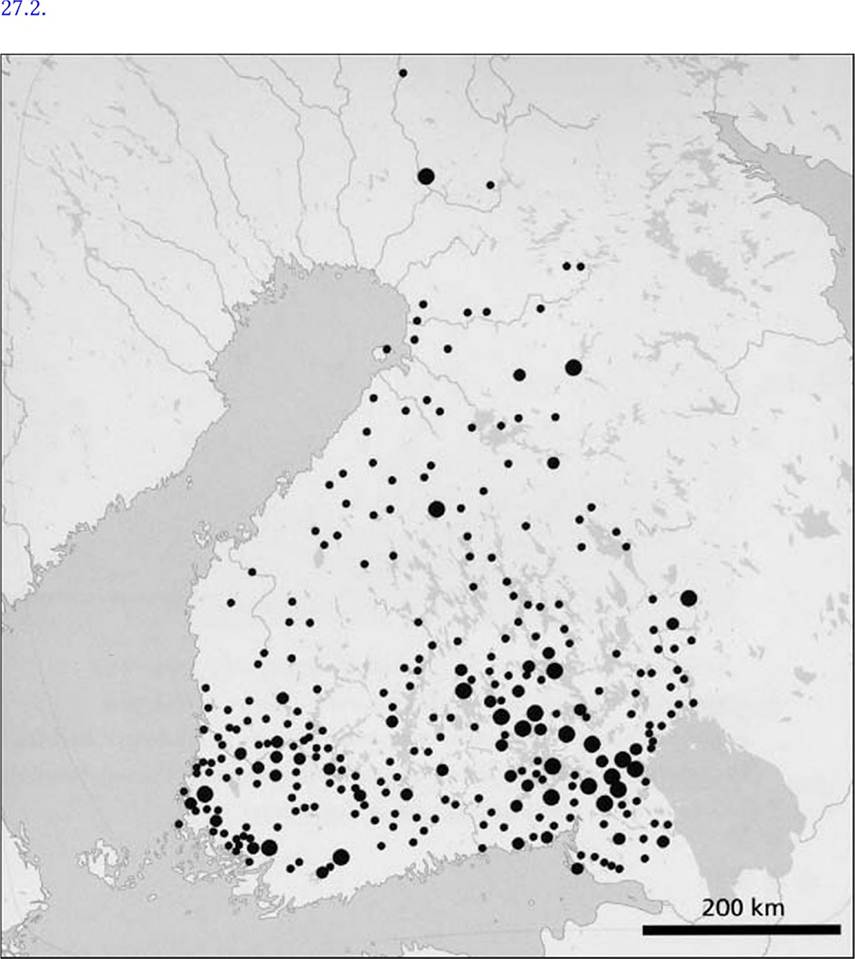
Figure 27.2 Hzzsz-initial place-names in Finland (Anttonen 2007: 35). © Affecto Finland Oy, Karttakeskus, Permission L8601/10.
During the Viking Age, the term hiisi was used to refer to both a cult place and a burial ground, and was used in a positive sense. After the arrival of Christianity, the socio-religious function of the hiisi institution came to be valued negatively. There was no equivalent referent for hiisi in the Christian vocabulary and the spatial term fell into a semantic vacuum. Later, during the Middle Ages when spatial distinctions were drawn in terms of a dualistic view of the world, hiisi began to be used to denote invisible, evil spirits originating from a mythological place dominated by diseases and other harmful things. The exclamation “Go to Hiisi!” came to mean “Go to hell.” In Christian folklore, the term is used to designate giants and a collective of post-mortal beings that dwell in forests. As a generic term, these were called hiidenvdki (“hiisi folk”). Conspicuous, large solitary rocks in the landscape deposited by Ice Age glaciers came to be explained as stones that hiisi giants had thrown at each other. In Christian legends, however, the beneficial properties of the otherworldly “hiisi folk” are also stressed: they cooperate with Christian converts in the building of churches (see Koski 1990: 427).
The semantic field of the notion of hiisi was closely connected in the pre- Christian Iron Age communities with another important signifier, namely the term denoting “sacred”. The notion of the sacred was an integral element in the spatial vocabulary that had been adopted by prehistoric hunters and early agriculturalists during the Bronze Age.
The attribute pyha, Finnish for “sacred”, is a proto-Germanic loanword dating back to the Bronze Age (ca. 1500-500 BCE). An earlier form of the word can be reconstructed as *pusa and is traceable back to a proto-Germanic adjective *wiha~, the root of which is *wz"/c- (“to cut, separate”) and which has a reflex in Gothic weihs “consecrated, made sacred by separation” (Koivulehto 1981: 333-76; Lutzky 1993: 288-92). In the very beginning, pyha was not a religious attribute, but was used as a geographical term to name and mark off border and transition areas in the wilderness.The adjective pyha was adopted to mark off boundaries between the domains of the interior and the exterior at topographically anomalous sites in the wilderness. The register of toponyms maintained by the National Land Survey of Finland includes more than a hundred such names, even though not all of them are directly connected with the pre-historic era. The attribute pyha appears in connection with such natural places as lakes, rivers, rapids, ponds, larger hills, capes, bays and fells (see Fig. 27.3).
In prehistoric times, py/zd-initial place-names were located in areas at a great distance from dwelling sites, at the outermost boundary of the inhabited area. By looking at how the notion of the sacred was introduced to the Baltic Sea culture area and elsewhere in northern Fennoscandia during the Bronze Age and the Iron Age, we can illuminate the geographical and spatial aspects of folk religious practices also prevalent in continental Europe. According to my findings, the term was used when all of the following spatial and social constraints can be observed in the prehistoric use of the the term “pyha”:
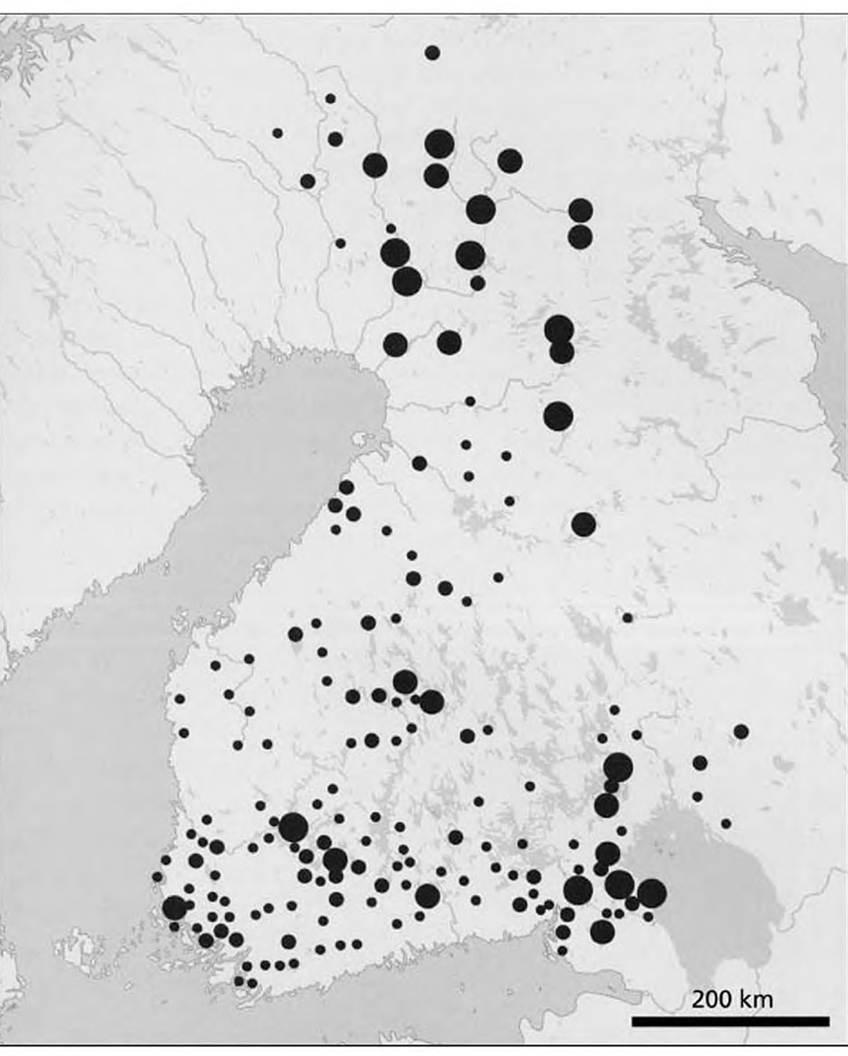
Figure 27.3 Py/zd-initial place-names in Finland (Anttonen 2007: 34). © Affecto Finland Oy, Karttakeskus, Permission L8601/10.
As Christianity was introduced to the Finns during the twelft h century CE, the missionaries adopted the spatial vocabulary of prehistoric hunters and agriculturalists. The term pyhd shifted and was now used to translate the Latin terms sacer and sanctus. In contrast with the pre-Christian system of marking spaces by means of the term pyhd, the attribute “migrated” from the remote wilderness regions to the heart of village settlements as it was adopted to set apart churchyards and Christian cemeteries.