Sacred Spaces and Objects
Like adherents of other religions, Buddhists recognize some places and objects as having a sacred character that sets them apart from the many other things they encounter in everyday life.
The most sacred sites in Buddhism are the Buddha’s birthplace at Lumbini in Nepal and, in India, Bodh Gaya, where the Buddha attained enlightenment; Samath, where he preached his Sermon in the Deer Park; and Kushinara, where the Buddha died and passed into parinirvana. Hundreds of thousands of pilgrims visit these and other sites every year, most made sacred by relics or connections with events in the lives of the Buddha and other Buddhist figures.
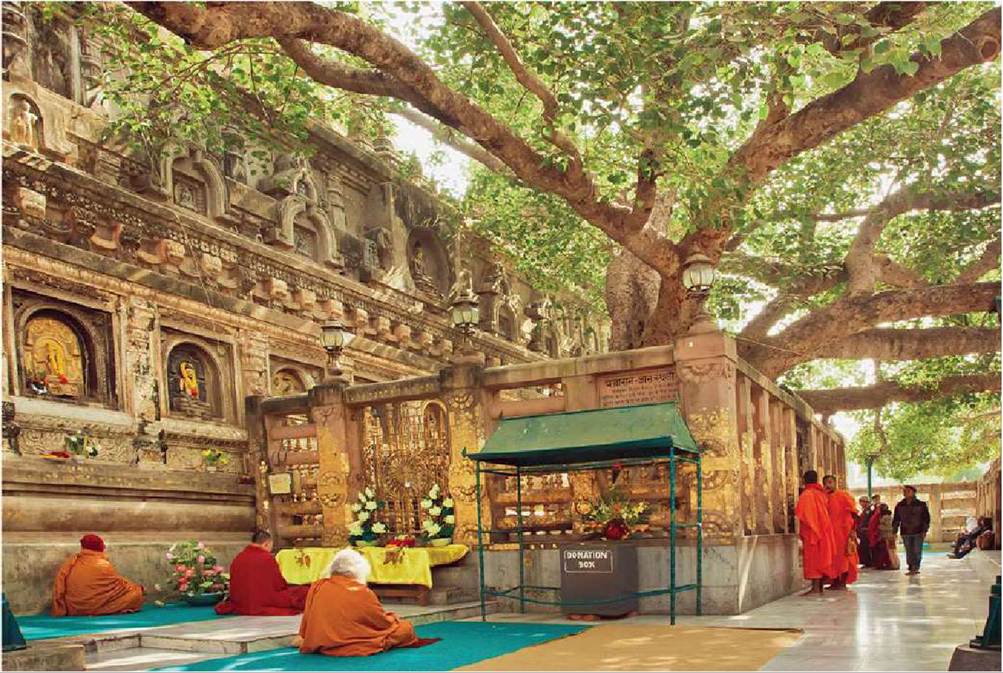
Buddhists visiting the site of the Bodhi tree under which the Buddha is said to have attained enlightenment. This tree is likely a descendant of the original Bodhi tree. Bodh Gaya, India.
Temples are sacred spaces where Buddhists venerate the Buddha and gather for rituals and ceremonies. Temples vary in outward appearance in accordance with regional architectural styles, but most share common interior features. These include an altar with a small statue of the Buddha and room for an incense bowl and offerings of fruit and flowers; a main hall; a library of sutras and other texts; a space for meditation; and rooms for resident monks.
For Buddhists, the most sacred of all objects are relics of the Buddha. According to tradition, the Buddha’s followers collected the ashes, teeth, bits of bone, and other relics that remained after his cremation. These were later divided into 84,000 portions by Ashoka, who ordered them enclosed in caskets and placed in earthen reliquary mounds called stupas. Today, most stupas are impressive hemispherical structures whose shapes are reminiscent of the original mounds built on the sites where they stand.
The relics they preserve have a powerful and inspiring effect on those who venerate them.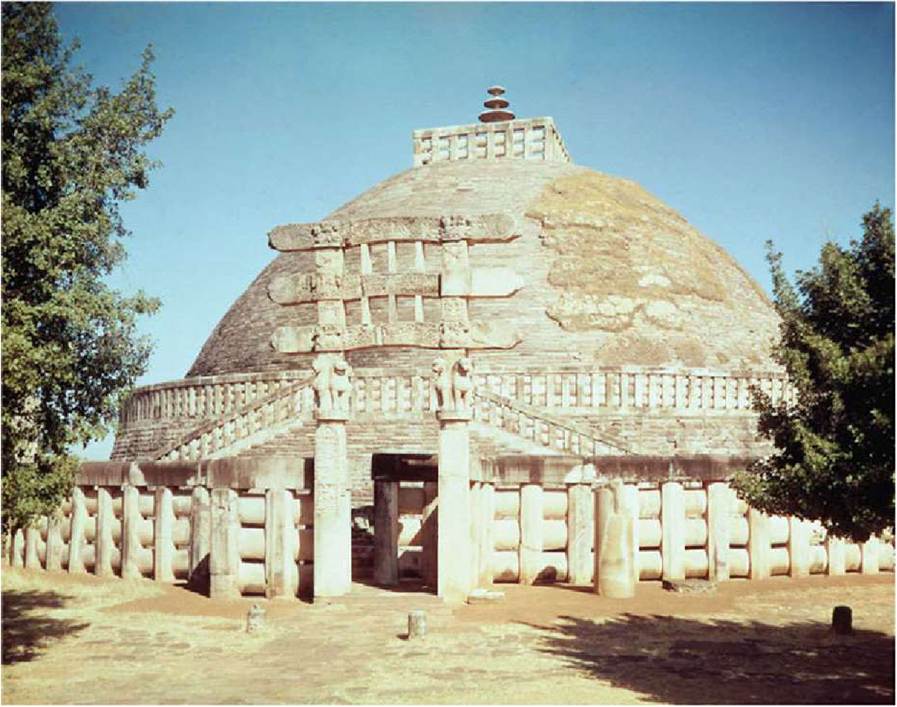
The Great Stupa of Sanchi, India. Early Andhra Dynasty, first century bce.
Because the Buddha said that his teaching would serve as his “Dharma body” after his death, many Buddhists venerate the sacred texts in which the Dharma is preserved. Some Mahayana and Vajrayana groups place manuscripts of sutras within images of the Buddha, making them objects especially worthy of veneration. For others, the titles of sutras, inscribed on stone, wood, or paper, are also objects of reverent devotion.
Artistic representations of the Buddha also have a sacred quality. Early Buddhist art tended not to represent the Buddha in human form. Instead, he was depicted in other ways; for example, as an empty chair, a pair of footprints, or the Bodhi tree he sat under at the time of his enlightenment. By the first century ce, Buddhists began to make extensive use of anthropomorphic images to represent more vividly the physical forms of Gautama Buddha and other buddhas and bodhisattvas. Many of these images make use of subtle iconographic cues such as mudras to represent the powers and functions of the buddhas and bodhisattvas they represent. Objects associated with important events in the life of the Buddha and aspects of his teaching are also sacred. Fig trees are revered, for it was in the shade of a fig tree that the Buddha attained enlightenment. Another commonly venerated symbol is the wheel. With eight spokes representing the eight aspects of the Noble Eightfold Path, the Dharmachakra, or Dharma wheel, is a universally recognized symbol of Buddhism. Prayer wheels, which have become a symbol of Vajrayana Buddhism, are almost as well known. Hand-held or mounted on posts, these hollow cylinders contain tightly wound scrolls on which mantras are written, in some cases more than a thousand times. Because one turning of the wheel is thought to generate as much merit as reciting the mantra as many times as it appears on the scroll, a few swipes of the hand on a prayer wheel can bring significant benefits for oneself and others.