Sikh Scripture
We have previously identified the Adi Granth, commonly known as Sri Guru Granth Sahib, as Sikhism’s most important sacred text. This is without question true for all Sikhs today.
There are, however, other texts that most Sikhs would classify as scripture, the most important being the Dasam Granth and the Rahit, both of which we consider here. In addition, works by two disciples of the Gurus are granted sufficient status to be recited in the gurdwara: Bhai Gurda (disciple of Guru Arjan and Guru Hargobind) and Nand Lal (disciple of Guru Gobind Singh). A collection of stories about the life of Guru Nanak, called the Janam-sakhi, also deserves mention. The account of Guru Nanak’s death cited in the previous section is from the Janam- sakhi.The Adi Granth
Compiled by Guru Aijan in 1603-1604, the Adi Granth contains the works of his four predecessors, along with his own hymns and various works by poets, such as Kabir (c. 1440- 1518). Through the centuries, the Adi Granth has occupied a central place in Sikhism. Whereas the Gurus once sat on a special seat amid Sikh disciples, since the time of the tenth and last historical Guru, Gobind Singh, the Adi Granth has occupied the same type of seat in the middle of any place of worship. And whereas the Gurus were once the authorities on religious matters, now Sikhs consult the Adi Granth.
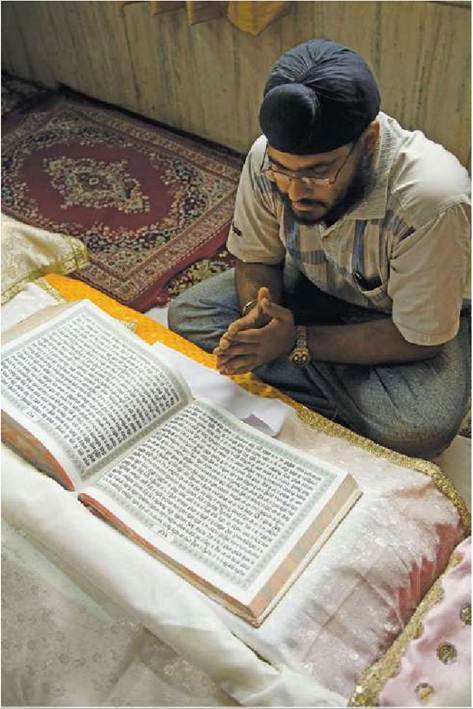
A Sikh reads from Sri Guru Granth Sahib, here occupying its customary place on a cushion within a gurdwara.
The name “Adi Granth” (“the Original Volume” or “the First Book”) is standard among scholars. Sikhs commonly express their reverence for the scripture by referring to it as Sri Guru Granth Sahib (“sahib” is a title of respect). Every copy is identical in both script and page number; there are 1,430 pages in every copy.
It was composed using the Gurmukhi script and a variety of languages that were used in northern India at the time, most prevalently Punjabi. It also contains some words in Arabic, Persian, Prakrit, and Sanskrit. All of these factors render the Adi Granth somewhat difficult to read, as well as difficult to translate. Today, however, English and French translations are available. Many Sikh families have at least a condensed version of the Adi Granth containing all of the works used in daily prayers, including Guru Nanak’s Japji, which is the only portion of the entire Adi Granth that is chanted rather than sung. For Sikhs, the Adi Granth rings with brilliance when it is set to music and proclaimed in its original language. In the words of one commentator: “The poetic excellence, the spiritual content, and the haunting, lilting melodies of the hymns of the Adi Granth are Sikhism’s greatest attraction to this day.”9The Dasam Granth
The composition of the Dasam Granth (“Volume of the Tenth Master”) has been traditionally attributed to Guru Gobind Singh, although many Sikhs today believe that only some parts were authored by the Guru. The first compilation of works into the Dasam Granth is thought to have taken place in 1734 (twenty-six years after the death of Guru Gobind Singh), although in the ensuing decades variant versions appeared. In 1902, the version that is used today was officially authorized.
During the eighteenth century, the Dasam Granth was considered to be Guru alongside the Adi Granth. Today, however, only one group of Sikhs, the Nihangs, bestow equal honor on the Dasam Granth. Nevertheless, the sections of the text that all Sikhs attribute to Guru Gobind Singh can safely be categorized as Sikh scripture. These sections include the well-known Jap Sahib and the Ten Savayyas; both are recited daily in morning prayers.
The Rahit
In the chapter’s opening, we observed that the Amrit Sanchar, the Khalsa initiation ceremony, is undertaken only by a minority of Sikhs, even though the Khalsa continues to exemplify the ideals of Sikhism. These ideals are spelled out in written form in rahit-namas, texts composed over the centuries and collectively referred to as the Rahit. Traditionally, the contents of the Rahit are believed to stem from the teachings of Guru Gobind Singh himself. In both this section on Sikh doctrinal teachings and the following section on Sikh religious life, we shall draw frequently from the contents of the Rahit.