The Life of Guru Nanak
Nanak was born in 1469 ce in the small village of Talvandi (modern-day Nankan Sahib, located near Lahore, Pakistan). He was born to Hindu parents of a mercantile caste who probably were worshipers of Vishnu (for more information about the caste system and the worship of Vishnu, see Chapter 4).
His parents arranged for him to marry early, when he was still in his teens, as was customary at the time. Nanak and his wife, Sulakhani, moved to Sultanpur, where Nanak’s older sister Nanaki lived. Soon Nanak and Sulakhani had two sons.Sultanpur, located on the main road between Lahore and Delhi, was a religiously diverse community, with residents and visitors who practiced varieties of Hinduism and Islam.
Nanak, who is said to have been dissatisfied with traditional forms of religion, gravitated toward a religious outlook similar to Hindu bhakti, the path of devotion (see Chapter 4). Nanak believed in the oneness of God and in the need to move closer to God. This could best be accomplished, he believed, through meditation and singing hymns in praise of God. Eventually, Nanak began composing his own hymns. With his friend Mardana, a Muslim musician, accompanying him on the rebab (a stringed instrument), Nanak sang his hymns at communal worship gatherings. These hymns are included in the Adi Granth and are sung in Sikh services today.
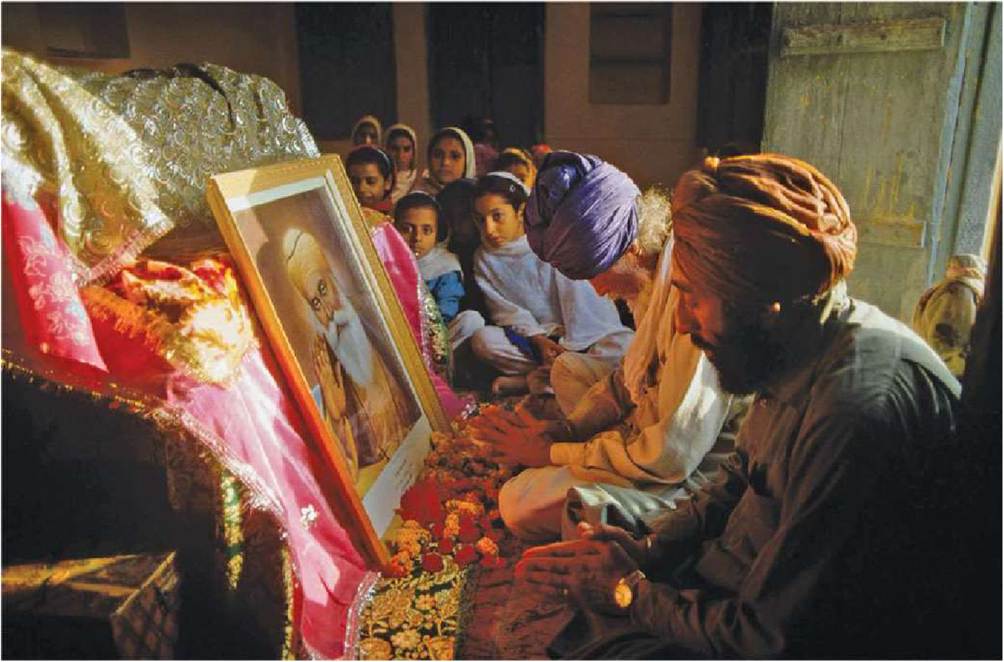
Sikhs pay homage to Guru Nanak, the founder of Sikhism, in a crowded room in Lahore, Pakistan.
According to tradition, Nanak became recognized as a spiritual leader early in his life. He would rise before dawn and bathe in the river, meditate, and then lead others in singing hymns of praise. When Nanak was about thirty years old, he underwent a crucial experience that led to the origin of the Sikh tradition.
Receiving God’s Revelation
One morning while Nanak was bathing in the river, he did not resurface from the water.
He was presumed drowned, and yet his body was not found. Three days and three nights later, however, Nanak emerged from the river, and, returning to the village, he proclaimed: “There is neither Hindu nor Muslim so whose path shall I follow? I shall follow God’s path. God is neither Hindu nor Muslim and the path which I follow is God’s.”4When he explained what had happened, Nanak said that he had been escorted to the court of God, who gave him a cup of amrit (the same drink that is used in the Khalsa initiation ceremony) and said to him:
This is the cup of the adoration of God’s name. Drink it. I am with you. I bless you and raise you up. Whoever remembers you will enjoy my favor. Go, rejoice in my name and teach others to do so. I have bestowed the gift of my name upon you. Let this be your calling.5
This experience dramatically changed Nanak’s life, causing him to cease participation in the civic life of Sultanpur, to send his wife and sons back to his parents’ home, and to embark on the next major stage of his life.
The Journeys of Guru Nanak
Deeply moved by this revelation, Guru Nanak spent the next two decades of his life, from age thirty to about age fifty, traveling far and wide and learning about a variety of religious customs, including Hindu, Muslim, and Jain. He is said to have undertaken four long journeys: eastward to Assan; southward to Sri Lanka; northward to the Himalayas; and westward, reaching as far as Mecca and Baghdad. He visited holy sites and encountered a wide variety of religious people. He also proclaimed and practiced his own teachings, sometimes to hostile audiences.
Several incidents during Guru Nanak’s travels illuminate the new message he proclaimed. On one occasion, while visiting a Hindu shrine in Haridwar, India, he found himself among brahmins throwing water toward the rising sun as an offering to their dead ancestors. Nanak turned and threw water the other way, explaining, “If you can send water to your dead ancestors in heaven, surely I can send it to my fields in the Punjab.”- On another occasion, Nanak was awakened from sleep by an angry Muslim who chastised him for sleeping with his feet pointing toward the Ka’ba in Mecca, the most sacred site in Islam. (Many Muslims consider showing the soles of one’s feet to be a grave insult.) Nanak responded: “Then turn my feet in some other direction where God does not exist.”2
Such stories as these illustrate a general theme of Nanak’s religious outlook.
He consistently rejected traditional rituals and “proper” religious protocol, whether Hindu or Muslim.Founding the Sikh Community
Drawing from his revelation experience and years of journeying, Nanak continued proclaiming his own religious ideals, among them monotheism; lack of distinctions based on gender, caste, or creed (for example, whether Hindu or Muslim); and performance of good deeds. Nanak attracted a large following. At about the age of fifty, he established a new settlement called Kartarpur (“abode of the creator”) in what is now Pakistan. Here he and his followers formed the first Sikh community and instituted the lifestyle that has characterized Sikh society to this day.
Guru Nanak erected a special building, a dharamsala (“abode of faith”), for worship. In so doing, he provided the prototype of the gurdwara, which today is the central structure of any particular Sikh community. (The term dharamsala gradually was replaced in the eighteenth century with gurdwara to designate the Sikh place of worship.) Nanak welcomed people from all segments of society to reside in Kartarpur and to work together to maintain it. Nanak himself joined in the work, which was primarily agrarian. Nanak also saw to the providing of food through a community kitchen known as the lang ar. This would become a standard feature of gurdwaras down through the centuries to the present day. Though in most respects a regular member of the community, Nanak sat on a special seat when addressing the congregation. Followers recognized the nature of the Guru as merely human and yet also as spiritually very advanced.
On September 22,1539, after leading the Kartarpur community for about twenty years, Guru Nanak died. According to the traditional account, the Guru (here referred to as “Baba Nanak”), aware of his approaching death, settled a dispute regarding the proper disposal of his body.
Hindus and Muslims who had put their faith in the divine Name began to debate what should be done with the Guru’s corpse.
“We shall bury him,” said the Muslims. “No, let us cremate his body,” said the Hindus. “Place flowers on both sides of my body,” said Baba Nanak, “flowers from the Hindus on the right side and flowers from the Muslims on the left. If tomorrow the Hindus’ flowers are still fresh let my body be burned, and if the Muslims’ flowers are still fresh let it be buried.” Baba Nanak then commanded the congregation to sing. They sang Kirtan Sohila and Arati.... Baba Nanak then covered himself with a sheet and passed away. Those who had gathered around him prostrated themselves, and when the sheet was removed they found that there was nothing under it. The flowers on both sides remained fresh, and both Hindus and Muslims took their respective shares. All who were gathered there prostrated themselves again.-Even with his death, Guru Nanak encouraged Hindus and Muslims to transcend their differences and to let peace prevail.
Guru Nanak’s example powerfully informs the beliefs and practices of Sikhs up to the present day. We will next turn our attention briefly to Sikh scripture, the collection of texts that contains the doctrinal position as set forth by Guru Nanak and his successor Gurus.
Compare Guru Nanak to founding figures of other religious traditions, with regard to establishing teachings and way of life and to the founding figure as a role model for others to follow.