Spiritual Ecology
For many of those who are committed to saving our planet from any further destruction of natural resources, the contemporary ecological movement lies at the intersection of science and religion, and possesses the same concern for the welfare of humankind that other, more established religious communities do.
This is particularly true for those persons of faith who have embraced—to a greater or lesser degree of literalness—the Gaia hypothesis of James Lovelock and Lynn Margulis. As stated first in the 1970s, and later revised in the 1990s, this revolutionaiy theory rests on the assumption that our planet can best be understood as a “selfregulating complex system” whose ultimate goal is to achieve homeostasis (i.e., “optimal conditions for life”). Both Lovelock, a chemist, and his colleague Lynn Margulis, a microbiologist, attribute something like intentionality to the various systems that make life possible on earth: hence the choice of the mythical name “Gaia” (in Greek mythology the goddess of earth) as the composite term for all of the phenomena which earth science has identified as prerequisite for all living organisms on this planet. Indeed, what makes their thesis so revolutionaiy is the tendency to see the evolving history of Earth as the story of a single organism, endowed with purposefulness and self-awareness, and capable of progressive adaptation.—Needless to say, this theory has been challenged again and again by scientists who insist that Lovelock and Margulis have done nothing more than literalize a metaphor, treating “Mother Nature” as something more than an image. However, various contemporary religious philosophers, and particularly those who are committed to the principles of the ecological movement, have found in the Gaia hypothesis a clue to the divine unity and manifest purpose of life on Earth, albeit, one that has eluded empirical sciences in the West until now.
This confluence of scientific and religious discourse—often termed “spiritual ecology”—can be found, for example, in Pope Francis’s 2015 encyclical entitled “Laudato Si’: On Care for Our Common Home” in which he argues that the present ecological crisis of global warming that we are witnessing today is essentially a spiritual crisis, stemming from the fact that we have forgotten the fact that Earth itself is a “gift from God,” who has instructed us to assume a burden of “stewardship” toward all living things. Pope Francis’s plea was later echoed at a meeting of the Parliament of World Religions, held that same year, and the view that emerged from that gathering of clerical and academic representatives was that the need to confront climate change was the principal moral and spiritual challenge of our time.A more radical and far-reaching version of this same argument, however, can be found in Rosemary Radford Reuther’s book Gaia and God: An Ecofeminist Theology of Earth Healing (1992), in which the author brings together several diverse strands of ecological spirituality. Thus, taking as her objective the need to “rebuild human society for a sustainable earth,” Reuther insists, like Pope Francis, that the ecological crisis is, in reality, a spiritual crisis, brought about by a civilization that views the natural world as something inhuman and devoid of spiritual value. Moreover, the dominant God concept of the West, she insists, is both utterly transcendent and hopelessly patriarchal, and therefore one that serves as the theological foundation of our present technological culture: a culture that both legitimizes the destruction of Nature and the exploitative domination of non-Western societies. In its place, Reuther proposes a revisionist, post-Christian understanding of humankind—one that places human beings within, rather than outside, the biosphere—and a concept of divinity that finds “God” both within human consciousness and within the world of natural process. Taking her cue from the Jesuit philosopher Teilhard de Chardin, Reuther envisions a newly sacralized universe in which matter and spirit have finally become one, and in which the human mind is at last understood to be the site of cosmic thought.
If Gaia and God are not simply interchangeable terms in Reuther’s worldview, then they are at least complementary forms of the same divine mystery.—The political imperatives that follow logically from this visionary reconstruction of Western religious thought are undeniably utopian in character: the redeemed world she envisions is a world without competition or aggression, in which poverty and injustice no longer flourish. Male domination in all its forms will have ceased to exist, and new creative forms of parenting and governing will have arisen. Like the biblical prophet Isaiah, Reuther envisions a future in which nation will not take up sword against nation, nor make war anymore. Once we have moved beyond patriarchy and the subjection of non-Western peoples, she insists, humankind will experience a kind of metanoia, or reversal of consciousness, that will allow for a final falling away of the self and the emergence of spiritually transformed societies at peace with themselves and with nature.
The Findhorn Foundation
If there is any community that has at least tried to embrace this vision of a reclaimed planet and a redeemed human race, it is, perhaps, the Findhorn Foundation in Scotland. Like so many New Age communities, Findhorn was a product of the political turmoil and revolutionary expectations of the 1960s. When its founders, Peter and Eileen Caddy, withdrew to a quiet Scottish village named Findhorn in 1962, they hoped to establish there a communitarian way of life that would be open to new forms of religious experience. Eileen Caddy had long believed that she had received messages from God, and that the end of the present world order was at hand. Her hope, then, was that the alternative society she and her husband planned to create would outlast the apocalypse and become a model for a small-scale agricultural way of life. As time went on, and as the Findhorn community grew, its subsequent leadership moved away from a postapocalyptic/survivalist mode of thinking to something more adaptive and progressive.
This shift in self-understanding and political perspectivecorresponding to Wallis’s distinction between a world-renouncing and a worldaccommodating ideology—was accompanied by the physical expansion of the original Findhorn colony and the development of residential educational programs designed to promote “planetary cleansing.”Today Findhorn is the site of one of the more successful ecovillages in any Western nation. It boasts that it has the “smallest ecological footprint” of any community in the postindustrial world, but even more remarkably it serves as a haven for spiritually minded persons who wish to pursue a nondogmatic contemplative life with active community engagement. In the nineteenth century the typical Findhorn resident would have been described as a “seeker,” and the fluid population of the entire Findhorn community makes it unlikely that it will ever become anything more than a village in size and composition.—
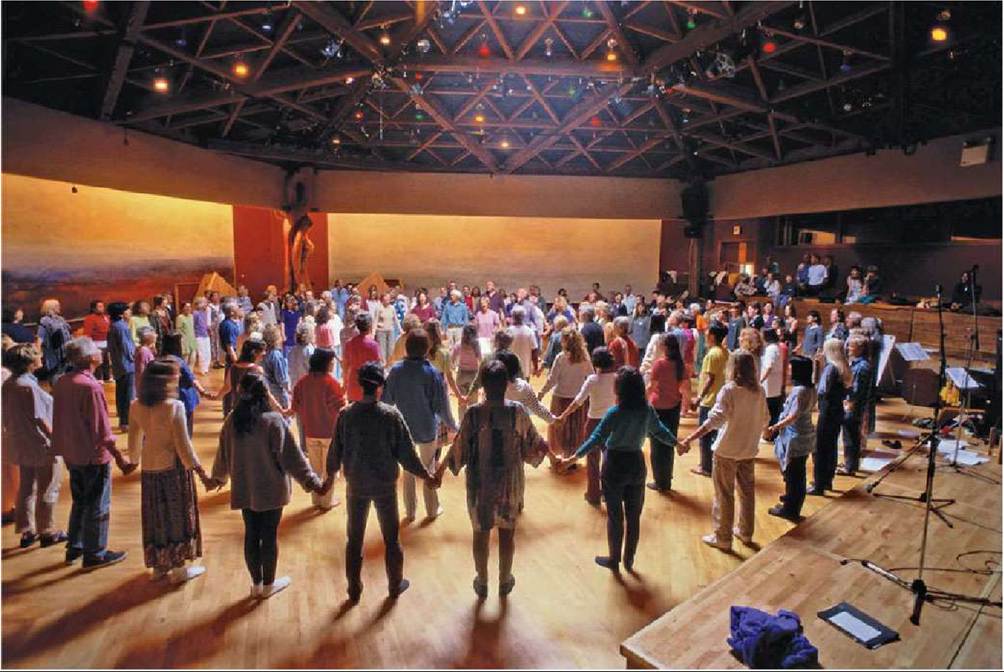
Members of Findhorn Foundation engaged in Sacred Dance.
Self-Assessment 14.5
[Please note: You must be using an online, browser-based eReader in order to view this content.]
More on the topic Spiritual Ecology:
- The Unification Church
- ADITYA, THE SUN GOD
- THE STAIRWAY TO THE SKY
- HITOMI TONOMURA
- INTRODUCTION
- PRACTICE AND THEORY
- Conclusion
- FINDING THE ‘ISLAM’ IN ISLAMIC ART
- Settlements
- The Military