TEMPORAL AND GEOGRAPHIC SPREAD OF MITHRAISM
Current views differ from Cumont’s speculation about Iranian origins which have never been found. Today it is assumed that the cult of Mithras spread from Italy, and based on the sheer quantity of the traces documenting the cult we can conclude that the point of origin is Rome or Ostia.
The urban cult retained a number of local particularities pointing back to origins in the first century CE, an early period from which we have, however, no monuments that can be dated with confidence. Among these local characteristics we find that the monographic bull-slaying motif (see below) played a proportionately far more important role than it did in the provinces. In Italy, other motifs are only found on approximately 10 per cent of all Mithras-related reliefs, whereas one quarter of the reliefs from the provinces display other motifs found in the central myth of Mithraism. The earliest dateable remains come from the provinces of the empire, but are connected with named individuals of Italic origins. Besides inscriptions, ceramics from the Rhine area point at the second half of the first century CE as the period when the earliest Mithraea were established there (Garbsch and Kellner 1985: 355-462; Huld-Zetsche 2008).From Italy, Mithraism reached not only the Rhine but also the areas around the Danube. The cult was transported there by soldiers recruited in Italy, by members of the families of Italic tax collectors and by other Roman citizens who moved to the provinces and took their religious practices with them. Such diffusion took place, for example, when Italic peoples moved to Dalmatia (the eastern Adriatic coast) in the first two centuries CE and when Dacia (present-day Romania) was colonized under Trajan in the second century CE.
By the middle of the second century CE, Mithraism had reached nearly all the points in the entire long-term maximum area of the diffusion of the cult.
With steadily increasing numbers of Mithraea established, the inscriptions documenting the cult also become more plentiful from this period. Mithraism had by then transcended its first social stratum of adherents. Slaves were freed, soldiers returned to civilian life as wealthy men, and both groups no doubt saw their allegiance to the god Mithras as a major factor in their good fortunes.Beginning with the reign of Marcus Aurelius (161-80 CE) and increasingly in that of Commodus (180-92 CE) we find inscriptions in Mithraea dedicated to the well-being, pro salute, of the emperor. This formulaic expression was one of the most popular expressions of the cult of the emperor (Herz 1975: 80-82). Such inscriptions are found in all parts of the Roman Empire to which the cult of Mithras had spread, and were erected by individuals from all social classes. Beginning with Commodus the epithet Invictus, “invincible”, “the unconquered”, which had been part of the titles of Mithras since the origins of the cult, was (E) where reclining initiates partook of the ritual meal. Fig. 19.2 shows a Mithraeum from Budapest.
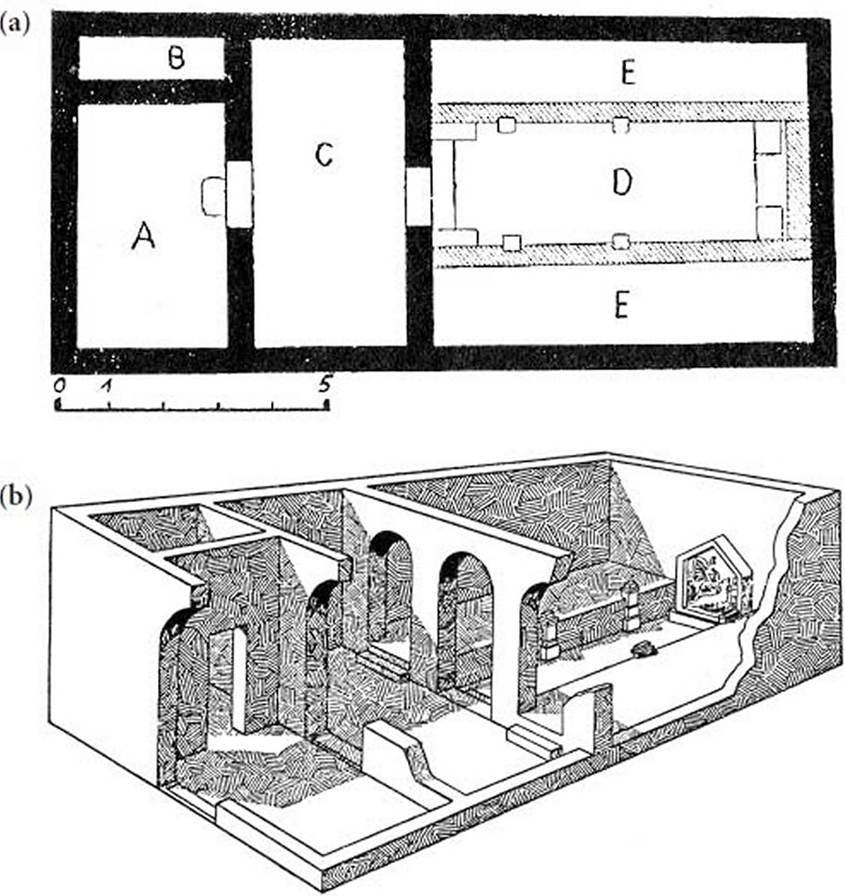
Figure 19.2 Mithraeum from Budapest: (a) ground plan; (b) in elevation. © Manfred Clauss.
Although the rooms were constructed identically, their furnishings and design were not. Details of the wall paintings, statues and ritual implements differed according to region and according to the particular tastes of the sponsors or of the congregation. In this respect, Mithraism serves as an instructive example of how a universally shared set of rituals and doctrines can go hand in hand with a broad spectrum of local variations.
Depending on the financial capabilities and the religious preferences of the adherents, Mithraea were furnished with various statues, reliefs and altars. An example that can be mentioned here is one of the sanctuaries at Stockstadt
Across the room from the entrance, the rear wall was often curved, forming a slightly elevated niche resembling an apse (Fig.
19.3). The main relief with the image of the tauroctony was placed there. Both the main room and the niche were made to resemble caves and symbolize the cosmos, the cave of the world as a microcosm in Porphyry’s explanation (Porphyry De antro nympharum [On the Cave of the Nymphs] 6; Lavagne 1974). In some places the ceiling was painted with the light blue colour of heaven with yellow or golden stars. The sanctuary thus models the world through which human beings walk towards the deity.The main relief on the rear wall thus presents the image of Mithras slaying the bull, surrounded by flickering oil lamps. These reliefs were painted, and gave a visual impression that modern viewers of the archaeological remains will need considerable imagination to reconstruct in the mind’s eye (a reconstruction of the colours used can be found in Huld-Zetsche 1986: 78). The various scenes on the relief could be contemplated by the initiates, but also illustrated the priests’ narratives of the deeds of the deity.
The architecture of the Mithraea gives us important clues about the nature of the cult. Contrary to the temples of other deities, the altar is located within the sanctuary and all ritual acts take place inside the cave-shaped structure. It may have been that the attraction of such a cave-like sanctuary was the possibility of withdrawing from the outside world into an intimate and secluded circle. In such small sanctuaries the experience of participation gives a feeling of companionship, strengthened by a shared participation in the ritual meal. Contrary to, for instance, the mysteries at Eleusis, where some three thousand could gather for the ceremony, the Mithraic congregations were gatherings for the elect few.