10 THE DIVINE PRESENCE AND ITS INTERPRETATION IN EARLY MESOPOTAMIAN DIVINATION* *
ABRAHAM WINITZER, UNIVERSITY OF NOTRE DAME
1
Divination, if one seeks to define it, is less difficult a task than is the counterpart for its alleged parent, religion — though perhaps only marginally so.
After all, one can approach the topic from virtually every entryway through which the drive to understand religion is tackled. Whether via its mythology or ritual, its accompanying liturgy, or the treatises its record may leave behind, the complexity of the phenomenon is such that it should give anyone deluded in believing that the meaning of divination is somehow self-evident room for pause. Still, no matter the approach to which one resorts, a central tenet that must be confronted at some point concerns not merely the existence of a divine realm, but of its willingness to reveal something of itself in the natural order, something perceivable to man; this, perhaps, does stand in contrast with religion.And so questions concerning the proclamation or signs of the divine’s manifestation or “presence” in divination systems, including those from ancient Mesopotamia, must be understood as basic to the broader enterprise. In a very real sense what enabled Mesopotamian diviners to proceed with their queries was the fundamental assumption of and hope for the divine’s manifestation via one of the various divinatory channels, of and for the divine’s virtual “presence” in the examined media, in the form of a sign.
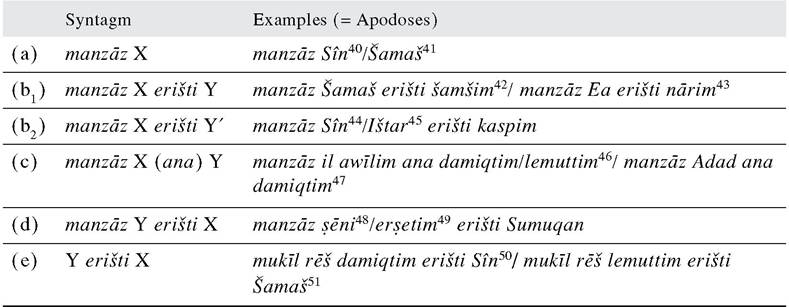
When, however, one turns to the omen collections from ancient Mesopotamia — by far the most elaborate testimony of divinatory interest stemming from this civilization — it is the relative silence concerning the mention of deities that is striking. On occasion one does encounter statements exhibiting an interest in this basic theological premise, though frequently upon their assessment it becomes clear that these are marginal to the broader enterprise of the collections.
And perhaps most telling of the divine realm’s place in these texts are those omens whose forecasts herald the presence of this or that deity but immediately see fit to gloss these statements, as if to reconfigure them, subsuming in the process proclamations of “divine presence” in the literature’s deep technical sea.In the following I attempt to explore this discrepancy, something that may be seen as one between Mesopotamian divination theory and practice, as Niek Veldhuis put it recently.1 In particular, I try to posit an explanation for it and to provide a model for its development. In so doing I hope that some light may be shed on the following two questions: What does the evolution in the place of the divine mean for an understanding of divination in ancient
ABRAHAM WINITZER
Mesopotamia? Is there a way in which this development reflects a change in attitude in Mesopotamia concerning the way by which divinatory knowledge was accessed, perhaps even about the very meaning of divination?
2
We might begin with a consideration of the testimony from the theoretical side of things. A recent study by Piotr Steinkeller (2005) presents a comprehensive picture of the conceptual setup of early Mesopotamian divination, at least for its most significant channel, extispicy. This reconstruction, it should be noted at the outset, is not without its drawbacks. One may quibble with particular aspects in Steinkeller’s overall model or even object to his synchronic approach; what follows, in fact, raises some challenges to his overall scheme. Still, Steinkeller’s contribution to the understanding of the overall picture cannot be overestimated; more to the point, for the present purposes his reservations about it, even if ultimately justified, prove to be tangential. Accordingly, it is recapped in what follows.
Table 10.1. The gods of Mesopotamian divination (following Steinkeller 2005)
| Major Gods: | Samas | Adad(?)[89] |
| Description: | bel dinim “Lord of Judgment” | bel birim/bel ikribi u birim “Lord of (extispicy) Inspection/Petitions and Inspection” |
| Other Deities: | Istar...(Venus), Sulpae (Jupiter), mulgal.si.sa (Sirius [Ninurta]), Sin (Moon), etc. | |
| Description: | ilu musitim “Gods of the Night” (Collective) | bel tertim “Lord of the Omen” (Individual) |
In his work, Steinkeller sought to understand the place of Samas, the sun-god, Adad, the weather-god — respectively the bel dinim “lord of judgment” and the bel birim/bel ikribi u birim “lord of (extispicy) inspection/petitions and inspection” — as well as the so-called Gods of the Night in the Mesopotamian conception of the divinatory universe.
In particular, it is the pairing of the former two that appears in many of extant prayers and prayer rituals of Old Babylonian divination (including ikribu- and tamitu-prayers, and other related material), something even more appreciable now with the recent publication of the tamitu (oracle) texts by Lambert.[90] As Steinkeller explains it, this Samas-Adad duo operates in tandem — with Adad providing for Samas, the real actor, a turbo-like boost — to enable the cosmic process. That divination takes place at night owes itself to the belief that at this time Samas traverses thesurri Samas u Adad, perhaps “if statement(s) (= casuistic omen sentences) of Samas and Adad,” discussed recently in Michalowski 2006.
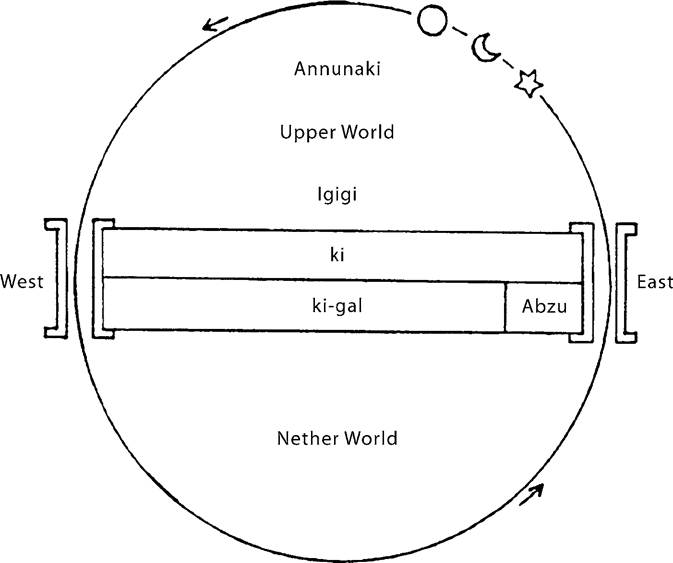
Figure 10.1. The Babylonian universe (after Steinkeller 2005)
Netherworld’s horizon, a mirror image of the one visible in daytime (fig. 10.1). At this time, when earthly judgment ceases, the interest of the cosmic judge turns to divinatory matters, the heavenly counterpart of legal verdicts.[91] The Gods of the Night, according to Steinkeller, are the selfsame deities named in many extispicy reports — including Istar (in her various guises), Sulpae, Ninurta, Sin, and so on — that are also to be equated with the night’s stars (thus Istar = Venus, Sulpae = Jupiter, Ninurta = Sirius, Sin = Moon, etc.). For a given extispicy one of these functions as the bel tertim, or the deity responsible for that extispicy, perhaps in accordance with personal proclivity or with astronomical and/or meteorological realities.[92] In all the system is, Steinkeller claims early on, “highly coherent and... internally logical,”6 and, more significant for the present purposes, unequivocal about the place of the divine realm in it.
Further evidence of the centrality of the idea of divine manifestation or presence in Mesopotamian divination may be witnessed when one turns to the phenomenology of the divinatory act, at least as it is met — faute de mieux — in the accompanying prayers and related literature.
In this respect, the transformation inherent in the extispicy act must be understood as a quasi-transfiguration for its practitioner and the conceptual universe he inhabits. Accordingly, the rooftop that provided the setting for the event serves as the axis mundi where the gods encounter the human realm. Indeed, the texts all but spell out the fulcrum on which the cosmic beam rests: having concluded the preparatory ritual, the diviner moves on to beseech the gods to have “truth” (kittum) established — or, perhaps better, materialized — before him. The coda of the well-known Prayer (to the Gods) of the Night[93] (example 1) makes the point clearly:1. In the extispicy I am performing / In the lamb I am offering[94] / Establish truth (kittum) for me![95]
So, too, for the Old Babylonian prayer of the divination priest YOS 11 22 (example 2), where this last imperative functions as the refrain of the entire text. The diviner beseeches the gods to establish truth (kittam sakanum) within his reach:
2. In the ikrib-blessing I am pronouncing / In the extispicy I am performing / Establish truth (kittam suknam) for me![96]
And what is here understood as “truth” is qualified elsewhere even further. Thus, upon the appeal for the establishment of truth via the extispicy performed, the petitioner turns to the gods in the initial prayer of the great Old Babylonian extispicy liturgical manual YOS 11 23 (and //)[97] with the following plea (example 3):
3. Cause the god, the lord of the omen I am performing, to be present for me!
In the extispicy I am performing establish truth for me!
In the manifestation(s)[98] of the great gods (siknat ill rabutim), in the tablet of the gods (tuppi sa ill), May a takaltum be present![99]
The precise identification of the term takaltum in this passage has been a matter of some debate. If one follows the view espoused most recently by Steinkeller, then in the present context the word should be understood as a euphemism for the (whole) liver, this on analogy with its primary meaning, a carrying bag for storage of small tools.[100] Accordingly, the un-inscribed liver was envisaged as the depository of equipment of a different sort, namely,
tun = takaltum in various (native) lexical lists, especially those in Hh, cited in CAD T, 61, s.v.
takaltu A, already noted in Starr, ibid., 53-54 n. 98; also Vanstiphout and Veldhuis, ibid., p. 31 n. 9.At issue is the relation between the takaltum (taka-al-tum) and the tuppi sa ill. If the latter is taken as a metaphor for the liver itself, then one must either: (a) interpret the takaltum as a subset of the liver or as something in its interior (so, e.g., Glassner 2002: 10 “les visceres”; Wilcke 2007: 236 “Tasche”), or (b), more radically, read the word in the genitive (ta-ka- al-tim) so as to have it in apposition with the tuppi sa ill (so Lambert 1998: 147).
The first of these options is possible, though it is not without its problems. It seems unlikely that the prayer would have in mind here either the liver's “organs” generally (whose sound presence, though certainly meaningful and desirable [see further below], did not articulate on its own the precise signification for which the diviner frequently awaited), or, alternatively, the (non-“canonical”) zone by the same name (for which see, e.g., Jeyes 1989: 76), to the exclusion of all the others. Less likely is Lambert's solution to
the divine message, with the liver amounting to a veritable tabula rasa, an empty slate upon which this message was recorded. Elsewhere too, in a tale intended to provide an etiology for divination, it is likened to nothing less than the Tablet of the Gods. This tale (example 4), the opening of a text concerned with proper diviner qualifications and procedures, which was reedited not long ago by Lambert,* 15 tells how Enmeduranki, the legendary king of Sippar, was given “the Tablet of the Gods, the liver, secret (or, just below in the same text: mystery) of Heavens and Earth,” along with instructions about how to conduct the craft of various sorts of divination and determine who might be their respective practitioners.
4. Samas in the Ebabbara [appointed] Enmeduranki, [King of Sippar], the beloved of Anu, Enlil, [and Ea]. Samas and Adad [brought him in] to their assembly, Samas and Adad [honored him], Samas and Adad [seated him] before [them] on a golden throne.
They showed him how to observe oil in water, a mystery of Anu [Enlil and Ea]. [Th]ey gave him the Tablet of the Gods, the liver, a secret of Heaven and the Netherworld (tuppi ilani takalta piristi same u erseti [i]ddinusu), they put the cedar in his hands, beloved by the great gods.And he, [in accordance with] their [command], brought into his presence the citizens of Nippur, Sippar, and Babylon, and honored them, he seated them before him on thrones, he showed them how to observe oil in water, a mystery of Anu, Enlil, and Ea, he gave them the Tablet of the Gods, the liver, a secret of Heaven and the Netherworld (tuppi ilani takalta piristi same u erseti iddinsunuti), he put the cedar in their hand, beloved by the great gods, the Tablet of the Gods, the liver, a mystery of Heaven and the Netherworld (tuppi ilani takalta nisirti same u erseti)....16
Now Lambert was astute to note similarities between some of the qualifications of would- be divination-priests and those incumbent upon Levitical priests in the Bible.17 Actually, a broader comparison — note: functional, not genetic — may be suggested, one that sheds further light on divination’s theoretical conceptual stance. After all, as presented in the legends and prayers surveyed,18 the entire extispicy event parallels much of what is the defining event in the biblical text, indeed of all revealed religions: revelation and transmission of the divine word from the god(s) to his/their select group of people.19 And if one accepts the premise that the Mesopotamians reckoned the sign or signs detected via extispicy, or through any divinatory channel, as divinely inspired in some transcendent fashion, then logically it follows that extispicy, or divination in general, is nothing less than a source of revelation, its product tantamount to the divinely revealed word. In fact this point was made long ago,20
but appears underappreciated for its basic phenomenological significance.[101] [102] All the same, of its basic truth there can be no doubt. And if, arbitrarily or from a comparatist’s standpoint, divination is not included among the premier league of moments of the divine’s manifestation in the human realm — those including revelation, incarnation, transubstantiation, or an ongoing mystical divine presence (the seklnd in Jewish Kabbalistic terminology, a cognate of the aforementioned siknatu “manifestation(s)” of the ill rabutim[103]) — then at least within a more modest Mesopotamian scope one is wise to include this version of Michelangelo’s “touch of God.”[104] and those concerned, prima facie, with the divine realm. He writes: The analysis of Athenian consultations of Delphi has divided them into categories that involved political, military and diplomatic issues as well as ‘religious' ones. However, in every case where we know the terms of the enquiry, and quite probably in all the cases where we don't know, the actual question asked of Delphi is directly about relations with the gods (Bowden 2004: 132). The point is illustrated even further if, upon returning to the Mesopotamian sphere, we consider an analogous situation from a comparable phenomenon: the record of prophecy and prophetic activity, along with the transmission of this information, at Mari. In one well-known instance known from this corpus, an episode involving the deliberations of (king) Zimri- Lim in a foreign-policy matter, reports of a certain prophetic utterance reach the king from multiple sources. The events surrounding these missives, if one follows their explication in Sasson 1995; also van der Toorn 2000: 230-33; idem 2007: 112-13, are intricate, and offer a supreme example of self-interest and crafty diplomacy by politically savvy parties. But this does not gainsay the existence of an enigmatic prophetic utterance at the core of the matter (sapal tibnim mu illaku “waters run beneath straw”), even if, as Sasson (ibid., 607-08) and van der Toorn (2000: 232-33; 2007: 113) wonder, it may be impossible even in this instance to settle on the ipsissima verba (assuming there was more to it than the above-mentioned aphorism!). 22 Already noted in Starr 1983: 53. To be sure, earlier reflexes of this idea abound in biblical writings, from Deuteronomy's so-called Name Theology (sikken sem) to the initial promise by the Israelite deity of presence in the portable sanctuary (Exod. 25:8) and, indeed, to the basic term for this “tabernacle” (miskdn). 23 Compare Durand 2008: 431-33. 3 Of course all this rests on a model of the theoretical conception of Mesopotamian divination. As such, its value may be challenged on two fronts. First, there is the question of the model’s accuracy: to what extent have we represented its basic ingredients correctly and proportionally? And there is a second question, one involving the degree to which theory reflects and matches practice. A word on each of these matters is in order. Concerning the model’s accuracy one might consider, by way of example, the question of the place of Adad within the conceptual framework. As described above, Steinkeller had contended that numerous references to this god as the bel birim, or “lord of divination,” are not incidental to the overall setup. And yet in numerous texts and even entire text genres that bear on the issue of the theoretical framework, Adad does not figure as Samas’ counterpart.[105] Even in the Enmeduranki etiology, connected as it is to Samas and his Sippar home, the Ebabbar temple, the place of Adad should probably be seen as an external intrusion to a native theology, as Lambert observed recently.[106] It is thus not unlikely that his place in the Babylonian divinatory universe, and even his title bel birim, represents a specific historical development, and not something that can be deemed autochthonous.26 the point. Then again, the text, which spares little in conveying Gudea’s piety throughout his sacred task, certainly does not refrain elsewhere from the mention of other deities. One finds the major gods of the Lagas pantheon to be sure, but also others, parenthetically mentioned, including Nisaba, Istaran and Samas, Ninzaga and Ninsikila, etc., each in connection to his/ her defining attribute (respectively, writing, justice, relation to Dilmun). Why, then, no mention should have been made of the gods of divination in the telling of events is worth considering. And elsewhere where the performance of extispicy is described this matter is even more curious. A case in point is the intriguing portion of a school letter “by” Ibbi-Sin, recently published in Michalowski 2006a. There Ibbi-Sin reports of having received a favorable omen via extispicy. The deity responsible for this, we are told, is Enlil, who, Ibbi-Sin swanks, “has looked upon me with grace and has taken my supplication in (his) holy heart; he established for me in my omens the favorable parts...” (ibid., 251). The verisimilitude of this omen, to put it mildly, is problematic; at the very least the issue must be considered in the context of the Old Babylonian scribal curriculum and in light of the literary and historiographic conventions of the royal letter genre (Michalowski 1976: 3-16, 27; 2006a: 256-57). Nevertheless, the question may still be raised as regards its image of extispicy therein, since, as Michalowski rightly observes, its language does contain elements that capture accurately both the technical side of extispicy and the reporting of extispicy omens in the (non-literary) Old Babylonian epistolary. Why then, in this light, is it Enlil who is depicted fashioning the liver’s regions (uzu zid/gub.ak) and setting signs in it (kin-gi>-a/ ABRAHAM WINITZER One is thus left to wonder what other aspects of the theoretical setup are secondary to native ideas of Mesopotamian divination, or, for that matter, whether such a “trait-list” investigative approach is prudent in any case. Now happily, this skepticism too has its limits. Certainly for divination literature in broad terms Steinkeller’s model is defensible for the early second millennium B.C., such that at least conceptually it may be said, in the spirit of Paul Veyne, that the Mesopotamians did indeed believe in their divination myth. But then there remains the second, larger matter, the one concerning the relevance of any of this for the understanding of the place of the divine in “practical” Mesopotamian divination. Theories of all kinds run their course,27 and in any case in practice things typically operate differently. With respect to the topic at hand one must ask to what extent the theoretical framework can serve as the guide to ideas about the place of the divine realm in Mesopotamian divination. In other words, at some point our quest must shift its focus onto other facets of the phenomenon of divination, lest we be fooled by the “fantastic screen” of the conceptual setup, to borrow Leo Oppenheim’s metaphor,28 and equate Mesopotamian divinatory mythology with Mesopotamian divination. So what place exactly did the divine realm hold in the eyes of its practitioners? What of the petitioners for whom the divination was performed? After all, if, as suggested by the theoretical framework, divine “presence” was a basic, even determinative, fact to the broader enterprise, then should one not anticipate a continuous and explicit witness to divine manifestation, whether in accounts of divinatory activity or, better yet, in the omens themselves? Might we not expect omen literature to be, in a word, more “theological” — and considerably less “technical”?29 4 Naturally, a comprehensive answer to this question must build on different areas of data, of which two in particular stand out. These are: (1) the testimony of or about diviners and divinatory concerns, especially that appearing in the considerable divinatory epistolary corpus from the Mari archives,30 and (2) the Mesopotamian omen collections themselves. Unfortunately, the present setting cannot take up both these angles, but rather must limit itself to only the latter of these.31 As is well known, Mesopotamian divination left an immense corpus of omen collections, from various divinatory channels, beginning apparently in the Old Babylonian period. To be sure, these cannot be conceived as the direct testimony of Mesopotamian divination or diviners. They represent, rather, part of the scientific literature of ancient Mesopotamia. More broadly this means the Mesopotamian penchant to organize data in massive lists, what at times is labeled Listenwissenschaft; more specifically, the collections form a subset of the casuistic literature — of which the law “codes” are better-known examples — and are the product of scribes, who organized and, on the basis of hermeneutic principles and deductive reasoning, generated the overwhelming majority of this material from an empirically based kernel.32 Nevertheless, a relation between Mesopotamian divination and the omen collections is beyond dispute,33 such that, if properly executed, the gleaning of details from the collections can serve as a legitimate source of information on Mesopotamian divination, especially in terms of its broader assumptions. Let us turn, then, to the omen collections, and specifically to a branch of the literature that has not received the attention of extispicy but which exists from the early periods of Mesopotamian divination and which, if the tradition reflected in the Enmeduranki etiology can serve as any guide, enjoyed a privileged status in the eyes of the ancients.34 * This is leca- nomancy, or the divinatory method studying the configuration of oil poured in water. Though its place in the first-millennium divinatory sciences or in the cuneiform “stream of tradition” appears negligible,35 there exists a respectable corpus of oil omens from the Old Babylonian period. These were the subject of a comprehensive edition and study by Giovanni Pettinato (1966), now over forty years ago, though apparently they have not inspired much interest since. For the present purposes their significance stems from the fact that they contain a considerable number of individual entries, each in the classic casuistic logic-sentence form, whose interpretations bear statements about the “presence,” or manzazum (or: mazzazum), of particular deities, literally their “stand.” Now similar statements, it is noted below, are not absent in extispicy, but when comparing the sizes of the respective corpora it is clear that such statements figure more prominently in lecanomancy.36 Concerning such manzazu-formulas, the question to be posed is a simple one: what is their meaning? How to interpret apodoses professing a particular god’s “presence?” Can one justly speak of these as conveying an early sort of what later theological reflection might label an epiphany? To answer these questions one must contend with another matter that frequently presents itself in those omens mentioning the manzazum of particular gods. This involves the mention of “requests” (singular: eristum) for specific items that accompany statements of divine “presence.” As the following demonstrates, the understanding of the relation between these terms sheds considerable light on the meaning of the manzazu-formulas themselves, 186 ABRAHAM WINITZER and also on the broader issue of the place of the very expression of “divine presence” in the omen collections. 5 From almost the very beginnings of the study of Mesopotamian divination, a relation was observed between statements about a deity’s request and those of its presence. Jastrow, in his pioneering work on Mesopotamian divination,37 had already qualified the relation between manzäzum and eristum as the deity’s “Bestand” and “aktive Tätigkeit,” respectively.38 Pettinato advanced this idea in his study of the lecanomancy corpus, observing that in these omens the manzäzu-formula was at times clarified and/or made more specific, most frequently via a statement describing a request, eristum.39 The evidence from the oil-omens corpus is instructive for the present purposes. Its reassessment, conducted below, provides an opportunity to test Pettinato’s observation systematically. More importantly, it sheds additional light on the ancients’ attempts to contend with the root of the problem: the meaning of divine presence in Mesopotamian divination. Within the lecanomancy corpus, apodoses with manzäzu-formulas and/or eristu-statements are attested in distinct types, summarized in the following (table 2), where an element Y somehow qualifies or is qualified by a statement about a deity X: Table 2. Synopsis of manzazum and eristum attestations in Old Babylonian lecanomancy omen collections Most frequently attested are apodoses where a simple statement about the “presence” of a particular deity (DN), expressed by way of a manzaz X formula, appears unqualified (a), for example, manzaz Sin/Samas, “(it represents) the presence of Sin/Samas.” Of the qualified variety (b-e), most common are cases where an eristu-statement appears to comment on a preceding manzaz X formula (b1-2). At times this is achieved via a paranomastic hermeneutic (b1) like the phrase eristi samsim, “(it is) a request of/for the sun disk (written: sa-am-si-im),” that follows manzaz Samas, “presence of Samas (written: dutu),” or eristi narim, “(it is) a request of/for the canal,” apparently as commentary the preceding manzaz Ea, “the presence of Ea.” In other instances of this type (b2) the qualification of the manzaz X formula by the eristu-statement does not seem to be based on paranomastic grounds: the presence of Sin/ Istar, manzaz Sin/Istar, is followed by a request (eristum) of/for silver, eristi kaspim. Still elsewhere the manzaz DN formula may be qualified without resort to an eristu-statement: for example, in (c) the phrases “for good/bad” qualify the previous manzaz X formulas. In a couple of cases (d) the manzazum and eristum appear crisscrossed: in the apodoses manzaz seni/ersetim eristi Sumuqan “the presence of the flock/Land; (it is) the request of Sumuqan,” the DN appears as part of the eristu-statement, seemingly as an explanation of the previous manzazu-formulas. Finally, in the apodoses mukil res damiqtim eristi Sin / mukil res lemuttim eristi Samas (e), an eristi X statement also appears to explain a preceding element, though in this case this element is not bound with manzazum. A number of general observations may be made from this survey. First, it is apparent that an eristu-statement, where it appears (b1-2, d, e), follows some component of the apodosis, whether a manzazu-formula (b1-2, d) or merely the element Y (e).52 Second, it is also evident that a manzazu-formula, where it appears and is qualified by (or, less likely, qualifies) another element in the apodosis (b1-2, c, d), precedes any other component of the apodosis, whether an eristu-statement (b1-2, d) or merely Y (c). Third, it is plain that the manzaz DN formula can be qualified, for example by ana damiqtim/lemuttim, that is, as positive or negative, and thus cannot be understood, in and of itself, as having an absolute value.53 From these observations it follows that the eristu-statements fill a fundamentally different role from those of manzazu-formulas (notwithstanding the cases [d-e] where a divine name appears as part of the eristu-statement). It is also apparent that the same eristu-statement can follow two alternative manzazu-formulas (b2, d); the converse, however, is not attested. Finally, on the basis of all these factors it seems likely that, if at least for the oil omens, Pettinato’s judgment stands: where they appear, the eristu-statements clarify or specify a preceding element — the latter often a manzaz DN formula. Yet, as noted above, this examination of the oil omens is instructive in another manner, one dovetailing with the preceding observation and illuminating the broader underlying issue of the meaning of divine-presence formulas. In at least two pairs of omens from this corpus an inverse relation seems to operate between interpretive eristu-statements in apodoses and the appearance of similes or metaphors in the counterpart protases. One reads (example 5): 5 1· If from the middle of the mass a(n oil) bubble came up54 and has burst (it represents) the presence of Sin: a request of/for silver (eristi kaspim). 2 If the oil, in your pouring water (on it), has taken (the shape of) two horns (qarnin[107]) (it represents) the presence of Sin 0.[108] 3- If in your pouring water into the middle of the oil one fourth of the oil separated (it represents) the presence of Samas: a request of/for the sun disk (eristi samsim). 4- If in your pouring water into the middle of the oil (the oil bubble) came up like a star (kima kakkabim ishit) (it represents) the presence of Samas 0.57 Notably, eristu-statements appear in the apodoses of the first omens of each pair (lines 1, 3), while in the latter of each couple (lines 2, 4) they do not (indicated by 0 above). What is remarkable about this is the relation of these apodoses with what precedes them. In the protases of the second omen of either pair one observes a transparent signification for the presence of Sin and Samas: the metaphor of “horns” (qarnu) and the simile of a rising star (kima kakkabim ishit), respectively; no such signification is found in the counterpart protases of omens (1) and (3). This finding can hardly be coincidental. Rather, one must assume that the appearance of the eristu-statements in the first of each pair, and their absence in the second, is directly related with the information given in the protases. To wit: where a sufficiently clear signification is offered in the protasis no explanatory gloss appears in the respective apodosis; where no such clarity is initially afforded on the other hand, one finds a compensatory explanation in the oracle itself. In other words, statements of requests occur in these examples where formulas of divine presence appear but are not prompted by some unusual finding in the corresponding protasis. By “unusual” here what is meant is precisely what Nougayrol (1976) had in mind when describing his “silhouettes de reference,” those similes occurring in many omen protases that stood outside the standardized metonymic signification system of a given divinatory technique. With these for one reason or another a choice was made to keep things at the metaphoric level, that is, outside the bounds of the divinatory technique’s established signification.58 The divine-presence formulas in these examples represent the product of such cases. Their expression, when matched by the accompanying “silhouettes,” appears foreign within the context of the established divinatory semiotics. Elsewhere, however, where found detached from their “silhouette” moorings, they are mediated by explanatory glosses. Such instances, as already observed, represent the majority among the overall number of occurrences of divinepresence formulas. From this picture it thus seems that not only do eristu-statements clarify often-preceding formulas of divine presence; they appear to do so when the accompanying manzaz DN formulas are not heralded by — one is tempted to say: have lost — metaphorical signs promoting various divine-presence significations. This evidence, then, though limited in scope, nonetheless points to a metaphorically based connection between statements concerning divine “presence” in certain omen apodoses and particular signs in the matching protases. This connection seems to represent an exception to the collection’s metonymy-based interpretive apparatus, what elsewhere in divination literature is plainly one of its defining features (see below). One wonders whether the unevenness in these findings suggests that a reconfiguration of ideas concerning the divine presence was THE DIVINE PRESENCE AND ITS INTERPRETATION IN EARLY MESOPOTAMIAN DIVINATION 189 already underway in Old Babylonian lecanomancy, though with the data available, at least for the oil-omen corpus, this question must remain in the realm of speculation. 6 Indeed, it remains to be seen whether the observations witnessed above for the case of lecanomancy hold for other branches of divination, most significantly extispicy. Elsewhere I argue that in fact a similar picture may be gleaned from the extispicy omens.59 One striking example involves the following passage, where one finds just the sort of reference to the divine presence that was encountered with the oil omens (example 6): 6. 1-2 [If] in the back of the Crucible of the right side a foo[t(-mark)] (sepum) has a [f]ork ([la]riam) (it represents) the foot of Nergal. 3 4. If in the back of the Crucible of the right side (there are) two feet(-marks) (sepan) Adad will devastate the iskaru-fields of the pa[lace]. 5. If in the back of the Crucible of the right side a foot(-mark looks) like a shawl with (of) a parsikku-band (()pur parsikkim)60 (it represents) the presence of Istar.61 Of particular interest is the third entry (line 5). In this instance again one encounters an unusual simile in the protasis, describing an image well outside of the standard metonymybased nomenclature and semiology of extispicy (something even more striking when compared with the standard marks in lines 1-2, 3-4: the “foot” [sepum] and “fork” [/arum]62). That it should thus be the subject of theological speculation about the “presence” of a deity, in this case Istar — this over against more standard formulations as those in the preceding entries63 * — is therefore less surprising than before.64 And yet a comparison between lecanomancy and extispicy is actually neither fair nor valid, since in the case of the latter, which was not only the most significant in the early periods but also the most technically advanced, statements concerning divine presence and requests had assumed, via metonymy, a place within the technical apparatus itself. In the case of divine presence this was probably the secondary name — manzazum, the “Presence” — of the first zone of the liver, naplastum (or: naplastum, the “View”), as Nougayrol first suggested.65 Concerning requests there existed a mark named eristum, or “Request,” whose appearance in the protasis frequently coincided with a statement of request in the accompanying apodosis (see, e.g., example 7 below).66 * 67 In short, “presence” begat “Presence”; divine (and other) “requests” engendered “(the) Request.” 7. If at the View’s head (is) a Request-mark (eristum) (it is) a request by the great god (eristi ilimrabim).66 Consequently, in terms of both protases and apodoses, omen statements from extispicy collections are highly systematized and rather predictable, certainly relative to contemporary divination from other avenues. One suspects, for instance, that were the technical apparatus of extispicy less advanced and abstract in this period, then the apodosis of an omen like that in example 7 might initially have made mention of the deity’s “presence,” and then follow with the request statement, perhaps: *manzaz DN eristi ginim, “presence of DN; request for an offering.” Remarkably, however, even among this highly standardized material one still finds traces of the old interest in the divine presence. Evidence of this appears in a number of the collections themselves, which entertain in various ways a deity’s “standing,” or presence, in the performed extispicy (examples 8-11). 8. 1· “If it has Palace Gate in whichever stanc[e (lit., stand) you] take the deity will protect you.” 2. “If it does not have a Palace Gate the gods will abandon the land.”68 9. 1· “[If it ha]s [a View] the man’s sacrifice for (lit., with) the god will be (lit., is) accepted.” 2. “[If it does not have a View] it (i.e., the man’s sacrifice for the god) will not be accepted (lit., did not stand).”69 10. “If the Path is situated (normally) the god will set straight the man’s path.”70 And compare: [6 omen entries concerning the Path] 11. “If it has a Strength divine umbrage [will b]e upon the man.”71 What is particularly striking about these examples is their place in the respective collections in which they appear: these represent the very opening of each. Even an apparent exception proves to confirm to the rule upon closer examination. This is example 11, an entry from a collection studying two different zones, which, when concerned with only the presence of the “Strength,” figures to be the very first in its respective section — immediately following a double line demarcating between the former and the current topics.72 * Following each of these entries their respective compendia turn to deal with more usual concerns, those describing abnormalities of one sort or another in the very zone for which the issue of normal presence had first been explored, though now in more specific terms and in greater detail. It would thus seem that in a very real sense the idea of a given zone’s normal state with which certain collections commence was intended to define the compendia, and to spell out the structural opposition between soundness and abnormality that elsewhere in the extispicy collections was the underlying assumption, what has been dubbed the “first paradigm” of divination.73 This evidence represents, in a sense, a vestige of an older interest that has been fossilized in the collections. But it is all the more significant for it. On its basis it is possible to say that at a fundamental level the basic theoretical notion of the deity’s presence remained the central — indeed foundational — tenet for the broader enterprise. That the collections are frequently anchored by this premise cannot be ignored; that soon thereafter they shift to more complex algebraic permutations is, in a real sense, secondary. One cannot, despite the immense technical sea that followed, overlook that which served as the foundation to it all: the belief in the theological notion of divine presence as sine qua non for Mesopotamian divination. Evidently, in all these examples the reality of the zone’s presence or absence was equated with the theological metaphor of divine presence or abandonment, respectively. One wonders to what extent this signification reflected an article of faith for the diviner-scholar, one that operated coherently and consistently within his system of hermeneutics, and, subsequently, from which additional theological ominous postulates were (or could be) generated. This question, too, cannot be entertained in the present context, and must await a full treatment elsewhere. Nevertheless, it already seems clear that its analysis will yield important findings, and not only for our understanding of the semiotics of divination literature. After all, in the final analysis, statements concerning the divine presence in Old Babylonian Mesopotamian divination bear more broadly on contemporary conceptions of religion and the divine realm within it. ABRAHAM WINITZER 7 Our journey, which must end, has not been a fruitless one, for we have gathered from it an answer to our initial query. The notion of divine presence in Mesopotamian divination, it is now clear, was not limited to theory alone. This remained a central tenet of Mesopotamian divination, even after the latter was reconfigured in part, with its empirical record incorporated into the scribal curriculum and the Mesopotamian written sciences.[109] In that new context a branch of Mesopotamian divination developed which no longer resembled what had previously been: Mesopotamian divination literature. This omen literature describes a different sort of divination altogether, one whose theater of operation was the written text and whose reasoning was derivative of the words themselves. In this rich new literary world — a world, in the manner of language itself, limitless in its deductive bounds — the manifestation of the divine figured much less prominently. Indeed, the beginnings of this process were already encountered above. The appearance of interpretative glosses describing “requests” following statements of divine “presence” in some examples suggests that even within the conceptual framework of any given divination technique, this Ursprache was, simply put, not enough; commentary would be needed to explain revelation. And what, one might ask by way of conclusion, was the fate of the latter? This, in turn, was relegated, in the way of a deus otiosus, to a conceptual attic from which, on unprecedented occasions, it could scarcely mutter a thin, small voice. Which reminds us of an old, if somewhat less ancient, Mesopotamian story, at first glance about an intellectual debate on an altogether different matter, unrelated to our subject: On that day Rabbi Eliezer brought forward every imaginable argument, but they [the other Rabbis] did not accept them. He said to them: “If the law is as I say, let this carob tree prove it!” Thereupon the carob tree was torn a hundred cubits out of place (others affirm: four hundred cubits). “No proof can be brought from a carob tree,” they answered. Again he said to them: “If the law is as I say, let the stream of water prove it!” Whereupon the stream of water flowed backwards. “No proof can be brought from a stream of water,” they answered. Again he argued: “If the law is as I say, let the walls of the schoolhouse prove it.” Whereupon the walls inclined to fall. (But Rabbi Joshua rebuked them, saying: “When scholars are engaged in... dispute, what have you to interfere? Hence they did not fall in honor of Rabbi Joshua, nor did they remain upright, in honor of Rabbi Eliezer, and they are still standing thus inclined.) Again he said to them: “If the law is as I say, let it be proved from heaven!” Whereupon a heavenly voice cried out: “Why do you dispute with Rabbi Eliezer, seeing that in all matters the law is as he says!” But Rabbi Joshua arose and exclaimed: “It is not in heaven (Deut. 30:12).” What did he mean by this? Said Rabbi Jeremiah: “That the Torah had already been given at Mount Sinai; we pay no attention to a heavenly voice, because You have long since written the Torah at Mount Sinai.. Rabbi Nathan met Elijah and asked him: “What did the Holy One, blessed be He, do at that moment?” He replied: “He laughed, saying: ‘My sons have defeated me, my sons have defeated me'” (Babylonian Talmud, Bava Metzi’a 59b). ABBREVIATIONS AbB Altbabylonische Briefe in Umschrift und Übersetzung AHw W. von Soden, Akkadisches Handworterbuch AO Musee du Louvre tablet number ARM 26 Durand 1988 CAD A. Leo Oppenheim et al., editors, The Assyrian Dictionary of the Oriental Institute of the University of Chicago CT Cuneiform Texts from Babylonian Tablets in the British Museum Erm Hermitage Museum tablet number ETCSL The Electronic Text Corpus of Sumerian Literature FM 7 Durand 2002 FM 8 Durand 2005 GAG W. von Soden, Grundriß der Akkadischen Grammatik Hh HAR.ra = hubullu (lexical series) KAL Keilschrifttexte aus Assur literarischen Inhalts KAR Keilschrifttexte aus Assur religiosen Inhalts MAH Musee d'Art et d'Histoire (Geneva) tablet number MDAI Memoires de la Delegation archeologique en Iran MSL Materials for the Sumerian Lexicon OB Old Babylonian OBE Jeyes 1989 Olwahrsagung Pettinato 1966 YOS 10 Goetze 1947 YOS 11 van Dijk, Goetze, and Hussey 1985 BIBLIOGRAPHY Bowden, Hugh 2004Classical Divination and the Delphic Oracle: Divination and Democracy. Cambridge: Cambridge University Press. Cooper, Jerrold S. 1983 The Curse of Agade. The Johns Hopkins Near Eastern Studies. Baltimore: Johns Hopkins University Press. van Dijk, Johannes J. A.; Albrecht Goetze; and Mary I. Hussey 1985 Early Mesopotamian Incantations and Rituals. Yale Oriental Series 11. New Haven: Yale University Press. Durand, Jean-Marie 1988 Archives epistolaires de Mari I/1. Archives Royales de Mari 26/1. Paris: Editions recherche sur les civilisations. 1997 “La divination par les oiseaux.” Mari: Annales de Recherches Interdisciplinaires 8: 273-82. 2000 Documents epistolaires du palais de Mari, Volume 3. Litteratures anciennes du Proche-Orient 18. Paris: Editions du Cerf. 2002Florilegium marianum VII: Le culte d’Addu d’Alep et l’affaire d’Alahtum. Memoires de N.A.B.U. 8. Paris: Societe pour l'etude du Proche-Orient ancien. 2005Florilegium marianum VIII: Le culte des pierres et les monuments commemoratifs en Syrie amorrite. Memoires de N.A.B.U. 9. Paris: Societe pour l'etude du Proche- Orient ancien. 2008 “La religion amorrite en Syrie a l'epoque des archives de Mari.” In Mythologie et religion des semites occidentaux, Volume 1: Ebla, Mari, edited by G. del Olmo Lete, pp. 161-716. Orientalia Lovaniensia Analecta 162. Leuven: Peeters. Eagleton, Terry 2003 After Theory. New York: Basic. Edzard, Dietz Otto 1997 Gudea and His Dynasty. The Royal Inscriptions of Mesopotamia, Early Periods 3/1. Toronto: University of Toronto Press. George, Andrew R. 2003 The Babylonian Gilgamesh Epic: Introduction, Critical Edition and Cuneiform Texts. 2 volumes. Oxford: Oxford University Press. Glassner, Jean-Jacques 2002 “takaltu.” N.A.B.U.: Nouvelles Assyriologiques Breves et Utilitaires 8: 9-10. 2005 “L'aruspicine paleo-babylonienne et le temoignage des sources de Mari.” Zeitschrift fur Assyriologie 95: 276-300. Goetze, Albrecht 1947 Old Babylonian Omen Texts. Yale Oriental Series 10. New Haven: Yale University Press. Second printing, 1966. Hunger, Johannes 1903 Becherwahrsagung bei den Babyloniern nach zwei Keilschrifttexten aus der Hammurabi-Zeit. Leipziger semitistische Studien I/1. Leipzig: J. C. Hinrichs. Jacobsen, Thorkild 1976 The Treasures of Darkness: A History of Mesopotamian Religion. New Haven: Yale University Press. Jastrow, Morris 1905-12 Die Religion Babyloniens und Assyriens. 2 volumes. Giessen: Alfred Topelmann. Jeyes, Ulla 1989 Old Babylonian Extispicy: Omen Texts in the British Museum. Publication de l'Ins- titut historique-archeologique neerlandais de Stamboul 64. Istanbul: Nederlands Historisch-Archaeologisch Instituut te Istanbul. Klein, Jacob 1980 “Some Rare Sumerian Words Gleaned from the Royal Hymns of Sulgi.” In Studies in Hebrew and Semitic Languages Dedicated to the Memory of Prof. Eduard Yechezkel Kutscher, edited by P. Artzi et al., pp. 9-28. Bar-Ilan Departmental Researches Department of Hebrew and Semitic Languages. Ramat Gan: Bar-Ilan University Koch(-Westenholz), Ulla 2000 Babylonian Liver Omens: The Chapters Manzäzu, Padänu and Pän täkalti of the Babylonian Extispicy Series Mainly from Assurbanipal’s Library. Carsten Niebuhr Institute Publications 25. Copenhagen: Museum Tusculanum. 2005Secrets of Extispicy: The Chapter Multäbiltu of the Babylonian Extispicy Series and Nisirti bäruti Texts mainly from Assurbanipal’s Library. Alter Orient und Altes Testament 326. Münster: Ugarit-Verlag. Labat, Rene, with the assistance of Dietz Otto Edzard 1974 Textes litteraires de Suse. Memoires de la Delegation archeologique en Iran 57. Paris: Paul Geuthner. Lambert, Wilfred G. 1967 “Enmeduranki and Related Matters.” Journal of Cuneiform Studies 21: 126-38. 1998 “The Qualifications of Babylonian Diviners.” In Festschrift für Rykle Borger zu sei nem 65. Geburtstag am 24. Mai 1994: tikip santakki mala basmu..., edited by S. M. Maul, pp. 141-58. Cuneiform Monographs 10. Groningen: Styx. 2007 Babylonian Oracle Questions. Winona Lake: Eisenbrauns. Lenzi, Alan 2008Secrecy and the Gods: Secret Knowledge in Ancient Mesopotamia and Biblical Israel. State Archives of Assyria Studies 19. Helsinki: Helsinki University Press. Machinist, Peter 1986 “On Self-Consciousness in Mesopotamia.” In The Origins and Diversity of Axial Age Civilizations, ed. by S. N. Eisenstadt, pp. 183-202, 511-18. Albany: State University of New York Press. Maul, Stefan M. 2003 “Omina und Orakel. A.” Reallexikon der Assyriologie 10, 1/2: 45-88. Michalowski, Piotr 1976 The Royal Correspondence of Ur. Ph.D. dissertation, Yale University. 2006“The Scribe(s) of MDAI 57 Susa Omens?” N.A.B.U.: Nouvelles Assyriologiques Breves et Utilitaires 41: 39-40. 2006a “How to Read the Liver — in Sumerian.” In If a Man Builds a Joyful House: Assyriological Studies in Honor of Erle Verdun Leichty, edited by A. K. Guinan et al., pp. 487-97. Cuneiform Monographs 31. Leiden/Boston: Brill. Moran, William L. 1969 “New Evidence from Mari on the History of Prophecy.” Biblica 50: 15-56. Nougayrol, Jean 1941 “Textes hepatoscopiques d'epoque ancienne conserves au Musee du Louvre.” Revue d’assyriologie et d’archeologie orientale 38: 67-83. 1946 “Textes hepatoscopiques d’epoque ancienne conserves au Musee du Louvre (II).” Revue d’assyriologie et d’archeologie orientale 40: 56-97. 1950 “Textes hepatoscopiques d’epoque ancienne conserves au Musee du Louvre (III).” Revue d’assyriologie et d’archeologie orientale 44: 1-40. 1967 “Rapports paleo-babyloniens d’haruspices,” Journal of Cuneiform Studies 21: 219-35. 1969 “Nouveaux textes sur le zihhu (I).” Revue d’assyriologie et d’archeologie orientale 63: 149-57. 1971 “Nouveaux textes sur le zihhu (II).” Revue d’assyriologie et d’archeologie orientale 65: 67-84. 1976“Les ‘silhouettes de reference’ de l’haruspicine.” In Kramer Anniversary Volume: Cuneiform Studies in Honor of Samuel Noah Kramer, edited by B. L. Eichler, pp. 343-50. Alter Orient und Altes Testament 25. Kevelaer: Butzon & Bercker; Neukirchen-Vluyn: Neukirchener. Oppenheim, A. Leo 1977Ancient Mesopotamia: Portrait of a Dead Civilization. 2nd edition. Chicago: University of Chicago Press. Parpola, Simo 1997 Assyrian Prophecies. State Archives of Assyria 9. Helsinki: Helsinki University Press. Pettinato, Giovanni 1966 Die Olwahrsagung bei den Babyloniern. 2 volumes. Studi Semitici 21-22. Rome: Istituto di studi del Vicino Oriente. Pongratz-Leisten, Beate 1999 Herrschaftswissen in Mesopotamien: Formen der Kommunikation zwischen Gott und Konig im 2. und 1. Jahrtausend v. Chr. State Archives of Assyria Studies 10. Helsinki: Helsinki University Press. Richter, Thomas 1994“Zu einigen speziellen Keulenmarkierungen.” Altorientalische Forschungen 21: 212-46. Rochberg, Francesca 1996 “Personifications and Metaphors in Babylonian Celestial Omina.” Journal of the American Oriental Society 116: 475-85. Sallaberger, Walther 2005 “The Sumerian Verb na de5(-g) ‘To Clear.’” In “An Experienced Scribe Who Neglects Nothing”: Ancient Near Eastern Studies in Honor of Jacob Klein, edited by Y. Sefati et al., pp. 229-53. Bethesda: CDL Press. Sasson, Jack M. 1995“Water beneath Straw: Adventures of a Prophetic Phrase in the Mari Archives.” In Riddles and Untying Knots: Biblical, Epigraphic, and Semitic Studies in Honor of Jonas C. Greenfield, edited by Z. Zevit et al., pp. 599-608. Winona Lake: Eisenbrauns. Schwemer, Daniel 2001 Die Wettergottgestalten Mesopotamiens und Nordsyriens im Zeitalter der Keilschriftkulturen: Materialien und Studien nach den schriftlichen Quellen. Wiesbaden: Harrassowitz. 2007 “The Storm-Gods of the Ancient Near East: Summary, Synthesis, Recent Studies, Part I.” Journal of Ancient Near Eastern Religions 7: 121-68. Starr, Ivan 1983 The Rituals of the Diviner. Bibliotheca Mesopotamica 12. Malibu: Undena. 1990 Queries to the Sungod: Politics and Divination in Sargonid Assyria. State Archives of Assyria 4. Helsinki: Helsinki University Press. Steinkeller, Piotr 2005“Of Stars and Men: The Conceptual and Mythological Setup of Babylonian Extispicy.” In Biblical and Oriental Essays in Memory of William L. Moran, edited by A. Gianto, pp. 11-47. Biblica et Orientalia 48. Rome: Pontifical Biblical Institute. van der Toorn, Karel 2000 “From the Oral to the Written: The Case of Old Babylonian Prophecy.” In Writings and Speech in Israelite and Ancient Near Eastern Prophecy, edited by E. Ben Zvi and M. H. Floyd, pp. 219-34. Society of Biblical Literature, Symposium Series 10. Atlanta: Society of Biblical Literature. 2007 Scribal Culture and the Making of the Hebrew Bible. Cambridge: Harvard University Press. Vanstiphout, Herman L. J., and Niek Veldhuis 1995 “tuppi iläni takältu piristi same u ersetim.” Annali 55: 30-32. Veldhuis, Niek 2006“Divination: Theory and Use.” In If a Man Builds a Joyful House: Assyriological Studies in Honor of Erle Verdun Leichty, edited by A. K. Guinan et al., pp. 487-97. Cuneiform Monographs 31. Leiden/Boston: Brill. Volk, Konrad 1996“Methoden altmesopotamischer Erziehung nach Quellen der altbabylonischen Zeit.” Saeculum 47: 178-216. Wiggermann, F. A. M. 1999 “Nergal. A.” Reallexikon der Assyriologie 9, 3/4: 215-23. Wilcke, Claus 2007“Das Recht: Grundlage des sozialen und politischen Diskurses im Alten Orient.” In Der geistige Erfassen der Welt im Alten Orient, edited by C. Wilcke, pp. 209-44. Wiesbaden: Harrassowitz. Winitzer, Abraham 2006 The Generative Paradigm in Old Babylonian Divination. Ph.D. dissertation, Harvard University. Forthcoming a “Writing and Mesopotamian Divination: The Case of Alternative Interpretation.” Journal of Cuneiform Studies. Forthcoming b “More on Inanna’s Symbol as Sign, and Her ‘Presence’ in OB Divination.” oi.uchicago.edu