9 THE CALCULATION OF THE STIPULATED TERM IN EXTISPICY
NILS P. HEEBEL, UNIVERSITY OF HEIDELBERG
Among the many different divinatory methods used in Mesopotamia, the practice of ex- tispicy stands apart. It has always been of special importance to society as it represents the only means of direct communication between mankind and the realm of the gods.
While other divinatory genres are concerned with signs as messages from the gods and sacrifice represents a human way to beseech the gods, they remain techniques for a one-way contact. Quite on the contrary, extispicy functions in both directions and therefore it is real communication: A human being formulates a question that can be answered with “yes” or “no,” the gods decide upon the answer and write their decision within the entrails of a sacrificial animal. Extispicy makes it possible to communicate with the divine sphere in order to find out the will of the gods concerning specific events and to align one’s deeds with it. Therefore, extispicy has been called a “checking technique,”1 which coordinates a planned action with the will of the gods. This possibility to communicate with the divine sphere can be seen as a highly stabilizing factor for a community, as the society could be sure to live in accordance with the decrees of the gods.However, the will of the gods, even when formulated as a simple yes-or-no answer to a predetermined question, was not easy to read. For the gods gave their answers not for free, but only after a sacrifice had been made; a sacrifice that represented something valuable for the person seeking a divine answer to a question, be it cedar from a diviner, flour from a widow, oil from a poor woman, or a lamb from a rich man.2 * No matter how poor or rich a person might be, in order to get an answer from the gods one had to sacrifice something valuable for oneself. And the answer of the gods was not communicated by a dream or a revelation, in a form that anyone could easily understand, but it was written within the physical material of the sacrifice, in the shape of either sprinkled flour, the smoke generated by burned cedar wood, or oil poured in water.
However, the most sophisticated technique was always to read the entrails of a sacrificial lamb, into which the gods wrote the answer to a question. Numerous passages illustrate that especially the liver of the sacrificial lamb was regarded as the “tablet of the gods.”3 And, therefore, the different elements of the liver surface, its marks, colors, sizes, and so on, could be viewed as a script that like cuneiform signs could be pieced together into a meaningful whole. In order to be able to read the answer, one had to be initiated in the art of extispicy and have a thorough understanding of the correct interpretation of extispicy results. These hermeneutics of extispicy are quite straightforward at first glance, as the rulesof interpretation follow the basic principles of society which are at the same time the basis for the interpretation of other divinatory genres. Simple examples are: right is positive, left is negative, white is good, black is bad, etc.4 But it does not end with this simple interpretation. Certain marks had their own value of interpretation that might affect the basic rules,5 signs had to be evaluated according to their exact location, different signs had to be balanced against each other, and certain signs called niphu or pitrustu could affect and, indeed, change the result of the whole extispicy to the opposite6 — and it is here at the latest where it becomes increasingly difficult for modern scholars to understand the rationale of Babylonian extispicy. And so Babylonian scholars put layer on layer of interpretation and the implications of each layer need to be assessed for their impact on the preceding layers of interpretation. One of the particularly enigmatic layers of interpretation is set forth in a group of texts called “Calculation of the Stipulated Term” that problematize the time period in which a given extispicy result can justly expect validity.
The earliest references to the use of a certain time period in extispcy can be found in Old Babylonian Mari, where extispicies are said to be taken for a specified time, for example for the well-being of a city or an area “for one month.”7 However, in Mari the technical term adannu for the “stipulated term” is not (yet) used, but the time period for the validity of the extsipicy result is usually rendered as: teretim ana sulum alimlsabim/GN ana U4 x-KAM epus “I made extispicies for the well-being of the town/troops/GN for x days/months.” In the extispicy queries taken at the court of the Sargonid kings the “stipulated term” (adannu), is mentioned frequently as a predetermined period of time, which is often well defined.8 This chronological range shows that the idea of a certain time period, for which a given extispicy was considered valid, had already been developed when the first extispicy texts were written down and that it was carried on until the end of cuneiform culture.
In the Old-Babylonian texts from Mari as well as in the extispicy queries from Ninive the time period for the validity of extispicies could be artificially defined by the person carrying out the extispicy. However, in addition to this simple system of fixing a certain time period for the extispicy, a handful of texts present us with more elaborate rules for the calculation of the stipulated term. These texts have been recently edited by Ulla Susanne Koch;9 while Koch was not the first in editing a text of this particular enigmatic group of extispicy treatises — this was Ernst Weidner already in 1917 — she was first in putting them in a coherent context and to explain the basic rules governing the texts. This group of texts makes it clear that the stipulated term can be extrapolated by the appearance of the finger (ubanu), one of the basic elements of the sheep’s liver. The finger, today called the processus caudatus by veterinary surgeons,10 * * is a piece of flesh sticking out of the liver, having three rather flat sides or surfaces. All these texts use the most common marks — pitru “notches,” silu “holes,” and kakku “weapons” — placed on the three zones (top, middle, basis) of the two outer surfaces of the finger to calculate the stipulated term. As Ulla Koch has shown, the significance of
the zones of the finger is quite straightforward, as the stipulated term depends on how many marks appear in which zone of the finger:11
| Right/Left Surface 1 mark | Right/Left Surface 2 marks | Right/Left Surface 3 marks | |
| Top | 1 | 4 | 7 |
| Middle | 2 | 5 | 8 |
| Basis | 3 | 6 | 9 |
But in order to calculate the stipulated term another factor has to be known.
This is the res adanni “the basis for (the calculation of) the stipulated term.” The res adanni again depended on two factors:1. The time period for which the extispicy should be performed, usually a day, a month, or a year. This is phrased in the texts as “If you perform the extispicy for a day/a month/a year.”
2. The uddazallu, the “correction,” which represents the constant coefficient.
The time period for which the extispicy is performed is multiplied with the uddazallu, the constant correction, as well as with a certain number, and the result of this multiplication is in turn multiplied with the number gained from the observation of the marks on the outer surfaces of the finger. This result then represents the adannu, the time period for which the extispicy is actually valid.
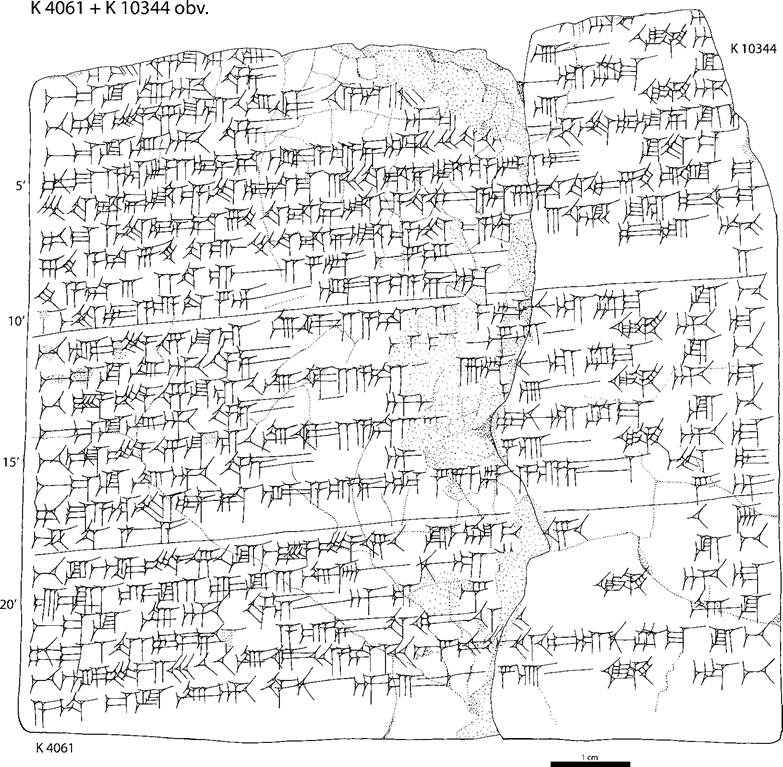
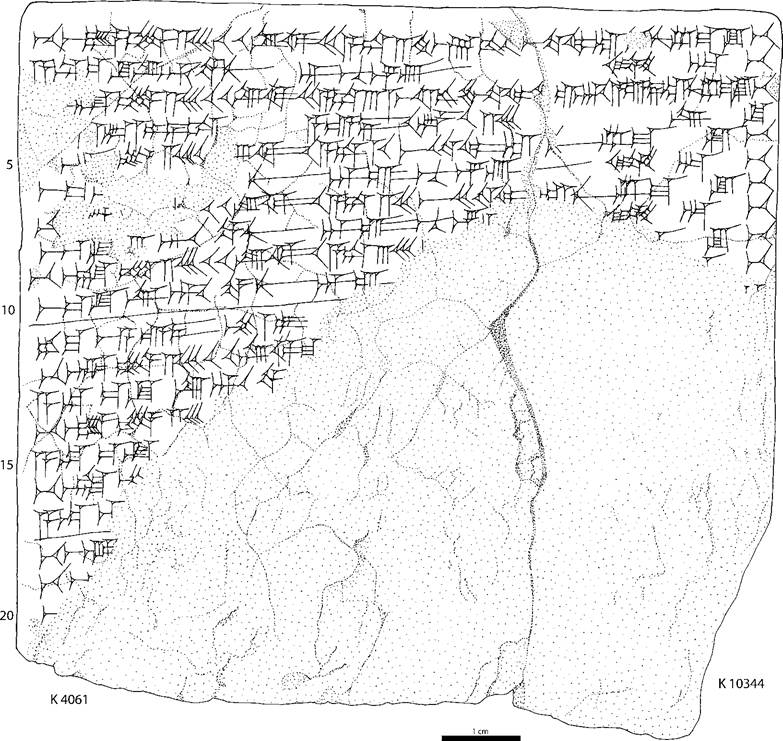
But what exactly is the uddazallu, the constant correction in extispicy, and with what exact value is it to be multiplied? Ulla Koch has shown that the uddazallu in extispicy differs from the uddazallu for astronomical purposes as laid down in the astronomical compendium Mul.apin.12 In extispicy the uddazallu according to the text K. 4061, published in CT 31/16, and 18[84] that lays down these rules, seems to be 6 2/3 (or: 6,666) for one day. However, the relevant passage in K. 4061, which might explain why this is the value of the uddazallu, is broken, as K. 4061 is only the lower left edge of the original tablet. However, while looking for parallels to the extispicy texts from Assur among the Ninive texts in the British Museum (siglum K.) I was able to find the missing right side of that tablet. By this new join (K. 4061 + K. 10344) it becomes clear that the uddazallu was multiplied with three times the sikin ubani “shape of the finger” (see the Appendix and figs. 9.1-2). The relevant passage reads:
7' sum-ma a-na MU 1-KAM DU-us 0;6,40 ud-da-zal-le-e u>-mi a-na 6 US u>-mi 0;6,40 IL-ma
8' 0;6,40 A.RA 360 40 tam-mar 40 ud-da-zal-le-e MU 1-KAM a-na 3 si-kin SU.SI i-si-ma
9' 40 A.RA 3 120 tam-mar 120 4 ITI ina NIG.KA9 i-ta-bal
10' ana MU 1-KAM a-dan-na GAR-an SAG a-dan-ni-ka 120
11 Koch 2005: 65.
12 Koch 2005: 64.
7' If you perform (the extispicy) for one year, then 1/9 is the correction of a day, multiply (it) with 360 days and
8' you will see that 1/9 times 360 is 40. 40 is the correction (uddazallu) for one year; multiply (it) with the three shapes of the finger (sikin ubani) and
9' you will see that 40 times 3 is 120. 120 corresponds to four months in the result.
10' (If) you determine the period for a year, (then) the basis for (the calculation of) your period is 120.
The still enigmatic term sikin ubani appears several times in the so-called DUB HA.LA texts, but we are far from really understanding what it means.[85] According to K. 4061 + K. 10344 obv. 8', it seems reasonable to view sikin ubani as a synonym to the surface of the finger (ser ubani). This would further support the convincing idea put forward by Ulla Koch, that the reciprocal of the uddazallu in extispicy being 9 corresponds to the three surfaces of the finger and their subdivision into the zones top/middle/basis.[86]
But this new join also puts into question the previously assumed number for the uddazallu in extispicy. In his first edition of this text Ernst Weidner (1917: 260) read the number of the uddazallu as 6 2/3 and all scholars followed him. However, a given number in the cuneiform sexagesimal writing system has many possible readings, as, for example, one vertical wedge can stand for the numbers 1, 60, 3600 and so on or even 1/60, 1/3600, etc.[87] The actual value, be it 60 times higher or lower, can only be determined through the context. The new text K. 4061 + K. 10344 shows that the uddazallu is to be multiplied with the three sikin ubani and not, as was formerly surmised, with the number 3/60 (or 1/20). Since it is much more likely that there are three sikin ubani and that they refer to the surfaces of the finger, we have to lower the uddazallu by the factor 60, which is perfectly possible in all texts. So instead of the formerly assumed uddazallu of 6 2/3 for a day, 200 for a month and 2400 for a year we now have an uddazallu of 1/9 for a day, 3 1/3 for a month, and 40 for a year.
Now, having established the actual value of the uddazallu and its multiplication with the three shapes of the finger (sikin ubani), we can derive a formula for the “calculation of the stipulated term”:
(planned time period X uddazallu X 3 sikin ubani) X marks on the finger = adannu
The first multiplications in the parentheses constitute the res adanni, the basis for the stipulated term, which is then multiplied with the value of the marks on the finger. To illustrate this, we can now analyze lines 7'-16' of the obverse of K. 4061 + K. 10344, which in its first section explains the rules for the calculation of the res adanni, which we have used to derive the formula, and in the second section actually calculates the stipulated term (adannu) by multiplying the res adanni with the results from the observed marks on the finger.
7' If you perform (the extispicy) for one year, then 1/9 is the correction (uddazallu) of a day; multiply (it) with 360 days, and
8' you will see that 1/9 times 360 is 40. 40 is the correction (uddazallu) for one
year; multiply (it) with the three shapes of the finger (sikin ubani) and
9' you will see that 40 times 3 is 120. 120 corresponds to four months in the result.
10' (If) you determine the period for a year, (then) the basis for (the calculation of) your period (res adanni) is 120.
11' If a hole lies in the top of the right surface of the finger: 120 times 1 is 120, 4 months. The enemy will besiege and seize the town,
12' in battle: defeat of the army, it will rain, a patient will recover.
13' If a hole lies in the middle of the right surface of the finger: 120 times 2 is [240], 8 months. The enemy will besiege and seize the town,
14' in battle: defeat of the army, it will rain, a patient will recover.
15' If a hole lies in the basis of the right surface of the finger: 120 times 3 is [360, one ye]ar. The enemy will besiege and seize the town,
16' in battle: defeat of the army, it will rain, a patient will recover.
The planned time period is a year or 360 days, the uddazallu-correction is 1/9 and this together with the 3 sikin ubani gives a number of 120 for the basis of the calculation (res adanni). This is now multiplied with the value gained from one hole in the different zones17 of the finger in order to get the result for the stipulated term (adannu).
From these texts for the calculation of the stipulated term, two important aspects for the Babylonian understanding of extispicy can be deduced: First, the adannu, the time period in which the extispicy is actually valid, is not necessarily identical with the time period for which the extispicy is performed. Even if a diviner “performs the extispicy for a year,” its adannu can be shorter or longer, or it can be identical, but this depends on the calculation of the stipulated term and, therefore, on the observation how many marks are located on the different surfaces of the finger. When a Babylonian diviner “performs an extispicy for a year,” this extispicy is not necessarily valid for a year. Basically, he is proposing a time period he is interested in. However, it is the part of the gods to decide how long the extispicy is actually valid. And they place their verdict into the appearance of the finger of the liver. The diviner, then, calculates this time period for the validity of the extispicy result according to the planned period and the uddazallu-correction. In this case, the adannu is not determined by the diviner or the client, but by the gods.18
The second aspect concerns the fact that the adannu not only indicates the time period of validity of the extispicy result, but it also determines the maximum time period that will elapse until a certain dreaded or hoped for event will happen. This is made clear by many entries in the texts for calculation of the stipulated term, speaking of “in x hours/days/months you will besiege and seize the enemy town.”19
This layer of interpretation called the “calculation of the stipulated term” again calls to mind the fact that Babylonian extispicy was never used to gain secure, unchangeable statements about the future. Extispicy results had a limited validity that seldom exceeded one year.[88] Therefore, extispicy was not used to make general statements about the far away future, but on the contrary was indicating the result of a development, which was viewed as threatening or desirable in the present. This might be regarded as one of the main reasons for its success with the common people as well as the ruling class, as it answered to the current needs and hopes of people.
APPENDIX
Edition of K. 4061 (CT 31/16, 18 [Koch 2005: 471-74]) + K. 10344
K. 4061+K. 10344, represents the lower half of a one-column tablet. The joined fragment measures 92 X 95 X 20 mm (see figs. 9.1-2).
Obv. 1' 1BE ina MURUB4 EDIN 15 SU.SI BUR SUB±-[di ] 1URU NIGIN-mi± D[AB-
bat]
2' ina 'Tl'Kl'I. SUB-ti ERIN-ni [AN-u SUR]-nun GIG T[I.LA]
3' BE SUHUS EDIN 15 SU.SI BUR SUB-di 10 A.RA 13 30± [ITI 1-KAM/30 u>-mi KU]R URU NIGIN-ma DAB-[bat]
4' ina "Tl'Kl'I. SUB-ti ERIN-ni AN-1U1 [SUR]-nun GIG TI.[LA]
5' sum-ma a-na ITI 2-KAM DU-us SAG a-dan-ni-ka 20 20 u4-m[i] EN MU 1-KAM tu-mal-lu-1u±
6' 40 ud-da-zal-le-e MU 1-KAM GUB-ma 3,20 ud-da-zal-le-e ITI 1-KAM tus-te-qa
7' sum-ma ana MU 1-KAM DU-us 0;6,40 ud-da-zal-le-e u>-mi a-na 6 US u4-mi 0;6,40 IL-ma
8' 0;6,40 A.RA 360 40 tam-mar 40 ud-da-zal-le-e MU 1-[KA]M a-na 3 si-kin SU.SI i-si-ma
9' 40 A.RA 3 120 tam-mar 120 4 ITI ina NIG.KA9 i-ta-bal
10' ana MU 1-KAM a-dan-na GAR-an SAG a-dan-ni-ka 120
11' BE SAG EDIN 15 SU.SI BUR SUB-di 120 A.RA 11 120 4 ITI± KUR URU NIGIN-ma DAB-bat
12' ina "Tl'Kl'I. SUB-ti ERIN-ni 1AN-u± SUR-1nun 1 GIG TI.LA
13' BE MURUB4 EDIN 15 SU.SI BUR SUB-di 120 A.RA 12± [240] 8 ITI [K]UR URU NIGIN-ma DAB-bat
14' ina "Tl'Kl'I. SUB-ti ERIN-ni AN-1 u SUR±-nun GIG TI.LA
15' BE SUHUS EDIN 15 SU.SI BUR SUB-di 120 A.RA 13 360± [MU 1]-KAM KUR URU NIGIN-ma DAB-bat
16' ina 'Tl'Kl'I. SUB-ti ERIN-ni AN-[u S]UR-nun GIG TI.LA
17' sum-ma a-na MU 2-KAM DU-us SAG a-dan-ni-ka 240 8 ITI a-dan-ni ana MU
1-KAM
18' EN UD.LA-a GAR-an
19' BE lu ina SAG EDIN 15 U lu ina MURUB4 EDIN 15 U lu ina SUHUS E[DIN] 15 U BUR.MES
20' u-lu 1 u-lu 2 u-lu 3 SUB.MES KUR URU NI[GIN-m]a DAB-bat
21' ina giSTUKUL SUB-ti ERIN-ni AN-fu± SUR-[nu]n GIG TI.LA
22' sum-ma ana U4 1-KAM DU-us a-dan-ni u>-mi 0;20!(Text: 0;10) T150± SUB-ku
23' BE ina SAG EDIN 150 U BUR SUB-di 0;20 A.RA 1 0;20 ina 4 DANNA u>-mi URU KUR NIGIN-ma DAB-bat
24' a-na 'TUKUL SUB-ti ERIN KUR AN-u NU [SU]R-nun GIG BA.US
End of obv.
Rev. 1 BE ina MURUB4 EDIN 150 U BUR SUB-di 0;20 A.RA 2 0;40 ina 8 DANNA u>-mi URU (erasure) KUR NIGIN-ma DAB-bat
2 a-na 'Tl'M'I. SUB-ti ERIN KUR AN NU SUR-nun GIG BA.US
3 [BE ina S]UHUS EDIN 150 U BUR SUB-di 0;20 A.RA 3 1 ina 12 DANNA u>-mi [ga]nd-mar-ti a-dan-ni URU KUR NIGIN-ma DAB-bat
4 [sum-m]a ana ITI 1-KAM DU-us a-dan-ni ITI 10 150 SUB-ku
5 iBEl ina ISAG1 EDIN 150 [U B]UR SUB-di 10 A.RA 1 10 ina 10 u4-mi URU KUR NIGIN-ma DAB-bat
6 ina rgiSlT[UKUL SUB-ti E]RIN KUR AN-u NU SUR-nun GIG BA.US
7 BE [ina] iMURUBj [EDIN 15]0 U BUR SUB-di 10 A.RA 2 20 ina 20 u>-mi URU KUR NIGIN-ma DAB-bat
8 ina TgiSTUKUL SUB-ti± ERIN KUR AN-u NU SUR-[nun] GIG BA.US
9 BE ina SUHUS EDIN 150 U BUR SUB-di 10 A.RA 3 30 in[a 30 u>-mi URU KUR NIGIN-ma DAB-bat
10 ina giSTUKUL SUB-ti ERIN KUR AN-u [NU SUR-nun GIG B]A.US
17 a-na I'TUKUL ]
18 BE ina SAG [ ]
19 BE ina [ ]
20 B[E ]
Translation
Obv. 1' If a hole lies in the middle of the right surface of the finger: [.................. : The
enemy] will besiege the town, he will t[ake (it)],
2' in battle: defeat of the army, [it will ra]in, a patient will rec[over].
3' If a hole lies in the basis of the right surface of the finger: 10 times 3 is 30 [days : The ene]my will besiege and seize the town,
4' in battle: defeat of the army, it will rain, a patient will rec[over].
5' If you perform (the extispicy) for two months, then the basis for (the calculation of) your period is 20, 20 days until one year you make full,
6' 40 is established as the correction for one year, 3 1/3 is the correction for one month, you let it pass.
7' If you perform (the extispicy) for one year, then 1/9 is the correction of a day, multiply (it) with 360 days and
8' you will see that 1/9 times 360 is 40. 40 is the correction for one year; multiply (it) with the three shapes of the finger (sikin ubani) and
9' you will see that 40 times 3 is 120. 120 corresponds to four months in the result.
10' (If) you determine the period for a year, (then) the basis for (the calculation of) your period is 120.
19' If holes lie either in the top of the right surface of the finger or in the middle of the right surface of the finger or in the basis of the right surface of the finger
20' either one, two, or three: The enemy will besiege and seize the town,
21' in battle: defeat of the army, it will rain, a patient will recover.
22' If you perform (the extispicy) for one day, then the period for one day is 1/3, the left side occurs for you
23' If a hole lies in the top of the left surface of the finger: 1/3 times 1 is 1/3. In 4 double-hours of a day you will besiege and seize the enemy town,
24' in battle: defeat of the enemy army, it will not rain, a patient will die.
End of obv.
Rev. 1 If a hole lies in the middle of the left surface of the finger: 1/3 times 2 is 2/3. In 8 double-hours of a day you will besiege and seize the enemy town,
2 in battle: defeat of the enemy army, it will not rain, a patient will die.
3 [If] a hole lies [in the b]asis of the left surface of the finger: 1/3 times 3 is 1. In the 12 double-hours of a day, in the completion of the period, you will besiege and seize the enemy town.
4 [I] f you perform (the extispicy) for one month, then the period for one month is 10, the left side occurs for you.
5 If a [hole l]ies in the top of the left surface of the finger: 10 times 1 is 10. In 10 days you will besiege and seize the enemy town,
6 in ba[ttle: defe]at of the enemy army, it will not rain, a patient will die.
7 If a hole lies [in the] middle [of the lef]t [surface] of the finger: 10 times 2 is 20. In 20 days you will besiege and seize the enemy town,
8 in battle: defeat of the enemy army, it will not rain, a patient will die.
9 If a hole lies in the basis of the left surface of the finger: 10 times 3 is 30. In 30 days you will besiege and seize the enemy town,
10 in battle: defeat of the enemy army, it will [not rain, a patient will d]ie.
11 If in the period of one year [........... ].
12 If a hole lies in the top of the left surface of the finger and [........... ],
13 in battle: defeat of the [enemy] army, [......... ].
14 If [a hole lies] in the middle of the left surface [of the finger and......... ],
15 in battle: [....... ].
16 If [a hole lies] in the basis of the [left] surf[ace of the finger and......... ],
17 in b[attle:....... ].
19 If in [......... ].
20 I[f........ ].
COMMENTARY
obv. 1' Despite the fact that this line is broken it is clear that the scribe wrote URU NIGIN-mz and not, as in obv. 3' etc., URU NIGIN-ma.
22' Here and in rev. 4 the phrase 150 SUB-^u shows that concerning the calculation of the stipulated term the right side refers to the enemy and the left side to the client of the extispicy, contrary to the usual custom in extispicy.
rev. 1 The scribe erased the sign NIGIN after URU as he had forgotten to write KUR before NIGIN.
K4061 +K 10344 rev.
174 NILS P. HEEßEL
BIBLIOGRAPHY
Borger, Rykle
1957 “nisirti bärüti, Geheimlehre der Haruspizin (Zu Neugebaurer-Sachs, MCT, V und
W, und einigen verwandten Texten).” Bibliotheca Orientalis 14: 190-95.
Brown, David
2004Review of Herrschaftswissen in Mesopotamien, by B. Pongratz-Leisten. Zeitschrift für Assyriologie 94: 112-21.
Durand, Jean-Marie
1988Archives epistolaires de Mari I/1. Archives Royales de Mari 26/1. Paris: Editions recherche sur les civilisations.
Friberg, Joran
1987-90 “Mathematik.” Reallexikon der Assyriologie 7: 531-85.
Gray, Clifton D.
1900/01 “The Samas Religious Texts.” American Journal of Semitic Languages and Literatures 17: 129-45 and 222-43.
Heeßel, Nils P.
forthcoming Divinatorische Texte II: Opferschau-Omina. Keilschrifttexte aus Assur literarischen Inhalts, Wissenschaftliche Veroffentlichungen der Deutschen Orient-Gesellschaft.
Jeyes, Ulla
1989Old Babylonian Extispicy. Publication de l‘Institut historique-archeologique neerlandais de Stamboul 64. Leiden: Nederlands historisch-archeologisch Instituut te Istanbul.
Koch(-Westenholz), Ulla Susanne
2000 Babylonian Liver Omens: The Chapters Manzäzu, Padänu and Pän täkalti of the
Babylonian Extispicy Series Mainly from Assurbanipal’s Library. Carsten Niebuhr Institute Publications 25. Copenhagen: Museum Tusculanum Press.
2005Secrets of Extispicy: The Chapter Multäbiltu of the Babylonian Extispicy Series and Nisirti bärüti Texts mainly from Assurbanipal’s Library. Alter Orient und Altes Testament 326. Münster: Ugarit-Verlag.
Lambert, Wilfred G.
1998“The Qualifications of Babylonian Diviners.” In Festschrift für Rykle Borger zu seinem 65. Geburtstag am 24. Mai 1994. tikip santakki mala basmu..., edited by S. M. Maul, pp. 141-58. Cuneiform Monographs 10. Groningen: Styx Publications.
Leiderer, Rosemarie
1990 Anatomie der Schafsleber im babylonischen Leberorakel. Munich: Zuckerschwerdt.
Maul, Stefan M.
2003-05 “Omina und Orakel. A. Mesopotamien.” Reallexikon der Assyriologie 10: 45-88.
Meyer, Jan-Waalke
1987 Untersuchungen zu den Tonlebermodellen aus dem Alten Orient. Alter Orient und
Altes Testament 39, Neukirchen-Vluyn: Neukirchner Verlag.
Oppenheim, A. Leo
1956 The Interpretation of Dreams in the Ancient Near East, with a Translation of an
Assyrian Dream-book. Transactions of the American Philosophical Society, n.s., 46/3: 177-373. Philadelphia: American Philosophical Society.
Pongratz-Leisten, Beate
1999Herrschaftswissen in Mesopotamien. State Archives of Assyria Studies 10. Helsinki: Helsinki University Press.
Starr, Ivan
1983 The Rituals of the Diviner. Bibliotheca Mesopotamica 12. Malibu: Undena
Publications.
1990 Queries to the Sungod. Divination and Politics in Sargonid Assyria. State Archives
of Assyria 4. Helsinki: Helsinki University Press.
Weidner, Ernst F.
1917 “Zahlenspielereien in akkadischen Leberschautexten.” Orientalistische
Literaturzeitung 20: 258-66.
oi.uchicago.edu