The Evidence: Indigenous Religious Activity in Central-West Sicily before 650 BCE
Using this methodology, it can be shown that the number of indigenous sites with signs of concentrated ritual activity rose significantly after 650 BCE, the date of the first Greek colonies in central-west Sicily.
During the Iron Age (900-650 BCE), there are twenty-six areas in twenty-one different settlements across the case-study region that present evidence corresponding to the framework of material correlates of religious activity. As demonstrated in figure 2 below, these correlates appear in both funerary and nonfunerary sectors.Attention-focusing features were the most frequent correlate, manifested via human alterations of the natural landscape, most notably rock-cut tombs that make a strong visual impression and draw the eye toward particular areas. Specialized furnishings and equipment also characterized multiple areas; benches were used in certain tombs at Monte Dessueri, Polizzello, and SantAngelo Mux- aro for laying out assemblages, while low ledges along large huts at Sabucina and Scirinda were used for seating and elevated support (Mollo Mezzena 1993, 141). Regarding mobile equipment, the choice of items was also repetitive, constituted most often by pitchers, pedestal plates, fibulae, and knives; of the sixty-four objects that can be dated securely to the Iron Age at Monte Bubbonia, for example, exactly half are pouring vessels (Pancucci and Naro 1992). Jugs make up almost
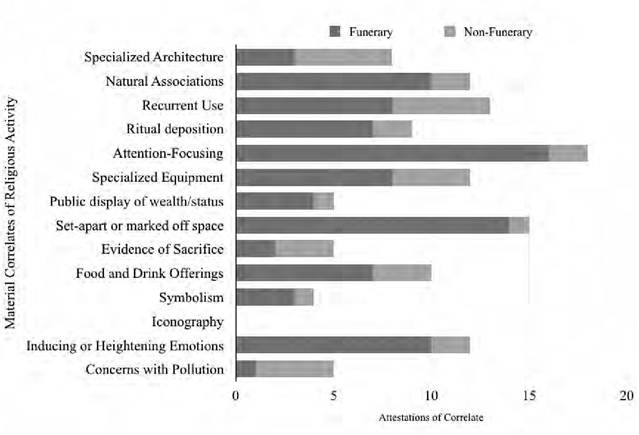
Figure 2. Frequency of material correlates of religion, documented among indigenous sites in Sicily prior to 650 BCE. Attestations of individual correlates are further distinguished between whether they were found in funerary or nonfunerary contexts.
40 percent of the assemblages at Monte Dessueri (Orsi 1912; Panvini 1993-1994). Jugs and pedestals accompanied most burials at SantAngelo Muxaro, while a “notable uniformity” was noted among the tomb finds of Santa Margherita Belice (Leighton 1999, 257-58; Marconi 1931, 400-401).
Most of this equipment probably functioned as tools in other ritual acts, such as the offering or consumption of food and drink or votive dedication, so it seems feasible to suppose that contexts with them may have hosted other rituals as well. Notably, many of these items have also been associated with the consumption of alcohol—via wine or other fermented beverages—a well-known means of enhancing or inducing an emotional state.Other material correlates are less well attested. Sacrifice, for example, was practiced to some degree in Iron Age Sicily, but overall it was not common and it's unclear whether “sacrifice” in some domestic settings was anything more than household cooking. The remains of burnt animal bones inside the narrow passageways of tomb chambers as occurred at Mokarta and Entella seem more convincing examples of sacrifice, but the number of sites that have these is very low. Conspicuous displays of wealth were also limited and made almost exclusively in the funerary sphere; additionally, the level of wealth that is on display is far less luxurious than contemporary “heroic” burials in central Greece. One of the wealthiest burials in Sicily, for example, the mass-inhumation (holding between twenty-six to thirty people) “Tomb of the Prince” at SantAngelo Muxaro averaged only two vessels and one ornament per individual, including two gold rings. The presence of gold hints at luxury, but very little wealth was actually on display for each person buried.
To base interpretations solely on the quantification of correlates would misrepresent the overall picture of ritual activity in Iron Age Sicily, though. Indeed, as figure 2 shows, correlate presence is far more frequent around graves than nonmortuary areas. This skewing is partly explained by methodological discrepancies, such as the general shortage of Iron Age data for the central-west part of the island, or the fact that burials are excavated more often than other parts of sites overall, or the inherent difficulty that comes from distinguishing “ritualistic” space from those of normal domestic activity.
But it is also explained by a genuine pattern of ritual preference, in which the funerary sphere functioned as the main outlet for actions that attempted to engage the supernatural realm: of the twenty-four places that have evidence corresponding to the correlates, nineteen are in cemeteries.Within those cemeteries, however, the correlates are dispersed over a wide area. Consequently, though necropoleis operated as centrifugal areas of ritual for Sicilian settlements, it was only rarely that the correlates clustered together in a way that demonstrates well-organized ritual activity. Two tombs (tombs 5 and 25) at Polizzello, for example, saw repeated visitation and ritual practice between the eighth and early sixth centuries BCE (De Miro 1988, 35; Fiorentini 1999, 188). Both areas were given a slightly different style of architecture from other tombs in the cemetery and had built enclosures nearby that perhaps were used as gathering spaces. Archaeologists found built altars with signs of intense burning, plus large quantities of ash and burnt and unburnt animal bones, pointing to repeated acts of animal sacrifice outside the tombs. A depositional area outside the tombs also produced piles of vessels, and a number of votive deposits were found dug into the ground. The evidence certainly looks like ritualized activity—animal sacrifice, offerings, and ritual feasting, all in larger and differentiated structural features—but not to the exclusion of other burials in the same necropolis also displaying signs of the correlates, if in less quantity. For nonfunerary areas, particular structures appear anomalous based on their larger size, finds, or the fact that they were later replaced with finer, “religious” structures. But in nearly every case, none of the structures are especially “polythetic” (meaning correlate-rich) nor do they appear exclusively used for ritual activity. The major exception to this overall pattern, however, is once again Polizzello. By the start of the seventh century, the residents of Polizzello had built a large (14.7 m diameter) round building (Sacello E) in megalithic construction at the top of the acropolis, where they left metal items in small votive pits as well as lots of drinking wares (Stanco, Battatio, and Gallo 2011, 14-16; Palermo, Tanasi, and Pappalardo 2009).
Thus, while some degree of material religious expression existed at a fair number of Iron Age sites in central-western Sicily, religious activity was loosely structured and only rarely centralized enough to have made a lasting impression in the archaeological record in a single context, and when it was, it tended to be around graves, with the major exception of Polizzello.