The Evidence
Indigenous Religious Activity in Central-West Sicily After 650 B CE
Signs of religious activity among indigenous sites increase starting around 650 BCE, roughly contemporary with the first generations of settlement of Phoenicians and Greeks in central and western Sicily.
Figure 3 presents the basic features of the development of these religious spaces, with each bar representing the total number of sacred spaces in use and the distribution of types (open-air, round building, or rectangular building) acknowledged by shading. The numbers inside each bar refer to the amount of new sacred areas for each time period (as opposed to the total in operation) and the solid line running between bars represents the number of settlements with evidence corresponding to the material correlates; multiple sacred areas or structures could and did exist at individual sites, which explains why no one-to-one correlation exists between the number of sacred areas in operation and number of settlements.Between 650 and 600 BCE, ten indigenous sites reserved spaces in their settlements for worship; importantly, none of these spaces were burial grounds. Open-air cult was typically practiced, and was characterized primarily by sacrifice, drinking and eating, and occasionally by votive dedication. At least five of these sites (Polizzello, Sabucina, Caltanissetta, Palma di Montechiaro, and Montagnoli) also included built structures, a pattern that would become more prominent in the sixth century. Unlike houses of the time, which were usually rectangular or elliptical, seventh-century buildings with evidence of other religious material correlates tended to be round. As such, they resembled, and probably deliberately evoked memories of, Bronze Age domestic architecture (cf. De Miro 1980-81, 561) and have received the label “hut-shrines” as a result. Other sites, however, built rectangular one- or two-room shrines stylistically similar to buildings at Greek sites like Gela, Himera, and Selinous.
Only two clear examples of such structures exist in central-west Sicily in the last two quarters of the seventh century. However, after 600 BCE, rectangular and round buildings were both widely present across the region, and sometimes, as was the case at Polizzello, Sabucina, Caltanissetta, Colle Madore, Monte Polizzo, Caltabellotta, Montagnoli di Menfi, and Monte Roveto, communities built both round and rectangular sacred structures. By 550 BCE, the construction of rectangular buildings began to outpace that of round structures, and by 525 BCE, no one was building new hut-shrines; in fact, many that had been built earlier in the sixth and seventh centuries were being abandoned.Recent scholarship has frequently discussed the architecture of these religious spaces, but less attention has been paid to other elements of religious practice associated with them. This is one of the ways in which the organization of evidence according to a set of religious material correlates—the same set used to examine
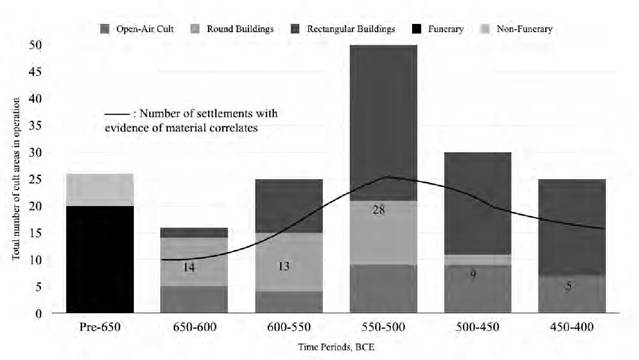
Figure 3. Development of indigenous religious spaces in central-west Sicily, 650-400 BCE.
the “precolonial” evidence—can be productive. Over the course of the Archaic and early Classical periods, for instance, seventy new cult spaces appeared at different sites across central-western Sicily. Ranking the correlate categories at an aggregate level produces a tiered profile of religious worship among indigenous communities after colonization. At the top, documented at just less than 75 percent of the spaces, was the use of specialized architecture and the strong natural associations of places where sacred areas developed, along with their tendency to be set apart or physically marked off from other areas. Below this level was the evidence for specific religious practices. Ritual deposition or treatment of items (votives) characterized 69 percent of the sacred areas; offerings of food and drink and the public display of wealth or status characterized 63 percent, and there was evidence for the heightening or inducing of emotions at 54 percent, mostly through the presence of wine vessels.
Attention-focusing devices filled out that level at 53 percent. Less than half of the sites had evidence corresponding to the other correlates—just slightly so for sacrifice (49 percent) and specialized equipment/furnishings (43 percent), but notably fewer in regards to symbolism, iconography, or concerns with pollution and cleanliness.A few sites illuminate these patterns more clearly. At Iron Age Sabucina, for example, ritual activity may have taken place at Hypogeum 1/83, a tomb-like structure going back to the Bronze Age and featuring a mixed assemblage of material both domestic and cultic in nature (Mollo Mezzena 1993; Guzzone 2006, 39-43), as well as at two other buildings (Building D and Hut 9) which appeared mostly residential, but had material corresponding to between one and three other religious correlates. Around 650 BCE, Sabucina overhauled its religious landscape. A sector just outside of one of the city gates was designated for ritual purposes, with activity centering on two hut-shrines (A and B), one of which featured a rectangular porch with Doric columns and was later decorated with architectural terracottas (De Miro 1980-1981, 561-66). Worshipers left items inside both structures, including a model of a hut-shrine that dated to the early sixth century and bronze belts decorated with anthropogenic images (Guzzone 2006, 73; Albanese Procelli 2003, 53-57). By the mid-sixth century, the people of Sabucina added a rectangular structure and two rock-cut buildings to that space, while also designating two new sacred areas, one inside and one outside the city walls. These new areas also featured a mixture of older and newer architectural styles, with the rectangular building receiving Geloan-style antefixes and the rock-cut structures echoing long-established building techniques at Sabucina.
A different example might be cited at Monte Saraceno. There is little evidence for Iron Age occupation of the site, but by the mid-seventh century, the group living there designated the acropolis for open-air cult (Calderone 1980-1981, 604).
Within one generation, they then cut a huge terrace in the same spot in order to build a monumental temenos wall enclosing three rectangular buildings. The largest of these buildings measured 20 by 40 meters, meaning that its square area was not only nearly ten times the size of the largest contemporary hut-shrine but was also larger than the main temples at the Greek sites of Gela and Himera. All the buildings were also decorated with terracotta antefixes probably made by a Geloan craftsman (Adamesteanu 1956, 128). The city would continue building new structures up to about 500 BCE before suffering a decline in the second quarter of the fifth century.Further west, variant patterns of development characterized different sites. At Colle Madore, south of Himera, for example, open-air cult marked by lots of drinking and animal eating in the seventh century BCE preceded the erection of an initial (probably wooden) round shrine on the acropolis, which was then replaced with a more permanent round hut-shrine around 550 BCE and used especially for cow, ovi-caprid, and deer sacrifice (Vassallo 1999, 60-61). Around the same time, however, the residents of Colle Madore also put up a narrow rectangular structure on the terrace just below the acropolis, marking its construction with a foundation deposit containing heirloom pottery, and using it (based on the material) both for leaving and manufacturing votives (Vassallo 1999, 67-71). All these areas, however, declined just before 500 BCE, when the site was abandoned (Vassallo 1999, 73-74). Meanwhile, at Segesta, ritual activity flourished into the Hellenistic period. Little Iron Age material has emerged for “Elymian” Segesta, but the Grotta Vanella area may have been used for ritual activity as early as the seventh century based on pottery found there (De la Genière 1997, 1033-34). By the sixth century, the center of ritual activity must have shifted to the Contrada Mango area, which around 550 BCE received a massive Doric-style temple (Tusa 1957, 86; 1961, 35). The publications for this area are confusing, but the boundary and foundation walls make clear that it would have rivaled certain sanctuaries at Greek sites. Investment in glorifying the gods continued during the fifth century at Segesta, with the construction of the iconic Doric temple on the western hill (Mertens 1984).
These few examples flesh out the outline of postcolonization indigenous religion in Sicily provided by the percentages described above. Neither numbers nor narratives, however, explain the significance of such changes; quantification is ultimately a method of condensing information, while narratives bring the material of individual sites closer. Concepts like extratextuality may be useful, then, in the sense that they help fill the gap between the two.
More on the topic The Evidence:
- Internal evolution and Indo-Europeans
- FIVE COMPONENTS OF LEGAL COMPETENCIES
- An evolutionary analysis of multilevel governance mechanisms for SHD at the local level
- THESTICKY ECONOMY
- PRACTICE AND THEORY
- Alsharari Nizar Mohammad (ed.). Banking and Accounting Issues. ITexLi,2022. — 175 p., 2022
- Experiences, Situations, Representations
- Cattle Movement Networks in Uganda
- The Netherlands and the UK: The Witteveen Reports and their contradictory results
- CASE 145: Periods of Gestation