The Formative Age
The fall of Jerusalem and of Masada, and the destruction of the Second Temple, signaled the end of the Second Temple era and the beginning of the third epoch of Judaism’s history, known variously as the Rabbinic Age and the Formative Age (c.
late first century CE-sixth century ce). As long as the Temple stood, it served as both a treasured symbol of Israel’s biblical past and the operational center of Jewish ritual life throughout the world. Once it lay in ruins, however, the Jewish people needed a new institutional center—a replacement sanctuary, until such time as the Temple could be rebuilt. The synagogue, whose remote origins can be traced back to the beginning of the Babylonian exile, provided just such a substitute, but unlike the Temple it was never a place of animal sacrifice, nor was it under the control of a priesthood. In all likelihood, the synagogue began simply as a place of assembly at which Judean exiles could meet and study together. With the Temple gone, however, Jews turned increasingly toward the synagogue as the place for religious leadership or for communal prayer.Unlike the Temple, which could stand in only one place (namely, Jerusalem), a synagogue could be built anywhere. Moreover, almost anyone could build a synagogue or serve as a communal leader. Priests had no role to play in the ritual or social life of a synagogue, which made it a more democratic institution from the start.
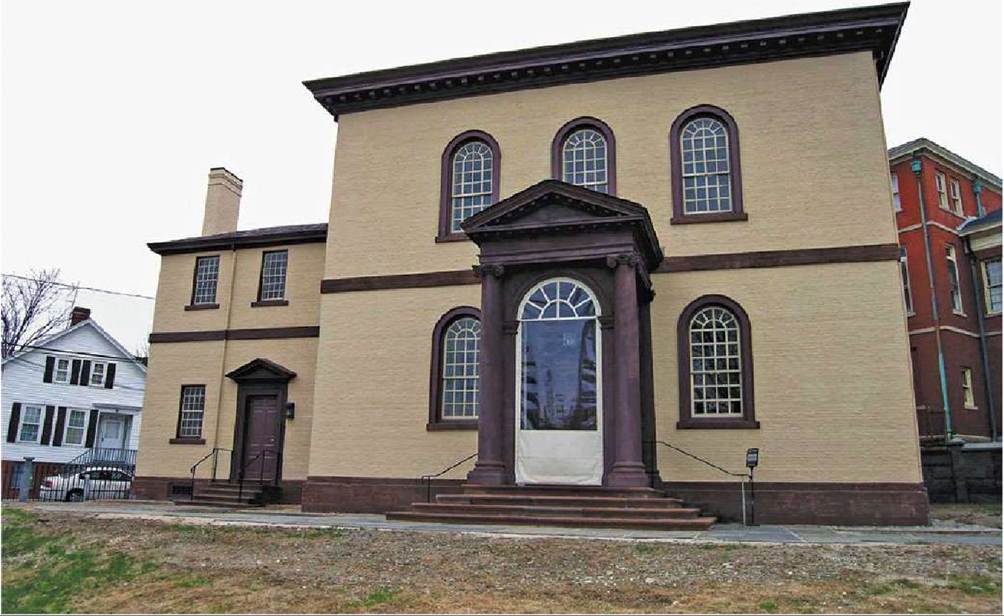
The Touro Synagogue, built in Newport, Rhode Island, in 1759, is the oldest synagogue in the United States.
The Rabbis
In time, the synagogue acquired a clerical leadership all its own, which brings us to the second major historical change that defines the Formative Age: the emergence of a class of religious intellectuals known as rabbis (rabbi in Hebrew means “my master”).
The word was a term of honor conferred on someone whose piety and learning caused him to stand out among his contemporaries and whose teachings (or legal rulings) were sufficiently memorable that subsequent generations viewed him with respect and even reverence.One such figure, who had come from Babylonia to study in Jerusalem, was Hillel (fl. 30 bce-4 bce), whose compassionate nature was as remarkable as his scholarship. According to legend, it was Hillel who, when asked (mockingly) by a pagan to teach him Torah while he stood on one foot, replied: “What is hateful to you, do not do to your neighbor; the rest is commentary”—a version of the so-called Golden Rule. Like Hillel, many of the early rabbis thought of themselves as more than just legal scholars whose expertise in biblical law allowed them to advise common folk on matters of correct observance. They also saw themselves as sages or wisdom teachers whose insights into human nature complemented their knowledge of divinely revealed law.
The Compilation of the Talmud
The signature accomplishment of the rabbinic scholar class during the Formative Age was the writing and compilation of the Talmud, a composite work that, in time, was seen as a second Torah, or at the very least, as an indispensable addendum to the Torah. On one level, the Talmud is a collection of expansive (and occasionally imaginative) interpretations of biblical law. The format of the Talmud is often dialogical (that is, a series of question-and-answer exchanges). Nearly every page consists of some portion of a rabbinic debate over the alternative ways in which a particular biblical statute can be understood or implemented. The practical objective of all these debates was the creation of an authoritative form of ritual behavior—referred to in Hebrew as halacha—that would enable the observant Jew to sanctify daily life and fulfill the commandments imparted to Moses on Sinai. God gave Torah to Israel, the rabbis believed, and now it was their responsibility to clarify its terms and relate them to daily life.
In the section of this chapter on sacred practices, we will see how halacha informs the ways many Jews today live their faith.The Babylonian version of the Talmud, compiled at the beginning of the sixth century ce, consists of sixty-three separate volumes covering a wide range of legal issues. The historical process by which these volumes came into being, however, can be studied in two stages: the earlier stage, known as the Mishnah (Hebrew, “repetition”), is written in Hebrew and consists of economical formulations of halacha, often accompanied by the attribution of specific legal opinions to particular rabbinic scholars; the later stage, referred to as the Gemara (Hebrew, “completion”), is written in Aramaic (a Semitic language, very close to Hebrew), and the rabbinic debates recorded there often take up where the Mishnah leaves off.
This process of recording and summarizing rabbinic debates continued, in both Palestine and Babylonia, during a period of roughly four centuries. As the body of rabbinic commentary evolved toward the next stage of completion—first in Jerusalem in the fifth century ce and later in Babylonia at the beginning of the sixth century ce—the Mishnah was combined with the far more elaborate text of the Gemara. Together these two scholarly works make up the Talmud. Judaism’s greatest challenge during this period, however, was not simply that of preserving the teachings of its religious elite but, more important, it was that of protecting itself from a rival “sister” religion—namely, Christianity—whose political might increased throughout the Roman Empire in the course of the fourth and fifth centuries, at the same time that Judaism’s power declined.