The Second Temple Period
The second great epoch in the history of Judaism, known as the Second Temple period, began with the gradual return of a relatively small band of Judean exiles from Babylonia, following the Persian conquest of the Babylonian Empire in 539 все.
The rebuilding of the First Temple (c. 516 все), which the Babylonians had earlier destroyed during their siege of Jerusalem in 587 все, signaled the renewal of a centralized ritual life for Jews in what was formerly the kingdom of Judah, now merely a province within the Persian Empire. However, the movement of Jews between Babylonia and “Yehud” (as the Persians called Judah) not only provided for the repopulation of Jerusalem and its restoration as a center of religious life but also for the passage of ideas and literature from Mesopotamia to the land of Israel.Even at the beginning of the Second Temple era, a “canon,” or collection of sacred Jewish writings, was slowly taking shape. Thus, the formation of Tanakh can be dated most reliably from this period, and the persons most likely responsible for the gathering and editing of these books were scribes and priests. Using the historical and theological perspectives of earlier prophets as their guides, these priestly editors selected works that embodied a recurrent pattern of teachings about divine promise, judgment, and hoped-for restoration, binding together this diverse collection of sacred works with an archetypal vision of Israel’s past and anticipated future.
Though politically turbulent, the Second Temple period saw both the growth of the Jewish Diaspora and an increase in the Jewish population of Palestine. In the absence of a Jewish nation-state, religious leadership within the Jewish community fell to the priesthood and to an intellectual class connected to the priesthood. These two groups are said to have formed a leadership “council,” known as the “Men of the Great Assembly.” Tradition assigns to this body the decision to “close” the canon of divinely revealed (or inspired) scripture.
Scholars differ today on the probable period in which religious authorities—whether in Jerusalem or Babylonia—considered the period of prophecy (and therefore the process of revelation) to have ended. However, it is commonly assumed that by the third centuiy все the writing and editing of the Torah had already reached a sufficient state of finality to allow Greek-speaking Jews to translate it from Hebrew into Greek. In time, additional portions of Tanakh were translated from available texts; this translation is referred to as the Septuagint, and it played a significant role in introducing Judaism to the larger Greek-speaking world. It was this version of Jewish Scriptures, rather than the Hebrew original, with which most early Christians were familiar.Division and Revolt
One important development within the Second Temple period was the increasing tension within the Jewish community between those who favored social and intellectual assimilation into Greek (and, later, Roman) culture and those who resisted such assimilation in favor of preserving “traditional” values and religious practices. This struggle became openly violent during the Maccabean revolt of 167-164 все, as the leaders of the revolt found themselves fighting against not only Syrian-Greek armies but also their more assimilated countrymen who sided with the Syrian king, Antiochus IV (c. 215-164 все). Although this conflict finally resulted in the reestablishment of an autonomous Jewish state (c. 140-63 все), one result of this internal struggle was the gradual appearance of religious “parties” whose influence on Jewish belief and practice grew during the period of Roman domination and occupation of Palestine.
The first-century Jewish historian Josephus (37-c. 100 ce) identified the most important of these parties as the Pharisees, who appear to have commanded the attention and loyalty of the Jewish masses. Central to the Pharisees’ form of Judaism was their belief in the “Oral Torah”—that is, a body of teachings imparted by God to Moses on Sinai (but never written down) and subsequently transmitted orally to later generations. For the Pharisees, these interpretive readings of scripture were an integral part of “scripture” itself, and therefore just as binding.
Thus, the Pharisees taught that Torah—that is, the totality of divine revelation to the Jews—incorporated a belief in both the immortality of the soul and the resurrection of the dead. In the eyes of the common people, the Pharisees’ knowledge of the biblical text and their familiarity with biblical law made them more reliable guides than the often corrupt and politically compromised priesthood. It is from the followers of the Pharisees that we derive our sense of what the dominant form of Judaism may have been like by the end of the first centuiy CE.A second group that Josephus identified was the Sadducees, whose influence on the Judaism of the time was much weaker. Drawing their constituents largely from priestly families, the Sadducees regarded the written Torah as exclusively sacred and authoritative and therefore rejected the very notion that an “Oral Torah” existed. Unlike the Pharisees, the Sadducees tended toward literalism in their understanding of scripture and therefore could find no warrant for believing in either immortality or resurrection. In politics, they tended to be sympathetic to—or at least accommodating of—Roman authority and therefore less likely than the Pharisees to favor revolutionary leaders.
The third, and most reclusive, community Josephus refers to is that of the Essenes, a general term designating groups of devout Jews who had withdrawn from society in protest against the moral and spiritual corruption of their contemporaries. These traditionalists viewed the temple priesthood with disgust and held the radical view of history that the “End Time” of divine judgment and global catastrophe was at hand. Such beliefs, which religious scholars refer to as eschatological, had become increasingly widespread during the late Second Temple era, particularly when coupled with a belief in a mess ah. Although such beliefs were well known throughout the Jewish world, Essenes held to their faith in the imminence of the world’s end with particular fervor, and they looked forward to a Messianic Age, when the Temple would at last be purified and the Romans defeated by armies of angels.
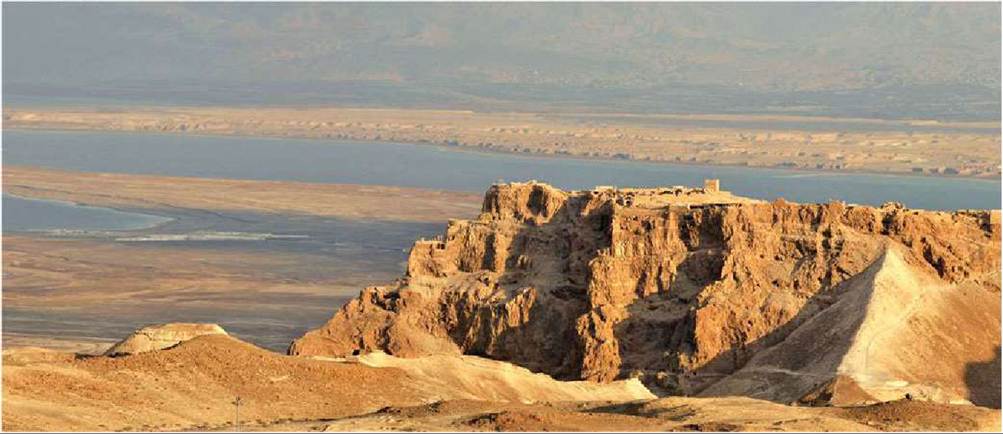
Masada was the last stronghold the Zealots held before taking their lives rather than yielding to the Roman army (73 ce).
Many historians today associate the Essenes with a community of sectarian Jews who withdrew from Judean society and built a settlement near the northwestern shore of the Dead Sea, at a place called Khirbet Qumran, sometime during the second century bce.-4 The religious literature written and preserved by this group was hidden away in caves near their settlement, and it was not until 1947-1956 that these ancient scrolls were discovered. Collectively, they are referred to as the Dead Sea Scrolls, and almost half of them are fragments of books from the Hebrew Bible. These copies of biblical texts are the oldest copies of the Jewish Scriptures known to exist today.
Last, and most transitory in their influence on Judaism, were those revolutionaries Josephus termed “the Zealots.” Like the Pharisees and the Essenes, the Zealots were eager to see the
Romans driven from the land of Israel and looked forward to a restoration of Israel’s sovereignty and of its monarchy. However, believing that God would fight on their side, the Zealots sought to expel the Roman army through direct action, and Zealot agitation and rebellion were underlying causes of the First Jewish War against Rome (66-70 ce). Even after this war ended in the defeat of Jewish forces and in the destruction of the Second Temple, a group of Zealots continued to hold out against the Romans until 73 ce, when their mountain fortress of Masada was besieged and overrun by the Roman army. Rather than surrender, the remnant of the Zealot fighters, along with their women and children, committed suicide (according to Josephus) rather than be taken alive by their enemy.