The History of Sikhism
Although Guru Nanak has remained the most prominent and revered of the ten Gurus of the Sikhs, his nine successors contributed significantly to development of the religion. Young Sikhs like Manjit and Sandeep learn about all of them as a natural part of their upbringing, celebrating their heroic life stories.
Guru Nanak’s Successors
All ten Gurus are considered to have been revealers of truth and to have been linked to one another through sharing the same divine essence. This made them spiritually more adept than ordinary people. They were not, however, thought to be divine incarnations of God. The Gurus thus are not to be worshiped by Sikhs, though they are greatly revered. Guru Nanak constantly stressed his human limitations, humbly referring to himself as God’s slave. All the Gurus were highly prestigious persons. They were revered for their spiritual gifts and acquired much worldly prestige as well. The Mughal (therefore, Muslim) emperors who ruled northern India knew the Gurus personally and tended to respect them, in some cases developing strong friendships with them.
Nanak’s successors are responsible for a wide variety of impressive accomplishments that gradually transformed the Sikh community. Arjan, the Fifth Guru (from 1581 to 1606), deserves special mention. For one thing, he compiled the scripture that would come to be known as the Adi Granth (“the Original Volume,” distinguishing it from the later Dasam Granth), thus giving the Sikhs their most important sacred scripture. By traditional count, he included 2,312 of his own compositions, beautifully melodic hymns that are considered to be among Sikhism’s most impressive musical accomplishments. Aijan also constructed at the city of Amritsar the Hari Mandar (“Temple of God”), now called Darbar Sahib (“Court of the Lord”) or the Golden Temple. This provided the Sikhs with a geographical center.
The Darbar Sahib remains one of the world’s most impressive and important religious buildings. Along with being architecturally magnificent, it is rich in symbolic meaning, beginning with the building process itself. At Aijan’s invitation, Mian Mir, a Muslim Sufi saint, laid the foundation stone. Even as the Sikh community was gaining independence from its Muslim and Hindu neighbors, Sikhism served as a bridge between religions. In contrast to Hindu temples, which typically have only one door, Aijan designed the Darbar Sahib with four doors. Traditionally, this is interpreted as representing Sikhism’s openness to all people—to adherents of all four of northwestern India’s major religious traditions of the time (Hinduism, Islam, Buddhism, and Sikhism); to people of all four classes of the prevalent Hindu caste system; and to people of the north, south, east, and west. It is therefore ironic that, in recent times, the Darbar Sahib has become associated with controversy and discord. In 1984, it was the site of the bloody military action known as Operation Blue Star, which we shall consider later in more detail.
Guru Gobind Singh and the Khalsa
The tenth Guru, Gobind Singh, who was born in 1666 and died in 1708, is revered as the greatest Guru after Nanak. His strength of character and spiritual adeptness made him a successful and memorable leader. By the time he became Guru at the age of nine, he had already begun training in the art of warfare and hunting, along with the ways of religion. A modern history of the Sikhs makes note of the enduring impression made by the Guru’s appearance:
Every description of Guru Gobind Singh’s person delineates him as a very handsome, sharp- featured, tall and wiry man, immaculately and richly dressed as a prince. Decked with a crest upon his lofty, cone-shaped turban with a plume suspended behind from the top, he was ever armed with various weapons, including a bow and a quiver of arrows, a sword, a discus, a shield and a spear.
His choice steed was of bluish-grey color and on his left hand always perched a white hawk when he sat on the throne or went out hunting.13Whereas Guru Nanak is traditionally depicted as being contemplative and the master of things spiritual, Guru Gobind Singh is portrayed as a worldly prince, ever ready for battle.
Guru Gobind Singh contributed significantly to the growth of Sikh militarism and engaged in many armed conflicts during a period when revolts against the Mughals, which had been occurring periodically for about a century, were common. Because of his success in consolidating and strengthening the Panth, the Sikhs had a realistic possibility of establishing independent rule. Most notably, Guru Gobind Singh brought about two innovations that forever changed the structure of Sikhism. As we have already noted, he instituted the Khalsa, which would redefine the Panth, and he installed the Adi Granth, the sacred scripture, as Guru, which radically altered the nature of leadership.
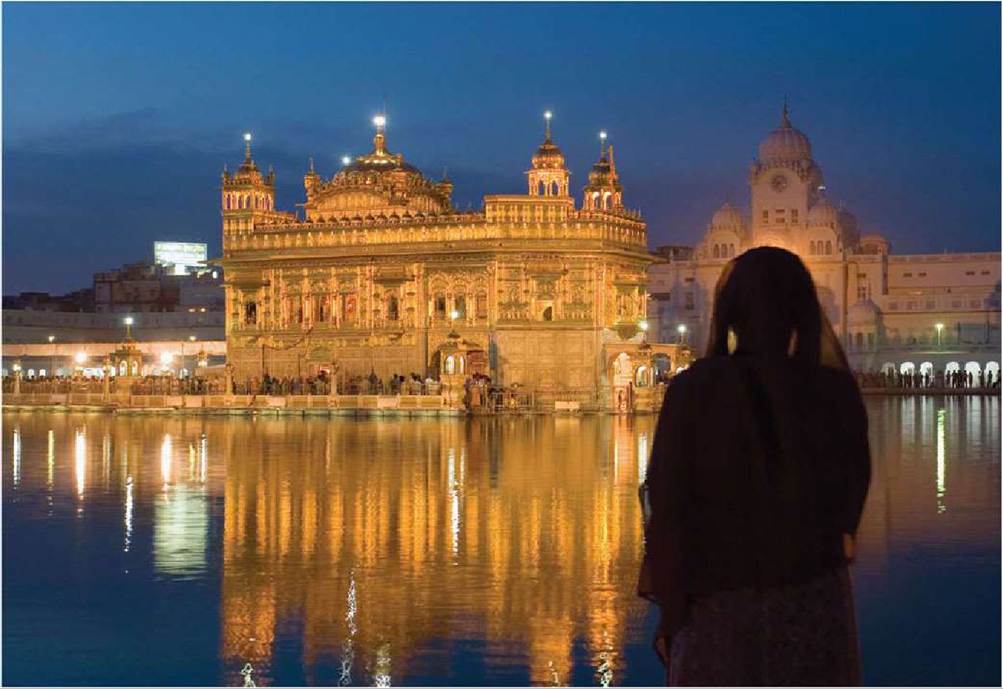
A woman prays at the Golden Temple in Amritsar, India.
Founding the Khalsa
The traditional story of this momentous event is set forth in this account by twentieth-century Sikh historians Teja Singh and Ganda Singh. Note the story’s emphasis on the virtues of loyalty and unity of the Sikh community, with its details concerning various castes and livelihoods.
On the Baisakhi day, March 30 of 1699, [Guru Gobind Singh] called a big meeting at Anandpur. When all were seated, he drew out his sword and cried, “Is there anyone here who would lay down his life for dharma?” At this the whole assembly was thrown into consternation; but the Guru went on repeating his demand. At the third call, Daya Ram, a Khatri of Lahore, rose from his seat and offered himself. The Guru took him into an adjoining enclosure, where a few goats were kept tied, and seating him there cut off a goat’s head.
He came out with the dripping weapon and flourishing it before the multitude asked again, “Is there any other Sikh here who will offer himself as a sacrifice?” At this Dharam Das, a Jat of Delhi, came forward and was taken into the enclosure, where another goat was killed. In the same way three other men stood up one after another and offered themselves for the sacrifice. One was Muhkam Chand, a washerman of Dwarka; another was Himmat, a cook of Jagannath; and the third was Sahib Chand, a barber of Bedar. The Guru after dressing the five in handsome clothes brought them before the assembly. He baptized them with sweetened water [i.e., amrit] stirred with a dagger and called them his Beloved Ones.^4Guru Gobind Singh, after preaching to the crowd about the unity of the Sikh community, asked the Panj Piare, the “Beloved Ones” (or “Beloved Five”), to baptize him—a surprising request given the traditional elevated standing of the Guru. The five baptized the Guru, thus forming the original Khalsa, the community of “Pure Ones” (as we noted in the chapter’s opening description of the initiation ceremony). Over the course of the next few days, some 80,000 were baptized. All the men were given the additional name Singh, which means “lion,” and all the women were named Kaur, which means “princess.” To this day, these names indicate a family’s affiliation with the Khalsa (although they no longer imply that one has undergone initiation).
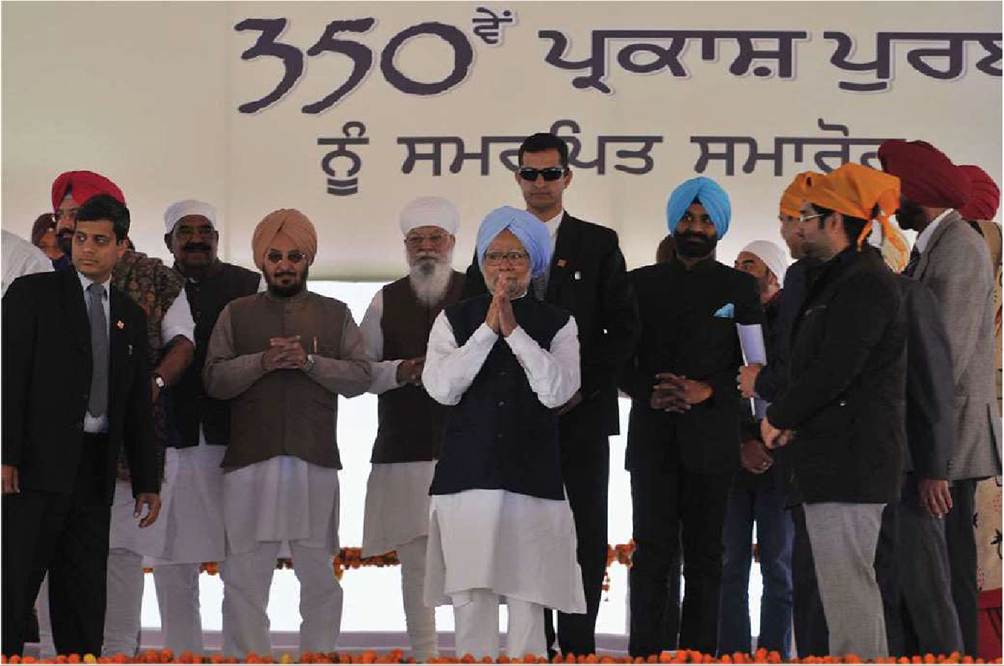
Manmohan Singh, who served as India’s Prime Minister from 2004 to 2014, the first Sikh to do so, joins a celebration of the 350th birth anniversary of Guru Gobind Singh on December 24,2017, in Ananadpur, India.
By the time of his death in 1708, Guru Gobind Singh had managed to befriend the Mughal rulership and to ease tensions between the peoples, although his own death came at the hands of a Mughal assassin. Before dying, he is said to have declared that he was to be succeeded, not by another individual, but by the Adi Granth and by the Panth, to both of which he assigned the title “Guru.”
More on the topic The History of Sikhism:
- The History of Sikhism
- Sikhism is the most recent in origin of the recognised Indian religions.
- Guru Nanak
- Sikh Worship in the Gurdwara
- The Sikh Attempt to Create a Religious State
- Sikhs in Conflict and in Search of Nationhood
- The Khalsa
- Teachings of Guru Gobind Singh and the Khalsa
- Life-Cycle Rituals
- Timeline of Chapters 6 and 7