The Individual and the Quest for Liberation
Having explored Hindu perspectives on divine reality, we turn now to basic concepts that form the framework of the Hindu outlook on the individual and the quest for liberation. Some of these concepts, such as samsara and karma, are also significant for other religions with Indian origins (Buddhism, Jainism, and Sikhism).
Atman
All Hindus believe in an undying soul or self, the atman, whose nature is neither limited by the physical body nor defined by its relationship to the world. It is the atman that moves from body to body through successive incarnations.
The task of recognizing the true nature of the essential self is understood to be arduous and rarely achieved. Most Hindus assume that this will require many lifetimes. One’s life ordinarily revolves around a sense of selfhood that is limited, constrained by desires and by ignorance of the true nature of atman. Therefore, life ordinarily is lived by the egoistic “self’ that is by nature selfish and stuck with false identification of the self with the physical body. This leads to suffering, as the body undergoes painful changes brought on by disease, old age, and death.
Monistic Hinduism, true to its basic premise that all reality is ultimately one, teaches that the atman is Brahman. Another famous passage from the Upanishads conveys this idea through the story of a young man named Svetaketu, who receives instruction from his father on the true nature of the atman. Using a number of analogies, the father explains that despite the appearance of multiplicity, all reality is one. The father emphatically declares: Tat tvam asi svetakato iti (“You are that, Svetaketu!”).4 Atman is Brahman.
Karma
The course of the atman through successive incarnations is determined by karma. In its original, most basic sense, karma means “action,” but for Hindus it means the consequences of action as well.
Karma functions in accordance with the law of cause and effect: good actions produce good effects, bad actions produce bad effects. Karma encompasses all kinds of action, physical as well as mental. A person’s situation in any given moment has been shaped by all previous actions. Similarly, the karmic forces that we set in motion in our present lives will determine the nature of our future incarnations. To ensure that the future will be good, our actions now must be good—and that means living in conformity with dharma.Dharma
For Hinduism, the term dharma can mean law, duty, righteousness, or even religion, all of which have to do with living in a way that upholds cosmic and social order. Dharma is traditionally believed to have been divinely revealed to the rishis, the poet-sages who composed the Vedas.
Through the centuries, Hindu texts have set forth ritual and social obligations that define a good life. The Laws ofManu, for example, a classic juridical text from the period 200 bce to 200 ce, contains detailed prescriptions for correct behavior in all aspects of life. The two ancient and enormously influential Indian epic poems, the Ramayana and the Mahabharata, depict the simultaneous particularity and universality of dharma. As we will consider in more detail in a later section, both poems present epic heroes who must resolve conflicts between social or family obligations and their own personal sense of what duty demands from them.
Samsara
Hindus use the term samsara in two closely related ways. Samsara is the continuing cycle of birth, death, and rebirth. It is also the worldly realm in which birth, death, and rebirth recur. When the physical body dies, the eternal self or soul, the atman, moves on to another body. This process continues until the true nature of the atman is recognized. As noted previously, the nature of each rebirth is determined by karma. Virtuous acts of kindness and generosity over lifetimes ensure favorable rebirths, perhaps even in the blissful heavens of the gods.
Selfish action and meanness lead to undesirable rebirths.Hindus believe in a multitude of heavens and hells, as well as other regions in between. A rebirth in a heaven or hell could last thousands of years but is still only temporary. The most desirable rebirth of all is as a human being in a situation that offers the greatest opportunity for realizing liberation from samsara; for example, as a sage or an ascetic.
The concept of samsara presents some basic questions. What gives rise to samsara? And why are human beings so prone to remain stuck in this samsaric realm? Through the ages, Hindus have offered various answers to these questions. Some of these answers have involved the concept of maya, which in the Vedas refers to the magical power the gods used to create this world. Is the world an illusion, as is often the case with magic, or real? Hindus are divided on this issue. In either case, they agree that human beings are powerfully attracted to this world, with its many particulars—our egoistic selves, our relationships, our possessions, and the seemingly countless objects of our desires. Our attachment to such things in all that we think and do and the karma it generates steer us after each lifetime back into the samsaric realm of particulars.
All of this leads to another basic question: Why should anyone want to escape from samsara? After all, the prospect of a future filled with numerous lifetimes would seem to be appealing. Hinduism’s answer is simple: beyond the samsaric realm lies something inexpressibly better.
Moksha
Freedom from the bondage of samsara is achieved through moksha, “release” or “liberation.” Having overcome attachments to this world, the atman realizes its true nature. For monistic Hindus, moksha is the realization of the union of the atman and Brahman, such that no sense of individuality any longer exists. For dualistic or devotional Hindus, for whom the divine reality is identified with their supreme God (be it Vishnu, Shiva, or another), moksha involves the eternal existence of the atman in the company of God.
Hindus also have differing opinions on whether moksha can occur for a living person or whether it must await death of the physical body. For all Hindus, however, moksha marks the end of the samsaric cycle of rebirth and the end of the effects of karma. Like Brahman, moksha is virtually impossible to describe, beyond being characterized—also like Brahman—as infinite awareness and eternal bliss.The quest for moksha, for liberating oneself from samsara even while constrained by the limits of this world, is extremely challenging. Hinduism offers three main paths to moksha, each of which provides the means of eradicating ignorance and egoistic attachment and thus freeing the atman.
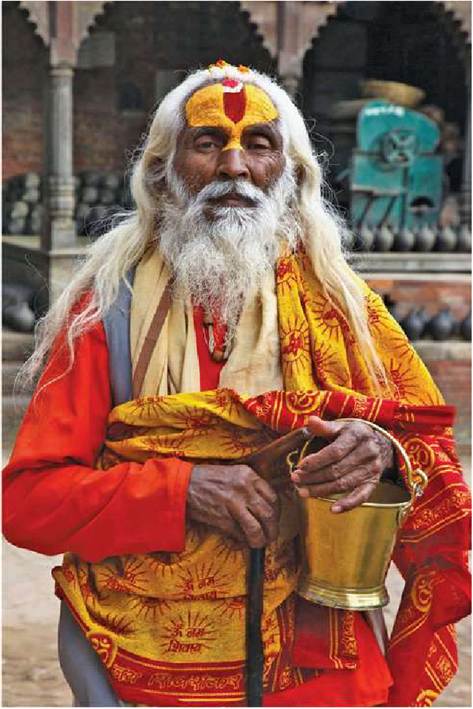
Asannyasi, or Hindu ascetic. His sectarian affiliation is indicated by his forehead marking, which demonstrates that he is a worshipper of Vishnu.