Hindu Beliefs about Divine Reality
In keeping with Hinduism’s general diversity, Hindu beliefs about divine reality are wide ranging. Indeed, one of the most fundamental differences in Hinduism is the split between monistic and dualistic or devotional viewpoints.
Monism, as explained in this book’s introductory chapter, is the doctrine that all reality is ultimately one. It is nondualistic in that there is no distinction between the divine reality and the rest of reality. The Hindu dualistic viewpoint, in contrast, understands divine reality as God, a personal being separate from the rest of reality. This means that God is separate from the individual, and therefore devotion to God is natural. Devotional practice of this sort is a primary religious activity of Hindus who hold this dualistic viewpoint. The majority of Hindus understand divine reality in this dualistic manner.id="Picutre 48" class="lazyload" data-src="/files/uch_group79/uch_pgroup305/uch_uch7255/image/image048.jpg">
World Hindu population.
Names of the Divine Reality
Hindus refer to divine reality in a variety of ways. In this chapter, in order to maintain clarity between references to the monistic and the dualistic viewpoints, we use two distinct terms. When referencing monism, we use the term Brahman (Sanskrit, “expansive”) to denote the divine reality, which monistic Hindus believe is the supreme, unitary reality that is the source of all being and all knowing. When referencing dualistic or devotional Hinduism, we use either “God” or the name of the specific deity under consideration.
In actual Hindu practice, conventions of naming the divine are often not so simple as our chapter’s use of these two distinct terms might imply. Sometimes monistic Hindus, for example, refer to Brahman as “God.” Many dualistic Hindus use “God” to denote a universal being that encompasses all the various deities worshiped in Hinduism, and sometimes they use “Brahman.” When dualistic Hindus refer to a particular deity, they often use the specific name, such as Krishna, Rama, or Shiva.
Devotees of the goddess traditions refer to God using terms such as Devi (“goddess”) or Mahadevi (“great goddess”).One Divine Reality, Many Gods The monistic viewpoint does not preclude belief in gods and goddesses. In a famous passage from the Upanishads (a collection of early philosophical texts), a sage is asked how many gods there are. Initially, he says there are “three hundred and three, and three thousand and three,” but, upon reflection, he ultimately concludes that there is only one.1 The sage explains that the various powers of the divine manifest as countless deities. In later times, the traditional number grew to 330 million. The passage from the Upanishads concludes with the sage giving the name of the one god: Brahman, which is the supreme, unitary reality, the ground of all being.
Although Brahman is the true nature of all that exists, including ourselves, it is virtually indescribable from the ordinary human perspective. Brahman can be described only by way of some general attributes: infinite being (sat), infinite awareness (chit), and infinite bliss (ananda). A passage from the Upanishads states that Brahman is neti, neti: “not this, not this.”- When all of the identifiable particulars of the universe are subtracted away, what remains is Brahman, the essential substratum of all existence. This is monism, the belief that all reality is ultimately one.
These passages from the Upanishads influence how later monistic Hinduism forms its understanding of the mystery and majesty of being. Many monistic Hindus believe that the divine reality is simultaneously one—as Brahman, the ground of all being—and many. Given the worship of many deities, along with affirmation of the ultimate singularity of the divine, and indeed of all reality, this form of Hinduism can be described as both polytheistic and monistic. Unlike polytheistic religions that see the various gods as limited, Hinduism regards each god as a manifestation of Brahman.
Divine Reality as Sound
The primordial sound OM (or, per the literal spelling, AUM) is constituted of three sounds of the Sanskrit language: A (the first vowel), U (the final vowel), and M (the final consonant).
OM therefore encompasses all words and all things they represent. OM is the sound through which the universe is manifested and thus is the very expression of Brahman. Some Upanishads also identify it with four states of consciousness: A is waking consciousness, U is dreaming consciousness, M is deep sleep without dreaming consciousness, and AUM in its entirety is the fourth and final state, oneness with Brahman. In later Hinduism, the sounds are identified with the gods Brahma, Vishnu, and Shiva and their functions of creating, preserving, and dissolving the universe.God as Image
Paradoxically, given the difficulty of comprehending the nature of divine reality, Hinduism is an intensely imagistic religious tradition. This is especially true of dualistic Hinduism, as
imagistic representations of God are naturally well suited for devotional practices.
Images of supernatural beings and mythical beasts decorate Hindu temples, as well as Hindu homes. These images can be richly adorned stationary icons enshrined in temples or beautifully crafted bronze icons carried in religious processions. Today, some Hindus revere print and online images of the divine. This love for the divine form emerges from Hindu notions of the simultaneous immanence and transcendence of God. An image of a deity is a symbolic representation meant to aid devotees in contemplating the deity’s divine attributes, but the image is also believed to be suffused with divine presence, as we saw in the opening narrative about the Ganesha festival and temple. Thus, Hindus believe that God becomes accessible to devotees through images. For Hindus, an image of a god is God.
The Divine in Nature
If Brahman is everywhere and everything, it follows that the natural world is an expression of the divine. This belief is held by most Hindus, whether inclined toward the monistic or the dualistic viewpoint. The worship of such natural entities as rivers, the earth, mountains, and the sun, as well as a reverence for certain trees and animals, can be traced back to the roots of Hinduism.
Many sacred sites arose in conjunction with the worship of rivers and mountains. Rivers in particular are worshiped as embodying the creative energy that generates the universe, as well as being powerful places of crossing between the divine and terrestrial worlds. It is for all of these reasons that many Hindus bathe in rivers—of which the Ganges in India is the most important—believing that they wash away one’s sins. For centuries, the awe-inspiring peaks of the Himalayas have attracted monks, yogis, and pilgrims seeking an experience of the divine. Mount Kailash, believed to be the home of the god Shiva, draws devotees who perform a ritual circumambulation of the mountain over the course of several days, reaching elevations of greater than 18,000 feet on the trek. Hindu mythology portrays the sun, planets, and other celestial bodies as gods.
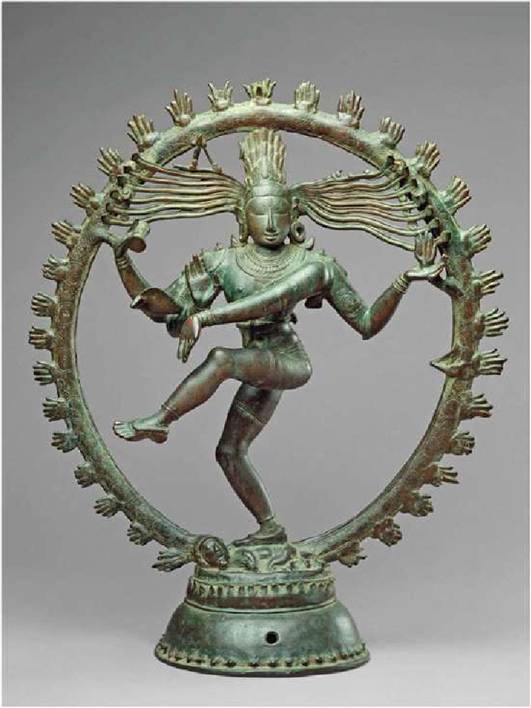
Shiva as Lord of the Dance (Nataraja) performs his Five Activities: creation, represented by the drum in his upper right hand; preservation, signified by the positions of his lower right and left hands; destruction, symbolized by the fire in his upraised left hand; illusion, personified by the Demon of Forgetfulness crushed beneath his right leg; and liberation, offered by surrendering to his upraised left foot. Chola period, c. eleventh century. India, Tamil Nadu.
For Hindus, all living things are sacred, and some especially so. For example, the type of fig tree under which Gautama the Buddha attained enlightenment (Chapter 5) is sacred to the god Vishnu. As is well known, Hindu society gives a special place to the cow, a practice that has deep historical roots in the pastoral, cattle-tending communities found throughout India. Because a child, once weaned from its mother’s breast, is frequently given cow’s milk, Hindus revere the cow as a second mother. Cows are worshiped on the first day of the important Hindu festival of Diwali, as well as on the first day of a harvest festival observed in southern India.
For Hindus, the worship of cows is an expression of respect for creatures that help humanity.Although Hinduism has a long history of reverence for natural entities, this has not always translated into ecological awareness and activism. The worship of rivers does not mean that India’s sacred waterways are pristine. Because rivers are divine, they are said to be able to absorb the sins of worshipers and still remain unaffected. Thus, for many Hindus, rivers remain pure even if they are polluted by waste. In recent years, Hindu environmental activists have begun to challenge these assumptions by employing Hindu beliefs about the divinity of the natural world to promote more informed ecological awareness.
God Comes Down: Avatars
Two of the most popular deities in Hinduism are Krishna and Rama. Each is an avatar, a “descent” (Sanskrit, avatara) of God to earth in a physical form with the specific goal of aiding the world. Like most avatars, they are manifestations of Vishnu, whose primary function is the preservation of order in the world. Vishnu is believed to have ten such forms, of which nine have already appeared. As noted, the most popular of the avatars are Rama, Vishnu’s seventh form, and Krishna, his eighth. It is said that Vishnu’s final avatar, Kalki, will arrive at the end of the present age to usher in an era of peace.
We have seen that Hindus often use the names of particular gods as a way of referring to divine reality. This is the case with avatars. For example, Hinduism’s best-known sacred text, the Bhagavad Gita (“The Song of the Lord”), presents Krishna as a manifestation of the supreme being.

A Hindu devotee performs rituals as he takes a holy dip in Allahabad, India, at the confluence of the Ganges and Yamuna rivers, one of Hinduism’s important centers.
In the Bhagavad Gita, Krishna asserts the principle that although God’s essential nature is unchangeable, God chooses to descend into the world in the form of an avatar when intervention is necessary to reinstate peace and harmony. Krishna says (4.6-8):
Though myself unborn, undying,
the lord of creatures, I fashion nature, which is mine, and I come into being through my own magic.
Whenever sacred duty decays
and chaos prevails,
then, I create
myself, Aijuna.
To protect men of virtue
and destroy men who do evil, to set the standard of sacred duty, I appear in age after age.3
We will learn more about the Bhagavad Gita later in this chapter.
More on the topic Hindu Beliefs about Divine Reality:
- Hindu Beliefs about Divine Reality
- TWO DIFFERENT TYPES OF REALITY
- THE DIVINE LADDER
- Divine and royal origins
- Hindu Environmentalism
- THE VIRTUAL REALITY OF THE LOGOS
- THE DIVINE ROSARY
- Reality as Stratified
- Vedanta: The Predominant School of Hindu Philosophy
- Returning to reality