The Teachings of Islam
Islam arose in the Arabian Peninsula in the seventh century, when Muslims believe that a man called Muhammad began receiving communication from God. The primary source of Islamic teachings is the Qur’an, which Muslims believe is the word of God as revealed to Muhammad.
According to Muslim belief, Islam was not introduced as a new religion. Rather, the revelations of the Qur’an to Muhammad were a reawakening or reintroduction of the original monotheistic faith of the prophet Abraham, a figure who is also important to Jews (Chapter 11) and Christians (Chapter 12). Islam is considered one of the Abrahamic religions, along with Judaism and Christianity, and the three religions share a great deal. Although many people in pre-Islamic Arabia were polytheists, significant numbers of Jews and Christians also lived in the region. People in Arabia were therefore familiar with biblical stories and characters, and several of these are mentioned in the Qur’an. In the Islamic view, Abraham (or Ibrahim, as Muslims call him) was the original monotheist who received a revelation from God, a revelation that taught him the true religion centering on the oneness of God. Muslims believe that when Muhammad received the revelations of the Qur’an, he was given a reminder for humanity of what God conveyed to Abraham. This section explores what Muslims believe about the revelation of the Qur’an to Muhammad. In a later section, we explore his life, his prophecy, and his leadership roles.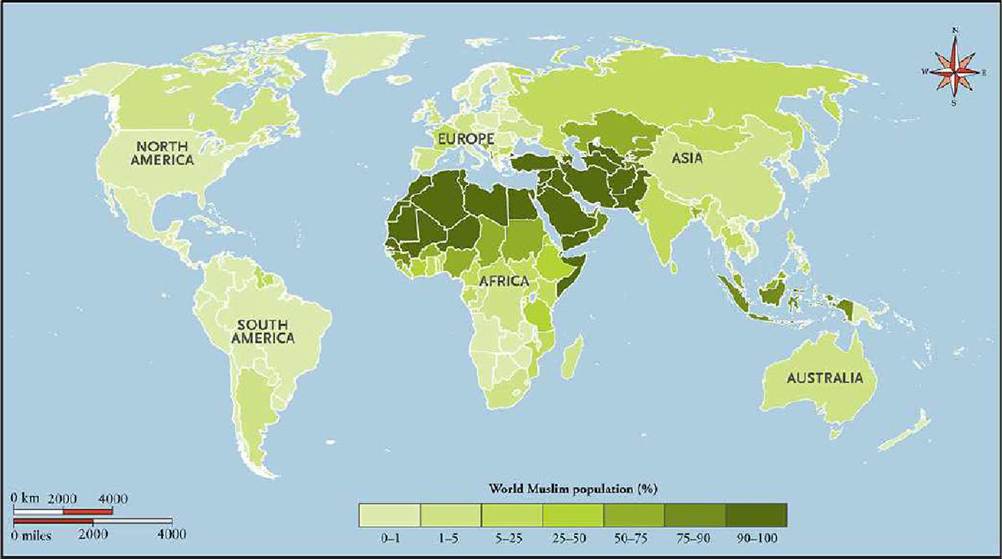
World Muslim population.
Muhammad and the Revelations
Muslims consider Muhammad (c. 570-632 ce) the final messenger in a series of prophets sent by God to humanity. In addition to Abraham, these prophets include many other figures important in the Jewish and Christian traditions, such as Noah, Moses, and Jesus.
In Muslim belief, all prophets are solely human—not divine. However, the importance of Muhammad to Muslims should not be underestimated. In addition to receiving the revelation of the Qur’an, Muhammad is considered an extraordinary man in all respects. He was the religious and political leader of the early Muslim community and, even today—fourteen centuries after his death—his life is considered an example for all Muslims to follow.Some of what we know about Muhammad and his life comes from the Qur’an. We also know something of his life from biographical writings and from what his close friends, associates, and family (who are known together as his companions} observed about him and passed on in reports. In addition, there are many stories and legends about the Prophet. Because most of what we know about Muhammad comes from sources that were compiled by Muslims after he became a prophet, we know very little about his early life. Muslims do not believe that Muhammad was divine, but rather consider him to be al-insan al-kamil, the ideal human. And although he was a prophet, in many respects he lived the life of a normal man. He had a family, earned a living, and was active in his community.
Most Muslims believe that Muhammad was a spiritual man and a religious seeker even before he began receiving the revelation of the Qur’an. He was considered a devout monotheist even at a time in which many of his contemporaries were polytheists, and it is said that he often meditated alone on the oneness of God. When he reached the age of forty, in the year 610 ce, the Angel Gabriel (known in Arabic as Jibril) visited Muhammad while he was praying in an isolated cave outside Mecca. Muhammad heard a voice that told him that he was the messenger of God and commanded him to “Recite!” Muhammad is said to have been awed and bewildered. He is thought to have hesitated three times at Jibril’s command because as an illiterate man he did not feel he was able to recite. Eventually, he repeated the words the angel told him to recite, and these are considered to be the first revealed verses of the Qur’an.
The rest of the Qur’an was revealed to Muhammad over the next two decades.Muhammad confided in his wife, Khadija, a wealthy and successful businesswoman, about the revelations. She listened carefully and believed his message. Because she was the first to believe the truth of the message received by Muhammad, Khadija is considered to be the first convert to Islam. Other early followers were Muhammad’s close friends and family members. Muhammad’s young cousin ‘Ali, who later became his son-in-law when he married Muhammad’s daughter Fatima, was the first male convert to Islam. A friend of Muhammad’s called Abu Bakr was also an early Muslim, and he became Muhammad’s father-in-law much later in life when, after Khadija’s death, Muhammad married Abu Bakr’s daughter.
After the first revelations, Muhammad began a life of preaching in Mecca. The verses of the Qur’an that he received during this time emphasized the oneness of God—the central tenet of Islam. Muhammad preached this idea to the people of Mecca and also taught about morality, social justice for the poor and downtrodden, and the inevitability of the Day of Judgment.
Muhammad was not the only prophet in the Islamic tradition. The Qur’an mentions many prophets by name and refers to the existence of many others. Muhammad, however, is known as the "seal of the prophets,” which means that the door of prophecy was closed—or “sealed”— with him because he was the final prophet. Muslims believe that the revelations to Muhammad came at a time when it was necessary to reawaken understanding of God’s message to humanity.
The Holy Qur’an
The Qur’an is the sacred text of Islam, and it is considered the literal word of God. The Arabic word qur’an means “recitation,” and the book is called such because Muhammad received the Qur’an orally and taught it to his followers in the same way. When the Qur’an was eventually written down, the text was corrected by the oral knowledge of those who had committed it to memoiy.
Even today, printed copies of the Qur’an bear the stamp of approval of a person known as hafidh or “keeper of the Qur’an.” This is a person who knows the entire Qur’an by heart.The Qur’an was not revealed all at once to Muhammad, but rather gradually over a period of more than twenty years until his death. The language of the Qur’an is classical Arabic, and stylistically it resembles the beauty of the Arabic poetry of the time in which it was revealed. However, it is important to note that Muslims do not regard the Qur’an as poetry. This is because poetry is a human endeavor, and Muslims view the Qur’an as solely the word of God. Reciting, reading, and studying the Qur’an are an important part of daily life for devout Muslims today, in all parts of the world.
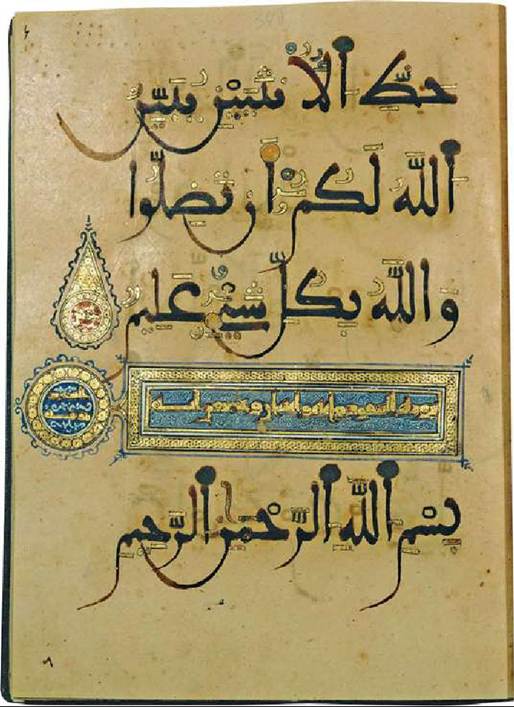
This illuminated Qur’an is from the thirteenth century.
The Qur’an is not a narrative text, which means that it does not tell a story from beginning to end (although there are some stories within the text). The Qur’an consists of 114 chapters, each of which is called a sura. Each sura consists of several verses. The suras are not organized around specific topics or time periods, and they are not arranged in the order of revelation, as one might expect. Rather, they are arranged roughly from the longest to the shortest, with the exception of the opening sura, which is quite short. Some suras are only a few verses long, and the longest has almost 300 verses. Each sura has a title. The titles were not revealed to Muhammad but were, rather, based on a distinctive element of the sura. For example, the third sura is called “The Women” because of the many verses within it that reference the status of women.
At the time of Muhammad’s death, the revelations of the Qur’an had not been collected into one book. Rather, the primary mode of teaching and learning the Qur’an was oral. During the rule of the caliph ‘Uthman, however, the revelations were organized into a written text.
For centuries, Muslims have considered this text standard. Today, however, some secular scholars think that a number of versions of the Qur’an originally existed and that the written text of the Qur’an emerged gradually in the seventh and eighth centuries.The most well-known sura is the first one, which is called al-fatihah, or the "the opening.” The fatihah is a common prayer used by Muslims in many different contexts. It is the first sura that Muslims learn when they begin studying the Qur’an as children or as adults. A devout Muslim will recite the fatihah several times during the day’s many prayers. The sura evokes the oneness of God, the all-powerful nature of God, the Day of Judgment, and God’s guidance for a righteous life.
The Opening (Al Fatihah)
In the name of Allah, most benevolent, ever-merciful
All praise be to Allah,
Lord of all the worlds, Most beneficent, ever merciful, King of the Day of Judgment. You alone we worship, and to You alone turn for help.
Guide us (O Lord) to the path that is straight, The path of those You have blessed, Not of those who have earned Your anger, Nor those who have gone astray.3
Today, most Muslims consider the Qur’an both inimitable and uncreated. This means that Muslims regard the holy text as unique and eternal. Today and historically, Muslims have believed that the Qur’an’s equal cannot be created by human effort, which is considered proof of its divine origins. Most contemporary Muslims also believe that the Qur’an is eternal—that it has always existed. This view has not always dominated, however. The Mutazilites, a rationalist school of Islamic thought that was prominent many centuries ago, argued that the Qur’an was not eternal but was rather created by God. The Mutazilite scholars argued that the idea of an eternal Qur’an compromised the unity of God because God alone was eternal and the creator of all things—including the Qur’an. This view had some support in the tenth century, but eventually the idea of the eternal Qur’an became dominant in the Islamic tradition.4
The Teachings of the Qur’an
The major teachings of the Qur’an are found throughout the text.
In any number of verses, we can find reference to the nature of God, the reality of the Day of Judgment, and guidelines for moral behavior.The Oneness of God Like the other Abrahamic religions, Islam is a monotheistic religion, and the most important principle of Islamic belief is the oneness of God. The Qur’an teaches that God, known in Arabic as “Allah,” is eternal, uncreated, all-knowing, and all-powerful, and it is God alone who created the universe and humankind. God is also merciful, just, and good. God is transcendent but also present, or immanent, in the lives of believers. A much-quoted verse of the Qur’an refers to God as closer to humanity “than the jugular vein” (50:16). Muslims believe that it is impossible for God to have a partner, consort, or family because no other being shares God’s divinity. Muslims believe that God is the same God of the Jews and Christians. However, to Muslims, the Christian doctrine of the Trinity compromises the unity of God. The Qur’an specifically comments on the impossibility of God begetting a son, as in the following verse:
He to whom belongs the kingdom of the heavens and the earth: who has neither begotten a son, nor has He a partner in kingdom: (who) created everything, and determined its exact measure (25:2).5
The Qur’an also teaches that Muslims should strive to acknowledge the oneness of God through acts of devotion. Because the unity of God is the central tenet of Islamic belief, it follows that denying or compromising this oneness is the greatest sin. This sin of associating anything or anyone else with God is called shirk. In the Qur’an, shirk is noted as the only unforgivable sin in the eyes of Allah. This is because it denies the existence of God and the true nature of God. For the believing Muslim, the worship of God should be given to God alone, and human beings should worship nothing else. Therefore, nature, idols, images, and human beings must not be worshiped.
In Muslim belief, Allah created the universe, the world, and everything in it, including the sun and the moon, the mountains and oceans, and all living things. The natural world is mentioned throughout the Qur’an, and elements of nature are referred to as ay at, or signs of God: “We shall show them Our signs in every region of the earth and in themselves, until it becomes clear to them that this is the truth” (41:53). Muslims view the natural world and the entire cosmos as a type of revelation from God. (The Qur’an itself, remember, is another type of revelation.) Therefore, in Muslim belief, the natural world as a whole is evidence of the existence of God, and human beings should be able to realize this simply by observing nature. Even so, human beings cannot truly know the ultimate essence of God, God’s ultimate purpose, and ultimate reality. Thus, Muslims may not be able to understand rationally why bad things happen to good people. However, they should have faith in God’s purpose, even though they cannot truly know it (2:216).
Prophecy
Prophecy is also an essential component of Islamic belief, and it is mentioned several times in the Qur’an. The belief in prophecy is also important to Judaism and Christianity, and the three Abrahamic faiths share many of the same prophets. In Islam, it is through the messages revealed to prophets that humanity comes to know the desires of God and the divine laws that govern the universe and creation. The belief in revealed scripture goes hand in hand with the belief in prophecy because Muslims believe that it is through prophets that humanity obtains scripture.
Muslims recognize that there have been many prophets since the beginning of creation. Each prophet received special words from God that were appropriate for humanity at the time in which the particular prophet lived. The prophet Abraham is mentioned several times in the Qur’an. The stories of his life resemble those told by Jews and Christians, and they serve as an important basis for the annual pilgrimage to Mecca (discussed in the next section). The Qur’an also names Jesus as an important prophet (and indeed says that Jesus will return to herald the Day of Judgment), and the Gospels are considered part of God’s revelation to humanity. Muslims believe that Jesus was born of the Virgin Mary, who is also mentioned in the Qur’an and is held in very high regard by Muslims. However, Muslims do not believe that Jesus was divine or the son of God. Verse 25:2, which you read earlier, reflects this idea in the passage that God has not “begotten a son.”
Muslims believe that all prophets bring communication from God. The Qur’an teaches that prophets fall into different classes based on the nature of that communication. Some are said to bring simply “news” from God. Others, like Muhammad, bring a major message. In addition to Muhammad, prophets such as Moses and Jesus also received major messages. Moses received the Torah as guidance for humankind, and Muslims regard the teachings of Jesus as a major message from God. Muslims consider all scriptures, including the Torah and the gospels, to be the work of God. Although the Qur’an refers to those peoples to whom scripture was revealed as “Peoples of the Book,” the Qur’an also teaches that the earlier messages have been misinterpreted or forgotten by the Christians and the Jews.
According to the Qur’an, Adam and his wife, Hawa (or Eve), were the first two humans. Adam became the first prophet in the Islamic tradition. Adam and Hawa were created separately by God from a single soul (4:1) and were made of dust or clay according to a divine model. Muslims believe that God blew spirit into humanity. Therefore, as in nature, the signs of God are also in humanity. The Qur’an teaches that human beings were created to worship God (51:56) and that the nature of humanity is to obey God and to give thankfulness for God’s blessings.
You will recall that the meaning of the term Muslim is “one who submits.” However, as part of God’s creation on earth, Muslims believe that humans should also act as responsible members of society and stewards of the natural world. The Qur’an contains a story that is similar to the one in Genesis, in which the first humans disobeyed God by tasting a forbidden fruit. In the Qur’anic story, which appears more than once in the text, Adam and Hawa are both to blame for this disobedience, and they are immediately forgiven for their transgressions by God (7:10-25; 20:114-123). Most Muslims believe that, unlike other living creatures, all human beings have free choice and thus must choose to submit to the will of God. Each individual’s choices will be evaluated on the Day of Judgment.
The Day of Judgment
The coming of the Day of Judgment and the reality of the afterlife are also central teachings of the Qur’an. Many of the early suras focus on God’s judgment and can be read as warnings to humanity to live a righteous life or suffer the consequences when facing God at the end of days. Despite the dire warning of some of these verses, God’s justice is strongly emphasized, and the Qur’an gives details about how to live a righteous life. Greed and hypocrisy are criticized, and kindness and generosity are praised. The Qur’an teaches that all believers, men and women alike, will stand alone in front of Allah and will be judged according to their actions in life. The Qur’an teaches that, after death, a person resides in the grave in a sleeplike state until the end of days, at which time the judgment will take place. The end of days is described in the Qur’an as a time when the world turns upside down in great calamity. Sura 99 dramatically describes Judgment Day:
When the world is shaken up by its cataclysm
And earth throws out its burdens,
And man enquires: “What has come over it?”
That day it will narrate its annals,
For your Lord will have commanded it.
That day people will proceed separately to be shown their deeds. Whosoever has done even an atom’s weight of good will behold it; And whosoever has done even an atom’s weight of evil will behold that.-
On Judgment Day, each person will have a book that details the deeds of his or her life. The book held in the right hand indicates a righteous life, and the book held in the left hand indicates the life of a sinner. The Qur’an teaches that each individual stands alone before God and that no one can intercede on his or her behalf. However, there is some debate about this issue, and some traditions in Islam suggest that Muhammad will be able to intercede on behalf of believers. Some Muslims believe that the Day of Judgment will be ushered in by a person known as the Mahdi, whose just rule will come to the earth at the end of days. The Mahdi is not mentioned in the Qur’an. Rather, the idea developed in Islamic thought in later centuries.
Those who are judged to be righteous will enter paradise. In the Qur’an, paradise is described in much detail as a lush garden with bountiful blessings of food, drink, and beautiful young men and women. Although some take this description to be literal, other Muslims think that it is instead a metaphor for the beauties of paradise. Those who have led sinful lives will be cast into hell, which is often referred to simply as “the fire.” Those who are doomed to hell include nonbelievers and Muslims who have rejected their faith by failing to live up to prescribed duties and moral standards. Some Muslims believe that sinners will eventually be forgiven and taken to paradise.
Angels and Jinn
The existence of angels is another component of Islamic belief, and angels are mentioned throughout the Qur’an. Angels are part of God’s creation, without body or gender. Humans are said to be made of clay and angels from light. Angels serve as important messengers and assistants to God. The most well known of the angels in Islamic tradition is Gabriel, or Jibril. This angel is mentioned several times in the Qur’an and was instrumental in bringing the revelation of the Qur’an to Muhammad from God. Islamic tradition also recognizes supernatural beings called jinn, which are said to be created from fire. They are also mentioned in several places in the Qur’an. Jinn can take various forms, and, like humans, they can be both good and evil and Muslim or non-Muslim. Much folklore has developed surrounding the jinn, and they are represented in tales like One Thousand and One Nights as both helping and harming humans. The English term genie derives from the Arabic word jinn.
Commentary on the Qur’an
The text of the Qur’an is ambiguous in some places and repetitive in others. This has resulted in a long tradition of commentary upon and interpretation of the meaning of the verses. The general Arabic term for commentary on the Qur’an is tafsir, which is translated in English as “interpretation.” Scholars have been engaging in tafsir for centuries, and their commentary takes many forms. In the first few generations following Muhammad’s death, scholarly commentary on the Qur’an focused primarily on grammar, language, and explanations of inconsistencies in the text. The goal of this type of tafsir was to clarify the meaning of the words of the Qur’an.
Muslims have not always agreed on how the Qur’an should be interpreted and understood. Some scholars have argued that the Qur’an must only be interpreted vis-à-vis itself. In other words, verses of the Qur’an should only be explained by using other passages of the text. Other scholars think that Muslims should use their own reason and rationality as believers to interpret the meaning of the verses. This method of tafsir is known as speculative tafsir.7- A famous eleventh-century Persian scholar called Abu Hamid al-Ghazali (1058-1111) wrote that, as rational judgment is a gift from God, people should always use it when considering the meaning of the Qur’an. However, some scholars criticized his approach as preferring human reason over the words of God. Ibn Taymiyya (1263-1328), an Arab scholar, argued that using human reason was not necessary because the entire meaning of the Qur’an could be found within the text. As we discuss later in this chapter, Ibn Taymiyya’s approach influenced some Islamic reformist movements in the modern era.
The Sunna: The Example of the Prophet
After the Qur’an, the second most important source of Islamic teachings is in the sunna, which refers to the “tradition” or way of life of the Prophet Muhammad. The sunna encompasses Muhammad’s actions and words. It includes the way he handled disputes in the early community, the way he dealt with his wives, friends, and children, and the way he went about the daily business of life. This extends even to such seemingly mundane matters as how the Prophet cleaned his teeth. To Muslims, Muhammad is considered the ideal human. He is therefore the model of the best way to live. To this day, Muhammad is an inspiration to all Muslims, who strive to follow his example of conduct in their own lives. (Muhammad is discussed in more detail in the section on the history of Islam.)
The Hadith Literature
How do Muslims know how Muhammad lived his life, how he treated his family, and how he handled problems facing members of the early Muslim community? Muslims have knowledge of Muhammad’s life through a literary tradition known as the hadith. Hadith is a form of literature that records in brief reports the details of the life of the Prophet, including his sayings and his deeds. The hadith reports come from the observations of Muhammad’s close friends and family, known as his “companions.” His companions realized his importance as an example of righteous behavior. They strove to remember his actions and words, and then passed them on through the generations in hadith reports.
A hadith consists of two parts: the isnad, or the chain of transmission of the hadith; and the matn, the report itself. The matn relates Muhammad’s words or deeds, and the isnad names those people who transmitted the hadith from the time of the Prophet. The isnad always originates with one of Muhammad’s close companions or a family member. One of Muhammad’s later wives, ‘A’isha, was one of the most important transmitters of hadith, as she passed on many reports about Muhammad’s life. Muslims do not consider all hadith to be equally valid. A complex science of hadith developed in the centuries following the death of the Prophet to evaluate their reliability as true reports of Muhammad’s life. Scholars ranked hadith from “solid” to “weak” based on the likelihood of authenticity. The hadith are compiled into collections of several thousand.
Reports known as hadith qudsi, or sacred sayings, are also important in the Islamic tradition. Although the name is similar, this is a very different sort of literary tradition from the regular hadith. The hadith qudsi are not reports of Muhammad’s life but are believed to be words of God. Muhammad is believed to have occasionally transmitted direct words of God that were not intended to be part of the Qur’an. Many of the hadith qudsi are succinct and beautiful. They focus on God’s love for humanity, God’s mercy, and the closeness of God to creation. The following hadith qudsi illustrates the quality of God’s mercy:
God says: “If my Servant intends a good deed and does not do it, I write it down for him as a good deed. Then if he does it, I write it down for him as ten good deeds, or up to seven hundred times that. And if my servant intends an evil deed and does not do it, I do not write it down against him. And if he does it, I write it down for him as [only one] evil deed.”-
Explore the concept of scripture in Judaism, Christianity, and Islam. What important elements do these religions share? How do they differ?
The Five Pillars
The essential teachings of Islam are closely related to Muslim worship practice. The five pillars form the basis of practice. These pillars are as follows:
1. Shahada: the declaration of faith
2. Salat: the daily prayer
3. Zakat: almsgiving
4. Sawm: fasting during the month of Ramadan
5. Hajj: pilgrimage to Mecca
Muslims believe that the foundations for the five pillars were set during the lifetime of Muhammad. The five pillars are carefully articulated in the hadith literature. All of the pillars are equally important. However, they address different elements of religious practice that must be performed at special times. For example, although prayer is a daily requirement, the Ramadan fast happens once per year, and the hajj must be performed only once in a lifetime. The pillars are generally required of all adult Muslims. However, individuals are sometimes excused from performing the pillars. For example, someone who is ill, pregnant, or nursing an infant would not be required to fast. Devout Muslims generally aim to observe all of the pillars, but as with every religious tradition, there are variations in levels of observance. Furthermore, there has been some historical variation across communities and cultures in how much emphasis is placed on the pillars. Some Muslim scholars have even debated the relative necessity of observing the pillars, though these scholars have always been in the minority.
The Declaration of Faith
The first pillar is the declaration of faith and is called the shahada. This is the statement of belief: “There is no God but God and Muhammad is the messenger of God.” The other four pillars all deal directly with religious practice, but the shahada is different in that it is much more a statement of belief than a ritualized religious practice. To become a Muslim, all one must do is utter the shahada with utmost sincerity in the presence of witnesses. Most new Muslims will first declare the shahada, and then begin a lifetime’s journey of learning the Qur’an, the sunna, and other aspects of the faith. Many people in North America and elsewhere who have converted to Islam note the simplicity of the religion as something that attracted them to Islam. This simplicity is illustrated by the succinct nature of the shahada.
The Daily Prayer
The salat, the mandatory daily prayers, is the second pillar. You encountered the careful preparations for the daily salat of Amina at the opening of this chapter. Devout Muslims perform five daily prayers at specific times of the day. Rather than performing all the prayers at once to get them over with for the day, week, or month, Muslims should do them at the required times. The first prayer should be done at dawn every morning. The next prayer is performed at about noon. The remaining prayers are the late afternoon prayer, the sunset prayer, and the final prayer in the evening. Prayer is mentioned in several places in the Qur’an. However, the number of prayers is established not in the Qur’an but rather in the hadith. The hadith literature relates that during a miraculous journey to heaven, known as the miraj, Muhammad came into the presence of God. God told Muhammad he should instruct people to make fifty daily prayers. However, when Muhammad told the prophet Moses about the prayers, Moses told him to go back to God to ask for a reduction, as fifty would be too many. Eventually, the number was settled at five, although God said that every prayer would count for ten.
The salat are not individualized prayers requesting aid from God or giving thanks, although those personal prayers, called dua, are also common among Muslims. Rather, the salat prayers are formalized. For each prayer, specific verses of the Qur’an are recited, and special body movements accompany the recitation.
Before beginning the prayers, a Muslim must enter a state of ritual purity. As you learned from Amina at the beginning of this chapter, this purification consists of ablutions, called wudu’, which involve cleansing the hands, head, face, and feet. The body should be covered for prayer, and most women and men also cover their heads. The prayer begins with the takbir, or the declaration Allahu Akbar, which means “God is great.” Throughout the prayer, the believer faces the direction of Mecca, where an important structure known as the Ka‘ba is located (you will learn more about the Ka‘ba later in this section). This means that Muslims in America pray facing the east. In prayer, a Muslim stands, kneels, and bows his head to the floor. These cycles of movements, along with the proper recitation, are called raka and vary in number according to the prayer. In some parts of the world, such as regions of Indonesia, the prayer opens with a declaration of intent to indicate that the Muslim is in the right frame of mind for performing the prayer.9 Not all Muslims declare their intent to pray, but most agree that proper intention is necessary. The intention of the believer is what validates and legitimizes the action of prayer. Many Muslims believe that the intention of the prayer is even more important than the prayer itself. After reciting verses of the Qur’an, the prayer closes with a greeting of peace.
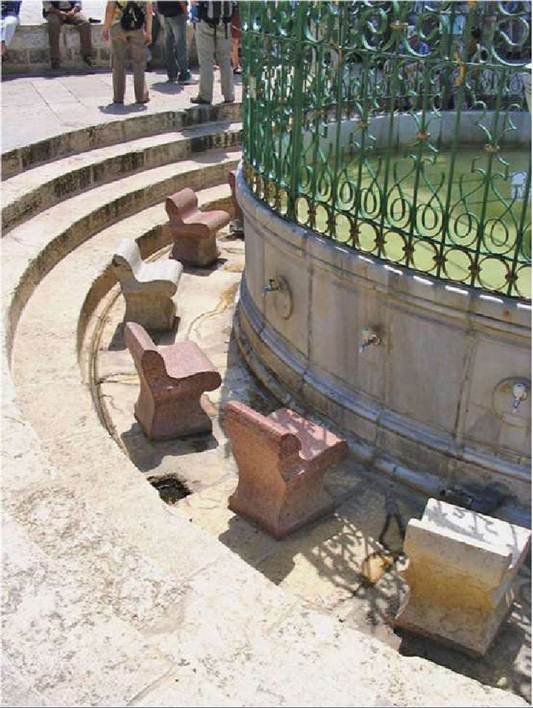
Ablution fountains outside of a mosque.
Prayers may be done anywhere—even in a park or airport. However, many Muslims perform prayers at a mosque (this English word is taken from the Arabic term masjid). A mosque is a place that is designated for prayer. Many people imagine elaborate feats of architectural workmanship when they think of mosques, but a mosque can be as simple as an unadorned room in a commercial building or even a clearing in the woods. Although mosque architecture and decoration vary from the very simple to the very ornate, mosques tend to share some features. All mosques have a prayer space, and most have a fountain so that people can perform the required ablutions. The direction of prayer, known as the qibla, is marked inside a mosque by a niche called a mihrab, which is sometimes beautifully decorated with botanical designs or Qur’anic verses. The floors of a mosque are often completely covered with colorful rugs or woven mats. Because Muslim prayer requires open space for bodily movement, there are usually no seats or pews. Many mosques, particularly those in the Middle East and North Africa, also have a tower called a minaret. The minaret is often used to broadcast the calls to prayer.
In much of the world, visitors of all faiths are welcome to enter mosques. Normally, all those entering a mosque will be asked to leave their shoes outside. Sometimes, shoes are placed in a designated cabinet watched by someone who may receive a tip and even clean the shoes. Leaving shoes outside ensures that no outside dirt will enter the mosque to violate the ritual purity of those who have made the proper ablutions for prayer. The prayer space in a mosque is open and peaceful, and people may use the mosque as a place for contemplation and rest throughout the day. When walking through the hot and dusty streets of busy Cairo, one can see men—and sometimes women—taking a break from the urban noise and bustle by resting in the serene interior of a neighborhood mosque. In many parts of the world, mosques are also used for teaching classes or for other community needs.
Friday is designated as the day for congregational prayer, known as salat al-jum‘ah. It is incumbent upon Muslim men to attend the midday prayer together, and they may also gather at a mosque for other prayers during the day. In some areas, women also attend the communal prayer, though their attendance is not regarded as mandatory. When Muslims pray in a group in a mosque or elsewhere, it is important that one person act as the imam, or prayer leader. The imam regulates the prayer session and ensures that all believers are praying together. The Friday prayer often features a sermon, which may be delivered by the imam or another preacher. Friday should not be confused with the Christian or Jewish Sabbath. Rather than a day of rest, it is a day for group prayer. In some Muslim countries, Friday is a work day, and businesses are open. In others, businesses are closed.
The five daily prayers are announced in the words of the adhan, or the call to prayer. The adhan is delivered by a person called a muezzin, who calls the faithful to prayer from the door of the mosque or the minaret, sometimes using a loudspeaker. The adhan is usually called in a rhythmic, recitational fashion. Hearing the adhan several times a day from the wee hours of the morning to evening is very much a part of life in the Muslim world. Many residents and travelers miss it enormously when they move away; non-Muslim travelers often remark that hearing the adhan every day is one of the most memorable experiences of visiting a Muslim country.
Adhan
God is most great (repeated four times)
I testify that there is no god but God (repeated twice)
I testify that Muhammad is the messenger of God (repeated twice)
Hurry to prayer (repeated twice)
Hurry to success (repeated twice)
Prayer is better than sleep (repeated twice before the morning prayer)
God is most great (repeated twice)
There is no god but God (once)—
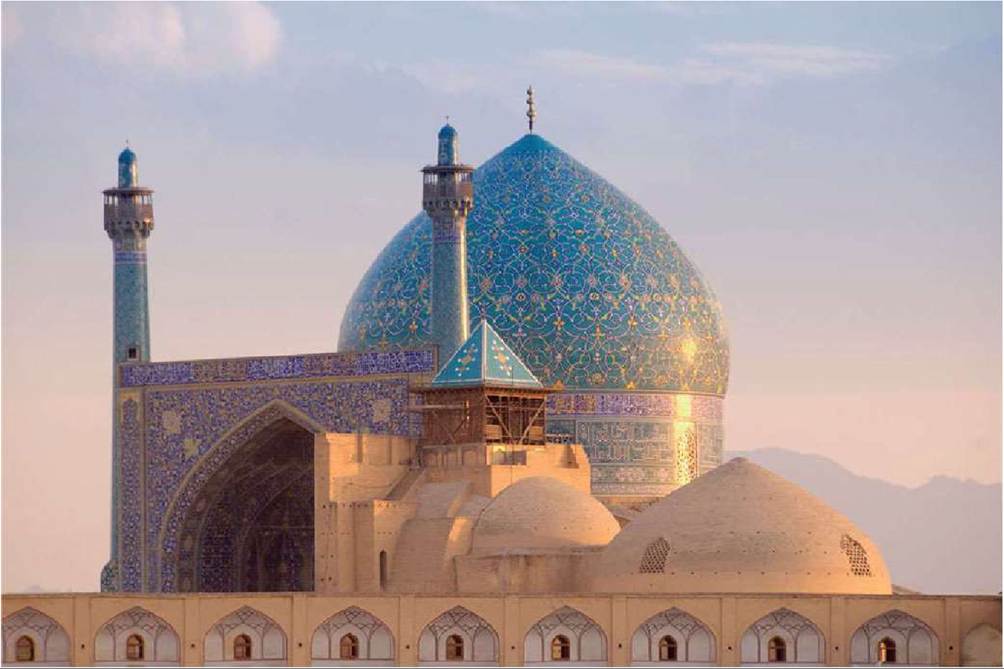
The beautiful Shah Mosque, in Isfahan, Iran, was built in the 1600s during the Safavid period.

This attractive small mosque in rural Zanzibar, Tanzania, is built in an architectural style that is similar to houses in the area.
Like the other pillars, the salat is incumbent upon all Muslims, both male and female. In much of the Muslim world, it is more common for men to pray in mosques than women, although this is not always the case. In such places as urban Egypt and Indonesia, women often pray in mosques. Although females may serve as imam for other women, most Muslims believe that they may not do so for men. When both women and men pray in mosques, usually the genders are separated—either in separate prayer halls or with women praying in rows behind the men. Some Muslims reason that this requirement is due to modesty and concentration. They argue that women and men should not be distracted from their prayers by the presence of the opposite gender. Others argue that men’s leadership in prayer is prescribed in the Qur’an. However, some Muslim feminist scholars, such as the American professor Dr. Amina Wadud, are challenging this tradition by arguing that women can lead men in prayer.
The daily prayers are important for Muslims on both an individual and a communal level. Many Muslims feel closest to God during prayer. Although praying five times a day may sound rigorous to non-Muslims, many Muslims welcome the breaks from mundane tasks to focus their attention completely on God. A believer must stop all activity to remember God five times every day. This indicates that submission to God is the most important part of life for a devout Muslim. On another level, praying the same prayers at the same time every day, and often in a group, draws the community of Muslims together in worship of God. Many Muslims report that, in addition to feeling an individual closeness to God during prayer, they also feel at one with the umma, the global community of Muslims, in the common purpose of worship.
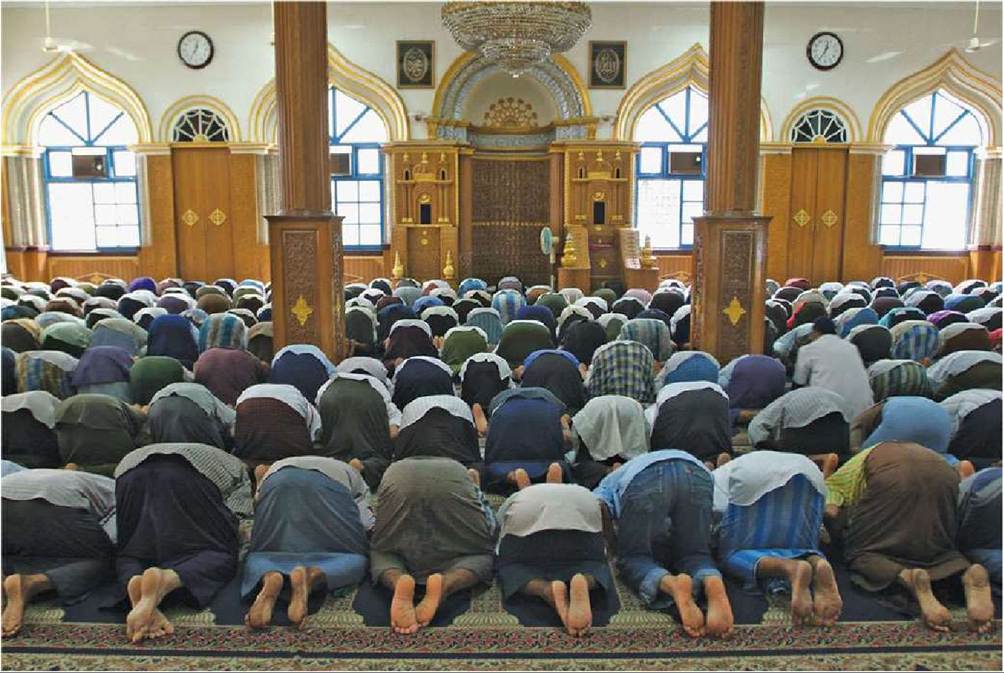
Muslim men pray together at a mosque.
Almsgiving
The third pillar, zakat, refers to required almsgiving, which is part of a believer’s devotion to God and the Muslim community. The rules about zakat are very specific, and the amount of zakat is figured as a percentage (about 2.5 percent) of the value of certain types of property, including cash. Zakat is therefore something like a tax. The wealth on which zakat has been paid is considered to be pure and clean. Therefore, some Muslims describe it as a means of purifying their property. The payment of zakat also expresses a Muslim’s commitment to improving his or her community in a real and concrete way. This is because the proceeds from zakat are normally distributed to the poor or are used to maintain public institutions such as mosques and schools. In some countries today, such as Pakistan, the government collects and redistributes zakat funds.— Elsewhere, it is up to individuals themselves to make the zakat payments. All adults should pay zakat, however, those who are mentally ill or unstable are exempt from the requirement.
Fasting During Ramadan
The fourth pillar is sawm, which is the mandatory fast during the month of Ramadan, the ninth month in the Islamic calendar. Muslims consider Ramadan a sacred month because it was during Ramadan that the Qur’an was first revealed to Muhammad. During Ramadan, all Muslims are required to fast from dawn to sundown. When fasting, Muslims refrain from eating, drinking, and sexual activity. Muslims also strive to avoid arguing and negative thoughts during the hours of the fast.
All adult and adolescent Muslims are generally expected to fast. However, exceptions are made for those who are traveling as well as for women who are pregnant, nursing, or menstruating. In Pakistan, curtained food stalls are set up at train stations during Ramadan. The stalls allow travelers to eat in private, where they are respectfully out of view of those who are fasting and do not wish to be tempted by the sight of someone eating. Individuals who miss fasting days or break the fast are expected to make up the days later. However, children, the sick, the mentally ill, and the very elderly are exempt from fasting entirely. Children are usually encouraged to begin fasting when they show interest, but they are only expected to fast when they are comfortable doing so.
The month of Ramadan is a special time. Although the fast can be challenging, many Muslims find Ramadan to be filled with religious meaning, joy, and sociability. In Muslim countries or communities, the rhythm of daily life changes significantly during Ramadan. Daily activity lessens, and streets are quiet during daylight hours. However, the world awakens at sunset, when the fast ends. Many people share the evening meal with family and friends, and streets are filled late into the evening with well-wishers. Many families eat again around midnight and also before dawn to gain the strength to make it through the day.
Muslims often break the fast with dates before performing the evening prayer. This is because eating dates is sunna: Muhammad broke the fast with dates, so many Muslims follow his example. In many cultures, special treats are prepared during Ramadan. Indonesian Muslims look forward to breaking the fast with a delectable drink made with coconut milk and tropical fruits. Some Indonesians say that the drink is so sweet because it represents the beauty of a day of focusing solely on God. In Iran and in Persian communities in the United States and Canada, a rice pudding flavored with saffron and rosewater is served during Ramadan.

This open-air market in Sumbawa Besar, Indonesia, is very popular during Ramadan, when people buy special foods to break the fast.
During Ramadan, Muslims around the world may spend time in the evenings reciting the Qur’an. Many try to achieve the goal of reciting the entire Qur’an during this special month. People may also stay up late into the night visiting friends and enjoying the celebratory and devotional atmosphere of the month. During the last few days of Ramadan, the Night of Power occurs. This is the night when Muslims believe that the Qur’an was originally revealed to Muhammad. Many Muslims believe that a wish may be granted during this special night. The end of Ramadan is marked by an important feast day called ‘Id (or Eid) al-Fitr, the feast of fast-breaking, which we discuss later in this chapter.
Like the preceding pillars, sawm is important on both personal and community levels. Fasting demonstrates an individual’s dependence on God, who provides for humanity. Also, by refraining from food and drink, Muslims become more sympathetic to the plight of the poor and the hungry and learn to appreciate the food they have. Like salat and zakat, fasting together also brings a sense of community to Muslims worldwide. A Muslim observing the fast in Los Angeles, for example, will know that fellow believers thousands of miles away in Malaysia are keeping the fast. In the United States, many mosques and Muslim organizations view Ramadan as a time of outreach to non-Muslim friends and neighbors and as a way of teaching people about Islam. For example, at California State University, Sacramento, the Muslim student organization holds a popular “fast for a day” event every year. Non-Muslims are invited to try fasting for a day and then breaking the fast with a special meal prepared for the entire community. These events often include guest speakers who talk about the meaning of Ramadan and the basics of the Islamic tradition. Guests are also sometimes invited to watch the evening prayer.
Pilgrimage to Mecca
The final pillar is called the hajj, which is the holy pilgrimage to Mecca in Saudi Arabia. The Qur’an specifies the pilgrimage as incumbent upon humanity. Every year, millions of Muslims descend upon the city of Mecca in a spectacular display of devotion. The hajj is generally understood to be required of all Muslims who are physically and financially able to make it. A Muslim only needs to perform the hajj once in his or her lifetime, but many Muslims who are able to do so repeat it. Pilgrims describe the event as one of unparalleled spiritual significance, and they experience intense feelings of connection to God and humanity during the hajj. Muslims who return from the hajj often use the title hajj (for men) or hajj a (for women) before their name to indicate that they have made the journey.
The hajj must be undertaken at a particular time of year, namely, during the second week of the month Dhu al-Hajj, which is the final month in the Islamic calendar. A person must be physically and financially able to make the trip, or else it is not valid. One may not borrow money to make the pilgrimage, but it is appropriate to accept financing for the trip as a gift. In addition, the money set aside for the hajj must be purified by paying zakat on it. As a means of organizing the millions of travelers who come for hajj, the government of Saudi Arabia today requires pilgrims to join a travel group to make the hajj. Planned excursions depart from every corner of the world, and tour companies arrange eveiything from air travel to bus transfers to accommodations. In Saudi Arabia, a great deal of planning is involved because of the sheer numbers of Muslims who arrive in Mecca and its environs during the week of hajj. Only Muslims may make the journey; curious tourists are not allowed to partake in the experience.
When making the hajj, pilgrims must leave behind indicators of their social and economic status to properly enter a state of ritual purity. This state is called ihram. All men must wear special clothing, also called ihram. This consists of two very simple pieces of white cloth—one is worn above the waist and one is worn below. Women may wear what they choose, and most dress in simple clothing and avoid makeup, jewelry, and perfume. Pilgrims should also refrain from sexual activity, arguing, and frivolous conversation while in a state of ihram. Ideally, these restrictions are meant to ensure that the pilgrim’s mind is solely on God and the hajj. The state of ihram also emphasizes the equality of all Muslims before God because all status markers, such as expensive jewelry, are removed.
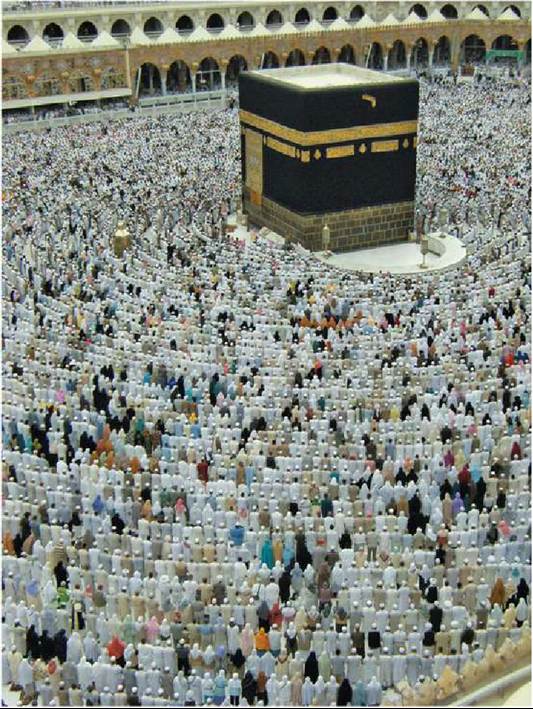
Muslim pilgrims prepare for prayer at the Haram mosque in Mecca.
The pilgrimage involves a number of highly specific, ritualized acts. Muhammad determined the sequence of the events of the hajj before his death, and some events reenact moments from his life. Many of the rituals also recall the actions of Abraham and his family. In this way, the rituals connect the believer to the distant past and the origins of monotheism with Abraham.
Perhaps the most important focus of the hajj is the structure known as the Kaija, which was a focus of pilgrimage in Arabia even before the time of Muhammad. It is a cubical building about thirty feet by thirty feet, and Muslims believe it was originally built and dedicated to Allah by Abraham and his son Ishmael. Today, the Kaija is covered by a doth embroidered with gold thread that is replaced every year by the Saudi government. When a pilgrim first arrives in Mecca, he enters the Great Mosque that encirdes the Kaija while reciting verses of the Qur’an. The pilgrim then circumambulates the Ka‘ba seven times in a counterclockwise direction. This is known as the tawaf. This ritual is an act of devotion that is believed to be in imitation of the angels circling God’s throne. The tawaf is performed three times during the course of the pilgrimage.
Another important rite of the hajj is called the sa‘y. This rite commemorates the story of Hagar, mother of Ishmael, who frantically searched for water in the desert by rushing seven times between two hills. During Hagar’s search, God made a spring appear, and Hagar and Ishmael were able to quench their thirst. Pilgrims visit this spring to this day, many taking the special waters home as a symbol of Mecca. Today, the route between the two hills is enclosed as part of the Great Mosque.
Another part of the hajj involves a journey to the plain of Arafat, where a tent city is established every year to house millions of pilgrims from around the world. It is here that Muslims recollect a story about Abraham that is also prominent in Jewish and Christian traditions. In all three traditions, Abraham is believed to have been commanded by God to sacrifice his son. (Most Muslims believe he intended to sacrifice Ishmael, but Jews and Christians usually regard Isaac as the object of sacrifice; the Qur’an does not mention which son was the intended sacrifice.) As Abraham prepared to make the sacrifice, the Angel Gabriel (Jibril) appeared at the last minute, and a ram was substituted for the son. Abraham’s willingness to sacrifice his beloved son is regarded as a model of faith in Islam, and this is a solemn, reflective time of the hajj. The pilgrims perform the “standing ceremony,” in which they remain standing from noon until sundown in praise of Allah. The hajj ends with the most important holiday of the year, the Feast of Sacrifice, which we discuss later in the chapter.
Now that we have covered the major teachings of Islam, let us turn to the history of the religious tradition, beginning with the birth of Muhammad.
Self-Assessment 13.1
[Please note: You must be using an online, browser-based eReader in order to view this content.]