13 IsIam
Jeffrey Brodd
California State University, Sacramento
Layne Little
University of California, Davis
Bradley Nystrom
California State University, Sacramento
Robert Platzner
California State University, Sacramento
Richard Shek
California State University, Sacramento
Erin Stiles
University of Nevada, Reno
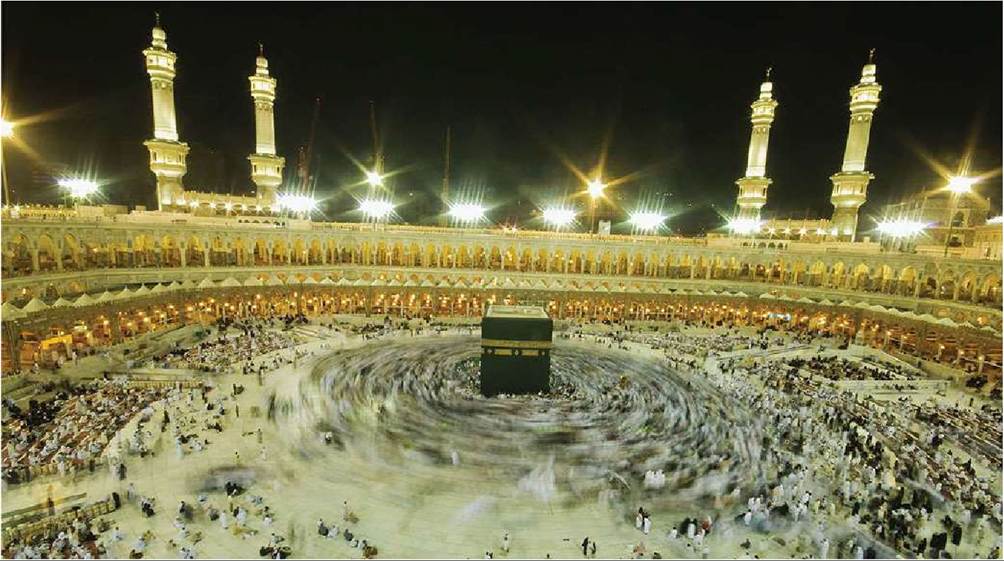
Pilgrims circumambulate the Ka'ba in Mecca, Saudi Arabia.
The pilgrimage to Mecca, known as the hajj, is a once-in-a-lifetime duty for devout Muslims.FAINT TRACES OF DAWN light up the tops of tall coconut palms and lush mango trees in a village in Zanzibar, an East African island in the Indian Ocean. Amina, a woman in her early thirties and a devout Muslim, rises from her bed. She was awakened by the sound of the call to prayer from the local mosque. In the open-air courtyard of her house, she begins her morning ablutions to prepare for the first of her daily prayers. She takes cool water from the cistern in the courtyard and carefully washes her face, hands, and feet, and rinses her mouth, nose, and ears. She also wets her head and hair. Before each of the five daily prayers, Amina performs similar ablutions. Although she occasionally wears eye makeup and lipstick, she is careful to avoid nail polish. She explains that all such adornment must be removed to purify herself for each prayer; makeup is easily removed with water, but nail polish is not.
After her ablutions, Amina returns to the house, covers her head and shoulders with a clean cotton wrap, and spreads a colorful woven prayer mat on the floor next to her bed. She removes her sandals, steps onto the mat, and begins the first of the five prescribed daily ritual prayers that are expected of all devout Muslims. The prayers are called salat and consist of the recitation of verses from the Qur’an, the sacred text of Islam, accompanied by specific bodily movements.
Together, the cycles of prayer and movement are called raka. Amina has made her daily prayers since she was a young girl. As a child, her mother and elder sisters taught her how to pray; eventually, she will do the same for her own children. She begins the prayer standing, then kneels, bows her forehead to the ground, and kneels again in accordance with her recitation. Hand movements accompany the bodily postures. Daily prayer is an essential part of Muslim worship. Through prayer, Amina is acknowledging to herself and her community that she is submitting herself to the will of God—an important tenet of the Islamic faith. In fact, the term Muslim means “one who submits” in Arabic.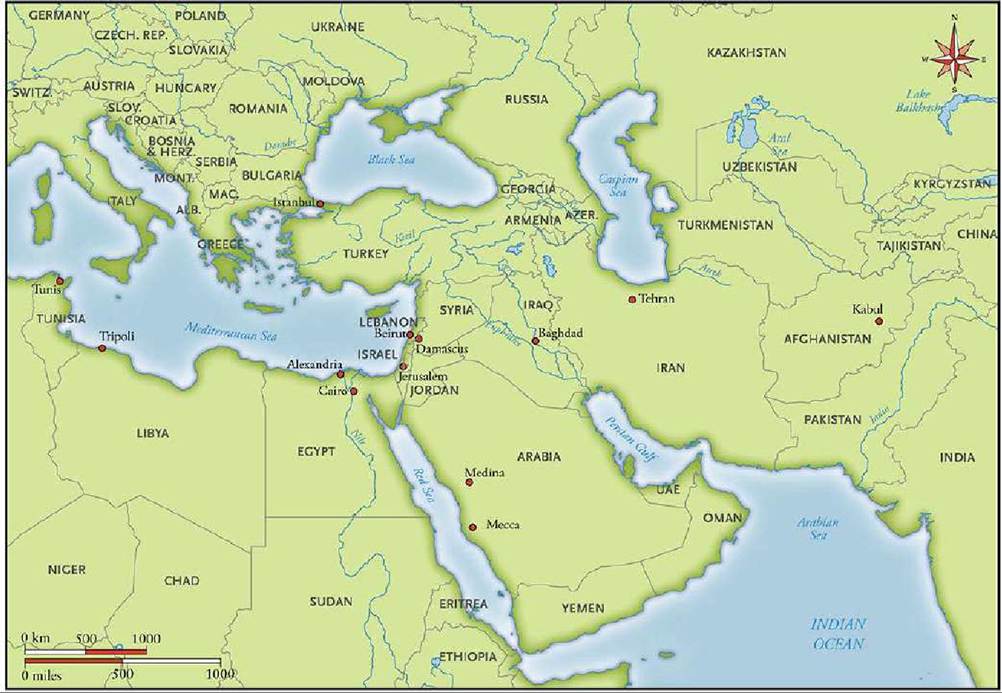
Significant sites in the history of Islam.
Click here to learn more in an interactive map.
Amina prays alone in her modest home, but men in her community typically gather at the local mosque for each of the daily prayers, which are led by a prayer leader called an imam. Like women, most Zanzibari men cover their heads when praying, most often with a brimless, embroidered cap. Although in some parts of the Muslim world women regularly pray in mosques, in Zanzibar, particularly in rural areas, it is uncommon for women to do so. However, women often gather together at mosques for other reasons, such as Qur’an study groups and sessions in religious instruction.
When she completes her prayers, Amina rolls up her prayer mat and sets it aside for later. She reads a few verses from the Qur’an in the early morning light and then begins the first tasks of her day—making tea and sweeping the courtyard.
TIMELINE
Islam
| c. 570 CE | The birth of Muhammad. |
| 610 | The first revelations of the Qur’an to Muhammad. |
| 622 | The hijra (migration) from Mecca to Medina. |
| 632 | The death of Muhammad; issue of succession. |
| 632-661 | Period of the Rightly Guided Caliphs. |
| 657 | Battle of Siffin. |
| 661 | ‘All killed. |
| 661-750 | Umayyad period. |
| 680 | Battle at Karbala and martyrdom of Husayn. |
| 750-1258 | Abbasid period. |
| 1095-1453 | Crusades. |
| 1207-1273 | Jalalludin Rumi. |
| 1281-1924 | Ottoman Empire. |
| 1483-1857 | Mughal Empire. |
| 1501-1722 | Safavid Empire. |
| 1703-1792 | Ibn Abd al-Wahhab. |
| 1849-1905 | Muhammad Abduh. |
| 1881-1938 | Mustafa Kemal Ataturk. |
| 1923 | Huda Sha’rawi unveils at Egyptian train station. |
| 1947 | Partition of India and Pakistan. |
| 1979 | Iranian Revolution. |
| 2004 | France bans wearing of headscarves and other religious identifiers in schools. |
| 2006 | Keith Ellison, a Democrat from Minnesota, is first Muslim elected to US Congress. |
| 2009 | Green Movement, Iran. |
| 2011 | “Arab Spring” pro-democracy movements spread across the Middle East. |
Click here to learn more in an interactive timeline.
Click here to compare other Abrahamic religions.
Amina is one of about 1.9 billion Muslims living in the world today; Islam is second only to Christianity in numbers of adherents. Amina lives in Africa, and most of the world’s Muslims live in South and Southeast Asia, not in the Arabic-speaking countries of the Middle East. In fact, Arab Muslims make up less than 20 percent of the total Muslim population worldwide. The country with the largest Muslim population in the world is the Southeast Asian nation of Indonesia, followed closely by India, Pakistan, and Bangladesh. Many countries in Africa also have very large Muslim populations. Today, there are about 3.5 million Muslims in the United States,1 and the number of Muslims in North America is increasing, mostly through immigration. Muslims also make up significant minority populations in many parts of Western Europe, especially in France, where they make up nearly 9 percent of the population.-
Islam developed in the Arabian Peninsula and rapidly spread through the Middle East, Asia, and Africa. Because of its global presence, Islam is practiced, understood, and interpreted in diverse ways in many different countries, cultures, and communities. However, certain beliefs and practices can be considered universal parts of Muslim religious life. First and most important of these is the monotheistic belief in the oneness of Allah, which is the Arabic term for God. Second, Muslims recognize Muhammad, who received the message of the Qur’an from God, as the final prophet in a long line of prophets sent to humanity by God. The Qur’an is believed to be the word of God and is the holy text of Muslims. In addition, Muslims around the world share the observance of the five pillars of worship practice. The term Islam (Arabic, “submission”) reflects Muslim belief in the importance of submitting to God’s will.