The temples of Egypt are peppered with images of the pharaoh as a victorious leader, a great man, chosen of the gods.
These static images are all that are left to the modern world. Surely, however, he was more than this to the early Egyptians, more than just an inscribed scene on a temple wall, or a colossal statue guarding a palace gateway.
Ostracon Cairo 25560 records a visit of Seti II1 to the city of Thebes for the Opet festival (Janssen 1997: 152). It includes mention of the king crossing the river to the West Bank although unfortunately the text stops before it reveals the reason for his visit (Janssen 1997: 152). In doing so, he left the palaces, the state temples and the administrative centre of the city - he became visible to, and perhaps even interacted with, ordinary Egyptians. Of course, one is left to ponder the reason for the visit, but one thing that is reasonably certain is that such events were not common. Why, then, do private tombs on the West Bank at Thebes in the early Ramesside Period so commonly contain images of kings? Moreover, images in private tombs did not usually depict the living king who may have played a role, however small, in the lives of the villagers at the time the tomb was created but kings who had died before the tomb owner was born. The memory of these kings must have been kept alive; more than that, they must have played an active role in the lives of the people, so that these royal figures were deemed important enough to play a role in the funerary depictions of the people. Boureau (2001: 184) has emphasized the importance of the king as a lieu de memoire in modern and early modern history, and perhaps these depictions in Egyptian tombs should be seen as evidence of a similar ideology in Ancient Egyptian history. Arguably, therefore, images of the king in private tombs are evidence of the place of the pharaoh in the memory of the people which was supported by festivals, mortuary estates, popular culture, an interest in ancestry, and by state desire for self-legitimization.When discussing whether features of Egyptian society constitute a form of cultural memory, two features of Assmanns theory are particularly important. First, there is the assertion that memory has not only a social but also a cultural basis founded largely in tradition (Assmann 2006: 1, 8); this contrasts with Halbwachs’ work, which treats memory and tradition as separate entities (Assmann 2006: 8). This study focuses largely on the role of traditions such as festivals, and the importance of active remembrance, the emphasis here being on the word ‘active’, implying forms of remembrance based around events in which members of the community took part as opposed to primarily written, or even oral, remembrances - cultural memory is something that one does, it is a process; it is not something that one simply possesses (Olick 2008: 159). Second, it is important to note the difference between cultural and communicative memory - communicative memory may be seen as spanning up to approximately three generations before it dies out, while other forms of memory, such as cultural memory, do not have a finite lifespan (Assmann 2006: 7; Luiselli 2011: 11). The images included in this study span several generations and in some cases over 700 years. This, again, is key when analyzing the place of cultural memory in Ramesside Egypt.
Sociologists such as Mannheim (1956: 184) have drawn clear distinctions between ‘high’ and ‘low’ culture, implying that the culture of ordinary people is both separate from, and inferior to, that of the elite. However, it is important not to ignore the culture and traditions of ordinary people2 in favour of the more commonly displayed culture of the elite in the early Nineteenth Dynasty.3 By examining the culture of the non-elite, it is possible to understand Egyptian society in its entirety, rather than simply that of the small minority who were responsible for the vast majority of surviving monuments. It is possible to find links between the cultures of the two groups, to assess the ways in which the elite may have deliberately affected the culture of the lower levels of society, as well as examining the ways in which ordinary Egyptians may have adapted that culture to their own ends.
In order for a memory to become successfully integrated into the lives of the ordinary people it must have had meaning for them - the non-elite must have been convinced both of its importance and of its relevance in their lives, rather than seeing it as a separate culture. The evidence used in this study, therefore, is primarily that of depictions in private tombs at Thebes. These tombs belonged to non-royal members of society (ranging from ‘divine fathers' of temples (TT277), to scribes (TT7) to workmen (TT357).4 These tombs, therefore, allow an understanding of the belief and culture of ordinary people and its relation to the culture of the elite.There are approximately 160 tombs at Thebes dating to the early Ramesside Period (c. 1295-1203 bce),5 of which 50 contain images of royal figures. Within these tombs are a total of 89 such images. Of these, 43 images include only Amenhotep I or Ahmose-Nefertari,6 while 28 also show other kings or queens. The identities of the figures in 18 depictions are uncertain. These kings include those from the Middle Kingdom (the most common being Nebhepetre-Mentuhotep), although most are from the Eighteenth and early Nineteenth dynasties.7 The images can be divided into three key categories; those showing the kings as a divine figure,8 those with the king as an historical figure,9 and those representing the king as a part of everyday life.10
As previously mentioned, there was an increase in depictions of deceased kings in private tombs in the Ramesside Period. Of approximately 104 images of royal figures in the pre-Amarna Period,11 only seven can be said to have been that of deceased kings, while 54 of 71 early Ramesside images of royal figures whose identity is certain include a depiction of a deceased king. This suggests that images of royalty in the pre-Amarna Period were primarily ‘autobiographical',12 such as can be seen in a scene in TT57 from the reign of Amenhotep III, which shows the king rewarding the officials of Upper and Lower Egypt (Lepsius 1849-58: 76[b]). While autobiographical scenes may be seen as an important part of the culture of ordinary people, they cannot be seen as a representation of the cultural memory of the group. This is in contrast to scenes from early Ramesside tombs, whose images of long deceased kings are more than simply autobiographical but are part of the collective memory of the group spanning several generations.13
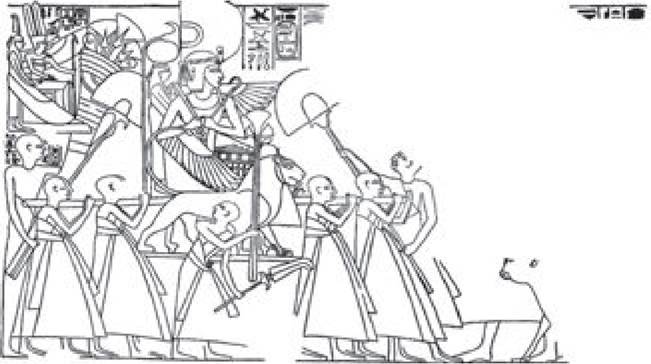
Figure 1. TT2: Deceased before statue of Amenhotep I in palanquin carried by priests, and statue of Amun, both protected by Maat (Cerny 1927: fig. 14).