Festivals of the King
Images of festivals of deceased kings14 are an important aspect of this discussion, as they directly depict an event connected with the cultural memory of the group. Nora (1984: 1) emphasized the importance of national days of remembrance in the developments of cultural memory and these events can be seen as such.
The scenes of festivals show large crowds watching the event and a variety of people involved in the process. One example can be seen in a depiction in TT31 (Fig. 2) which shows a festival of Thutmose III before a temple of Monthu. The scene includes nine priests and three priestesses (holding sistra), as well as several laymen, of whom some are rowing the boats used in the festival, and laywomen. Such a variety of people is not uncommon in scenes of royal festivals found in private Ramesside tombs and so, if one is to assume that these images depict an actual event in the lives of the people, then one must conclude that many members of society were involved in, or witnessed royal festivals. Herodotus wrote of a festival at Bubastis at which ‘the numbers... are... as many as seven hundred thousand men and women' (II. 60-1), and although this is a slightly later festival, and almost certainly a great exaggeration, it does imply that large crowds attended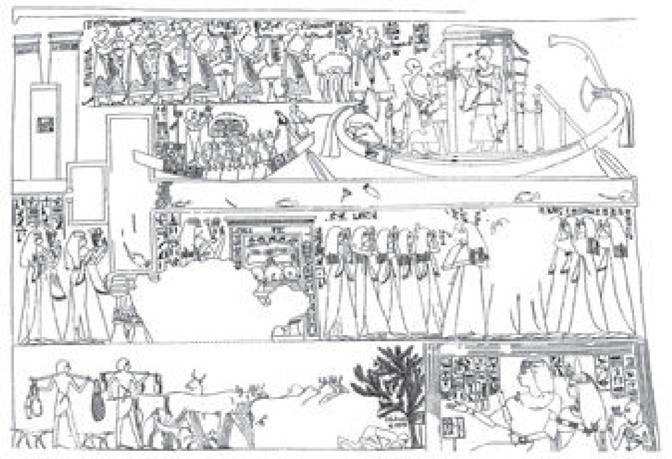
Figure 2. TT31: Festival of Thutmose III, with royal bark in procession before temple, received by priests and priestesses (songstresses of Montu). Herdsmen with dogs bringing cows and goats before deceased, Ruia, and family, with standard of estate of Thutmose IV in front (Davies and Gardiner 1948: pl. xv). Courtesy of the Egypt Exploration Society.
state festivals. Of course, one cannot assume that the numbers of people shown in festival scenes in tombs are an exact representation of the numbers of people involved as it is likely that they were restricted by space, time and aesthetic preference.
However, the scenes create an impression of many people and, therefore, one must assume that events such as this involved an audience.Being involved in these events created a sense of connection between the people and the king and the repetition of these events ensured that the memory of the king remained potent. The public festivals of kings had a double purpose - the first was to ‘appease the gods and provide for the deceased king in the afterlife which could also be achieved through private cults within the temples'; the second was ‘both to demonstrate the power of the state to the people and to bring them together under a common aim, thus creating a unity within the community' (Heffernan 2010: 11). The success of the second aim depended upon the willingness of the people to support the festivals, and depictions in private tombs of crowds of people witnessing these events suggest success in this second aim. Furthermore, these ceremonies could help to give people knowledge of royal genealogy, as seen in festivals such as the Beautiful Feast of the Valley, which involved carrying statues of the gods to the mortuary temples of royal ancestors. Another festival, a depiction of which can be seen in the Ramesseum,15 was the Min Festival, which involved carrying the statues of 14 royal ancestors (Lepsius 1849-58: 162-3). The inclusion of royal genealogy in public festivals made the knowledge of royal ancestors an active part of the lives of the people.
Royal festivals may also have helped to retain the memory of key events in a king's reign. Some ‘appearance' festivals of the king (McDowell 1992: 101) correlated to events such as the death or succession of a pharaoh,16 thus introducing key dates into the annual calendar of the group. However, this was not always the case. In the case of Amenhotep I's festivals at Deir el-Medina, for example, there seem to have been too many ‘appearances' for this to be accurate.17 This suggests that there was another origin for festivals of Amenhotep I at Deir el-Medina, possibly beliefs and traditions that had grown up independently of the state.
Perhaps then, one must see some festivals as being state-led and based on political events while others were founded in local traditions, and yet more may have developed from a combination of state and local ideology. This would demonstrate an amalgamation of state and local ideology in the cultural memory of the group. The appropriation of royal iconography into local festivals and traditions suggests that ordinary groups of Egyptians saw royal figures as an important part of their culture - they were an integral part of the cultural memory of the group. Furthermore, it was not always the chronological order of feasts that was important but simply the mention of ‘key festivals' (Spalinger 1996: 71) which is a reminder that these festivals were not intended to be a by-rote calendar of events, but could act as a ‘cultural memory resource'.Oracular processions imbued the king with more than simply a place in the traditions of the people; they gave him an active role in their lives, letting him affect decisions that were made within communities. The best recorded oracle in the period was that of Amenhotep I at Deir el-Medina, with a probable depiction found in TT2: this depiction shows a statue of Amenhotep I being carried in a palanquin by priests, with a statue of Amun behind him (Fig. 1). However, other oracles, such as that of Ahmose at Abydos have also been recorded as being approached to solve disputes, such as is recorded on Stela Cairo J. E. 43469, which describes a land dispute during the reign of Ramesses II (Legrain 1916: 162 and plate; Harvey 1998: 121). Disputes put before the oracle of Amenhotep I at Deir el-Medina include those over property, and over stolen clothes (Cerny 1927: 178-9). By giving deceased kings the status of oracles, temples encouraged a view of the king as all knowing and benevolent as well as retaining his relevance in the lives of the people by giving his image the power to make decisions. This all helped to sustain his position in the memory of the group. Halbwachs (1992: 73) argues that ancestors only survive in the memory if they remain ‘at least fictitiously in contact' with the living, and oracles served this purpose for royal ancestors such as Amenhotep I and Ahmose.
More on the topic Festivals of the King:
- Festivals of the King
- Public Festivals
- The King and the Gods
- Festivals and Holidays
- Combat in Rituals and Festivals
- The Major Festivals
- Holidays and Festivals
- DEITIES AND FESTIVALS
- Celebration of Important Occasions in Personal Life and Festivals
- Festivals