The theory of everything
A most famous maxim by Goethe reads ‘[a] man who has no acquaintance with foreign languages knows nothing of his own' (Goethe 1893: 154, maxim n. 414). Paraphrasing such dictum on language, Max Müller asserted in his first lecture on the ‘science of religion' that ‘[h]e who knows one [religion,] knows none' (Max Müller 1872: 11).
Indeed, the Victorian comparative science of religion, the first coherent academic endeavour of this kind, was nothing short of a global, encyclopaedic, trans-disciplinary and cross-cultural comparison among past and present mythologies. The Tylorian search for panhuman trajectories and (pre-)rational explanations embedded in religious thought was the precipitate of the rational and empirical quest for knowledge typical of the Enlightenment. Max Müller's linguistic explanations and Frazer's eclectic systematization epitomized the painstaking categorization of worldwide mythologies according to rational and progressionist patterns of development (Figure 8).The Victorian science of religion played a major part in the establishment of a truly scientific approach to religion. Hypotheses were advanced and discussed with an unprecedented vigour. The search for the ultimate ancestor of all religious traditions was supported by the psychic unity, and continuity, of mankind: mythologies from Greece, Rome, ancient Egypt, Northern Europe, along with folklore and worldwide ethnographic accounts, were all plumbed to find their greatest common divisor. Pan- Babylonianism and Pan-Egyptianism were also advanced and discussed, and eventually rejected, each one positing an original and pristine culture as the unique primordial source for the worldwide diffusion of all or most religions (in these cases, respectively, Mesopotamian and Egyptian; see Bianchi 1975a: 107-9; Bowler 1987: 57, 217-18; philological Pan-Sanskritism might also be recalled here as a subset of such diffusionist theses). Previous theoretical proposals were keenly examined in a new academic environment, while many seminal theories and concepts related to the ultimate explanation of religion were incessantly advanced.
The most famous of such new theoretical counter-proposals was probably m ana, a label borrowed from Austronesia by Marett. Mana was intended as the wedge to dethrone Tylorian animism from the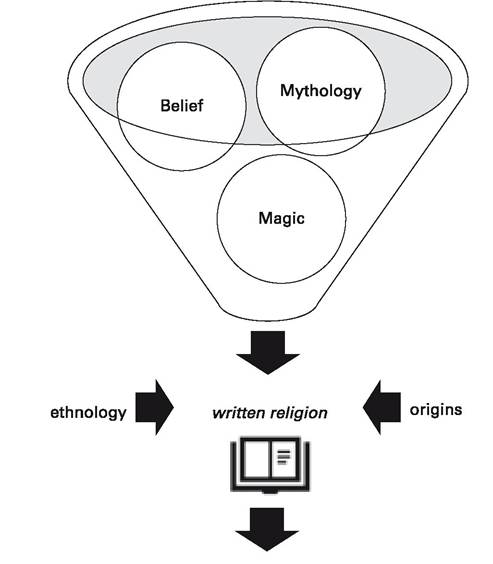
Comparative Science of Religion
Figure 8 Comparative science of religion: original features, influences and main themes
absolute beginning of religion per se and reconfigure a primordial phase where ‘a sense of the uncanny', an ‘impersonal force which [Marett] felt to be present in virtually any unusual object or striking natural phenomenon', was to provide a proto-religious, not- yet or not-strictly animistic feeling or, as the loose translation of mana implies, i.e. ‘power' (Sharpe 1986: 67).1
The main features of all these theoretical paradigms were, as classicist Oswyn Murray listed, ‘the beliefs that myth was a secret language disguising a universal earlier stage of humanity, that poetry was the chief literary vehicle for primitive societies, and that ancient art as well as the written record could be used as evidence in the decipherment of this encoded text of a universal lost past' (Murray 2010: 121). Indeed, mythology was on the verge of becoming the humanistic key to solving the theory of everything, from language to social organization, from imagination and folklore to customs and (ir)rationality. And yet, this state-of-the-art approach was to be subverted soon by a rather peculiar Scottish scholar.