The History of the Exemption of Costs of Judicial Proceedings
The French 1806 Code de procedure civile regulated civil procedure in Belgium until replaced by the 1967 Judicial Code (Gerechtelijk Wetboek, Code judiciaire).[166] The French civil procedure was very formalistic.[167] It involved the assistance of bailiffs, for citations and execution of judgments, and procurators, for all kind of procedural documents.[168] Litigants had to pay not only for their services but also for court fees and other costs (judiВcial experts, notaries, etc.).
Obviously, this was a significant obstacle for indigent litigants procuring access to justice.The Belgian rules on the exemption of costs of legal proceedings origiВnate in the Dutch Period (1815-1830). On 26 May 1824, King William I issued a Royal Decree that accorded the exemption of costs of legal proВceedings to all the impecunious inhabitants of the Kingdom.[169] To benefit from this exemption, the poor had to send a request to the court,[170] includВing a certificate issued by the municipality that proved their indigence. Two judges studied the request and summoned both parties to a hearing. The adversarial party could oppose the pro Deo request, either by proving that the claimant was not poor or by convincing the judges that the cause was obviously wrong.[171] Afterwards, the two judges advised the court on the matter.[172] The court granted the “jus pro Deo” only if indigence was
proven and the cause considered justified.[173] In that case, the court autoВmatically appointed a bailiff and a procurator, if necessary.[174] All the docuВments they issued were “in debet,” to be recovered from the adversarial party when it lost the case.[175] These rules were obviously the continuation of earlier practices; during the Ancien Regime, the poor also had to submit a request to the court and similar conditions applied: the case had to be justified, the litigant had to prove his or her indigence with certificates, and the court heard the other side.[176]
After Belgian independence, the Dutch rules on jus pro Deo remained in force.[177] Yet, there was ongoing concern amongst officials about the abuse of certificates of indigence.[178] In 1835, a circular letter from the Minister of Home Affairs clarified that only those on the municipal lists of the poor were to be considered indigent.[179] However, courts could still independently grant the jus pro Deo if they considered it appropriate.[180]
As Fig.
1 demonstrates, in the 1840s through the 1860s, judges were quite strict and rejected up to one-fourth of requests. Gradually they became more lenient, and by the end of the nineteenth century, they rejected only 5-10%. It is difficult to explain why this change occurred. Perhaps, they became more benevolent towards the causes that the poor brought before them. Hermann Pergameni, a lawyer, complained in 1878 that judges too easily granted the benefit of free proceedings because they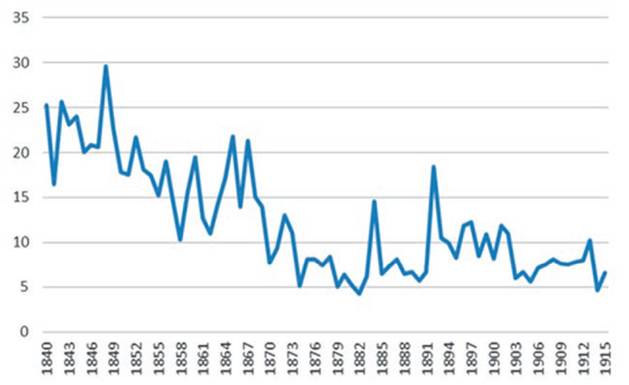
Fig. 1 Percentage of the requests for pro Deo procedure rejected by the Tribunals of First Instance in the period 1840-1915. (Judicial statistics 1840-1915, available online via http://www.digithemis.be/, accessed 5 May 2020)
only relied on certificates of indigence.[181] After all, such documents were susceptible to abuse as they did not always reflect the actual financial status of the litigant.[182]
During most of the nineteenth century, there were only a few hundred cases a year, most likely due to the formality and slowness of the proceВdure. According to the socialist lawyer Jules Destree, in 1889 obtaining an exemption of costs could easily take up to three months—and possibly six or more if the pro Deo lawyer did not strongly advocate for it.[183] This was especially problematic in urgent matters.[184] Yet another problem was that the poor could only benefit from the jus pro Deo for civil proceedings, and not for commercial and criminal proceedings.[185]
In 1889, new legislation addressed these critiques.[186] The legislature simplified procedures and extended the jus pro Deo to commercial and criminal proceedings. Further, the 1889 Act obliged all kinds of public officials—including notaries, procurators, bailiffs, and court clerks—to deliver all necessary documents free of charge.[187] It further addressed abuses with the certificates of indigence by requiring the poor to deliver an extract from their taxes and a “declaration of indigence.”[188]
The effects of the 1889 Act were immediate.
Approximately half of the cases before the Tribunal of First Instance of Brussels were exempt from costs.[189] The Tribunal now only denied approximately 3% of requests. One could argue that this was a positive evolution in the direction of creating an accessible justice system, but some contemporaries saw it differently. They asserted that many of these free proceedings were never pursued by the party, which could be interpreted as a sign of unmeritorious litigaВtion.[190] Another problem was that the newly required documents (still) did not guarantee the applicant’s indigence and tribunals did not actually check the validity of such documents. Not surprisingly, procurators and bailiffs were the biggest critics of these new practices as they increasingly had to provide their services for free.[191]In 1929, the legislature responded to the demands of such officials.[192] The state was now to provide remuneration for services rendered to the poor by such actors.[193] Further, the legislature once more tried to address abuses of the system by introducing stricter regulations regarding how such poverty was to be demonstrated.[194] Another innovation was the introВduction of the Office of Judicial Assistance (in French the Bureau d'assistance judiciaire and in Dutch the Bureau voor Rechtsbijstand) in First Instance Courts, to avoid the same judge deciding both the request for exemption of costs and the actual case. The 1929 Act also foresaw the possibility of (only) a partial exemption of the costs, when the claimant was relatively poor, but still had some financial means.[195] Further, the legВislature extended the exemption to all costs of the procedure, including the cost of expert opinions.[196] Finally, there was now also a possibility of appeal, which illustrates an important change in mentality. The jus pro Deo was no longer seen as a favour from the court, but as a fundamental right. The 1929 Act laid the foundation for the current system, incorporated in articles 664-699 of the 1967 Judicial Code.[197]